
Real-life Skills Coaching Alert!

NESCA now has two Occupational Therapists offering in-person, community-based Real-life Skills Coaching in the Newton area. To learn more or book sessions, complete our Inquiry/Intake Form.

Tag

trauma-informed Archives - NESCA

Subscribe to NESCA Notes

Child with behavioral challenges is evaluated

Often Overlooked: Recognizing and Supporting Children with Fetal Alcohol Spectrum Disorder

By | NESCA Notes 2025

Child with behavioral challenges is evaluatedBy Leah Weinberg, Ph.D. 
Pediatric Neuropsychologist, NESCA

One of the reasons I joined the NESCA team was for the opportunity to continually learn and grow professionally. NESCA has a well-earned reputation for fostering an environment where clinicians can expand their knowledge and refine their skills in meaningful ways, and a session I was able to attend for our staff earlier this year was a perfect example of that.

I attended an insightful seminar on Fetal Alcohol Spectrum Disorder (FASD), a topic that is often overlooked yet critically important in neuropsychological practice. The presentation provided clinically relevant information and tools to better recognize and address this condition.

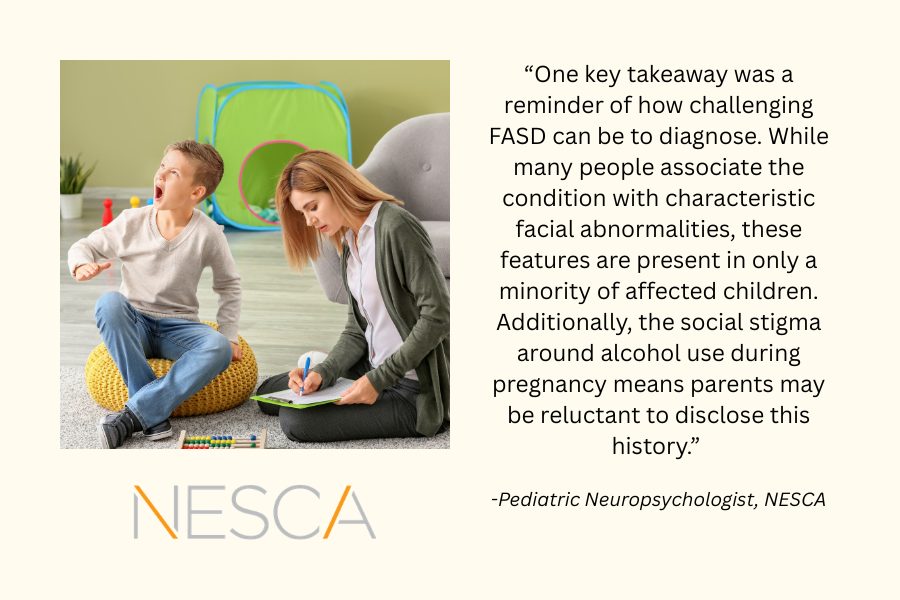
One key takeaway was a reminder of how challenging FASD can be to diagnose. While many people associate the condition with characteristic facial abnormalities, these features are present in only a minority of affected children. Additionally, the social stigma around alcohol use during pregnancy means parents may be reluctant to disclose this history. This can make it easy to miss the diagnosis, particularly in children who present with behavioral or learning challenges that could be attributed to other conditions.

Hallmark symptoms of FASD include executive functioning deficits (e.g., working memory), poor impulse control, difficulties with generalization (people, situations, consequences), difficulties with abstraction, perseverations, and diminished adaptive skills within the context of healthy levels of intellect.

The seminar emphasized why making an accurate diagnosis is so critical: It directly informs how we approach treatment, including how we assist families in accessing services, setting realistic expectations for the child, diminishing the risk of the child receiving inappropriate diagnoses (e.g., Oppositional Defiant Disorder), and assisting the child in developing stronger self-awareness and self-advocacy skills. Moreover, it is important for the adults in the child’s life, including parents and educators, to understand that behaviors that are part of the disability are not willful. Behavioral challenges in children with FASD, for example, often do not respond well to traditional behavioral programs. Instead, a trauma-informed approach is typically more effective, as it accounts for the neurodevelopmental impact of prenatal alcohol exposure and addresses the underlying emotional and regulatory difficulties these children face.

Being part of a team that prioritizes professional development, like the one at NESCA, means continually sharpening my skills and expanding my understanding to better serve the children and families we work with. The FASD seminar was not only a great learning experience but also a reminder of the importance of staying open to complex diagnoses and tailoring treatment plans to meet the unique needs of each child.

About the Author

Dr. Weinberg specializes in the assessment of school-aged children and adolescents with a wide range of concerns including development disorders, such as autism spectrum disorder, learning disabilities (e.g. dyslexia, dysgraphia), language-based learning difficulties, AttentionHeadshot of Leah Weinberg, Ph.D. Deficit Hyperactivity Disorder (ADHD), Nonverbal Learning Disability (NVLD), and executive functioning disorders (e.g. slow processing speed). She also has experience in working with individuals with psychiatric difficulties, such as anxiety, mood disorders (e.g. depression), and behavioral disorders. Dr. Weinberg has expertise in working with children with complex profiles or multiple areas of strength and weakness that cannot be encapsulated by a single diagnosis. Dr. Weinberg is passionate about helping families better understand their child’s neuropsychological profile and the impact it may be having on their behavior or functioning in order to best support them in all areas of their life.

To book a neuropsychological evaluation with Dr. Weinberg or another expert neuropsychologist at NESCA, complete NESCA’s online intake form

NESCA is a pediatric neuropsychology practice with offices in Newton, Plainville, and Hingham, Massachusetts; Londonderry, New Hampshire; and the greater Burlington, Vermont region, serving clients from infancy through young adulthood and their families. For more information, please email info@nesca-newton.com or call 617-658-9800.
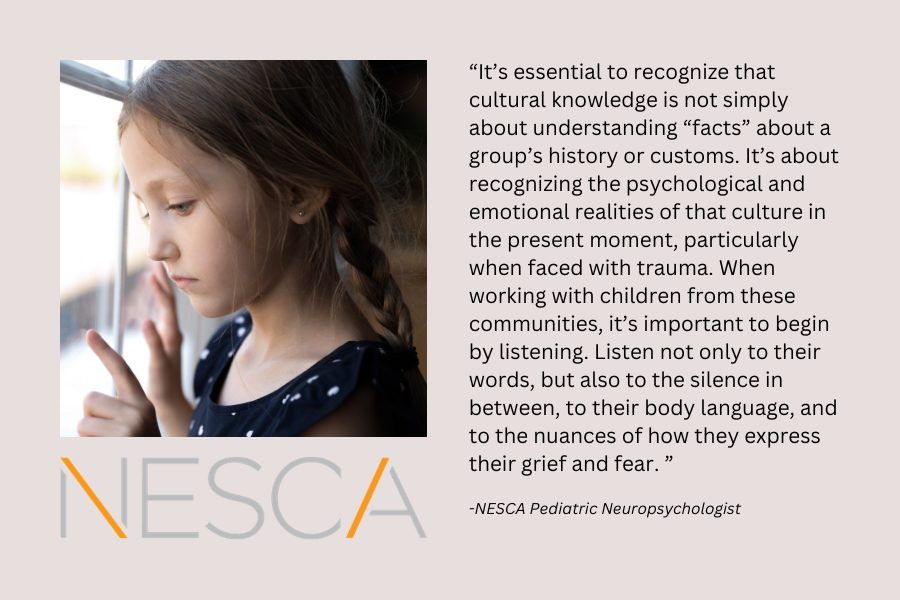
image of a girl impacted by trauma

Approaching Cultural Knowledge and Sensitivity as More Than Just Buzzwords: A Neuropsychologist’s Perspective

By | NESCA Notes 2024

image of a girl impacted by traumaBy Leah Weinberg, Ph.D. 
Pediatric Neuropsychologist, NESCA

In recent years, the conversation around cultural knowledge and sensitivity has gained significant traction across many fields, including education, healthcare, and psychology. Yet, despite the increasing prevalence of these terms, we must ask ourselves: Are we truly embodying cultural sensitivity, or are we merely paying lip service to it?

As a neuropsychologist, originally from the former Soviet Union (what is now Ukraine), I believe that cultural competence is not just a set of buzzwords we throw around to make ourselves sound aware; it’s a crucial, ongoing practice that demands attention, empathy, and, above all, genuine understanding. Now more than ever, as we witness global conflicts and societal shifts, it’s essential to engage deeply with the cultural and psychological needs of children who are affected by these events. The horrific events of October 7, 2023, in Israel, the subsequent rise in incidents involving anti-Jewish sentiments, and other crises around the world have had a profound impact on vulnerable children. How can we, as mental health professionals, approach these children in a way that truly honors their cultural identities while understanding the potential toll of trauma?

Children who experience trauma often find themselves at the intersection of multiple identities—cultural, familial, national, and personal. In the Jewish community, for example, the devastating events of October 7, 2023, marked a profound moment of collective grief and fear. For some Jewish children, the emotional impact of these events may be compounded by historical trauma, including awareness of past experiences of antisemitism and persecution. These children may be processing not only the immediacy of their own situation but also an ancestral history of violence and oppression. Similarly, Ukrainian children displaced by the ongoing conflict face a complex mix of trauma. These children might not only be mourning the loss of their homes, but also grappling with the disintegration of their sense of safety and national identity. The trauma of war is not just physical; it disrupts the very fabric of who these children are and how they see the world. Their cultural identity, bound up in language, traditions, and the shared history of their people, may suddenly feel threatened or fragmented.

It’s essential to recognize that cultural knowledge is not simply about understanding “facts” about a group’s history or customs. It’s about recognizing the psychological and emotional realities of that culture in the present moment, particularly when faced with trauma. When working with children from these communities, it’s important to begin by listening. Listen not only to their words, but also to the silence in between, to their body language, and to the nuances of how they express their grief and fear. Children from these communities may not always have the language to articulate their feelings, particularly when these feelings are wrapped up in both current trauma and long-standing cultural narratives. For instance, a Jewish child might not immediately say, “I’m scared because of antisemitism.” Instead, they may exhibit anxiety in social settings, avoidance of certain situations, or a sense of hypervigilance. It’s essential to recognize these subtler expressions of distress. Furthermore, cultural sensitivity means appreciating how culture influences coping mechanisms. For Jewish children, faith, community rituals, and family structures often play a significant role in both day-to-day life and in how they process adversity. These rituals, whether it’s a prayer or a specific practice for remembering the dead, can provide crucial emotional support, and understanding their importance can help guide effective interventions. Similarly, Ukrainian children may draw strength from their deep cultural connection to the land and their national identity. Understanding these cultural touchstones allows us to better support their emotional recovery.

To effectively support children affected by trauma, it is important to approach care from a framework that integrates both cultural sensitivity and trauma-informed practice. Children need to feel understood, and this means recognizing their cultural identity as an integral part of their experience. Safe spaces where children can express themselves without fear of judgment are paramount. It is important for clinicians not only to appreciate the current crisis but also the cumulative effect of historical events that have shaped the children’s cultures. As a clinician, this means being aware of the historical context and acknowledging the weight of collective memory. This helps to build trust and validates the child’s emotional experience. Working with families and community leaders helps ensure that interventions are not only culturally relevant but also supported by the broader social structure. This collaborative approach fosters resilience and provides ongoing emotional support.

Cultural competence is not a static goal, but rather a lifelong learning process. As clinicians, we must constantly engage with the evolving cultural, social, and political landscapes to ensure our approach remains relevant and respectful. This includes continuing education and being open to adjusting our practices based on new insights. Ultimately, cultural sensitivity is not about checking off a list of “do’s and don’ts.” It’s about recognizing and understanding that culture shapes how children experience and process the world. This empathetic approach allows us to meet children where they are—emotionally, psychologically, and culturally—and to support them as needed. As we move forward, let us take cultural sensitivity beyond a buzzword and make it a true cornerstone of our practice. In times of crisis, the need for empathy, understanding, and culturally informed care has never been greater.

NESCA has a long-standing commitment to working with internationally based clients, families, and schools through neuropsychological evaluation, consultation, coaching, and transition services. For more information on NESCA’s international work, visit: https://nesca-newton.com/international/.

About the Author

Dr. Weinberg specializes in the assessment of school-aged children and adolescents with a wide range of concerns including development disorders, such as autism spectrum disorder, learning disabilities (e.g. dyslexia, dysgraphia), language-based learning difficulties, AttentionHeadshot of Leah Weinberg, Ph.D. Deficit Hyperactivity Disorder (ADHD), Nonverbal Learning Disability (NVLD), and executive functioning disorders (e.g. slow processing speed). She also has experience in working with individuals with psychiatric difficulties, such as anxiety, mood disorders (e.g. depression), and behavioral disorders. Dr. Weinberg has expertise in working with children with complex profiles or multiple areas of strength and weakness that cannot be encapsulated by a single diagnosis. Dr. Weinberg is passionate about helping families better understand their child’s neuropsychological profile and the impact it may be having on their behavior or functioning in order to best support them in all areas of their life.

To book a neuropsychological evaluation with Dr. Weinberg or another expert neuropsychologist at NESCA, complete NESCA’s online intake form

NESCA is a pediatric neuropsychology practice and integrative treatment center with offices in Newton, Plainville, and Hingham, Massachusetts; Londonderry, New Hampshire; the greater Burlington, Vermont region; and Brooklyn, New York (coaching services only) serving clients from infancy through young adulthood and their families. For more information, please email info@nesca-newton.com or call 617-658-9800.

Buyer’s Guide 101: How to Shop for a Pediatric Occupational Therapist

By | NESCA Notes 2021

By: Julie Robinson, OT
Director of Clinical Services; Occupational Therapist, NESCA

As a parent of a child who has just been referred for Occupational Therapy (OT) services, the prospect of what to do next and where to go can be quite confusing. With so many providers in the area, it can be difficult to know who would be the right fit for your family. Typically, when you reach out to express interest in OT services at NESCA, Julie Robinson, OT, our department director, will have a personal phone call with you to help you through the process. As you conduct your search for the right fit for your child and family, here are some good questions you might ask to help you determine what works best. We’ve offered answers regarding NESCA’s services to let you know more about how we provide OT services.

What type of insurance do you take for occupational therapy?

Here at NESCA, we are in-network for BCBS and Allways, and we bill them directly on behalf of our patients.

How long are your OT sessions?

We spend 45 minutes directly with a child and another 5 – 10 minutes at the end of the session to consult with the caregiver. Other practices provide 30 or 38 minute sessions to compensate for decreases in insurance payments since the outset of Covid-19.

How long do we have to wait for an OT session? 

We can initiate an evaluation within 2 – 3 weeks of initial contact. If you have availability to bring your child in for treatment during the school day, there is no waitlist at this time. If you require sessions in the afterschool hours, there is a very small waitlist.

How many patients does a clinician typically see per week?

Some practices require their clinicians to perform as many as 30 or 32 patient hours per week to maximize their income. Here at NESCA, we cap patient hours at 26 per week. It is very important for us to focus on providing excellent clinical care to our clients with staff who are not burnt out or struggling to manage paperwork, treatment planning, and administrative activities, such as phone calls and emails to support our families. We are proud to offer research-backed services and want to provide our clinicians with ample time for continued opportunities for learning, allowing them to reach their highest level of potential and skill as a therapist – which they then pass on that knowledge and skill to our families.

What does your OT practice focus on?

At NESCA, our focus of therapy is based on a holistic view of a child to encourage life-long functional skill acquisition. We use a combination of sensory motor, sensory integration, developmental, and trauma-informed techniques, as well as practice and repetition of those techniques. We offer coaching on daily living skills to address weaknesses across a variety of areas: self-regulation, executive functions, self-care skills, such as dressing and bathing, handwriting and fine motor development, feeding, academic readiness, organization and attention. Other practices may utilize sensory integration or applied behavioral analysis as the basis for their program, for example.

Does the practice provide OT services in a clinical setting, remotely, at home, in school, or in the community?

Our primary service provision at NESCA is in the office or over teletherapy. In some instances, where schedules can be accommodated, we will provide services in the home, schools, or in the community. There may be additional travel fees involved for services outside of the office.

Does your OT practice offer comprehensive or second opinion evaluations for academic programming if needed?

NESCA does provide this service.

Will your practice consult with teachers or other caregivers if needed?

Yes. Sometimes additional fees are required, as insurance does not cover this service. We believe that consultation with outside providers is a critical part of our success!

Does your practice provide any specific programs outside of traditional sensory-motor based Occupational Therapy services?

At NESCA, we provide several specialty services in addition to traditional OT:

  • Feeding therapy
  • Safe and Sound Protocol for auditory sensitivity and self-regulation
  • Handwriting Without Tears
  • Trauma-informed Sensory Integration

What makes our clinicians so special?

One of the things that makes our occupational therapists an ideal match for your family is our love for children, the work we do, and our commitment to lifelong learning and the development of our clinical skills. Our entire OT department has known each other for at least four years, and we all came together as a team from another practice, with clinicians that are hand-picked by our director. We meet together on a weekly basis to share ideas and information, as well as to support each other in our clinical development.

For more information about NESCA’s Pediatric Occupational Therapy services, please visit: http://nesca-newton.com/occupational_therapy/ or submit an online Intake Form: https://nesca-newton.com/intake-form/.


About the Author

Julie Robinson is an occupational therapist with over 25 years of experience as a clinician. The work Julie does is integral to human development, wellness and a solid family unit. She particularly enjoys supporting families through the process of adoption and in working with children who are victims of trauma. Julie has extensive experience working with children diagnosed with an Autism Spectrum Disorder (ASD), or who have learning or emotional disabilities. She provides services that address Sensory Processing Disorder (SPD) and self-regulation challenges, as well as development of motor and executive functioning skills.

To book an appointment or to learn more about NESCA’s Occupational Therapy Services or other clinical therapies, please fill out our online Intake Form, email info@nesca-newton.com or call 617-658-9800.


Neuropsychology & Education Services for Children & Adolescents (NESCA) is a pediatric neuropsychology practice and integrative treatment center with offices in Newton, Massachusetts, Plainville, Massachusetts, and Londonderry, New Hampshire, serving clients from preschool through young adulthood and their families. For more information, please email info@nesca-newton.com or call 617-658-9800.


Skip to content