
NESCA’s Londonderry, NH location has immediate availability for neuropsychological evaluations. Our NH clinicians specialize in the following evaluations: Neuropsychological; Autism; and Emotional and Psychological, as well as Academic Achievement and Learning Disability Testing. Our NH clinicians also conduct evaluations for students who are at boarding schools, and two of our NH clinicians have PsyPACT authorization, allowing them to conduct evaluations out-of-state.

Visit www.nesca-newton.com/intake for more information or to book an evaluation.

Category

NESCA Notes 2020

Subscribe to NESCA Notes

The Therapeutic Great Outdoors—Part 2

By | NESCA Notes 2020

By: Sophie Bellenis, OTD, OTR/L
Occupational Therapist; Real-life Skills Program Manager and Coach

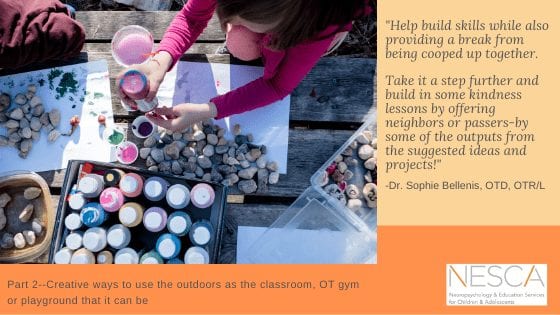
In last week’s blog, we provided the first five ideas on how to teach and build OT skills by getting outdoors. This week, we bring the next installment of ideas to help build skills while also providing a break from being cooped up together. Take it a step further and build in some kindness lessons by offering neighbors or passers-by some of the outputs from the suggested ideas and projects!

  1. Make Fossils. This activity consists of finding unique and special treasures outdoors and making imprints of them back inside. First, find some small solid objects, such as rocks, small sticks, acorns, leaves or shells. This is a perfect activity to do after a nature scavenger hunt! Then have your children press these objects into playdough or plaster of Paris to make their own fossils. Children work on their fine motor skills as they roll out the plaster, pinch their objects and push them down to make an imprint. Try making this great playdough recipe together before you get started. For some extra creative options, to try include: incorporating small toys, such as dinosaur figurines or LEGOs or using cookie dough as a base, then eat your fossils for a snack!
  2. Make a Bird Feeder. There are many different creative ways to make bird feeders with your children. Choose a bird feeder that requires multiple fine motor skills and is appropriate for your child’s level! Two options are:
    1. Bagel Feeder – Start with a bagel. Help your child tie a string or piece of ribbon through the center hole of the bagel in a large loop. Next, have your child choose a topping to put onto the bagel. I generally suggest peanut butter! Have the child practice spreading this topping all over the bagel. Using a knife to spread such a thick, sticky substance is a pretty difficult fine motor task! Next have your child use their “pinchy fingers” (thumb and pointer finger) to pick up bird seed and sprinkle it on the peanut butter. The end product will be a bagel covered in peanut butter and bird seed that is ready to hang on a tree outside. Place it near a window and let your children watch the birds enjoy their creation!
    2. Cheerio Feeder – You may have heard that stringing beads is an excellent occupational therapy activity that promotes bilateral coordination, fine motor precision, motor planning and a pincer grasp. Consider making a bird feeder by stringing Cheerios (or any cereal with a hole in the center) onto a piece of string and hanging them in the trees. Birds will love to peck off the individual pieces as a snack.
  3. Paint Rocks or Shells. Painting rocks and other outdoor treasures is a great activity that allows children to be creative while using tools and practicing a functional grasp. Allow children to pick up the rocks and get messy to help promote some bilateral coordination!
  4. Draw with Sidewalk Chalk. While writing with chalk may seem very similar to writing with a pencil to us adults, for children who are just learning to manipulate a pencil, it can be a hugely different experience. Writing on the uneven ground provides tactile feedback. Holding a piece of chalk that moves with the contours of the ground requires increased hand strength. Children get to practice modulating how hard they need to push down on the chalk to make a solid line. If your child is hesitant to practice handwriting, try sneaking outside 5 or 10 minutes before them to create a few “sidewalk worksheets” for them to complete before they start to draw their creative masterpieces. For some children, there is a huge sensory piece to sidewalk chalk, as they work to tolerate the new texture and the feeling of chalk on their hands.
  5. Bring out the Bubbles. In occupational therapy, we often use bubbles to help children work on their oral motor skills. Children work to make their mouth into a round “O” shape and blow with enough force to create the bubbles themselves. Prompt your kids to pop bubbles by clapping their hands together. This helps to practice eye-hand and bilateral coordination. Next, have your child try to keep their eyes on one bubble as long as possible to practice visual tracking!


About the Author

Dr. Sophie Bellenis is a Licensed Occupational Therapist in Massachusetts, specializing in educational OT and functional life skills development. Dr. Bellenis joined NESCA in the fall of 2017 to offer community-based skills coaching services as a part of the Real-life Skills Program within NESCA’s Transition Services team. Dr. Bellenis graduated from the MGH Institute of Health Professions with a Doctorate in Occupational Therapy, with a focus on pediatrics and international program evaluation. She is a member of the American Occupational Therapy Association, as well as the World Federation of Occupational Therapists. Having spent years delivering direct services at the elementary, middle school and high school levels, Dr. Bellenis has extensive background with school-based occupational therapy services.  She believes that individual sensory needs and visual skills must be taken into account to create comprehensive educational programming.

To book an appointment or to learn more about NESCA’s Occupational Therapy Services, please fill out our online Intake Form, email info@nesca-newton.com or call 617-658-9800.


Neuropsychology & Education Services for Children & Adolescents (NESCA) is a pediatric neuropsychology practice and integrative treatment center with offices in Newton, Massachusetts, Plainville, Massachusetts, and Londonderry, New Hampshire, serving clients from preschool through young adulthood and their families. For more information, please email info@nesca-newton.com or call 617-658-9800.
 

Meltdowns Happen

By | NESCA Notes 2020

By Dot Lucci, M.Ed., CAGS

Director of Consultation and Psychoeducational Services, NESCA

When we think of the word meltdown, we may think of the economy or stock market, glaciers, nuclear meltdowns or even volcanoes erupting. These are all examples of things collapsing from being over-stressed, overheating, a major disruption to a system or an internal collapse. Using the word meltdown to describe people is similar. In homes across America, even as we settle into quarantine, slow down our lives and find ways to enjoy our time together, there may be more meltdowns happening that are filled with tears, screams and lots of “No, I don’t want to!” Adults and children are becoming overheated, over-stressed, and our systems are over-burdened. And when a system can no longer take it, it melts down, boils over, erupts, or crashes and burns. In these moments, it is the only way of coping – to let loose, let off of steam, erupt – or just plain melt down. Sometimes it’s hard to believe, but each of us is doing the best we can to cope with a difficult environment. We’re trying to do the best we can, because our biological system is in a meltdown. We are not responding; instead we are reacting from our “downstairs” brain and not our “upstairs” brain.

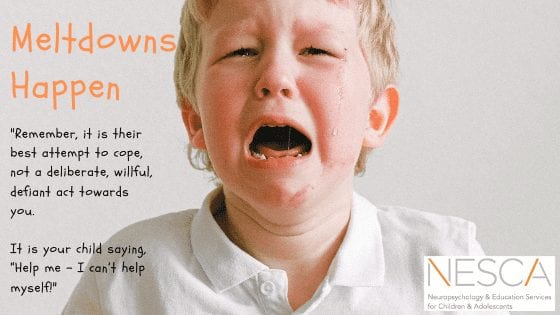
A meltdown may be an explosion and look like crying, throwing things, yelling, aggressing, breaking things, etc. Or it may be more like an implosion – a withdrawal from the family, hiding, sleeping more, lethargy, etc. Both are the same in many ways biologically; the system is in fight, fright or freeze. A meltdown should be viewed as a “neurological storm.” This fight, flight or freeze response is not a child being “bad” or disrespectful, but rather is “bad behavior” that needs to be changed. Remember, it is their best attempt to cope, not a deliberate, willful, defiant act towards you. It is your child saying, “Help me – I can’t help myself! I’ve lost it!” This is not a time to teach, reason with, or win a battle. It is a fire to be put out, and you as the parent or caretaker is the firefighter. It’s a crisis to be managed, and you become your child’s “upstairs brain” or frontal lobe (even though you may want to react from your “downstairs brain,” because you may also be losing it.

Everyone wants to have a good day. Remember, when it’s going in a different direction, you are the adult. You can take a breath and even walk away (if you can) for a few seconds to compose yourself. This allows you to respond versus react. It is your job to manage the situation and take the emotional high road (often easier said than done). In these moments, it is really only about a few things.

  1. Safety and dignity
  2. Keep calm and reduce/simplify your language
  3. Keep calm and know this too shall pass
  4. Don’t get pulled off topic by all the things your child is saying or doing – this is a rabbit hole that you won’t emerge from
  5. Mention what you want to have happen, rather than what you want to stop (“Bang your pillow” instead of “Stop banging the wall”)
  6. Establish connection – right brain to right brain. Remember the mantra, “Name it to tame it.” (i.e. I know this is hard; I know you don’t want to do it; I wouldn’t want to either; or I know you don’t like it, etc.)

Resources:

https://www.drdansiegel.com/books/the_whole_brain_child/


About the Author

NESCA’s Director of Consultation and Psychoeducational Services Dot Lucci has been active in the fields of education, psychology, research and academia for over 30 years. She is a national consultant and speaker on program design and the inclusion of children and adolescents with special needs, especially those diagnosed with Autism Spectrum Disorder (ASD). Prior to joining NESCA, Ms. Lucci was the Principal of the Partners Program/EDCO Collaborative and previously the Program Director and Director of Consultation at MGH/Aspire for 13 years, where she built child, teen and young adult programs and established the 3-Ss (self-awareness, social competency and stress management) as the programming backbone. She also served as director of the Autism Support Center. Ms. Lucci was previously an elementary classroom teacher, special educator, researcher, school psychologist, college professor and director of public schools, a private special education school and an education collaborative.

Ms. Lucci directs NESCA’s consultation services to public and private schools, colleges and universities, businesses and community agencies. She also provides psychoeducational counseling directly to students and parents. Ms. Lucci’s clinical interests include mind-body practices, positive psychology, and the use of technology and biofeedback devices in the instruction of social and emotional learning, especially as they apply to neurodiverse individuals.


To book a consultation with Ms. Lucci or one of our many expert neuropsychologists, complete NESCA’s online intake form. Indicate whether you are seeking an “evaluation” or “consultation” and your preferred clinician/consultant in the referral line.


Neuropsychology & Education Services for Children & Adolescents (NESCA) is a pediatric neuropsychology practice and integrative treatment center with offices in Newton, Massachusetts, Plainville, Massachusetts, and Londonderry, New Hampshire, serving clients from preschool through young adulthood and their families. For more information, please email info@nesca-newton.com or call 617-658-9800.


Life Skills for College to Work on Now – Part 2

By | NESCA Notes 2020

By: Kelley Challen, Ed.M., CAS
Director of Transition Services; Transition Specialist

In Massachusetts, we are more than five weeks into home-based learning and looking toward another two months (or more) of schools and childcare facilities being closed. Unfortunately, this is taking a particularly large social and emotional toll on our teenagers and young adults. One strategy for coping with current conditions is to focus on concrete ways that we can control our daily lives and to set short-term tangible goals. With that in mind, I am writing a second blog focusing on the opportunity teenagers are being given to build daily living and executive functioning skills that will ultimately help them live away from home and self-direct their lives. Last week, I discussed four important skills that are critical for attending residential colleges: getting up on time each morning, doing laundry, having basic kitchen skills, and using basic tools for assembling and fixing things around home. This week, I am offering another four skills. For any young person, I always suggest letting the student pick the skill(s) they want to work on first. When you have a lot to work on, you may as well pick the starting point that feels most important and motivating!

  • Medications: For students who have been on medication during high school, keeping that medication regimen stable is typically a must during the transition to college. Students need to have the knowledge, preparation and organizational skills needed to maintain their own medication regimen. Often a good way to start this process is to purchase a 7-day pill organizer and have teens be responsible for dispensing their own medication for the week. Certainly, a smartphone or smartwatch with several alarms can be useful for remembering medications at needed times. For more information about medication management expectations in college, check out this article by Rae Jacobson. He makes some useful recommendations, such as using a unique alarm tone for medication reminders and putting pills in highly or frequently visible locations (e.g., next to your toothbrush that you routinely use).
  • Money: Students in early stages of high school may be too young for their own bank accounts and credit cards. However, some banks do offer accounts that are specially tailored for minors. Students can open a joint bank account as a minor with a parent or legal guardian. Teens can also practice managing plastic through use of traditional prepaid debit cards, Amazon.com or store gift cards, or a debit card made especially for minors like Greenlight. From home, teens can practice making necessary online purchases, tracking payments and shipping, checking account balances, and using a software like Microsoft Excel or Google Sheets to keep a record of purchases. There are also plenty of great free web-based financial literacy resources that teens can use to learn about banking and consumer skills from home; a few resources that my colleague Becki Lauzon, M.A., CRC, and I like include:
  • Building an Exercise Routine: Believe it or not, basic fundamentals like healthy eating, sleep hygiene and regular vigorous exercise are strong predictors of college success and satisfaction. As we are living in a period of time where team sports are not accessible, this may be exactly the right time for teenagers to build their own individual exercise routine that can be carried out at home and in one’s local neighborhood. A good baseline to strive for is a routine that includes exercise sessions at least three days per week. With decreased time factors in our lives, students can play around with morning, afternoon or evening exercise to see what feels best for their bodies and brains. If brisk dog-walking, jogging/running or biking activities are not appealing, there are plenty of great YouTube exercise videos (e.g., dance, yoga, strength training, cardio training, etc.) that require no equipment and are calibrated for all kinds of bodies and levels of fitness. Setting a schedule for weekly workouts will help to ensure that exercise becomes more routine and tracking progress with that schedule (e.g., journaling, marking a calendar, using an app like Strava or Aaptiv, etc.) helps to build and sustain motivation. Some teens (and adults) also find that they are more able to stick to an exercise routine if they use a smartwatch to help track, celebrate and prompt their progress.
  • Using a Calendar System for Scheduling: The alarm clock mentioned in last week’s blog is certainly an important time management tool that is vital to master prior to attending college. Another critical time management tool for college (and life beyond) is a calendar system for managing one’s schedule. When starting to build time management skills, simply asking your teen to write down their schedule can be a good place to start. What do they know they have to do each day of the week? What appointments or activities are missing? Teens may have a calendar system that they are already accustomed to using for checking the date, but may not be using that tool to manage their entire schedule. Some common calendar app tools include iCal, Google Calendar and Outlook, but some teens may do better with paper-based systems. If a teen benefits from a paper copy of their schedule, I would still recommend that they learn to use something electronic, then just print off their daily, weekly or monthly schedule based on preference and need. Practice inputting activities that are happening right now, such as assignments, remote classes, meals, therapy, etc. Teens can also play around with reminder settings to see what feels best for prompting participation in activities. Sometimes 15 minutes is too much time, but 5 or 10 is just right. Other times, more than one reminder is needed.

To read more about the Life Skills recommendations from last week’s Transition Thursday blog, click here!


If you are interested in working with a transition specialist at NESCA for consultation, coaching, planning or evaluation, please complete our online intake form: https://nesca-newton.com/intake-form/.


About the Author:

Kelley Challen, Ed.M., CAS, is NESCA’s Director of Transition Services, overseeing planning, consultation, evaluation, coaching, case management, training and program development services. She is also the Assistant Director of NESCA, working under Dr. Ann Helmus to support day-to-day operations of the practice. Ms. Challen began facilitating programs for children and adolescents with special needs in 2004. After receiving her Master’s Degree and Certificate of Advanced Study in Risk and Prevention Counseling from Harvard Graduate School of Education, Ms. Challen spent several years at the MGH Aspire Program where she founded an array of social, life and career skill development programs for teens and young adults with Asperger’s Syndrome and related profiles. She additionally worked at the Northeast Arc as Program Director for the Spotlight Program, a drama-based social pragmatics program, serving youth with a wide range of diagnoses and collaborating with several school districts to design in-house social skills and transition programs. Ms. Challen is co-author of the chapter “Technologies to Support Interventions for Social- Emotional Intelligence, Self-Awareness, Personality Style, and Self-Regulation” for the book Technology Tools for Students with Autism. She is also a proud mother of two energetic boys, ages six and three. While Ms. Challen has special expertise in supporting students with Autism Spectrum Disorders, she provides support to individuals with a wide range of developmental and learning abilities, including students with complex medical needs.

Neuropsychology & Education Services for Children & Adolescents (NESCA) is a pediatric neuropsychology practice and integrative treatment center with offices in Newton, Massachusetts, Plainville, Massachusetts, and Londonderry, New Hampshire, serving clients from preschool through young adulthood and their families. For more information, please email info@nesca-newton.com or call 617-658-9800.

The Therapeutic Great Outdoors—Part 1

By | NESCA Notes 2020

By: Sophie Bellenis, OTD, OTR/L
Occupational Therapist; Real-life Skills Program Manager and Coach

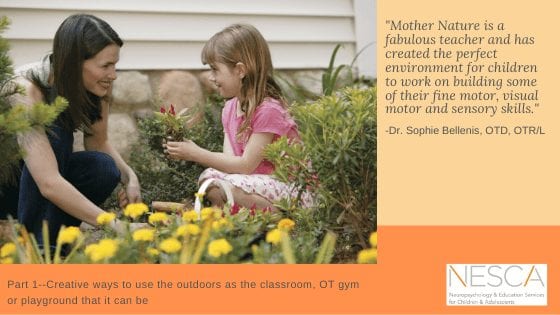
Aside from a spring snowfall this week, it looks like springtime may have truly arrived here in New England. Flowers are popping up on trees, the peepers and morning birds are singing and the warm sun is finally convincing most of us to leave the coats and hats inside. Now more than ever, the opportunity for children to get outside seems like a welcome reprieve from the weeks either cooped up or bundled up.  Mother Nature is a fabulous teacher and has created the perfect environment for children to work on building some of their fine motor, visual motor and sensory skills. This week, we’ll explore five of 10 creative ways to use the outdoors as the classroom, OT gym or playground that it can be! Check back next Tuesday for the next five!

  1. Get Dirty! Thankfully, some of the simplest activities work on the most skills. Letting kids get as dirty as they can works on building sensory tolerance. Digging in the dirt builds hand strength and endurance. Squatting down to play in the mud builds gross motor coordination and whole-body control. Consider bringing out utensils, cups and bowls and so your children can practice scooping, pouring and mixing!
  2. Plant a Garden. Take playing in the dirt one step further by incorporating the steps to planting a garden. This “garden” could be flower or veggie patch, a planter or just a little pot to keep on the window sill. Children work on isolating one finger by poking a hole in the soil, a pincer grasp by picking up small seeds between their thumb and pointer finger and hand strength by digging holes and burying seeds. This is also a great opportunity for children to practice the responsibility of watering plants every day. Add in some math review by having them measure the height of their plants and recording the information in a table.
  3. Climb Trees. The age-old activity of climbing trees works on building gross motor coordination, muscle strength and motor planning. To incorporate some visual skills practice, have children bring “binoculars,” or two toilet paper rolls taped together, to seek out different things that they can see from a new vantage point.
  4. Nature Scavenger Hunt. Scavenger hunts are an excellent way to target building visual skills as they prompt kids to scan their environment, search for specific things in a busy visual field and ignore the overwhelming amount of visual stimulation around them. Bring in a sensory element by asking children to observe, feel and smell each of their treasures. Check out this fabulous Egg Carton Nature Scavenger Hunt created by The Silvan Reverie.
  5. Build a Fort. Encourage kids to use their imagination and build outside. Provide them with twine or string, an old sheet, and a hammer and nails (if they can use them safely). If they are not ready to use these tools, they can practice propping sticks up against a tree to build a lean-to or gathering sticks and branches to make a platform to sit on. All of these options require motor planning, trial and error, and get kids to move their bodies.


About the Author

Dr. Sophie Bellenis is a Licensed Occupational Therapist in Massachusetts, specializing in educational OT and functional life skills development. Dr. Bellenis joined NESCA in the fall of 2017 to offer community-based skills coaching services as a part of the Real-life Skills Program within NESCA’s Transition Services team. Dr. Bellenis graduated from the MGH Institute of Health Professions with a Doctorate in Occupational Therapy, with a focus on pediatrics and international program evaluation. She is a member of the American Occupational Therapy Association, as well as the World Federation of Occupational Therapists. Having spent years delivering direct services at the elementary, middle school and high school levels, Dr. Bellenis has extensive background with school-based occupational therapy services.  She believes that individual sensory needs and visual skills must be taken into account to create comprehensive educational programming.

To book an appointment or to learn more about NESCA’s Occupational Therapy Services, please fill out our online Intake Form, email info@nesca-newton.com or call 617-658-9800.


Neuropsychology & Education Services for Children & Adolescents (NESCA) is a pediatric neuropsychology practice and integrative treatment center with offices in Newton, Massachusetts, Plainville, Massachusetts, and Londonderry, New Hampshire, serving clients from preschool through young adulthood and their families. For more information, please email info@nesca-newton.com or call 617-658-9800.


Good Ideas for Dogs are Good for People, Too

By | NESCA Notes 2020

By Dot Lucci, M.Ed., CAGS

Director of Consultation and Psychoeducational Services, NESCA

  • Play Every Day! — Play can promote calmness and reduce anxiety. This is true for adults and kids.
  • Play Is Learning — Reflect after play by creating and asking questions. Did you learn anything new? What surprised you? How did you feel before you played? How you feel now?
  • Walk, Walk, Walk! — Walking helps dogs stay engaged with the world and brains stimulated. Yup, works for humans, too.
  • Be Present While Walking — Go for walks with or without a dog. Feel the air blowing, smell the flowers, hear the birds singing, feel the rain on your face. Learn the bird calls, bring binoculars and look closely at the birds. Be present as you walk, laugh, sing, splash in puddles….
  • Game Play — Playing games can help satisfy natural instincts. Play old games, teach your children games you played as a child, learn new games. Any games will do – board, card, dice, movement, etc. Play skill games, games of chance or luck games, silly games, etc.
  • Feed Relationships Through Play and Exercise — Bond with each other (a child, a dog or both!) through playing or getting some exercise together. Be active together…teach new tricks, kick a ball around, play catch, take a yoga or Zumba class, watch GoNoodle as long as it’s together.
  • Be in gratitude that you are experiencing this time together to slow down and reconnect with each other. Laugh, play, sing and dance together. Love and care for each other. Enjoy each other.


About the Author

NESCA’s Director of Consultation and Psychoeducational Services Dot Lucci has been active in the fields of education, psychology, research and academia for over 30 years. She is a national consultant and speaker on program design and the inclusion of children and adolescents with special needs, especially those diagnosed with Autism Spectrum Disorder (ASD). Prior to joining NESCA, Ms. Lucci was the Principal of the Partners Program/EDCO Collaborative and previously the Program Director and Director of Consultation at MGH/Aspire for 13 years, where she built child, teen and young adult programs and established the 3-Ss (self-awareness, social competency and stress management) as the programming backbone. She also served as director of the Autism Support Center. Ms. Lucci was previously an elementary classroom teacher, special educator, researcher, school psychologist, college professor and director of public schools, a private special education school and an education collaborative.

Ms. Lucci directs NESCA’s consultation services to public and private schools, colleges and universities, businesses and community agencies. She also provides psychoeducational counseling directly to students and parents. Ms. Lucci’s clinical interests include mind-body practices, positive psychology, and the use of technology and biofeedback devices in the instruction of social and emotional learning, especially as they apply to neurodiverse individuals.


To book a consultation with Ms. Lucci or one of our many expert neuropsychologists, complete NESCA’s online intake form. Indicate whether you are seeking an “evaluation” or “consultation” and your preferred clinician/consultant in the referral line.


Neuropsychology & Education Services for Children & Adolescents (NESCA) is a pediatric neuropsychology practice and integrative treatment center with offices in Newton, Massachusetts, Plainville, Massachusetts, and Londonderry, New Hampshire, serving clients from preschool through young adulthood and their families. For more information, please email info@nesca-newton.com or call 617-658-9800.


Life Skills for College to Work on Now – Part 1

By | NESCA Notes 2020

By: Kelley Challen, Ed.M., CAS
Director of Transition Services; Transition Specialist

As a transition specialist working with students who have the cognitive and academic potential for college but have sometimes missed opportunities to develop life skills while keeping up with rigorous academic and extracurricular schedules, I am encouraging families to think of this time as a gift. Students, especially those in 8th-10th grade, have a novel opportunity to build life skills that can help them to live away from home and self-direct their schedules. Without school closures, this opportunity likely would not have come until after 12th grade. With that in mind, here is a list of 4 life skills that are critical for attending residential college that I am recommending some of my students work on:

  • Getting up “on time” each morning: We all know that teenage sleep schedules are rarely in alignment with traditional high school hours. Without transportation time, there is a new opportunity to practice using an alarm clock and build a sleep schedule and that is a little closer to teenage physiological needs. If teens are using a cell phone alarm, it is helpful to put the phone in airplane mode and plug it in away from the bed. With an alarm clock, some experts recommend clocks with blue numbers and facing the clock away from the bed. Good sleep hygiene depends on many factors, such as diet, caffeine intake, exercise, temperature, clothing and electronics use, so teens may want to organize their own “sleep study” to figure out what helps them personally to build a successful sleep routine. Teens can also play around with the sound an app or alarm clock makes to find something that is effective in waking them up without startling.
  • Laundry: When building new skills, I always recommend that students learn and practice the skills to the point of automaticity. Given the amount of time that we are now spending at home, this is the perfect opportunity to learn to do laundry, including reading labels, sorting clothing/linens and running the washer and dryer. If a teen is not interested in learning from a parent, YouTube is a great resource for learning steps to manage laundry and how to operate practically any model of washer or dryer. Teens will learn more quickly if they are practicing the skills multiple times per week, so consider building a schedule that takes into account repeated practice (e.g., clothing is washed midweek, and sheets and towels are washed on the weekend).
  • Basic kitchen skills: While colleges do have meal plans available, many students will still choose to cook a least one meal a day or week for themselves. Being able to cook some basic breakfast, lunch and dinner foods allows students to save money and time, be creative or enjoy a preferred taste/food that they are missing. If a student enjoys cooking and wants to learn to cook for others, that is a great social skill—food is definitely a way to build community (I still have college friends who request I make them grilled cheeses when we get together). I recently came across this parenting piece in The Washington Post highlighting 7 kitchen skills kids need before they leave for college, and now is certainly a good time to work on some of these skills. The article highlights wielding a knife, boiling water, sautéing, baking and roasting, using a slow cooker, planning meals and doing the dishes. But you may want to just start with planning and prepping preferred cold foods or microwave safety. Teens should consider their favorite basic foods and go from there.
  • Using basic tools: You don’t need to know every household maintenance skill to live in a college dorm. But being able to assemble things, fix loose screws and make other basic repairs is important for setting up your dorm or apartment space and saving time (and energy) chasing down maintenance. Some of the basic tools that are useful to be familiar with include a hammer, screwdrivers, measuring tape, pliers, a level, Allen keys and even some wrenches. There are lots of ways to start building familiarity with tools, such as inventorying current household tools, tightening screws on cabinet and drawer handles, hammering down loose nails on a porch, etc. As home repairs need to be tackled, use this as a life skills lesson and include teens in the process. One additional maintenance task that does not require tools is replacing lightbulbs—students should know how to safely remove bulbs from floor and table lamps and check the size, shape and wattage of the bulb, and shop for replacement bulbs.

Stay tuned for additional Life Skills recommendations in next week’s Transition Thursday blog!


If you are interested in working with a transition specialist at NESCA for consultation, coaching, planning or evaluation, please complete our online intake form: https://nesca-newton.com/intake-form/.


About the Author:

Kelley Challen, Ed.M., CAS, is NESCA’s Director of Transition Services, overseeing planning, consultation, evaluation, coaching, case management, training and program development services. She is also the Assistant Director of NESCA, working under Dr. Ann Helmus to support day-to-day operations of the practice. Ms. Challen began facilitating programs for children and adolescents with special needs in 2004. After receiving her Master’s Degree and Certificate of Advanced Study in Risk and Prevention Counseling from Harvard Graduate School of Education, Ms. Challen spent several years at the MGH Aspire Program where she founded an array of social, life and career skill development programs for teens and young adults with Asperger’s Syndrome and related profiles. She additionally worked at the Northeast Arc as Program Director for the Spotlight Program, a drama-based social pragmatics program, serving youth with a wide range of diagnoses and collaborating with several school districts to design in-house social skills and transition programs. Ms. Challen is co-author of the chapter “Technologies to Support Interventions for Social- Emotional Intelligence, Self-Awareness, Personality Style, and Self-Regulation” for the book Technology Tools for Students with Autism. She is also a proud mother of two energetic boys, ages six and three. While Ms. Challen has special expertise in supporting students with Autism Spectrum Disorders, she provides support to individuals with a wide range of developmental and learning abilities, including students with complex medical needs.

Neuropsychology & Education Services for Children & Adolescents (NESCA) is a pediatric neuropsychology practice and integrative treatment center with offices in Newton, Massachusetts, Plainville, Massachusetts, and Londonderry, New Hampshire, serving clients from preschool through young adulthood and their families. For more information, please email info@nesca-newton.com or call 617-658-9800.

Helping Children Transition from One Activity to the Next

By | NESCA Notes 2020

By: Sophie Bellenis, OTD, OTR/L
Occupational Therapist; Real-life Skills Program Manager and Coach

Here at NESCA we often talk about Transition as the process by which an adolescent or young adult develops the necessary skills to function independently in the adult world (Big “T”), but many younger students are working to master much smaller transitions throughout the day (little “t’s”). Classroom teachers are all acutely aware of the difficulty that some student have when transitioning back from activities, such as lunch, recess, physical education or art class. These students also frequently struggle switching from math to English or social studies to science. It is a balancing act when determining what is a reasonable expectation and what supports we may need to build in for our kids to be successful during these times. Here are some tips to try at home, as parents continue to take on the role of teacher and attempt to keep children on task and sticking to a schedule.

  • Give warnings. Some children just need a quick heads-up, such as, “In 5 minutes we will be heading inside to practice your math problems!” Other children may need repetition, with 5-minute, 3-minute and 1-minute warnings. Consider using a timer if your children seem hesitant to believe that it has truly been a whole 5 minutes!
  • Remember that children love to finish! Allow adequate time for kids to complete the project or activity that they are so diligently working on. If this is not possible, identify a specific time that they can come back to the project. For example, “It’s time for you to move onto your math homework, but at 1 o’clock you can take out your art supplies and finish your picture. 1 o’clock will probably be right after we eat lunch.”
  • Use movement. Movement breaks or “brain breaks” are often great transition activities between two sedentary tasks. If a student is transitioning from Delta Math online to a reading comprehension activity, movement can help them re-regulate their bodies and wake up their nervous system a little bit. Getting outside for a quick run around the backyard, kicking a soccer ball back and forth or doing 10 jumping jacks are great outdoor options. On rainy days or when there is limited outdoor space, consider videos from GoNoodle, Cosmic Kids Yoga or The Learning Station YouTube Channel. Try to keep these movement breaks to under 5 minutes so that children do not lose their focus.
  • Use calming activities. While movement breaks may be a great option between two low energy tasks, kids may need a different strategy to help them transition back to schoolwork from a high energy activity. This is the case for many of our students after lunch in a traditional school setting. Creating a calming environment (i.e. soft music, low light and minimal distractions) and allowing children to choose one peaceful activity, such as coloring, building with Legos or reading a favorite book, to focus on for 10 minutes can help them calm their bodies and prepare for work. Make sure that it is something they truly enjoy.
  • Try a transition “cue.” A transition cue is really any prompt that is used to notify a child that it is about to be time to switch activities. It acts as a concrete representation of the upcoming shift. These prompts can be auditory, visual or tactile. Examples of each include:
    • Auditory – Many teachers use songs as auditory cues throughout the day. From the Welcome Song to The Clean Up Song, teachers prompt their students to change their behavior and get ready for the next activity of the day through song. If you do not feel comfortable singing at home or this feels too immature for your child, consider picking a song to play when it is time to start transitioning. Challenge your student to be ready for the next activity by the end of the song. Provide a direct explanation of expectations, such as, “By the end of this song I want to see the table clear of your art materials, your science notebook in front of you, and you seated at the table with a pencil.”
    • Visual – Visual cues could include a transition card that is carefully placed next a child 5-minutes before they need to move to a new activity, a visual timer or even a pre-agreed upon hand signal.
    • Tactile – Tactile cues are less frequently used in the school setting, but may be helpful at home. Some children benefit from a transition object, such as a fidget, a ball or favorite stuffed animal to hold and play with while a new activity is being set up.
  • Give feedback and teach children to self-monitor. Make sure to give feedback on both the positives and the negatives. Many children thrive on positive reinforcement and love having their successes highlighted. Consider including children in this process and allowing them to reflect on how they did during a transition. Use questions such as, “How did playing that song work for you? Was it helpful?” or “I noticed that you had a hard time calming down after we played outside today, do you think that coloring or a listening to a book on tape would help? What do you think might work for you?” Giving our children the language they need to describe how they are feeling and experiencing this learning process will help them to develop the ability to self-monitor and reflect on their own performance.

As we all do our best to get through these unique times, remember that sometimes the littlest things are the most difficult. Accept that our children are almost all still building the ability to transition successfully, and they will need time to practice, especially in the new remote learning environment.


About the Author

Dr. Sophie Bellenis is a Licensed Occupational Therapist in Massachusetts, specializing in educational OT and functional life skills development. Dr. Bellenis joined NESCA in the fall of 2017 to offer community-based skills coaching services as a part of the Real-life Skills Program within NESCA’s Transition Services team. Dr. Bellenis graduated from the MGH Institute of Health Professions with a Doctorate in Occupational Therapy, with a focus on pediatrics and international program evaluation. She is a member of the American Occupational Therapy Association, as well as the World Federation of Occupational Therapists. Having spent years delivering direct services at the elementary, middle school and high school levels, Dr. Bellenis has extensive background with school-based occupational therapy services.  She believes that individual sensory needs and visual skills must be taken into account to create comprehensive educational programming.

To book an appointment or to learn more about NESCA’s Occupational Therapy Services, please fill out our online Intake Form, email info@nesca-newton.com or call 617-658-9800.


Neuropsychology & Education Services for Children & Adolescents (NESCA) is a pediatric neuropsychology practice and integrative treatment center with offices in Newton, Massachusetts, Plainville, Massachusetts, and Londonderry, New Hampshire, serving clients from preschool through young adulthood and their families. For more information, please email info@nesca-newton.com or call 617-658-9800.


Skill Highlight: Touch Typing!

By | NESCA Notes 2020

By: Sophie Bellenis, OTD, OTR/L
Occupational Therapist; Real-life Skills Program Manager and Coach

As you are sitting at home with your child and working to find a reasonable balance of academics, physical movement, chores, social time and relaxation, one specific skill to consider targeting is touch typing or keyboarding. As we move further and further into the digital age and, more recently, an unprecedented era of remote learning, the ability to successfully type and get ideas onto the screen is paramount. We often joke that our children are more technologically adept that we are, as they easily navigate between iPad apps and turn on anything with a screen. While this is, in many ways, true, two things I constantly observe in students are the propensity to type with just their pointer fingers (hunt and peck method) and that they initially learn about a keyboard for games rather than academics.

As their fingers fly around the keyboard, I am often asked, “Why does it matter if they can use all ten fingers? Who cares if they are typing with two fingers if they are getting the information out of their head?” These are all great questions, and I hope to answer and provide clarity around the ones I hear most frequently.

Why does ten-finger, touch-typing matter?

Massachusetts State Guidelines recommend that a student should be typing at a speed of 5 times their grade level with 80-95% accuracy. For example, a third grader should be typing at 15 words per minute (3 x 5), and a seventh grader should be typing at about 35 words per minute (7 x 5). Following this formula, by graduation, a senior in high school should type with a speed of at least 60 words per minute, a functional speed for an adult in most professions.

While it is likely that some third grade students can use two fingers and type at a rate of 15 words per minute, as these students get older and the demand increases, it is unlikely they will be able to keep up with these guidelines if they have not been taught a functional typing approach.

That may be true for some students, but I promise my child is able to type quickly! Can I just let her teach herself?

While children may be able to type quickly using their own typing method, ten-finger typing uses almost of all of the intrinsic hand muscles to complete the task. This means that children are much less likely to feel fine motor fatigue than if they were using two or three fingers. While this may not matter for a young student typing a paragraph, it will absolutely affect a high school student who is working on a 10- or 15-page paper. Teaching the correct approach will set young students up for future success.

Is it okay to start later in elementary school? My student is still working on handwriting.

There are some mixed opinions on the best time to start teaching keyboarding. I personally recommend first or second grade as an appropriate starting point. At this level, most students can identify their letters and are used to using computers to some extent. As with most motor tasks, practice makes perfect, and the more time our children spend using all ten fingers to type, the better at it they will be. It is perfectly fine to learn handwriting and keyboarding simultaneously.

How much time do you recommend my child spends practicing?

I recommend students practice for about 20-30 minutes at a time. This allows time for direct practice, as well as time for playing games that promote correct finger placement. If a student can do this practice two to three times a week, they will absolutely start to develop the motor patterns necessary and commit them to muscle memory.

What are your thoughts on speech-to-text software?

Speech-to-text software programs are excellent tools when they are used with the right student. They increase accessibility, help students get information on the page and can increase the speed at which a student completes their work. I am hesitant to introduce these tools too early or with the wrong student.  The need to type will not go away and not all programs can support a speech-to-text option. Additionally, in an academic setting, using a speech-to-text option requires a student to have extra testing accommodations, such as a separate room for testing and 1:1 test administration. For some of our students, this is exactly what they need for success, but for others these accommodations are not reasonable or necessary.

Can I leave my child to practice on their own?

Children quickly slip back into old habits. I recommend keeping a watchful eye to ensure that a ten-finger approach is truly being practiced.

Is there anything else I should consider?

Yes! Make sure to consider your child’s posture as they sit at the computer. Ideally, ankles, knees, hips and elbows should all be at 90 degrees, while wrists should be “neutral” or flat.

Where can I go to find lessons or tutorials for my child?

Great Question! Fortunately, there are many excellent online options to help teach children how to type. Some free online sites that directly teach and help to practice ten-finger typing include www.typingclub.com and www.typing.com. Other reasonably priced options include Typing Instructor for Kids Platinum, Mavis Beacon Keyboarding Kidz and Mickey’s Typing Adventure. For more entertaining, game-based practice, take a look at www.abcya.com and www.typinggames.zone.


About the Author

Dr. Sophie Bellenis is a Licensed Occupational Therapist in Massachusetts, specializing in educational OT and functional life skills development. Dr. Bellenis joined NESCA in the fall of 2017 to offer community-based skills coaching services as a part of the Real-life Skills Program within NESCA’s Transition Services team. Dr. Bellenis graduated from the MGH Institute of Health Professions with a Doctorate in Occupational Therapy, with a focus on pediatrics and international program evaluation. She is a member of the American Occupational Therapy Association, as well as the World Federation of Occupational Therapists. Having spent years delivering direct services at the elementary, middle school and high school levels, Dr. Bellenis has extensive background with school-based occupational therapy services.  She believes that individual sensory needs and visual skills must be taken into account to create comprehensive educational programming.

To book an appointment or to learn more about NESCA’s Occupational Therapy Services, please fill out our online Intake Form, email info@nesca-newton.com or call 617-658-9800.


Neuropsychology & Education Services for Children & Adolescents (NESCA) is a pediatric neuropsychology practice and integrative treatment center with offices in Newton, Massachusetts, Plainville, Massachusetts, and Londonderry, New Hampshire, serving clients from preschool through young adulthood and their families. For more information, please email info@nesca-newton.com or call 617-658-9800.


An OT’s Guide to Home Learning: Board Games and Puzzles

By | NESCA Notes 2020

By: Sophie Bellenis, OTD, OTR/L
Occupational Therapist; Real-life Skills Program Manager and Coach

As social distancing recommendations, stay-at-home orders and shelter-in-place mandates continue to keep families confined to the home, parents are quickly being asked to take on the roles of teacher, therapist, warden, work-from-home professional, best friend and more. For parents of children with special needs and learning differences, this can feel extra daunting. There are countless online resources providing specific in-home activities, recommendations, and suggestions for working on targeted skills (e.g., literacy, fine motor, sensory integration, gross motor, etc.) in the home. It’s easy to get quickly overwhelmed by the onslaught of information.

While I believe there are many useful and creative free resources available online (I’ve written some of them!), our “new normal” includes many barriers to easy implementation including time, expertise, resources and confidence. Today, I want to share how some fun activities involving board games that you may already have in your home could make the task of keeping children engaged, interested and learning a little bit easier. Our game makers are getting increasingly creative and aware of their role in helping children build their skills, and the games listed below are just a few of the many options available.

5 Board Games for Development of Visual Perception

  • Connect 4 – Playing Connect 4 with the traditional rules requires kids to track horizontally, vertically and diagonally with their eyes. They need to visualize where their checker will land and place it in the correct spot at the top. Additionally, children need to monitor two colors at a time to ensure that they do not need to block their opponent on their next turn. For younger children, consider using the board to practice patterns or make shapes out of one color.
  • Quirkle – Quirkle combines colors, shapes and a grid pattern to create an interactive game for children to play with their parents. It promotes form perception, visual discrimination, tracking and matching.
  • Dominoes – There are many different games that can be played with Dominoes, making it easy to scaffold the activity for all different ages. Dominoes works on many of the same skills as Quirkle, but really allows children to practice visual figure ground. Figure ground is the ability to distinguish relevant information from a busy or overwhelming background. Dominoes have lots of different colored little dots in different patterns and alignments allowing children to practice this skill. Notably, Dominoes often have a tactile aspect allowing children to both see and feel the dots.
  • Spot it! / Spot it Jr! – Spot it! has quickly become a favorite game of occupational therapists, speech language pathologists and school psychologists alike. It practices a multitude of important skills. In terms of visual perception, Spot it! focuses on visual discrimination, hand-eye coordination, attention to detail, figure ground and more. Due to its popularity, Spot it! has provided us with an excellent variety of specific versions, such as Alphabet, NFL, Gone Camping, Animals, as well as substantial Spot it Jr.! options.
  • Memory – Unsurprisingly, the game Memory works on increasing visual memory! Children have to remember which cards they have picked, where they are on a grid and where the matches are. There are lots of options to order online, but this can absolutely be played used playing cards or DIY pictures drawn on pieces of paper. Children are also able to practice pronation/supination by flipping over the cards and placing them back down on the table.

 5 Board Games for Development of Fine Motor Skills

  • Trouble – Trouble allows children to work on building hand strength as they push down the pop-o-matic die roller. Try to ensure that children are using the muscles in their hands and fingers to push down, and limit the amount of body weight they use to help them push down. Additionally, children practice a pincer grasp as they pinch their pegs to move them around the board.
  • Hi-Ho! Cherry-O! – This game includes little plastic fruit that need to be placed in a basket to promote a pincer grasp and a spinner board that helps teach kids to flick or push a spinner.
  • BedBugs – Tongs and tweezers are part of an OT’s go-to toolbox as they promote fine motor precision, keeping an open webspace, and hand strength and coordination. This game is for children age 4 and up and provides each player with their own tongs to try and catch little bouncy bugs on a bed. Add a layer of complexity by having kids each try to catch one color!
  • Avalanche Fruit Stand – Another game that incorporates tweezers, Avalanche Fruit Stand promotes grip strength, pincer grasp and problem-solving as children need to balance different fruits on a stand. There is also a spinner to add in another element.
  • Hungry Hungry Hippos – Use this game to practice finger isolation and increase finger/hand strength. Encourage your children to use one finger at a time to depress the lever and make their hippo eat the marbles. Try switching fingers for each round.

*Bonus!* While many of these games work on more than one skill at a time, one age-old recreational activity that targets visual perception, visual motor integration and fine motor skill is simply completing a puzzle. Focus on teaching strategy and problem-solving by having your children start with the edge pieces, organize by color or choose one figure or character in the puzzle to build independently.

About the Author

Dr. Sophie Bellenis is a Licensed Occupational Therapist in Massachusetts, specializing in educational OT and functional life skills development. Dr. Bellenis joined NESCA in the fall of 2017 to offer community-based skills coaching services as a part of the Real-life Skills Program within NESCA’s Transition Services team. Dr. Bellenis graduated from the MGH Institute of Health Professions with a Doctorate in Occupational Therapy, with a focus on pediatrics and international program evaluation. She is a member of the American Occupational Therapy Association, as well as the World Federation of Occupational Therapists. Having spent years delivering direct services at the elementary, middle school and high school levels, Dr. Bellenis has extensive background with school-based occupational therapy services.  She believes that individual sensory needs and visual skills must be taken into account to create comprehensive educational programming.

To book an appointment or to learn more about NESCA’s Occupational Therapy Services, please fill out our online Intake Form, email info@nesca-newton.com or call 617-658-9800.


Neuropsychology & Education Services for Children & Adolescents (NESCA) is a pediatric neuropsychology practice and integrative treatment center with offices in Newton, Massachusetts, Plainville, Massachusetts, and Londonderry, New Hampshire, serving clients from preschool through young adulthood and their families. For more information, please email info@nesca-newton.com or call 617-658-9800.


Five Tips for Promoting Fine Motor Development in the Home!

By | NESCA Notes 2020

By: Sophie Bellenis, OTD, OTR/L
Occupational Therapist; Real-life Skills Program Manager and Coach

  • Writing on a vertical surface is a great way to promote proper hand/wrist positioning and fine motor growth – try taping paper to an easel or to the wall and allowing them to try writing on this plane.
  • Skip the fat pencils for our little learners. While specific adapted writing utensils for children with fine motor needs can be best assessed by an occupational therapist, for the majority of our young learners, the rule “the object promotes the grasp!” is applicable. If we want our learners to be building strength and learning proper hand positioning, I suggest trying either a standard number 2 pencil or a mini golf pencil.
  • Let your children peel off and stick on their own stickers! In reality this could end up with some ripped stickers or extra time spent on a project, but peeling off stickers promotes a pincer grasp, bilateral coordination and visual motor integration. If your child is too young to find the edge and begin to peel, consider starting the sticker and then letting them finish peeling it off independently.
  • Use scissors to cut anything and everything! While supplies of construction paper and worksheets sent home from school may be dwindling, consider letting your children cut up junk mail (make sure it’s sanitized), old magazines, newspapers and scraps of old cloth. Some of our kids will want to use these scraps to create a collage or other art projects, while others will simply enjoy the act of shredding. You can make this activity accessible for really young kids by simply having them tear the paper with both hands.
  • Bring out the tool box! Twisting a bolt onto a screw, using a wrench to tighten a hex-nut and using a hammer to pull nails out of a block of wood all help with fine motor and increasing strength. For more of a visual perception task, considering mixing all of the screws, nails and bolts together and having your child sort them into different bowls or containers.


About the Author

Dr. Sophie Bellenis is a Licensed Occupational Therapist in Massachusetts, specializing in educational OT and functional life skills development. Dr. Bellenis joined NESCA in the fall of 2017 to offer community-based skills coaching services as a part of the Real-life Skills Program within NESCA’s Transition Services team. Dr. Bellenis graduated from the MGH Institute of Health Professions with a Doctorate in Occupational Therapy, with a focus on pediatrics and international program evaluation. She is a member of the American Occupational Therapy Association, as well as the World Federation of Occupational Therapists. Having spent years delivering direct services at the elementary, middle school and high school levels, Dr. Bellenis has extensive background with school-based occupational therapy services.  She believes that individual sensory needs and visual skills must be taken into account to create comprehensive educational programming.

To book an appointment or to learn more about NESCA’s Occupational Therapy Services, please fill out our online Intake Form, email info@nesca-newton.com or call 617-658-9800.


Neuropsychology & Education Services for Children & Adolescents (NESCA) is a pediatric neuropsychology practice and integrative treatment center with offices in Newton, Massachusetts, Plainville, Massachusetts, and Londonderry, New Hampshire, serving clients from preschool through young adulthood and their families. For more information, please email info@nesca-newton.com or call 617-658-9800.


Skip to content