

By: Ann Helmus, Ph.D.
NESCA Founder/Director
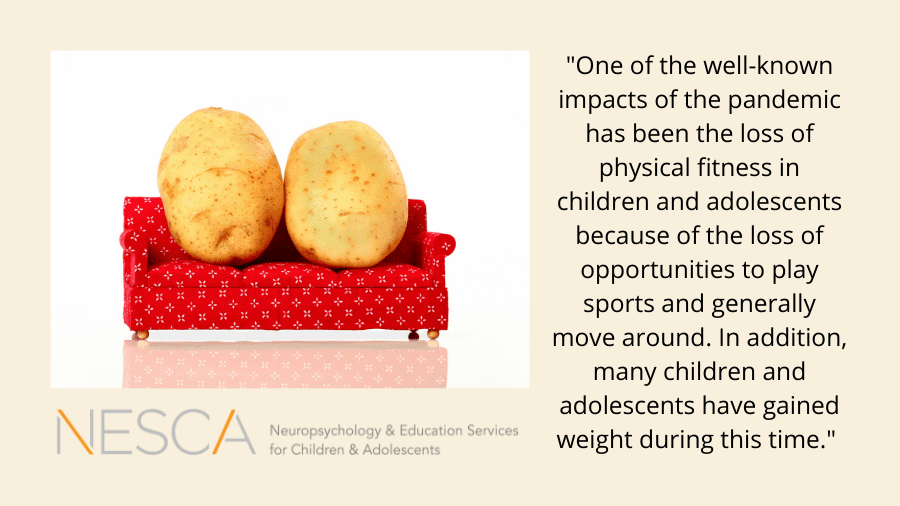
One of the well-known impacts of the pandemic has been the loss of physical fitness in children and adolescents because of the loss of opportunities to play sports and generally move around. In addition, many children and adolescents have gained weight during this time. Maintaining a healthy weight and being physically fit offer many benefits for social-emotional development as well as academic performance. Numerous research studies link physical exercise to significant improvements in the regulation of mood and anxiety as well as attention and executive functioning.
Parents are often at a loss for how to help their child get back into good habits to lose weight, exercise regularly, or get back into a sport. Common parenting approaches, such as offering “helpful suggestions,” encouraging, nagging and bribing usually don’t work for long term—or even short term—positive change. Instead, these approaches often “back fire,” making the child feel even more ashamed or powerless—emotions that are not likely to fuel motivation to change habits.
So how do we support children and adolescents in developing the positive habits that are necessary for maintaining health and fitness? The key lies in empowering the child to determine his or her own goals and establishing their “why” through discussion of why they would like to reach this goal, what they will get by achieving the goal, and, perhaps most important, how they will feel when they reach this goal. This type of motivational interviewing builds internal motivation, which beats external motivators every time in terms of creating long term change.
Once the child or adolescent is clear on what they would like to achieve and why, the next step is determining the behavior changes that will help the child achieve their outlined goal and working with the child to figure out what’s manageable so that success can be ensured. For example, one adolescent might easily commit to a 30-minute daily bike ride, whereas another might want to start with a daily 10-minute walk. Success breeds success, so it is important to set goals that are challenging but also achievable. Throughout this process, the focus is on creating a positive mindset and positive emotional state of empowerment, hopefulness, optimism, and pride.

Some children may be open to this type of process with their parents; however, most adolescents will likely not want to be involved at this level with a parent. NESCA offers health and life coaching, aimed at helping adolescents and young adults with this process. Coaching offers a structured approach to helping an adolescent or young adult define his/her own goals and motivations as well as understanding the obstacles that they have encountered in reaching those goals, which are usually limiting beliefs (e.g., “I can never stick to things.”) or faulty self-identities (e.g., “I’m not athletic.”). The coaching process works through a combination of structured activities as well as a highly supportive personal relationship. To learn more, please join us for a webinar on Thursday, September 23 at 1:00 PM ET, view a previous webinar on this topic on our website or contact Health & Life Coach Billy Demiri for a free 30-minute consultation to determine if health coaching might be helpful for your child.
About the Author
NESCA Founder/Director Ann Helmus, Ph.D. is a licensed clinical  neuropsychologist who has been practicing for almost 20 years. In 1996, she jointly founded the Children’s Evaluation Center (CEC) in Newton, Massachusetts, serving as co-director there for almost ten years. During that time, CEC emerged as a leading regional center for the diagnosis and remediation of both learning disabilities and Autism Spectrum Disorders.
In September of 2007, Dr. Helmus established NESCA (Neuropsychology & Education Services for Children & Adolescents), a client and family-centered group of seasoned neuropsychologists and allied staff, many of whom she trained, striving to create and refine innovative clinical protocols and dedicated to setting new standards of care in the field.
Dr. Helmus specializes in the evaluation of children with learning disabilities, attention and executive function deficits and primary neurological disorders. In addition to assessing children, she also provides consultation and training to both public and private school systems. She frequently makes presentations to groups of parents, particularly on the topics of non-verbal learning disability and executive functioning.
To book an evaluation with Dr. Helmus, NESCA Founder and Director, or one of our many other expert neuropsychologists or therapists, complete NESCA’s online intake form.
Neuropsychology & Education Services for Children & Adolescents (NESCA) is a pediatric neuropsychology practice and integrative treatment center with offices in Newton and Plainville, Massachusetts, as well as Londonderry, New Hampshire. NESCA serves clients from preschool through young adulthood and their families. For more information, please email info@nesca-newton.com or call 617-658-9800.

 and academia for over 30 years. She is a national consultant and speaker on program design and the inclusion of children and adolescents with special needs, especially those diagnosed with Autism Spectrum Disorder (ASD). Prior to joining NESCA, Ms. Lucci was the Principal of the Partners Program/EDCO Collaborative and previously the Program Director and Director of Consultation at MGH/Aspire for 13 years, where she built child, teen and young adult programs and established the 3-Ss (self-awareness, social competency and stress management) as the programming backbone. She also served as director of the Autism Support Center. Ms. Lucci was previously an elementary classroom teacher, special educator, researcher, school psychologist, college professor and director of public schools, a private special education school and an education collaborative.
 Zeitler joined NESCA full-time in the fall of 2020 to offer occupational therapy assessment and treatment for children of all ages, as well as to work in conjunction with Abigael Gray, MS, CCC-SLP, on the feeding team.
 Londonderry, NH office. She specializes in the evaluation of anxious children and teens, working to tease apart the various factors lending to their stress, such as underlying learning, attentional, or emotional challenges. She particularly enjoys working with the seemingly “unmotivated” child, as well as children who have “flown under the radar” for years due to their desire to succeed.


 (Movement Matters, 2020).
 pediatric settings. Maddie received her undergraduate degree in Exercise Science/Kinesiology at The College of Charleston in South Carolina and earned her Doctorate degree in Occupational Therapy from The MGH Institute of Health Professions in Boston.



 unique pattern of strengths and weaknesses to best formulate a plan for intervention and success. With experiences providing therapy and assessments, Dr. Creedon bridges the gap between testing data and therapeutic services to develop a clear roadmap for change and deeper of understanding of individual needs.
Connect with Us