NESCA’s Newton, MA location has immediate availability for neuropsychological evaluations. Our MA clinicians specialize in the following evaluations: Neuropsychological; Autism; and Emotional and Psychological, as well as Academic Achievement and Learning Disability Testing.

Visit www.nesca-newton.com/intake for more information or to book an evaluation.

Subscribe to NESCA Notes

The Intention to Thrive

By | NESCA Notes 2021

By: Ann Helmus, Ph.D.
NESCA Founder/Director

As I reflect on the year that we have all come through, my overwhelming emotion (aside from exhaustion) is pride in the NESCA team for working together in an extraordinary manner under incredibly challenging circumstances. Just before closing the doors at NESCA in mid-March, I wrote to all staff:

NESCA is going to not only survive through this pandemic but we are going to thrive as an organization and show leadership in the special education community. The needs of our clients have not gone away; in fact, they are likely increasing.  School systems are scrambling to meet their obligations for students with special needs. We will continue to do the work we have always done, albeit in a somewhat modified fashion. 

Each of the NESCA staff—clinical and administrative—immediately rose to the occasion to help me realize this vision for navigating the pandemic. We increased the frequency our blog posts and introduced regular webinars, gearing them towards the needs of parents facing the challenges of the pandemic and increased our social media following from 4,000 to more than 40,000 by offering supportive and helpful content. NESCA clinicians offered multiple, free online support groups for parents and professionals related to topics they were now experiencing due to COVID-19. We acknowledged and addressed the unprecedented COVID-19-related concerns and challenges professionals and educators who support those with autism were experiencing through our free Autism Educator Hangouts.

After a great deal of research and discussion about how to conduct evaluations in a manner that ensured the safety of staff and clients while producing valid results, we settled on our “two office model,” renovating our space with plexiglass panes so that clients and clinicians would be able to work together in separate but adjoining offices. We collaborated with Massachusetts Advocates for Children (MAC), Massachusetts Department of Elementary and Secondary Education (DESE), The Federation for Children with Special Needs (FCSN) and the Massachusetts Urban Project, Inc., providing information about assessments and other services during the pandemic.

NESCA grew by adding new staff and service offerings this past year. We welcomed Dr. Moira Creedon to our pediatric neuropsychology staff. Tabitha Monahan, M.A., CRC, and Becki Lauzon, M.A., CRC, both joined NESCA’s Transition Services team. Julie Robinson, OT, joined NESCA in September with three occupational therapists to offer insurance-based, sensory-motor therapy. Abigael Gray, MS, CCC-SLP, also joined at that time to offer insurance-based speech/language and feeding therapy at NESCA. These staff have been incredibly innovative in their use of teletherapy to continue providing services to clients remotely.  And, they and their clients have experienced some surprising benefits stemming from the delivery of services via telehealth. 2020 also saw the introduction of NESCA’s ASD Diagnostic Clinic, helping families to diagnose children with Autism Spectrum Disorder as early as possible so they may gain access to critically important interventions.

Over the last decade, NESCA has had a strong commitment to international work, seeing clients for evaluation and consultation in the NESCA offices as well as abroad. With travel severely limited by the pandemic, we have instituted teletherapy for international work and are pleased to continue to assist  families abroad. NESCA was honored to be a Gold Sponsor for the annual SENIA conference (Special Education Network & Inclusion Association) that was held virtually. I was pleased to present about the differences between testing and assessment with professionals from schools all over Asia.

In the midst of the global pandemic, we continued to do the work that we have always done. We continued to support each other and became even more closely bonded as a team. We contributed to the community. No matter how challenging it has been, we are motivated by the knowledge that children with special needs and their parents need our support now more than ever.


About the Author: 

NESCA Founder/Director Ann Helmus, Ph.D. is a licensed clinical neuropsychologist who has been practicing for almost 20 years. In 1996, she jointly founded the  Children’s Evaluation Center (CEC) in Newton, Massachusetts, serving as co-director there for almost ten years. During that time, CEC emerged as a leading regional center for the diagnosis and remediation of both learning disabilities and Autism Spectrum Disorders.

In September of 2007, Dr. Helmus established NESCA (Neuropsychology & Education Services for Children & Adolescents), a client and family-centered group of seasoned neuropsychologists and allied staff, many of whom she trained, striving to create and refine innovative clinical protocols and dedicated to setting new standards of care in the field.

Dr. Helmus specializes in the evaluation of children with learning disabilities, attention and executive function deficits and primary neurological disorders. In addition to assessing children, she also provides consultation and training to both public and private school systems. She frequently makes presentations to groups of parents, particularly on the topics of non-verbal learning disability and executive functioning.

To book an evaluation with Dr. Helmus, NESCA Founder and Director, or one of our many other expert neuropsychologists or therapists, complete NESCA’s online intake form

Neuropsychology & Education Services for Children & Adolescents (NESCA) is a pediatric neuropsychology practice and integrative treatment center with offices in Newton and Plainville, Massachusetts, as well as Londonderry, New Hampshire. NESCA serves clients from preschool through young adulthood and their families. For more information, please email info@nesca-newton.com or call 617-658-9800.

Approaching 2021 with Ease and Grace

By | NESCA Notes 2021

By Dot Lucci, M.Ed., CAGS

Director of Consultation and Psychoeducational Services, NESCA

I think we are all relieved that 2020 is behind us. All of us experienced a “mental health crisis” of some level of anxiety, depression and fear since March, 2020. As the pandemic spread across our globe, ravaged our lives, took loved ones from us, created economic upheaval, food insecurity and amplified the technological discrepancies that existed within our communities, we adapted and survived…we had to. And the Black Lives Matter movement gained strength also because it had to. From the crisis came opportunity.

Hopefully we learned something about ourselves and each other both across the globe and within our small circles. Now we know the unfathomable and unexpected can and does happen, and it upends our lives like we never expected. What we once thought was important doesn’t seem as important any more. Hopefully, as the months passed in 2020, we settled into the “new normal” and began to develop rhythms and beliefs that sustained us and fed our souls. Let’s hope that we developed a sense of what is truly important and can approach 2021 with new-found hope, resiliency, ease and grace. Approach 2021 by cultivating and remembering the bright spots of this past year, the surprises or treasures of 2020. They may help you think more clearly about 2021.

At the start of a new year, many people make New Year’s resolutions that are long-term goals. Some people manage to keep their resolutions while others aren’t able to sustain the motivation and commitment. Given this past year, it may be difficult to think about resolutions or even conceptualize what the future will look like. Even with vaccines on the horizon, our brains are not ready for long-term planning as our futures may still be a bit unclear. We can hope for a “return to normal,” but what will that “normal” look like?

There is still an uncertainty of what the future holds, so my thinking is to keep it simple. As we start 2021, remember what’s important. If you chose to make New Year’s resolutions, keep them manageable and small. Hopefully what you learned in 2020 can guide your thinking in 2021. Some everyday ideas might be to be kind and gentle with oneself and others. Don’t sweat the small stuff; most of it is small stuff. Smile and laugh every day. Promise yourself to go outside every day and breathe fresh air, be amazed at the glistening snow, the warmth of the sun, the flight of a bird. Take a walk. Three times a day, focus on your breath for at least three minutes. Before going to sleep, think of something to be thankful and grateful for. 2021 can be a year of hope, wonder and faith in a “newer normal” that will emerge, where each of us is responsible for creating a better day, world and a normal that may be even better than the normal of the past.

To everyone, peace, good health and Happy New Year!


About the Author

NESCA’s Director of Consultation and Psychoeducational Services Dot Lucci has been active in the fields of education, psychology, research and academia for over 30 years. She is a national consultant and speaker on program design and the inclusion of children and adolescents with special needs, especially those diagnosed with Autism Spectrum Disorder (ASD). Prior to joining NESCA, Ms. Lucci was the Principal of the Partners Program/EDCO Collaborative and previously the Program Director and Director of Consultation at MGH/Aspire for 13 years, where she built child, teen and young adult programs and established the 3-Ss (self-awareness, social competency and stress management) as the programming backbone. She also served as director of the Autism Support Center. Ms. Lucci was previously an elementary classroom teacher, special educator, researcher, school psychologist, college professor and director of public schools, a private special education school and an education collaborative.

Ms. Lucci directs NESCA’s consultation services to public and private schools, colleges and universities, businesses and community agencies. She also provides psychoeducational counseling directly to students and parents. Ms. Lucci’s clinical interests include mind-body practices, positive psychology, and the use of technology and biofeedback devices in the instruction of social and emotional learning, especially as they apply to neurodiverse individuals.


To book a consultation with Ms. Lucci or one of our many expert neuropsychologists, complete NESCA’s online intake form. Indicate whether you are seeking an “evaluation” or “consultation” and your preferred clinician/consultant in the referral line.


Neuropsychology & Education Services for Children & Adolescents (NESCA) is a pediatric neuropsychology practice and integrative treatment center with offices in Newton, Massachusetts, Plainville, Massachusetts, and Londonderry, New Hampshire, serving clients from preschool through young adulthood and their families. For more information, please email info@nesca-newton.com or call 617-658-9800.


Meet Abigael Gray, NESCA’s Speech-Language Pathologist & Feeding Specialist

By | NESCA Notes 2020

This Fall, NESCA debuted its new feeding, speech and language and direct sensory/motor occupational therapy services. Leading NESCA’s feeding and speech and language therapy is Abigael Gray, MS, CCC-SLP. In today’s blog, we sat down with Abbey to learn about her role as a Feeding Specialist; Speech-Language Pathologist.

What led you to your interest in speech and language and feeding, in particular?

I received an undergraduate degree in psychology from Syracuse University. After graduating, I worked in a preschool for children with autism and developmental delays. This is really what made me interested in speech and language pathology (SLP), since all of the children there were receiving speech-language therapy. While I was working there, I observed quite a bit and decided I wanted to learn and do more in this area. After five years of working there, I enrolled at Emerson College to earn my Master’s in Communications Sciences and Disorders. While there, I discovered that Emerson has a great program for feeding. Many schools don’t have a focus on swallowing and feeding in pediatrics, like Emerson does. I had a placement with one of my professors at her practice in Needham. I eventually took a position with this clinic and received great training in pediatric feeding therapy there during my clinical fellowship. This is where I became passionate about feeding therapy. I eventually moved into a multidisciplinary practice for two more years and then joined the team at NESCA.

Why were you attracted to NESCA?

I saw this as a great opportunity to bring speech-language pathology and feeding therapy to NESCA. I loved the  multidisciplinary aspect to the practice and thought I could strengthen what NESCA already offers by adding feeding and SLP to it. I like how all of the various services are built into one practice right here. Many of the  kids being seen at NESCA can also benefit from the therapies that I offer. Having those services available to parents and children right in the same location is a huge plus for them.

After meeting Ann Helmus, Ph.D., NESCA’s founder and director, I knew that it was the right cultural fit for me, being so collaborative. It also gave me the opportunity to continue to work with Julie Robinson, OT, who oversees this new clinical offering. It’s great to be able to continue with my working relationships with the occupational therapists who also joined when I did. The seamless communication between all of us in the clinical therapy practice makes for really well-rounded therapy for the children we treat as well as more convenient for their parents/caregivers.

What are the most exciting and the most challenging parts of your role?

The most exciting part of my new role at NESCA is being able to offer speech-language and feeding  services in-house. Often the recommendations from neuropsychologists through their assessment is to have some SLP support, whether it’s having to do with reading, writing, social skills, expression or comprehension. Being able to offer that right in the same practice allows for continuity of care among clinicians on behalf of the child. It’s exciting for me because I can go back to the neuropsychologist or other clinician at NESCA who referred the client with any new observations or questions I may have. This makes the process much smoother for the parents and our clinicians. There’s just a lot less “red tape” to go through to be able to communicate and collaborate.

It’s also exciting to build this service offering from the ground up. I can take all of the experiences I have had and knowledge I’ve gained through my years in various positions and make our services our own at NESCA.

As far as challenges go, right now as we build out this new service, I am currently the only SLP on board. While that is the case for now, I have a great network of past colleagues and friends who are SLPs to bounce thoughts off of. Our plan is to have other SLPs join our team as we grow the practice.

What are your clinical interests?

Feeding is my big passion area. Within feeding, I am currently completing a lactation counseling training to become a certified lactation counselor. Babies can struggle with breast feeding, then can have even more difficulties transitioning from the breast to solid foods. I love working with infants and toddlers, and having this certification will round out my knowledge about feeding for this age range.

Within speech, I love working on articulation with kids who have speech sound disorders, phonological disorders and childhood apraxia of speech. Within language, I really enjoy working on social pragmatic communication with kids who are on the higher functioning side of the autism spectrum, or Asperger’s, or those who have social pragmatics difficulties.

I also really enjoy working on early literacy skills, sound letters, identification, rhyming and phonological awareness. When it comes to kids who may be in their older elementary school or early middle school years, I love to work on writing skills with them.

One characteristic among NESCA clinicians is that they are all lifelong learners. In what ways are you a lifelong learner?

I loved that having the curiosity to continue to learn is a draw here at NESCA! That’s really important to me. Right now, I’m currently working my way through three different courses:

  • The lactation counseling certification that I mentioned previously
  • A “Feed the Peds” course, which is a refresher course on feeding therapy with some new approaches in the areas of tethered oral tissues (i.e., tongue ties, lip ties) and how those impact feeding. The course covers how to assess and treat these issues. What’s interesting is that these new approaches are appropriate for people across the lifespan – not just for young children. There is also a module on treating those with medical complexities. Often times, medically complex patients have issues with feeding and/or are tube-fed, and can then go on to have challenges progressing through age-appropriate feeding skills or transitioning off of tube-feeding.
  • The third area I am currently in training for is with orofacial myofunctional disorders, including tethered oral tissues and the impact on speech and feeding. This covers anything that structurally or functionally impairs speech, the airway or feeding. This is a growing area in our field, so it’s important to be current and well-informed on this topic.

How has Covid-19 impacted the way you treat patients and families?

Right now, we are delivering speech-language and feeding therapy via teletherapy. While it’s always great to work with a child and/or family in-person, the plus side of teletherapy is that we get to see the child in their natural home environment as well as how the child communicates with family members. Sometimes, when we see the child in this setting, we can detect and observe a feeding or speech-language issue as the family sees it on a regular basis. It’s also nice to be able to work with parents in their own setting. We can better understand their priorities for therapy since we are talking directly with them. It also allows the child to generalize the skills they would normally learn in the clinic setting right into their home. As therapists, we can see what a typical meal at home looks like, which is obviously a more natural setting than the clinic. We used to have to ask parents to send us videos of mealtimes. Now, it’s like we are at a meal with them over Zoom!

Covid-19 was the catalyst for us to offer teletherapy, which has helped parents who work and have to travel to get to therapy tremendously. They are now able to be more hands-on in the therapy sessions. Also, for some medically complex kids, it’s just hard to get out of the house and drive to therapy. And, parents don’t have to cancel appointments if a sibling is home sick or even quarantining. And, we can stay on track with therapy via telehealth even in inclement weather that makes it challenging to drive to the clinic.

Covid-19 has certainly had its drawbacks, but we’re seeing some of the upsides in teletherapy as well.


About the Author

Abigael Gray has over six years of experience in assessment and treatment of a variety of disorders, including dysphagia, childhood apraxia of speech, speech sound disorder, receptive and expressive language disorder, autism spectrum disorder and attention deficit hyperactivity disorder. She has a special interest and experience in working with children with feeding and swallowing disorders, including transitioning infants to solid foods, weaning from tube feeding, improving sensory tolerance, developing chewing skills, increasing variety and volume of nutritional intake and reducing avoidance behaviors during mealtimes.


If you are interested in learning more about NESCA’s speech-language therapy or feeding therapy, please complete our online intake form, or email NESCA’s Director of Clinical Services Julie Robinson at jrobinson@nesca-newton.com.


Neuropsychology & Education Services for Children & Adolescents (NESCA) is a pediatric neuropsychology practice and integrative treatment center with offices in Newton, Massachusetts, Plainville, Massachusetts, and Londonderry, New Hampshire, serving clients from preschool through young adulthood and their families. For more information, please email info@nesca-newton.com or call 617-658-9800.


Digital Literacy, Executive Function and Remote Learning

By | NESCA Notes 2020

By: Sophie Bellenis, OTD, OTR/L

Occupational Therapist; Real-life Skills Program Manager and Coach, NESCA

The experience of watching a small child who is only two or three years old pick up a smartphone, quickly type in a passcode (as they have memorized the pattern) and open up their favorite game can be jarring for adults who remember the days of dial-up internet and who learned to use technology as it staggeringly evolved. For many of today’s children, handheld electronics have always been a fundamental part of their world. Flipping between apps, using their pointer finger to manipulate games and opening a screen using facial recognition all feel like second nature to many in the current generation of school age children. We assume that children have higher digital literacy than we do and intrinsically understand technology in a way that many of us never will. But what do our children actually know? And, are they missing out on vastly important direct instruction when adults make an assumption that they are already tiny experts in the digital field?

Over the past six months, a time fraught with a monumental shift in education, I have worked one-on-one with a widely diverse group of learners. If I had to pinpoint one theme that comes up over and over, across ages, levels of ability and school systems, it is frustration, confusion and lack of problem-solving strategies as they relate to technology. Statements I have heard during this period of remote learning include:

  • “I don’t turn off my Chromebook. I lose everything, and I’m actually not quite sure that I know how to turn it back on.” – High school honors student
  • “I didn’t know that Google Slide and PowerPoint were different things. I lost so much trying to switch between them.” – High school senior
  • “Hardware or software? I didn’t realize there was a difference.” – Middle school student
  • “I just save my document with whatever my computer suggests as a title. I guess it does make it tricky to find things later.” – High school junior

As an occupational therapist focused on making sure our students can access their curriculum, comments like these teach me a few incredibly important lessons.

  1. Students are lacking information on the basics. The same student who is not sure how to turn off his Chromebook can quickly navigate Google Classroom without any support, both uploading files and opening modules with ease. We need to focus on teaching the fundamentals of technology. What are hardware and software and how to they interact? What options exist within the system preferences of a particular device? How is an iPad different from a Chromebook, a Windows laptop or a MacBook? Why do we need to power down devices sometimes? What are the downsides to never restarting a computer or updating an operating system?
  2. Successful digital organization does not come naturally. Students are typically taught specific systems for organizing physical space and materials, such as color-coded folders, binders and labels. Teaching students to organize their digital space and their digital materials is equally, if not even more, important. Learning to create folders for each class and systematic ways of labeling documents saves students time and energy, and this often decreases frustration in the moment.
  3. Academic and professional tools are not particularly intuitive (a stark contrast to entertainment tools). There are incredible programs designed to help students create presentations, synthesize data and put documents together. These include, but are not limited to, the Microsoft Suite and Google Workspace. These tools can be tricky to manipulate and many middle and high school students would benefit from taking an introductory course, watching online tutorials or working directly with teachers to explore their functionality before layering on assignments requiring competent use of the tools.
  4. Students are often completely unaware of their gaps in knowledge. This is potentially due to the fact that today’s students are so impressive when it comes to using technology for leisure purposes. They seamlessly transition from an iPad, to a Chromebook, to a Samsung phone and can access games or social media without difficulty on each device. Unfortunately, very few schools have programs focused on teaching computing skills or digital literacy in the academic context. Our students piece together enough information to get by for a short while, but often come up against challenges later. Students also may believe they have built competency because they have some exposure to a tool. For instance, I have worked with students who are building resumes and including claims such as, “Proficient in Excel, PowerPoint and Word” but score poorly when tested on these computer abilities.

So, what do can we do?

The first step towards ensuring that a child or adolescent has adequate digital literacy skills is to actually assess how much they already know. Some students do have these skills mastered and others will have unexpected deficits or gaps. This assessment can be done formally or informally. A starting point I often use is to sit down with a student at a computer and ask how they organize, how they navigate, how they save files, etc. I also like using online assessment resources, such as TypingClub.com and Northstar Digital Literacy.

Once the skills that a student needs to grow are identified, there are many opportunities available to teach them. A few options include:

  • Online courses in specific software programs. Sites, such as Coursera, LinkedIn and Udemy, have comprehensive courses focused on specific programs for all different levels of learners.
  • Free online videos. A quick search on YouTube often leads to short, accurate videos and tutorials filmed by teachers or professionals. If your student learns well through video format, these can be a great tool.
  • Ask your school for support. Often, students learn better with direct instruction. If a student’s team is aware of their lack of knowledge regarding technology, there are many professionals at school who may be able to teach these skills during a free period, study hall or meeting.


About the Author

Dr. Sophie Bellenis is a Licensed Occupational Therapist in Massachusetts, specializing in educational OT and functional life skills development. Dr. Bellenis joined NESCA in the fall of 2017 to offer community-based skills coaching services as a part of the Real-life Skills Program within NESCA’s Transition Services team. Dr. Bellenis graduated from the MGH Institute of Health Professions with a Doctorate in Occupational Therapy, with a focus on pediatrics and international program evaluation. She is a member of the American Occupational Therapy Association, as well as the World Federation of Occupational Therapists. Having spent years delivering direct services at the elementary, middle school and high school levels, Dr. Bellenis has extensive background with school-based occupational therapy services.  She believes that individual sensory needs and visual skills must be taken into account to create comprehensive educational programming.


To book an appointment or to learn more about NESCA’s Occupational Therapy Services, please fill out our online Intake Form, email info@nesca-newton.com or call 617-658-9800.


Neuropsychology & Education Services for Children & Adolescents (NESCA) is a pediatric neuropsychology practice and integrative treatment center with offices in Newton, Massachusetts, Plainville, Massachusetts, and Londonderry, New Hampshire, serving clients from preschool through young adulthood and their families. For more information, please email info@nesca-newton.com or call 617-658-9800.


I Can Tell You a Story…I Just Can’t Write It

By | NESCA Notes 2020

By: Alissa Talamo, PhD
Pediatric Neuropsychologist, NESCA

According to understood.org, “Written expression disorder is a learning disability that results in a person having trouble expressing their thoughts in writing… They might have the greatest ideas, but their writing is disorganized and full of grammar and punctuation mistakes.” Experts believe that between 8 and 15 percent of people have a written expression disorder and it often co-occurs with other learning challenges, with two of the most common being dyslexia and attention-deficit/hyperactivity disorder (AD/HD).

Writing is difficult because it depends upon many separate components that need to be integrated into a complex whole. For example, to write well, a person needs to have acquired knowledge about the topic, retrieve needed vocabulary and express the information in a way that can be followed by the reader. At the same time, the writer needs to be able to self-monitor their progress, including switching between the main idea and writing mechanics, such as spelling, punctuation and grammar. People with written expression disorder might be able to tell an organized and interesting story, but struggle when asked to recreate that information in written form. Receiving a formal diagnosis can help a child receive extra help at school or even specialized instruction. Also, a diagnosis can possibly lead to accommodations at college.

There are also several methods of instruction that can help a student organize their writing. These programs help a student visualize or represent abstract ideas by using visually-based templates. While many of these methods are copyrighted and cannot be reproduced in this blog, some examples are programs such as Thinking maps by David Hyerle, Ed.D. or “Brain Frames.” These programs have developed specific graphic organizers to help a student with a variety of writing assignments (e.g., comparing and contrasting, ordering and sequencing) and provide specialized instruction that can help a student greatly improve their ability to express their ideas in writing.

If you believe that your child may be experiencing difficulties in the area of writing, one step is to determine the root of the difficulty. For example, does the student have an underlying learning disability or reduced self-regulation that may be negatively impacting their progress? Receiving a neuropsychological evaluation could be a useful tool in determining the appropriate supports and services to best help your child.

Sources:

https://www.understood.org/en/learning-thinking-differences

http://www.ldonline.org/article/33079/

http://www.thinkingmaps.com

http://www.architectsforlearning.com


About the Author:

With NESCA since its inception in 2007, Dr. Talamo had previously practiced for many years as a child and adolescent clinical psychologist before completing postdoctoral re-training in pediatric neuropsychology at the Children’s Evaluation Center.

After receiving her undergraduate degree from Columbia University, Dr. Talamo earned her doctorate in clinical health psychology from Ferkauf Graduate School of Psychology and the Albert Einstein College of Medicine at Yeshiva University.

She has given a number of presentations, most recently on “How to Recognize a Struggling Reader,” “Supporting Students with Working Memory Limitations,” (with Bonnie Singer, Ph.D., CCC-SLP of Architects for Learning), and “Executive Function in Elementary and Middle School Students.”

Dr. Talamo specializes in working with children and adolescents with language-based learning disabilities including dyslexia, attentional disorders, and emotional issues. She is also interested in working with highly gifted children.

Her professional memberships include MAGE (Massachusetts Association for Gifted Education), IDA (International Dyslexia Association), MABIDA (the Massachusetts division of IDA) and MNS (the Massachusetts Neuropsychological Society).

She is the mother of one teenage girl.


To book a consultation with Dr. Talamo or one of our many other expert neuropsychologists, complete NESCA’s online intake form.

Neuropsychology & Education Services for Children & Adolescents (NESCA) is a pediatric neuropsychology practice and integrative treatment center with offices in Newton, Massachusetts, Plainville, Massachusetts, and Londonderry, New Hampshire, serving clients from preschool through young adulthood and their families. For more information, please email info@nesca-newton.com or call 617-658-9800.

Transition Assessment: What is it anyway? How is it different from neuropsychological evaluation?

By | NESCA Notes 2020

By: Kelley Challen, Ed.M., CAS
Director of Transition Services; Assistant Director, NESCA

If you have a child who receives special education services or work in education, you are likely familiar with the Individuals with Disabilities Education Improvement Act of 2004 (IDEA 2004). This is the law that guarantees students with disabilities the right to free appropriate public education (FAPE) and that dictates that the purpose of special education and related services is to prepare students with disabilities for further education, employment, and independent living.

IDEA 2004 mandates that students have measurable postsecondary goals written in their individualized educational programs (IEPs), that describe the outcomes that a team expects for the student to achieve after exiting public education and that these goals must be “based upon age-appropriate transition assessments related to training, education, employment, and where appropriate, independent living skills.”[1] But, IDEA 2004 does not specifically define transition assessment.

Instead, the best and most commonly accepted definition for transition assessment comes from the Division on Career Development and Transition (DCDT). DCDT defines transition assessment as an “…ongoing process of collecting data on the individual’s needs, preferences, and interests as they relate to the demands of current and future working, educational, living, and personal and social environments.”[2]

Transition assessment can include formal testing, such as a standardized, published tests that compare students to others by age or grade or informal activities, such as interviewing or observing a student. Most students who are transition-aged (i.e., 14 or older in Massachusetts; 16 by federal law) have already had some assessments that will inform their transition planning, such as school evaluations, private evaluations, standardized academic testing, report cards, or even activities that happen within their guidance curriculum (e.g., assessment of strengths, learning style, personality type, career interests). But often, there will still be some testing needed to help better determine a student’s strengths and aptitudes, their preferences and interests for postsecondary adult life, and the gaps between their current knowledge and abilities and the requirements of the living, learning, and working environments in which they plan to function when they exit high school.

At NESCA, transition assessment is a highly individualized process that is designed to get a better sense of a student’s postsecondary living, learning, social, and vocational goals, to determine the strengths the student has that will help them reach those goals as well as the skills a student needs to develop to get there. While it is rare for two students to have the same assessment battery, transition assessment at NESCA often evaluates abilities, such as self-care, self-direction, self-advocacy, career interests, career aptitudes, communication, community use, functional academics, health and safety, domestic skills, leisure, readiness for college or other forms of postsecondary learning and training, transferrable work skills and readiness for employment. Once the student’s profile is understood, specific recommendations, aimed at readying that student for transition from high school to the next phase of life, are provided.

Often parents of transition-aged students are familiar with the term “neuropsychological evaluation“ and a student may have even had this type of private evaluation. But there can be some confusion regarding the difference between these two types of comprehensive testing. Neuropsychological evaluation focuses primarily on a student’s learning profile and the fit of that learner within their current academic setting. A good neuropsychological evaluation is a comprehensive assessment of a child’s functioning in many domains, including communication, visual-spatial ability, problem solving, memory, attention, social skills, and emotional status. The assessment of these functions is based upon information obtained from the child’s history, clinical observations, and testing results. Moreover, one of the most important aspects of a neuropsychological evaluation is the integration of all the information about a child into a meaningful profile of functioning that describes “The Whole Child.”

In contrast, a transition assessment evaluates the fit between a student and their future preferred learning, living, and employment activities and environments. While information from a neuropsychological evaluation about a student’s learning profile is greatly informative, a transition assessment gives equal weight to a student’s daily living skills, social skills, coping skills, pre-vocational skills, career interests and preferences, and self-advocacy skills. While transition assessments provide detailed recommendations related to current educational programming and transition services, a strong focus of transition assessment is an emphasis on what will be needed now, and in the near future, to assist a student in functioning, and, actually being successful and satisfied, in their postsecondary adult life.

For more information about transition assessment at NESCA, visit our transition services page and our transition FAQs.

[1] 34 CFR § 300.320(b)

[2] Division on Career Development and Transition (DCDT) of the Council for Exceptional Children, 1997, p. 70-71


About the Author:

Kelley Challen, Ed.M., CAS, is NESCA’s Director of Transition Services, overseeing planning, consultation, evaluation, coaching, case management, training and program development services. She is also the Assistant Director of NESCA, working under Dr. Ann Helmus to support day-to-day operations of the practice. Ms. Challen began facilitating programs for children and adolescents with special needs in 2004. After receiving her Master’s Degree and Certificate of Advanced Study in Risk and Prevention Counseling from Harvard Graduate School of Education, Ms. Challen spent several years at the MGH Aspire Program where she founded an array of social, life and career skill development programs for teens and young adults with Asperger’s Syndrome and related profiles. She additionally worked at the Northeast Arc as Program Director for the Spotlight Program, a drama-based social pragmatics program, serving youth with a wide range of diagnoses and collaborating with several school districts to design in-house social skills and transition programs. Ms. Challen is co-author of the chapter “Technologies to Support Interventions for Social- Emotional Intelligence, Self-Awareness, Personality Style, and Self-Regulation” for the book Technology Tools for Students with Autism. She is also a proud mother of two energetic boys, ages six and three. While Ms. Challen has special expertise in supporting students with Autism Spectrum Disorders, she provides support to individuals with a wide range of developmental and learning abilities, including students with complex medical needs.

Neuropsychology & Education Services for Children & Adolescents (NESCA) is a pediatric neuropsychology practice and integrative treatment center with offices in Newton, Massachusetts, Plainville, Massachusetts, and Londonderry, New Hampshire, serving clients from preschool through young adulthood and their families. For more information, please email info@nesca-newton.com or call 617-658-9800.

When No One Looks Like Me

By | NESCA Notes 2020

By:  Stephanie Monaghan-Blout, Psy.D.

Coordinator of Therapy Services; Trauma-informed Therapist; Pediatric Neuropsychologist

We form our sense of identity by “trying on” aspects of other people to see how their ideas, tastes and values “fit,” keeping those things that seem to resonate and discarding those that don’t. We find those models for identification in our families, schools and community. We also find those sources in the books we read, the news we catch and the movies we see – the larger community in which we live. This larger community offers many models who may offer something that resonates with us.

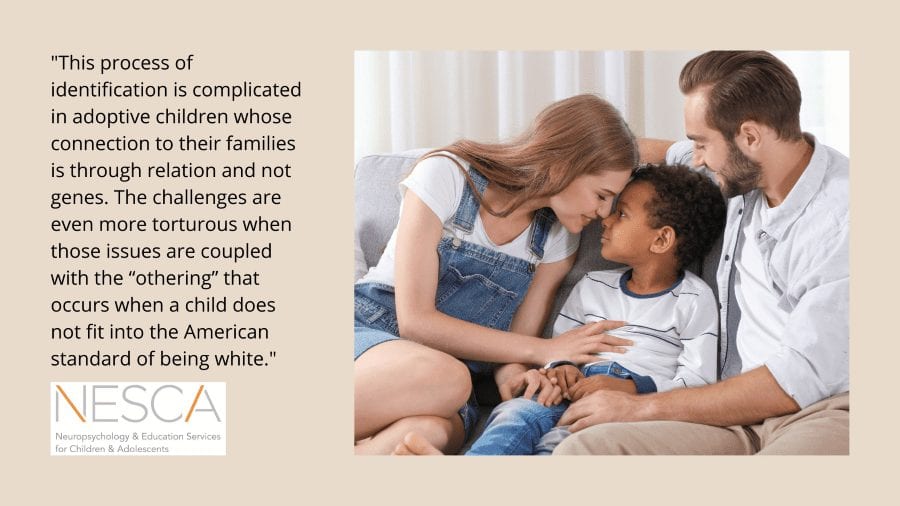
This process of identification is complicated in adoptive children whose connection to their families is through relation and not genes. The challenges are even more torturous when those issues are coupled with the “othering” that occurs when a child does not fit into the American standard of being white. In my neuropsychological practice assessing adoptive children, my own little bubble of white privilege has been pricked many times by a child saying, sometimes to me or sometimes through their parent, that “no one looks like me.” The loneliness of this statement is palpable, but the cost goes beyond to indicate impediments to the healthy development of identity, which includes that of racial identity.

In an article for Time Magazine written by the parent of a transracially adopted child and with the help of adoptees and their parents, the following four “comforting but dangerous” myths about race and difference were identified:

Myth 1: Color doesn’t matter. Oh, but it does; just ask the child who has been called the “N” word or the one who is assumed to be a math whiz because they are Asian. Adopted children who are raised by a Caucasian family and in a Caucasian community will tend to think of themselves as white – sort of – until they hit the wall of the way others perceive them. People have expectations about others based on race and ethnicity and insisting that people “should” be colorblind is ignoring reality. It leaves no room for the child to ask questions about what makes them the person that they are and prevents the parent from giving them what they most need – a caring listener when they are hurt or confused.

Myth 2: If I talk to my kids about race, I’m just creating an issue. As parents, we cannot protect our children from the verbal and physical assaults of others, but we can prepare them for how to handle it if it happens. One adoptee and current adoption advocate asks parents if they would not teach their children how to safely cross a street because they may become frightened of being hit by a car. This includes having “the talk” with our African American boys about how to handle themselves with police officers and other authority figures.

Myth 3: No matter what, a “good” school is best for my child. This is the source of the “No one looks like me” plaint of many of my clients but it is the toughest of all myths to unpack for most white parents to whom education has been touted as pretty much the solution for everything. A “good school” may be the one with high test scores and good real estate value, but it is unlikely to be the school with a diverse student and teacher population that could provide a non-white child with a rich source of role models and narratives to use in the development of their own identity. Other sources of identification include churches, community groups and cultural organizations, such as language schools and adoptive family groups. Lacking these sources, the child’s options for racial identity are determined by those who know nothing about their culture.

Myth 4: You are the hero of your child’s story. As someone who has heard many terrible and tragic origin stories and stood in awe of the efforts adoptive parents have made to help their children, I have often been guilty of encouraging this kind of thinking without considering the consequence to the child who has been rescued. The burden of “forced gratitude” is emotionally crippling and prevents the child from asking questions about their biological parents or fantasizing (in the way that all children do) about what it would have been like to be in a different family. Conversely, the concept of “saving” a child feeds into the parental fantasy that if we just love our child enough and do all the right things, we can protect them from being hurt by the loss of adoption and the ugly reality of racism. This is also an ultimately futile effort. As Martha Crawford, psychotherapist and mother of two transracially adopted children, stated, “An adoptive parent’s job is to be a sturdy scaffold for kids to do their own work, not to tell them how to construct their own identities.”


About the Author:

Dr. Stephanie Monaghan-Blout is a senior clinician who joined NESCA at its inception in 2007. She specializes in the neuropsychological and psychological assessment of children and adolescents with complex learning and emotional issues and enjoys consulting to schools on these issues. Her responsibilities at NESCA also include acting as Clinical Coordinator, overseeing therapeutic services, providing therapy and psychoeducational counseling and, in the time of the COVID-19 crisis, providing teletherapy to parents and teens.

In her early career as an adolescent and family therapist, Dr. Monaghan-Blout became very interested in the needs of those contending with traumatic experiences. She brought that interest to her work as a pediatric neuropsychologist and continues to be passionate about treating this population. She has developed an expertise in working with adoptive children and others who have experienced early trauma. She is a longtime member of the Trauma and Learning Policy Initiative (TLPI) associated with Massachusetts Advocates for Children and the Harvard Law Clinic and presents nationally and regionally on assessment and treatment of children with complex/developmental trauma.

Dr. Monaghan-Blout graduated from Bowdoin College and received a Master’s Degree in Counselor Education from Boston University. She obtained her Doctorate in Clinical Psychology from Antioch New England Graduate School with a dissertation entitled, “A Different Kind of Parent; Resisting the Intergenerational Legacy of Maltreatment.” She completed an internship in pediatric neuropsychology and child psychology at North Shore University Hospital in New York, and a postdoctoral fellowship at HealthSouth/Braintree Rehabilitation Hospital.

She joined Dr. Ann Helmus at Children’s Evaluation Center in 2003, and again at NESCA in 2007. A member of the Massachusetts Neuropsychological Society Board of Directors from 2010 – 2013 and from 2014-2017, Dr. Monaghan-Blout served in many capacities, including as President. Dr. Monaghan-Blout is the mother and stepmother of four children and the grandmother of six. She is also an avid ice hockey player, cook, gardener and devotee of urban fantasy.


To book therapy services with Dr. Monaghan-Blout or an evaluation with one of our many expert neuropsychologists and transition specialists, complete NESCA’s online intake form.


Neuropsychology & Education Services for Children & Adolescents (NESCA) is a pediatric neuropsychology practice and integrative treatment center with offices in Newton, Massachusetts, Plainville, Massachusetts, and Londonderry, New Hampshire, serving clients from preschool through young adulthood and their families. For more information, please email info@nesca-newton.com or call 617-658-9800.

Movement Breaks – Part 2

By | NESCA Notes 2020

By: Julie Robinson, OT

Director of Clinical Services; Occupational Therapist, NESCA

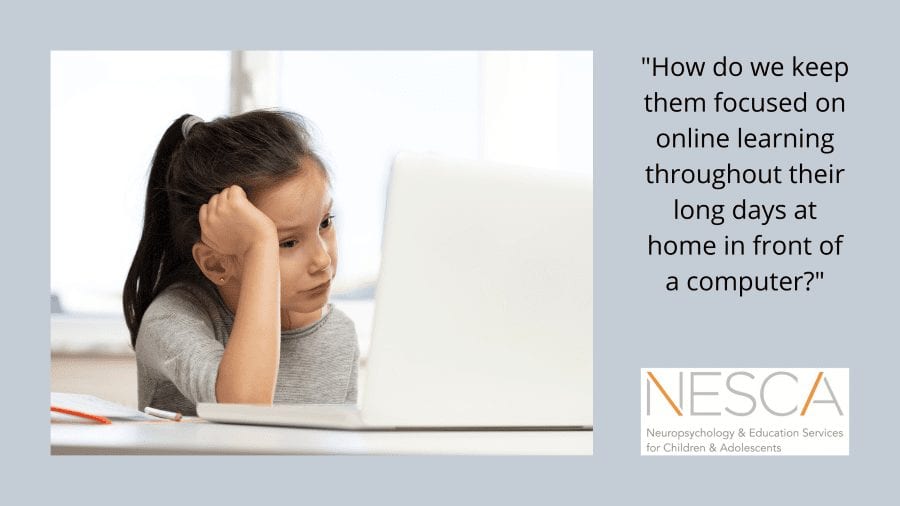
In our last blog, we delved into ideas and suggestions to help preschoolers stay on track with remote and hybrid learning through movement breaks. In this week’s OT Tuesday blog, we move up to our elementary school-aged kids. How do we keep them focused on online learning throughout their long days at home in front of a computer?

Again, here are some suggestions that require minimal equipment, generally using things you can find around your home.


Gross Motor for Elementary-age Children

A movement break for 5- to 10-minutes every hour and a half to 2 hours is recommended.

Hopscotch – Draw with chalk or use painter’s tape and play this old school game! Begin by throwing a beanie baby, rock or bean bag so it lands in the first square. Hop over it and jump on all the other squares. At the end, turn around and come back and try to pick up the object while trying to balance on one foot! The next time, throw the object to square 2 and repeat through all the numbers!


Photo Credit: sciencebuddies.org

Homemade Hockey Sticks – Use a long wrapping paper roll or tape together paper towel rolls as the handle. Cut a long strip of cardboard and tape to the handle or use an old plastic water bottle. Enjoy playing this game with a balloon or tennis ball. Mark goals with tape, chalk or use empty cardboard boxes.


Stack the Cardboard Boxes – Got empty boxes? Have the child stack them up high and knock them over by running into them, or rolling/kicking a soccer ball into them. To make it a little silly, place a tennis ball in the leg of a pair of stockings and the waistband over your child’s head. Use the tennis ball to knock over boxes or cans, with their head upside down.


Photo Credit: Hands On As We Grow®

Stair Bean Bag Toss – Try to get bean bags to land on different steps. More points for the higher they land!


Tic Tac Toe – Make a big board with sidewalk chalk or painter’s tape. Use bean bags, frisbees, paper plates or crumpled up paper and throw into boxes for a fun spin. Get creative with items around the house – even food!


Photo Credit: OT Plan

Belly Catch – Have your child lay on their belly with feet or legs resting on a couch and hands on the floor (plank style). Roll balls or balloons and have them play catch with you, a great exercise to work on core and upper extremity strength.


 Fine Motor for Elementary-age Children

Photo Credit: Hoglets.org

Monster Feet – Grab some old tissue boxes or cardboard and make your own monster feet. Decorate the toe nails with markers, pom poms or however else you’d like! For an added challenge, try wearing them by using string to tie the child’s feet to them. Or tape their shoes to them and walk around like a monster!


Photo Credit: kidsactivitiesblog.com

Homemade Tennis Racquets – Cut slits in a paper plate or punch holes. String yarn through the holes and attach to a paper towel roll, spatula or wooden spoon/popsicle stick. Use it to keep a ball or balloon in the air!


Hangman! – Or for an added twist, play Melting snowman! Draw a snowman, and each time someone guesses a letter incorrectly, erase a part of the snowman until he is fully melted!


Make Your Own Quicksand – Mix roughly equal parts cornstarch and play sand. Add water until it is the desired consistency.

●       If you don’t have play sand, add 1 cup of water to a bowl and slowly add 1-½ cup of cornstarch and stir.

●       Put toys into quicksand and watch them sink!


Paint Pinecones – As the weather gets colder, collect some pine cones or rocks and paint them! Make kindness rocks by writing messages on them with a Sharpie. Leave them out along a wooded trail for others to find.


About the Author

Julie Robinson is an occupational therapist with over 25 years of experience as a clinician. The work Julie does is integral to human development, wellness and a solid family unit. She particularly enjoys supporting families through the process of adoption and in working with children who are victims of trauma. Julie has extensive experience working with children diagnosed with an Autism Spectrum Disorder (ASD), or who have learning or emotional disabilities. She provides services that address Sensory Processing Disorder (SPD) and self-regulation challenges, as well as development of motor and executive functioning skills.

To book an appointment or to learn more about NESCA’s Occupational Therapy Services, please fill out our online Intake Form, email info@nesca-newton.com or call 617-658-9800.


Neuropsychology & Education Services for Children & Adolescents (NESCA) is a pediatric neuropsychology practice and integrative treatment center with offices in Newton, Massachusetts, Plainville, Massachusetts, and Londonderry, New Hampshire, serving clients from preschool through young adulthood and their families. For more information, please email info@nesca-newton.com or call 617-658-9800.


The Holiday Blues Coupled with Covid

By | NESCA Notes 2020

By: Angela Currie, Ph.D.
Pediatric Neuropsychologist, NESCA
Director of Training and New Hampshire Operations

The holidays can be a time of great joy, but they can also be a time of great stress. Celebrations and merriment can be contrasted with pressure to amaze, long to-do lists, financial constraints or reminders of those we have lost. For many, it is a time of mixed emotions or strong internal conflict about why they cannot feel happy during a season that practically dictates it.

Holiday blues have been felt my many people for a long time, but now during a global pandemic, those feelings may be amplified and more prevalent than previous years. Families are trying to provide children with a positive holiday experience during a time of high stress and significant restriction. Family gatherings and holiday traditions are being cancelled, and many families are mourning the loss of loved ones. Adults are not the only ones feeling increased stress as we enter the holiday season. Children likely feel excited about the holiday but sad about not seeing family, not having holiday parties in school, and not being able to attend their traditional holiday events. This holiday season is simply different in ways that can bring great strain.

So, what can we do as adults to emotionally support children this holiday season? Do we allow them to observe our stress or do we keep it to ourselves in an effort to provide them with the happy holiday season that they deserve?

In June 2018, I wrote a blog post titled: “The Struggle is Not only Real, It is Necessary,” which discusses the importance of embracing uncomfortable, unwanted emotions as being necessary for personal growth and resiliency. By acknowledging, accepting and using unwanted feelings in a functional manner, we teach children to be competent and confident in their ability to navigate a stressful world. Of course, when I wrote the article, I could not have imagined the extent or duration of stress or discomfort that we would be facing in 2020. But does that change anything?

To put it simply, no, not really. Entering into the holidays with the expectation that we can protect our children from life’s stress is unrealistic. Attempting to do so will only add pressure while ignoring the mixed emotions that children are likely feeling as well. During this emotionally high-stakes time, acceptance of the struggles we face is even more critical. Adults and children both need “permission” to feel sad, frustrated, lonely or scared while also still allowing themselves to feel excited, thankful, and, yes, even joyful.

Here are some suggestions for how to help your family navigate the holiday blues this unique holiday season:

  • Talk about your feelings – wanted and unwanted ones – throughout the day, modeling and encouraging regular emotional discourse (e.g. “I love giving gifts, but getting all the shopping done is kind of stressful.”).
  • Help children label and interpret the emotions they may be having, as they may not have the right words or language for expressing them (e.g. “It sounds like you’re really disappointed we can’t go to Grandma’s house.”).
  • Be careful to not accidentally dismiss children’s feelings (e.g. “No need to be sad; we will find another fun way to celebrate.”), instead reflecting their emotion (e.g. “I know you’re sad that we can’t have a holiday party; I am, too.”).
  • Normalize the experience of mixed emotions (e.g. It’s okay to be excited for children while also feeling sad that we won’t see our family.).
  • Find new, safe holiday activities or events (e.g. holiday light drive, virtual gift exchange, etc.) and adapt previous traditions when able (e.g. virtual family gatherings).
  • Don’t romanticize the traditions that were lost this year (e.g. avoid such things as, “Our parties were always the most magical part of the holiday.”).
  • Help children understand new holiday plans as an opportunity to “celebrate” or “experience” the holiday, but be careful to not impose emotional expectations (e.g. “Enjoy the holidays!”) that can add pressure.
  • Reassure children that these changes are temporary, and traditions and visits will continue when it is safe to do so.


About the Author

Dr. Angela Currie is a pediatric neuropsychologist at NESCA. She conducts neuropsychological and psychological evaluations out of our Londonderry, NH office. She specializes in the evaluation of anxious children and teens, working to tease apart the various factors lending to their stress, such as underlying learning, attentional, or emotional challenges. She particularly enjoys working with the seemingly “unmotivated” child, as well as children who have “flown under the radar” for years due to their desire to succeed.


To book an evaluation with Dr. Currie or one of our many other expert neuropsychologists, complete NESCA’s online intake form. Indicate whether you are seeking an “evaluation” or “consultation” and your preferred clinician in the referral line.


Neuropsychology & Education Services for Children & Adolescents (NESCA) is a pediatric neuropsychology practice and integrative treatment center with offices in Londonderry, NH, Plainville, MA, and Newton, MA serving clients from preschool through young adulthood and their families. For more information, please email info@nesca-newton.com or call (603) 818-8526.

Transition Planning for Adulthood—It Starts at Birth

By | NESCA Notes 2019


By: Kelley Challen, Ed.M., CAS
Director of Transition Services; Transition Specialist

There are many transitions throughout a person’s life, but as a transition specialist working at a pediatric neuropsychology practice, my focus is most often on helping students who have struggled with learning, social and/or emotional difficulties to plan for and successfully navigate the transition from secondary school to whatever comes next in life (e.g., employment, transition program, community college, apprenticeship, etc.). I focus on helping young people envision their future selves and set short- and long-term goals for themselves—putting them into the driver’s seat for their own lives and helping them manage the risks and responsibilities that come with making choices for themselves.

When a family walks into my office for the first time, it is common for one parent or caretaker to worry aloud that they are starting transition planning for their child “too late.” I consistently respond that it is never too late to start planning and to begin transferring responsibility from one generation to the next. But today, I also want to emphasize that “it’s never too early” to start to plan for your child to be a more independent and competent adult—the best transition planning starts at birth.

Some common examples of transitions that start at a very early age that many parents and caregivers can relate to are: a child sleeping through the night for the first time unsupported, holding a cup and drinking without spilling, feeding oneself with a spoon, and/or riding a bicycle. Each of these activities is an example of a child building competence and independence while their parents simultaneously relinquish some amount of control. Often times, mistakes, messes and even pain are a natural part of the process.

From a young age, there are many skills that children can learn that will make a big difference for them later in life. Some examples include:

  • Picking out clothes for the next morning
  • Putting dirty clothes in a hamper
  • Loading the washing machine
  • Putting clean clothes away in drawers
  • Washing hands before eating, after using the bathroom and after playing outside
  • Setting the table (maybe not plates or glasses, but perhaps napkins, forks and spoons)
  • Carrying dishes to the counter and placing them next to the sink after dinner—or even in the dishwasher
  • Putting their own garbage in the trash
  • Collecting small trash bins to dump into a larger bin/bag on trash day
  • Helping to pack their own lunch
  • Helping to prep a meal (e.g., washing veggies, pouring ingredients, etc.)
  • Getting condiments from the refrigerator and putting them away after dinner
  • Getting a snack for self or a sibling from the refrigerator or pantry
  • Wiping down the table after a meal
  • Feeding/providing water for pets
  • Weeding
  • Raking leaves
  • Shoveling snow
  • Helping to get the mail
  • Brainstorming for/making a shopping list
  • Finding assigned items at the grocery store
  • Carrying light grocery bags
  • Helping to pack belongings for a family trip
  • Making gifts/cards for a celebration
  • Budgeting a few dollars to buy inexpensive but thoughtful gifts for family members

Some of these will apply to your child and some of them will not. And some of these may require adding time to your schedule, allowing a child to complete tasks at their own pace, or doing some household reorganization, allowing a child to access items necessary to complete tasks. Finally, a lot of deep breathing and patience—for both you and your child—will be required!

At any point in time, you can identify a task  you regularly do for your child and consider where there are pieces they can do for themselves. If your only role in the task is to prompt your child, consider whether there might be a low-technology tool (post-it, photograph) or high-technology tool (alarm, phone reminder) that could take the place of your prompt. If you are not sure how to make a change, it may be a good time to get help from a teacher, pediatrician, behavioral therapist, special educator, etc.

The important thing is that you are starting to think about where there is a potential for increasing competence, independence, confidence and self-esteem for your child. You are starting to plan for your own obsolescence in your child’s life, or at least in their carrying out every day self-care activities and chores. While that is a scary thing, it is also a beautiful and empowering thing!

*This blog was originally published in August, 2019.


If you are interested in working with a transition specialist at NESCA for consultation, planning or evaluation, please complete our online intake form: https://nesca-newton.com/intake-form/.


About the Author:

Kelley Challen, Ed.M., CAS, is NESCA’s Director of Transition Services, overseeing planning, consultation, evaluation, coaching, case management, training and program development services. Ms. Challen began facilitating programs for children and adolescents with special needs in 2004. After receiving her Master’s Degree and Certificate of Advanced Study in Risk and Prevention Counseling from Harvard Graduate School of Education, Ms. Challen spent several years at the MGH Aspire Program where she founded an array of social, life and career skill development programs for teens and young adults with Asperger’s Syndrome and related profiles. She additionally worked at the Northeast Arc as Program Director for the Spotlight Program, a drama-based social pragmatics program, serving youth with a wide range of diagnoses and collaborating with several school districts to design in-house social skills and transition programs. Ms. Challen is co-author of the chapter “Technologies to Support Interventions for Social- Emotional Intelligence, Self-Awareness, Personality Style, and Self-Regulation” for the book Technology Tools for Students with Autism. She is also a proud mother of two energetic boys, ages seven and eleven. While Ms. Challen has special expertise in supporting students with Autism Spectrum Disorders, she provides support to individuals with a wide range of developmental and learning abilities, including students with complex medical needs.

Neuropsychology & Education Services for Children & Adolescents (NESCA) is a pediatric neuropsychology practice and integrative treatment center with offices in Newton, Massachusetts, Plainville, Massachusetts, and Londonderry, New Hampshire, serving clients from preschool through young adulthood and their families. For more information, please email info@nesca-newton.com or call 617-658-9800.


Skip to content