
NESCA’s Londonderry, NH location has immediate availability for neuropsychological evaluations. Our NH clinicians specialize in the following evaluations: Neuropsychological; Autism; and Emotional and Psychological, as well as Academic Achievement and Learning Disability Testing. Our NH clinicians also conduct evaluations for students who are at boarding schools, and two of our NH clinicians have PsyPACT authorization, allowing them to conduct evaluations out-of-state.

Visit www.nesca-newton.com/intake for more information or to book an evaluation.

Tag

Dot Lucci Archives - NESCA

Subscribe to NESCA Notes

Image of a sign saying, "You Belong Here."

Is Inclusion Enough?

By | NESCA Notes 2024

Image of a sign saying, "You Belong Here."By Dot Lucci, M.Ed., CAGS
Director of Consultation and Psychoeducational Services, NESCA

In the United States, we have federal and state laws that support individuals with disabilities: The ADA, IDEA, Section 504 of the 1973 Rehabilitation, Chapter 766, Chapter 688, and more. Each of these laws supports the inclusion of individuals with disabilities at school, in employment, and in the community by mandating wheelchair ramps/automatic doors, mainstreaming children with special needs into general education classrooms, assistive technology for an individual at a workplace, and more. We have made many strides in including people with disabilities; yet there is still a long way to go.

In education circles, the word inclusion has effectively replaced the term mainstream. By definition, inclusion means placing students with disabilities in regular or “mainstream” settings along with their “non-disabled” peers, focusing on the “physical integration” of children with disabilities rather than, what was more common at the time – placing them into separate, segregated or “self-contained” settings with other “disabled peers.”

Inclusion embodies a shift from just physical inclusion/integration to a broader definition that promotes equal access and support for all children, creating an environment that promotes the success of every student regardless of ability (Karlsudd, 2017). Inclusion, at its best should offer universally designed environments/curricula, specialized supports, services, accommodations, modifications, and differentiation in instruction, and more, as all students – whether identified as “special needs” or typical – are unique in their learning profiles.

Education lecturer and researcher Gregor Maxwell, 2018, describes in a published article, three perspectives on inclusion. They are:

  • The Compensation Perspective is like the deficit model or medical model which emphasizes a child’s impairment or limitation as the reason for exclusion. It focuses on Identifying the limitation/deficit and remediating it through individualized accommodations and supports that enable the student to be included.
  • The Critical Perspective is comparable to the Social Model of Disability in that it identifies the problem within the broader context of the environment, and the focus is on changing policies, structures, and attitudes about disability and inclusion.
  • The Dilemma Perspective is a critique of the Compensation and Critical Perspectives. It emphasizes that meaningful participation is central to inclusion, and that inclusive practices need to recognize and celebrate the diversity of all children regardless of whether they have a disability or not. Participation is defined as the involvement in life situations with family, same-aged peers, and other community members, and is distinct from inclusion, according to the International Classification of Function, Disability, and Health (ICF) of the World Health Organization.

While individuals with disabilities are being included and participating in schools, in employment settings, and in the community, there still seems to be the lingering question of, “Is inclusion and participation enough?” Do individuals with disabilities feel valued and honored for who they are? Are their strengths being recognized (ideally, the new Massachusetts IEP form should help with this)? Do they feel like they are “one of the gang,” like they belong/fit it and have friends? Having worked in many public schools, I think many students with disabilities are participating in inclusion activities but don’t feel like they belong nor are valued for who they are.

Erik Carter, professor of Special Education at Vanderbilt University, has studied inclusion and belonging for many years. He concludes, “Where we once pursued integration, we now talk about promoting inclusion. But my sense is that both terms fall short of what really matters most. People want to be more than merely integrated or included. They want to experience true belonging.” In more recent years, schools have been focusing on social and emotional learning (SEL), yet many students with and without disabilities still feel isolated and like they don’t fit in/belong. Belonging, feeling valued for who one is and being recognized for one’s strengths, is more significant than inclusion. It is at the very core of who we are as humans; it is a basic need. Let’s help our special needs students feel that they belong. Let’s hope that as the new MA IEP, with its focus on student strengths and participation, will be afford us the opportunity to focus on what truly matters…a sense of belonging for all of our students.

For more information and helpful handouts about Erik Carter’s approach, visit: Progress Center Reflecting on our Practice: Ten Ways Schools Can Foster Belonging Among Students With and Without Disabilities https://promotingprogress.org/sites/default/files/2022-02/Fostering_Belonging_Handout.pdf


Resources

Erik Carter https://www.erikwcarter.com

Karlsudd, P. (2017) The Search for Successful Inclusion. DCID, 28(1), 142-160.

Maxwell, G.R. Granlund, M. & Augustine, L. (2018) Inclusion through participation: Understanding participation in the international classification of functioning, disability, and health as a methodological research tool for investigating inclusion. Frontiers in Education, (3), Article 41, 1- 16.


About the Author

NESCA’s Director of Consultation and Psychoeducational Services Dot Lucci has been active in the fields of education, psychology, research and academia for over 30 years. She is a national consultant and speaker on program design and the inclusion of children and adolescents with special needs, especially those diagnosed with Autism Spectrum Disorder (ASD). Prior to joining NESCA, Ms. Lucci was the Principal of the Partners Program/EDCO Collaborative and previously the Program Director and Director of Consultation at MGH/Aspire for 13 years, where she built child, teen and young adult programs and established the 3-Ss (self-awareness, social competency and stress management) as the programming backbone. She also served as director of the Autism Support Center. Ms. Lucci was previously an elementary classroom teacher, special educator, researcher, school psychologist, college professor and director of public schools, a private special education school and an education collaborative.

Ms. Lucci directs NESCA’s consultation services to public and private schools, colleges and universities, businesses and community agencies. She also provides psychoeducational counseling directly to students and parents. Ms. Lucci’s clinical interests include mind-body practices, positive psychology, and the use of technology and biofeedback devices in the instruction of social and emotional learning, especially as they apply to neurodiverse individuals.

To book a consultation with Ms. Lucci or one of our many expert clinicians, complete NESCA’s online intake form. Indicate whether you are seeking an “evaluation” or “consultation” and your preferred clinician/consultant/service in the referral line.

NESCA is a pediatric neuropsychology and related services practice with offices in Newton, Plainville, and Hingham, Massachusetts; Londonderry, New Hampshire; the greater Burlington, Vermont region; and Coral Gables, Florida, serving clients from infancy through young adulthood and their families. For more information, please email info@nesca-newton.com or call 617-658-9800.
 

Dot Lucci and Dr. Ann Helmus consulting internationally

Advancing Inclusion and Education Internationally

By | NESCA Notes 2025

Dot Lucci and Dr. Ann Helmus consulting internationallyBy Dot Lucci, M.Ed., CAGS
Director of Consultation and Psychoeducational Services, NESCA

Expanding on NESCA’s previous work in the Philippines and other Asian countries, this October, NESCA’s Founder and Director Dr. Ann Helmus and I widened NESCA’s outreach and education around the world, traveling to Central America, specifically Honduras, Nicaragua, El Salvador, and Costa Rica.

During our time in Central America, we presented multiple full-day workshops to various educational

NESCA’s Dot Lucci and Dr. Ann Helmus with a group of Central American Principals at the Association of American Schools of Central America Conference

professional and administrative audiences at the Association of American Schools of Central America conference, the Elementary Principals Conference, and at individual schools. The full-day workshops included information about: the presentations and diagnosis of various conditions, such as ADHD, ASD, SLD, anxiety, etc., how to best serve these students in general education classrooms, and the most current thinking on specific interventions and curriculums.

Along our journey, Dr. Helmus also presented to parents in Nicaragua and Honduras, discussing what exactly makes a high-quality evaluation, what an evaluation should include, and how to integrate all the findings to produce individualized recommendations for students.

On this trip, our consultations consisted of onsite visits that provide professional development, modeling, direct service of instruction/ongoing virtual consultation, and the sharing of resources and tools. We help these teams develop or enhance their programs and systems aimed at supporting students with special needs. While much of this work pertains to educational programming, it also involves expanding the mindsets of some teachers about neurodivergent students, who may require additional time and effort than typically developing students. In our work, we are helping teachers to recognize students’ disabilities, how they present, and how to work with the various challenges while identifying and capitalizing on their strengths.

Consulting internationally allows us to share our knowledge and expertise of neuropsychological assessment and educational practices with schools and families abroad, where resources may be scarce or non-existent. While each country has special education laws pertaining to inclusion, when children struggle in these classrooms, there are unfortunately limited resources for them. Many of these students are expelled and do not receive an education due to aberrant behavior. There are some separate “special education” schools, but these are also limited in their ability to educate neurodivergent children. In all of these countries, the training of teachers in special education is not in-depth, which is why NESCA was there to support their efforts. This work is vital to the improvement of the education of all students and especially those with special needs.

With very few – if any – related service professionals in this region (i.e., neuropsychologists, SLPs, OTs, etc.), many students go without direct services or travel to Miami for evaluations and care during the summer months. Because of the lack of supports in this region, we noticed more clients over the past several years traveling to Boston for evaluations and services. This is one of the reasons NESCA opened an office in Miami, more conveniently offering better supports and services for our Central American clients.

We look forward to continuing this consultation work with schools, organizations, etc., while also making big differences for families on a more individualized level, educating them on how they can support their children.

Our work in international schools and families is rich and rewarding, and is making big differences.


About the Author

NESCA’s Director of Consultation and Psychoeducational Services Dot Lucci has been active in the fields of education, psychology, research and academia for over 30 years. She is a national consultant and speaker on program design and the inclusion of children and adolescents with special needs, especially those diagnosed with Autism Spectrum Disorder (ASD). Prior to joining NESCA, Ms. Lucci was the Principal of the Partners Program/EDCO Collaborative and previously the Program Director and Director of Consultation at MGH/Aspire for 13 years, where she built child, teen and young adult programs and established the 3-Ss (self-awareness, social competency and stress management) as the programming backbone. She also served as director of the Autism Support Center. Ms. Lucci was previously an elementary classroom teacher, special educator, researcher, school psychologist, college professor and director of public schools, a private special education school and an education collaborative.

Ms. Lucci directs NESCA’s consultation services to public and private schools, colleges and universities, businesses and community agencies. She also provides psychoeducational counseling directly to students and parents. Ms. Lucci’s clinical interests include mind-body practices, positive psychology, and the use of technology and biofeedback devices in the instruction of social and emotional learning, especially as they apply to neurodiverse individuals.

To book a consultation with Ms. Lucci or one of our many expert clinicians, complete NESCA’s online intake form. Indicate whether you are seeking an “evaluation” or “consultation” and your preferred clinician/consultant/service in the referral line.

NESCA is a pediatric neuropsychology practice and related services center with offices in Newton, Plainville, and Hingham, Massachusetts; Londonderry, New Hampshire; the greater Burlington, Vermont region; and Coral Gables, Florida, serving clients from infancy through young adulthood and their families. For more information, please email info@nesca-newton.com or call 617-658-9800.
 

Image of a distraught teen on his phone and a quote by Dot Lucci

Do You Know Who Your Teen’s Friends Are?

By | NESCA Notes 2025

Image of a distraught teen on his phone and a quote by Dot LucciBy Dot Lucci, M.Ed., CAGS
Director of Consultation and Psychoeducational Services, NESCA

Artificial Intelligence (AI) is a part of our lives, and we may even be using it ourselves at work, in our cars, and at home. There has been much press about the pros and cons of AI, and it continues to evolve at a rate that our laws can’t keep up with. AI is here to stay and is present in almost all aspects of our lives whether we want it to be or not, or whether we use it deliberately or not. Sometimes, we aren’t even aware of its infiltration into our lives.

So, you’ve heard of AI, but have you heard of character.ai? Do you have an AI companion that keeps you company by chatting with you, helping you with your mental health issues, or brainstorming ideas with you? At this point you may be thinking what is an AI companion? Well, if you are a parent of a teen or young adult or work with teens or young adults, you might want to read on. Many of our teens and young adults have heard of it, and according to Common Sense, it is trending in teens and young adults with 51% having used it at least once; some using it daily as their sole companion (Common Sense, 2024).

Character.ai is an AI tool where you can digitally create a character/persona (avatar) of famous people, historical figures, athletes, politicians, movie characters, anime, gaming worlds, or anyone who’s in your imagination. This is where your ideal friend and companion comes in! Usually, AI characters are positive, supportive, and caring. There are many different AI apps and tools to pick from, such as character.ai, Talkie, CHAI, Replika AI, to name a few. Character.ai differs from regular AI, which is frequently used in professional settings to help create efficiencies in our daily tasks. These character-based tools, however, are built for entertainment, companionship, role playing, storytelling, to play a game with, practice a foreign language, or get feedback and brainstorm different ideas or topics with, etc. These avatars can even be your mental health counselor. You can have a companion/friend at your fingertips who is there to support you at any given moment 24/7 for entertainment or emotional support. In essence, these apps let you talk in real time with whomever you’ve created, and it can carry on realistic conversations based on how you’ve programmed it to “be.”

Character.ai and other similar apps have been trained on large language learning models (LLM) and natural language processing (NLP) as well as deep machine learning (DML), which allows them to create natural, flowing, and engaging conversations. Like all AI, it has been trained on massive amounts of data, and these applications consider context and can predict responses. These apps are programmed to show and sound emotionally concerned. The characters can respond with different tones, word choice, personality traits, and more – all based on what you’ve built into it. Within the privacy settings, you can also have your character be available to others on the platform, so you can essentially create a “community of companions and friends” to engage with. These Ai companions can even talk amongst themselves with you in a group chat and share differing opinions and ideas for you to think about.

Like all digital platforms and apps, there are disclaimers, safety rules, and community guidelines, etc. These AI apps also include disclaimers addressing risks like exposure to hate speech, sexual harassment, self-harm, etc., in their safety rules. However, like all AI and social media, it is not foolproof and can be overlooked or bypassed. Because it is trained with LLM, NLP, and DML, the person who it interacts with it runs the risk of the potential for harmful and inappropriate content being included in its interactions.

Since our legal system has not yet caught up with the rapid-fire developments of the AI space, legal issues have been emerging about the duty of the technology companies to protect the mental health, and the emotional and psychological wellbeing of its users, especially those who are more vulnerable. For younger-aged users, or youth who are naïve, have mental health challenges, have less access to professional counselors, or may be in countries where mental health is not endorsed, this type of AI can have dire consequences if left unchecked. For instance, a mother in Florida filed a lawsuit against character.ai after her teenage son, who was diagnosed with an autism spectrum disorder, took his own life after getting emotionally attached to his character (World Law Group, 2024).

Many users of character.ai and tools with AI chatbots/avatars, allow the characters or avatars to become and serve as their sole friend. Users can develop a strong emotional attachment to their character, which can lead to a dependence and over-reliance on the character. The danger is that some characters may provide inaccurate, harmful, dangerous, or misleading advice, depending on their database, if they are not monitored properly (which many are not), as in the case of the Florida teen. These avatars are only as good as their training, and they are not humans. Needless to say, they are not fully able to understand the complexities of human interactions (and the nuances that come with them) and relationships, particularly in the contexts in which they occur. Becoming more reliant on an AI character can lead to isolation and a decrease in real life social interaction with family and friends. (Science Digest, 2024)

As with all technology, there are advantages and disadvantages to character AI avatars. For many, AI avatars/chatbots can also have positive benefits. For instance, they offer immediate accessibility to a listening ear, a non-judgmental friend, mental health support, and more – all which can quickly turn into cons. They can also be an outlet for creativity, imagination, working out the anxieties of connecting with a person in real life, and helping them practice and try on different ways of interacting.

In the broader context, character AI tools can be used for educational purposes, such as personalizing learning, simulating real-world scenarios, training individuals in various skills, using scientific figures to teach concepts, and more. If used properly, the story-telling and role-playing aspects can be harnessed to create interactive formats.

As with all technology usage, adults should be aware of what teens and young adults are engaged in online. As a parent or caregiver, it is important to stay ahead of this trend and its usage, especially if it is being used as a substitute for human companionship and mental health support. For many young people, the benefits of “having a friend, being seen, heard, and valued” by a chatbot/avatar is better than not having a friend, being seen, heard, and valued in real life. Although there are warnings on all of these platforms that the avatar is not real and that the conversation is computer-generated, it may not matter to the user if it feels real, sounds real, and provides real comfort. For them, it is worth it. This real-time friend, who is non-judgmental, supportive and readily available, is powerful for many teens and young adults.

If you notice a person changing their habits regarding engagement in real life activities, connection with family and friends, retreating/isolating to their room, becoming secretive, or only talking about their AI character, these could all be “red flags.”

Guidelines for Usage of Character-based AI

If you know of a teen who is using character AI, begin by checking in about their app use with a conversation. Approach it with curiosity and openness; not blame and punishment. Ask to see their avatars/characters to see if there is anything potentially harmful about their personalities. Assess whether there is anything beyond their maturity level. Teens and many young adults do not have fully-developed frontal lobes, or critical thinking and decision making skills to use character AI and manage potential harmful content and situations.

Schools are teaching teens about social media, internet safety, privacy, etc.; parents and caregivers must build on what is being taught at school in the home by reviewing the privacy and safety features with their teen/young adult and the reasons they are necessary. Review how they can spot harmful content when they see it, report it, and fully understand the app’s community guidelines.

If you feel the user may not be ready to access character-based AI, use parental controls on their devices, in the app store, and on the internet network to restrict character-based AI access. Just like other social media platforms, there are published guidelines for using character-based AI: don’t upload images of themselves, friends, or family members or recordings of their voices.

As teens become more active with AI and character-based AI, set time limits for its use and where they can use character-based AI (i.e., at the kitchen table), and how they will use it by identifying what function will it serve for them (i.e., practice conversational foreign language). Explain why the boundaries are there and how you want to help them make good decisions about AI usage in general, as it is and will continue to be all around them now and as they move on in life, where they will be making these decisions themselves. Set a good foundation early on.

References


About the Author

NESCA’s Director of Consultation and Psychoeducational Services Dot Lucci has been active in the fields of education, psychology, research and academia for over 30 years. She is a national consultant and speaker on program design and the inclusion of children and adolescents with special needs, especially those diagnosed with Autism Spectrum Disorder (ASD). Prior to joining NESCA, Ms. Lucci was the Principal of the Partners Program/EDCO Collaborative and previously the Program Director and Director of Consultation at MGH/Aspire for 13 years, where she built child, teen and young adult programs and established the 3-Ss (self-awareness, social competency and stress management) as the programming backbone. She also served as director of the Autism Support Center. Ms. Lucci was previously an elementary classroom teacher, special educator, researcher, school psychologist, college professor and director of public schools, a private special education school and an education collaborative.

Ms. Lucci directs NESCA’s consultation services to public and private schools, colleges and universities, businesses and community agencies. She also provides psychoeducational counseling directly to students and parents. Ms. Lucci’s clinical interests include mind-body practices, positive psychology, and the use of technology and biofeedback devices in the instruction of social and emotional learning, especially as they apply to neurodiverse individuals.

To book a consultation with Ms. Lucci or one of our many expert clinicians, complete NESCA’s online intake form. Indicate whether you are seeking an “evaluation” or “consultation” and your preferred clinician/consultant/service in the referral line.

NESCA is a pediatric neuropsychology practice and integrative treatment center with offices in Newton, Plainville, and Hingham, Massachusetts; Londonderry, New Hampshire; the greater Burlington, Vermont region; and Brooklyn, NY, serving clients from infancy through young adulthood and their families. For more information, please email info@nesca-newton.com or call 617-658-9800.


Image of a sign saying, "You Belong Here."

Is Inclusion Enough?

By | NESCA Notes 2024

Image of a sign saying, "You Belong Here."By Dot Lucci, M.Ed., CAGS
Director of Consultation and Psychoeducational Services, NESCA

In the United States, we have federal and state laws that support individuals with disabilities: The ADA, IDEA, Section 504 of the 1973 Rehabilitation, Chapter 766, Chapter 688, and more. Each of these laws supports the inclusion of individuals with disabilities at school, in employment, and in the community by mandating wheelchair ramps/automatic doors, mainstreaming children with special needs into general education classrooms, assistive technology for an individual at a workplace, and more. We have made many strides in including people with disabilities; yet there is still a long way to go.

In education circles, the word inclusion has effectively replaced the term mainstream. By definition, inclusion means placing students with disabilities in regular or “mainstream” settings along with their “non-disabled” peers, focusing on the “physical integration” of children with disabilities rather than, what was more common at the time – placing them into separate, segregated or “self-contained” settings with other “disabled peers.”

Inclusion embodies a shift from just physical inclusion/integration to a broader definition that promotes equal access and support for all children, creating an environment that promotes the success of every student regardless of ability (Karlsudd, 2017). Inclusion, at its best should offer universally designed environments/curricula, specialized supports, services, accommodations, modifications, and differentiation in instruction, and more, as all students – whether identified as “special needs” or typical – are unique in their learning profiles.

Education lecturer and researcher Gregor Maxwell, 2018, describes in a published article, three perspectives on inclusion. They are:

  • The Compensation Perspective is like the deficit model or medical model which emphasizes a child’s impairment or limitation as the reason for exclusion. It focuses on Identifying the limitation/deficit and remediating it through individualized accommodations and supports that enable the student to be included.
  • The Critical Perspective is comparable to the Social Model of Disability in that it identifies the problem within the broader context of the environment, and the focus is on changing policies, structures, and attitudes about disability and inclusion.
  • The Dilemma Perspective is a critique of the Compensation and Critical Perspectives. It emphasizes that meaningful participation is central to inclusion, and that inclusive practices need to recognize and celebrate the diversity of all children regardless of whether they have a disability or not. Participation is defined as the involvement in life situations with family, same-aged peers, and other community members, and is distinct from inclusion, according to the International Classification of Function, Disability, and Health (ICF) of the World Health Organization.

While individuals with disabilities are being included and participating in schools, in employment settings, and in the community, there still seems to be the lingering question of, “Is inclusion and participation enough?” Do individuals with disabilities feel valued and honored for who they are? Are their strengths being recognized (ideally, the new Massachusetts IEP form should help with this)? Do they feel like they are “one of the gang,” like they belong/fit it and have friends? Having worked in many public schools, I think many students with disabilities are participating in inclusion activities but don’t feel like they belong nor are valued for who they are.

Erik Carter, professor of Special Education at Vanderbilt University, has studied inclusion and belonging for many years. He concludes, “Where we once pursued integration, we now talk about promoting inclusion. But my sense is that both terms fall short of what really matters most. People want to be more than merely integrated or included. They want to experience true belonging.” In more recent years, schools have been focusing on social and emotional learning (SEL), yet many students with and without disabilities still feel isolated and like they don’t fit in/belong. Belonging, feeling valued for who one is and being recognized for one’s strengths, is more significant than inclusion. It is at the very core of who we are as humans; it is a basic need. Let’s help our special needs students feel that they belong. Let’s hope that as the new MA IEP, with its focus on student strengths and participation, will be afford us the opportunity to focus on what truly matters…a sense of belonging for all of our students.

For more information and helpful handouts about Erik Carter’s approach, visit: Progress Center Reflecting on our Practice: Ten Ways Schools Can Foster Belonging Among Students With and Without Disabilities https://promotingprogress.org/sites/default/files/2022-02/Fostering_Belonging_Handout.pdf


Resources

Erik Carter https://www.erikwcarter.com

Karlsudd, P. (2017) The Search for Successful Inclusion. DCID, 28(1), 142-160.

Maxwell, G.R. Granlund, M. & Augustine, L. (2018) Inclusion through participation: Understanding participation in the international classification of functioning, disability, and health as a methodological research tool for investigating inclusion. Frontiers in Education, (3), Article 41, 1- 16.


About the Author

NESCA’s Director of Consultation and Psychoeducational Services Dot Lucci has been active in the fields of education, psychology, research and academia for over 30 years. She is a national consultant and speaker on program design and the inclusion of children and adolescents with special needs, especially those diagnosed with Autism Spectrum Disorder (ASD). Prior to joining NESCA, Ms. Lucci was the Principal of the Partners Program/EDCO Collaborative and previously the Program Director and Director of Consultation at MGH/Aspire for 13 years, where she built child, teen and young adult programs and established the 3-Ss (self-awareness, social competency and stress management) as the programming backbone. She also served as director of the Autism Support Center. Ms. Lucci was previously an elementary classroom teacher, special educator, researcher, school psychologist, college professor and director of public schools, a private special education school and an education collaborative.

Ms. Lucci directs NESCA’s consultation services to public and private schools, colleges and universities, businesses and community agencies. She also provides psychoeducational counseling directly to students and parents. Ms. Lucci’s clinical interests include mind-body practices, positive psychology, and the use of technology and biofeedback devices in the instruction of social and emotional learning, especially as they apply to neurodiverse individuals.

To book a consultation with Ms. Lucci or one of our many expert clinicians, complete NESCA’s online intake form. Indicate whether you are seeking an “evaluation” or “consultation” and your preferred clinician/consultant/service in the referral line.

NESCA is a pediatric neuropsychology practice and integrative treatment center with offices in Newton, Plainville, and Hingham, Massachusetts; Londonderry, New Hampshire; the greater Burlington, Vermont region; and Brooklyn, NY, serving clients from infancy through young adulthood and their families. For more information, please email info@nesca-newton.com or call 617-658-9800.


Working to Make Traffic Stops for Autistic Drivers Less Stressful

By | NESCA Notes 2024

By Dot Lucci, M.Ed., CAGS
Director of Consultation and Psychoeducational Services, NESCA

Any driver who has ever cruised down a highway and suddenly sees flashing blue lights and hears the siren of a police car pulling up behind them knows that feeling of panic and dread – that immediate stress response that runs through your body. The internal questioning begins…What did I do wrong?, Was I speeding?, Did I not use my turn signal?, etc. The flight and fight response courses through our body. We pull over and wait while the officer gets out of their car and approaches. We know to keep our hands visible, wait patiently, and wait to be spoken to. These “unwritten rules” may not be specifically taught, but we just know to do them. Now, imagine for a moment that you are autistic and unwritten rules are difficult for you in general – never mind in this stressful situation. This situation is exacerbated in intensity by the very nature of their Autism Spectrum Disorder (ASD) diagnosis, which may lead to the driver experiencing difficulty with communicating, their ability to manage the stress of the situation, interacting as expected socially, and managing the total flooding of their sensory systems. If the driver is a minority and autistic, the stress may be further compounded.

Recently in Massachusetts, The Blue Envelope initiative was unanimously passed by both the House and Senate. This initiative assists autistic drivers in auto accident situations and traffic stops. While it is voluntary for police departments and autistic individuals to participate, the hope is that both groups will avail themselves of this potential to support and be supported in driving situations that arise. It is designed to make experiences like the one outlined above safer, and to ease communication between autistic drivers and police officers. The program began through a collaborative effort among autistic individuals, their parents, and multiple agencies and organizations, including the Massachusetts Chiefs of Police Association, Massachusetts State Police, Advocates for Autism of Massachusetts, and The Arc of Massachusetts.

The Blue Envelope Program is literally based on a blue envelope that autistic drivers keep in their vehicle with their important papers inside (i.e., driver’s license, registration, insurance card, and a contact card). The Blue Envelope isn’t just an ordinary envelope to keep things organized. Rather, it’s meant to be a “life saver and game changer,” as it is specially designed to provide critical communication guidelines and support as well as other important information about ASD. The communication information is printed on the outside of the envelope, thus alerting the officer that they are interacting with an autistic person. Along with general information about ASD, the information in the envelope can be personalized –  since we know that each person’s strengths and challenges are never the same from one individual with autism to the next. Also included on the outside of the envelope are “instructions/guidelines” for the individual. The intent of this program, by alerting officers that they are interacting with an autistic individual, is so they may potentially modify their interaction approach and style; possibly averting the individual becoming escalated, leading to more serious encounter. The Blue Envelope Program is available in many states, including RI, CT, ME, NJ, PA, AZ, and CA. It is currently in use by the Massachusetts State Police and some local communities. The program also includes training for law enforcement officers on how to approach and interact with individuals should they have a Blue Envelope.

The Blue Envelope Program hopes to, “enhance understanding, reduce anxiety, streamline communication and encourage preparedness,” and create a “positive outcome” for all. There are tips for officers that include things like, “use simple, direct language, avoid idioms, be observant, allow drivers longer time to respond, and clearly tell the driver when the stop is done.” If signs of distress are visible, try to reduce sensory inputs (turning off flashlights, sirens, etc.). Tips for drivers include handing the officers the Blue Envelope and telling them you’re autistic, following instructions, and asking for clarification if they do not understand something the officer is saying. The general guidance remains to always keep your hands visible – on the steering wheel; and if you need to reach for anything, tell the officer what you are doing before doing it.

The goal of the Blue Envelope Program is to create an outcome that is safe, respectful, and positive for all parties involved in a traffic stop, whether it be an accident or a traffic violation. Its aim is that autistic drivers will feel safer, calmer, more secure, and less stressed during traffic stops and that the officer training will help them be more aware of whom they are interacting with, be more prepared, exhibit greater empathy, and be more patient when interacting with an autistic driver. It has the potential to be a win-win program for all involved.

If you would like to apply for a Blue Envelope in Massachusetts, visit: https://www.mass.gov/info-details/blue-envelope-program#tips-for-a-safe-traffic-stop-

Additional Resources:


About the Author

NESCA’s Director of Consultation and Psychoeducational Services Dot Lucci has been active in the fields of education, psychology, research and academia for over 30 years. She is a national consultant and speaker on program design and the inclusion of children and adolescents with special needs, especially those diagnosed with Autism Spectrum Disorder (ASD). Prior to joining NESCA, Ms. Lucci was the Principal of the Partners Program/EDCO Collaborative and previously the Program Director and Director of Consultation at MGH/Aspire for 13 years, where she built child, teen and young adult programs and established the 3-Ss (self-awareness, social competency and stress management) as the programming backbone. She also served as director of the Autism Support Center. Ms. Lucci was previously an elementary classroom teacher, special educator, researcher, school psychologist, college professor and director of public schools, a private special education school and an education collaborative.

Ms. Lucci directs NESCA’s consultation services to public and private schools, colleges and universities, businesses and community agencies. She also provides psychoeducational counseling directly to students and parents. Ms. Lucci’s clinical interests include mind-body practices, positive psychology, and the use of technology and biofeedback devices in the instruction of social and emotional learning, especially as they apply to neurodiverse individuals.

To book a consultation with Ms. Lucci or one of our many expert clinicians, complete NESCA’s online intake form. Indicate whether you are seeking an “evaluation” or “consultation” and your preferred clinician/consultant/service in the referral line.

NESCA is a pediatric neuropsychology practice and integrative treatment center with offices in Newton, Plainville, and Hingham, Massachusetts; Londonderry, New Hampshire; the greater Burlington, Vermont region; and Brooklyn, NY, serving clients from infancy through young adulthood and their families. For more information, please email info@nesca-newton.com or call 617-658-9800.


Creating a Kinder, Gentler New Year

By | NESCA Notes 2024

By Dot Lucci, M.Ed., CAGS
Director of Consultation and Psychoeducational Counseling Services, NESCA

We use the start of every new year as motivation to set goals for ourselves, and we often ask children to do the same thing. A New Year’s Resolution is a tradition, in which we set our mind, heart, and spirit to change an undesired trait or behavior, accomplish a personal goal, or otherwise improve ourselves in some tangible way. We may set a goal to lose weigh, exercise more, eat less sugar, meditate daily for five minutes, do homework without a fuss, help out with chores around the house, or walk the dog when my parents ask, etc. Often, we make New Year’s Resolutions, but we don’t usually accomplish them. Within a month or so, we start slipping back into our old ways. Habits are hard to change, and we are resistant to change – it is partly due to our wiring. So, if you are one of these people who has good intentions and sets New Year’s Resolutions then fails, know you are not alone. Hopefully, this fact can help you feel less shame and guilt when you “fail” at keeping them.

I’d like to suggest that if you decide to set a New Year’s Resolution, you do it with yourself and other people in mind. There is so much angst and strife in the world right now that if we resolve to be kinder, gentler, and more patient with ourselves and each other, the world would be a better place.

One idea is to make group resolutions that impact the functioning of the collective. For instance, we could consider Family New Year’s Resolutions or Classroom New Year’s Resolutions. With this in mind, here are some sample suggestions for New Year’s Resolutions for families, classrooms, parents, teachers, and children. Keep your resolution(s) manageable – i.e., only pick one that you are truly committed to working on and putting the energy into changing, as your brain is partly “against you” changing! As they say, “May the Force Be With You!”

General New Year’s Resolutions

  • Sleep – It’s important for everyone, so try to set bedtimes for everyone and stick to them (parents included). Bedtimes should be different depending upon the ages of each child. Getting more sleep may afford us the ability to be more patient with others.
  • Unplug – Take time to unplug from your devices for an hour or more every day. Go for a walk, talk to each other, get the kids involved in preparing the dinner, play a board game. (i.e., take part in old fashioned “family time”). Unplugging affords us the opportunity to be more connected with each other, and being with others (Social Engagement) has been proven to improve one’s quality of life.

For All of Us:

  • Develop patience and compassion when you mess up, as you will mess up.
  • Develop patience and compassion with others because they, too, will mess up.
  • Develop a calming practice if you do not currently have one. Stress happens and is a “silent killer” (i.e., higher blood pressure, poor eating habits, etc.). We have smart watches that can remind us to take a breath…set it to remind yourself. Come back to your breath in moments of stress. Just a few minutes a day mindfully breathing can lower your heart rate and, over time, lower your blood pressure and reduce cortisol (a stress hormone) in your body.
  • Listen more/Talk less.

For Classrooms:

  • Encourage each student to identify one area related to Personal Growth (i.e., ask more questions in class, volunteer to help another classmate, remain calm when challenged academically, etc.). I will ___Settle Down___ when asked by the teacher by the end of the count; show ___Kindness___ to others in my class by___; Ask more questions; volunteer to ___.

For Teachers:

  • Start the New Year off with renewed energy and reimagine equity in your classroom.
  • Talk about fairness – Fair doesn’t mean equal; it means everyone gets what they need to succeed.
  • Talk about school-based stressors/triggers for students (i.e., a certain subject/activity type, tests/quizzes, speaking in front of the class, etc.). Teach them that stress is a normal part of life, then teach them simple stress-reduction techniques (i.e., mindfulness, deep breathing, yoga poses, etc.) they can weave into their day.
  • Teach students about perseverance, grit, and effort and how they are all entwined. Involve students in identifying when they are using them.

For Parents:

  • Self-care – Priority #1 for parents. Just like the airlines say, “Put your own oxygen mask on first.” Define what this means for you and make a plan to stick with it. One small step at a time.
  • “Be Present” with your kids. Often, we are “with” our kids a lot, but are we truly present in mind and body? Usually not; we are doing something else when they are talking to us (i.e., cooking, paying attention to our phones, packing lunches, etc.), so our attention is split. Try taking 10 minutes every day with each of your kids to be truly present in mind and body with your attention solely on them in the moment.
  • Talk with your children about home/life stressors/triggers (i.e., not getting to do what they want, having to do something they don’t want to do, moving from a preferred to non-preferred activity, etc.). Teach them that stress is a normal part of life, then teach them simple stress-reduction techniques (see above) and work together to weave them into the day. Model practicing them yourself!
  • Show gratitude for their words and actions.

Here’s to hoping we are blessed in 2024 with more peace in our hearts and a kinder, gentler, and more compassionate family, classroom, and world!

Resources on these topics:

Keeping Resolutions

Family Resolutions

Stress & the Body

Awesome Year by Kid President


About the Author

NESCA’s Director of Consultation and Psychoeducational Services Dot Lucci has been active in the fields of education, psychology, research and academia for over 30 years. She is a national consultant and speaker on program design and the inclusion of children and adolescents with special needs, especially those diagnosed with Autism Spectrum Disorder (ASD). Prior to joining NESCA, Ms. Lucci was the Principal of the Partners Program/EDCO Collaborative and previously the Program Director and Director of Consultation at MGH/Aspire for 13 years, where she built child, teen and young adult programs and established the 3-Ss (self-awareness, social competency and stress management) as the programming backbone. She also served as director of the Autism Support Center. Ms. Lucci was previously an elementary classroom teacher, special educator, researcher, school psychologist, college professor and director of public schools, a private special education school and an education collaborative.

Ms. Lucci directs NESCA’s consultation services to public and private schools, colleges and universities, businesses and community agencies. She also provides psychoeducational counseling directly to students and parents. Ms. Lucci’s clinical interests include mind-body practices, positive psychology, and the use of technology and biofeedback devices in the instruction of social and emotional learning, especially as they apply to neurodiverse individuals.


To book a consultation with Ms. Lucci or one of our many expert clinicians, complete NESCA’s online intake form. Indicate whether you are seeking an “evaluation” or “consultation” and your preferred clinician/consultant/service in the referral line.


NESCA is a pediatric neuropsychology practice and integrative treatment center with offices in Newton, Plainville, and Hingham, Massachusetts; Londonderry, New Hampshire; and the greater Burlington, Vermont region, serving clients from infancy through young adulthood and their families. For more information, please email info@nesca-newton.com or call 617-658-9800.


On-the-Ground Parent & School Consultation in Honduras

By | Nesca Notes 2023

By Dot Lucci, M.Ed., CAGS
Director of Consultation and Psychoeducational Counseling Services, NESCA

NESCA’s International Work
NESCA is well regarded as an expert in providing neuropsychological evaluations for children and teens from around the globe as part of its International Evaluation program. To date, NESCA has provided evaluations to clients from more than 20 countries across Europe, Asia, Africa, South America, and North America.

Many families bring their child/children to our offices in New England to be evaluated, and NESCA’s founder and director Ann Helmus, Ph.D., has traveled to many countries to provide evaluations overseas. She also has a long-standing history training neuropsychologists in the Philippines. Our Transition and Coaching Services teams also conduct transition assessments for international clients as well as virtual executive function coaching to many young adults overseas.

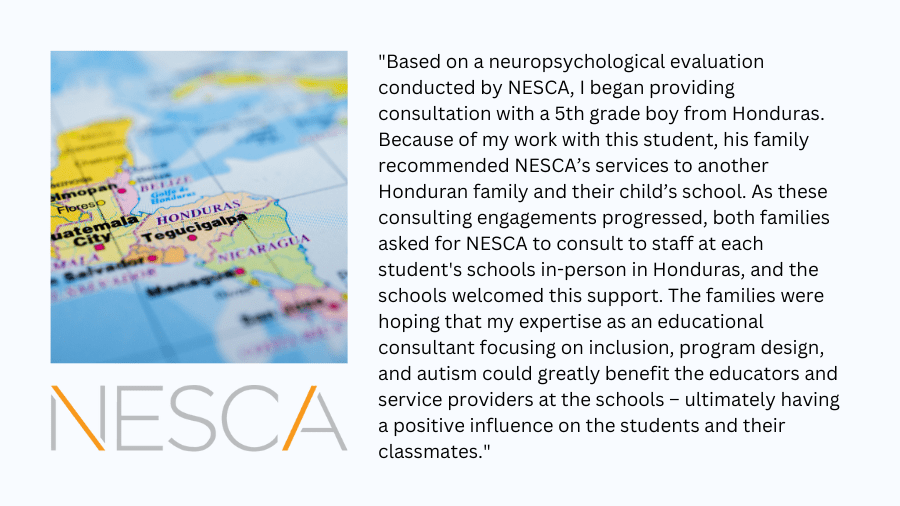
Based on a neuropsychological evaluation conducted by NESCA this past year, I began providing consultation with a 5th grade boy from Honduras who is a student at a non-profit, bilingual, independent, private PK-12 college preparatory school there. Because of my work with this student, his family recommended NESCA’s services to another Honduran family and their child’s school. As a provider, knowing that a family trusts us and finds what we do so beneficial that they recommend us to another family is extremely rewarding.

Setting the Stage: The Special Education Landscape in Honduras
The special education system in Honduras is very different than in the U.S. in that they do not have the variety of resources we are accustomed to in the U.S., and there are not many evaluators in Honduras in any discipline (i.e., neuropsychologists, speech/language, OT, etc.). For instance, there are only six neuropsychologists in the entire country. Another major difference is that it is the parents’ responsibility – not the school’s – to hire a 1:1 paraprofessional or aide if needed for their child. Paraprofessionals function similarly to their U.S. counterparts, but since they are not employed by the school, they are separate from the school.

The special education teachers and counselors also function similarly to those in the U.S.; however, there are unfortunately not enough of them, limiting treatment services. They work from documents similar to IEPs but that are qualitatively are very different from our IEPs.

There are only a couple of special education models used for students: 3 times a week for general special education support or 5 times a week for pull-out reading or math instruction. The 5 times a week options ends at 6th grade. Some of the teachers we worked with reportedly had training in Wilson and Orton-Gillingham, but there are no SLPs or OTs at the schools, and families pay for these services to be provided at the school or after school. Since there are so few professional service providers in the country, these interventions are extremely limited.

Parent & School Consultation in Honduras
As these consulting engagements progressed, both families asked for NESCA to consult to staff at each of the student’s schools in-person in Honduras, and the schools welcomed this support. The families were hoping that my expertise as an educational consultant focusing on inclusion, program design, and autism could greatly benefit the educators and service providers at the schools – ultimately having a positive influence on the students and their classmates.

Both schools are international, bilingual, non-profit, tuition-based college preparatory schools, and are accredited by the Honduran National Ministry of Education, AdvancED, and the International Baccalaureate Organization. One is a Christian faith-based school. Both serve students from nursery through high school and use N-12 American standards of Core Curriculum. They are similar to American schools in that they have a wide choice of classes/electives as students move up in the grades, as well as sports and after school clubs and activities. Upon completion of their high school careers, students at these schools have the opportunity to earn three diplomas: each school’s typical high school diploma, the Honduran Bachillerato, and the International Baccalaureate diploma. A high percentage of graduates go on to higher education in the United States and abroad. They accept students with a variety of “moderate” special needs and have special education teachers and mental health counselors to support them.

For these in-person school consults, I teamed up with another professional who was also already consulting at these schools. She is a Board Certified Behavior Analyst (BCBA) and speaks Spanish – a welcomed addition, as I do not. She is very skilled at providing behavioral support and is not overly rigid in her approach with students. Together, we presented Professional Development trainings for the two schools on the ground in Honduras. We brought a combined, well-rounded knowledge base to our work with the families and schools, offering lessons in a variety of topics, such as Universal Design in Learning (UDL), Differentiated Instruction (DI), Social Skills training/approaches, Mindset and Mindfulness, Sensory Integration, and Positive Behavioral Intervention and Supports (PBIS), along with the ABCs (antecedent-behavior-consequence) and functions of behavior (EATS: escape-attention-tangible-sensory). In this first engagement, we provided a broad overview of these topics, giving the staff much to think about regarding their instructional practices, behavior management, classroom design, and teaching styles. We will continue to provide both virtual and in-person consults this coming school year so their learning can continue to grow and deepen.

This is an ongoing training/learning process for the staff at these schools. As mentioned, we will continue providing ongoing training to help the staff implement Universal Design principles in developing their lessons. We will continue our discussion about viewing student aberrant behavior through multiple lenses – not just as “breaking the rules and needing consequences” (i.e., neurology-sensory, cognitive disconnect, attention, etc.), instead thinking about what the student is trying to communicate through their behavior. This education helps them to think differently about prevention and antecedents, thus impacting behavior management and discipline practices.

The Experience
Staff at both schools were willing to learn and collaborate, and welcomed our input, with one school attending the training the week before their school year started, because we were scheduled to be in-person! The Honduran teachers we worked with throughout the year, prior to our in-person visit, were so open to instruction, feedback, and learning more, often reaching out to us between our scheduled virtual meetings preceding our visit. They were eager to figure out how to support their neurodiverse (a new word for them) learners and allowed me to join their classes remotely so I could model different techniques and practices. They were willing to share their successes, questions, and challenges, making consultation both productive and powerful. They were open to the many “homework assignments” (i.e., articles/books to read, videos to watch, visuals to make, etc.) given to them and the recommendations provided. They implemented new class-wide and individual behavior plans (self-awareness plans) and benefited from the modeling of strategies I demonastrated.

It was a wonderful experience for them and us, and I am happy that our relationship is continuing and will deepen well into this new school year. I am looking forward to watching their continued growth – directly impacting the two students who started it all, as well as their classmates and those to come in future years.

If you are interested in learning more about NESCA’s international evaluation, transition, consultation, and coaching services, complete our online Intake Form.


About the Author

NESCA’s Director of Consultation and Psychoeducational Services Dot Lucci has been active in the fields of education, psychology, research and academia for over 30 years. She is a national consultant and speaker on program design and the inclusion of children and adolescents with special needs, especially those diagnosed with Autism Spectrum Disorder (ASD). Prior to joining NESCA, Ms. Lucci was the Principal of the Partners Program/EDCO Collaborative and previously the Program Director and Director of Consultation at MGH/Aspire for 13 years, where she built child, teen and young adult programs and established the 3-Ss (self-awareness, social competency and stress management) as the programming backbone. She also served as director of the Autism Support Center. Ms. Lucci was previously an elementary classroom teacher, special educator, researcher, school psychologist, college professor and director of public schools, a private special education school and an education collaborative.

Ms. Lucci directs NESCA’s consultation services to public and private schools, colleges and universities, businesses and community agencies. She also provides psychoeducational counseling directly to students and parents. Ms. Lucci’s clinical interests include mind-body practices, positive psychology, and the use of technology and biofeedback devices in the instruction of social and emotional learning, especially as they apply to neurodiverse individuals.


To book a consultation with Ms. Lucci or one of our many expert clinicians, complete NESCA’s online intake form. Indicate whether you are seeking an “evaluation” or “consultation” and your preferred clinician/consultant/service in the referral line.


NESCA is a pediatric neuropsychology practice and integrative treatment center with offices in Newton and Plainville, Massachusetts, Londonderry, New Hampshire, and Burlington, Vermont, serving clients from preschool through young adulthood and their families. For more information, please email info@nesca-newton.com or call 617-658-9800.


Self-efficacy: An Important Characteristic to Develop in Children

By | Nesca Notes 2023

By Dot Lucci, M.Ed., CAGS
Director of Consultation and Psychoeducational Counseling Services, NESCA

We often talk a lot about wanting our children to have good self-esteem. There’s nothing wrong with good self-esteem; it means that a child has a positive view of themselves and their worth. However, self-esteem is not enough. Life has its challenges, failure being one of them. How are we helping children to pick themselves up and try again? If our children are lagging in this ability, we need to help them develop realistic self-efficacy.

Self-efficacy and self-esteem are related but are also qualitatively different. Self-efficacy is related to how you feel about your ability to succeed in different contexts. It is more specific and context-driven versus self-esteem. Is your child capable of preserving at performing a difficult task? Do they stay engaged and try again, or do they give up? Self-esteem is considered a global belief about oneself, whereas, according to psychologist Albert Bandura, self-efficacy is “the belief in one’s capabilities to organize and execute the courses of action required to manage prospective situations.”

A child with high self-efficacy believes their challenges are obstacles to overcome. Failures don’t immobilize them. Their inner voice says, “I’ve got this!” They may demonstrate good self-awareness by knowing their strengths and challenges, thus setting manageable goals and achieving success because the goals are indeed attainable. Their motivation to try difficult tasks is buoyed by a positive thinking style and an inner belief system that recognizes failure as a part of life. So, when they fail at something, their self-esteem remains intact. They don’t “beat themselves up” when they make a mistake. They recognize it as a part of learning. As they say, “they get back in the saddle.” Children with good self-efficacy have better self-regulation, utilize a growth mindset, and have a stronger sense of agency and mastery. As Henry Ford said, “Whether you think you can, or you think you can’t–you’re right.”

Children with poor self-efficacy often shy away from work that they failed at or with tasks that they perceive as difficult. They tend to believe that these tasks are beyond their capabilities, so they shy away from even trying to do them. Children with low self-efficacy often berate themselves when they make a mistake, lose confidence in themselves, and their self-esteem suffers.

Helping children develop self-efficacy is important to their overall social-emotional functioning and well-being. The earlier we start helping to develop self-efficacy in our children, the better off they will be at improving their self-efficacy independently throughout their lives. Bandura identified four influencers or sources that impact self-efficacy: performance experience, vicarious experience, social persuasion, and physical and emotional states. Using these as our guideposts when teaching our children enhances their development of self-efficacy.

Performance Experience refers to when we perform a task successfully, it strengthens our sense of self-efficacy. This can also be called Mastery Experiences. We feel good about ourselves, our skills, and our knowledge; however, the converse is true as well. Failing to perform a task well will further weaken self-efficacy, particularly if it was not strong to begin with. Thus, it is important to emphasize and normalize the concept that failure is a part of the learning process.

When we watch others who are like us succeed by persevering at and completing a difficult task, it can raise the observers’ beliefs that they, too, can achieve it. This is Vicarious Experience or Social Modeling. By watching another person succeed through dedication, a person can be inspired to achieve the goals they set for themselves.

Another way to improve self-efficacy is through Social Persuasion. It is just as it sounds – someone you trust as a credible source giving verbal encouragement about your ability to perform a task can have a positive impact on one’s self-efficacy, becoming a self-fulfilling prophecy.

The last influencer, Our Own Personal Physical Sensations, Moods, Emotional Reactions, and Stress Level, etc., can dramatically…and positively or negatively impact how a person feels about their skills and abilities to complete a task. Bandura, highlighted, “it is not the sheer intensity of the emotional and physical reactions that is important but how they are perceived and interpreted by the person.” If we can acknowledge the stress and minimize it when we are confronted with a challenging task, we can improve self-efficacy. These are all important ways to help facilitate a child’s development of self-efficacy.

Facilitating the development of self-efficacy in our children can be done through a variety of means, keeping Bandura’s four influencers in mind. Here are some approaches to consider:

  • Keep in mind Bandura’s four self-efficacy influencer types as your guideposts.
  • Model self-efficacy and point it out to your children. Share your struggles/set-backs and how you managed to persevere. Talk about how you are willing to work towards a goal even though you failed multiple times along the way. Typically, parents do it without even knowing it.
  • Help children develop realistic self-efficacy by praising them honestly and concretely. Praise their effort, not their ability. Help them recognize failure is a part of life and learning.
  • Preview new learning by saying something like, “Remember you’re learning ___. You might make some mistakes. It’s okay. Mistakes are a part of learning.”
  • Use failures to help build realistic expectations and self-confidence by pointing out growth from previous attempts. Help children learn from their set-backs.
  • Empathize with their emotions related to their failures, struggles, etc.
  • Name their strengths and challenges, and use them as jumping off points related to their effort, not ability.
  • Help children set “realistic” short-term goals and help them stay on track. Help children recognize that their achievements are related to internal strengths, skills, and thoughts – not on external factors (i.e., I learned that hook shot because I practiced, watched and analyzed videos, and listened to my coach, etc.).
  • Create opportunities that are within “their zone of proximal development” (i.e., just right learning level – not too hard or too easy). To help build self-efficacy, a child needs a difficulty level to hold their interest, feel challenged, and experience some amount of struggle while ultimately achieving success.

Self-efficacy is worth paying attention to as it is truly one of the best gifts we can instill in our children. As Mahatma Gandhi said, “If I have the belief that I can do it, I shall surely acquire the capacity to do it even if I may not have it at the beginning.”

References

Bandura, A. 1999. Self-efficacy in Changing Societies. Cambridge Univ. Press, UK.

Self-Efficacy: Helping Children Believe They Can Succeed https://www.forsyth.k12.ga.us/cms/lib3/ga01000373/centricity/domain/31/self-efficacy_helping_children_believe_they_can_suceed.pdf

If You Think You Can’t… Think Again: The Sway of Self-Efficacy https://www.psychologytoday.com/intl/blog/flourish/201002/if-you-think-you-can-t-think-again-the-sway-self-efficacy


About the Author

NESCA’s Director of Consultation and Psychoeducational Services Dot Lucci has been active in the fields of education, psychology, research and academia for over 30 years. She is a national consultant and speaker on program design and the inclusion of children and adolescents with special needs, especially those diagnosed with Autism Spectrum Disorder (ASD). Prior to joining NESCA, Ms. Lucci was the Principal of the Partners Program/EDCO Collaborative and previously the Program Director and Director of Consultation at MGH/Aspire for 13 years, where she built child, teen and young adult programs and established the 3-Ss (self-awareness, social competency and stress management) as the programming backbone. She also served as director of the Autism Support Center. Ms. Lucci was previously an elementary classroom teacher, special educator, researcher, school psychologist, college professor and director of public schools, a private special education school and an education collaborative.

Ms. Lucci directs NESCA’s consultation services to public and private schools, colleges and universities, businesses and community agencies. She also provides psychoeducational counseling directly to students and parents. Ms. Lucci’s clinical interests include mind-body practices, positive psychology, and the use of technology and biofeedback devices in the instruction of social and emotional learning, especially as they apply to neurodiverse individuals.


To book a consultation with Ms. Lucci or one of our many expert clinicians, complete NESCA’s online intake form. Indicate whether you are seeking an “evaluation” or “consultation” and your preferred clinician/consultant/service in the referral line.


NESCA is a pediatric neuropsychology practice and integrative treatment center with offices in Newton and Plainville, Massachusetts, Londonderry, New Hampshire, and Burlington, Vermont, serving clients from preschool through young adulthood and their families. For more information, please email info@nesca-newton.com or call 617-658-9800.


Technology to Relieve Holiday Stress – Really?

By | NESCA Notes 2022

By Dot Lucci, M.Ed., CAGS
Director of Consultation and Psychoeducational Counseling Services, NESCA

During this holiday season, life for most people gets a bit more hectic. Many of us feel more stressed, busy, and overwhelmed with everyday life as well as preparing for the holidays. Our children are stressed as well, as they feel our stress. Older students feel the end of semester stress of papers being due and final exams looming.

A client, who is a college student, called me the other day and said, “I am just so stressed and angry, I couldn’t wait ‘til my appointment. I am angry at nothing and everything. I am being hard on myself and others.” I reflected on these feelings, and we discussed that, at this time of year, many people feel more stress and have a “shorter fuse.” I reminded him that being angry at himself for being angry wasn’t the solution/remedy; that just intensifies the feeling. Instead, we talked about normalizing his feelings, remembering to focus on his breath, and have compassion. When we focus on our breath, we shift our attention away from the thoughts and feelings that make us spiral. This client plays video games, so introducing him to stress management apps/games was a “no brainer.” I reminded him to use the app at least once a day for a few minutes, especially during this holiday season. This practice helps him and can help all of us to establish a new habit of stress reduction to help us remember how to focus on our breath and shift our attention.

Since most adults and children are using technology daily, let’s focus on spending some of that screen time for managing our mental health and stress levels. Experiment with free versions of apps and find one that resonates with you or your children, then practice it every day. Make it a part of your daily routine for at least 5 minutes. Pick the time that works for you. It is something that can even be done as a family. We establish routines for reading at night, let’s establish a routine of stress management at night, whether it’s an app or another method. Prioritize the time; it will make all your lives better! This habit and skill development will ultimately help us develop stress management skills and be able to use them when we are stressed. The development of these skills also helps us feel less stressed in general. Instead of feeling stress during the holidays, let’s feel the joy, love, and gratitude that abounds.

Listed below are a sampling of several stress management apps related to mindfulness, emotional recognition and regulation, and anxiety/depression to help you and/or your children manage the stress of the upcoming holiday season. Hopefully one of them will resonate with you and your children so that you all may experience more resilience and peace when stress does happen.

Headspace (Children through Adult) is a mindfulness/meditation app that helps people reconnect with their breath. Headspace for Kids focuses on five areas: Calm, Focus, Kindness, Sleep, and Wake Up.

Calm (Children through Adult) is an app that focuses on mindfulness, yoga, guided meditation, breathing programs, improving focus, calming and relaxing music, and more.

Insight Timer (Children through Adult) is an app that includes lessons/classes, talks, music, and more on a variety of topics, such as mindfulness, stress reduction, achieving better sleep, anxiety, yoga, and other areas.

Super Better (Age 13 through Adult) is an app that uses games to build resilience, change mindset, emotional control, mental flexibility, achieve goals – even with challenges – and helps with anxiety, depression, chronic pain, and more.

Mindshift CBT (Teens through Adult) is an app that focuses on anxiety reduction, including worry, perfectionism, social anxiety, panic, phobias, and more.

Breathe2Relax (Teens through Adult) is an app that focuses on diaphragmatic breathing and stress reduction.

Smiling Mind  (Ages 7 through 18) is part of a broader collection of tools/curriculum that focuses on mental health for children and adults (teachers and parent). It focuses on mindfulness, deep breathing, body scan, gratitude, and more.

Positive Penguins (Ages 4 through 11) is an app that helps children understand how their feelings and thoughts are connected and to develop more positive thinking.

Resilient Family, Happy Child (Ages 4 through Adult) is an app that uses simple mindfulness- based movement to support the development of resilience and self-regulation.

Mightier (Ages 6 through 14) is a biofeedback tool that uses a heart sensor to help children understand their emotions and teaches them calming strategies.

HeartMath (Ages PreK through Adult) is a company that has many tools, games, music, curriculum, books, and more that focu on stress reduction. They have biofeedback apps and desktop computer versions for single users, classes, or multiple clients. They all use a heart sensor. Inner Balance is the app it uses within the program.

DreamyKid (Ages 9 through 18) is an app that uses guided visualizations, meditations, and affirmations related to mindfulness.

WellBeyond Meditation for Kids (Ages 4 through 8) is like DreamyKid but is geared towards younger kids with guided meditations, visualizations, and breathing exercises.

Breathe Think Do Sesame (Ages 2 through 5) is an app that helps children learn deep breathing, problem solving, an emotional vocabulary, positive thinking habits, and more through guided meditations, visualizations, stories, breathing exercises, and more.

Mindful Powers for Kids (Ages 5 through 10) Through play, games, stories, and more, kids learn about emotions, mindfulness, positive thinking, body scanning, and more. It uses Acceptance and Commitment Therapy (ACT) as a guiding principle of its platform.


About the Author

NESCA’s Director of Consultation and Psychoeducational Services Dot Lucci has been active in the fields of education, psychology, research and academia for over 30 years. She is a national consultant and speaker on program design and the inclusion of children and adolescents with special needs, especially those diagnosed with Autism Spectrum Disorder (ASD). Prior to joining NESCA, Ms. Lucci was the Principal of the Partners Program/EDCO Collaborative and previously the Program Director and Director of Consultation at MGH/Aspire for 13 years, where she built child, teen and young adult programs and established the 3-Ss (self-awareness, social competency and stress management) as the programming backbone. She also served as director of the Autism Support Center. Ms. Lucci was previously an elementary classroom teacher, special educator, researcher, school psychologist, college professor and director of public schools, a private special education school and an education collaborative.

Ms. Lucci directs NESCA’s consultation services to public and private schools, colleges and universities, businesses and community agencies. She also provides psychoeducational counseling directly to students and parents. Ms. Lucci’s clinical interests include mind-body practices, positive psychology, and the use of technology and biofeedback devices in the instruction of social and emotional learning, especially as they apply to neurodiverse individuals.


To book a consultation with Ms. Lucci or one of our many expert clinicians, complete NESCA’s online intake form. Indicate whether you are seeking an “evaluation” or “consultation” and your preferred clinician/consultant/service in the referral line.


Neuropsychology & Education Services for Children & Adolescents (NESCA) is a pediatric neuropsychology practice and integrative treatment center with offices in Newton, Massachusetts, Plainville, Massachusetts, and Londonderry, New Hampshire, serving clients from preschool through young adulthood and their families. For more information, please email info@nesca-newton.com or call 617-658-9800.
 

Parenting is a Hard Job – Remember You are Good Enough!

By | NESCA Notes 2022

By Dot Lucci, M.Ed., CAGS
Director of Consultation and Psychoeducational Counseling Services, NESCA

Much has been published about parenting and parenting styles, whether in YouTube clips, books, podcasts, scholarly articles, newspaper articles, and so much more. But basically, if you are a parent, you are just doing your job – you are parenting, trying to guide your children, teens, and young adults on their own paths so they grow up to be “good humans and lead happy, successful lives.”

My guess is you probably haven’t given your parenting style too much thought. You just go about whatever the day brings you with whatever you’ve got in your tank that day. You’ve probably heard the terms Helicopter Parents, Tiger Moms, Free-range Parenting, etc., to describe different parenting styles. Usually, our parenting styles emerge from our own histories, role models, experiences, and personalities. You may be parenting how you were parented because it worked for you or because you disliked the way you were parented so you moved to the complete opposite way of parenting.

Remember the book, “Battle Hymn of The Tiger Mother,” by Amy Chua from 2011? She wrote this book as a memoir – not as a parenting guide – but what a controversy it stirred regarding parenting styles! Alan Paul, a journalist for The Wall Street Journal then wrote, “Tiger Mom…Meet Panda Dad,” as a commentary against the Tiger Mom mentality and to bring dads into the parenting discussion. During this time period, there was much written about parenting styles, often characterized into four styles: Authoritative, Authoritarian/Disciplinarian, Permissive/Indulgent, and Uninvolved/Neglectful. As you can imagine, each style has its driving principles. In case you are interested in what the research says about the four parenting styles, the Authoritative parenting style wins out over the others in helping children develop into well-functioning adults.

No matter what style you are, you are giving it your best shot. Each of the styles has much written about them and their impact on child development – some good some not so good. Parents may change their style(s) depending upon a variety of factors and adopt new ways. Try to be aware of your style and its impact on your kids – this realization may happen as you go. That’s okay. You are learning this job as you go, and we all know there is no manual. You are just doing it, living each and every day with what it brings to you. Most parents do not think about what parenting style they are going to use in the moment. Sometimes you may “catch yourself,“ see your child’s reaction, and adjust your style. Perhaps you are the “softie” most of the time, but then turn on the “tough love” style when needed.

As a parent consultant, I often hear, “I must be the worst parent you’ve ever seen. You must think I’m a fool. Do all kids do this? Am I the only one who struggles getting their kids to follow directions?”…and so much more. Sure, I give them specific suggestions for parenting their child who has ADHD or is autistic; however, I match my recommendations to their parenting styles and personalities.

As a consultant, I often find myself saying these mantras in parent sessions:

You are good enough.
Show and tell your kids you love them.
You are giving it your best shot in this moment.
Be kind and gentle with yourself and your kids.
Have compassion and empathy for yourself and your kids.
Stay calm in the eye of the storm. ___ Happens!
You are human, and humans make mistakes – own them.
Don’t expect perfection. It is overrated. Cut yourself some slack.
Point out the positives. Catch ‘em being good!
Tell them what to do not what not to do.
Develop honest, authentic relationships with your kids.
Lead with your heart.

And as the saying goes….

If you are interested in learning more about NESCA’s Consultation Services, please complete our online Intake Form.

References

Alan Paul http://alanpaul.net/panda-dad/

4 Research-Backed Parenting Styles and How they affect your kids by Caroline Bologna https://www.huffpost.com/entry/four-parenting-styles-affect-kids_l_6270493fe4b0bc48f57e705f

4 Types of Parenting Styles and their effects on the child https://www.parentingforbrain.com/4-baumrind-parenting-styles/

Here’s what makes ‘authoritative parents’ different from the rest—and why psychologists say it’s the best parenting style by Francyne Zelster
https://www.cnbc.com/2021/10/05/child-psychologist-explains-why-authoritative-parenting-is-the-best-style-for-raising-smart-confident-kids.html


About the Author

NESCA’s Director of Consultation and Psychoeducational Services Dot Lucci has been active in the fields of education, psychology, research and academia for over 30 years. She is a national consultant and speaker on program design and the inclusion of children and adolescents with special needs, especially those diagnosed with Autism Spectrum Disorder (ASD). Prior to joining NESCA, Ms. Lucci was the Principal of the Partners Program/EDCO Collaborative and previously the Program Director and Director of Consultation at MGH/Aspire for 13 years, where she built child, teen and young adult programs and established the 3-Ss (self-awareness, social competency and stress management) as the programming backbone. She also served as director of the Autism Support Center. Ms. Lucci was previously an elementary classroom teacher, special educator, researcher, school psychologist, college professor and director of public schools, a private special education school and an education collaborative.

Ms. Lucci directs NESCA’s consultation services to public and private schools, colleges and universities, businesses and community agencies. She also provides psychoeducational counseling directly to students and parents. Ms. Lucci’s clinical interests include mind-body practices, positive psychology, and the use of technology and biofeedback devices in the instruction of social and emotional learning, especially as they apply to neurodiverse individuals.


To book a consultation with Ms. Lucci or one of our many expert neuropsychologists, complete NESCA’s online intake form. Indicate whether you are seeking an “evaluation” or “consultation” and your preferred clinician/consultant in the referral line.


Neuropsychology & Education Services for Children & Adolescents (NESCA) is a pediatric neuropsychology practice and integrative treatment center with offices in Newton, Massachusetts, Plainville, Massachusetts, and Londonderry, New Hampshire, serving clients from preschool through young adulthood and their families. For more information, please email info@nesca-newton.com or call 617-658-9800.


Skip to content