NESCA’s Newton, MA location has immediate availability for neuropsychological evaluations. Our MA clinicians specialize in the following evaluations: Neuropsychological; Autism; and Emotional and Psychological, as well as Academic Achievement and Learning Disability Testing.

Visit www.nesca-newton.com/intake for more information or to book an evaluation.

Tag

MENTAL HEALTH Archives - Page 5 of 5 - NESCA

Subscribe to NESCA Notes

Becoming a Behavior Detective

By | NESCA Notes 2020

By Dot Lucci, M.Ed., CAGS

Director of Consultation and Psychoeducational Services, NESCA

Behavior = Communication

Behavior is everywhere you look. All behavior is adaptive and purposeful whether “appropriate or inappropriate,” “expected or unexpected,” or “regulated or not.” Have you ever heard of the phrase, “Behavior = Communication?” It is often used to help us think about behavior as a meaningful and purposeful means of communication, even when it is maladaptive.

Behavior is multifaceted and can be internally- and externally-driven. Every behavior that any one of us does can be interpreted as communicative and as having meaning. When a mom says to load the dishwasher and a child doesn’t respond, the child may not have heard her or may have actually heard the direction and chosen to ignore her. Ignoring her and not responding is actually responding – the is escaping a demand or that direction. If a child asks for a toy at the store and the parent says, “No,” and the child cries and stomps their feet in displeasure, the child is definitely expressing feelings. If the parent gives in to the tantrum and agrees to buy the toy to quiet the child down, the parent is reinforcing the inappropriate behavior/tantrum. This pattern often repeats itself, leaving parents and kids in a vicious cycle. The child learns that crying and stomping gets what he/she wants.

Becoming a Behavior Detective

In the current COVID-19/stay at home landscape, being a behavior detective could serve parents and caregivers well! Parents and children are feeling stressed and anxious, even if they don’t appear so. This is a communal feeling given the current situation, and parents may need to pick and choose their battles wisely. Otherwise, they may spend hours of each day dealing with many unpleasant moments. Being “cooped up” with each other may present an opportunity for parents to become behavior detectives to figure out what their kids are trying to communicate. If the children are older, parents may want share this with them so both parent and child become detectives together; maybe even of each other!

Conjunction, Junction, What’s the Function?

Maladaptive behavior is communicating something, and if we want to change that we need to know what the communicative function of the behavior is. By knowing the function behind the behavior (what they are trying to accomplish by the behavior), we can then think about prevention, intervention and post-intervention—thus being able to intervene at three different times before a behavior actually occurs, during the behavior or after the behavior occurs.

Communicative functions of behavior include:

  • Escape/Avoidance of a task
  • Access to something/someone desirable
  • To make a request or a comment
  • Negations/refusal
  • Self-non-interactive—communicating with ourselves or self-talk/actions
  • Attention-seeking
  • Expression of feelings
  • Expression of sensory needs

Given our current environment, it may be important to think about the communicative function of a child’s “maladaptive behaviors.” This provides a way to intervene with a hypothesis of function and consistency of prevention, intervention or response. Given parents’ own mental, emotional or psychological state, they have the option to escalate or deescalate any situation. Be honest with your kids if you are tired, stressed or overloaded; let them know that you may have less patience when appropriate. Remind them that they have a role in helping to make the house and family a kind, happy and compassionate place. Honest communication, kindness and gentleness with one another (even when we lose control) goes a long way to help during these trying times.

If you need help in being a behavior detective, NESCA is providing virtual parent coaching and consultation. Complete our online Intake Form for more information.


About the Author

NESCA’s Director of Consultation and Psychoeducational Services Dot Lucci has been active in the fields of education, psychology, research and academia for over 30 years. She is a national consultant and speaker on program design and the inclusion of children and adolescents with special needs, especially those diagnosed with Autism Spectrum Disorder (ASD). Prior to joining NESCA, Ms. Lucci was the Principal of the Partners Program/EDCO Collaborative and previously the Program Director and Director of Consultation at MGH/Aspire for 13 years, where she built child, teen and young adult programs and established the 3-Ss (self-awareness, social competency and stress management) as the programming backbone. She also served as director of the Autism Support Center. Ms. Lucci was previously an elementary classroom teacher, special educator, researcher, school psychologist, college professor and director of public schools, a private special education school and an education collaborative.

Ms. Lucci directs NESCA’s consultation services to public and private schools, colleges and universities, businesses and community agencies. She also provides psychoeducational counseling directly to students and parents. Ms. Lucci’s clinical interests include mind-body practices, positive psychology, and the use of technology and biofeedback devices in the instruction of social and emotional learning, especially as they apply to neurodiverse individuals.


To book a consultation with Ms. Lucci or one of our many expert neuropsychologists, complete NESCA’s online intake form. Indicate whether you are seeking an “evaluation” or “consultation” and your preferred clinician/consultant in the referral line.


Neuropsychology & Education Services for Children & Adolescents (NESCA) is a pediatric neuropsychology practice and integrative treatment center with offices in Newton, Massachusetts, Plainville, Massachusetts, and Londonderry, New Hampshire, serving clients from preschool through young adulthood and their families. For more information, please email info@nesca-newton.com or call 617-658-9800.
 

Meltdown Analysis — Part 2

By | NESCA Notes 2020

By Dot Lucci, M.Ed., CAGS

Director of Consultation and Psychoeducational Services, NESCA

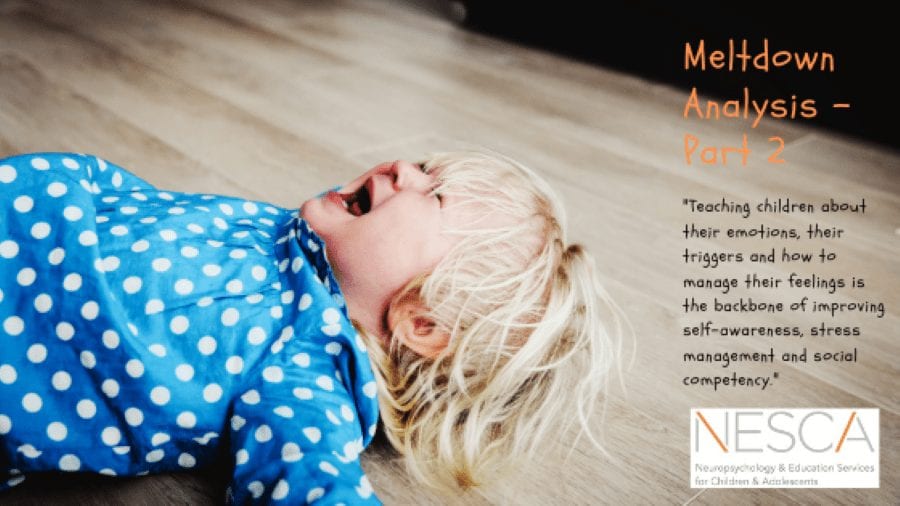
As discussed in last week’s blog, Meltdowns Happen, all children meltdown. Adults meltdown, too. Losing control can take many forms. It is a part of human nature unless we deliberately work on “controlling the beast” that’s lurking inside of us when our system gets taxed. When children are very young, we expect them to lose control because they are learning how to identify and express their emotions. A three-year-old who tantrums is not that uncommon; however, by the time that child is six and then 10, we want them to have developed more and more control as they mature.  But, many children don’t always develop the control that we’d like, and those diagnosed with learning differences sometimes have even more difficulty controlling their emotions.

Teaching children about their emotions, their triggers and how to manage their feelings is the backbone of improving self-awareness, stress management and social competency (3 Ss). If children can label and recognize feelings, notice how their body feels with different emotions and know how to calm themselves when stressed, the better off they will be in life. In a previous role as the program director of Aspire/MGH, we focused on these 3 Ss and utilized a volcano image with our autism spectrum disorder (ASD) participants to teach them about their stress cycle. The volcano image represented a meltdown (see below).

In using this with your child, pick a quiet, calm moment to introduce it to him/her. You might want to start the conversation by reading a book about stress or big emotions. There are many to choose from depending upon the age of your child. You could also just begin a discussion with volcano image to help them understand what they look like and sound like when they are melting down. Discuss with your child what you think s/he looks like as s/he begins to meltdown starting at the bottom of the volcano and working all the way to the top (5) and then what s/he looks like when s/he begins to calm down and recover (moving down the right side of the volcano). If your child has not learned stress management strategies, this is a good time to practice. If your child has learned some techniques, you can also create a list of strategies that s/he can do at each step to help gain control so s/he doesn’t continue to escalate to the next stage. For instance, at a 3, you may be able to use humor to help redirect, but when s/he is at a 4 or 5, using humor may increase distress. I hope this image helps with understanding and reducing the meltdowns that are occurring every day in everyone’s home.

If you’d like assistance in creating your child’s personal meltdown plan, self-awareness plan or behavior plan, NESCA’s parent coaching services can assist you in the journey.


About the Author

NESCA’s Director of Consultation and Psychoeducational Services Dot Lucci has been active in the fields of education, psychology, research and academia for over 30 years. She is a national consultant and speaker on program design and the inclusion of children and adolescents with special needs, especially those diagnosed with Autism Spectrum Disorder (ASD). Prior to joining NESCA, Ms. Lucci was the Principal of the Partners Program/EDCO Collaborative and previously the Program Director and Director of Consultation at MGH/Aspire for 13 years, where she built child, teen and young adult programs and established the 3-Ss (self-awareness, social competency and stress management) as the programming backbone. She also served as director of the Autism Support Center. Ms. Lucci was previously an elementary classroom teacher, special educator, researcher, school psychologist, college professor and director of public schools, a private special education school and an education collaborative.

Ms. Lucci directs NESCA’s consultation services to public and private schools, colleges and universities, businesses and community agencies. She also provides psychoeducational counseling directly to students and parents. Ms. Lucci’s clinical interests include mind-body practices, positive psychology, and the use of technology and biofeedback devices in the instruction of social and emotional learning, especially as they apply to neurodiverse individuals.


To book a consultation with Ms. Lucci or one of our many expert neuropsychologists, complete NESCA’s online intake form. Indicate whether you are seeking an “evaluation” or “consultation” and your preferred clinician/consultant in the referral line.


Neuropsychology & Education Services for Children & Adolescents (NESCA) is a pediatric neuropsychology practice and integrative treatment center with offices in Newton, Massachusetts, Plainville, Massachusetts, and Londonderry, New Hampshire, serving clients from preschool through young adulthood and their families. For more information, please email info@nesca-newton.com or call 617-658-9800.


Meltdowns Happen

By | NESCA Notes 2020

By Dot Lucci, M.Ed., CAGS

Director of Consultation and Psychoeducational Services, NESCA

When we think of the word meltdown, we may think of the economy or stock market, glaciers, nuclear meltdowns or even volcanoes erupting. These are all examples of things collapsing from being over-stressed, overheating, a major disruption to a system or an internal collapse. Using the word meltdown to describe people is similar. In homes across America, even as we settle into quarantine, slow down our lives and find ways to enjoy our time together, there may be more meltdowns happening that are filled with tears, screams and lots of “No, I don’t want to!” Adults and children are becoming overheated, over-stressed, and our systems are over-burdened. And when a system can no longer take it, it melts down, boils over, erupts, or crashes and burns. In these moments, it is the only way of coping – to let loose, let off of steam, erupt – or just plain melt down. Sometimes it’s hard to believe, but each of us is doing the best we can to cope with a difficult environment. We’re trying to do the best we can, because our biological system is in a meltdown. We are not responding; instead we are reacting from our “downstairs” brain and not our “upstairs” brain.

A meltdown may be an explosion and look like crying, throwing things, yelling, aggressing, breaking things, etc. Or it may be more like an implosion – a withdrawal from the family, hiding, sleeping more, lethargy, etc. Both are the same in many ways biologically; the system is in fight, fright or freeze. A meltdown should be viewed as a “neurological storm.” This fight, flight or freeze response is not a child being “bad” or disrespectful, but rather is “bad behavior” that needs to be changed. Remember, it is their best attempt to cope, not a deliberate, willful, defiant act towards you. It is your child saying, “Help me – I can’t help myself! I’ve lost it!” This is not a time to teach, reason with, or win a battle. It is a fire to be put out, and you as the parent or caretaker is the firefighter. It’s a crisis to be managed, and you become your child’s “upstairs brain” or frontal lobe (even though you may want to react from your “downstairs brain,” because you may also be losing it.

Everyone wants to have a good day. Remember, when it’s going in a different direction, you are the adult. You can take a breath and even walk away (if you can) for a few seconds to compose yourself. This allows you to respond versus react. It is your job to manage the situation and take the emotional high road (often easier said than done). In these moments, it is really only about a few things.

  1. Safety and dignity
  2. Keep calm and reduce/simplify your language
  3. Keep calm and know this too shall pass
  4. Don’t get pulled off topic by all the things your child is saying or doing – this is a rabbit hole that you won’t emerge from
  5. Mention what you want to have happen, rather than what you want to stop (“Bang your pillow” instead of “Stop banging the wall”)
  6. Establish connection – right brain to right brain. Remember the mantra, “Name it to tame it.” (i.e. I know this is hard; I know you don’t want to do it; I wouldn’t want to either; or I know you don’t like it, etc.)

Resources:

https://www.drdansiegel.com/books/the_whole_brain_child/


About the Author

NESCA’s Director of Consultation and Psychoeducational Services Dot Lucci has been active in the fields of education, psychology, research and academia for over 30 years. She is a national consultant and speaker on program design and the inclusion of children and adolescents with special needs, especially those diagnosed with Autism Spectrum Disorder (ASD). Prior to joining NESCA, Ms. Lucci was the Principal of the Partners Program/EDCO Collaborative and previously the Program Director and Director of Consultation at MGH/Aspire for 13 years, where she built child, teen and young adult programs and established the 3-Ss (self-awareness, social competency and stress management) as the programming backbone. She also served as director of the Autism Support Center. Ms. Lucci was previously an elementary classroom teacher, special educator, researcher, school psychologist, college professor and director of public schools, a private special education school and an education collaborative.

Ms. Lucci directs NESCA’s consultation services to public and private schools, colleges and universities, businesses and community agencies. She also provides psychoeducational counseling directly to students and parents. Ms. Lucci’s clinical interests include mind-body practices, positive psychology, and the use of technology and biofeedback devices in the instruction of social and emotional learning, especially as they apply to neurodiverse individuals.


To book a consultation with Ms. Lucci or one of our many expert neuropsychologists, complete NESCA’s online intake form. Indicate whether you are seeking an “evaluation” or “consultation” and your preferred clinician/consultant in the referral line.


Neuropsychology & Education Services for Children & Adolescents (NESCA) is a pediatric neuropsychology practice and integrative treatment center with offices in Newton, Massachusetts, Plainville, Massachusetts, and Londonderry, New Hampshire, serving clients from preschool through young adulthood and their families. For more information, please email info@nesca-newton.com or call 617-658-9800.
 

Good Ideas for Dogs are Good for People, Too

By | NESCA Notes 2020

By Dot Lucci, M.Ed., CAGS

Director of Consultation and Psychoeducational Services, NESCA

  • Play Every Day! — Play can promote calmness and reduce anxiety. This is true for adults and kids.
  • Play Is Learning — Reflect after play by creating and asking questions. Did you learn anything new? What surprised you? How did you feel before you played? How you feel now?
  • Walk, Walk, Walk! — Walking helps dogs stay engaged with the world and brains stimulated. Yup, works for humans, too.
  • Be Present While Walking — Go for walks with or without a dog. Feel the air blowing, smell the flowers, hear the birds singing, feel the rain on your face. Learn the bird calls, bring binoculars and look closely at the birds. Be present as you walk, laugh, sing, splash in puddles….
  • Game Play — Playing games can help satisfy natural instincts. Play old games, teach your children games you played as a child, learn new games. Any games will do – board, card, dice, movement, etc. Play skill games, games of chance or luck games, silly games, etc.
  • Feed Relationships Through Play and Exercise — Bond with each other (a child, a dog or both!) through playing or getting some exercise together. Be active together…teach new tricks, kick a ball around, play catch, take a yoga or Zumba class, watch GoNoodle as long as it’s together.
  • Be in gratitude that you are experiencing this time together to slow down and reconnect with each other. Laugh, play, sing and dance together. Love and care for each other. Enjoy each other.


About the Author

NESCA’s Director of Consultation and Psychoeducational Services Dot Lucci has been active in the fields of education, psychology, research and academia for over 30 years. She is a national consultant and speaker on program design and the inclusion of children and adolescents with special needs, especially those diagnosed with Autism Spectrum Disorder (ASD). Prior to joining NESCA, Ms. Lucci was the Principal of the Partners Program/EDCO Collaborative and previously the Program Director and Director of Consultation at MGH/Aspire for 13 years, where she built child, teen and young adult programs and established the 3-Ss (self-awareness, social competency and stress management) as the programming backbone. She also served as director of the Autism Support Center. Ms. Lucci was previously an elementary classroom teacher, special educator, researcher, school psychologist, college professor and director of public schools, a private special education school and an education collaborative.

Ms. Lucci directs NESCA’s consultation services to public and private schools, colleges and universities, businesses and community agencies. She also provides psychoeducational counseling directly to students and parents. Ms. Lucci’s clinical interests include mind-body practices, positive psychology, and the use of technology and biofeedback devices in the instruction of social and emotional learning, especially as they apply to neurodiverse individuals.


To book a consultation with Ms. Lucci or one of our many expert neuropsychologists, complete NESCA’s online intake form. Indicate whether you are seeking an “evaluation” or “consultation” and your preferred clinician/consultant in the referral line.


Neuropsychology & Education Services for Children & Adolescents (NESCA) is a pediatric neuropsychology practice and integrative treatment center with offices in Newton, Massachusetts, Plainville, Massachusetts, and Londonderry, New Hampshire, serving clients from preschool through young adulthood and their families. For more information, please email info@nesca-newton.com or call 617-658-9800.


When Grandparents Become Parents Again

By | NESCA Notes 2020

By Yvonne M. Asher, Ph.D. 

Pediatric Neuropsychologist

Grandparents can hold a special place for any child. For some, though, grandparents play a central role in their day-to-day lives. When grandparents raise a child, it is often related to parental challenges, tragic circumstances or government intervention. This brings inherent, understandable stressors for grandparents. Additionally, grandparents face the more typical challenges of child-rearing, such as managing educational experiences, ensuring emotional well-being and navigating health care.

When concerns with educational achievement, behavior, emotional or social functioning arise, there are many obstacles with which grandparents must wrestle. Feelings of guilt may arise, which can stem from a variety of sources. Grandparents may question their own parenting practices, worrying about past “mistakes” in raising their children. They may be especially sensitive to shielding their grandchildren from exposure to risky situations that their children may have faced without their knowledge. Grandparents may struggle when grandchildren are given diagnoses such as ADHD, autism or learning disabilities, wondering if their children faced these same challenges without formal diagnosis or intervention. Many grandparents express understandable fears around their grandchildren’s future, particularly their level of independence. While many caregivers have concerns with the independence of the children in their care, grandparents are often acutely aware of the limited time they will have to support, counsel and assist their grandchildren through their young adult years.

In navigating the special education and mental health care systems, grandparents can face many complex situations. Complexity may be increased if grandparents are in a caregiving role due to parents’ substance use or dependence. Depending on the timing and extent of substance use, there can be long-lasting impacts on grandchildren’s educational, cognitive or emotional health. This can substantially increase the difficulties that grandparents encounter, both in terms of accessing necessary services and supports, as well as coping with the stresses of caregiving.

There are also a number of strengths that grandparents can bring to their time as caregivers. They may be more aware of their rights as caregivers within the educational system, seeking out services and interventions when the “first signs” of difficulty arise. They may have a broader perspective on the school system, potentially having raised children who went through the same schools in the past. With the wisdom that comes in later adulthood, grandparents may be more discerning and skeptical about the opinions of professionals. They may ask more pointed questions, with less reserve or fear. Grandparents may also have built stronger support networks and have deeper connections to community organizations. These strengths can serve grandparents well in managing the complex systems that all caregivers face.

Several states have created advisory councils or legislation specifically designed to support grandparents raising grandchildren. In addition, there are many resources available to grandparents who are caring for and raising grandchildren, including:

https://www.helpguide.org/articles/parenting-family/grandparents-raising-grandchildren.htm

https://www.grandfamilies.org

http://www.massgrg.com/massgrg_2019/index.html

https://sixtyandme.com/resources-for-grandparents-raising-grandchildren/


About Pediatric Neuropsychologist Dr. Yvonne Asher:

Dr. Yvonne M. Asher enjoys working with a wide range of children and teens, including those with autism spectrum disorder, developmental delays, learning disabilities, attention difficulties and executive functioning challenges. She often works with children whose complex profiles are not easily captured by a single label or diagnosis. She particularly enjoys working with young children and helping parents through their “first touch” with mental health care or developmental concerns.

Dr. Asher’s approach to assessment is gentle and supportive, and recognizes the importance of building rapport and trust. When working with young children, Dr. Asher incorporates play and “games” that allow children to complete standardized assessments in a fun and engaging environment.

Dr. Asher has extensive experience working in public, charter and religious schools, both as a classroom teacher and psychologist. She holds a master’s degree in education and continues to love working with educators. As a psychologist working in public schools, she gained invaluable experience with the IEP process from start to finish. She incorporates both her educational and psychological training when formulating recommendations to school teams.

Dr. Asher attended Swarthmore College and the Jewish Theological Seminary. She completed her doctoral degree at Suffolk University, where her dissertation looked at the impact of starting middle school on children’s social and emotional wellbeing. After graduating, she completed an intensive fellowship at the MGH Lurie Center for Autism, where she worked with a wide range of children, adolescents and young adults with autism and related disorders.


Neuropsychology & Education Services for Children & Adolescents (NESCA) is a pediatric neuropsychology practice and integrative treatment center with offices in Newton, Massachusetts, Plainville, Massachusetts, and Londonderry, New Hampshire, serving clients from preschool through young adulthood and their families. For more information, please email info@nesca-newton.com or call 617-658-9800.


To book an appointment with Dr. Yvonne Asher, please complete our Intake Form today. For more information about NESCA, please email info@nesca-newton.com or call 617-658-9800.


When is it Actually Bullying?

By | NESCA Notes 2019

By Yvonne M. Asher, Ph.D. 
Pediatric Neuropsychologist

Autumn holds excitement for many students – heading back to school to see old friends, meet new teachers and learn new skills. However, for some, a new school year holds more apprehension than enthusiasm. Students worry that their teacher will be mean, their math homework will be hard or that their recess time cut short by bad weather. One fear that is described more and more often by parents and children is the fear of bullying.

What is bullying?

There is no single definition of bullying, but most researchers describe the following necessary and sufficient characteristics:

  • unwanted, intentionally aggressive behavior that is aimed at harming another person
  • carried out repeatedly
  • in a relationship where there is a power differential

The quintessential example of this is the hulking, five-foot-five elementary schooler who pushes, shoves and steals the lunch money of a short, scrawny younger child every day. Luckily, this kind of aggression is rare; however, the rarity of “classic” bullying requires us to be somewhat more mindful of what childhood behaviors are (and, are not) considered bullying.

First and foremost, behavior must be unwanted and intended to harm. This means that the rambunctious children rough-housing on the playground is generally not a bullying situation. Playful acts, or acts with the intent of friendly, physical play, are not bullying. Certainly, there are times when children may misunderstand the intent of their peers or friends and perceive an action as hurtful. In that case, a frank discussion of intended message versus experienced consequence is required, but there is no immediate concern for bullying. If a child did not intend to hurt their peer, bullying is not the issue.

When researchers use the term “aggressive behavior,” it should be clarified that aggression is not always physical. Aggression comes in three forms: physical, verbal and relational. Physical aggression is exactly what you are imagining – punching, kicking, hitting and similar behaviors. This kind of aggression occurs in very young children (think: toddlers), most often as a means of communication due to their limited verbal skills. By early childhood, kids rarely use physical aggression to communicate, as most children are able to talk and verbalize their wants, needs and feelings.

The second type of aggression is verbal aggression. This can involve things like yelling, screaming, swearing, threatening and name-calling. This kind of aggression occurs throughout childhood and adolescence, with the frequency decreasing as children mature.

The last form of aggression is the most complex. It is called relational aggression. Researcher Nicki Crick defined relational aggression as any act that uses the social relationships, social standing or social experiences of an individual to harm them. The stereotypical examples of relational aggression come from films like Mean Girls. Gossip, social exclusion, humiliation, embarrassment, rumor spreading and intentional ignoring are all examples of behaviors that fall into the category of relational aggression. This frequency of relational aggression generally increases as children develop, as relational aggression requires more sophisticated verbal and social skills to carry out. In addition, relational aggression is rarely noticed by adults and often does not carry the same disciplinary consequences as physical or verbal aggression. Children learn quickly that refusing to play with a peer or spreading a nasty rumor is unlikely to get them “in trouble,” making this type of aggression far more effective for older children and adolescents.

It is important to note that both boys and girls engage in aggressive behavior. Girls tend to start using relational aggression younger, and use it consistently throughout their lives. Boys tend to start out using physical aggression, and shift to relational aggression as they mature. However, both boys and girls engage in aggressive behavior at all developmental stages.

Back to our definition of bullying – the next element is “happens repeatedly.” Bullying is not a one-time occurrence. The behavior, or harm caused by the behavior, must happen over and over. Two children who are angry and get into a fight in the cafeteria may well be intending to harm one another. However, if the fight is a one-time occurrence, there is no immediate concern for bullying. One challenging aspect of this part of the definition is how we handle online or cyberbullying (i.e., bullying that happens through electronic media such as text or social media). Because posts to social media, texts and images online can be viewed multiple times by multiple people, a single act carried out online may meet the definition of bullying. For example, posting a message that conveys a nasty rumor about a peer to one classmate’s profile can have untold impact on the victim’s social relationships depending on how many times that post is forwarded, tagged, “liked,” discussed or otherwise shared across the social network.

The last part of the definition of bullying is that it occurs “in a relationship where there is a power differential.” Power differentials exist in many relationships – parent/child, teacher/student, employer/employee, landlord/renter, therapist/patient and so on. In children, power differentials may exist when a child is:

  • older
  • physically larger
  • more popular
  • more socially skilled

While this is not an exhaustive list, these are the most common situations where we find power differentials in children. Without a power differential present in the relationship, bullying is not an immediate concern. It is not uncommon for children to have challenges in their friendships, such as teasing, unwanted horseplay, sitting with other friends at lunch and choosing to work with a different partner on a project. However, these challenges typically do not meet the “power differential” criterion of bullying. They are better defined as normal, healthy obstacles in relationships that, when worked through productively, can help children develop more sophisticated social problem-solving skills.

What to do when it is bullying

We’ve discussed many examples of what is not bullying, so what should happen when behaviors are best characterized as bullying? First and foremost, assess your child’s safety. If physical aggression is part of the bullying, consider immediate action, such as talking to your child’s teacher or school administrator. Note that bullying is now a legal matter in many states, including Massachusetts. When talking to your child, remember that bullying comes with plenty of shame and anxiety, so make every effort to ask simple, clear, direct questions with as calm a tone as possible.

If your child’s safety is not a primary concern, ask your child if they want your help to solve the problem. If so, consider helping your child map out the social dynamics of what is happening. Who is saying what? To whom? Is it just you who is the victim, or are the bullies doing the same thing to other children? Does the teacher notice? If so, do the bullies get in trouble? Depending on the answers, help your child work toward a strategy to solve the problem. Younger children may require more adult intervention, such as a parent reaching out to the teacher. Older children and adolescents may be able to try out problem-solving strategies independently, with your support at home.

If your child does not want your help, consider letting them try to solve the problem on their own. Remind them that you love and trust them, and have confidence in their ability to figure out tough situations. Encourage your child to participate in other social activities where they experience more positive interactions, such as martial arts, Girl or Boy Scouts, team sports or clubs outside of school. Having strong, positive friendships is one of the most important resiliency factors when a child is the victim of bullying.

It may help to know that upwards of 90% of adults report having been the victim of bullying at least once in their lifetime. Interestingly, over 70% also report having bullied someone else.


About Pediatric Neuropsychologist Dr. Yvonne Asher:

Dr. Yvonne M. Asher enjoys working with a wide range of children and teens, including those with autism spectrum disorder, developmental delays, learning disabilities, attention difficulties and executive functioning challenges. She often works with children whose complex profiles are not easily captured by a single label or diagnosis. She particularly enjoys working with young children and helping parents through their “first touch” with mental health care or developmental concerns.

Dr. Asher’s approach to assessment is gentle and supportive, and recognizes the importance of building rapport and trust. When working with young children, Dr. Asher incorporates play and “games” that allow children to complete standardized assessments in a fun and engaging environment.

Dr. Asher has extensive experience working in public, charter and religious schools, both as a classroom teacher and psychologist. She holds a master’s degree in education and continues to love working with educators. As a psychologist working in public schools, she gained invaluable experience with the IEP process from start to finish. She incorporates both her educational and psychological training when formulating recommendations to school teams.

Dr. Asher attended Swarthmore College and the Jewish Theological Seminary. She completed her doctoral degree at Suffolk University, where her dissertation looked at the impact of starting middle school on children’s social and emotional wellbeing. After graduating, she completed an intensive fellowship at the MGH Lurie Center for Autism, where she worked with a wide range of children, adolescents and young adults with autism and related disorders.


Neuropsychology & Education Services for Children & Adolescents (NESCA) is a pediatric neuropsychology practice and integrative treatment center with offices in Newton, Massachusetts, Plainville, Massachusetts, and Londonderry, New Hampshire, serving clients from preschool through young adulthood and their families. For more information, please email info@nesca-newton.com or call 617-658-9800.


To book an appointment with Dr. Yvonne Asher, please complete our Intake Form today. For more information about NESCA, please email info@nesca-newton.com or call 617-658-9800.


The Struggle is Not Only Real, It is Necessary

By | NESCA Notes 2018


By: Angela Currie, Ph.D.
Pediatric Neuropsychologist

From an early age, we are subliminally taught that stress is a bad thing. Whether frustrated because your LEGO tower broke or confused about which two paint colors to mix to get green, you were more likely to hear “Calm down – no reason to get stressed,” than you were to hear “Let’s use your stress to help us make a plan for how to solve this problem.”

For most adults, the natural, well-meaning response to a child’s expression of stress, or most any unwanted feeling, is to try to fix it, make it go away, avoid it, or make it seem like it isn’t such a big deal. We do this by saying things like:

“Don’t be sad.”
“No need to worry about it.”
“It’s not as bad as you think it is.”
“Just try thinking about something else.”
“Let me do that for you.”

We all say and do these things, and the good intention is clear. Nobody likes to see a child struggle or experience discomfort. Unfortunately, manageable stress and discomfort is necessary for growth. When we minimize, distract, or dismiss a child’s emotional reaction, we are sending the message that feelings are unimportant, untrustworthy, and bad. This means that we are also missing the opportunity to teach the child about why we have feelings, and how even the unwanted ones are incredibly useful.

Stress and anxiety are at an all-time high nowadays. It is important to think about small things that we can do each day to help children feel more confident and competent in their ability to navigate this stressful world. One of the best ways we can help them to become more resilient is by creating an environment where emotions are acknowledged, accepted, and used in a functional manner. To start doing this, here are some basic things to keep in:

1) Feelings are information. They are telling us that something is important and may require our attention.
2) Feelings are never bad or “negative,” though they may be unwanted.
3) Stress is often a good thing – without it we would not prepare for tests, show up to work, or care about our relationships. Life without stress would be pretty unfulfilling.
4) The goal is not to control stress or other unwanted feelings – the goal is to recognize, use, and cope with them.
5) Acknowledging and accepting unwanted emotions is one of the best ways to reduce their impact.
6) Regular, casual discourse about wanted and unwanted feelings is healthy and normal. If we talk about the day to day feelings, it will make it easier to talk about the “big ones.”
7) Let children struggle sometimes. Don’t feel the need to fix things right away. Help them express how they’re feeling, gently guide them toward problem-solving, and praise their persistence in the face of challenge.


About the Author:

Currie

Dr. Angela Currie conducts neuropsychological and psychological (projective) assessments out of NESCA’s Londonderry, NH and Newton, MA offices, seeing individuals with a wide range of concerns. She enjoys working with stressed-out children and teens, working to tease apart the various factors that may be lending to their stress, including assessment of possible underlying learning challenges (such as dyslexia or nonverbal learning disability), attentional deficit, or executive function weakness. She also often conducts evaluations with children confronting more primary emotional and anxiety-related challenges, such as generalized anxiety, obsessive-compulsive disorder, or depression. Dr. Currie particularly enjoys working with the seemingly “unmotivated” child as well as children who have “flown under the radar” for years due to their desire to succeed.


To book an evaluation or consultation with Dr. Currie or one of our many other expert neuropsychologists, complete NESCA’s online intake form. Indicate whether you are seeking an “evaluation” or “consultation” and your preferred clinician in the referral line.


Neuropsychology & Education Services for Children & Adolescents (NESCA) is a pediatric neuropsychology practice and integrative treatment center with offices in Newton, Massachusetts, Plainville, Massachusetts, and Londonderry, New Hampshire, serving clients from preschool through young adulthood and their families. For more information, please email info@nesca-newton.com or call 617-658-9800.


Skip to content