
NESCA’s Newton, MA location has immediate availability for neuropsychological evaluations. Our MA clinicians specialize in the following evaluations: Neuropsychological; Autism; and Emotional and Psychological, as well as Academic Achievement and Learning Disability Testing.

Visit www.nesca-newton.com/intake for more information or to book an evaluation.

Tag

nesca londonderry nh Archives - Page 3 of 3 - NESCA

Subscribe to NESCA Notes

How to Talk to Your Kids about Racial Inequality and Current Events

By | NESCA Notes 2020

By: Cynthia Hess, PsyD
Pediatric Neuropsychologist Fellow and Therapist

It is old news that parents and children have been experiencing an increased sense of uncertainty and vulnerability due to COVID-19. That vulnerability may be exacerbated by the news of violent protests that were sparked by anger over police brutality against black men and women. News of widespread violence around the country spread rapidly in a country already stressed to its capacity in dealing with a global pandemic and the resulting economic hardship. In the aftermath of these recent tragedies, parents should be aware that children may be experiencing collateral consequences, such as fear, anxiety and confusion. Rhea Boyd, MD, MPH, stated, “Whether from social media accounts, conversations with peers or caregivers, overheard conversations, or the distress they witness in the faces of those they love, children know what is going on. And without the guidance and validation of their caregivers, they may be navigating their feelings alone.” So, what do we do?

First, take care of yourself. Now is a good time to practice self-compassion and selfcare. The stress of watching traumatic events on television and smartphones “lingers within our bodies and minds,” states developmental pediatrician Dr. Jenny Radesky. Recognize that vicarious trauma is real, and even if you have not been directly affected, you may be experiencing heightened anxiety, difficulty sleeping, fatigue or increased irritability. Practice accepting your own feelings, instead of controlling them. Go for a walk, talk with a friend, practice relaxation techniques or do something you enjoy.

It is important to consider how we talk with children. While children from birth to age three do not understand what is happening, they can feel it through the reactions of the adults around them. You may notice that your young child has become more irritable, or perhaps crying more than usual. In addition to calming your child, limit the amount of time you spend accessing unsettling news reports in the presence of young children.

With elementary children, it is wise to begin your discussion with, “tell me what you know.” By elementary age, children have a good idea about what is happening. Asking children what they know and following up with any questions they might have will help you to provide age appropriate information. It is important to keep channels of communication open, because as time passes it is likely more questions will arise. Children may want to know that they are safe and, if they ask, provide reassurance. With that being said, limit their exposure to media, be it on television, tablet or smartphone. If they are accessing media, be aware of what they are watching and learning. Answer questions as appropriate and, as with all ages, validate their feelings and assure them that whatever they are feeling, it is okay.

It is probable that teenage youth have seen the images and been involved in learning about the events that precipitated the violence that unfolded. They may even be getting involved in activism by posting and re-posting social media messages. Teenagers often process events by talking with their peers, and it can, at times, be difficult to engage them in conversation. Approach the topic with your teen from a position of curiosity. What do they know? How do they know it? How do they feel about it? It is also a good time for you and your teen to become more educated about the history of racism in our country and how it has been perpetuated through generations of people. A broader societal context of racism will help youth have a better understanding of the anger seen in the demonstrations. A documentary called “13th,” about the 13th amendment, takes an in-depth look at the prison system in the United States and how it mirrors the nation’s history of racial inequality. It is both educational and provides a starting point for having conversations about race with your teen. Additionally, as much as possible, be aware of your teen’s online activity. There is a lot of misinformation and inflammatory rhetoric on social media, and teens need guidance on how to be thoughtful and responsible consumers of all types of media.

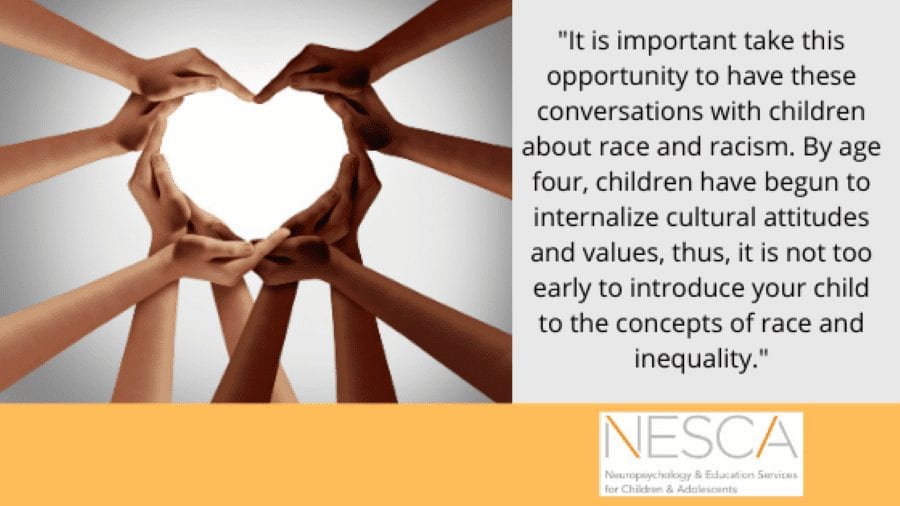
Given that the recent unrest was sparked by anger over police brutality against black people, it is important take this opportunity to have these conversations with children about race and racism. By age four, children have begun to internalize cultural attitudes and values, thus, it is not too early to introduce your child to the concepts of race and inequality. Books that include multi-racial characters are a good way to introduce children to people of color in a positive light. Common Sense Media has a list of books appropriate for kids of all ages beginning in infancy, and the link is provided below.

Experts stress that parents also need to give their children the broader societal context of racism to try to explain the rage of protestors filling the streets of cities across the nation. Doing so helps build empathy and teach perspective-taking, shifting the focus from the child’s specific fears. Helping children to view events from different perspectives provides understanding and promotes empathy. When your child sees something on television, YouTube or social media, employ a sense of curiosity. Ask them what they saw, how they felt about what they saw, and have them think about and share how they think different people involved in the situation felt. Dr. Radesky suggests, “Instead of focusing on questions the child may have about concrete things, ask them questions like ‘How do you think those people were feeling? Do you know why they were angry? What do you do when you feel like something is unfair?’” We all have our different perspectives regarding racism and the complex history of race in our country. Providing space for children to ask questions, discuss their feelings and process the world around them will help them cope with the myriad emotions that may arise due to current events and the sense of helplessness and fear they may be experiencing.


Some helpful resources:

https://www.pbs.org/parents/authors/jenny-radesky-md

https://www.commonsensemedia.org/lists/books-with-characters-of-color

https://www.commonsensemedia.org/blog/black-history-movies-that-tackle-racism

https://www.commonsensemedia.org/lists/movies-that-inspire-kids-to-change-the-world

https://pediatrics.aappublications.org/content/144/2/e20191765

https://raisingequity.org/


About the Author

Dr. Cynthia Hess recently graduated from Rivier University with a PsyD in Counseling and School Psychology. Previously, she earned an M.A. from Antioch New England in Applied Psychology. She also worked as an elementary school counselor and school psychologist for 15 years before embarking on her doctorate. During her doctorate, she did her pre-doctoral internship with RIT in Rochester, N.Y. where she worked with youth ages 5-17 who had experienced complex developmental trauma. Dr. Hess’s first post-doctoral fellowship was with The Counseling Center of New England where she provided psychotherapy and family therapy to children ages 5-18, their families and young adults. She also trained part-time with a pediatric neuropsychologist conducting neuropsychological evaluations. Currently, Dr. Hess is a second-year post-doctoral fellow in pediatric neuropsychological assessment, working with NESCA Londonderry’s Dr. Angela Currie.


To schedule an appointment with one of NESCA’s expert neuropsychologists, please complete our online intake form


Neuropsychology & Education Services for Children & Adolescents (NESCA) is a pediatric neuropsychology practice and integrative treatment center with offices in Newton and Plainville, Massachusetts, and Londonderry, New Hampshire, serving clients from preschool through young adulthood and their families. For more information, please email info@nesca-newton.com or call 617-658-9800.


The Uncertainty, Stress and Anxiety About What School Will Look Like

By | NESCA Notes 2020

By: Cynthia Hess, PsyD
Pediatric Neuropsychologist Fellow and Therapist

Much of adjusting to the world in the midst of a global pandemic has been learning to live with nearly constant uncertainty. Undoubtedly, this pandemic and ensuing uncertainty has caused significant stress for youth and their families. The experience of persistent stress can result in increased vulnerability to anxiety and depression. Symptoms may become magnified in those who already faced mental health challenges. There is little doubt that there will be increases in mental and behavior health problems for children and families both in anticipating the re-opening of schools, and when schools reopen their physical buildings.

We all wonder what school will look like in the fall. The anticipation of returning to school can be especially stressful, and will likely be so for most youth. Given that students will not have been in schools with their peers for several months, it can be anticipated that they might feel a heighted sense of insecurity and uncertainty. Even in “normal times,” returning to the complex social and educational environment of school can be worrisome for many children and adolescents.

Each individual child will have had their own experiences while schools were closed. Some children and/or staff members may have been impacted by COVID-19 and some families and/or staff may be experiencing financial hardship due to parental unemployment or loss of household income. It is important to realize that regardless of their experience, each individual will have a unique response. It is helpful to recognize the signs of stress and help children learn positive ways of coping with it.

Signs of stress in preschool children include, but are not limited to, anger, nervousness, eating and sleeping problems (including nightmares), fear of being alone, irritability and uncontrollable crying.

In elementary age children, stress may manifest as increased complaining of headaches and stomachaches, feeling insecure, reduced appetite and difficulty sleeping, withdrawal and worrying about the future.

Signs of stress in pre-teens and teens may include anger, disillusionment, distrust of the world, low self-esteem, stomachaches and headaches, panic attacks and rebellious behavior.

As each person works through this very challenging situation, it is more important than ever to adopt a position of acceptance, as we never truly know what another person is experiencing or has experienced. The following are offered as suggestions on how to help children and teens cope with stress.

  • Help them identify how they are feeling and acknowledge and validate those feelings.
  • Encourage them to talk about what is bothering them.
  • Share strategies you use to cope with stress.
  • Talk openly and, as appropriate, share stories about stress in your day.
  • Find a physical activity and/or hobby that they enjoy and encourage them to participate.
  • Encourage them to eat healthy foods and emphasize the importance of a healthy lifestyle, especially as it relates to stress.
  • Make sure they get plenty of sleep.
  • Set clear expectations, without being overly rigid, and allow for “down” time.
  • Spend time outdoors, encourage them to do something they love – read a book, ride their bike, bake, etc.
  • Learn and teach your children relaxation skills, such as breathing exercises, muscle relaxation exercises, meditating, yoga, drawing or writing.

Our world will have changed by the time children re-enter their classrooms. No matter what happens in the fall, when it is time for school to start, it will inevitably be stressful. Learning to cope with and manage stress is important for physical and emotional health. However, if you are concerned about your child or are struggling yourself, seek help and support for yourself, your child or anyone in your family who is struggling.

Below are some helpful resources:

https://www.apa.org/topics/children-teens-stress

https://nesca-newton.com/helping-your-anxious-child-through-covid-19/

https://childmind.org/article/how-to-ask-what-kids-are-feeling-during-stressful-times/

https://healthy.kaiserpermanente.org/health-wellness/health-encyclopedia/he.stress-in-children-and-teens.ug1832


About the Author

Dr. Cynthia Hess recently graduated from Rivier University with a PsyD in Counseling and School Psychology. Previously, she earned an M.A. from Antioch New England in Applied Psychology. She also worked as an elementary school counselor and school psychologist for 15 years before embarking on her doctorate. During her doctorate, she did her pre-doctoral internship with RIT in Rochester, N.Y. where she worked with youth ages 5-17 who had experienced complex developmental trauma. Dr. Hess’s first post-doctoral fellowship was with The Counseling Center of New England where she provided psychotherapy and family therapy to children ages 5-18, their families and young adults. She also trained part-time with a pediatric neuropsychologist conducting neuropsychological evaluations. Currently, Dr. Hess is a second-year post-doctoral fellow in pediatric neuropsychological assessment, working with NESCA Londonderry’s Dr. Angela Currie.


To schedule an appointment with one of NESCA’s expert neuropsychologists, please complete our online intake form


Neuropsychology & Education Services for Children & Adolescents (NESCA) is a pediatric neuropsychology practice and integrative treatment center with offices in Newton and Plainville, Massachusetts, and Londonderry, New Hampshire, serving clients from preschool through young adulthood and their families. For more information, please email info@nesca-newton.com or call 617-658-9800.
 

Mindfulness: It’s Not Just for Grown-ups

By | NESCA Notes 2019

By: Cynthia Hess, PsyD
Pediatric Neuropsychologist Fellow

There has been increasing interest in intervention strategies that target self-regulation in childhood. Self-regulation is the process through which the systems of emotion, attention and behavior are controlled in response to a situation, stimulus or demand. It develops rapidly in the early years of life. Self-regulation is necessary for social development because it supports and enhances peer acceptance and social success. Furthermore, it increases academic performance, particularly in elementary school. Problems with self-regulation and the accompanying executive functioning have been shown to correlate with a number of behavioral and emotional problems, particularly depression and anxiety. Mindfulness is emerging as an effective intervention for children struggling with self-regulation, especially when implemented at a time when children are acquiring these foundational skills.

Mindfulness is a way of paying attention, on purpose and non-judgmentally, to the experience of the present moment. Being mindful involves reflecting on the current internal experiences such as thoughts or emotions and the current external environment, such as sights and sounds, both clearly and objectively. This act of purposeful reflection enhances and facilitates self-regulation by promoting control, such as sustained attention and cognitive flexibility. Furthermore, it helps to reduce the incidences of such things as snap judgments, emotional reactivity or distressing thoughts.

Mindfulness-based social-emotional training has been shown to be effective in reducing stress, improving coping skills and building resilience when used with children. Mindfulness teaches children the skills needed to improve focus, calm themselves, plan and organize, and behave in a thoughtful manner. Research on adult populations shows that practicing mindfulness may reduce symptoms of anxiety and depression, and limited number of studies show some of the same benefits in children. Mindfulness is well tolerated by children and has been proven to improve psychological well-being. Introducing mindfulness practices to children has the potential to make a positive impact on a child’s ability to self-regulate, and thus facilitate their social, emotional and educational growth.

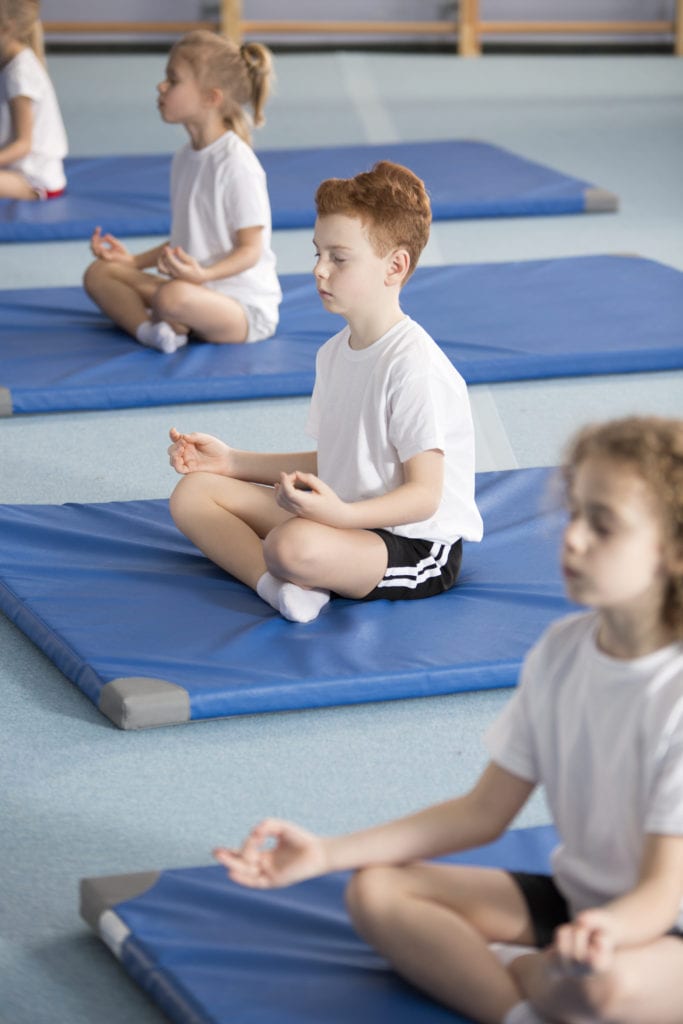
There are a number of ways to introduce children to mindfulness. One activity that children have responded positively to is being challenged to sit still and silent for as long as they possibly can. I have used this strategy in classrooms of children from pre-k to high school, as well as individually with children of all ages. Sometimes they are able to sit for 15 seconds, but they embraced the challenge of trying to beat their record by trying it again. Another mindful technique that works well with children is called “grounding.” Grounding techniques use the five senses to bring ourselves into the present moment. One grounding technique is finding five things in the room – they can be 5 things of the same color or any five things; four things the child can feel; three things the child can hear; two things the child can smell; and one thing the child can taste. Mindfulness can be playful and fun for children and families while effectively reducing stress, improving coping skills, improving ability to self-regulate and building resilience in children.


Helpful resources for families:

Mindful Games Activity Cards: 55 Fun Ways to Share Mindfulness with Kids and Teens. Susan Kaiser Greenland and Annaka Harris

A Still Quiet Place: A Mindfulness Program for Teaching Children and Adolescents to Ease Stress and Difficult Emotions By Amy Salzman, MD

I am Peace: A Book of Mindfulness By Susan Verde and Peter H. Reynolds

Breathe Like a Bear: 30 Mindful Moments for Kids to Feel Calm and Focused Anytime, Anywhere By Kira Willey


References:

Britton, W. B., Lepp, N. E., Niles, H. F., Rocha, T., Fisher, N. E., & Gold, J. S. (2014). A randomized controlled pilot trial of classroom-based mindfulness meditation compared to an active control condition in sixth-grade children. Journal of School Psychology, 52(3), 263-278.

Masten, A. S., Best, K. M., & Garmezy, N. (1990). Resilience and development: Contributions from the study of children who overcome adversity. Development and psychopathology, 2(4), 425-444.

Schonert-Reichl, K. A., Oberle, E., Lawlor, M. S., Abbott, D., Thomson, K., Oberlander, T. F., & Diamond, A. (2015). Enhancing cognitive and social–emotional development through a simple-to-administer mindfulness-based school program for elementary school children: A randomized controlled trial. Developmental psychology, 51(1), 52.

Schonert-Reichl, K. A., & Lawlor, M. S. (2010). The effects of a mindfulness-based education program on pre-and early adolescents’ well-being and social and emotional competence. Mindfulness, 1(3), 137-151.

Sibinga, E. M., Webb, L., Ghazarian, S. R., & Ellen, J. M. (2016). School-based mindfulness instruction: an RCT. Pediatrics, 137(1), e20152532.


About the Author

Dr. Cynthia Hess recently graduated from Rivier University with a PsyD in Counseling and School Psychology. Previously, she earned an M.A. from Antioch New England in Applied Psychology. She also worked as an elementary school counselor and school psychologist for 15 years before embarking on her doctorate. During her doctorate, she did her pre-doctoral internship with RIT in Rochester, N.Y. where she worked with youth ages 5-17 who had experienced complex developmental trauma. Dr. Hess’s first post-doctoral fellowship was with The Counseling Center of New England where she provided psychotherapy and family therapy to children ages 5-18, their families and young adults. She also trained part-time with a pediatric neuropsychologist conducting neuropsychological evaluations. Currently, Dr. Hess is a second-year post-doctoral fellow in pediatric neuropsychological assessment, working with NESCA Londonderry’s Dr. Angela Currie and Dr. Jessica Geragosian.


To schedule an appointment with one of NESCA’s expert neuropsychologists, please complete our online intake form


Neuropsychology & Education Services for Children & Adolescents (NESCA) is a pediatric neuropsychology practice and integrative treatment center with offices in Newton and Plainville, Massachusetts, and Londonderry, New Hampshire, serving clients from preschool through young adulthood and their families. For more information, please email info@nesca-newton.com or call 617-658-9800.


Skip to content