NESCA’s Newton, MA location has immediate availability for neuropsychological evaluations. Our MA clinicians specialize in the following evaluations: Neuropsychological; Autism; and Emotional and Psychological, as well as Academic Achievement and Learning Disability Testing.

Visit www.nesca-newton.com/intake for more information or to book an evaluation.

Tag

NESCA Archives - Page 28 of 34 - NESCA

Subscribe to NESCA Notes

“Doomscrolling” and Creating Space for Gratitude

By | NESCA Notes 2020

By: Cynthia Hess, PsyD
Pediatric Neuropsychologist Fellow and Therapist

A recent article in the New York Times (July 15, 2020) discusses a newly coined term for a coping strategy that has become pervasive amidst all the uncertainty: “Doomscrolling.” In the article, doomscrolling is defined as, “…the experience of sinking into emotional quicksand while bingeing on doom-and-gloom news.” It has become so common, it has a name.

We are collectively experiencing a great deal of anticipatory anxiety, which occurs when we feel anxious or stressed about an event that will happen in the future. We know there will be an event, but we do not know when or what that event will be. For those who participate in doomscrolling, perhaps it is an effort to find a sense of certainty. If we know what is coming next, it helps us feel more in control. However, while doomscrolling may provide a short-term sense of control, like many maladaptive ways of coping, it will eventually take a toll on our mental and physical well-being. Several wonderful suggestions are offered in the article and a follow-up piece to deal with doomscrolling. Another positive strategy for coping with anxiety and stress is practicing gratitude.

According to the National Institutes of Health, early research suggests that a daily habit of practicing gratitude may improve emotional and physical health. Practicing gratitude reduces stress and anxiety by regulating stress hormones in the brain. It also enhances the production of dopamine and serotonin, two neurotransmitters responsible for our emotions and sense of well-being. Practicing gratitude can be as simple as taking a moment to appreciate a good cup of coffee or a refreshing breeze on a hot day. There are many ways to create space for gratitude:

  • Take a few moments each day to write down as many things as you can that you are grateful for
  • Try to notice positive moments as they are happening
  • Compliment yourself each day and say it out loud
  • Keep a gratitude journal that includes: Compliments that you give yourself, current challenges and what you are learning, people you are grateful for, and significant assets of your life right now.
  • Start a gratitude jar with your family where each person writes one thing they are grateful for that day on a slip of paper and adds it to the jar. The notes can be read aloud at the start of each new week.

For further reading check out these articles:

https://www.nytimes.com/2020/07/15/technology/personaltech/youre-doomscrolling-again-heres-how-to-snap-out-of-it.html

https://www.nytimes.com/2020/07/16/technology/coronavirus-doomscrolling.html?searchResultPosition=2

https://positivepsychology.com/neuroscience-of-gratitude.


About the Author

Dr. Cynthia Hess recently graduated from Rivier University with a PsyD in Counseling and School Psychology. Previously, she earned an M.A. from Antioch New England in Applied Psychology. She also worked as an elementary school counselor and school psychologist for 15 years before embarking on her doctorate. During her doctorate, she did her pre-doctoral internship with RIT in Rochester, N.Y. where she worked with youth ages 5-17 who had experienced complex developmental trauma. Dr. Hess’s first post-doctoral fellowship was with The Counseling Center of New England where she provided psychotherapy and family therapy to children ages 5-18, their families and young adults. She also trained part-time with a pediatric neuropsychologist conducting neuropsychological evaluations. Currently, Dr. Hess is a second-year post-doctoral fellow in pediatric neuropsychological assessment, working with NESCA Londonderry’s Dr. Angela Currie.


To schedule an appointment with one of NESCA’s expert neuropsychologists, please complete our online intake form


Neuropsychology & Education Services for Children & Adolescents (NESCA) is a pediatric neuropsychology practice and integrative treatment center with offices in Newton and Plainville, Massachusetts, and Londonderry, New Hampshire, serving clients from preschool through young adulthood and their families. For more information, please email info@nesca-newton.com or call 617-658-9800.


Interoception: Helping Children Develop their “Hidden Sense”

By | NESCA Notes 2020

By: Sophie Bellenis, OTD, OTR/L

Occupational Therapist; Real-life Skills Program Manager and Coach

In our last OT Tuesday, we reviewed the sense of interoception, the ability to perceive information coming from inside the body. From basic human experiences, such as hunger and fatigue, to more complex internal emotions, such as anxiety and fear, interoception allows us to perceive and understand the sensations coming from our own bodies. As with other senses, this sense develops as children grow and, like the rest of us, will all have varied abilities. Some of our kids are naturally in tune with their bodies – they take to potty training without a hitch, recognize when they need a snack or a drink of water, and intuitively understand what their bodies are trying to tell them. Unsurprising, these exceptionally well regulated kids are not the majority, and most of our children benefit from some guidance, modelling and direct education on how to interpret the signals and sensations they are experiencing. Let’s discuss some tips and strategies for helping children to perceive, understand and appropriately respond to this internal information. Many of these tips are simple ideas to build into daily life and ways to take advantage of naturally occurring teachable moments.

Language – Incorporating language that teaches children to acknowledge internal cues and body sensations helps them to naturally and consistently notice the clues they are receiving from their bodies.

  • Verbally describe the choices that you make based on your own sense of interoception.
    • “I am going to put on a jacket because when I stepped outside this morning, I felt really cold.”
    • “My mouth feels dry and I’m starting to get a bit of a headache, I am going to have some water because my body is telling me that I am thirsty.”
  • Link requests that your child makes to how they may be feeling inside.
    • “You asked me for a snack. Are you hungry? How is your belly telling you that you’re hungry?”
  • Point out physical clues that hint at internal sensations.
    • “I notice you are having a hard time keeping your eyes open. That tells me you are feeling tired.”
    • “You are crossing your legs and dancing around a bit while you are coloring that picture. I think that your body is giving signals that you have to pee. It is important to pay attention to those signals so that you don’t wet your pants.”

Activities

  • Check Your Pulse! – Have your child sit quietly and teach them how to feel their pulse or heartbeat. Ask them to describe it – is it slow, fast, moving, hitting their fingers, etc.? Then have them run in place and do the same thing. How has it changed? Have them describe it now. Once children understand how their heartrate may be affected by physical activity, a next step would be pointing out that strong emotions, such as anger or excitement, can also affect one’s heartrate. This is a simple activity that provides some biofeedback and teaches children how their actions can affect their bodies.
  • Mindfulness – Zen Master, Thich Nhat Hanh defines mindfulness by stating, “Mindfulness shows us what is happening in our bodies, our emotions, our minds, and in the world.” While not all mindfulness activities focus on interoception, many of the principles and activities build this skill. If you are looking for some resources to work on mindfulness with your child, explore these sites: org, susankaisergreenland.org, mindful.org, and drchristopherwillard.com. Additionally, consider some apps to use with your child: Mindful Powers, Smiling Mind, Breathe Think Do with Sesame and Headspace.
  • Breathing exercises – Breathing exercises are common in mindfulness and can help children to relax. If apps are not for you, consider researching breathing exercises, such as: five-finger breathing, lazy 8 breathing or bumblebee breathing.
  • Progressive muscle relaxation – This practice involves alternating tension and relaxation in different muscle groups in the body. Dr. Monica Fitzgerald provides an excellent script to use with children working to relax here. If you are interested in exploring this practice with children with disabilities, many resources can be found at org.
  • Yoga – Yoga focuses on intentionally moving the body, pairing body movement and breathing, and increasing the mind-body connection. There are many apps and online videos that make yoga accessible to children. Some options include Simply Yoga, Gaia.com and Cosmic Kids Yoga. For some of our children who may need yoga broken down and presented differently, consider com or childlightyoga.com.


About the Author

Dr. Sophie Bellenis is a Licensed Occupational Therapist in Massachusetts, specializing in educational OT and functional life skills development. Dr. Bellenis joined NESCA in the fall of 2017 to offer community-based skills coaching services as a part of the Real-life Skills Program within NESCA’s Transition Services team. Dr. Bellenis graduated from the MGH Institute of Health Professions with a Doctorate in Occupational Therapy, with a focus on pediatrics and international program evaluation. She is a member of the American Occupational Therapy Association, as well as the World Federation of Occupational Therapists. Having spent years delivering direct services at the elementary, middle school and high school levels, Dr. Bellenis has extensive background with school-based occupational therapy services.  She believes that individual sensory needs and visual skills must be taken into account to create comprehensive educational programming.

To book an appointment or to learn more about NESCA’s Occupational Therapy Services, please fill out our online Intake Form, email info@nesca-newton.com or call 617-658-9800.


Neuropsychology & Education Services for Children & Adolescents (NESCA) is a pediatric neuropsychology practice and integrative treatment center with offices in Newton, Massachusetts, Plainville, Massachusetts, and Londonderry, New Hampshire, serving clients from preschool through young adulthood and their families. For more information, please email info@nesca-newton.com or call 617-658-9800.


Coronavirus & Social Injustice: A Crisis or an Opportunity? – Part 2

By | NESCA Notes 2020

By Dot Lucci, M.Ed., CAGS

Director of Consultation and Psychoeducational Services, NESCA

Last week in my blog post, I wrote about one’s perspective about the coronavirus as an opportunity or as a crisis. Initially, most everyone thought it was a crisis and we needed to mobilize to fight it. Massachusetts Governor Charlie Baker recognized it as a crisis early on and has handled it with steadfastness and clarity; whether or not you agree with his decisions. Recently, he mobilized a commission to discuss the re-opening of schools in the fall. This commission has stakeholders from across the Commonwealth, including parents, business leaders, community leaders, educators and administrators. As part of guidance on the reopening of schools, Governor Baker and the Massachusetts Department of Elementary and Secondary Education (DESE) told school district administrators to plan for three scenarios of returning to school in the fall: in-person, a hybrid of remote and in-person, and all remote learning. The districts were given deadlines to submit their plans – a daunting task for all involved. But this pandemic has created many daunting tasks for all of us, and we must come together thinking flexibly, creatively and collaboratively to handle this crisis and move towards thinking about it as an opportunity. Our world as we know it and much of the workings of our world have changed and probably will remain changed for the foreseeable future (i.e., open floor offices are a thing of the past; working from home is proving for some to be more productive).

We are all in this together and when parents, students, teachers and administrators think about the return to in-person instruction in the fall, it brings about many different emotions as well as concerns. Administrators have to plan for all three scenarios, because there are so many unknown variables to consider. For instance, we could start in-person learning then need to switch to remote if there is an uptick in positive cases of the coronavirus. School re-entry in the fall is an unknown, but our leaders are trying to plan as best they can for all possibilities. Ultimately, returning to in-person learning will be a personal decision for every parent based on many variables for each of their children. What’s good for one child may not be good for another in the same family, let alone one family to another.

I wonder about viewing the coronavirus and the havoc it’s wreaked on our educational systems as a genuine opportunity to truly rethink how we educate students. Maybe it is seriously time to consider dramatic school reform. Our education system is antiquated and has not changed much over the years even with the advent of STEAM. We still have achievement gaps with many students not succeeding even with reforms and many dollars spent. Maybe the coronavirus and the social injustice movement are just the crises that are the opportunity that will really change how we think about education, bringing about dynamic and dramatic school reform.

In last week’s blog, I quoted John F. Kennedy as saying, “The Chinese use two brush strokes to write the word ‘crisis.’ One brush stroke stands for danger; the other for opportunity. In a crisis be aware of the danger – but recognize the opportunity.” The coronavirus and social injustice are certainly crises of today, yet I do see them as an opportunity to heal the divisions in our country, increase dialogue and create change.

Last week Massachusetts DESE Commissioner Riley’s Weekly Update included “Protocols for Responding to COVID-19 Scenarios.” This guidance provides more information and protocols to answer the following questions:

  • What should a district do if there is a symptomatic individual – at home, on the bus or at school?
  • What should a district do if someone in the school community tests positive for COVID-19 – be it a student, teacher, staff, bus driver, or one of their household members or close contacts?
  • Who should get tested for COVID-19 and when?
  • In what circumstances would someone need to quarantine (when they have been exposed but are not sick) or isolate (when they are sick)?
  • What should school districts do to monitor COVID-19 spread in their communities?”

These guidelines may change as the situation changes, but as they stand now. I have heard a variety of responses to these guidelines, such as:

  • “This makes my head hurt and eyes blur.”
  • “They have got to be joking.”
  • “It’s an attempt. They’re trying.”
  • “Kids have to go back some day.”
  • “Deep breaths and an open mind are needed.”
  • “We’re all in this together. We have to try.”

As these comments demonstrate, there are many different feelings and thoughts about going back to in-person instruction in the fall. Our administrators and leaders are juggling so many different variables in making decisions. It “requires” us to trust them and show concern, compassion and gratitude in their attempts at re-opening schools. I recognize the three options presented are just that – three options. No matter what the decisions are about how we return to school, it will be what it will be in each community.

It is my hope that our leaders can view this pandemic, this crisis, as an opportunity to seriously contemplate and delve deeply into discussions about school reform within our country. This pandemic has dramatically shown the inequities that exist across our state and country and in our cities and towns. We knew they were there before, but now they are in our faces. We have an opportunity to think about education as not related to one’s zip code, socio-economic status, color of one’s skin/ethnicity or other factors; instead we can think about it as a basic human right that should be equal for all.

Education is about preparing children to become a competent member of our society and community. We have an opportunity to think about how and where we educate students. Education is about learning and preparing students for tomorrow. Many districts that were socially-emotionally-focused and had good technology capabilities were able to be nimble and pivoted smoothly to remote learning during the pandemic. These districts also had good leadership, solid communication with families and students, and staff felt cared for. There were many other districts that struggled to pivot to remote learning for a myriad of reasons, and this points out that equity in our educational system is necessary. So, while you think about the fall and schools reopening, do what you think is right for your child and family. Also, remember that this “new normal” of remote learning can be okay if done well.

In the special education vernacular, you often hear that special education isn’t a place or a program. That is also true for all education – education isn’t a place. It is so much more. The Center for Education Reform states that the future of schools is students, not systems. This might be a good time to devote some energy to reforming our educational system for the future.


About the Author

NESCA’s Director of Consultation and Psychoeducational Services Dot Lucci has been active in the fields of education, psychology, research and academia for over 30 years. She is a national consultant and speaker on program design and the inclusion of children and adolescents with special needs, especially those diagnosed with Autism Spectrum Disorder (ASD). Prior to joining NESCA, Ms. Lucci was the Principal of the Partners Program/EDCO Collaborative and previously the Program Director and Director of Consultation at MGH/Aspire for 13 years, where she built child, teen and young adult programs and established the 3-Ss (self-awareness, social competency and stress management) as the programming backbone. She also served as director of the Autism Support Center. Ms. Lucci was previously an elementary classroom teacher, special educator, researcher, school psychologist, college professor and director of public schools, a private special education school and an education collaborative.

Ms. Lucci directs NESCA’s consultation services to public and private schools, colleges and universities, businesses and community agencies. She also provides psychoeducational counseling directly to students and parents. Ms. Lucci’s clinical interests include mind-body practices, positive psychology, and the use of technology and biofeedback devices in the instruction of social and emotional learning, especially as they apply to neurodiverse individuals.


To book a consultation with Ms. Lucci or one of our many expert neuropsychologists, complete NESCA’s online intake form. Indicate whether you are seeking an “evaluation” or “consultation” and your preferred clinician/consultant in the referral line.


Neuropsychology & Education Services for Children & Adolescents (NESCA) is a pediatric neuropsychology practice and integrative treatment center with offices in Newton, Massachusetts, Plainville, Massachusetts, and Londonderry, New Hampshire, serving clients from preschool through young adulthood and their families. For more information, please email info@nesca-newton.com or call 617-658-9800.


Processing Speed Deficits and College – Part 1 – The Dilemma

By | NESCA Notes 2020

By: Kelley Challen, Ed.M., CAS
Director of Transition Services; Transition Specialist

By nature, transition specialists are generalists—professional who support students with a wide range of disabilities in moving toward an even wider range of learning and life outcomes. Working in Massachusetts, with an early background as a guidance counselor in a college preparatory high school, I often support students who are contemplating whether and when they should matriculate to a four-year college program. Many of these students experience processing speed deficits. This means that these students may be capable of reasoning at average or above average levels, and therefore being stimulated and actively engaged by college course content, but these students also need extra time to process visual and verbal information, to make sense of this information, and to produce output.

Landmark College in Putney, Vermont, assembled an assessment for parents and students—A Guide to Assessing College Readiness—that includes five areas considered essential for students with learning disabilities who want to succeed in a traditional college setting. These include academic skills, self-understanding, self-advocacy, executive function and motivation/confidence. Some of the academic items include being able to read up to 200 pages of college level text in a week, writing an organized 10-page paper that cites multiple sources, and being able to complete all of the steps of a long-term project in a timely manner. Within the assessment, it is carefully noted that this is not a diagnostic tool and is intended to inform discussion about the appropriate environment and supports that the student will need to achieve success and struggle less in college. So, when I recently received a question from a parent who was wondering if it actually mattered that her student was not able to read 100 pages in only a few days, the answer I provided was, “it depends.”

While there are many ways that we accommodate and modify instruction for students who have processing speed deficits during high school, some of these methods are easy to replicate across college environments and others are heavily dependent on the environment or only replicable with a good deal of external support provided by people and technologies. For example, in high school, students with significant processing speed deficits may be supported through accommodations, such as teachers reducing their pace of instruction, providing copies of instructional materials and/or fill-in-the-blank note-taking templates, actively following up with students to confirm their understanding of material, and actively assisting students in digesting complex reading materials. They may also receive modifications such as reducing the amount of work a student is expected to do per quarter or on a test and offering lighter or alternative reading. When all of these accommodations and modifications are added together, a student has a highly specialized high school experience and may be left with gaps in their academic, executive functioning and self-advocacy skills that need to be carefully bridged when the student aspires to participate in college learning.

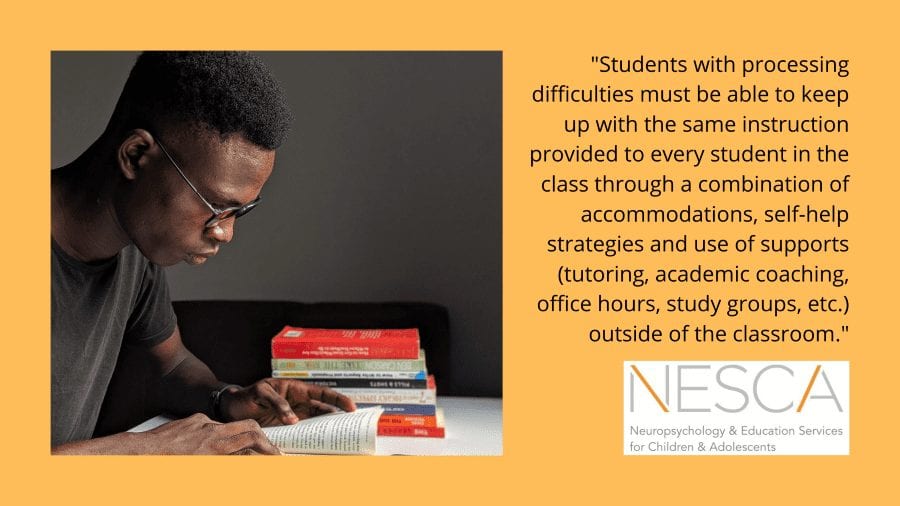
While high school accommodations and modifications center on supporting a student to successfully make progress in school, accommodations at the college level focus exclusively on what a student needs to be able to access the instruction that is already available at that college. Rather than individually modifying the curriculum or work load in a college course, a student must be able to keep up with the same instruction provided to every student in the class and the same requirements as every student in the college through a combination of accommodations, self-help strategies and use of supports (tutoring, academic coaching, office hours, study groups, etc.) outside of the classroom. Accommodations are still very individualized, but educational programming is typically not. This makes the college search and selection process complex and important for students with processing speed deficits. Not every college that specializes in supporting students who face learning difficulties is a good choice for a student with slow processing speed. And not every student with a processing speed deficit has the same skills, or faces the exact same challenges, when navigating college.

Stay tuned for our next Transition Thursday blog where I will elaborate on some of the common modifications and accommodations provided to high school students with processing speed deficits and how to think critically about college selection, support and accommodation based on experience with those accommodations.


About the Author:

Kelley Challen, Ed.M., CAS, is NESCA’s Director of Transition Services, overseeing planning, consultation, evaluation, coaching, case management, training and program development services. She is also the Assistant Director of NESCA, working under Dr. Ann Helmus to support day-to-day operations of the practice. Ms. Challen began facilitating programs for children and adolescents with special needs in 2004. After receiving her Master’s Degree and Certificate of Advanced Study in Risk and Prevention Counseling from Harvard Graduate School of Education, Ms. Challen spent several years at the MGH Aspire Program where she founded an array of social, life and career skill development programs for teens and young adults with Asperger’s Syndrome and related profiles. She additionally worked at the Northeast Arc as Program Director for the Spotlight Program, a drama-based social pragmatics program, serving youth with a wide range of diagnoses and collaborating with several school districts to design in-house social skills and transition programs. Ms. Challen is co-author of the chapter “Technologies to Support Interventions for Social- Emotional Intelligence, Self-Awareness, Personality Style, and Self-Regulation” for the book Technology Tools for Students with Autism. She is also a proud mother of two energetic boys, ages six and three. While Ms. Challen has special expertise in supporting students with Autism Spectrum Disorders, she provides support to individuals with a wide range of developmental and learning abilities, including students with complex medical needs.

Neuropsychology & Education Services for Children & Adolescents (NESCA) is a pediatric neuropsychology practice and integrative treatment center with offices in Newton, Massachusetts, Plainville, Massachusetts, and Londonderry, New Hampshire, serving clients from preschool through young adulthood and their families. For more information, please email info@nesca-newton.com or call 617-658-9800.

Coronavirus & Social Injustice: A Crisis or an Opportunity? – Part 1

By | NESCA Notes 2020

By Dot Lucci, M.Ed., CAGS

Director of Consultation and Psychoeducational Services, NESCA

As our leaders try to handle the crises of today, we can be angry or pleased at their attempt. I know I’ve been both, but yet recognize that they are trying to make tough decisions while taking into consideration many uncontrollable variables. In making these tough decisions (i.e. opening/shutting down schools, stay at home orders, managing protesters, etc.), it is almost impossible to please everyone. As the days turn into months, panic, anger, guilt and irrational thinking won’t work for us as individuals nor as a community. Instead it would behoove us to come together, show care, concern, empathy and gratitude toward each other. Recognizing that the divisions that exist amongst us are what keeps us fighting, in fear and not working towards common goals. We must acknowledge our differences, yet come together to be problem solvers and be optimists to handle the crises of the coronavirus and the social injustice that is plaguing our cities and impacting our children.

John F. Kennedy was quoted as saying, “The Chinese use two brush strokes to write the word ‘crisis.’ One brush stroke stands for danger; the other for opportunity. In a crisis be aware of the danger – but recognize the opportunity.” The coronavirus is most certainly a daunting, unprecedented crisis that has befallen our country and our world.

In March, our lives changed dramatically as schools in Massachusetts were shut down and we were told to quarantine. Now five months later, we begin to reopen. Now, I wonder if we can look at this crisis a bit differently – maybe as an opportunity. But an opportunity for what? Seeing a crisis as an opportunity takes courage and faith and requires a peace of mind that is rooted in a sense of calm, not fear. This allows creative and flexible thinking to emerge. We become problem solvers. As days turned into months of quarantine and we tried to “settle into the new normal and go with the flow,” my hope is that some of the initial panic and fear has subsided slightly in your hearts and minds. Maybe new rhythms or routines have been created – we’re commuting less, enjoying time with family, cleaning the basement, cooking more, etc. Some opportunities have arisen whether we’ve noticed them or not and whether we’ve liked them or not. Do you think you’re ready to think differently about this crisis? Can you find moments in each day that arise because of the crisis that open up opportunities or possibilities?

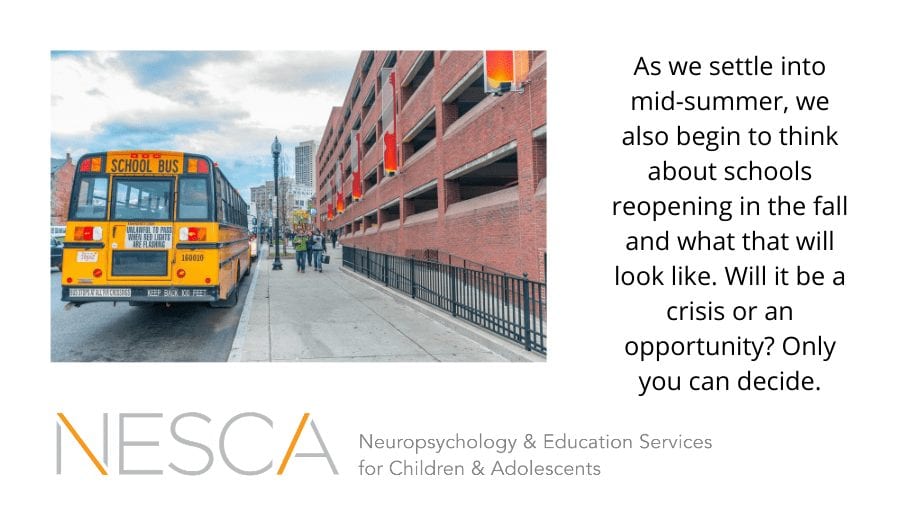
As we settle into mid-summer, we also begin to think about schools reopening in the fall and what that will look like. Will it be a crisis or an opportunity? Only you can decide.


About the Author

NESCA’s Director of Consultation and Psychoeducational Services Dot Lucci has been active in the fields of education, psychology, research and academia for over 30 years. She is a national consultant and speaker on program design and the inclusion of children and adolescents with special needs, especially those diagnosed with Autism Spectrum Disorder (ASD). Prior to joining NESCA, Ms. Lucci was the Principal of the Partners Program/EDCO Collaborative and previously the Program Director and Director of Consultation at MGH/Aspire for 13 years, where she built child, teen and young adult programs and established the 3-Ss (self-awareness, social competency and stress management) as the programming backbone. She also served as director of the Autism Support Center. Ms. Lucci was previously an elementary classroom teacher, special educator, researcher, school psychologist, college professor and director of public schools, a private special education school and an education collaborative.

Ms. Lucci directs NESCA’s consultation services to public and private schools, colleges and universities, businesses and community agencies. She also provides psychoeducational counseling directly to students and parents. Ms. Lucci’s clinical interests include mind-body practices, positive psychology, and the use of technology and biofeedback devices in the instruction of social and emotional learning, especially as they apply to neurodiverse individuals.


To book a consultation with Ms. Lucci or one of our many expert neuropsychologists, complete NESCA’s online intake form. Indicate whether you are seeking an “evaluation” or “consultation” and your preferred clinician/consultant in the referral line.


Neuropsychology & Education Services for Children & Adolescents (NESCA) is a pediatric neuropsychology practice and integrative treatment center with offices in Newton, Massachusetts, Plainville, Massachusetts, and Londonderry, New Hampshire, serving clients from preschool through young adulthood and their families. For more information, please email info@nesca-newton.com or call 617-658-9800.


Interoception: The “Hidden Sense”

By | NESCA Notes 2020

By: Sophie Bellenis, OTD, OTR/L

Occupational Therapist; Real-life Skills Program Manager and Coach

Conventionally, children are taught that there are five different senses, and that these senses help them to experience and understand the world around them. These five senses are sight, sound, smell, taste and touch. Clinically, we refer to these sensory systems as the visual, auditory, olfactory, gustatory and tactile systems. Each system provides unique information and works to alert the brain about the environment around them. Children all develop these systems differently, and all have unique preferences, strengths and interpretations of the world around them. As adults, a sommelier likely has an incredibly refined gustatory system, while a classical musician’s strength lies in their auditory system.

As knowledge about the human body continues to expand, two additional sensory systems have started to make their way into the common lexicon—the vestibular system and the proprioceptive system—both of which describe body awareness. The vestibular system gathers information from the inner ear and tells us where our body is in space. It monitors movement, acceleration and deceleration, balance and any changes in position. A gymnast uses this sense constantly as they flip across a mat or balance on the beam. The proprioceptive system gathers information from our muscles and joints and tells our brains about our position in space and any strength or force that we are using. Proprioception allows us to touch our noses with our eyes closed! These seven senses are all generally acknowledged and frequently assessed by occupational therapists. But what is interoception? And why is it referred to as the hidden sense?

Interoception refers to the perception of information coming from inside the body. Organ systems and the autonomic nervous system provide information about heart rate, hunger, thirst, temperature, respiration and even emotion (Vaitl, 1996). This sense of interoception helps us meet our most basic needs, such as knowing when we need food and water, realizing that it is time to use the restroom and putting on a jacket if it is cold outside. It also helps us to gain a more nuanced understanding of ourselves, such as realizing that an activity is making us anxious by acknowledging heightened heart rate and perspiration. This sensory system is often referred to as the “hidden sense,” because it is completely unique to each individual and no one knows exactly what someone else is feeling internally.

Children develop this sense slowly, with the most basic cues, such as hunger being recognized first. As they continue to grow, different internal signals are more easily understood and start to impact behavior. For example, around the age of two or three, most children start the process of potty training when they begin to recognize what it feels like to have a full bladder. As children continue to grow through their elementary, middle and high school years, this sense continues to be refined. As is expected, this is easier for some children than others.

Recent research shows that there is a strong connection between interoception and emotional/self-regulation. Individuals with low interoception often have more difficulty with both understanding and regulating their bodies and emotions (Zamariola et al., 2019). It appears that the ability to truly understand our body allows us to more intentionally control our responses. Luckily, as with other sensory systems, there are ways to increase interoceptive awareness and help children to notice the information that their bodies are feeding to their brains. In our next OT Tuesday blog, we will discuss some tips and strategies for helping children to perceive, understand and appropriately respond to this internal information.


References

Vaitl D. (1996). Interoception. Biol. Psychol. 42 1–27. 10.1016/0301-0511(95)05144-9

Zamariola G., Frost N., Van Oost A., Corneille O., Luminet O. (2019). Relationship between interoception and emotion regulation: new evidence from mixed methods. J Affect Disord  246:480–5. doi: 10.1016/j.jad.2018.12.101

About the Author

Dr. Sophie Bellenis is a Licensed Occupational Therapist in Massachusetts, specializing in educational OT and functional life skills development. Dr. Bellenis joined NESCA in the fall of 2017 to offer community-based skills coaching services as a part of the Real-life Skills Program within NESCA’s Transition Services team. Dr. Bellenis graduated from the MGH Institute of Health Professions with a Doctorate in Occupational Therapy, with a focus on pediatrics and international program evaluation. She is a member of the American Occupational Therapy Association, as well as the World Federation of Occupational Therapists. Having spent years delivering direct services at the elementary, middle school and high school levels, Dr. Bellenis has extensive background with school-based occupational therapy services.  She believes that individual sensory needs and visual skills must be taken into account to create comprehensive educational programming.

To book an appointment or to learn more about NESCA’s Occupational Therapy Services, please fill out our online Intake Form, email info@nesca-newton.com or call 617-658-9800.


Neuropsychology & Education Services for Children & Adolescents (NESCA) is a pediatric neuropsychology practice and integrative treatment center with offices in Newton, Massachusetts, Plainville, Massachusetts, and Londonderry, New Hampshire, serving clients from preschool through young adulthood and their families. For more information, please email info@nesca-newton.com or call 617-658-9800.


There Is No Wrong Decision

By | NESCA Notes 2020

By:  Alissa Talamo, Ph.D.
Pediatric Neuropsychologist

We are living in an unprecedented time. As such, parents are faced with decisions that they have never faced before. For example, families are facing the challenging decision about whether or not to send their children back to school for in-person classes in the middle of the COVID-19 pandemic. Parents have to wrestle with the idea that, on the one hand, sending children to school could increase the risk of COVID-19 among children and family members; while on the other hand, children who don’t return to in-person school may experience disruptions in their education and may miss out on the social interaction and community feeling within the school building. In addition, some families simply don’t have a choice because they need to go to work or a family member at home is immunocompromised.

What is most important is to recognize is that whether or not to send a child to school in the fall means something different to everybody. It is imperative that, as parents, you give yourself permission to feel whatever it is that you are feeling, and that you do what feels right for you and your family. It may be difficult to accept, but we have little control over much of what is happening around us right now. While it is important to acknowledge how you are feeling, it is equally important to remember that, in fact, any reactions are normal under the current circumstances.

How you respond to stress during the COVID-19 pandemic can depend on your background, your financial situation, your health and emotional background, your social support system, the community you live in and many other factors. When it comes to parenting, every day can be a challenge, and the coronavirus has made an already scary world feel even more menacing.  Remember to “ignore the noise” and give yourself credit for taking care of yourself and your family.


About the Author:

With NESCA since its inception in 2007, Dr. Talamo had previously practiced for many years as a child and adolescent clinical psychologist before completing postdoctoral re-training in pediatric neuropsychology at the Children’s Evaluation Center.

After receiving her undergraduate degree from Columbia University, Dr. Talamo earned her doctorate in clinical health psychology from Ferkauf Graduate School of Psychology and the Albert Einstein College of Medicine at Yeshiva University.

She has given a number of presentations, most recently on “How to Recognize a Struggling Reader,” “Supporting Students with Working Memory Limitations,” (with Bonnie Singer, Ph.D., CCC-SLP of Architects for Learning), and “Executive Function in Elementary and Middle School Students.”

Dr. Talamo specializes in working with children and adolescents with language-based learning disabilities including dyslexia, attentional disorders, and emotional issues. She is also interested in working with highly gifted children.

Her professional memberships include MAGE (Massachusetts Association for Gifted Education), IDA (International Dyslexia Association), MABIDA (the Massachusetts division of IDA) and MNS (the Massachusetts Neuropsychological Society).

She is the mother of one teenage girl.

To book a consultation with Dr. Talamo or one of our many other expert neuropsychologists, complete NESCA’s online intake form.

Neuropsychology & Education Services for Children & Adolescents (NESCA) is a pediatric neuropsychology practice and integrative treatment center with offices in Newton, Massachusetts, Plainville, Massachusetts, and Londonderry, New Hampshire, serving clients from preschool through young adulthood and their families. For more information, please email info@nesca-newton.com or call 617-658-9800.

YES! COVID-19 May be Making Basic Daily Tasks More Difficult: The Link Between Executive Function Difficulties and Anxiety/Stress

By | NESCA Notes 2020

By: Sophie Bellenis, OTD, OTR/L

Occupational Therapist; Real-life Skills Program Manager and Coach

As our country continues to adapt to life in the era of COVID-19, it is quite well established that there has been a rise in anxiety and stress among our population. According to the Centers for Disease Control and Prevention (CDC), the mental health effects of the current pandemic have been substantial and include difficulty sleeping, worsening chronic health problems, changes in eating patterns, fear about personal health and the health of loved ones, and increased use of tobacco and alcohol (CDC, 2020). Many of these fears and new challenges are expected and understandable. They are responses that intuitively make sense to us as humans, as many of us experience them on a small scale throughout a typical year. Most people can name a time when they could not fall asleep before a big test or did not take excellent care of their physical health when they were hugely stressed or anxious. However, one effect of this newly heightened stress and anxiety that is less frequently mentioned is the decrease in executive function skills.

The term executive function refers to the brain processes that allow someone to stay organized, initiate tasks, maintain focus and attention, and manipulative information in their mind. As NESCA Pediatric Neuropsychologist Dr. Alissa Talamo describes in her piece, “What is Executive Function?,” this group of skills can be thought of as the conductor of the brain, similar to the conductor of an orchestra. They are keeping time, telling us when to start and stop tasks and helping us to stay regulated through the ups and downs of the day. You may have noticed that through stay at home orders and social distancing regulations, organizing daily tasks has become increasingly difficult. You may find yourself missing calls or meeting times, forgetting to respond to emails or misplacing items that are usually easy to track. You are not alone. Some people have started to describe a brain fog and a perceived inability to stay focused on a task for more than a short period of time.

While maybe not as intuitive as a lack of sleep, this decrease in executive function is to be expected as we collectively move through this stressful experience. Substantial research has described the correlation between depression, anxiety and stress, and executive function deficits. This seems to be particularly strong for adolescents with depressive and anxious symptoms, who have trouble with cognitive flexibility (Han, Helm, Iucha, Zahn-Waxler & Hastings, 2016). Similarly, university students are another population vulnerable to these effects, as described by Ajilchi and Nejati in 2017, who found specific difficulties with sustained attention and decision making. It is no surprise that one diagnostic criteria for generalized anxiety disorder is “difficulty concentrating or mind going blank” (APA, 2013). When reviewing the literature, it is clear that the brain fog and inability to focus through COVID-19 is not only unsurprising, for many people, it was inevitable.

So, what do we do? How do we soldier on through this incredibly unique time, despite the feeling that everything takes just a bit more time and effort?

It is increasingly important to cut ourselves some slack and stop expecting perfection. Focusing on self-care and taking care of each other emotionally will potentially lead to a natural return to successful executive function. By creating habits and routines that promote positive mental health, we are more likely to mitigate the feelings of being overwhelmed and the potential for burnout. Additionally, using technology and digital reminders to help take over the tasks of initiation and organization can give our over-extended brains a bit of a rest.

Finally, it is imperative that we think about the adolescents and students in our communities who are just starting to build these skills. Building executive function skills comes from a combination of direct instruction and opportunity to practice. Currently, students are being provided ample opportunity to practice, with limited direct instruction and guidance. Consider teaching your children and adolescents the tricks that you have learned to stay organized, prepared and productive. If you feel like teaching these skills is outside of your wheelhouse, or at all daunting, look into the prospect of an executive function coach. With all of the uncertainty about what education will look like this fall, helping students feel ready to tackle learning is one way to mitigate the anxiety and stress of this transitional time.


References

Ajilchi, B., & Nejati, V. (2017). Executive Functions in Students with Depression, Anxiety, and Stress Symptoms. Basic and clinical neuroscience8(3), 223–232. https://doi.org/10.18869/nirp.bcn.8.3.223

American Psychiatric Association. (2013). Diagnostic and statistical manual of mental disorders (5th ed.). Arlington, VA: American Psychiatric Publishing.

Center for Disease Control and Prevention. (2020) Coronavirus disease 2019: Coping with stress. Retrieved from: https://www.cdc.gov/coronavirus/2019-ncov/daily-life-coping/managing-stress-anxiety.html

Han, G., Helm, J., Iucha, C., Zahn-Waxler, C., Hastings, P. D., & Klimes-Dougan, B. (2016). Are Executive Functioning Deficits Concurrently and Predictively Associated with Depressive and Anxiety Symptoms in Adolescents?. Journal of clinical child and adolescent psychology : the official journal for the Society of Clinical Child and Adolescent Psychology, American Psychological Association, Division 5345(1), 44–58. https://doi.org/10.1080/15374416.2015.1041592


About the Author

Dr. Sophie Bellenis is a Licensed Occupational Therapist in Massachusetts, specializing in educational OT and functional life skills development. Dr. Bellenis joined NESCA in the fall of 2017 to offer community-based skills coaching services as a part of the Real-life Skills Program within NESCA’s Transition Services team. Dr. Bellenis graduated from the MGH Institute of Health Professions with a Doctorate in Occupational Therapy, with a focus on pediatrics and international program evaluation. She is a member of the American Occupational Therapy Association, as well as the World Federation of Occupational Therapists. Having spent years delivering direct services at the elementary, middle school and high school levels, Dr. Bellenis has extensive background with school-based occupational therapy services.  She believes that individual sensory needs and visual skills must be taken into account to create comprehensive educational programming.

To book an appointment or to learn more about NESCA’s Occupational Therapy Services, please fill out our online Intake Form, email info@nesca-newton.com or call 617-658-9800.


Neuropsychology & Education Services for Children & Adolescents (NESCA) is a pediatric neuropsychology practice and integrative treatment center with offices in Newton, Massachusetts, Plainville, Massachusetts, and Londonderry, New Hampshire, serving clients from preschool through young adulthood and their families. For more information, please email info@nesca-newton.com or call 617-658-9800.


“Can I Hug You?” – Why the pandemic has us craving closeness

By | NESCA Notes 2020

By: Angela Currie, Ph.D.
Pediatric Neuropsychologist, NESCA
Director of Training and New Hampshire Operations

At the end of a testing session last week, my young client and I stood looking at each other through the large glass window of our contactless, adjoined testing rooms. Our hands were newly washed; the fresh scent of antibacterial wipes emitted from the tables; and our face coverings were in place. And while looking at one another from our respective bubbles, inside this necessarily sterile setting, my client looked me in the eye and asked: “Can I hug you?”

The question hung in the air for a moment. In the 15 years that I have worked with children, I have rarely hesitated when a child asks me this. But there we were, mid-pandemic, in this brief, perhaps imperceptible, moment of uncertainty.

One thing I have become keenly aware of since starting to see family and friends for socially distanced visits is how much I, and my children, have to consciously fight the physical urge to embrace the people we love. The urge is palpable. But where does this come from?

There is a great body of research demonstrating the importance of physical touch, particularly hugging. Hugs are not just a simply a way of demonstrating your love or support for someone, but hugging actually causes physiological changes within the body. Stress hormones, such as cortisol, reduce, and the nervous system slows down. Oxytocin – a hormone integral to bonding – is released, increasing closeness and affection. Over time, close physical contact results in improved brain development, heart health, emotional health, relationship patterns and immune function.

In many ways, physical touch is a basic human need that must be met. Individuals who are deprived of these experiences, particularly early in life, can experience detrimental effects. Fortunately, some of these effects can be mitigated once opportunities for closeness are offered. As such, our bodies and brains never fully give up on the urge for closeness, even after long durations of it being unmet. And this urge has a name – skin hunger.

Most people have felt skin hunger at some point – a driving urge for human contact and connection. This may come after a particularly stressful day at work, an argument with a friend or just a general feeling of loneliness. In times of uncertainty, distress or instability, the human need for closeness increases. And yet, for so many who are enduring the COVID-19 pandemic, closeness is the exact thing that they are being deprived of. Even when we are lucky enough to still have access to our families, or perhaps a small group of close friends, our emotional needs are high. Physiologically, psychologically, we need more hugs.

The good news is, there are things that you can do to meet this need:

  • Consciously make an effort to hug those you can, and do it more often than typical.
  • Snuggle up with your dog, your cat or other pet of choice.
  • For those who live alone and do not have pets, a weighted blanket, warm bath or hugging a pillow can simulate the effects of human touch.
  • Maintain social connection through video chat, phone calls and socially distanced visits. Interpersonal contact without hugging is better than no contact.
  • Be careful to not accidentally over-associate hugs or touch with danger. Coronavirus will eventually be managed, but training our children to fear closeness could have enduring, negative effects. Choose words wisely, teaching pragmatic, unemotional caution, not fear.


About the Author:

Dr. Angela Currie is a pediatric neuropsychologist at NESCA. She conducts neuropsychological and psychological evaluations out of our Londonderry, NH office. She specializes in the evaluation of anxious children and teens, working to tease apart the various factors lending to their stress, such as underlying learning, attentional, or emotional challenges. She particularly enjoys working with the seemingly “unmotivated” child, as well as children who have “flown under the radar” for years due to their desire to succeed.


To book an evaluation with Dr. Currie or one of our many other expert neuropsychologists, complete NESCA’s online intake form. Indicate whether you are seeking an “evaluation” or “consultation” and your preferred clinician in the referral line.


Neuropsychology & Education Services for Children & Adolescents (NESCA) is a pediatric neuropsychology practice and integrative treatment center with offices in Londonderry, NH, Plainville, MA, and Newton, MA serving clients from preschool through young adulthood and their families. For more information, please email info@nesca-newton.com or call (603) 818-8526.

Transition Planning Timelines for Students with Disabilities

By | NESCA Notes 2020

By: Kelley Challen, Ed.M., CAS
Director of Transition Services; Transition Specialist

When families come to NESCA for transition support, a common request is to work with a transition specialist to create a detailed step-by-step transition plan with action items and deadlines that will ensure their child makes a successful transition to postsecondary adulthood. As you can imagine, many hours are needed to create an appropriate plan individualized to the student—their goals and their needs—and this plan requires frequent updating as students progress toward adulthood, have new experiences, stumble at new hurdles and make developmental leaps. However, for families who are interested in creating an individualized transition timeline plan for their student at home, there are a number of readymade timelines and checklists that can be used as starting points. While I am presenting several options below, I would encourage picking the one that you like best and that fits your child best, and using that as a foundation for your planning. Please note that even though the resources below that have been assembled by agencies who specifically support individuals with autism and are therefore described as focusing on autism spectrum disorder (ASD), they may still be important for individuals with other disabilities to review.

Transition from School to Adult Life – Time Lines, by The Arc of Massachusetts, is a two-page brochure that includes bulleted timeline recommendations for students ages 13-22

A Resource Guide for Transition Aged Youth and Young Adults with Autism Spectrum Disorder (ASD), by the Autism Commission, is a 12-page pamphlet compiled to help families and individuals in the state of Massachusetts to better understand the resources available for students aged 14-22 with ASD. If viewing this pamphlet online, it is important to closely follow the page numbers. The Transition Timeline starts on page two and continues through page four.

Transitioning teens with autism spectrum disorders: Resources and timeline planning for adult living, by the Autism Consortium, is a 73-page guide intended to provide resources and information for parents and guardians of children with ASDs in Massachusetts. Pages 64-70 outline critical timelines related to education, guardianship, housing, postsecondary education, employment, healthcare, recreation and more for students ranging from age 11-22.

A Family Guide to Transition Services in Massachusetts, published by the Massachusetts Rehabilitation Commission (MRC) in collaboration with the Federation for Children with Special Needs (FCSN), is a 44-page guide intended to assist parents, students and professionals in understanding the requirements of transition services for all individuals with disabilities that are eligible for special education in Massachusetts. Pages 22-23 offer an easy-to-read timeline covering important steps for youth ages 14-18.

Important Transition Information Every Family Should Know: Transition Information Fact Sheets, by the Massachusetts Department of Developmental Services, is a 44-page compilation of fact sheets with important information for all families of individuals with developmental disabilities in Massachusetts. The fifth fact sheet, on page 9, is a simple but detailed visual timeline covering steps for students ages 14-22.

Turning 18 Checklist, by Autism Housing Pathways, is not a timeline! But it is a detailed and continually updated three-page document with a checklist of critical steps to take when a student with a disability turns 18 as well as a list of useful transition resources that correlate with the checklist. While the document was created by Autism Housing Pathways, the checklist is applicable for many individuals who are turning 18 and who may be seeking human service supports and disability-related benefits.


If you are interested in working with a transition specialist at NESCA for consultation, coaching, planning or evaluation, please complete our online intake form: https://nesca-newton.com/intake-form/.


About the Author:

Kelley Challen, Ed.M., CAS, is NESCA’s Director of Transition Services, overseeing planning, consultation, evaluation, coaching, case management, training and program development services. She is also the Assistant Director of NESCA, working under Dr. Ann Helmus to support day-to-day operations of the practice. Ms. Challen began facilitating programs for children and adolescents with special needs in 2004. After receiving her Master’s Degree and Certificate of Advanced Study in Risk and Prevention Counseling from Harvard Graduate School of Education, Ms. Challen spent several years at the MGH Aspire Program where she founded an array of social, life and career skill development programs for teens and young adults with Asperger’s Syndrome and related profiles. She additionally worked at the Northeast Arc as Program Director for the Spotlight Program, a drama-based social pragmatics program, serving youth with a wide range of diagnoses and collaborating with several school districts to design in-house social skills and transition programs. Ms. Challen is co-author of the chapter “Technologies to Support Interventions for Social- Emotional Intelligence, Self-Awareness, Personality Style, and Self-Regulation” for the book Technology Tools for Students with Autism. She is also a proud mother of two energetic boys, ages six and three. While Ms. Challen has special expertise in supporting students with Autism Spectrum Disorders, she provides support to individuals with a wide range of developmental and learning abilities, including students with complex medical needs.

Neuropsychology & Education Services for Children & Adolescents (NESCA) is a pediatric neuropsychology practice and integrative treatment center with offices in Newton, Massachusetts, Plainville, Massachusetts, and Londonderry, New Hampshire, serving clients from preschool through young adulthood and their families. For more information, please email info@nesca-newton.com or call 617-658-9800.

Skip to content