

By: Sophie Bellenis, OTD, OTR/L
Occupational Therapist; Real-life Skills Program Manager and Coach
As our country continues to adapt to life in the era of COVID-19, it is quite well established that there has been a rise in anxiety and stress among our population. According to the Centers for Disease Control and Prevention (CDC), the mental health effects of the current pandemic have been substantial and include difficulty sleeping, worsening chronic health problems, changes in eating patterns, fear about personal health and the health of loved ones, and increased use of tobacco and alcohol (CDC, 2020). Many of these fears and new challenges are expected and understandable. They are responses that intuitively make sense to us as humans, as many of us experience them on a small scale throughout a typical year. Most people can name a time when they could not fall asleep before a big test or did not take excellent care of their physical health when they were hugely stressed or anxious. However, one effect of this newly heightened stress and anxiety that is less frequently mentioned is the decrease in executive function skills.
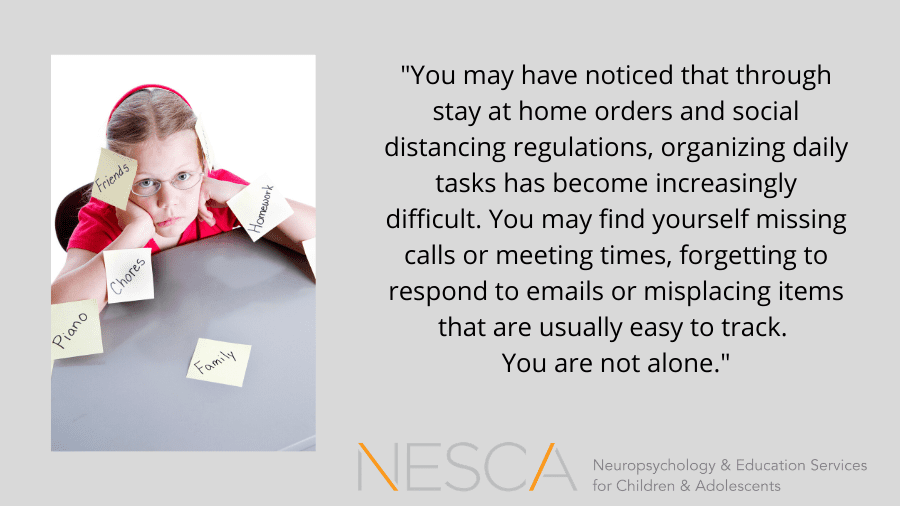
The term executive function refers to the brain processes that allow someone to stay organized, initiate tasks, maintain focus and attention, and manipulative information in their mind. As NESCA Pediatric Neuropsychologist Dr. Alissa Talamo describes in her piece, “What is Executive Function?,” this group of skills can be thought of as the conductor of the brain, similar to the conductor of an orchestra. They are keeping time, telling us when to start and stop tasks and helping us to stay regulated through the ups and downs of the day. You may have noticed that through stay at home orders and social distancing regulations, organizing daily tasks has become increasingly difficult. You may find yourself missing calls or meeting times, forgetting to respond to emails or misplacing items that are usually easy to track. You are not alone. Some people have started to describe a brain fog and a perceived inability to stay focused on a task for more than a short period of time.
While maybe not as intuitive as a lack of sleep, this decrease in executive function is to be expected as we collectively move through this stressful experience. Substantial research has described the correlation between depression, anxiety and stress, and executive function deficits. This seems to be particularly strong for adolescents with depressive and anxious symptoms, who have trouble with cognitive flexibility (Han, Helm, Iucha, Zahn-Waxler & Hastings, 2016). Similarly, university students are another population vulnerable to these effects, as described by Ajilchi and Nejati in 2017, who found specific difficulties with sustained attention and decision making. It is no surprise that one diagnostic criteria for generalized anxiety disorder is “difficulty concentrating or mind going blank” (APA, 2013). When reviewing the literature, it is clear that the brain fog and inability to focus through COVID-19 is not only unsurprising, for many people, it was inevitable.
So, what do we do? How do we soldier on through this incredibly unique time, despite the feeling that everything takes just a bit more time and effort?
It is increasingly important to cut ourselves some slack and stop expecting perfection. Focusing on self-care and taking care of each other emotionally will potentially lead to a natural return to successful executive function. By creating habits and routines that promote positive mental health, we are more likely to mitigate the feelings of being overwhelmed and the potential for burnout. Additionally, using technology and digital reminders to help take over the tasks of initiation and organization can give our over-extended brains a bit of a rest.
Finally, it is imperative that we think about the adolescents and students in our communities who are just starting to build these skills. Building executive function skills comes from a combination of direct instruction and opportunity to practice. Currently, students are being provided ample opportunity to practice, with limited direct instruction and guidance. Consider teaching your children and adolescents the tricks that you have learned to stay organized, prepared and productive. If you feel like teaching these skills is outside of your wheelhouse, or at all daunting, look into the prospect of an executive function coach. With all of the uncertainty about what education will look like this fall, helping students feel ready to tackle learning is one way to mitigate the anxiety and stress of this transitional time.
References
Ajilchi, B., & Nejati, V. (2017). Executive Functions in Students with Depression, Anxiety, and Stress Symptoms. Basic and clinical neuroscience, 8(3), 223–232. https://doi.org/10.18869/nirp.bcn.8.3.223
American Psychiatric Association. (2013). Diagnostic and statistical manual of mental disorders (5th ed.). Arlington, VA: American Psychiatric Publishing.
Center for Disease Control and Prevention. (2020) Coronavirus disease 2019: Coping with stress. Retrieved from: https://www.cdc.gov/coronavirus/2019-ncov/daily-life-coping/managing-stress-anxiety.html
Han, G., Helm, J., Iucha, C., Zahn-Waxler, C., Hastings, P. D., & Klimes-Dougan, B. (2016). Are Executive Functioning Deficits Concurrently and Predictively Associated with Depressive and Anxiety Symptoms in Adolescents?. Journal of clinical child and adolescent psychology : the official journal for the Society of Clinical Child and Adolescent Psychology, American Psychological Association, Division 53, 45(1), 44–58. https://doi.org/10.1080/15374416.2015.1041592
About the Author

Dr. Sophie Bellenis is a Licensed Occupational Therapist in Massachusetts, specializing in educational OT and functional life skills development. Dr. Bellenis joined NESCA in the fall of 2017 to offer community-based skills coaching services as a part of the Real-life Skills Program within NESCA’s Transition Services team. Dr. Bellenis graduated from the MGH Institute of Health Professions with a Doctorate in Occupational Therapy, with a focus on pediatrics and international program evaluation. She is a member of the American Occupational Therapy Association, as well as the World Federation of Occupational Therapists. Having spent years delivering direct services at the elementary, middle school and high school levels, Dr. Bellenis has extensive background with school-based occupational therapy services. She believes that individual sensory needs and visual skills must be taken into account to create comprehensive educational programming.
Neuropsychology & Education Services for Children & Adolescents (NESCA) is a pediatric neuropsychology practice and integrative treatment center with offices in Newton, Massachusetts, Plainville, Massachusetts, and Londonderry, New Hampshire, serving clients from preschool through young adulthood and their families. For more information, please email info@nesca-newton.com or call 617-658-9800.


 Londonderry, NH office. She specializes in the evaluation of anxious children and teens, working to tease apart the various factors lending to their stress, such as underlying learning, attentional, or emotional challenges. She particularly enjoys working with the seemingly “unmotivated” child, as well as children who have “flown under the radar” for years due to their desire to succeed.
 By:
By: 
 Erin Gibbons, Ph.D.


 Since we were very aware that some parents would not be comfortable with this model, we continued our exploration and education, landing on an innovative two-office model. The two-office set-up involves a four foot by eight foot clear plexiglass window to be installed between two offices. This allows for clear observation of the child by the evaluator, the ability for the child and evaluator to communicate with each other via a high-quality intercom system and for the evaluator to visually demonstrate activities that the child is asked to perform during testing. A parent helper can be allowed in the room with the child should they need support during the session. Again, many of the tests would be administered via an iPad, which is controlled by the evaluator in the adjoining room. All additional test materials are organized and arranged in the office where the child is prior to testing.
 NESCA’s two-office approach was piloted in our Londonderry, N.H. office by Dr. Angela Currie. Due to its maximum risk reduction for all parties and its similarity to the standard testing experience, NESCA expanded its testing capabilities with this model to the Newton office, where there are currently two of these testing areas available. While it does have some limitations, it is working very well with our families.
 neuropsychologist who has been practicing for almost 20 years. In 1996, she jointly founded the Children’s Evaluation Center (CEC) in Newton, Massachusetts, serving as co-director there for almost ten years. During that time, CEC emerged as a leading regional center for the diagnosis and remediation of both learning disabilities and Autism Spectrum Disorders.

 M.A. from Antioch New England in Applied Psychology. She also worked as an elementary school counselor and school psychologist for 15 years before embarking on her doctorate. During her doctorate, she did her pre-doctoral internship with RIT in Rochester, N.Y. where she worked with youth ages 5-17 who had experienced complex developmental trauma. Dr. Hess’s first post-doctoral fellowship was with The Counseling Center of New England where she provided psychotherapy and family therapy to children ages 5-18, their families and young adults. She also trained part-time with a pediatric neuropsychologist conducting neuropsychological evaluations. Currently, Dr. Hess is a second-year post-doctoral fellow in pediatric neuropsychological assessment, working with NESCA Londonderry’s
Connect with Us