NESCA’s Newton, MA location has immediate availability for neuropsychological evaluations. Our MA clinicians specialize in the following evaluations: Neuropsychological; Autism; and Emotional and Psychological, as well as Academic Achievement and Learning Disability Testing.

Visit www.nesca-newton.com/intake for more information or to book an evaluation.

Tag

Neuropsychological Evaluation Archives - Page 2 of 23 - NESCA

Subscribe to NESCA Notes

Image of an SAT and an ACT exam with a quote from Dr. Erin Gibbons

Don’t Miss Out: Planning Ahead for College Entrance Testing Accommodations

By | NESCA Notes 2025

Image of an SAT and an ACT exam with a quote from Dr. Erin GibbonsBy: Erin Gibbons, Ph.D. 
NESCA MA Clinical Director; Pediatric Neuropsychologist

If you’re the parent of a high schooler with a disability, you might be thinking ahead to college entrance exams like the ACT or SAT. These tests can be stressful for any student, but for those who need accommodations—such as extended time, additional breaks, or accessible testing formats—planning ahead is especially important. One of the most common pitfalls families encounter is missing the deadline to apply for accommodations. Here’s why you should check those deadlines now, and how to get started.

Why Accommodations Matter

Accommodations help level the playing field for students with disabilities, ensuring they have the support they need to demonstrate their potential. Whether your student has ADHD, a learning disability, anxiety, or another disability, the right accommodations can make a significant difference in their performance and confidence.

Deadlines Sneak Up Fast

Exams, such as the ACT, SAT, and Advanced Placement, require students to apply for accommodations well in advance of the test date—sometimes several months ahead. The process involves gathering documentation, working with your child’s school, and waiting for approval. If you miss the deadline, your student may have to take the test without the support they need or wait for the next test date.

Don’t Forget About Updated Evaluations

One important detail to keep in mind: the College Board and similar organizations require current documentation to support accommodation requests. If your student’s last neuropsychological evaluation is more than 2 years old, you will likely need to schedule an updated evaluation this fall.

What You Should Do Now

  • Check the official website for deadlines: https://accommodations.collegeboard.org/
  • Contact your school’s guidance counselor or learning support specialist
  • Gather documentation – most recent neuropsychological evaluation, current IEP or 504 Plan
  • Schedule updated neuropsychological testing if needed
  • Apply early! If the requested accommodations are not approved, you may need to start an appeal process, which can take a good amount of time to gather the required documentation or other materials.


About the Author

Since 2011, Dr. Gibbons has been a trusted expert at NESCA where she evaluates children presenting with a range of attentional, learning,Erin Gibbons headshot and developmental disabilities. She has a particular interest in children with autism spectrum disorders, intellectual disabilities, and those with complex medical histories. In addition, she evaluates adults who have concerns about whether they meet criteria for an ASD or ADHD diagnosis.

If you are interested in booking an evaluation with a NESCA neuropsychologist/clinician, please fill out and submit our online intake form

NESCA is a multidisciplinary practice with offices or staff in Newton, Hingham, and Plainville, Massachusetts; Londonderry, New Hampshire; the Burlington, Vermont region: and Coral Gables/Miami, Florida, serving clients from preschool through young adulthood and their families. For more information, please email info@nesca-newton.com or call 617-658-9800.

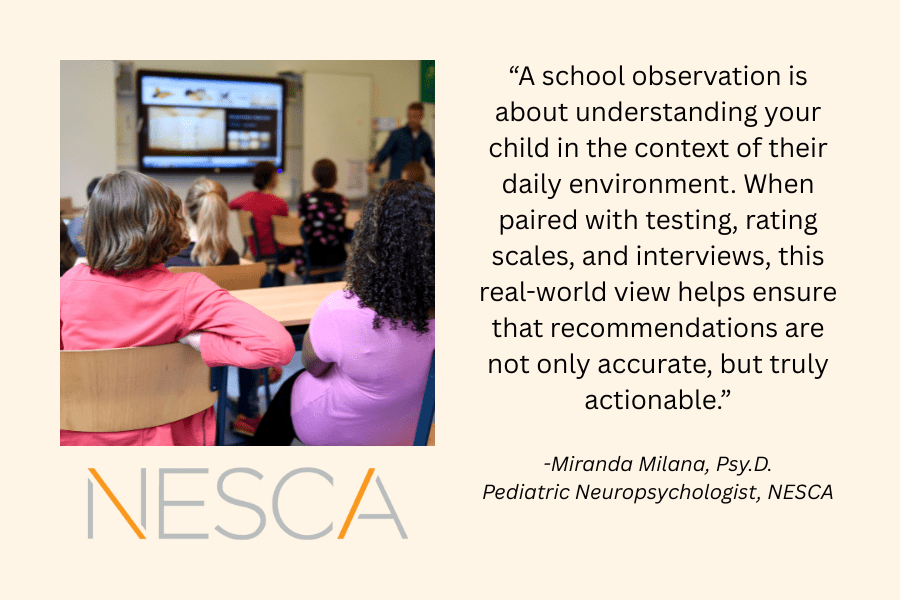
image of adults observing a school classroom

Why School Observations Matter in a Neuropsychological Assessment

By | NESCA Notes 2025

image of adults observing a school classroomBy Miranda Milana, Psy.D.
Pediatric Neuropsychologist

When families seek a neuropsychological evaluation for their child, it’s usually because they’re looking for a deeper, more comprehensive understanding of their child’s profile—including both strengths and challenges. This kind of evaluation helps answer important questions about how a child learns, thinks, manages emotions, and interacts with others.

By gaining this insight, we can better support a child in all areas of life—at school, at home, with friends, and in community settings. Sometimes, however, the most valuable piece of the puzzle doesn’t come from test scores at all.

In some cases, your neuropsychologist may determine that observing your child in their natural learning environment—a school observation—can provide crucial information that simply can’t be gathered in an office setting.

What Is a School Observation?

A school observation involves a trained professional—usually the neuropsychologist conducting your child’s evaluation—visiting your child’s school to observe them in real time.

This observation might include time spent watching your child:

  • During classroom instruction
  • In social settings like lunch or recess
  • While transitioning between classes
  • In additional services, such as speech/language therapy or occupational therapy

The purpose is to see how your child functions across different settings and situations throughout their school day.

Why Is a School Observation So Valuable?

You might wonder: if the evaluator already has detailed testing results, rating forms from parents and teachers, and information from the intake appointment and outside providers, why observe at school?

Even the best testing environment can’t fully replicate real-world situations. In a quiet, 1:1 testing setting, a child might appear regulated, focused, and engaged—but in a classroom filled with distractions and increased demands, their behavior and overall presentation might look very different. A school observation helps us understand how a child manages in the real-world environments where challenges often arise.

Observations allow us to:

  • Identify situations that may be triggering challenging behaviors (like transitions, group work, or unstructured time)
  • Determine whether a child is well-matched with their peers or may be in the wrong instructional group
  • Notice social dynamics—Are they connecting with peers? Are they withdrawn or overly controlling during play?

Another critical area we assess during school observations is whether the learning environment is a good fit for your child:

  • Is the classroom appropriately structured?
  • Are staff using the tools and supports outlined in the IEP?
  • Does your child respond well to the strategies, like visual schedules or token boards, being used?

Observing how a child responds to the classroom setup and supports can help determine whether their current environment is truly meeting their needs—or if changes are required to allow them to access the curriculum.

When Is a School Observation Recommended?

Not every evaluation requires a school observation, but there are several situations where it can provide especially meaningful insight. Examples include:

  • A child who struggles with behaviors at school that aren’t seen at home or during testing
  • A child who performs well on standardized tests but is reported to be having a hard time keeping up in class
  • Uncertainty about whether the child’s current classroom or program is the right fit for their learning profile
  • Questions about whether the child would benefit from a different instructional approach, such as a language-based classroom or one using ABA methods

At NESCA, our clinicians are trained to determine when a school observation would add helpful information to the evaluation process. We view it as one of many tools to build the most accurate picture of your child’s needs.

What to Expect During the Observation

If you and your evaluator decide that a school observation would be helpful, we’ll coordinate the visit with your child’s school—with full permission from you and the school team.

On the day of the observation:

  • The evaluator typically sits in the back of the classroom, making every effort not to disrupt the flow of the day.
  • The goal is to blend in and observe naturally occurring interactions and behaviors.
  • Observations are done in a respectful, non-intrusive manner with the sole purpose of helping your child.

Afterward, the evaluator will include a summary of the observation in the written report, and the insights gained will be integrated into the diagnostic impressions and recommendations.

A school observation is about understanding your child in the context of their daily environment. When paired with testing, rating scales, and interviews, this real-world view helps ensure that recommendations are not only accurate, but truly actionable.

If you have any questions about the school observation process—or want to know whether it might be helpful for your child—don’t hesitate to reach out to your evaluator. We’re always here to help guide you through the process and help your child get the support they need to succeed.


About the Author

Dr. Miranda Milana provides comprehensive evaluation services for children and adolescents with a wide range of concerns, includingMiranda Milana PsyD headshot attention deficit disorders, communication disorders, intellectual disabilities, and learning disabilities. She particularly enjoys working with children and their families who have concerns regarding an autism spectrum disorder. Dr. Milana has received specialized training on the administration of the Autism Diagnostic Observation Schedule (ADOS).

Dr. Milana places great emphasis on adapting her approach to a child’s developmental level and providing a testing environment that is approachable and comfortable for them. She also values collaboration with families and outside providers to facilitate supports and services that are tailored to a child’s specific needs.

Before joining NESCA, Dr. Milana completed a two-year postdoctoral fellowship at Boston Children’s Hospital in the Developmental Medicine department, where she received extensive training in the administration of psychological and neuropsychological testing. She has also received assessment training from Beacon Assessment Center and The Brenner Center. Dr. Milana graduated with her B.A. from the University of New England and went on to receive her doctorate from William James College (WJC). She was a part of the Children and Families of Adversity and Resilience (CFAR) program while at WJC. Her doctoral training also included therapeutic services across a variety of settings, including an elementary school, the Family Health Center of Worcester and at Roger Williams University.

Dr. Milana grew up in Maine and enjoys trips back home to see her family throughout the year. She currently resides in Wrentham, Massachusetts, with her husband and two golden retrievers. She also enjoys spending time with family and friends, reading, and cheering on the Patriots, Bruins, Red Sox, and Celtics.​

To book an appointment with Dr. Miranda Milana or another expert NESCA neuropsychologist, please complete our Intake Form today. 

NESCA is a multidisciplinary pediatric neuropsychology practice with offices in Newton, Plainville, and Hingham, Massachusetts; Londonderry, New Hampshire; and the greater Burlington, Vermont region, serving clients from infancy through young adulthood and their families. For more information, please email info@nesca-newton.com or call 617-658-9800.


Image of a cell phone with a banned symbol over it; quote from Angela Currie, Ph.D.

Teaching Executive Function Strategies in the Landscape of Cell Phone Ban Policies

By | NESCA Notes 2025

Image of a cell phone with a banned symbol over it; quote from Angela Currie, Ph.D.By Angela Currie, Ph.D.
Pediatric Neuropsychologist; Londonderry, NH Director, NESCA

As students head back to school this fall, many are facing new policies and restrictions around cell phone use in school. For many states and districts, this is defined by a “bell to bell” cell phone ban, which prohibits students from using their phones from the first bell to final dismissal. For many, these policies are long awaited, as there has been growing concern about student distraction, social disengagement, and the negative impact of social media access in schools. By removing access to cell phones, tablets, and smart watches, “bell to bell” policies aim to reduce distractions and foster a more focused, interactive learning environment.

The benefits of cell phone policies are clear; however, they also may present unique challenges for some students who have learned to rely on technology as an appropriate tool for executive function. Executive function refers to a set of cognitive and self-management skills that help individuals manage time, stay organized, remember information, and meet goals efficiently. Because cell phones and tablets are readily accessible and have many embedded tools, many students have integrated technology into their daily routines, using features like calendars, alarms, and note-taking apps to stay on top of assignments and deadlines. These digital tools have become a practical way for some students to stay organized and ensure they are meeting expectations.

With “bell to bell” cell phone bans in place, students will no longer have “on demand” access to the apps or other executive function tools that previously kept them organized, possibly raising concern about increased forgetfulness, missed assignments, and heightened stress. Positively, the laws provide exemptions for students whose IEP, 504 plan, or Title IX needs identify specific technology accommodations (e.g., insulin monitoring, assignment log, communication tools, etc.). However, these students may feel hesitant to use their devices during the school day out of concern for standing out or feeling stigmatized. As a result, even students who are permitted to use their devices may choose to find alternative ways to manage their academic demands in order to avoid feeling singled out.

Cell phone policies are being developed for good reasons, but within this landscape, schools and families must start thinking about how to teach executive function strategies that are not technology-based. Children and teens are developing in a technological world, and they may not have the skills for managing demands without these supports. This provides an opportunity for them to learn more independent skills for daily management, but they may not figure this out on their own. To support students, educators and parents can introduce practical strategies, such as using physical planners to track assignments and deadlines, breaking down larger projects into smaller, actionable steps, and organizing materials with color-coded folders or checklists. Teaching time management techniques, encouraging regular routines, and modeling how to prioritize tasks can also help students build the foundational skills they need to succeed both in and out of the classroom, even without the constant aid of technology.

Ultimately, cell phone bans have the potential to create a more focused and engaged learning environment, fostering improved learning and social interactions. However, as access to technology is reduced, it becomes increasingly important for schools to provide explicit instruction in executive function strategies. By offering concrete tools and strategies, educators can help all students develop enduring, life-long skills that will benefit them not only in managing their responsibilities at school, but also in their future personal an


About the Author

Dr. Currie specializes in evaluating children, teens, and young adults with complex profiles, working to tease apart the various factors lending to their challenges, such as underlying learning, attentional, social, or emotional difficulties. She particularly enjoys working with the seemingly “unmotivated” child, as well as children who have “flown under the radar” for years due to their desire to succeed.


To book an evaluation with Dr. Currie or one of our many other expert neuropsychologists, complete NESCA’s online intake form. Indicate whether you are seeking an “evaluation” or “consultation” and your preferred clinician in the referral line.


NESCA is a pediatric neuropsychology practice and integrative treatment center with offices in Newton, Plainville, and Hingham, Massachusetts; Londonderry, New Hampshire; and staff in greater Burlington, Vermont, serving clients from infancy through young adulthood and their families. For more information, please email info@nesca-newton.com or call 617-658-9800.

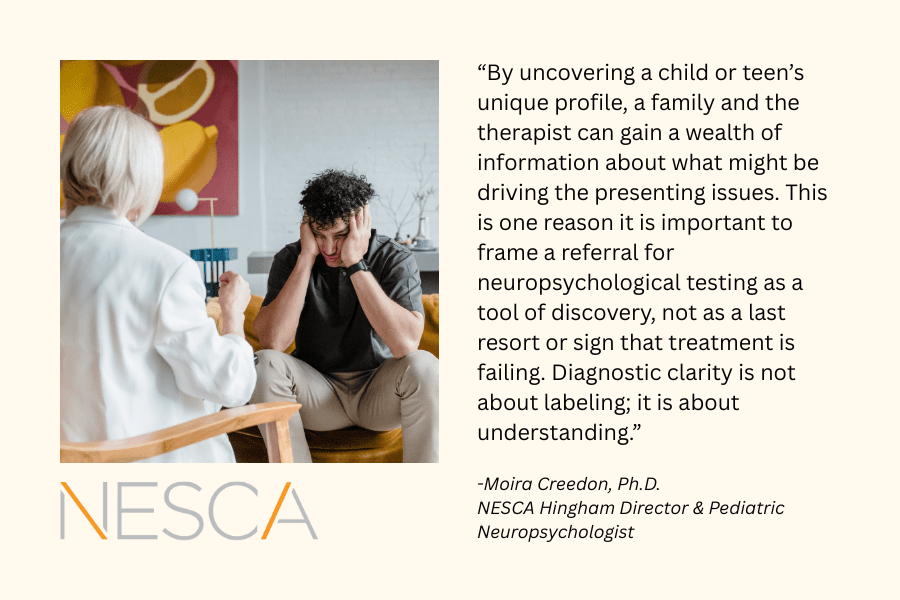
Image of a teen male feeling frustrated with a therapist and a quote from Dr. Moira Creedon

Bridging the Gap between Neuropsychological Testing and Therapy

By | NESCA Notes 2024

Image of a teen male feeling frustrated with a therapist and a quote from Dr. Moira CreedonBy: Moira Creedon, Ph.D. 
NESCA Hingham Director & Pediatric Neuropsychologist

Sometimes therapy hits a wall. A child or teen may be attending sessions regularly but still seems “stuck.” They might be unable to make progress, reluctant to engage, or struggling in ways that don’t fully add up. Even the most dedicated clients, those who do their therapy “homework” and participate openly, may continue to face challenges outside of the therapy room. This can be both frustrating and confounding for everyone involved. In these situations, neuropsychological testing does not have to be a last resort. It can be a powerful, collaborative tool that helps uncover what might be happening or why certain obstacles keep getting in the way. By clarifying diagnoses, identifying how a child or teen processes information, and highlighting cognitive or emotional patterns, neuropsychological testing offers insight that can shape therapeutic work to offer meaningful change.

There are few key gaps that neuropsychological testing can help to fill that are not a part of the normal course of therapy. First, neuropsychologists tend to get more extensive histories across all domains. Often times, therapists get some history about the presenting symptoms right away, but then they quickly have to dive into supporting a child, building rapport, providing psychoeducation, or practicing new coping strategies.

Neuropsychologists tend to get data across a broader range of developmental patterns for a holistic understanding of how the child has developed. Secondly, neuropsychologists then get concrete, quantifiable data on how a child or teen processes information – what their cognition is, how they encode and store information in their memory, how they tackle a hard problem, how they interpret a social challenge, and how they reflect on their own emotional experience. The focus is on how a person processes information, not just what their current symptoms are.

Why is this important? Take, for example, the case of a recent 16-year-old seen for neuropsychological testing who was in therapy for years due to a general sense of worry. Neuropsychological testing helped to highlight problems with cognitive flexibility, poor working memory, and distractibility. In addition to her anxiety, she was also struggling with ADHD. Lapses in attention were making her more anxious, leading her to long hours studying, blaming herself for her shortcomings. these long study sessions were disorganized and inefficient because of inherent executive functioning problems.

Take another example of a younger child who was 7-years-old. His parents felt frustrated by his dysregulated behaviors at home. He was disengaged in therapy and seemed unable to talk with his parents about what was going on after a big incident. Neuropsychological testing helped to undercover significant problems with language processing. This led to more frustration as he could not explain why he was upset, and traditional “talk therapy” methods had to be adapted so that language was simple and concrete.

By uncovering a child or teen’s unique profile, a family and the therapist can gain a wealth of information about what might be driving the presenting issues. This is one reason it is important to frame a referral for neuropsychological testing as a tool of discovery, not as a last resort or sign that treatment is failing. Diagnostic clarity is not about labeling; it is about understanding. It is a process of giving a complete picture of a child or teen’s functioning, seeking alternative pathways for change, and capitalizing on the client’s strengths.

With new information provided in neuropsychological testing, therapists can collaborate with a neuropsychologist to individualize treatment. Here are some examples for how testing can help therapists:

  • A therapist can slow down their interventions and offer more repetition for children with processing speed troubles.
  • A therapist can use simplified language for a child with cognitive impairments or reduced language skills.
  • A therapist can reduce the “homework” they assign for a teen with weak working memory and executive functioning deficits.
  • A therapist can pull in a new evidence-based treatment when anxiety veers into a pattern of intense obsessions and compulsive behaviors in a teen with OCD.
  • A therapist can support a teen overwhelmed with anxiety when facing a mountain of assignments at school if their executive functioning challenges make it hard for them to break down these tasks into smaller steps.
  • A therapist can explore the opportunity to collaborate with an executive functioning coach, group therapy program, or psychiatrist if a child’s profile suggests this is helpful.

When therapy stalls, it doesn’t mean a child isn’t trying or the treatment isn’t helpful. It might mean we are missing part of the picture. Neuropsychological testing can offer the insight needed to move forward with greater compassion, precision, and effectiveness.

Being “stuck” does not have to be seen as a sign of failure. It can be a turning point or an opportunity to uncover processing patterns that shift the focus from blame to change. When testing and therapy work hand in hand, they offer families not just answers, but a compassionate and informed way forward.


About the Author

Dr. Creedon offers her expertise in evaluating children and teens with a variety of presenting issues. SheMoira Creedon headshot is interested in uncovering an individual’s unique pattern of strengths and weaknesses to best formulate a plan for intervention and success. She tailors each assessment to address a range of referral questions, such as developmental disabilities, including Autism Spectrum Disorder, learning disabilities, attention challenges, executive functioning deficits, and social-emotional struggles. She also evaluates college-/grad school-age/adult individuals with developmental issues, such as ASD and ADHD, particularly when there is a diagnostic clarity or accommodation question.


If you are interested in booking an evaluation with Dr. Creedon or another NESCA neuropsychologist, please fill out and submit our online intake form


NESCA is a pediatric neuropsychology practice and integrative treatment center with offices in Newton, Plainville, and Hingham, Massachusetts; Londonderry, New Hampshire; and the greater Burlington, Vermont region, serving clients from infancy through young adulthood and their families. For more information, please email info@nesca-newton.com or call 617-658-9800.

Image of a feedback session with a parent and neuropsychologist along with a quote from Dr. Rodriguez

Beyond a Label: The Value of Neuropsychological Evaluation Even When There’s No Clear Diagnosis

By | NESCA Notes 2024

Image of a feedback session with a parent and neuropsychologist along with a quote from Dr. RodriguezBy: Maggie Rodriguez, Psy.D.
Pediatric Neuropsychologist, NESCA

Why Diagnosis Matters

Most parents seek out a neuropsychological evaluation because they’re looking for answers. Often, someone in the child’s life—whether a parent, teacher, or caregiver—has noticed something that doesn’t quite add up. Pursuing testing is a wise and proactive step toward understanding the root of a child’s challenges. In many cases, families hope to find a diagnosis that explains what’s going on. To borrow a phrase from psychiatrist and author Dan Siegel, “You have to name it to tame it.” Having a name for a child’s difficulties is often the first step toward effective support and intervention. Many parents describe feeling validated and relieved when a professional can identify and explain what their child is experiencing. Knowing there is an understandable reason behind their child’s struggles can be both reassuring and empowering.

Why A Clear Diagnosis Isn’t Always Possible

Despite everyone’s best efforts, sometimes a child’s challenges don’t fit neatly into a single diagnostic label. There are several reasons for this:

  • Human complexity: Diagnoses can be helpful frameworks, but they don’t always capture the full picture. Children are wonderfully complex, and their unique mix of strengths and challenges often doesn’t align perfectly with one specific category.
  • Overlap between conditions: Diagnoses are often presented as distinct “boxes,” but in real life, there is a lot of overlap between conditions. It’s often more accurate to picture diagnoses as overlapping circles in a Venn diagram, with many children’s experiences falling in the spaces where these circles intersect. It’s not always possible—or even helpful—to fully separate features into distinct diagnoses.
  • Gradual emergence of symptoms: Some conditions develop slowly and may not be fully recognizable until later in life. For example, mild Autism Spectrum Disorder can be subtle and hard to identify, especially in gender-conforming girls and women. Social challenges may not be obvious in early childhood but can become clearer as social demands increase in adolescence, delaying a clear diagnosis.
  • Lack of formal diagnostic labels: There are profiles commonly seen in clinical settings that don’t yet have formal diagnostic labels. For instance, significant executive functioning weaknesses can greatly impact daily life and academics, but there is no official diagnosis for this. Similarly, while we may use the term “Non-Verbal Learning Disorder” to describe certain patterns of difficulty with visual-spatial skills, organization, social cues, or motor abilities, this label isn’t formally recognized in current diagnostic systems.

What To Do Next

Receiving an evaluation without a clear diagnosis can be disappointing and even anxiety-provoking for parents; however, a neuropsychological assessment still offers significant value. The true strength of a thorough evaluation lies in its ability to provide a detailed understanding of your child’s unique strengths and challenges, and to clearly outline the supports and interventions that will be most helpful. Even among children who share a diagnosis, there can be important differences in how their difficulties present. A high-quality assessment goes beyond simply assigning a label; rather, it paints a comprehensive picture of your child as an individual. Ultimately, the most effective recommendations are those tailored specifically to your child’s needs, regardless of whether they meet criteria for a particular diagnosis.

If you find yourself in this situation, allow yourself space for your feelings. It’s natural to crave clear answers, and it can be difficult to live with uncertainty. Yet, there are concrete steps you can take:

  • Recognize challenges independently of diagnosis: Throughout history, people have faced real and significant difficulties long before science could provide official explanations. For example, prior to advanced imaging, vision problems caused by multiple sclerosis were often mislabeled as “hysterical blindness” until CT scans revealed nervous system lesions. Similarly, before HIV was identified as the cause of AIDS, individuals suffered and died from the illness without a clear diagnosis. Sometimes, it takes time for science to catch up. In the same way, your child’s needs are real and valid, regardless of whether a formal diagnosis has been made.
  • Advocate for your unique child: Similarly, focus on addressing their specific areas of need, rather than waiting for a label.
  • Seek appropriate support services: There’s no need to wait for a formal diagnosis to pursue executive function coaching, psychotherapy, occupational or speech therapy, or specialized academic support. In some cases, early intervention may even help prevent a difficulty from becoming a full-blown diagnosis.
  • Try to be patient and stay open to change:  Remember that your child is still developing in very significant ways. Consider re-evaluation in a few years, as more information may become clear over time.

Remember, your child is more than a label. The insights from a neuropsychological evaluation can guide you in supporting their growth and well-being, even when there isn’t a specific diagnostic term to describe their unique profile. If you have questions or want to discuss whether a neuropsychological evaluation might be helpful, our team is here to support you.


About the Author

Maggie Rodriguez, Psy.D., provides comprehensive evaluation services for children, adolescents, and young adults with often complex presentations. She particularly enjoys working with individuals who have concerns about attention and executive functioning, language-based learning disorders, and those with overlapping cognitive and social/emotional difficulties.

Prior to joining NESCA, Dr. Rodriguez worked in private practice, where she completed assessments with high-functioning students presenting with complex cognitive profiles whose areas of weakness may have gone previously undiagnosed. Dr. Rodriguez’s experience also includes pre- and post-doctoral training in the Learning Disability Clinic at Boston Children’s Hospital and the Neurodevelopmental Center at MassGeneral for Children/North Shore Medical Center. Dr. Rodriguez has spent significant time working with students in academic settings, including k-12 public and charter school systems and private academic programs, such as the Threshold Program at Lesley University.

Dr. Rodriguez earned her Psy.D. from William James College in 2012, where her coursework and practicum training focused on clinical work with children and adolescents and on assessment. Her doctoral thesis centered on cultural issues related to evaluation.

Dr. Rodriguez lives north of Boston with her husband and three young children.  She enjoys spending time outdoors hiking and bike riding with her family, practicing yoga, and reading.

To book a consultation with Dr. Rodriguez or one of our many other expert neuropsychologists, complete NESCA’s online intake form.

NESCA is a pediatric neuropsychology practice and integrative treatment center with offices in Newton, Plainville, and Hingham, Massachusetts; Londonderry, New Hampshire; the greater Burlington, Vermont region; and Brooklyn, NY, serving clients from infancy through young adulthood and their families. For more information, please email info@nesca-newton.com or call 617-658-9800.

Image of teo children reading outside on the grass with a quote from NESCA Pediatric Neuropsychologist Alissa Talamo, Ph.D.

How to Encourage Summer Reading with Your Child

By | NESCA Notes 2025

Image of teo children reading outside on the grass with a quote from NESCA Pediatric Neuropsychologist Alissa Talamo, Ph.D.By: Alissa Talamo, PhD
Pediatric Neuropsychologist, NESCA

Summer is an important time for children to relax and recharge, but it also provides a valuable opportunity to make reading enjoyable. Research consistently shows that students who do not read over the summer are at risk for the “summer slide,” which is a decline in reading skills acquired during the school year. In contrast, children who continue to read during the summer not only maintain but can even improve their literacy abilities.

The benefits of summer reading extend well beyond academics. Regular reading helps expand general knowledge, improve vocabulary and spelling, and strengthen focus and attention. According to Dr. Sally Shaywitz, author of Overcoming Dyslexia, children who read for just 20 minutes a day are exposed to approximately 1.8 million words each year, compared to only 8,000 words for those who read just a few minutes daily. This increased exposure to language supports both language development and writing skills.

Reading for just 20 minutes each day offers numerous advantages. Children experience significant vocabulary growth, encounter diverse perspectives that foster empathy, and develop stronger critical thinking skills as they engage with stories and information. Additionally, reading can be a relaxing activity, particularly before bedtime, helping children unwind after a busy day.

Despite these benefits, some children may be reluctant to read due to reading difficulties, uncertainty about their interests, or a preference for other activities. To encourage reading, it is important to let children choose books that interest them, set aside time to read together, and create a cozy reading environment at home. Pairing reading with interactive activities, such as visiting a museum, landmark, or travel destination related to a book’s topic, characters, or setting, can also make reading more appealing. Regular library visits, audiobooks, and a variety of reading materials—including magazines, comics, and graphic novels—can also help sustain interest. Introducing children to book series and modeling your own enjoyment of reading are additional strategies to foster a positive reading culture.

Helpful Resources and Tools

There are many excellent websites and apps that can support your child’s reading journey. Here are some sites to consider:

  • Unite for Literacy: A collection of audio/picture books read aloud to your child.
  • Reading Rockets—Reading Adventure Packs: Downloadable guides with book suggestions and activities.
  • Starfall.com: Early literacy games and books, ideal for young children.
  • Talking is Teaching: Encourages parents to talk, read, and sing with children to boost early brain and vocabulary development.

Other Resources:

Conclusion

Encouraging your child to read over the summer—and throughout the year—can have lasting benefits for their academic, social, and emotional development. By making reading enjoyable and accessible, and by supporting their individual interests and needs, you can help your child build a lifelong love of reading.


References:

  • Sally Shaywitz, MD, Overcoming Dyslexia (2020 Edition): Second Edition, January 4, 2005
  • https://specialedresource.com/benefits-of-reading-20-minutes-a-day
  • https://www.k12reader.com/why-read-20-minutes-a-day/
  • https://www.understood.org/articles/en/14-ways-to-encourage-your-grade-schooler-to-read


About the Author

Alissa Talamo headshotWith NESCA since its inception in 2007, Dr. Talamo had previously practiced for many years as a child and adolescent clinical psychologist before completing postdoctoral re-training in pediatric neuropsychology at the Children’s Evaluation Center.

After receiving her undergraduate degree from Columbia University, Dr. Talamo earned her doctorate in clinical health psychology from Ferkauf Graduate School of Psychology and the Albert Einstein College of Medicine at Yeshiva University.

She has given a number of presentations, most recently on “How to Recognize a Struggling Reader,” “Supporting Students with Working Memory Limitations,” (with Bonnie Singer, Ph.D., CCC-SLP of Architects for Learning), and “Executive Function in Elementary and Middle School Students.”

Dr. Talamo specializes in working with children and adolescents with language-based learning disabilities including dyslexia, attentional disorders, and emotional issues. She is also interested in working with highly gifted children.

Her professional memberships include MAGE (Massachusetts Association for Gifted Education), IDA (International Dyslexia Association), MABIDA (the Massachusetts division of IDA) and MNS (the Massachusetts Neuropsychological Society).

She is the mother of one college-aged daughter.

To book a consultation with Dr. Talamo or one of our many other expert neuropsychologists, complete NESCA’s online intake form.

NESCA is a pediatric neuropsychology practice and integrative treatment center with offices in Newton, Plainville, and Hingham, Massachusetts; Londonderry, New Hampshire; the greater Burlington, Vermont region; and Brooklyn, New York (coaching services only) serving clients from infancy through young adulthood and their families. For more information, please email info@nesca-newton.com or call 617-658-9800.

Image of child with profound autism and quote from Erin Gibbons

Understanding and Supporting Profound Autism

By | NESCA Notes 2025

Image of child with profound autism and quote from Erin GibbonsBy: Erin Gibbons, Ph.D.
Pediatric Neuropsychologist, NESCA

In April, I had the good fortune to attend the Profound Autism Summit, a multidisciplinary conference hosted by the Profound Autism Alliance and Nashoba Learning Group. Presentations were given by a variety of specialists from behavior analysts to pediatricians to speech pathologists… I am eager to apply my newfound knowledge and help educate those around me about this important and often overlooked population within the autism community.

In my role as a neuropsychologist, I often see clients with autism spectrum disorder (ASD). As its name implies, ASD represents a broad spectrum of individuals whose strengths, weaknesses, and behaviors vary widely. During the 1980s and 1990s, much of the research devoted to ASD included individuals with significant challenges, such as lack of speech, self-injurious behaviors, and limited independent living skills. Over the last 20 years or so; however, there has been a shift in the research such that most of the recent studies exclude autistic individuals who are nonverbal and/or exhibit unsafe behaviors. As a result, this portion of the autism community has become increasingly marginalized, under-researched, under-funded, and under-served. This was part of the impetus for the Profound Autism Alliance, an organization created by parents and other activists who saw a need for more awareness of and education about the needs of their dependents.

The term profound autism is used to describe autistic individuals who require 24/7 care throughout their lives. Individuals who fit criteria for profound autism experience a unique set of challenges that make them one of the most vulnerable communities in our society. The statistics show that profoundly autistic individuals are significantly underserved in preventative medical and dental care because they have such difficulty tolerating the appointments. Through the Summit I attended, I learned about local organizations that are working to improve access to healthcare for this population. The Lurie Center at MGH offers behaviorally-based exposure treatments so that profoundly autistic patients learn the skills to endure what many people would consider simple procedures, such as blood draws. The Arc is pairing with local medical schools to improve the training of medical students in how to work effectively with autistic patients. I was inspired by so many individuals and felt moved to do my part as well.

I have been working with profoundly autistic individuals for over 20 years. As a college student, I worked as a behavior therapist at a residential school for students with ASD and other developmental disabilities. Throughout graduate school and into my early career years, I turned my focus to neuropsychological testing and have been fortunate to continue supporting the autistic community in this capacity. Having worked at NESCA for almost 15 years, I provide evaluations to children, adolescents, and young adults with profound autism, many of whom have been unfairly deemed “untestable.” It is true that many of our standardized assessment tools were not developed for individuals who are nonverbal or have limited fine motor precision, for example. However, test scores are not the only way to capture a student’s strengths and potential. Providing quality evaluations for profoundly autistic students is incredibly important. Not only can the findings help caregivers and educators better understand the student’s learning style, but the information helps create road maps for the future, a key component of NESCA reports.

Through my work as a neuropsychologist, I am dedicated to supporting families of profoundly autistic individuals, helping them to find the supports and services they need. Further, I strive to educate schools, medical professionals, and other providers about the unique needs of this population. I learned an immense amount at the Summit I attended and felt honored to be further educated by some of the top researchers in the world of ASD. Please read more about the Profound Autism Alliance here: www.profoundautism.org.


About the Author

Since 2011, Dr. Gibbons has been a trusted expert at NESCA where she evaluates children presenting with a range of attentional, learning,Erin Gibbons headshot and developmental disabilities. She has a particular interest in children with autism spectrum disorders, intellectual disabilities, and those with complex medical histories. In addition, she evaluates adults who have concerns about whether they meet criteria for an ASD or ADHD diagnosis.
If you are interested in booking an evaluation with a NESCA neuropsychologist/clinician, please fill out and submit our online intake form

Neuropsychology & Education Services for Children & Adolescents (NESCA) is a pediatric neuropsychology practice and integrative treatment center with offices in Newton, Hingham, and Plainville, Massachusetts; Londonderry, New Hampshire; and staff in Burlington, Vermont and Brooklyn, NY, serving clients from preschool through young adulthood and their families. For more information, please email info@nesca-newton.com or call 617-658-9800.

Inattentive student image and quote from Dr. Alison Burns

To Test or Not to Test (for ADHD)?

By | NESCA Notes 2025

Inattentive student image and quote from Dr. Alison BurnsBy: Alison Burns, Ph.D.
Pediatric Neuropsychologist, NESCA

Attention Deficit/Hyperactivity Disorder (ADHD) is a neurodevelopmental disorder that is characterized by difficulty with sustained attention, hyperactivity, and/or impulsivity. Some kids mostly have difficulty with attention (referred to as ADHD, Predominantly Inattentive Presentation, formerly called ADD), some kids mostly have symptoms of hyperactivity and impulsivity (referred to as ADHD, Predominantly Hyperactive-Impulsive Presentation), and some kids have difficulty with both attention and hyperactivity/impulsivity (referred to as ADHD, Combined Presentation).

The diagnosis of ADHD can be very straightforward for a subset of children. These kids may demonstrate highly impairing, overt symptoms of ADHD, often from a young age. These children tend to have symptoms of hyperactivity and impulsivity that are quickly noted by parents and preschool or kindergarten teachers. This group of children may appear as if they are driven by a motor or always on the go, and they have trouble paying attention within a very short period of time. The diagnosis of ADHD for this subset of children is frequently made by a pediatrician after parents and teachers complete a questionnaire (often the Vanderbilt Assessment Scale) and the child scores above a certain threshold.

However, the larger majority of children exhibit symptoms of inattention, hyperactivity, and impulsivity that are not as overt or clear cut. This may present as a lack of focus for certain tasks or in certain situations, daydreaming or distractibility, poor attention to detail or rushing through work, talking constantly, or fidgeting. Parent and teacher questionnaires may show levels of inattention and hyperactivity/impulsivity that are above the threshold, but this subset of children would greatly benefit from testing to confirm the diagnosis. That is because there are many other reasons why a child may be distracted, inattentive, rush through their work, not start a task independently, fidget, or chat excessively. Here are a few examples:

  • A child with anxiety may be distracted because they are focused on their worries (e.g., “I forgot to study for my next period’s test!” “What if people laugh at me when it’s my turn to read aloud?”). They may rush through their work because they are worried about completing the test in the allotted time period or have trouble starting a task as they “freeze.” They may fidget or talk excessively when feeling nervous.
  • A child with a learning disability may zone out or appear distracted when they are having trouble understanding a concept or completing an assignment. They may get bored or frustrated and begin to move around in their seat, and they may rush through their work to get it done as quickly as possible out of embarrassment. They may also have trouble starting a task independently as they do not know how to complete the work.
  • A child with a language disorder may become inattentive and distracted when they cannot understand what the teacher is saying. They may become fidgety and “check out,” and they may not start tasks independently as they did not understand the task instructions.

These example children (a child with ADHD, anxiety, a learning disability, and a language disorder) may all present in a similar fashion, with the same behaviors endorsed on a questionnaire (e.g., does he have trouble paying attention? Is he fidgety or restless?). But the reasons why these behaviors are occurring are fundamentally different. Making an accurate diagnosis is critical to getting the right treatment plan in place. We would not want to treat a child with a stimulant medication if the underlying cause of inattention is a language disorder, just as we would not recommend speech and language therapy for a child with ADHD (without language issues).

This is where testing comes into play. A neuropsychological assessment is an excellent tool for teasing out the underlying root cause behind the surface symptoms. A comprehensive neuropsychological assessment, such as the ones done at NESCA, assesses a child’s intellectual ability, academic skills (e.g., reading, writing, math), expressive and receptive language skills, visual-spatial skills, learning and memory style, fine motor skills, attention and executive functioning, social-emotional well-being, and adaptive living skills. This breadth and depth of testing can help to rule out alternative explanations and ensure that attention difficulties are truly caused by ADHD.

Testing also allows us to compare a child’s performance on testing to a sample of children the same age. This objective information is considered along with a host of other information (e.g., history given by the parents/caregivers, record review, questionnaires completed by parents and teachers, behavioral observations during testing). This comprehensive evaluation provides a great deal of information and increases the likelihood of an accurate diagnosis and effective treatment plan.


About the Author

Dr. Burns conducts comprehensive evaluations of school-aged children, adolescents, and young adults with a variety of developmental, learning, and emotional difficulties. She has expertise in the evaluation of individuals following a concussion/mild traumatic brain injury and particularly enjoys working with individuals with attention (ADHD) and executive functioning (EF) difficulties. Dr. Burns is passionate about helping individuals and their families better understand their areas of strength and weakness and provides tailored treatment recommendations based upon that unique profile to make the evaluation most helpful for each client.

To book a consultation with Dr. Burns or one of our many other expert neuropsychologists, complete NESCA’s online intake form.

NESCA is a pediatric neuropsychology practice and integrative treatment center with offices in Newton, Plainville, and Hingham, Massachusetts; Londonderry, New Hampshire; the greater Burlington, Vermont region; and Brooklyn, New York (coaching services only) serving clients from infancy through young adulthood and their families. For more information, please email info@nesca-newton.com or call 617-658-9800.

Image of a tortoise studying on a notebook with a quote from Miranda Milana, Psy.D., NESCA Neuropsychologist

Smart Doesn’t Always Mean Fast: Understanding Intelligence and Processing Speed

By | NESCA Notes 2024

Image of a tortoise studying on a notebook with a quote from Miranda Milana, Psy.D., NESCA NeuropsychologistBy Miranda Milana, Psy.D.
Pediatric Neuropsychologist

Picture what it means to be intelligent.

Do you imagine someone who knows many facts about a variety of topics? Someone who has quick wit? The first person to offer up answers? Chances are that you picture someone who not only knows a lot of information—but thinks fast on their feet. Maybe you envision someone who finishes tests before everyone else, completes homework effortlessly, or could dominate any round of Jeopardy.

Those are all common examples of what comes to mind when someone is described as “smart.” Society often rewards efficiency and how fast someone is to provide answers and results, which is why we equate efficiency and speed with high intellect. The fact of the matter is that intelligence does not always mean fast, and there are many extremely bright individuals who perform slower when it comes to tasks like timed tests, fast-paced conversations, or quick decision-making.

This might seem confusing—how can someone so clearly intelligent struggle to perform tasks efficiently? If they have so many answers, why can’t they provide them quickly?

The answer to this question lies in how our brains are wired. Your cognitive profile is complex and includes many factors. Someone can be intellectually gifted, or considered a “genius,” but still be slow to process information.

If you imagine the brain as a car:

  • Core cognitive abilities—things like reasoning, memory, and language—are the engine. They represent how powerful, thoughtfully designed, and capable the car is.
  • Processing speed is the acceleration. It’s how fast that car can go.

Some people might have a powerful engine that takes longer to accelerate. Once it gets going, however, and gains momentum, it can go far and handle any road it encounters. Others might have very fast acceleration but a reduced capability of maneuvering on complex routes.

How Does This Happen?

Many individuals with this “smart but slow” learning profile have exceptional cognitive skills but need more time to show what they know as it takes them longer to take in, make sense of, and respond to information (functions of processing speed).

This discrepancy between intellect and processing speed can cause significant frustration, both for the individual and for those around them. It can be especially difficult in environments that place an emphasis on speed, such as classrooms, standardized testing, or high-pressure workplaces with fast work deadlines/turnaround times.

Factors that Affect Processing Speed

Some brains are simply wired for a slower pace. But other factors can influence processing speed as well, including:

  • Anxiety
  • ADHD and attentional differences
  • Autism spectrum traits
  • Depression and mood disorders
  • Fatigue or chronic stress
  • Substance use or medications

These factors can cause weaknesses and/or variability in processing speed—even in individuals with otherwise high cognitive reasoning abilities. Unfortunately, this “smart but slow” presentation often leads to incorrect labels, such as laziness or reduced capabilities, when in fact, they just need more time to showcase what they know.

No matter the reason for slower processing speed, these individuals benefit from accommodations and strategies such as:

  • Extended time on tasks, tests, or writing assignments
  • Flexible expectations in fast-paced discussions or decision-making settings
  • Alternative ways to demonstrate knowledge, like untimed projects or creating visuals

Now that we have taken some time to understand how intelligence is defined, I encourage you to consider expanding your idea of what comprises intelligence as a whole the next time someone asks you what it means to be intelligent. Some of the most insightful, creative, and capable thinkers are the ones who take their time to pause, reflect, and dive deep before they respond. These individuals might be the smartest people in the room who just move at their own pace and deserve just as much recognition.


About the Author

Dr. Miranda Milana provides comprehensive evaluation services for children and adolescents with a wide range of concerns, includingMiranda Milana PsyD headshot attention deficit disorders, communication disorders, intellectual disabilities, and learning disabilities. She particularly enjoys working with children and their families who have concerns regarding an autism spectrum disorder. Dr. Milana has received specialized training on the administration of the Autism Diagnostic Observation Schedule (ADOS).

Dr. Milana places great emphasis on adapting her approach to a child’s developmental level and providing a testing environment that is approachable and comfortable for them. She also values collaboration with families and outside providers to facilitate supports and services that are tailored to a child’s specific needs.

Before joining NESCA, Dr. Milana completed a two-year postdoctoral fellowship at Boston Children’s Hospital in the Developmental Medicine department, where she received extensive training in the administration of psychological and neuropsychological testing. She has also received assessment training from Beacon Assessment Center and The Brenner Center. Dr. Milana graduated with her B.A. from the University of New England and went on to receive her doctorate from William James College (WJC). She was a part of the Children and Families of Adversity and Resilience (CFAR) program while at WJC. Her doctoral training also included therapeutic services across a variety of settings, including an elementary school, the Family Health Center of Worcester and at Roger Williams University.

Dr. Milana grew up in Maine and enjoys trips back home to see her family throughout the year. She currently resides in Wrentham, Massachusetts, with her husband and two golden retrievers. She also enjoys spending time with family and friends, reading, and cheering on the Patriots, Bruins, Red Sox, and Celtics.​

To book an appointment with Dr. Miranda Milana or another expert NESCA neuropsychologist, please complete our Intake Form today. 

NESCA is a pediatric neuropsychology practice and integrative treatment center with offices in Newton, Plainville, and Hingham, Massachusetts; Londonderry, New Hampshire; the greater Burlington, Vermont region; and Brooklyn, New York (coaching services only) serving clients from infancy through young adulthood and their families. For more information, please email info@nesca-newton.com or call 617-658-9800.


Map of Hingham, MA and quote by Dr. Moira Creedon

Strengthening the South Shore Community: Supporting Our Children, Teens, and Adults

By | NESCA Notes 2024

Map of Hingham, MA and quote by Dr. Moira CreedonBy: Moira Creedon, Ph.D. 
Pediatric Neuropsychologist, NESCA

It was an exciting dream realized when our NESCA South Shore office in Hingham opened in November 2023. As a resident of the South Shore, I was looking forward to connecting to my community closer to home. I was expecting to enjoy a shorter commute and great location. Pausing to reflect after 16 months with our doors open in Hingham, I realize that it is so much more.

I am grateful for how quickly we were welcomed by pediatricians, therapists, psychiatrists, tutors and executive functioning coaches, attorneys, advocates, and public and private schools. We have all quickly aligned on the needs of our communities. There are many children, teens, and adults struggling with gaps in learning, trouble with social connections, high anxiety, depressed mood, and behavioral troubles. Many of these collaborations have also communicated the frustration and sense of burnout facing families who feel like they have been working hard and trying to make changes. Teachers feel discouraged when they have dedicated their hearts and minds to support students, and yet students continue to struggle. Adults are also going through this in record numbers. The experience in our community is universal – it’s so hard to watch our kids, teens, young adults, and our contemporaries struggle.

This can leave many wondering if neuropsychological testing is just one more “hoop” to jump through. Within the trenches of the daily struggle, it can be hard to see how testing might help – especially when change is so slow. I do all that I can to explain why neuropsychological testing is way more than a hoop; it can be a roadmap. How?

  1. Even if you or your child has had “evaluations before,” neuropsychological testing is a chance at an integrated and comprehensive evaluation. What does that mean? It means that if you have had pieces of testing before, you still have a pile of pieces – an educational evaluation from school, a private OT evaluation, an early speech evaluation, a diagnostic interview with a therapist, etc. My goal is to take all of those pieces, plus the new ones I add, and put them together into one cohesive puzzle demonstrating how a child or teen thinks and learns.  This is one of the reasons NESCA does academic testing as part of its testing batteries, because these pieces are essential for diagnostic clarity, to see how the profile impacts a person’s real life skills/functioning, and because being a student is a kid or teen’s full time job. It’s not a piece to be overlooked.
  2. Neuropsychological testing can be a chance to understand the “why” when there are many complicated layers. When an individual is struggling, we often start in the middle of the process. Often, parents and/or schools want to try to solve the problem with school support, or interventions such as a referral to a therapist or connection to a social skills group. When those efforts stall, the impulse is to try a different solution.  Neuropsychological testing lets us step back, learn about a larger profile or picture of all aspects of a child’s learning or thinking to make meaning of what is happening. Then, we can choose a path for intervention that has the best chance of success. When a child is struggling, trying to see what works in a way that’s not fully informed or that addresses the child as a whole, is often not the best use of time and resources. The same goes for adults who seem to be missing a piece of their own puzzle.
  3. Neuropsychological testing uses the data collected from the testing to outline the steps for what to do next. Any good plan needs a detailed understanding of a problem. Oftentimes, it’s a combination of services that are needed – in the community, at home, and/or at school. It can be hard to figure out how to prioritize the steps, and it’s important to consider what is realistic and feasible. Neuropsychological evaluation can help make those steps clearer.
  4. Neuropsychological testing can give us a good baseline and measure of progress. Caretakers know their children best, so they can often spot subtle issues before they bloom into the bigger issues. Neuropsychological testing can be proactive, and it can help to track how a student responds to interventions. We can also use neuropsychological testing to maximize potential, including how students find their strengths, build their “academic diet” of courses in high school and college, and build stronger study skills along the way.
  5. At NESCA, neuropsychological testing involves important collaboration, perspective, and insight. The reason I mention the community that I’ve met through our South Shore office is because collaboration is key. The observations and insight offered by anyone who comes in contact with a child or teen is invaluable. Standardized test measures are a critical piece of the puzzle, but it’s one part of the critical triad of history, observations, and testing. These collaborations are also helpful to keep the neuropsychological test report “alive” as the community putting the recommendations into action works best through communication.

In the upcoming year, we set many goals for NESCA as a leader in our field. I want to pledge to my community that we will continue to provide the highest quality care and to respect and value our clients and families.  We will continue to build connections to our community members to join the efforts in supporting children, teens, and young adults. I am thrilled for upcoming opportunities to learn and grow alongside you all.  I am deeply grateful to be part of the South Shore community supporting children, teens, and young adults.


About the Author

Dr. Creedon offers her expertise in evaluating children and teens with a variety of presenting issues. SheMoira Creedon headshot is interested in uncovering an individual’s unique pattern of strengths and weaknesses to best formulate a plan for intervention and success. She tailors each assessment to address a range of referral questions, such as developmental disabilities, including Autism Spectrum Disorder, learning disabilities, attention challenges, executive functioning deficits, and social-emotional struggles. She also evaluates college-/grad school-age/adult individuals with developmental issues, such as ASD and ADHD, particularly when there is a diagnostic clarity or accommodation question.


If you are interested in booking an evaluation with Dr. Creedon or another NESCA neuropsychologist, please fill out and submit our online intake form


NESCA is a pediatric neuropsychology practice and integrative treatment center with offices in Newton, Plainville, and Hingham, Massachusetts; Londonderry, New Hampshire; the greater Burlington, Vermont region; and Brooklyn, NY (coaching services only) serving clients from infancy through young adulthood and their families. For more information, please email info@nesca-newton.com or call 617-658-9800.

Skip to content