Real-life Skills Coaching Alert!

NESCA now has two Occupational Therapists offering in-person, community-based Real-life Skills Coaching in the Newton area. To learn more or book sessions, complete our Inquiry/Intake Form.

Tag

occupational therapist Archives - Page 4 of 6 - NESCA

Subscribe to NESCA Notes

Learning to Ride a Bike: A Rite of Passage

By | NESCA Notes 2021

By: Jessica Hanna MS, OTR/L
Occupational Therapist, NESCA

If there is one positive takeaway from the COVID-19 pandemic, it’s the ever-growing love for being outdoors. It’s spring, the flowers are blooming, the sun is out, and the air is light. Everything in our body is telling us to go outside and play.

For many kids with and without disabilities, bike riding is meaningful, liberating, and a rite of passage. Close your eyes and try to remember the first time you rode a two-wheel bike. Can you remember the color of your bike? The smell in the air? The complete joy it brought you? That was the day we all felt a bit more confident and like we grew a bit taller.

So how do we help our children achieve this meaningful occupation? The days of running behind our children while holding onto their bike seat, telling them to pedal, not to stop, and hoping for the best and that they will forgive us when we let go (when we clearly promised we would not let go!) should be far behind us. But are they?

A lot goes into learning how to ride a bike, so do not let your child give up so soon when it takes more than a couple of days, weeks, or months to get it right. Consider the following skills that are addressed in learning to ride a bike:

  • Attention and concentration
  • Bilateral coordination
  • Balance
  • Body awareness
  • Core strength
  • Hand-eye coordination
  • Motor planning
  • Postural stability
  • Sensory processing
  • Upper and lower extremity strength
  • Visual scanning

Children as young as five years of age will begin to acquire and develop the skills needed to ride a two-wheel bike, and still others may not feel ready until they are pre-teens or even into adulthood.

Before getting started, here are a couple things to consider regarding the equipment involved in learning how to ride a bike:

  • Bike – The height of the bike is a crucial element to success when learning how to ride. When seated on the bike, your child’s feet should be firmly planted on the ground. The bike seat may appear too low and the bike too small; however, this technique enables movement security, engages proper core and postural stability, and increases confidence.
  • Braking System – Be sure to learn the difference between hand brakes vs. coaster brakes (using feet to backpedal). Both braking systems have pros and cons. Hand brakes are a personal favorite. They are more flexible to position, offer better control, but require adequate hand strength and coordination to manipulate. Coaster brakes (using your feet to pedal backward to brake) use an intuitive motor planning motion for children. When you pedal forward, you go; when pedaling backward, you stop. They are helpful for children who lack the hand strength skills to wrap and squeeze their hands around a hand brake; however, they provide awkward foot positioning and the constant tendency to backpedal.
  • Helmet – Safety, Safety, Safety! When handling a bike for any occasion (i.e., walking a bike, doing balance drills on a bike, or riding a bike), it should become an automatic habit to wear a helmet. Your child should be in charge of putting on and taking off their helmet independently. There is nothing more important than wearing a helmet that fits correctly with fasteners that can be easily manipulated. When choosing a helmet, be cognizant of the type of fastener/clasp it comes with and if your child has the fine motor skills to adjust it (this skill could take time to learn).If you are unsure if your child’s helmet is a good fit, any cycling store will be more than pleased to assist in finding your child the most appropriate size. 
  • Pedals – When learning to ride for the first time, the removal of pedals should be highly considered. It provides the opportunity to address balance, core, and postural stability for both younger and older children while also increasing movement security.
  • Training Bike – Which is best…balance bikes vs. training wheels? Balance bikes are light in weight and can be introduced to children at a much younger age than a pedal bike. They promote core strength and increase motor planning, sequencing, and balance training skills, making the transition from a balance bike to a two-wheel pedal bike more fluid and easier to manage. Training wheels promote ease in learning motor planning techniques to push on pedals while providing assisted balance. It’s important to note that removing the balance component can be disadvantageous when transitioning from training wheels to a two-wheel pedal bike.

Overall, the literature supports the observation that, for children with and without disabilities, learning to ride a bike is a popular activity that increases confidence, provides opportunities for shared recreation with families and peers, and promotes social inclusion (Dunford, Bannigan, Rathmell (2016).

Several of the many clinical diagnoses of children who can ride a bike follow here; however, this list is certainly not inclusive of the many other diagnoses that do not preclude children from bike riding:

  • ADHD
  • Anxiety
  • Autism Spectrum Disorder
  • Cerebral Palsy
  • Developmental Coordination Disorder
  • General learning disability
  • Hearing impairment
  • No diagnosis

The art of bike riding can be broken down into various steps, from learning how to use the kickstand to the act of pedaling. Each step deserves attention, because through repetition and practice, confidence is achieved.

If using these tips feels difficult or is not helping your child with the level of focus and skill they need to successfully achieve their goal to use a bike, we recommend reaching out to your occupational therapist or getting an occupational therapy evaluation. If in-person direct services continue to be a concern, biking riding skills can be offered via telehealth from the comfort of  your home. Jessica offers successful biking riding drills and adaptive home exercise plans through telehealth that address the skills required to learn to ride a bike. Contact NESCA’s Director of Clinical Services Julie Robinson, OT, to learn more at: jrobinson@nesca-newton.com.


References
Dunford, Bannigan, Rathmell (2016) Learning to ride a bike: Developing a therapeutic intervention. Children Young People & Families Occupational Therapy Journal 20(1) 10-18


About the Author

Jessica Hanna has over 10 years of pediatric OT experience in conducting assessments and providing treatment of children and adolescents with a broad range of challenges and disabilities, including autism spectrum disorders, sensory processing disorders, visual impairments, cerebral palsy, executive function deficits and developmental disorders of motor function. Prior to joining NESCA, Jessica trained and worked in a variety of settings, including inpatient and outpatient hospital settings, private practice, schools and homes. She has served on interdisciplinary treatment teams and worked closely with schools, medical staff and other service providers in coordinating care. In addition, Jessica provided occupational therapy services at Perkins School for the Blind and Spaulding Rehabilitation Hospital pediatric inpatient unit, where she conducted comprehensive evaluations and interventions for children with a broad range of presentations.


To book an appointment or to learn more about NESCA’s Occupational Therapy Services, please fill out our online Intake Form, email info@nesca-newton.com or call 617-658-9800.


Neuropsychology & Education Services for Children & Adolescents (NESCA) is a pediatric neuropsychology practice and integrative treatment center with offices in Newton, Massachusetts, Plainville, Massachusetts, and Londonderry, New Hampshire, serving clients from preschool through young adulthood and their families. For more information, please email info@nesca-newton.com or call 617-658-9800.


Executive Function Tools: Natural Consequences

By | NESCA Notes 2021

By: Sophie Bellenis, OTD, OTR/L
Occupational Therapist; Real-life Skills Program Manager and Coach, NESCA

In my last blog that focused on executive function tools, I delved into the benefits of using and committing to a digital calendar. The calendar is a concrete tool that can be directly taught to students using traditional methods. Less concrete, but in many ways equally useful, is this next executive function tool – the natural consequence.

When most people think of natural consequences, they think of younger children refusing to do things like eat a meal that their caregiver prepared or put on a coat when it is cold outside. If a child refuses their dinner, the natural consequence is hunger. If a child refuses to wear their coat, the natural consequence is feeling cold. These are consequences that will happen without parents or caregivers explicitly providing a consequence. When it comes to executive function mishaps, the natural consequence is often the need to independently deal with the fallout.

Many of the students I serve directly need scaffolded executive function support with direct instruction and specific opportunities for practice. I am not advocating for removing these services or throwing these students to the proverbial wolves. What I am advocating for is using mistakes or lapses in executive function skill as learning opportunities, as opposed to absolving our students from all responsibility and continuously jumping in to save the day. To demonstrate this difference, here are a few examples of ways I have seen parents successfully use natural consequences as a tool to teach executive function.

Case Studies

  1. Amber is a student who has had consistent difficulty organizing her time after school. While she attends many different afterschool activities, such as recycling club and track, she is often late to practice or misses important changes to the schedule. To help Amber, her parents set up a calendar with notifications and reminders that appear on her phone and her computer directly after school. Recently, Amber started driving lessons with the local driving school. A few weeks ago, Amber had a conversation with her mother in the morning about the fact that she would be picked up for a lesson 10 minutes after the end of the school day. Amber’s notification on her phone went off 15 minutes before the lesson, and she received a pop-up on her computer screen 30 minutes before the end of the school day. Despite these reminders, Amber hopped onto the bus at the end of the day. While this was an honest mistake, Amber was not using her tools or the time management strategies that she has been taught and is expected to use. Amber’s parents decided that as a natural consequence, Amber would need to deal with fixing her mistake. They were there to support her as she called the driving school, apologized to the instructor, and rescheduled her appointment. If she was not willing to take these steps, another natural consequence would have been a delay in getting her license. This caused some heightened anxiety for Amber, but with encouragement from her parents, she practiced the phone call out loud and looked through her calendar to see where she had availability for a make-up appointment. Amber’s parents could have easily called the driving school and fixed these problems for her; however, Amber would have missed out on an opportunity to practice problem solving.
  2. Another student who benefited from natural consequences is Albert. Albert’s parents hired a tutor to meet with him over Zoom twice per week to prepare for the SATs. He was expected to meet with his tutor, Barry, two times per week to start building up his skills. Unfortunately, despite frequent reminders and systems being put in place, Albert often missed or was late to these meetings as he was distracted by playing video games. When Albert’s parents started to receive charges for missed appointments from Barry’s company, they thought carefully about how to impress on Albert the importance of using his strategies and making it to his appointments. Eventually, Albert’s parents informed him that if he missed another session, he would be responsible for the late fee, as the charge was an inevitable consequence. When Albert eventually missed another session, his father drove him to the bank and helped him withdraw the money from his own savings account to pay his parents for the missed session. Unsurprisingly, this was hugely frustrating to Albert in the moment; however, his meetings with Barry became a priority and Albert quickly started making it to tutoring on time. After experiencing the natural consequence himself, Albert began to change his actions.

Both of these examples led to increased buy-in from the adolescents who were actively working on building up their executive functioning skills. As they started to participate in problem solving after they made a mistake, they were more aware of the work that their parents had typically been doing for them. Some language that can be productive includes:

  • “I know it was a mistake and now we just need to figure out how to fix it. What do you think we should do?”
  • “What are the next steps you need to take to solve this problem?”
  • “I can tell you what I think we should do, but I would love to hear your ideas first. Where would you start?”

As adolescents forge toward young adulthood, they will inevitably make mistakes, miss appointments, arrive late, and misplace some of their belongings. If we are constantly picking up the pieces, then they are missing out on the opportunity to learn how to solve their own problems and build an understanding of the consequences.


About the Author
Sophie Bellenis is a Licensed Occupational Therapist in Massachusetts, specializing in educational OT and functional life skills development. Bellenis joined NESCA in the fall of 2017 to offer community-based skills coaching services as a part of the Real-life Skills Program within NESCA’s Transition Services team. Bellenis graduated from the MGH Institute of Health Professions with a Doctorate in Occupational Therapy, with a focus on pediatrics and international program evaluation. She is a member of the American Occupational Therapy Association, as well as the World Federation of Occupational Therapists. Having spent years delivering direct services at the elementary, middle school and high school levels, Bellenis has extensive background with school-based occupational therapy services.  She believes that individual sensory needs and visual skills must be taken into account to create comprehensive educational programming.


To book an appointment or to learn more about NESCA’s Occupational Therapy Services, please fill out our online Intake Form, email info@nesca-newton.com or call 617-658-9800.


Neuropsychology & Education Services for Children & Adolescents (NESCA) is a pediatric neuropsychology practice and integrative treatment center with offices in Newton, Massachusetts, Plainville, Massachusetts, and Londonderry, New Hampshire, serving clients from preschool through young adulthood and their families. For more information, please email info@nesca-newton.com or call 617-658-9800.


Mind the Gap: Why You Should Consider Summer OT and Speech Services at NESCA

By | NESCA Notes 2021

By: Julie Robinson, OT
Director of Clinical Services; Occupational Therapist, NESCA

It has been a challenging school year, with ever-changing schedules, routines, and unfortunately with a good deal of inconsistency in the provision of therapeutic services through the schools, due to the many impacts of COVID. Parents, caregivers and students have all experienced differing levels of anxiety about what progress has been and is being made, with many children experiencing some level of regression with regard to behavior, self-regulation, motor skills or language development. In anticipation of many of our children returning to school in-person in April, parents have expressed concerns that their children may be lagging behind or that they have not had ample support throughout the earlier parts of their school year to ensure they can keep up with the other children in their class. Over the months of April, May and June, we will all get to see firsthand where the gaps might arise. And then when school is over, many of us might be concerned that the gains of just a few short months will be lost again over summer. This is why those of us at NESCA perceive that the benefits of summer services will be an important part of ensuring progress and the ability to jump right back into learning – as we hope all school will be in-person again in the fall.

NESCA is available to provide summer services, as we do consistently for our weekly patients. In addition, we are offering short-term services to those children who may not qualify for them through their school systems, or for those families who would simply like to supplement what their children are receiving in-district to give them a boost before school begins again in the fall.

Our occupational therapists (OTs) can work on the following areas of focus with your child:

  • self-regulation and coping skills
  • how best to transition from the quiet of home to the multiple stimuli of a classroom full of children
  • how to cope with longer hours of wearing a mask
  • how to follow social distancing requirements, when they long for a closer physical connection with their peers

We can also help to ease the anxiety some children may have about becoming sick or how NOT to feel fearful of getting back into the classroom when sensory processing issues push them to feel uneasy. Our OTs can continue work on handwriting and motor development work started throughout the school year to ensure there is no regression or to improve the speed and automaticity of written expression and legibility. We can teach organizational and executive functioning skills to encourage kids to be independent, prioritize assignments and manage their time. OTs can address self-care skills of dressing, shoe tying, feeding and hygiene, which are likely to require more independence with social distancing requirements. While it’s summer, we help build outdoor skills, such as bike riding and greater self-confidence on the playground to elicit more social connections with peers. Our OTs are providing services in-person in our Newton and Plainville, Massachusetts clinics, by teletherapy or outdoors in the community as appropriate.

Our speech therapists at NESCA can also help to continue and supplement the hard work children have been putting in throughout the school year. They can work on social pragmatics and help with the skills needed to transition from so much time alone, to being in groups with their peers once again. NESCA’s speech therapists can support children on how to:

  • initiate play
  • find shared interests
  • be flexible thinkers
  • communicate with kindness and an appropriate level of voice
  • read gestures and non-verbal communication (especially while wearing masks, which can impede the ability to properly read another person’s mood, reactions or emotions)

We can continue to work on the established goals from school, regarding both expressive and receptive communication, language articulation and language as it pertains to written communication. Our speech therapists are currently providing all services via teletherapy while we work on a transition back to in-person therapy.

If you are interested in seeking out summer services at NESCA, or any of our assessments and services, please contact NESCA’s Director of Clinical Services Julie A. Robinson. She can be reached at jrobinson@nesca-newton.org and will conduct a phone intake with you to help you best determine your needs.


About the Author

Julie Robinson is an occupational therapist with over 25 years of experience as a clinician. The work Julie does is integral to human development, wellness and a solid family unit. She particularly enjoys supporting families through the process of adoption and in working with children who are victims of trauma. Julie has extensive experience working with children diagnosed with an Autism Spectrum Disorder (ASD), or who have learning or emotional disabilities. She provides services that address Sensory Processing Disorder (SPD) and self-regulation challenges, as well as development of motor and executive functioning skills.

To book an appointment or to learn more about NESCA’s Occupational Therapy Services or other clinical therapies, please fill out our online Intake Form, email info@nesca-newton.com or call 617-658-9800.


Neuropsychology & Education Services for Children & Adolescents (NESCA) is a pediatric neuropsychology practice and integrative treatment center with offices in Newton, Massachusetts, Plainville, Massachusetts, and Londonderry, New Hampshire, serving clients from preschool through young adulthood and their families. For more information, please email info@nesca-newton.com or call 617-658-9800.


Appreciating and Responding to The New York Times article, For Some Teens, It’s Been a Year of Anxiety and Trips to the E.R. by Benedict Carey

By | NESCA Notes 2021

By: Sophie Bellenis, OTD, OTR/L
Occupational Therapist; Real-life Skills Program Manager and Coach, NESCA

As an occupational therapist working almost exclusively with teenagers and young adults over the past year, the title of Benedict Carey’s article jumped out at me like a tired and worn flag, waving frantically for acknowledgement. Our teens are anxious, tired, and dealing with living through the proverbial “unprecedented times” without the developmental capabilities needed to quickly adapt in this era of remote learning, remote social interaction, and remote extracurriculars. Remote everything!

It is important for me to note that I really enjoy working with teenagers. I find myself in constant awe of their resiliency, their willingness to confront hard truths that many of us shy away from, and their ability to push forward despite having huge questions about who they truly are. All of these things are tough and require immense emotional fortitude, but this year many of these challenges feel impossible.

Carey has taken the time to gather perspectives from multiple stakeholders. He provides a platform for parents, educators, professors, therapists, pediatricians, and directors of hospital programs to explain the struggles of supporting these kids without adequate resources. Parents describe the fear of supporting their children as they struggle with mental health. Doctors discuss the frustration of having inadequate resources and support in emergency rooms around the country. Carey highlights that, according to the Centers for Disease Control and Prevention (CDC), the proportion of adolescent emergency admissions for mental problems, like panic and anxiety, is up 31 percent. Some of my clients add to this statistic and are navigating their own path through chaotic hospitalizations and overwhelmed support systems. Carey’s article is absolutely worth taking the time to read, if only to see the ubiquity of these issues and how they are happening all around our country. Simply put, we have a clear problem. Less clear, is the solution.

When meeting with adolescents and young adults themselves, I hear three main fears popping up week after week. Here are a few thoughts and suggestions on how to support these specific fears or feelings.

  1. “I can’t get this done, (and therefore) I am going to completely ruin my future.”

When looking at future success through a transition lens, we consider the areas of independent living, community participation, post-secondary education, and employment. In the school setting, most students’ curricula are focused solely on academic success. Sometimes, we do a poor job of teaching students about multiple intelligences or emphasizing the importance of hard work. While grades are important, they are not everything, and while standardized testing is returning to students’ schedules, they should not serve as students’ measure of self-worth. We know this, but do they? We have to teach our children that if they are hardworking, kind, and truly doing their best, the threat of “ruining their future” is much less likely than they fear. Let’s highlight the undeniably true narrative that everyone’s path can look different and still lead to success.

  1. “I’m so tired. All of the time.”

Many of my clients tell me they are not sleeping. If they are sleeping, they fall asleep late with a phone in their hand, constantly refreshing apps or trying to maintain communication with their peers. In our current remote world, the phone can feel like a lifeline. Sleep is a foundational need for mental and physical health. Students who are 15 or 16 years old often have a limited understanding of how holistic the effects of decreased sleep can be. Sleep is not their priority. Recently, I have seen parents disable the internet or have their teenagers put their phones into a lockbox from midnight until 6:00am. This new boundary is often met with anger or frustration at the beginning, but then these students start to sleep. They are better able to manage their emotions. They have more energy. They start to see the benefits despite their skepticism. If a tech break doesn’t feel quite right for your family, it is still worth opening up a conversation about the need for strong sleep hygiene and modeling a routine that promotes calming down by limiting screens before bed, which can have hugely positive effects.

  1. “This is never going to end.”

In many ways, a year feels much longer to a 17 year-old than it does to an older adult. Working at a job for four years never feels as long or as formative as the four years of high school. And objectively, a year to a 17 year-old is over five percent of their life, while it’s only two percent of 50 year old’s life. Let’s acknowledge that. Let’s verbalize the fact that teenage years are also full of milestones that have been constantly cancelled or changed to fit social distancing recommendations and safety precautions. There is a sense of loss and grief surrounding many events that these students have been looking forward to since elementary school. Encourage students to do their own research into what the next six months may look like as we start to open back up. Help them to understand the vaccine rollout and the pitfalls and successes that we have had as a nation tackling a novel disease.

Adolescent mental health is going to be an on-going challenge that we tackle as a community. As we slowly forge out of isolation, let’s center our conversations around the mental health of our teens and honestly acknowledge the unique position that they have found themselves in.

References

Carey, B. (2021, February 23). For some teens, it’s been a year of anxiety and trips to the e.r. The New York Times. https://www.nytimes.com/2021/02/23/health/coronavirus-mental-health-teens.html

Leeb, R.T., Radhakrishnan, L., Martinez, P., Njaj, R., Holland, K.M. (2020, October 27). Mental health-related emergency department visits among children aged <18 during the covid-19 pandemic. MMWR Morbidity and Mortality Weekly Report 2020:1675-1680. DOI: http://dx.doi.org/10.15585/mmwr.mm6945a3


About the Author

Sophie Bellenis is a Licensed Occupational Therapist in Massachusetts, specializing in educational OT and functional life skills development. Bellenis joined NESCA in the fall of 2017 to offer community-based skills coaching services as a part of the Real-life Skills Program within NESCA’s Transition Services team. Bellenis graduated from the MGH Institute of Health Professions with a Doctorate in Occupational Therapy, with a focus on pediatrics and international program evaluation. She is a member of the American Occupational Therapy Association, as well as the World Federation of Occupational Therapists. Having spent years delivering direct services at the elementary, middle school and high school levels, Bellenis has extensive background with school-based occupational therapy services.  She believes that individual sensory needs and visual skills must be taken into account to create comprehensive educational programming.


To book an appointment or to learn more about NESCA’s Occupational Therapy Services, please fill out our online Intake Form, email info@nesca-newton.com or call 617-658-9800.


Neuropsychology & Education Services for Children & Adolescents (NESCA) is a pediatric neuropsychology practice and integrative treatment center with offices in Newton, Massachusetts, Plainville, Massachusetts, and Londonderry, New Hampshire, serving clients from preschool through young adulthood and their families. For more information, please email info@nesca-newton.com or call 617-658-9800.


Executive Function Tools: The Calendar

By | NESCA Notes 2021

By: Sophie Bellenis, OTD, OTR/L
Occupational Therapist; Real-life Skills Program Manager and Coach, NESCA

When working with young adults and adolescents to build up executive function skills, my main goal is to find systems and strategies that are truly helpful, easily accessed and that will eventually be used independently. While there are many fabulous apps that have been developed to target specific organizational skills, such as medication management, creating to-do lists and taking notes, I would argue that the number one, most important tool is an accurate, up-to-date calendar. The format of a digital calendar provides three hugely important supports.

  1. Visual Map of Time – Time management is tricky, and for many of our students, the concept of time itself is quite abstract. A calendar that has chunks of time visually blocked out helps to concretize an abstract concept. Additionally, having a calendar can help students plan their work. If a student has five different assignments to work on in a given week, looking at a calendar to find available segments of time will often help them realize that leaving everything until the last minute will not be possible. Notably, this requires guidance at first. Asking students questions, such as, “how long does an assignment like this generally take you?” or “would that available hour on Tuesday give you enough time for your problem set?” will help them start to internally ask themselves the right questions.
  2. Built-in Notification Systems – Some students use the alarms on their phone as reminders that they need to complete academic or daily living tasks. For example, they may have an alarm at 7:00pm every evening as a prompt to take their medication. Digital calendar apps allow for notifications to be linked to an event or task. Sometimes a simple reminder 10 minutes before a meeting or class is plenty, and our students can arrive on time with that quick prompt. For other appointments, I have students set two separate notifications, one in the morning and one at the time they would need to start getting ready or prepared for an appointment. For example, if a student has a doctor’s appointment two months in the future, a student could benefit from setting a notification eight hours and 1 hour before the appointment. This way, they start their morning with an acute awareness of their responsibility that afternoon and are reminded again when they need to start getting ready to leave.
  3. Constant Access when Synced across Devices – Calendars, such as the Google Calendar, sync seamlessly across digital devices. The same calendar can be accessed from a phone, a tablet, a laptop or a desktop quickly and easily. Students can refer to their phone when they are out and about or their computer if they are focused in class.

Research shows us that building executive function skills requires direct instruction and the opportunity to practice (Semenov & Zelazo, 2019). While using a calendar may seem like a simple skill, many of the systems provided in high schools take away the opportunity for students to practice setting up and maintaining their own calendar. Online portals have calendars that are immediately synced to the teacher’s schedule with assignments and due dates already entered. Additionally, many of our students rely on their parents to keep track of any and all appointments (medical or otherwise), meetings and other scheduled activities. This means that when starting a more independent schedule – whether at a university, vocational program or first job – these students often find themselves overwhelmed by the deadlines and the number of responsibilities that they must track. I urge parents to slowly increase the number of appointment and activities that students are in charge of remembering on their own. Helping a student enter doctor or dentist appointments, vacation details, such as flight or bus times, and deadlines into their personal calendar helps them start to build this habit and provides opportunity for practice. We have the tools to help students make this transition more easily, and with small, intentional changes to expectations of responsibility and independence, we can provide students with tools in their back pockets so they are ready to support (and schedule) themselves!

References

Semenov A, D, Zelazo P, D: Mindful Family Routines and the Cultivation of Executive Function Skills in Childhood. Human Development 2019;63:112-131. doi: 10.1159/000503822


About the Author

Sophie Bellenis is a Licensed Occupational Therapist in Massachusetts, specializing in educational OT and functional life skills development. Bellenis joined NESCA in the fall of 2017 to offer community-based skills coaching services as a part of the Real-life Skills Program within NESCA’s Transition Services team. Bellenis graduated from the MGH Institute of Health Professions with a Doctorate in Occupational Therapy, with a focus on pediatrics and international program evaluation. She is a member of the American Occupational Therapy Association, as well as the World Federation of Occupational Therapists. Having spent years delivering direct services at the elementary, middle school and high school levels, Bellenis has extensive background with school-based occupational therapy services.  She believes that individual sensory needs and visual skills must be taken into account to create comprehensive educational programming.


To book an appointment or to learn more about NESCA’s Occupational Therapy Services, please fill out our online Intake Form, email info@nesca-newton.com or call 617-658-9800.


Neuropsychology & Education Services for Children & Adolescents (NESCA) is a pediatric neuropsychology practice and integrative treatment center with offices in Newton, Massachusetts, Plainville, Massachusetts, and Londonderry, New Hampshire, serving clients from preschool through young adulthood and their families. For more information, please email info@nesca-newton.com or call 617-658-9800.


The Benefits of Sensory-based Play

By | NESCA Notes 2021

By: Madelyn (Maddie) Girardi, OTD, OTR/L
Occupational Therapist, NESCA

The importance of play for child development

Play is considered an essential aspect of child development as it contributes to cognitive, physical, social and emotional well-being. As a pediatric occupational therapist, play is an integral part of my job. When children have opportunities to play, this allows them to build their creativity and imagination, resolve conflicts and learn self-advocacy skills. Through play, children develop new abilities that lead to enhanced confidence and resiliency, skills crucial for navigating day to day challenges. Play allows kids to practice decision-making skills, discover areas of interest and engage in passions. (Ginsburg, 2007).

 What is sensory-based play?

Sensory play can be described as any play activity that stimulates an individual’s sensory system. The sensory system includes touch (tactile), smell (olfactory), taste (gustatory), sight (visual), hearing (auditory), balance (vestibular) and movement (proprioception). Common examples include sensory bin or sandbox play, play with shaving cream, finger paint and/or food, use of a balance beam, ball pit, and/or swings, sound tubes, and so much more!

Why is sensory play beneficial?

While we know that play is a critical part of child development, incorporating a multi-sensory approach into play activities can be particularly beneficial. When activities are fun and meaningful – our senses are engaged – we learn best!

  • Promotes learning – children who engage multiple senses to accomplish a task are better able to remember and recall learned information.
  • Facilitates exploration, creativity and curiosity in children who may be seeking, or avoiding, certain types of stimuli.
  • Allows for strengthening of the brain pathways and connections that allow for efficient sensory integration.
  • Promotes self-regulation by allowing for interaction with different mediums that may be calming for the child (Educational Playcare, 2016).

What kinds of OT skills can be targeted through sensory play?

  • Sensory processing skills
  • Fine motor skills
  • Gross motor skills
  • Feeding skills
  • Body awareness
  • Motor planning
  • Visual perceptual skills
  • Communication and play skills
  • Self-regulation and coping skills

References:

Educational Playcare. (2016, October 27). Why Sensory Play is Important for Development.
https://www.educationalplaycare.com/blog/sensory-play-important-development/#:~:text=Sensory%20play%20includes%20any%20activity,%2C%20create%2C%20investigate%20and%20explore

Ginsburg, K. R. (2007). The importance of play in promoting healthy child development and
maintaining strong parent-child bonds. Pediatrics119(1), 182-191.

To learn more about Maddie Girardi, watch this video interview between NESCA Occupational Therapists Sophie Bellenis, OTD, OTR/L, and Maddie Girardi, OTD, OTR/L.

About the Author
Madelyn (Maddie) Girardi is a Licensed Occupational Therapist in Massachusetts with experience in both school-based and outpatient pediatric settings. Maddie received her undergraduate degree in Exercise Science/Kinesiology at The College of Charleston in South Carolina and  earned her Doctorate degree in Occupational Therapy from The MGH Institute of Health Professions in Boston.

Maddie is a passionate therapist with professional interest in working with young children with neurodevelopmental disorders, fine and gross motor delays and Autism Spectrum Disorder (ASD).

To book an appointment or to learn more about NESCA’s Occupational Therapy Services, please fill out our online Intake Form, email info@nesca-newton.com or call 617-658-9800.


Neuropsychology & Education Services for Children & Adolescents (NESCA) is a pediatric neuropsychology practice and integrative treatment center with offices in Newton, Massachusetts, Plainville, Massachusetts, and Londonderry, New Hampshire, serving clients from preschool through young adulthood and their families. For more information, please email info@nesca-newton.com or call 617-658-9800.


Digital Literacy, Executive Function and Remote Learning

By | NESCA Notes 2020

By: Sophie Bellenis, OTD, OTR/L

Occupational Therapist; Real-life Skills Program Manager and Coach, NESCA

The experience of watching a small child who is only two or three years old pick up a smartphone, quickly type in a passcode (as they have memorized the pattern) and open up their favorite game can be jarring for adults who remember the days of dial-up internet and who learned to use technology as it staggeringly evolved. For many of today’s children, handheld electronics have always been a fundamental part of their world. Flipping between apps, using their pointer finger to manipulate games and opening a screen using facial recognition all feel like second nature to many in the current generation of school age children. We assume that children have higher digital literacy than we do and intrinsically understand technology in a way that many of us never will. But what do our children actually know? And, are they missing out on vastly important direct instruction when adults make an assumption that they are already tiny experts in the digital field?

Over the past six months, a time fraught with a monumental shift in education, I have worked one-on-one with a widely diverse group of learners. If I had to pinpoint one theme that comes up over and over, across ages, levels of ability and school systems, it is frustration, confusion and lack of problem-solving strategies as they relate to technology. Statements I have heard during this period of remote learning include:

  • “I don’t turn off my Chromebook. I lose everything, and I’m actually not quite sure that I know how to turn it back on.” – High school honors student
  • “I didn’t know that Google Slide and PowerPoint were different things. I lost so much trying to switch between them.” – High school senior
  • “Hardware or software? I didn’t realize there was a difference.” – Middle school student
  • “I just save my document with whatever my computer suggests as a title. I guess it does make it tricky to find things later.” – High school junior

As an occupational therapist focused on making sure our students can access their curriculum, comments like these teach me a few incredibly important lessons.

  1. Students are lacking information on the basics. The same student who is not sure how to turn off his Chromebook can quickly navigate Google Classroom without any support, both uploading files and opening modules with ease. We need to focus on teaching the fundamentals of technology. What are hardware and software and how to they interact? What options exist within the system preferences of a particular device? How is an iPad different from a Chromebook, a Windows laptop or a MacBook? Why do we need to power down devices sometimes? What are the downsides to never restarting a computer or updating an operating system?
  2. Successful digital organization does not come naturally. Students are typically taught specific systems for organizing physical space and materials, such as color-coded folders, binders and labels. Teaching students to organize their digital space and their digital materials is equally, if not even more, important. Learning to create folders for each class and systematic ways of labeling documents saves students time and energy, and this often decreases frustration in the moment.
  3. Academic and professional tools are not particularly intuitive (a stark contrast to entertainment tools). There are incredible programs designed to help students create presentations, synthesize data and put documents together. These include, but are not limited to, the Microsoft Suite and Google Workspace. These tools can be tricky to manipulate and many middle and high school students would benefit from taking an introductory course, watching online tutorials or working directly with teachers to explore their functionality before layering on assignments requiring competent use of the tools.
  4. Students are often completely unaware of their gaps in knowledge. This is potentially due to the fact that today’s students are so impressive when it comes to using technology for leisure purposes. They seamlessly transition from an iPad, to a Chromebook, to a Samsung phone and can access games or social media without difficulty on each device. Unfortunately, very few schools have programs focused on teaching computing skills or digital literacy in the academic context. Our students piece together enough information to get by for a short while, but often come up against challenges later. Students also may believe they have built competency because they have some exposure to a tool. For instance, I have worked with students who are building resumes and including claims such as, “Proficient in Excel, PowerPoint and Word” but score poorly when tested on these computer abilities.

So, what do can we do?

The first step towards ensuring that a child or adolescent has adequate digital literacy skills is to actually assess how much they already know. Some students do have these skills mastered and others will have unexpected deficits or gaps. This assessment can be done formally or informally. A starting point I often use is to sit down with a student at a computer and ask how they organize, how they navigate, how they save files, etc. I also like using online assessment resources, such as TypingClub.com and Northstar Digital Literacy.

Once the skills that a student needs to grow are identified, there are many opportunities available to teach them. A few options include:

  • Online courses in specific software programs. Sites, such as Coursera, LinkedIn and Udemy, have comprehensive courses focused on specific programs for all different levels of learners.
  • Free online videos. A quick search on YouTube often leads to short, accurate videos and tutorials filmed by teachers or professionals. If your student learns well through video format, these can be a great tool.
  • Ask your school for support. Often, students learn better with direct instruction. If a student’s team is aware of their lack of knowledge regarding technology, there are many professionals at school who may be able to teach these skills during a free period, study hall or meeting.


About the Author

Dr. Sophie Bellenis is a Licensed Occupational Therapist in Massachusetts, specializing in educational OT and functional life skills development. Dr. Bellenis joined NESCA in the fall of 2017 to offer community-based skills coaching services as a part of the Real-life Skills Program within NESCA’s Transition Services team. Dr. Bellenis graduated from the MGH Institute of Health Professions with a Doctorate in Occupational Therapy, with a focus on pediatrics and international program evaluation. She is a member of the American Occupational Therapy Association, as well as the World Federation of Occupational Therapists. Having spent years delivering direct services at the elementary, middle school and high school levels, Dr. Bellenis has extensive background with school-based occupational therapy services.  She believes that individual sensory needs and visual skills must be taken into account to create comprehensive educational programming.


To book an appointment or to learn more about NESCA’s Occupational Therapy Services, please fill out our online Intake Form, email info@nesca-newton.com or call 617-658-9800.


Neuropsychology & Education Services for Children & Adolescents (NESCA) is a pediatric neuropsychology practice and integrative treatment center with offices in Newton, Massachusetts, Plainville, Massachusetts, and Londonderry, New Hampshire, serving clients from preschool through young adulthood and their families. For more information, please email info@nesca-newton.com or call 617-658-9800.


Movement Breaks – Part 2

By | NESCA Notes 2020

By: Julie Robinson, OT

Director of Clinical Services; Occupational Therapist, NESCA

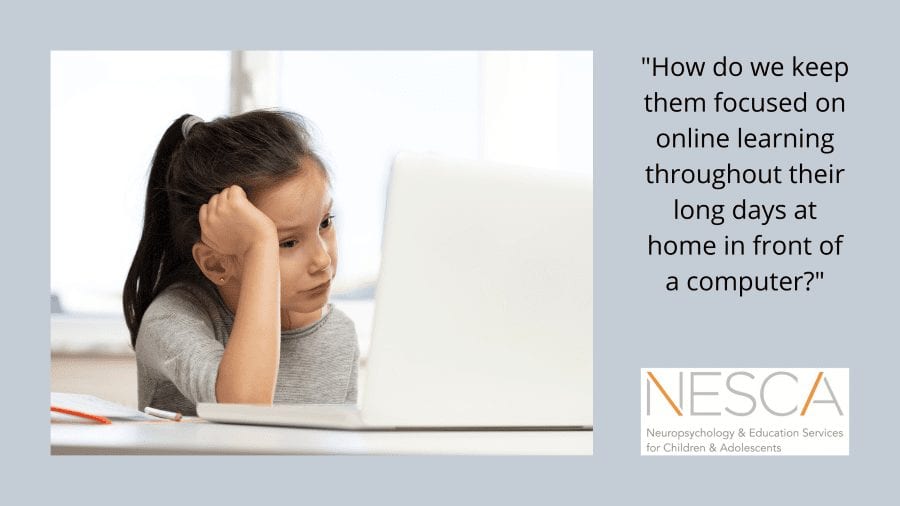
In our last blog, we delved into ideas and suggestions to help preschoolers stay on track with remote and hybrid learning through movement breaks. In this week’s OT Tuesday blog, we move up to our elementary school-aged kids. How do we keep them focused on online learning throughout their long days at home in front of a computer?

Again, here are some suggestions that require minimal equipment, generally using things you can find around your home.


Gross Motor for Elementary-age Children

A movement break for 5- to 10-minutes every hour and a half to 2 hours is recommended.

Hopscotch – Draw with chalk or use painter’s tape and play this old school game! Begin by throwing a beanie baby, rock or bean bag so it lands in the first square. Hop over it and jump on all the other squares. At the end, turn around and come back and try to pick up the object while trying to balance on one foot! The next time, throw the object to square 2 and repeat through all the numbers!


Photo Credit: sciencebuddies.org

Homemade Hockey Sticks – Use a long wrapping paper roll or tape together paper towel rolls as the handle. Cut a long strip of cardboard and tape to the handle or use an old plastic water bottle. Enjoy playing this game with a balloon or tennis ball. Mark goals with tape, chalk or use empty cardboard boxes.


Stack the Cardboard Boxes – Got empty boxes? Have the child stack them up high and knock them over by running into them, or rolling/kicking a soccer ball into them. To make it a little silly, place a tennis ball in the leg of a pair of stockings and the waistband over your child’s head. Use the tennis ball to knock over boxes or cans, with their head upside down.


Photo Credit: Hands On As We Grow®

Stair Bean Bag Toss – Try to get bean bags to land on different steps. More points for the higher they land!


Tic Tac Toe – Make a big board with sidewalk chalk or painter’s tape. Use bean bags, frisbees, paper plates or crumpled up paper and throw into boxes for a fun spin. Get creative with items around the house – even food!


Photo Credit: OT Plan

Belly Catch – Have your child lay on their belly with feet or legs resting on a couch and hands on the floor (plank style). Roll balls or balloons and have them play catch with you, a great exercise to work on core and upper extremity strength.


 Fine Motor for Elementary-age Children

Photo Credit: Hoglets.org

Monster Feet – Grab some old tissue boxes or cardboard and make your own monster feet. Decorate the toe nails with markers, pom poms or however else you’d like! For an added challenge, try wearing them by using string to tie the child’s feet to them. Or tape their shoes to them and walk around like a monster!


Photo Credit: kidsactivitiesblog.com

Homemade Tennis Racquets – Cut slits in a paper plate or punch holes. String yarn through the holes and attach to a paper towel roll, spatula or wooden spoon/popsicle stick. Use it to keep a ball or balloon in the air!


Hangman! – Or for an added twist, play Melting snowman! Draw a snowman, and each time someone guesses a letter incorrectly, erase a part of the snowman until he is fully melted!


Make Your Own Quicksand – Mix roughly equal parts cornstarch and play sand. Add water until it is the desired consistency.

●       If you don’t have play sand, add 1 cup of water to a bowl and slowly add 1-½ cup of cornstarch and stir.

●       Put toys into quicksand and watch them sink!


Paint Pinecones – As the weather gets colder, collect some pine cones or rocks and paint them! Make kindness rocks by writing messages on them with a Sharpie. Leave them out along a wooded trail for others to find.


About the Author

Julie Robinson is an occupational therapist with over 25 years of experience as a clinician. The work Julie does is integral to human development, wellness and a solid family unit. She particularly enjoys supporting families through the process of adoption and in working with children who are victims of trauma. Julie has extensive experience working with children diagnosed with an Autism Spectrum Disorder (ASD), or who have learning or emotional disabilities. She provides services that address Sensory Processing Disorder (SPD) and self-regulation challenges, as well as development of motor and executive functioning skills.

To book an appointment or to learn more about NESCA’s Occupational Therapy Services, please fill out our online Intake Form, email info@nesca-newton.com or call 617-658-9800.


Neuropsychology & Education Services for Children & Adolescents (NESCA) is a pediatric neuropsychology practice and integrative treatment center with offices in Newton, Massachusetts, Plainville, Massachusetts, and Londonderry, New Hampshire, serving clients from preschool through young adulthood and their families. For more information, please email info@nesca-newton.com or call 617-658-9800.


Movement Breaks – Part 1

By | NESCA Notes 2020

By: Julie Robinson, OT

Director of Clinical Services; Occupational Therapist, NESCA

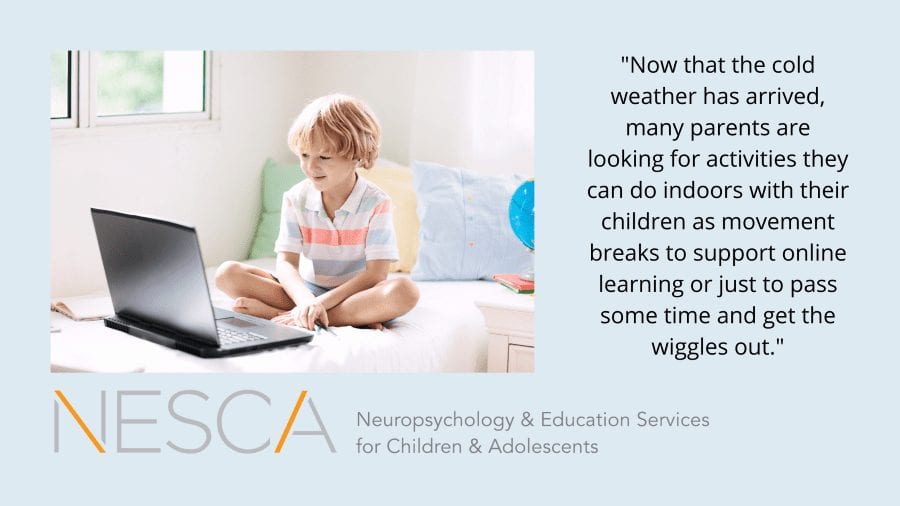
Many parents are overwhelmed, juggling homeschooling, childcare and work from home. And now that the cold weather has arrived, many parents are looking for activities they can do indoors with their children as movement breaks to support online learning or just to pass some time and get the wiggles out. Here are some suggestions that require minimal equipment, generally using things you can find around your home.

In this week’s OT Tuesday blog, we provide suggestions on both gross and fine motor activities for preschoolers. In our second part of the blog series, we will offer ideas to target fine and gross motor activities for elementary school-age students during movement breaks.


Gross Motor Activities for Preschoolers

A 5- to 10-minute movement break is suggested every hour to hour and a half for children in this age group.

Balloon Games – Blow up and see how many times your child can hit the balloon in the air! Use a fly swatter or tennis/badminton racquet to mix it up a little.
Mazes – Use painter’s tape indoors or sidewalk chalk outdoors in the driveway to make mazes for your child to follow. You can even use the lines as a balance beam for added balance practice, draw feet to jump in, make curly lines to indicate twirling around, etc.! If you are looking for ideas, research sensory paths online. You can also draw crazy roads for toy cars or ride-on toys.
Bowling – Fill up old plastic water or soda bottles and have kids knock them over by rolling a ball towards them! You can add stuffed animals on top to make it more enticing.
The Floor Is Lava – Pretend the floor is lava and have the child walk around without touching the ground by walking on pillows and other objects!
Shape Games – Draw shapes, letters or numbers with sidewalk chalk or painter’s tape and try throwing stuffed animals into the shapes an adult calls out. Make it more challenging by increasing the number of shapes, throwing from further away or trying to balance on one foot while throwing.


Fine Motor Activities for Preschoolers

Hide Beads In Playdough! – Grab some putty or playdough and hide beads in it. Once all the beads are hidden, encourage your child to try to get them out! This is a great exercise to work on hand strength. It can also be fun to put raw spaghetti into the dough and “string” the beads onto them for working on fine motor precision.
Make Your Own Stamps! – Use household items, such as wine corks, water bottle caps, toilet paper rolls or anything else you can find. Dip them in paint and press onto paper. Enjoy the different shapes you create! For picky eaters, it can be fun to use foods, such as applesauce, yogurt or dips for paint.
Clothespin Activities – Use clothespins to pick up pom poms and put them in containers, such as an ice cube tray. This is a great activity for practicing a tripod grasp.
Shaving Cream Play – Use a tray or large plate and put shaving cream or other messy play materials on it. Allow your child to practice writing their letters with their fingers and have fun with it! To simplify, you can encourage your child to imitate shapes, letters or numbers after you have written them.
Noodle Necklaces – String noodles onto string to make a noodle necklace. Use noodles and put on a string or a pipe cleaner to make a necklace. Color or paint noodles, or soak cooked noodles in food coloring and allow them to dry for more interesting patterns.


About the Author

Julie Robinson is an occupational therapist with over 25 years of experience as a clinician. The work Julie does is integral to human development, wellness and a solid family unit. She particularly enjoys supporting families through the process of adoption and in working with children who are victims of trauma. Julie has extensive experience working with children diagnosed with an Autism Spectrum Disorder (ASD), or who have learning or emotional disabilities. She provides services that address Sensory Processing Disorder (SPD) and self-regulation challenges, as well as development of motor and executive functioning skills.

To book an appointment or to learn more about NESCA’s Occupational Therapy Services, please fill out our online Intake Form, email info@nesca-newton.com or call 617-658-9800.


Neuropsychology & Education Services for Children & Adolescents (NESCA) is a pediatric neuropsychology practice and integrative treatment center with offices in Newton, Massachusetts, Plainville, Massachusetts, and Londonderry, New Hampshire, serving clients from preschool through young adulthood and their families. For more information, please email info@nesca-newton.com or call 617-658-9800.


Skip to content