Tag

pediatric neuropsychology Archives - Page 12 of 19 - NESCA

Subscribe to NESCA Notes

How to Tame Holiday Stress

By | NESCA Notes 2021

By: Angela Currie, Ph.D.
Pediatric Neuropsychologist, NH Director, NESCA

The holidays are supposed to bring joy, but they also bring a lot of pressure, expectations, and stress. Planning and preparing can take months, and balancing this planning with school events, holiday parties, and our every day demands can be a lot to handle. That said, there are some basic things that we can to do manage holiday stress and focus on the things that matter most, including the following:

Identify and prioritize your values. Reflect and decide ahead of time what is most important to you this holiday season. Whether it is being with family, following through with traditions, giving back to others, or something else, knowing what you care most about will help you know where to put your time and energy.

Simplify where you can. Once you know your priorities, cut out things that are not in line with these. We tend to go a bit above and beyond at the holidays, and we often find ourselves doing things just because we always have done so, not because we want to. Invest your time where it matters most. This year, I cut out holiday cards. While cute, they are time consuming and the majority likely go straight to the trash. Creating cute waste is not my priority. Sorry, grandparents – maybe next year.

Take focus off of gift giving as much as possible. Overindulgent gift giving is not only financially burdensome and time consuming, but it is also likely not in line with your intrinsic holiday values. Streamline your gift giving where able. For example, adults draw names instead of buying for everyone, set a limit for the number of gifts per person, or buy group gifts and experiences. In our house, when buying for the kids, we try to stick with: one thing you want, one thing you need, one thing to wear, and one thing to read. Sometimes we stray a bit, but it helps keep our priorities focused and manage the children’s expectations.

Communicate expectations. Tell your family or friends what they can expect from you this holiday season. This should include talking with your children about how your family will celebrate the holidays, and how it may be different from what others do. If you know you’ll be invited to three holiday dinners, or if someone may expect your visit to be longer than you desire, get ahead of it and tell them your anticipated schedule and plans.

Pick your battles. The holidays are overwhelming for everyone, including children. They may try to manage their stress by exerting control, including pushing back against holiday traditions or expectations. Before asking things of them, remind yourself of your priorities and values. If you don’t really care whether your child wears slacks versus sweatpants during Christmas dinner, don’t pick that battle.

Provide familiarity. To help manage the uncertainty and stimulation of holiday festivities, do what you can to provide children with some familiarity, such as having some preferred foods in the dinner buffet or giving them a designated break away from the chaos to play alone without the pressure to socialize.

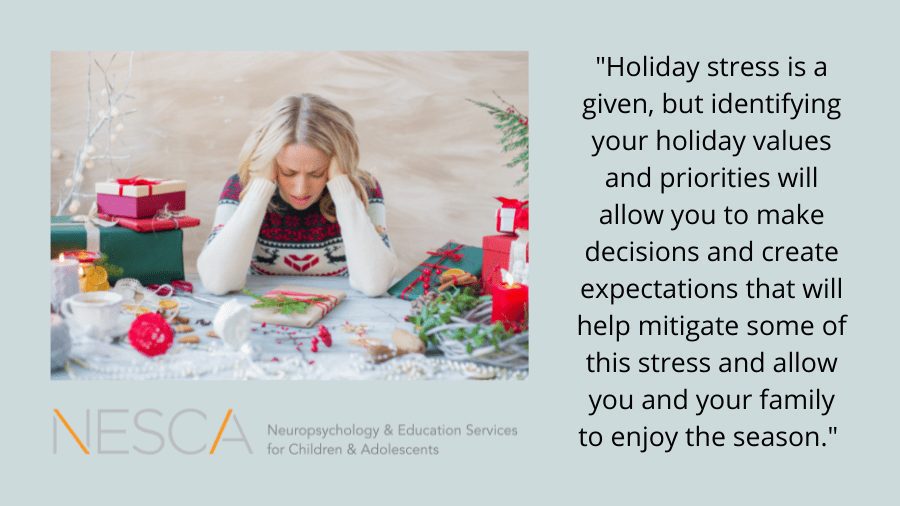
In sum, holiday stress is a given, but identifying your holiday values and priorities will allow you to make decisions and create expectations that will help mitigate some of this stress and allow you and your family to enjoy the season.


About the Author

Dr. Angela Currie is a pediatric neuropsychologist at NESCA. She conducts neuropsychological and psychological evaluations out of our Londonderry, NH office. She specializes in the evaluation of anxious children and teens, working to tease apart the various factors lending to their stress, such as underlying learning, attentional, or emotional challenges. She particularly enjoys working with the seemingly “unmotivated” child, as well as children who have “flown under the radar” for years due to their desire to succeed.


To book an evaluation with Dr. Currie or one of our many other expert neuropsychologists, complete NESCA’s online intake form. Indicate whether you are seeking an “evaluation” or “consultation” and your preferred clinician in the referral line.


Neuropsychology & Education Services for Children & Adolescents (NESCA) is a pediatric neuropsychology practice and integrative treatment center with offices in Londonderry, NH, Plainville, MA, and Newton, MA serving clients from preschool through young adulthood and their families. For more information, please email info@nesca-newton.com or call (603) 818-8526.

Vocational Aptitude Testing

By | NESCA Notes 2021

By: Kelley Challen, Ed.M., CAS
Director of Transition Services; Transition Specialist, NESCA

Over the past month, my colleague Tabitha Monahan and I have been dedicating our blog entries to vocational assessment as a critical tool for helping students learn about employment and set career goals for themselves. Previous blogs have provided an overview of vocational assessment as well as an in depth look at career interest inventories and real-life experiences, such as informational interviews and job shadows. Many of these tools provide opportunities for students to learn more about the world of work and types of jobs that match with their interests and things that they know they like. Today, I am going to share information about a different type of assessment, vocational aptitude testing.

It is not uncommon for middle and high school students to have job aspirations that do not fully align with their physical and cognitive strengths or even their general preferences for daily work (e.g., being seated, indoors, casually dressed, etc.). When you have had very little exposure to employment and you spend most of your time in a structured educational environment, it is hard to picture yourself as a worker and fully appreciate the skills, knowledge, education, abilities, and experience needed for a particular job. Vocational aptitude testing is formal testing of a set of abilities known to impact an individual’s potential for success and satisfaction in a variety of occupations.

Similar to intelligence or cognitive assessment tools, vocational aptitude tests vary in format, activities, and the defined abilities or factors that are tested. For instance, at NESCA three of the most common vocational aptitude tests we use are quite different from one another—an online computer-based assessment tool that is designed for self-administration, a paper-based assessment tool that is formally administered in an office or classroom with both a test booklet and scantron answer sheets, and a functional hands-on set of performance activities that simulate actual work activities (e.g., sorting mail by zip code, alphabetizing post cards, assembling pipes, tightening screws, etc.). However, most vocational aptitude tests include tests designed to evaluate the following aptitude factors (i.e., abilities):

Verbal Aptitude – The ability to understand and use words effectively, to comprehend verbal concepts and language, and to express ideas clearly in words. People who score highly generally do well in school, particularly in subjects where verbal concepts are important.

Numerical Aptitude – The ability to do arithmetic and other numerical computations quickly and accurately. People who score highly on this aptitude may do well in such school subjects as math and physics.

Spatial Aptitude – The ability to visualize two-dimensional objects in three-dimensional space, and to mentally manipulate objects through different spatial orientations. People who get high scores have the aptitude to perform well in school subjects and work involving drafting, art, architecture, clothes designing, and so on.

Perceptual Aptitude – The ability to compare and discriminate words, numbers, symbols, or other graphic material to see if slight differences exist between them. People who score highly in this area should do well in proofreading, copyediting, and nonverbal tasks that require attention to detail and rapid visual discriminations.

Manual Dexterity – The ability to coordinate eye and hand movements and perform manual tasks rapidly and accurately. High scores indicate the ability to manipulate tools and objects with speed and precision.

General Ability – The ability to learn and achieve in training or academic situations. People who get high scores “catch on” quickly in new situations, and are proficient in making judgments and in grasping underlying principles and solving problems. (This is often computed through summing or averaging an individual’s verbal and numerical aptitudes.)

Definitions provided by/taken from the Occupational Aptitude Survey and Interest Schedule Aptitude Survey (OASIS-3: AS) Examiner’s Manual.

If a student has participated in other kinds of standardized testing over time, especially intelligence testing and occupational therapy testing, it is likely that quite a bit of information is already known regarding the students’ aptitudes for employment. However, there are many vocational aptitude tests that are bundled with interest inventory tests, enabling a quick and clear comparison of the student’s vocational aptitudes and interests. For example, the OASIS-3 Aptitude Survey mentioned above is part of a testing kit that includes the OASIS-3 Interest Schedule and an Interpretation Workbook for easily comparing jobs within a student’s interest areas with their current career abilities.

Career aptitude testing can give a student a clear sense of their relative strengths and areas of challenge as well as a sense of how their current abilities compare with the abilities required for jobs of interest. However, it is important to caution that career aptitude testing does not predict the kind of work that a student should do. Results of career aptitude testing may differ considerably based on many factors, including new learning and work experiences. Results of testing should change as a student gains education and work exposure and can certainly be used to help us understand what skills might need remediation for a student to have a better chance of participating in certain kinds of employment.

One final thought regarding career aptitude testing is that while it can sometimes be an option to administer standardized testing with accommodations, I would encourage only providing accommodations that would reasonably be provided on a work site. For example, offering a student who has comprehension or processing speed difficulties the opportunity to take aptitude testing with unlimited time may not help the student to get a sense of how their aptitudes truly match up with the demands of a particular job. The reality is that most employers are not able to give employees unlimited time to do their jobs. Using text-to-speech during computer-based administration of a test may be far more relevant as long as test results are interpreted with the need for this accommodation in mind.

To read more about vocational assessment, check out the following blog entries:

For more information about vocation assessment and transition assessment at NESCA, visit our transition services page and our transition FAQs.


About the Author
Kelley Challen, Ed.M., CAS, is NESCA’s Director of Transition Services, overseeing planning, consultation, evaluation, coaching, case management, training and program development services. Ms. Challen also provides expert witness testimony in legal proceedings related to special education. She is also the Assistant Director of NESCA, working under Dr. Ann Helmus to support day-to-day operations of the practice. Ms. Challen began facilitating programs for children and adolescents with special needs in 2004. After receiving her Master’s Degree and Certificate of Advanced Study in Risk and Prevention Counseling from Harvard Graduate School of Education, Ms. Challen spent several years at the MGH Aspire Program where she founded an array of social, life and career skill development programs for teens and young adults with Asperger’s Syndrome and related profiles. She additionally worked at the Northeast Arc as Program Director for the Spotlight Program, a drama-based social pragmatics program, serving youth with a wide range of diagnoses and collaborating with several school districts to design in-house social skills and transition programs. Ms. Challen is co-author of the chapter “Technologies to Support Interventions for Social- Emotional Intelligence, Self-Awareness, Personality Style, and Self-Regulation” for the book Technology Tools for Students with Autism. She is also a proud mother of two energetic boys, ages six and three. While Ms. Challen has special expertise in supporting students with Autism Spectrum Disorders, she provides support to individuals with a wide range of developmental and learning abilities, including students with complex medical needs.


Neuropsychology & Education Services for Children & Adolescents (NESCA) is a pediatric neuropsychology practice and integrative treatment center with offices in Newton, Massachusetts, Plainville, Massachusetts, and Londonderry, New Hampshire, serving clients from preschool through young adulthood and their families. For more information, please email info@nesca-newton.com, call 617-658-9800 or complete our online Intake Form.

When the Honeymoon Period Is Over: Signs of School Refusal

By | NESCA Notes 2021

By: Moira Creedon, Ph.D. 
Pediatric Neuropsychologist, NESCA

As we reach the end of our second month back to school, many of us may be reaching the end of that glorious honeymoon period – the phase when kids are excited to see friends, optimistic for the school year, and reviewing material they likely already know. For some, the return did not start this rosy; the bloom is falling off the rose and kids are getting tired. You and your child are not alone in this. My goal for today’s blog is to share with you some warning signs that your child may be struggling and ways to get support before they grow to become bigger problems. The biggest problem I want to avoid: school refusal.

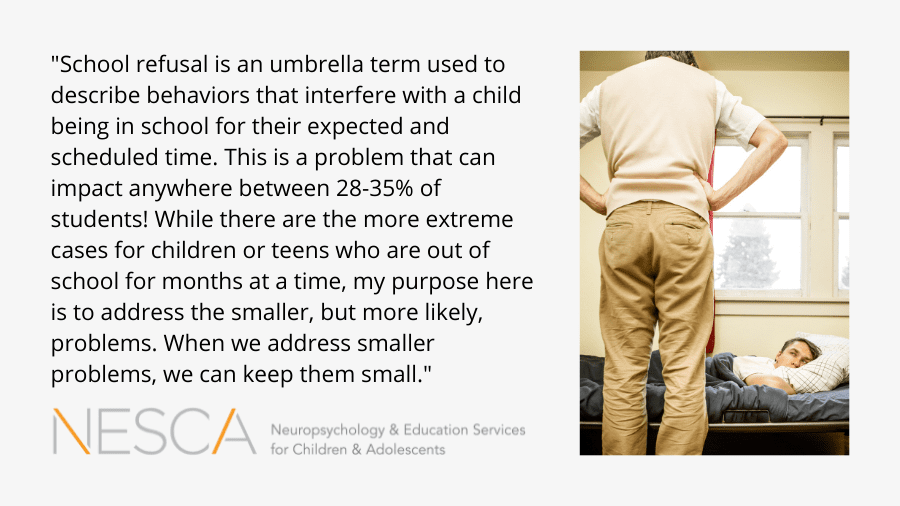
Have you heard this yet? – “My tummy hurts. I have to stay home.” Or, “I hate school. Please don’t make me go.” Or, “I’m not going!” Or perhaps these messages are communicated more subtly with covers over their heads in the morning, difficulty getting out the door on time, tantrums or disruptive behaviors in the mornings, missed buses, or the overwhelming frustration of homework that erupts into nightly battles. According to researcher Christopher Kearney, these are signs to pay attention to as they can evolve into what he terms “school refusal behavior.” School refusal is an umbrella term used to describe behaviors that interfere with a child being in school for their expected and scheduled time. This is a problem that can impact anywhere between 28-35% of students! While there are the more extreme cases for children or teens who are out of school for months at a time, my purpose here is to address the smaller, but more likely, problems. When we address smaller problems, we can keep them small.

Risky signs that your child is struggling with school:

  • Consistent statements of hating school, their teacher, or specific peers. A casual mention of a bad day is not cause for alarm. We all have bad days. If the statements keep coming and they get louder and stronger, then parents should pay attention.
  • The outward behaviors are getting bigger in the mornings before school or over homework. Behavior is a way for children to communicate with us how they are feeling. So, explosions over homework or tantrums in the morning that lead to tardiness are warning signs. The occasional homework meltdown or rushed morning is normal; we are all human! But, the problem is in the pattern.
  • Avoidance rears its ugly head. While some kids show on the outside that they are uncomfortable through their explosions, others communicate very clearly through their withdrawal. Some kids and teens struggle to get out of bed, are constantly tired, not completing work, falling asleep in class, or sharing every somatic complaint or symptom available on Google. If medical causes are ruled out, anxiety can be a culprit.
  • Consider the role of a major transition. According to Kearney, the riskiest time for a child to develop a pattern of school refusal is during times of significant transition – like starting kindergarten or changing schools from middle to high school. In addition to the social and emotional jump that these transitions bring, there is also a massive leap in demands for academic independence. It is very common for kids to struggle with the leap initially.

Oh no. So now what?

  • First and foremost, keep calm. It is far easier to keep small problems small when we have a clear-headed approach. Pull in anxiety management techniques like deep breathing, sleep, and exercise to support your own anxiety as a parent.
  • Reach out to your child’s teacher or school psychologist. Let them know your child is struggling with homework or coming to school. This is a great chance to gather information on what is going on in your child’s day and put your child on their teacher’s radar. This is critical as the only effective approach to remedy a problem with school refusal is a team approach.
  • Talk to your child honestly about what is going on. This has to include a chance for kids to talk about what might be happening to make them feel stressed or why they dislike school. Don’t shortcut this step. If your child has trouble explaining what is going on (which can be especially true for younger kids), try this approach: you and your child are both going to be detectives to learn together what is making school feel hard. We can’t solve a problem until we understand it. By joining with your child in gathering information, you are demonstrating great empathy and validating that their feelings are real.
  • Be careful of your language and conversation about school. It can be tempting to go too far in validating a child to give the message that the assignment really is stupid or their teacher really is unreasonable and mean. It’s best to stick to the feeling (“that must feel so frustrating”) without reinforcing negative messages about school.
  • Hold the line. As you gather more information, it is really important to maintain the message that it is your child’s job to go to school. It might feel conflicting to both validate the feelings of hating school and give the message to attend school. It might feel something like this: It’s either “I love and support my child OR I’m going to force them to go to school even when it’s hard.” Let’s change that OR to AND. Reframe the thought to: “I love and support my child AND they have to go to school AND they can do hard things.”

For more information, please check out:

Kearney, C.A. (2007). Getting your child to say “yes” to school: A guide for parents of youth with school refusal behavior. New York: Oxford University Press.


About the Author

Dr. Creedon has expertise in evaluating children and teens with a variety of presenting issues. She is interested in uncovering an individual’s unique pattern of strengths and weaknesses to best formulate a plan for intervention and success. With experiences providing therapy and assessments, Dr. Creedon bridges the gap between testing data and therapeutic services to develop a clear roadmap for change and deeper of understanding of individual needs.


If you are interested in booking an evaluation with Dr. Creedon or another NESCA neuropsychologist, please fill out and submit our online intake form


Neuropsychology & Education Services for Children & Adolescents (NESCA) is a pediatric neuropsychology practice and integrative treatment center with offices in Newton and Plainville, Massachusetts, and Londonderry, New Hampshire, serving clients from preschool through young adulthood and their families. For more information, please email info@nesca-newton.com or call 617-658-9800.

Meet NESCA Pediatric & Adult Neuropsychologist Miranda Milana, Psy.D.

By | NESCA Notes 2021

By: Jane Hauser
Director of Marketing & Outreach

This September, NESCA welcomed a new neuropsychologist to its team. Learn more about Pediatric & Adult Neuropsychologist Miranda Milana, Psy.D., in my interview with her below.

Where did your interest in neuropsychology come from?

I knew from an early age that I wanted to work with children. I initially thought I would work with children in the medical field, but I ended up being fascinated by child psychology, which led to my focus on the clinical aspect of therapy with kids and their families.

I then started to notice the importance of neuropsychological reports in schools, treatment planning, formulating diagnoses and determining the tools needed to help kids be successful. I knew I wanted to do that! I saw my fair share of unhelpful reports and wanted to take the opportunity to write truly beneficial ones.

Over time, I’ve gotten to work with families and have been able to offer evaluations to the adults as well as young adults.

Who do you evaluate??

I really enjoy working with all kids, but have a particular intertest in early elementary-aged kids – toddlers through early elementary schoolers. I love to get to know kids whose parents, caregivers or educators are questioning whether they may have an autism spectrum disorder (ASD) or some kind of learning challenge. It’s exciting to start to work with a child as they are entering school and continue to watch them progress throughout their education.

Additionally, I have a particular interest in working with older adolescents and adults who feel there may be a “missing piece” in their understanding of themselves, or who seek greater insight into their personal profile to inform appropriate therapies, access relevant services, and enhance self-awareness.

Tell me about your clinical experience prior to joining NESCA.

Before coming to NESCA, I was a post-doctoral fellow at Boston Children’s Hospital, which provided me with great exposure to a wide variety of kids and the challenges they were experiencing. My case load there exposed me to a vast range of educational and developmental concerns and presentations. Working with children aged 2 through 17 who showed a wide-ranging array of presentations really helped me to become a flexible thinker.

It was a great opportunity to work with all types of clinicians, families and children. Also, having such a diverse case load afforded me the opportunity to become part of so many teams within the hospital, including the Down Syndrome, Adoption and Teenager teams, among others. It was rewarding to be able to learn from each one of them.

What drew you to NESCA?

I wanted to continue to work in a collaborative environment, where it wasn’t just me contributing to a child’s evaluation and plan. I really wanted to learn and collaborate with a team of psychologists and other providers in a group practice, outside of the hospital setting. Being part of a child’s trajectory in school is exciting, and NESCA allows me to do just that!

Joining NESCA also allows me to work with a more diverse group of individuals based on age. While I love working with children and adolescents, I also welcome the opportunity to work with more adults, parents, or young adults who are trying to secure adult services and supports.

What are some of the more rewarding experiences you’ve had as a neuropsychologist?

Getting kids who are closed off to share their experiences with me is very rewarding. With these kids, we have to be creative in how we approach them, get them to share and play. Having anxious, resistant children feel comfortable opening up to me in conversation or who allow themselves to be vulnerable by sharing personal information, is such a rewarding part of what I do. To know you have built that kind of trust with a child is so fulfilling.

Working with adults has also been rewarding, as it allows me to provide meaningful insights and answers to individuals who have often spent years seeking clarity without success.

What’s your secret sauce in building that trust with a child who is anxious or resistant?

I am kind of a kid at heart, so I use that in testing children to engage them and create a more fun environment. I take pride in getting to know a child beyond the test scores and collected data. Finding common ground and relating to them is so important. I also like to make sure they know I am part of their team who will support them as they move forward in school and in life. It’s a personal challenge to me to get the most resistant kids to engage and maybe even crack a smile during the evaluation!


About Miranda Milana, Psy.D.

Dr. Miranda Milana provides comprehensive evaluation services for children, adolescents, and adults with a wide range of concerns, including attention deficit disorders, communication disorders, intellectual disabilities, and learning disabilities. She particularly enjoys working with children and their families who have concerns regarding an autism spectrum disorder. Dr. Milana has received specialized training on the administration of the Autism Diagnostic Observation Schedule (ADOS).

Dr. Milana places great emphasis on adapting her approach to a individual’s developmental level and providing a testing environment that is approachable and comfortable for them. She also values collaboration with families and outside providers to facilitate supports and services that are tailored to a person’s specific needs.

Before joining NESCA, Dr. Milana completed a two-year postdoctoral fellowship at Boston Children’s Hospital in the Developmental Medicine department, where she received extensive training in the administration of psychological and neuropsychological testing. She has also received assessment training from Beacon Assessment Center and The Brenner Center. Dr. Milana graduated with her B.A. from the University of New England and went on to receive her doctorate from William James College (WJC). She was a part of the Children and Families of Adversity and Resilience (CFAR) program while at WJC. Her doctoral training also included therapeutic services across a variety of settings, including an elementary school, the Family Health Center of Worcester and at Roger Williams University.

Dr. Milana grew up in Maine and enjoys trips back home to see her family throughout the year. She currently resides in Wrentham, Massachusetts, with her husband and two golden retrievers. She also enjoys spending time with family and friends, reading, and cheering on the Patriots, Bruins, Red Sox, and Celtics.​


To book an evaluation with Pediatric Neuropsychologist Dr. Milana or one of our many other expert neuropsychologists or therapists, complete NESCA’s online intake form

Neuropsychology & Education Services for Children & Adolescents (NESCA) is a pediatric neuropsychology practice and integrative treatment center with offices in Newton and Plainville, Massachusetts, as well as Londonderry, New Hampshire. NESCA serves clients from preschool through young adulthood and their families. For more information, please email info@nesca-newton.com or call 617-658-9800.

Vocational Assessment and Transition Planning

By | NESCA Notes 2021

By: Kelley Challen, Ed.M., CAS
Director of Transition Services; Transition Specialist, NESCA

Transition planning is a complex process centered around helping students, typically who receive special education services, to set goals for their postsecondary adult lives and to engage in learning, services, and experiences that will help them to ultimately reach those goals. Assessment is a critical aspect of this process, both as a means for collecting baseline information about the student and measuring progress throughout the planning process. While transition planning focuses on outcomes in several key areas (e.g., further education and training, employment, independent living, community engagement, adult service involvement), many families who seek transition assessment and planning help are specifically concerned about employment. What can my child do? What career path is best for my daughter? Will my son be able to support himself? For these families, vocational assessment is a critical piece of the transition planning process. Yet, many families do not have a good understanding of what a vocational evaluation includes and the types of results and recommendations that can come from such evaluation.

Vocational assessment has a relatively simple definition. It is the process of gathering information about a student’s interests, abilities, and aptitudes as they relate to the student’s work potential.[i] However, there is not one universal test or process used to collect this information. In fact, any of the following types of tests might be part of vocational assessment:

  • Record review
  • Informal interview with the student
  • Informal interview with parents, teachers, or other professionals who know the student well
  • Observation of student in current familiar environments
  • Interest inventories (informal or formal)
  • Learning style inventories
  • Self-reported skill, ability and achievement inventories
  • Work preference and motivation assessments
  • Work-related behavior inventories
  • Employability/Life skills assessment
  • Formal aptitude assessment
  • Situational assessment of a student in a controlled work environment
  • Work samples
  • Functional assessment of simulated or real job tasks

Importantly, most students do not need to participate in all of the above types of assessments. In fact, a lot of the best information comes from the first few informal steps of the process, record review (which often includes rich data about a student’s cognitive skills, sensory and motor skills, perceptual skills, and learning style) and interviews with the student and adults familiar with the student. Ultimately, the purpose of vocational assessment is to develop a profile of the student’s interests, skills, and aptitudes and formulate measurable short- and long-term career goals. However, it is important to remember that participation in vocational assessment typically does not, and should not, result in identification of one specific career to pursue. That’s not how any of the tests, or the overall process, is designed. Instead, results of vocational assessment will suggest a variety of careers or career families that a student may be interested in exploring more in depth. It is an important starting point of career exploration, especially for students who are unsure about their career goals. Results can also be helpful for identifying where there is alignment in a student’s aptitudes and interests or where more exposure and instruction may be needed to support a student’s career development. The information that comes out of vocational assessment is an invaluable part of comprehensive transition assessment and planning for students with and without disabilities.

For more information about vocation assessment and transition assessment at NESCA, visit our transition services page and our transition FAQs.

Also, stay tuned for more blogs about vocational assessment this fall as my colleague Tabitha Monahan and I will be specifically breaking down some of the above types of testing in greater detail.

[i] Instructional Materials Laboratory. (1998).  Vocational assessment for students with special needs. Columbia, MO: Author.


About the Author
Kelley Challen, Ed.M., CAS, is NESCA’s Director of Transition Services, overseeing planning, consultation, evaluation, coaching, case management, training and program development services. Ms. Challen also provides expert witness testimony in legal proceedings related to special education. She is also the Assistant Director of NESCA, working under Dr. Ann Helmus to support day-to-day operations of the practice. Ms. Challen began facilitating programs for children and adolescents with special needs in 2004. After receiving her Master’s Degree and Certificate of Advanced Study in Risk and Prevention Counseling from Harvard Graduate School of Education, Ms. Challen spent several years at the MGH Aspire Program where she founded an array of social, life and career skill development programs for teens and young adults with Asperger’s Syndrome and related profiles. She additionally worked at the Northeast Arc as Program Director for the Spotlight Program, a drama-based social pragmatics program, serving youth with a wide range of diagnoses and collaborating with several school districts to design in-house social skills and transition programs. Ms. Challen is co-author of the chapter “Technologies to Support Interventions for Social- Emotional Intelligence, Self-Awareness, Personality Style, and Self-Regulation” for the book Technology Tools for Students with Autism. She is also a proud mother of two energetic boys, ages six and three. While Ms. Challen has special expertise in supporting students with Autism Spectrum Disorders, she provides support to individuals with a wide range of developmental and learning abilities, including students with complex medical needs.


Neuropsychology & Education Services for Children & Adolescents (NESCA) is a pediatric neuropsychology practice and integrative treatment center with offices in Newton, Massachusetts, Plainville, Massachusetts, and Londonderry, New Hampshire, serving clients from preschool through young adulthood and their families. For more information, please email info@nesca-newton.com, call 617-658-9800 or complete our online Intake Form.

When Gaming Is No Longer A Game

By | NESCA Notes 2021

By: Cynthia Hess, PsyD
Pediatric Neuropsychologist and Therapist

Many parents are wrestling with how much time their children are engaging with screens, and finding themselves wondering how much is too much. Children who experience difficulty related to symptoms of ADHD are especially drawn to the stimulation of screens. And children with ADHD tend to require frequent and immediate rewards, making them especially drawn to screen-time activities. While a specific cause for ADHD has not been identified, there is some consensus that a shortage of dopamine could be to blame. Dopamine not only plays a role in how we feel pleasure, it is also significant in the uniquely human ability to think and plan.

Part of the allure of gaming – and social media – is that each new level reached and each new “like,” instantly releases a small dose of dopamine directly into the brain’s reward center. If you have ever had to fight with your child to get off technology, this is likely why. A deficit in dopamine is easily fed by screen-time activities, leading children to want more. This has led to a demand for content, resulting in tens of millions of dollars having been made by YouTubers whose entire platform is gaming, and children love watching them. They are entertaining, and kids learn tips for improving their own gaming.

Children worship gaming YouTubers, and many strive to be one someday. It is challenging for parents to keep up with the content their children are accessing largely because YouTube has created an algorithm in the system that suggests what to watch next based on frequent views or recent searches. YouTube’s recommendation system is specifically engineered to maximize watch time and often “up next” videos play automatically. In fact, this feature is responsible for more than 70 percent of all time spent on the site, indicating that children, and others, are consistently and reliably exploring recommended “up next” content. It is important for parents to do their research and know who their children are watching and following on YouTube, as they may be drawn into content that could be highly influential and contrary to family values. While many YouTubers are harmless, there are those who include brief, perhaps undetectable messages (e.g., PewDiePie) that influence what shows up next. Children are curious, and YouTube’s goal is to keep them engaged, which can turn into the perfect storm.

YouTube consists of a business model that rewards provocative videos with large sums of money. They strive to attract viewers by leading them down paths meant to keep people engaged. While much of the content may seem innocuous, there are reasons to be cautious as things aren’t always as innocent as they seem. Provocative content creates intrigue. It piques interest and may be especially attractive to older children and adolescents. As individuals strive to create the next viral video, putting forth extreme beliefs and violent content may be their pathway to becoming a celebrity. For these reasons, and as technology becomes increasingly embedded in children’s lives, it is important for parents to do their research and stay informed.

Some helpful resources include:

https://www.pewresearch.org/internet/2020/07/28/parenting-children-in-the-age-of-screens/

https://chadd.org/wp-content/uploads/2018/06/ATTN_06_15_TooMuchScreenTime.pdf

https://childmind.org/article/healthy-limits-on-video-games/


About the Author

Dr. Cynthia Hess recently graduated from Rivier University with a PsyD in Counseling and School Psychology. Previously, she earned an M.A. from Antioch New England in Applied Psychology. She also worked as an elementary school counselor and school psychologist for 15 years before embarking on her doctorate. During her doctorate, she did her pre-doctoral internship with RIT in Rochester, N.Y. where she worked with youth ages 5-17 who had experienced complex developmental trauma. Dr. Hess’s first post-doctoral fellowship was with The Counseling Center of New England where she provided psychotherapy and family therapy to children ages 5-18, their families and young adults. She also trained part-time with a pediatric neuropsychologist conducting neuropsychological evaluations.


To schedule an appointment with one of NESCA’s expert neuropsychologists, please complete our online intake form


Neuropsychology & Education Services for Children & Adolescents (NESCA) is a pediatric neuropsychology practice and integrative treatment center with offices in Newton and Plainville, Massachusetts, and Londonderry, New Hampshire, serving clients from preschool through young adulthood and their families. For more information, please email info@nesca-newton.com or call 617-658-9800.


The Path Back to Fitness

By | NESCA Notes 2021

By: Ann Helmus, Ph.D.
NESCA Founder/Director

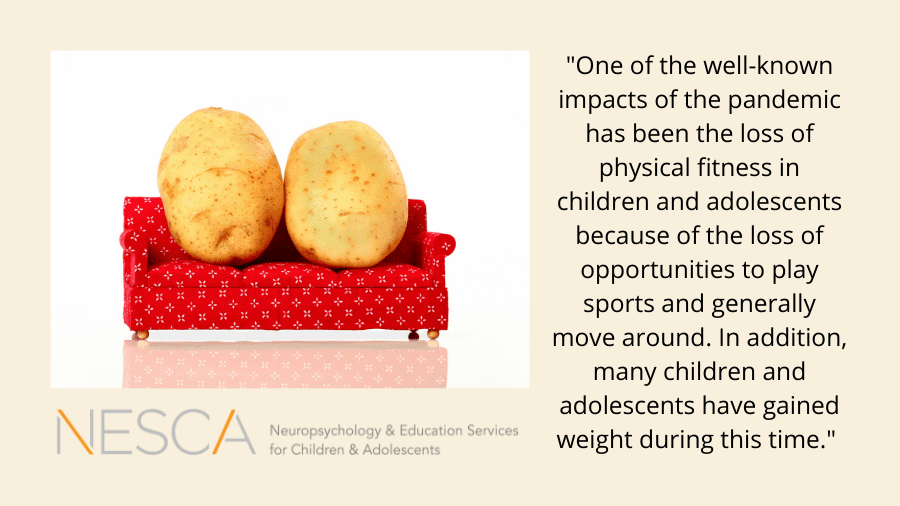
One of the well-known impacts of the pandemic has been the loss of physical fitness in children and adolescents because of the loss of opportunities to play sports and generally move around. In addition, many children and adolescents have gained weight during this time. Maintaining a healthy weight and being physically fit offer many benefits for social-emotional development as well as academic performance. Numerous research studies link physical exercise to significant improvements in the regulation of mood and anxiety as well as attention and executive functioning.

Parents are often at a loss for how to help their child get back into good habits to lose weight, exercise regularly, or get back into a sport. Common parenting approaches, such as offering “helpful suggestions,” encouraging, nagging and bribing usually don’t work for long term—or even short term—positive change. Instead, these approaches often “back fire,” making the child feel even more ashamed or powerless—emotions that are not likely to fuel motivation to change habits.

So how do we support children and adolescents in developing the positive habits that are necessary for maintaining health and fitness? The key lies in empowering the child to determine his or her own goals and establishing their “why” through discussion of why they would like to reach this goal, what they will get by achieving the goal, and, perhaps most important, how they will feel when they reach this goal. This type of motivational interviewing builds internal motivation, which beats external motivators every time in terms of creating long term change.

Once the child or adolescent is clear on what they would like to achieve and why, the next step is determining the behavior changes that will help the child achieve their outlined goal and working with the child to figure out what’s manageable so that success can be ensured. For example, one adolescent might easily commit to a 30-minute daily bike ride, whereas another might want to start with a daily 10-minute walk. Success breeds success, so it is important to set goals that are challenging but also achievable. Throughout this process, the focus is on creating a positive mindset and positive emotional state of empowerment, hopefulness, optimism, and pride.

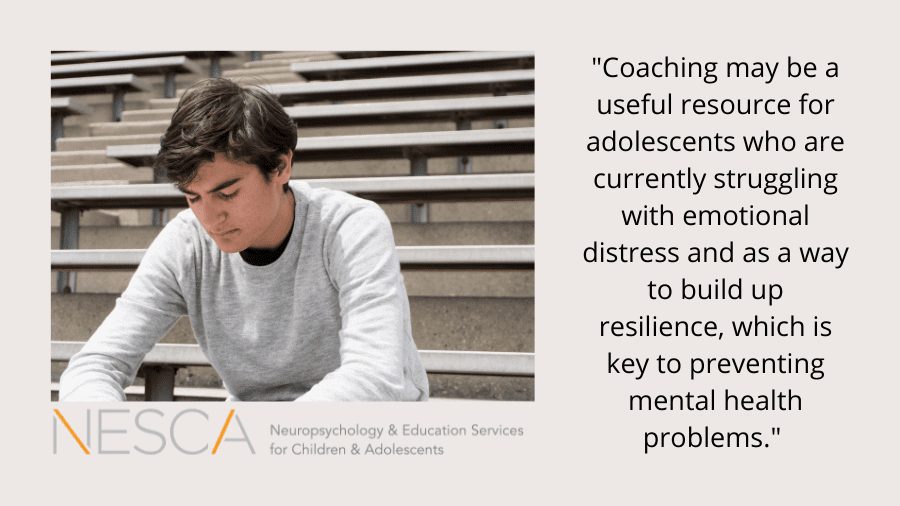
Some children may be open to this type of process with their parents; however, most adolescents will likely not want to be involved at this level with a parent. NESCA offers health and life coaching, aimed at helping adolescents and young adults with this process. Coaching offers a structured approach to helping an adolescent or young adult define his/her own goals and motivations as well as understanding the obstacles that they have encountered in reaching those goals, which are usually limiting beliefs (e.g., “I can never stick to things.”) or faulty self-identities (e.g., “I’m not athletic.”). The coaching process works through a combination of structured activities as well as a highly supportive personal relationship. To learn more, please join us for a webinar on Thursday, September 23 at 1:00 PM ET, view a previous webinar on this topic on our website or contact Health & Life Coach Billy Demiri for a free 30-minute consultation to determine if health coaching might be helpful for your child.


About the Author

NESCA Founder/Director Ann Helmus, Ph.D. is a licensed clinical neuropsychologist who has been practicing for almost 20 years. In 1996, she jointly founded the  Children’s Evaluation Center (CEC) in Newton, Massachusetts, serving as co-director there for almost ten years. During that time, CEC emerged as a leading regional center for the diagnosis and remediation of both learning disabilities and Autism Spectrum Disorders.

In September of 2007, Dr. Helmus established NESCA (Neuropsychology & Education Services for Children & Adolescents), a client and family-centered group of seasoned neuropsychologists and allied staff, many of whom she trained, striving to create and refine innovative clinical protocols and dedicated to setting new standards of care in the field.

Dr. Helmus specializes in the evaluation of children with learning disabilities, attention and executive function deficits and primary neurological disorders. In addition to assessing children, she also provides consultation and training to both public and private school systems. She frequently makes presentations to groups of parents, particularly on the topics of non-verbal learning disability and executive functioning.

To book an evaluation with Dr. Helmus, NESCA Founder and Director, or one of our many other expert neuropsychologists or therapists, complete NESCA’s online intake form

Neuropsychology & Education Services for Children & Adolescents (NESCA) is a pediatric neuropsychology practice and integrative treatment center with offices in Newton and Plainville, Massachusetts, as well as Londonderry, New Hampshire. NESCA serves clients from preschool through young adulthood and their families. For more information, please email info@nesca-newton.com or call 617-658-9800.
Helping Students Transition Back to School

By | NESCA Notes 2021

By: Angela Currie, Ph.D.
Pediatric Neuropsychologist, NH Director, NESCA

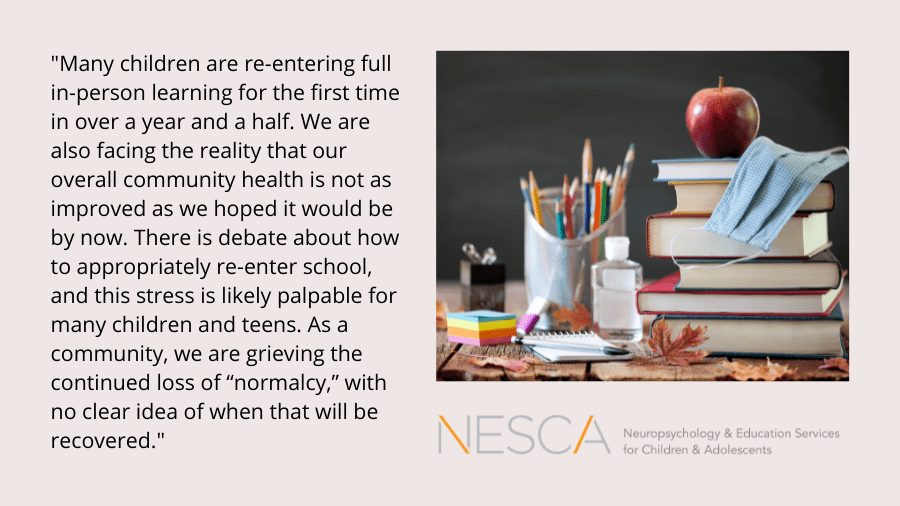
Back in June, I wrote a blog about dealing with uncertainty at the end of the school year. Now, two months later, families are focused on the transition back to school, and a level of uncertainty still remains. Many children are re-entering full in-person learning for the first time in over a year and a half. We are also facing the reality that our overall community health is not as improved as we hoped it would be by now. There is debate about how to appropriately re-enter school, and this stress is likely palpable for many children and teens. As a community, we are grieving the continued loss of “normalcy,” with no clear idea of when that will be recovered.

How do we help children, and their adults, transition back to school during such a time? Some of the basic strategies are similar to those that we do to help them cope with the end of the school year. This includes watching for signs that your child may be struggling (e.g., difficulty sleeping) and talking about their feelings related to starting school in an open and validating manner. In addition, here are some strategies for helping to ease the upcoming transition to school:

  • Start to work into your schoolyear daily routine within the last week or two of summer. This includes bedtimes and wakeup times.
  • Create a morning and evening routine checklist or schedule. Use visual prompts for young children. For example, a morning checklist may include: Wake Up, Get Dressed, Eat Breakfast, Brush Teeth, Pack Bag (listing words or pictures of what to pack), and Departure Time. Practice this checklist for a couple days ahead of school starting to help you child get into the routine and understand how long each task will take.
  • Preview your child’s schoolyear to the extent possible. This may include reviewing their class schedule, looking at their teacher’s profile or picture on the school website, going to a back-to-school event at their school, etc.
  • Help your child set some goals for the upcoming year, trying to create intrinsic goals (e.g., build confidence with reading; make a new friend; ask questions more; etc.), rather than extrinsic (e.g., get straight As).
  • For children who were full remote last year and whose schools have mask mandate, practice wearing a mask at home for increasing durations of time.
  • Avoid scheduling extra activities during the first two weeks of school, such as weekend trips or appointments, allowing for a more relaxed transition.
  • Particularly for elementary age children, email your child’s teacher ahead of the year starting in order to briefly introduce yourself and your child. If you child has specialized needs, concisely highlight key things that the teacher should be aware of heading into the year.
  • For children who will be using a locker for the first time, have them practice opening a combination lock at home before the year starts.
  • For families feeling dissatisfaction regarding your school’s COVID-related mandates or plan, work to keep this conflict or stress away from your child.

Understood.org has a range of tools to help children transition back to school, including a Back to School Update for teachers, Backpack Checklists, Back-to-School Worksheet, Introduction Letter templates, and a Self-Awareness Worksheet, among others. Consider the above tips and resources and determine which are most appropriate for your child and their current skill set and feelings regarding the return to school. With the right tools in place, children and families can feel more confident entering the school year.


About the Author:

Dr. Angela Currie is a pediatric neuropsychologist at NESCA. She conducts neuropsychological and psychological evaluations out of our Londonderry, NH office. She specializes in the evaluation of anxious children and teens, working to tease apart the various factors lending to their stress, such as underlying learning, attentional, or emotional challenges. She particularly enjoys working with the seemingly “unmotivated” child, as well as children who have “flown under the radar” for years due to their desire to succeed.

 

To book an evaluation with Dr. Currie or one of our many other expert neuropsychologists, complete NESCA’s online intake form. Indicate whether you are seeking an “evaluation” or “consultation” and your preferred clinician in the referral line.


Neuropsychology & Education Services for Children & Adolescents (NESCA) is a pediatric neuropsychology practice and integrative treatment center with offices in Londonderry, NH, Plainville, MA, and Newton, MA serving clients from preschool through young adulthood and their families. For more information, please email info@nesca-newton.com or call (603) 818-8526.

Student Involvement in IEPs: Ten Tips to Help Middle School Students Get Started – Part 2

By | NESCA Notes 2021

By: Kelley Challen, Ed.M., CAS
Director of Transition Services; Transition Specialist, NESCA

As discussed in my previous blog, federal law requires that students with Individual Education Programs (IEPs) be invited to attend their transition IEP meetings. In Massachusetts, this means that students approaching the age of 14, often 8th graders, should be invited to attend their IEP meetings to start the process of transition planning if this has not already begun. However, many students are not invited to their team meetings until high school, if at all. Additionally, research has indicated that when students do attend team meetings, they have the lowest level of satisfaction about their IEP meeting of any team member and they feel the least comfortable sharing their thoughts and suggestions in the meeting.[i] Nevertheless, studies across the country have shown that students can learn skills to actively participate in their IEP meetings, especially when they are directly taught terminology, roles, and how to participate, and when team members expect student participation.[ii] In the first part of this blog series, I provided five tips for helping students to become involved in their IEP process: Explicitly learn about the IEP document and process; Talk about strengths; Talk about challenges; Complete interest and preference inventories; and, Talk about the student’s goals for after high school. Today, I am adding five more tips aimed at truly helping the student to be an instrumental part of their team meeting. After all, the student’s voice and their vision are the most important aspects of transition planning and special education.

  1. If testing is being discussed, make sure that an adult talks about the testing with the student BEFORE the IEP meeting—The ability to use assessment information to develop goals is one of the most important skills a student needs in order to be an active participant in their transition planning process. This means that students need to have access to, and an understanding of, assessment information just like every other member of the team. Professionals and parents all have the right to access evaluation results ahead of a team meeting and traditionally come to the meeting having read the evaluations, often more than once. Moreover, they have typically seen the same tests or similar tests beforehand and usually already have some sense of the student’s learning profile, strengths, and challenges. When the student has undergone evaluations that will inform IEP development, it is critical for the evaluator or another adult who understands the testing well to sit with the student and explain the findings and recommendations from the evaluations in a developmentally appropriate manner. The student needs to know what areas were evaluated, and to have a general sense of the strengths, challenges, interests, and preferences that were highlighted within the testing, in order to be able to participate in a meaningful discussion about their short- and long-term goals and the services that they need. Moreover, they need to have time to process this information, with support, before they are expected to participate in a discussion about what to do with the information.
  2. Give the student options as to how they would like to participate—Just like any other activity, an IEP meeting can be broken down through a task analysis process, and participation in the IEP meeting can be scaffolded, rather than taking an all or nothing approach. There are many actions and “micro-actions” that a student can take to be involved in their team meeting in a way that feels comfortable and satisfying to the student. Certainly, there are the preparatory activities described in my previous blog (e.g., participating in assessment, learning about the IEP, completing a one-pager, etc.). But there are also administrative tasks that the student can participate in, like photocopying materials or sending out invitations or reminders to participants. Students may also want to prepare a script, PowerPoint, video, work portfolio or other materials they can share with the team during the meeting. Also, they may want to share their experience at the meeting with peers afterward or present highlights of the meeting to a staff member or family member who could not attend. There are many examples of ways to participate before, during, and after the team meeting in this great brochure from the I’m Determined project (https://www.imdetermined.org/wp-content/uploads/2017/10/iep_participation_brochure.pdf). Some students may choose to take a more passive role, but it is important that the student has the opportunity to prepare and to make an informed choice regarding their participation. Over time, students should be building their skills for IEP participation so that they can ultimately lead one or more of their transition IEP meetings (http://www.ciclt.net/ul/mgresa/2.HowtoHelpStudentsLeadIEP.pdf).
  3. Practice!—This tip may seem obvious, but I am taking time to state it because it is often something that is forgotten. Participating in an IEP meeting, especially as the student, is not a normal activity. Sitting in tight quarters with your parents, general educators, special educators, therapists, counselors, and any number of other professionals, who are all talking about you and your challenges is inherently uncomfortable—especially if you have difficulties with language, social cues, anxiety, etc. One way to make the experience “less weird” is to practice. Generally, students will be asked questions about their concerns, strengths, accomplishments, challenges, and goals for the future. It helps to practice answering questions about these areas outside of the IEP meeting and to not be answering these types of questions for the first time in the meeting. An even more useful practice activity is to have a mock IEP meeting. There are plenty of scripts online that follow the typical format of an IEP meeting, such as introductions and attendance, questions and concerns, reports of current performance, transition planning, and IEP development. It is particularly important for the student to be aware of times in the meeting when they will be specifically asked for their contribution (e.g., introductions, student concerns, vision statement, etc.).
  4. Invite preferred staff—Scheduling team meetings is a logistical puzzle, and often not all staff can be present for the whole meeting, if at all. Ask the student who they feel knows them best and who they really want on their team. If you know which teachers are the most motivating for the student, make sure that they are invited. Moreover, when there is a choice related to staff participation, prioritize having the meeting at a time when staff who the student likes and feels comfortable with can be part of the meeting. For student’s who have 1:1 paraprofessional support, it is really important for the paraprofessional to be at the meeting so that the student can have the same level of assistance (and feel the same sense of safety and support) that they do throughout their school day. The student is the most important member of their IEP team, and they will feel most included if they look around the room and see familiar faces of people they know are on their side.
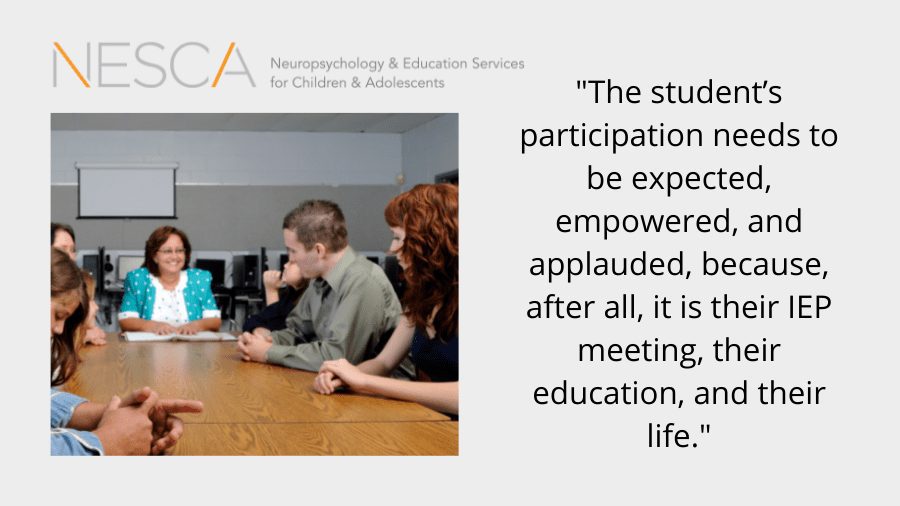
  5. Expect the student to participate!—The  most important thing that adults can do to assist students in participating in their IEP meetings is to make the time and space for the student to participate in the meeting. This may mean requesting a longer meeting than usual so that adults in the meeting can slow down or rephrase language in terms that are accessible for the student and so that the student has time to formulate their thoughts and language in order to participate in the meeting. Whatever accommodations a student needs to participate actively in a classroom discussion should be considered and put in place if they are needed for a student to participate actively in the team meeting discussion. Adults need to be respectful of the student’s voice and to not speak for the student, interrupt the student, talk over the student, or disregard the student’s input. The student’s participation needs to be expected, empowered, and applauded, because, after all, it is their IEP meeting, their education, and their life.

[i] http://www2.ku.edu/~tccop/files/Martins_Perspective.pdf

[ii] http://www2.ku.edu/~tccop/files/Martins_Perspective.pdf


About the Author
Kelley Challen, Ed.M., CAS, is NESCA’s Director of Transition Services, overseeing planning, consultation, evaluation, coaching, case management, training and program development services. Ms. Challen also provides expert witness testimony in legal proceedings related to special education. She is also the Assistant Director of NESCA, working under Dr. Ann Helmus to support day-to-day operations of the practice. Ms. Challen began facilitating programs for children and adolescents with special needs in 2004. After receiving her Master’s Degree and Certificate of Advanced Study in Risk and Prevention Counseling from Harvard Graduate School of Education, Ms. Challen spent several years at the MGH Aspire Program where she founded an array of social, life and career skill development programs for teens and young adults with Asperger’s Syndrome and related profiles. She additionally worked at the Northeast Arc as Program Director for the Spotlight Program, a drama-based social pragmatics program, serving youth with a wide range of diagnoses and collaborating with several school districts to design in-house social skills and transition programs. Ms. Challen is co-author of the chapter “Technologies to Support Interventions for Social- Emotional Intelligence, Self-Awareness, Personality Style, and Self-Regulation” for the book Technology Tools for Students with Autism. She is also a proud mother of two energetic boys, ages six and three. While Ms. Challen has special expertise in supporting students with Autism Spectrum Disorders, she provides support to individuals with a wide range of developmental and learning abilities, including students with complex medical needs.


Neuropsychology & Education Services for Children & Adolescents (NESCA) is a pediatric neuropsychology practice and integrative treatment center with offices in Newton, Massachusetts, Plainville, Massachusetts, and Londonderry, New Hampshire, serving clients from preschool through young adulthood and their families. For more information, please email info@nesca-newton.com, call 617-658-9800 or complete our online Intake Form.

Skip to content