To accommodate requests for neuropsychological evaluations after the start of the new school year, NESCA has added evaluation dates in its Newton, MA office. Immediate openings are now available for scheduling. Please complete our Inquiry/Intake Form for more information or to start the scheduling process.

Tag

praise Archives - NESCA

Subscribe to NESCA Notes

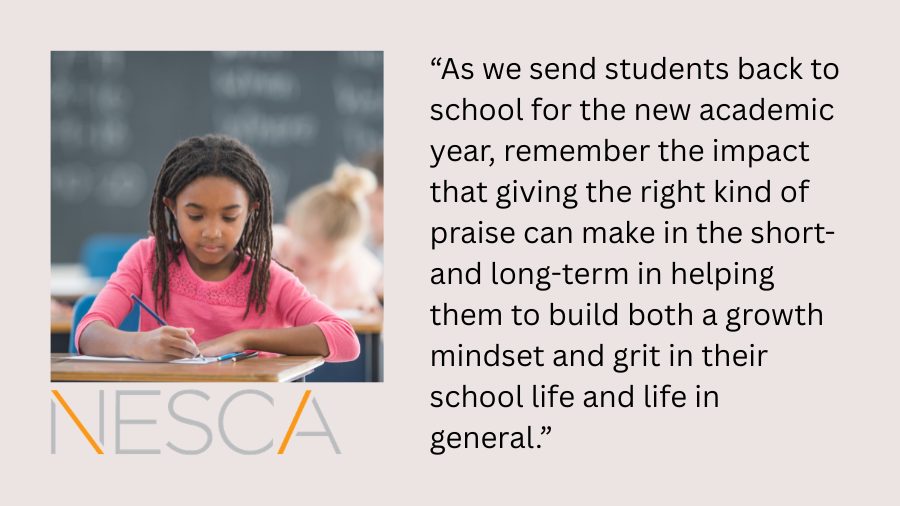
Image of a student putting forth effort on an exam and a quote from a NESCA clinician

The Right Praise Leads to Grit – Part 2

By | NESCA Notes 2026

Image of a student putting forth effort on an exam and a quote from a NESCA clinicianBy Dot Lucci, M.Ed., CAGS
Director of Consultation and Psychoeducational Services, NESCA

In my last blog, I discussed why the right kind of praise matters for students. In Part 2 of my blog series about Praise, I’m going to discuss how the right kind of praise leads to students having grit or perseverance. Grit or perseverance is often understood as sustained effort toward a achieving a goal. Research links grit, self-regulated learning, and resilience with students’ engagement and persistence in challenging academic tasks as the ability persist through challenges, setbacks, and failures.

In Part 1, I discussed Carol Dweck’s research that distinguished praising intelligence versus praising effort. When students are told they are “smart,” their identity gets “locked in” on being/appearing smart, so they avoid difficult tasks that could expose them to failure or being perceived as “dumb or not smart.” Therefore, praising effort encourages a “growth mindset,” which is the belief that abilities can develop through learning, practice, and persistence.

This idea connects directly to grit. Praising effort naturally encourages grit. It teaches that productive failure is part of the learning process and prepares students for setting long-term goals or assignments that are challenging. It prepares them for life! Failure should be viewed as a part of life and learning, and not associated with shame or a permanent label. Failure can be used as a jumping off point to explore where the breakdown happened. This is why we praise “productive failure.” It encourages students to ask questions about what happened and move forward with curiosity. Grades should not be ignored, but they should not be the sole object of praise. Instead, use good grades as a recognition of mastery of content, study habits, effort, perseverance, practicing the hardest problems, asking for help when needed, and revising mistakes, etc.

Teachers and parents should praise actions instead of results or identity labels. Instead of saying, “You’re such a math whiz,” try saying, “You stuck with those confusing word problems and kept trying a different approach, that’s great.” Or instead of, “You failed the test,” one can offer, “This test score shows me that you didn’t really understand this concept or study in a way that allowed you to master the content.” These types of phrases show students that failure and setbacks are temporary and actionable – not permanent.

A growth mindset allows students to approach life with an openness that allows them to fail, make mistakes, and be/feel okay about themselves. It does not define who they are as a person! Praise about the process they took or the effort they put forth helps students develop intrinsic motivation, resilience, and greater challenge-seeking behaviors. They don’t see themselves as a failure and won’t give up as easily. Remind them that failure is part of learning, and building grit will carry them forward in future endeavors. Praising effective strategies, improvement, and sustained effort can help students develop resilience. Ultimately, praise that emphasizes the process of learning can strengthen the mindset that supports grit, helping individuals persist because they understand that effort can lead to growth.

As we send students back to school for the new academic year, remember the impact that giving the right kind of praise can make in the short- and long-term in helping them to build both a growth mindset and grit in their school life and life in general.


Resources:

“How to Encourage Academic Grit and a Growth Mindset in Your Students”
By Princy Quadros-Mennella, PhD, Associate Professor of Psychology, Director of the Neuroscience Program, Bay Path University and Thomas Mennella, PhD, Associate Professor of Biology Director of the M.S. in Applied Laboratory Science and Operations Program, Bay Path University
https://www.academicimpressions.com/how-to-encourage-academic-grit-and-a-growth-mindset-in-your-students/

Psychologist Angela Duckworth’s research about grit:
https://www.angeladuckworth.com

https://americanradioworks.publicradio.org/features/tomorrows-college/grit/angela-duckworth-grit.html


About the Author

NESCA’s Director of Consultation and Psychoeducational Services Dot Lucci has been active in the fields of education, psychology, research and academia for over 30 years. She is a national consultant and speaker on program design and the inclusion of children and adolescents with special needs, especially those diagnosed with Autism Spectrum Disorder (ASD). Prior to joining NESCA, Ms. Lucci was the Principal of the Partners Program/EDCO Collaborative and previously the Program Director and Director of Consultation at MGH/Aspire for 13 years, where she built child, teen and young adult programs and established the 3-Ss (self-awareness, social competency and stress management) as the programming backbone. She also served as director of the Autism Support Center. Ms. Lucci was previously an elementary classroom teacher, special educator, researcher, school psychologist, college professor and director of public schools, a private special education school and an education collaborative.

Ms. Lucci directs NESCA’s consultation services to public and private schools, colleges and universities, businesses and community agencies. She also provides psychoeducational counseling directly to students and parents. Ms. Lucci’s clinical interests include mind-body practices, positive psychology, and the use of technology and biofeedback devices in the instruction of social and emotional learning, especially as they apply to neurodiverse individuals.

To book a consultation with Ms. Lucci or one of our many expert clinicians, complete NESCA’s online intake form. Indicate whether you are seeking an “evaluation” or “consultation” and your preferred clinician/consultant/service in the referral line.

NESCA is a pediatric neuropsychology practice and related services center with offices in Newton, Plainville, and Hingham, Massachusetts; Londonderry, New Hampshire; and Coral Gables, Florida, serving clients from infancy through young adulthood and their families. For more information, please email info@nesca-newton.com or call 617-658-9800.
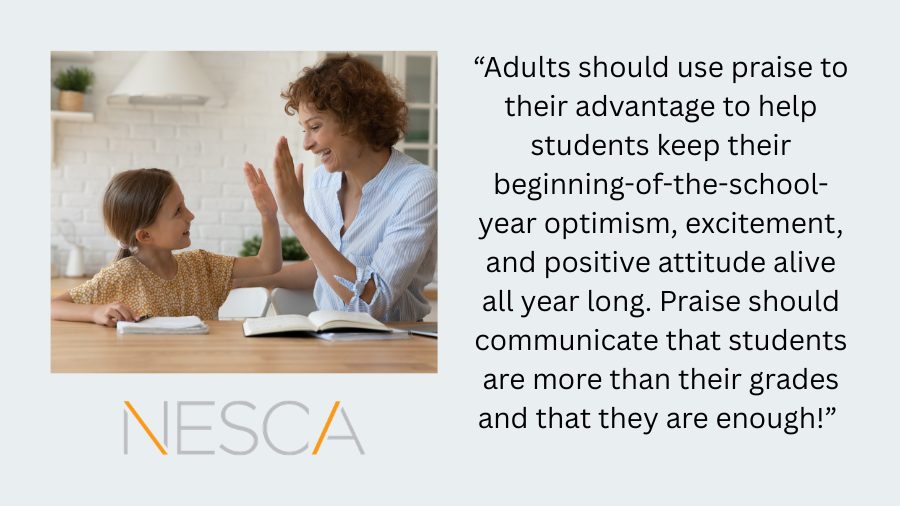
 

Image of a parent praising a student with a high five and a quote from a NESCA provider.

The Right Type of Praise Matters – Part 1

By | NESCA Notes 2026

Image of a parent praising a student with a high five and a quote from a NESCA provider.By Dot Lucci, M.Ed., CAGS
Director of Consultation and Psychoeducational Services, NESCA

I just returned from consulting to a couple of schools in Honduras. While there, I met with teachers, parents, and students, and provided workshops to the teachers there. I have been honored and excited to consult to these schools and to witness the teachers implementing the lessons gained from our workshops, showing how they have positively shifted their habits and practices as they have welcomed students back for their new school year.

On the first day of school at one of the schools, the graduating seniors lead a pep rally for the whole school, and it was exhilarating. Watching this assembly then witnessing all of the students – not just the seniors – go to their classes with enthusiasm, excitement, and optimism was palatable.  The whole experience energized the entire student body and faculty alike. My goal in all my school consults is to help teachers keep this spirit and enthusiasm alive within their students throughout the whole school year.

One of the workshops I gave was on how to keep students’ motivation, optimism, and positive self-worth alive. Most students start off the year with a positive attitude and hope for the future, but as the school year progresses these feelings tend to shift and wane. Sometimes this shift is influenced by how the adults in the student’s life provide feedback. Teachers, parents, and caregivers can sometimes provide feedback that turns the student off to working harder and trying difficult tasks. When we say things like, “You’re so smart,” “You got an A,” or “You’re a great creative writer,” we are praising a person’s worth on achievement, talent, results, and intelligence. Grade-, intelligence-, and achievement-based praise, or results-driven praise places a student’s worth on the final result. Praise that encourages effort, grit, and perseverance activates the brain to keep going with an attitude of, “I can do it,” “I’ll try even if it is hard,” or “I’m good enough even if I make a mistake.” It fosters the mindset that their self-worth isn’t tied up in getting the good grade or isn’t attached to being intelligent.

Psychologist Carol Dweck’s research on the growth mindset highlights how powerful this difference is when students are confronted with difficult work or failure. Dweck’s growth mindset research contrasts the belief that intelligence is fixed with the belief that ability can develop through practice, effective strategies, feedback, and help from others. When teachers, parents, and caregivers repeatedly praise grades, intelligence, or talent alone, students then infer that they have to be smart, successful, and can’t make mistakes to be loved (by parents) and valued and respected (by teachers). Thus, when a student gets a disappointing grade, it feels like evidence that they are not good enough or smart enough, which often leads to feelings of unworthiness and a lack of risk-taking behavior related to academic challenge. Studies conducted by Carol Dweck and fellow Stanford psychologist and research director Claudia Mueller showed that students who were praised for their intelligence after achieving a good grade were more likely to choose easier tasks afterward and showed weaker performance following failure than students who were praised for their effort. In contrast, the effort-praised students demonstrated greater persistence, enjoyment, and post-failure performance, choosing a more difficult test to complete than their counterparts. For more on this, watch this YouTube video: Carol Dweck – A Study on Praise and Mindsets – https://www.youtube.com/watch?v=NWv1VdDeoRY.

Adults should use praise to their advantage to help students keep their beginning-of-the-school-year optimism, excitement, and positive attitude alive all year long. Praise should communicate that students are more than their grades and that they are enough! By honoring solid effort, thoughtful strategies and attempts, perseverance, and learning from mistakes, teachers and parents help students develop the confidence to attempt difficult things and the resilience to continue even when success does not come naturally.


Resources:

Carol Dweck – Praising Intelligence: Costs to Children’s Self-Esteem and Motivation
https://bingschool.stanford.edu/news/carol-dweck-praising-intelligence-costs-childrens-self-esteem-and-motivation

Claudia Mueller and Carol Dweck – Praise for intelligence can undermine children’s motivation and performance.
https://psycnet.apa.org/record/1998-04530-003


About the Author

NESCA’s Director of Consultation and Psychoeducational Services Dot Lucci has been active in the fields of education, psychology, research and academia for over 30 years. She is a national consultant and speaker on program design and the inclusion of children and adolescents with special needs, especially those diagnosed with Autism Spectrum Disorder (ASD). Prior to joining NESCA, Ms. Lucci was the Principal of the Partners Program/EDCO Collaborative and previously the Program Director and Director of Consultation at MGH/Aspire for 13 years, where she built child, teen and young adult programs and established the 3-Ss (self-awareness, social competency and stress management) as the programming backbone. She also served as director of the Autism Support Center. Ms. Lucci was previously an elementary classroom teacher, special educator, researcher, school psychologist, college professor and director of public schools, a private special education school and an education collaborative.

Ms. Lucci directs NESCA’s consultation services to public and private schools, colleges and universities, businesses and community agencies. She also provides psychoeducational counseling directly to students and parents. Ms. Lucci’s clinical interests include mind-body practices, positive psychology, and the use of technology and biofeedback devices in the instruction of social and emotional learning, especially as they apply to neurodiverse individuals.

To book a consultation with Ms. Lucci or one of our many expert clinicians, complete NESCA’s online intake form. Indicate whether you are seeking an “evaluation” or “consultation” and your preferred clinician/consultant/service in the referral line.

NESCA is a pediatric neuropsychology practice and related services center with offices in Newton, Plainville, and Hingham, Massachusetts; Londonderry, New Hampshire; and Coral Gables, Florida, serving clients from infancy through young adulthood and their families. For more information, please email info@nesca-newton.com or call 617-658-9800.


Skip to content