
Tag

remote services Archives - NESCA

Subscribe to NESCA Notes

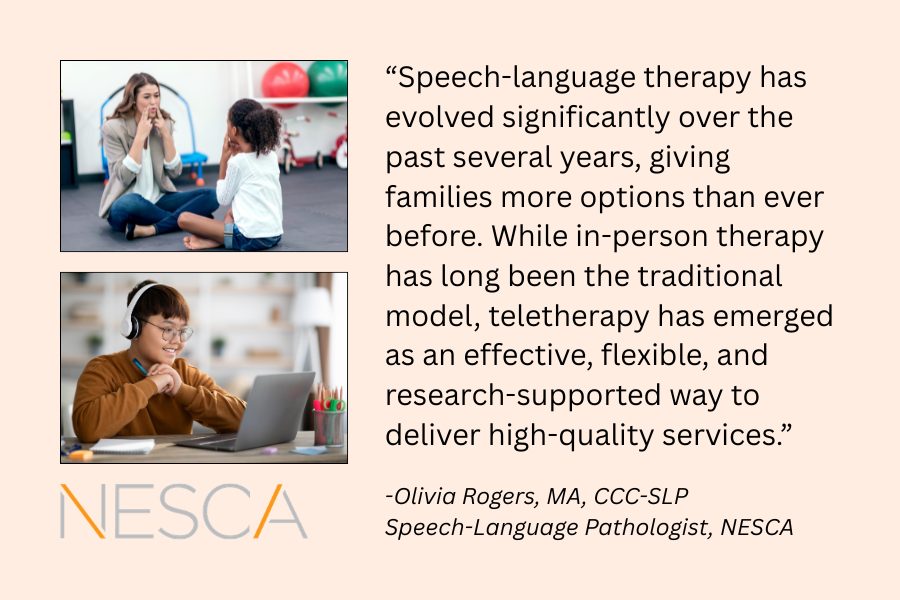
images showing what In-person or Teletherapy Speech Services look like and a quote from Olivia Rogers, CCC-SLP

Teletherapy vs. In-Person Therapy: What Families Should Know

By | NESCA Notes 2026

images showing what In-person or Teletherapy Speech Services look like and a quote from Olivia Rogers, CCC-SLPBy Olivia Rogers, MA, CCC-SLP
Speech-Language Pathologist, NESCA

Speech-language therapy has evolved significantly over the past several years, giving families more options than ever before. While in-person therapy has long been the traditional model, teletherapy has emerged as an effective, flexible, and research-supported way to deliver high-quality services.

Both approaches can support meaningful progress, but they offer different advantages depending on a student’s needs, learning style, and family schedule.

What is In-Person Therapy?
In-person therapy takes place face-to-face in a clinic, school, or home setting. Sessions often include hands-on materials, physical movement, and direct interaction with the clinician in the same space.

Benefits of In-Person Therapy

  • Natural opportunities for play-based learning
  • Physical prompts and hands-on support
  • Easier for very young children who need frequent redirection
  • Helpful when targeting feeding, articulation placement, or sensory-motor skills

For some students – particularly younger children or those needing physical cueing – in-person therapy can be an important option.

What is Teletherapy?
Teletherapy delivers speech, language, and coaching services through a secure video platform. Sessions remain interactive, individualized, and structured and use digital materials, shared screens, real-time coaching, and collaborative activities. Teletherapy is not “less than” in-person therapy. In many cases, it offers unique advantages that directly support academic and functional skill development.

The Benefits of Teletherapy

  1. Therapy Happens in the Student’s Real Learning Environment

Students often join sessions from home or school, allowing strategies to be applied immediately to real assignments, writing tasks, and classroom demands. This is especially powerful for:

  • Academic language
  • Writing
  • Executive functioning
  • Organization and study skills

Skills transfer more naturally because therapy is embedded in everyday routines.

  1. Increased Engagement for Older Students

Many school-age students and adolescents are highly responsive to digital learning. Interactive slides, collaborative documents, and visual supports can increase participation and independence. Teletherapy often feels:

  • Less intimidating
  • More conversational
  • Provides more room for independence
  • More aligned with how students already learn

This can lead to stronger buy-in and carryover.

  1. Greater Family Involvement

Caregivers can easily observe sessions, ask questions, and learn strategies without travel. Due to the ease of meeting, consultation time can easily be built into teletherapy sessions or added on as a monthly service. This improves consistency between therapy and daily life – one of the biggest predictors of progress.

  1. Flexible Scheduling and Reduced Barriers

Teletherapy eliminates commuting, waiting rooms, and geographic limitations. Families can access specialized services that may not exist locally. This flexibility is particularly helpful for:

  • Busy families
  • Students with extracurricular schedules
  • Students who fatigue easily
  • Families planning transitions or moves
  1. Strong Fit for Language, Literacy, and Executive Functioning

Many higher-level communication skills naturally occur on screens, such as reading passages, writing responses, organizing ideas, and managing tasks. Middle and High School students now type essays, rather than handwriting. Teletherapy allows clinicians to:

  • Model writing in real time
  • Scaffold comprehension strategies
  • Practice planning and organization
  • Teach digital learning skills students already need

For these goals, the teletherapy environment can actually mirror classroom expectations more closely than a clinic setting.

When One Approach May Be Better Than the Other
In-person therapy may be preferred when:

  • Physical cueing is essential
  • Attention regulation is extremely challenging
  • Sensory-motor or feeding work is a primary goal

Teletherapy may be ideal when:

  • Goals are academic or language-based
  • Students benefit from visual/digital supports
  • Families need scheduling flexibility
  • Collaboration with caregivers or teachers is important

Often, the best approach is individualized, and some students benefit from a combination over time.

Final Thoughts
Teletherapy has expanded what is possible in speech-language support. For many students, particularly those working on language, literacy, and executive functioning, it provides a flexible, effective, and highly relevant model of care.

Rather than replacing in-person therapy, teletherapy offers another pathway for families to access specialized support and help students build skills that extend beyond the therapy session.

At NESCA, we know that the research shows that outcomes depend less on location and more on the clinician’s expertise, individualized goals, consistency of sessions, and strategy carryover into daily life. Whether sessions occur in-person or online, meaningful progress happens when therapy is functional, engaging, and connected to a student’s real-world demands. For more information on Speech and Language Therapy and services at NESCA, please complete our online Inquiry/Intake Form or email me directly at orogers@nesca-newton.com.


About the AuthorOlivia Rogers

Olivia Rogers is a licensed speech-language pathologist with experience in pediatric clinics and public schools, working with children from age 2 through young adulthood across a range of communication challenges. With a special interest in the connection between oral language and literacy, Ms. Rogers is trained in the Orton-Gillingham method and the Brain Frames program, supporting students in language comprehension, expression, and written organization. She is dedicated to making therapy engaging and personalized for each child.

To learn more about NESCA’s Speech and Language Services or schedule appointments, complete our online Intake Form or email orogers@nesca-newton.com.


NESCA is a pediatric neuropsychology and related services practice with offices in Newton, Plainville, and Hingham, Massachusetts; Londonderry, New Hampshire; and Coral Gables, Florida, serving clients from infancy through young adulthood and their families. For more information, please email info@nesca-newton.com or call 617-658-9800.
 

Why Teletherapy?

By | Nesca Notes 2023

By: Carly Edelstein, MSW, LCSW
Licensed Clinical Social Worker and Executive Function Coach

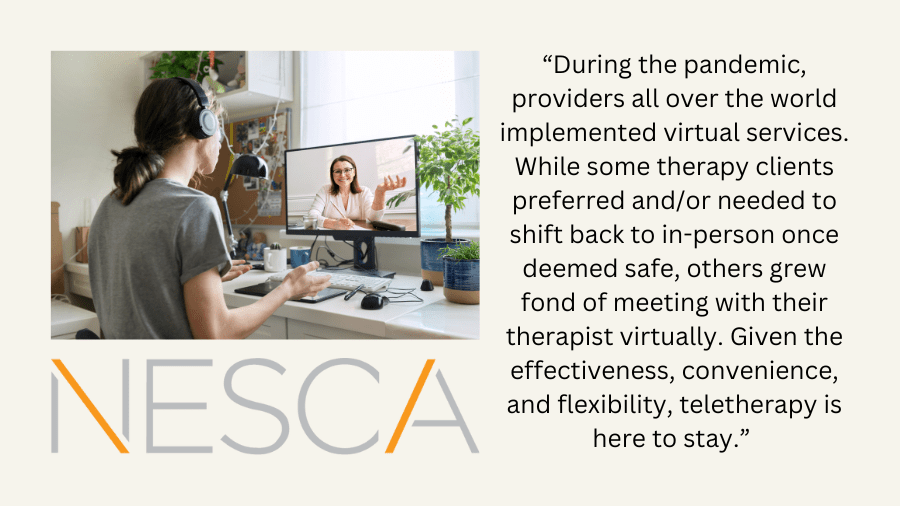
During the pandemic, providers all over the world implemented virtual services. While some therapy clients preferred and/or needed to shift back to in-person once deemed safe, others grew fond of meeting with their therapist virtually. Given the effectiveness, convenience, and flexibility, teletherapy is here to stay. Unlike medical doctors, most therapists don’t need to check your temperature or blood pressure when they see you. Rather, therapists aim to create a physical space where their clients feel safe and comfortable. That said, what if you feel the most comfortable being vulnerable in your home? While not everyone sees the appeal in teletherapy, having the option increases accessibility, and studies show clients attend teletherapy more consistently than in-person, yielding more desired outcomes.

Feeling emotionally and physically comfortable at home during teletherapy is just as important as its convenience. Perhaps you’re a college student or working parent with limited free time in your busy schedule. Teletherapy offers flexibility by removing transportation and wait times. With rates of anxiety, depression, and other mental health conditions rapidly rising, teletherapy is an option to consider if you’re seeking support.

Tips for preparing for your first teletherapy session:

  1. Consider privacy; place yourself in a room or space where you can discuss confidential information without others overhearing your conversation. Sound machines that make white noise can help to prevent sound waves from escaping the room.
  2. Limit any distractions; sign into the teletherapy platform in a brand new window versus a tab, so you’re not tempted to browse the web or check emails during your session. You want to set yourself up for success when it comes to being focused and staying present.
  3. Notice what’s in your background; in order to feel as comfortable as possible, make note of what your therapist may see behind you while on video.
  4. Sit back, relax, and trust the process!

Sources:

https://www.forbes.com/health/mind/teletherapy-for-mental-health-treatment/

How well is telepsychology working? (apa.org)


About the Author

Carly Edelstein is a Licensed Clinical Social Worker practicing in Massachusetts and Rhode Island. Having worked both in private practice and schools, she has extensive experience supporting students, families and educational teams to make positive changes. Ms. Edelstein provides executive function coaching and psychotherapy to clients ranging from middle school through adulthood. She also offers consultation to schools and families in order to support her clients across home and community environments.

To schedule an appointment with one of NESCA’s counselors, coaches, or other experts, please complete our online intake form

NESCA is a pediatric neuropsychology practice and integrative treatment center with offices in Newton, Plainville, and Hingham, Massachusetts; Londonderry, New Hampshire; and the greater Burlington, Vermont region, serving clients from infancy through young adulthood and their families. For more information, please email info@nesca-newton.com or call 617-658-9800.


NESCA Welcomes Back Carly Edelstein, MSW, LCSW, Licensed Clinical Social Worker and Executive Function Coach

By | Nesca Notes 2023

By: Jane Hauser
Director of Marketing & Outreach, NESCA

NESCA welcomes Ms. Carly Edelstein, MSW, LCSW, back to its coaching and psychotherapy services teams. She previously interned with NESCA, and we are thrilled to have her back on board as both a Psychotherapist and Executive Function Coach. Read more about Ms. Edelstein’s career journey and her return to NESCA in the following Q&A interview.


This is your second time working with NESCA. Tell us what you did with NESCA previously.
Yes, and I am elated to be back! During my graduate studies at Simmons University, I interned at NESCA as a psychotherapist. In addition to providing individual psychotherapy to children, adolescents, and young adults, I worked with a few high school and college students as an executive function (EF) coach. I also provided psychotherapy to clients from India and the Philippines, which was an incredible and unique experience. I have yet to find a practice as dynamic and integrative as NESCA and look forward to rejoining as a seasoned clinician!

You will be splitting your time and talents in two roles here at NESCA. Fill us in on your dual role and what your previous experiences bring to both.
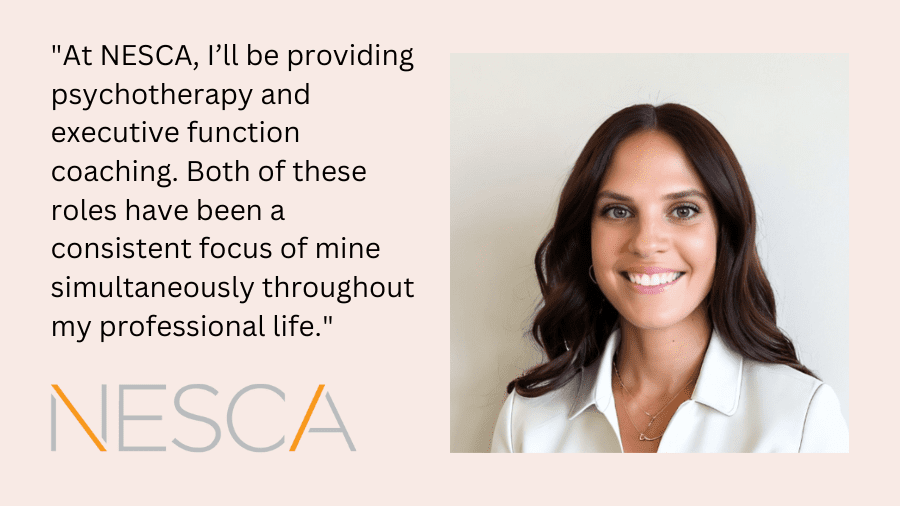
At NESCA, I’ll be providing psychotherapy and executive function coaching. Both of these roles have been a consistent focus of mine simultaneously throughout my professional life. After obtaining a B.S. in education at the University of Vermont, I worked in special education as a paraprofessional, supporting students with special needs in the classroom. In this role, I helped students learn new strategies to maintain their focus, self-regulate, and improve their organization. Additionally, throughout graduate school, I worked part-time as an EF coach at Engaging Minds, helping elementary, middle, and high schoolers with their homework and school assignments by finding ways to improve their task initiation, organization, time management, and planning skills.

My interest in social work/mental health counseling was sparked by my experience as a student teacher at UVM. During the entirety of my practicum, I found myself  gravitating towards students who struggled academically, mentally, socially, and emotionally. I was determined to help these students navigate their challenges by building meaningful connections, providing additional academic support, and increasing their self-confidence by focusing on their strengths.

My counseling experience officially started in graduate school with two full-year-long internships. My first internship took place in the counseling department at Boston Green Academy, a public charter school for grades 6-12, and my second was at NESCA. After graduate school, I worked as a school adjustment counselor at Newton South High School and also took on clients part-time at a private practice. In these roles, I supported the social and emotional wellbeing of students with special needs, as well as their families. After working in corporate wellness for the last year and a half, I am excited to return to the clinical setting, working for a practice that was a major part of my social work journey.

Having worked as a high school adjustment counselor, you must have seen many of the challenges students have with executive function. What are your biggest takeaways from that experience? How do you think that prepared you to be an EF coach?
The majority of my students struggled with executive function, therefore providing support in this area was part of my day-to-day routine. My biggest takeaways are:

  1. Identifying a “why” helps individuals become more motivated to be proactive in their EF journey. For example, I tend to ask people how improving these skills will affect their academic goals, mental health, social relationships, etc., so that there is significant meaning to the work being done.
  2. There is a system that works for everyone! Whether it’s electronic or physical, once someone identifies an organization system that increases their independence, it’s important that they stick to it and are consistent with it. Having a set system will allow them to easily locate their assignments, know when they are due, and how they’ll go about completing them. It’s always helpful for parents and teachers to be made aware of this system as well so that everyone is on the same page.
  3. Creating a regular homework routine is key to increasing productivity and limiting distractions. This includes having an identified start time, location, and plan. I always recommend structured breaks being part of this plan as well.
  4. I always advise folks to not compare themselves to others when it comes to their EF skills! We all have natural strengths. A skill that comes easy to you may be the most challenging task for someone else.

There have been countless reports and studies related to the negative impact COVID had on kids. As a psychotherapist to teens and young adults, what challenges are you seeing most in youth post-pandemic?
There’s no doubt that the impact of COVID on our youth has presented serious and complex challenges. The loss of structure, social opportunities, and extracurriculars (to name a few) is a shock to the system and very traumatic. The biggest challenges I’ve seen post-pandemic have been an increase in digital dependence, cyberbullying, school-based anxiety/refusal, and regression in social skills. That being said, as important as it is to identify post-pandemic challenges, there is value in pointing out gained strengths as well. A lot of students who I worked with learned new coping skills, acquired a deeper understanding of their needs, and discovered exciting new hobbies that they now get to share with others.


About Carly Edelstein, MSW, LCSW
Carly Edelstein is a Licensed Clinical Social Worker practicing in Massachusetts and Rhode Island. Having worked both in private practice and schools, she has extensive experience supporting students, families and educational teams to make positive changes. Ms. Edelstein provides executive function coaching and psychotherapy to clients ranging from middle school through adulthood. She also offers consultation to schools and families in order to support her clients across home and community environments.


To schedule an appointment with Ms. Edelstein for psychotherapy or EF coaching, please complete our online intake form


NESCA is a pediatric neuropsychology practice and integrative treatment center with offices in Newton and Plainville, Massachusetts, Londonderry, New Hampshire, and the greater Burlington, Vermont area, serving clients from preschool through young adulthood and their families. For more information, please email info@nesca-newton.com or call 617-658-9800.
 

Skip to content