
Tag

root cause Archives - NESCA

Subscribe to NESCA Notes

Picture depicting the root cause of a person's functioning or challenges

When Neuropsychological Evaluations Fall Short: Finding the Root Cause through Thorough Analysis vs. Giving a Label

By | NESCA Notes 2025

Picture depicting the root cause of a person's functioning or challengesBy Ann Helmus, Ph.D.
Founder & Director, NESCA

In a recent blog, I discussed how not all neuropsychological evaluations yield equally useful outcomes for helping a struggling child and touched on the consequences of misdiagnosis. This week, I’d like to explore another common challenge: evaluations that merely label a symptom without uncovering the underlying cause.

Consider a patient who visits a doctor with concerns of persistent fatigue and weight gain. After routine labwork returns normal results, the doctor offers the diagnoses  “mild obesity” and “idiopathic fatigue”—labels that describe the symptoms but do not provide a meaningful explanation. The patient is advised to get more sleep or possibly prescribed a new medication. After waiting months for the appointment and paying out of pocket, the individual is left feeling frustrated and still without clarity or direction about how to address the root cause of the problem.

Parents sometimes experience this result from their child’s neuropsychological evaluations, particularly when conclusions focus primarily on standardized test results without integrating the broader picture of a child’s daily functioning, course of development, and learning profile.

For example, I recently reviewed a report for a fifth grader whose parent was deeply concerned about the emotional distress their child experienced with writing. Despite the teacher reporting that the child’s writing was “fine,” and the child handling other homework with ease, the parent observed significant distress during writing tasks. The evaluation found a discrepancy between IQ and written expression scores, diagnosing a Disorder of Written Expression (ICD-10 F81.81), and recommending a writing tutor as intervention.

While this diagnosis is valid based on test scores, it simply labels the problem rather than explaining why the writing challenge existed or what type of support might be most effective for this individual. Difficulties with written expression can stem from a variety of root causes—fine motor challenges, language deficits, executive functioning difficulties, or learning differences like dyslexia, among others. Effective interventions vary widely depending on the underlying issue. For example:

  • Children with communication disorders may benefit most from working with a speech-language pathologist on written expression embedded in the context of language development
  • Children with dyslexia often require structured literacy approaches
  • Children with executive functioning challenges may need explicit, scaffolded instruction in planning and organizing written output

In the case I reviewed, the child’s intellectual abilities were in the Very Superior range, with especially strong abstract reasoning and pattern recognition. Standard tests showed that his organizational skills were age-appropriate, yet he struggled to express his ideas in writing. Why? Because the complexity and richness of his ideas exceeded his ability to structure them effectively. In this case, his frustration stemmed from a bottleneck in translating thoughts into written form—a challenge not uncommon in gifted learners.

The solution wasn’t simply more writing practice; it was a targeted program matched to his unique cognitive profile, along with strategies for reducing emotional stress around writing.

After additional observation and analysis, we were able to offer the family not only a clear explanation but also a tailored plan, including specific interventions and home supports. Most importantly, we helped the child understand why writing felt so difficult and reassured him that effective help was available.

When done thoughtfully, a neuropsychological evaluation can be truly transformative. At NESCA, we are deeply committed to providing comprehensive evaluations that go beyond scores to understand the whole child. We aim to provide the kind of service we would want for our own children—thorough, compassionate, and actionable.

NESCA clinicians receive ongoing training and mentorship to ensure a consistently high standard of care. Each clinician participates in multiple weekly case conferences to discuss complex profiles and refine their clinical thinking. We also offer weekly seminars to stay informed about evolving interventions and treatments. New team members—regardless of prior experience—receive six months of mentorship to support their transition into our collaborative model. This structure fosters a culture of continual learning and clinical rigor. We take pride in our work because we know that careful, individualized evaluations can change the trajectory of a child’s life.


About the Author

NESCA Founder and Director Ann Helmus, Ph.D., is a licensed clinical neuropsychologist who has beenAnn Helmus headshot practicing neuropsychology for 35 years and has been director of NESCA’s Neuropsychology practice for nearly three decades, continuously training and mentoring neuropsychologists to meet the highest professional standards.

To book a neuropsychological evaluation at NESCA, complete NESCA’s online intake form

NESCA is a pediatric neuropsychology practice and integrative treatment center with offices in Newton, Plainville, and Hingham, Massachusetts; Londonderry, New Hampshire; the greater Burlington, Vermont region; and Brooklyn, New York (coaching services only) serving clients from infancy through young adulthood and their families. For more information, please email info@nesca-newton.com or call 617-658-9800.
The Intersection of Mental Health and Executive Function

By | NESCA Notes 2024

By: Carly Edelstein, MSW, LCSW
Licensed Clinical Social Worker and Executive Function Coach

Mental Health challenges and executive function (EF) deficits are often intertwined, as one can easily impact the severity of the other. As a psychotherapist and executive function coach, I find myself regularly assessing my clients with comorbid EF and mental health challenges in order to identify which presented first.

Why does this matter?
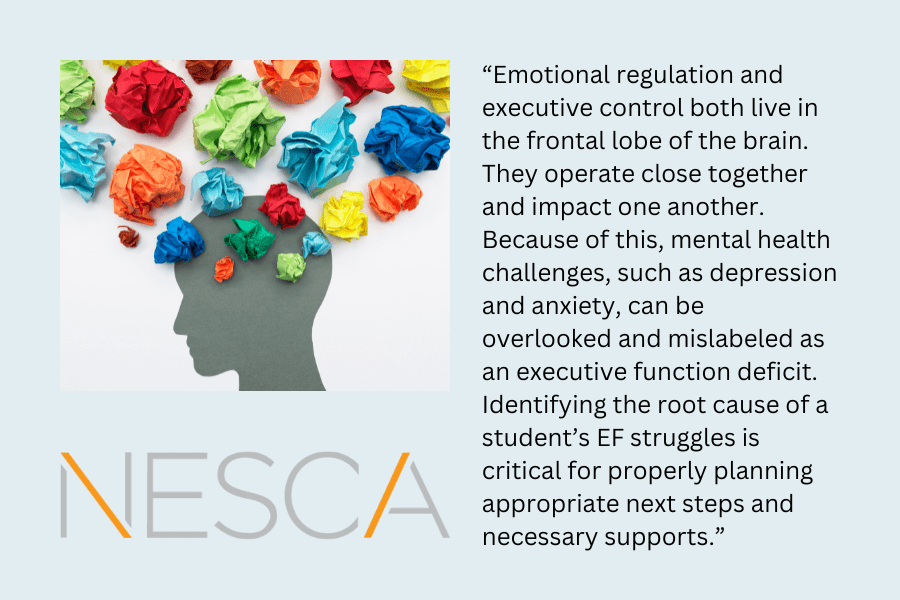
Emotional regulation and executive control both live in the frontal lobe of the brain. They operate close together and impact one another. Because of this, mental health challenges, such as depression and anxiety, can be overlooked and mislabeled as an executive function deficit. Identifying the root cause of a student’s EF struggles is critical for properly planning appropriate next steps and necessary supports. For example, if a student’s depression is causing them not to initiate and/or complete work, the depression usually needs to be addressed before they receive EF coaching. If the student is already working with a mental health professional, such as a therapist, it is important for them to be cleared by the therapist to add in an EF coach. Working on too many new skills at once can be overwhelming, so it is important that enough foundational coping skills are learned first.

An example of anxiety causing an EF deficit:
Clara gets extremely anxious in social situations due to a lack of self-esteem. She had a negative experience in middle school where other students made fun of her lisp whenever she read out loud in class. Now, in high school, Clara is afraid to ask questions, even when she is confused. She is left not fully understanding the material, class assignment expectations, or how to approach studying for quizzes and tests. Rather than asking for help, Clara keeps to herself. Even when teachers offer to help her, she responds with, “Thank you, but I’m all set.”

Clara’s parents can see that she struggles to initiate homework assignments, rarely studies for upcoming tests, and that her grades are declining. They don’t fully understand why, because when they ask her, she is quick to deflect and change the subject.

By checking in with Clara’s teachers, her parents may receive feedback that she often shies away from their support. With a lack of understanding why, her teachers aren’t sure how else to approach the situation other than continuing to check in. Jumping into EF coaching to address her task initiation and study skills may help, but it doesn’t address the root of the problem. A more appropriate action plan would be for Clara to first receive psychotherapy, addressing the bullying that led to her social anxiety and self-esteem issues and then shifting to EF skill building.

An example of an EF deficit causing anxiety/depression:
Gabriel is a seventh grade student diagnosed with ADHD. He has a difficult time advocating for himself and asking for help due to some additional communication challenges. His ADHD also makes it challenging to stay on task and pay attention to details. This results in Gabriel constantly forgetting what his homework assignments are and when they are due, creating a lot of missing work. Gabriel’s teachers are often redirecting him and reminding him of incomplete work. They have tried to help him develop plans to make it up, but he struggles to follow through with these plans. At home, Gabriel’s parents often share their frustrations with him and try to help him get back on track. With adults constantly reminding him he’s behind, Gabriel has developed internalized anxiety, often wondering why he can’t be like everyone else. He tries so hard to remember what his homework is and when it is due, but can never seem to get it right. Over time, he begins to experience symptoms of depression as his self-esteem declines.

In this situation, Gabriel’s lack of EF skills is the root cause of his negative thinking patterns. By receiving EF coaching, he can learn ways to regularly track his assignments. He can be taught how to break them down into smaller, more manageable tasks in a way that helps him overcome procrastination. Additionally, he is able to become proactive and communicate with his teachers so that they are kept on the same page. As these skills get stronger, Gabriel becomes more responsible, and gets praise from his teachers and parents in return. Given the impact of this situation, he may also benefit from short-term counseling to better understand the connection between his EF and anxiety. Increased self-awareness helps students learn how to advocate for themselves the next time they encounter a similar situation.

Does this sound familiar?
These scenarios are common and can be difficult to navigate without proper assessment and guidance from professionals. If you or your child struggles with mental health and EF-related challenges and you are not sure where to start, book a free introductory call with me or one of our other wonderful and experienced EF coaches. NESCA also offers comprehensive neuropsychological evaluation services and neuropsychological consultation for families who are wondering about possible missed learning, attention, mental health, or other diagnoses. We look forward to working with you!


About the Author

Carly Edelstein is a Licensed Clinical Social Worker practicing in Massachusetts and Rhode Island. Having worked both in private practice and schools, she has extensive experience supporting students, families and educational teams to make positive changes. Ms. Edelstein provides executive function coaching and psychotherapy to clients ranging from middle school through adulthood. She also offers consultation to schools and families in order to support her clients across home and community environments.

To schedule an appointment with one of NESCA’s counselors, coaches, or other experts, please complete our online intake form

NESCA is a pediatric neuropsychology practice and integrative treatment center with offices in Newton, Plainville, and Hingham, Massachusetts; Londonderry, New Hampshire; and staff in the greater Burlington, Vermont region and Brooklyn, New York, serving clients from infancy through young adulthood and their families. For more information, please email info@nesca-newton.com or call 617-658-9800.


Skip to content