


Director of Consultation and Psychoeducational Services, NESCA
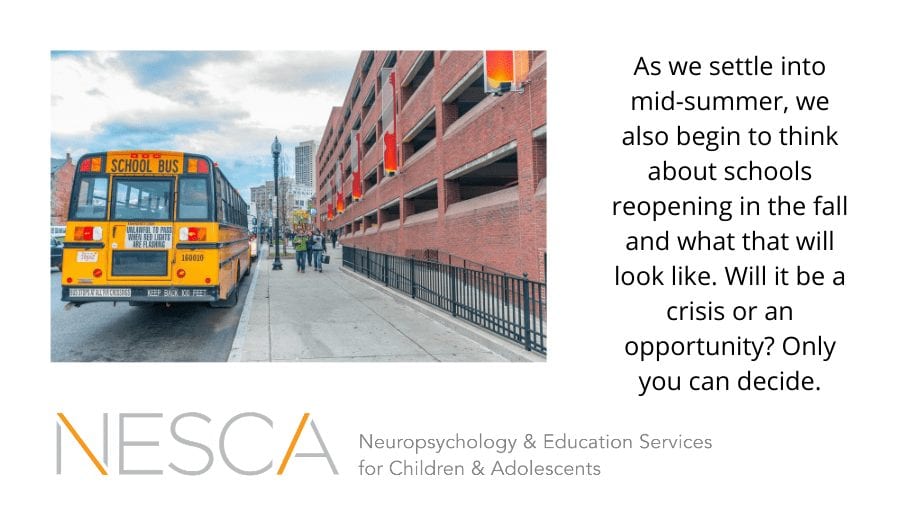
Last week in my blog post, I wrote about one’s perspective about the coronavirus as an opportunity or as a crisis. Initially, most everyone thought it was a crisis and we needed to mobilize to fight it. Massachusetts Governor Charlie Baker recognized it as a crisis early on and has handled it with steadfastness and clarity; whether or not you agree with his decisions. Recently, he mobilized a commission to discuss the re-opening of schools in the fall. This commission has stakeholders from across the Commonwealth, including parents, business leaders, community leaders, educators and administrators. As part of guidance on the reopening of schools, Governor Baker and the Massachusetts Department of Elementary and Secondary Education (DESE) told school district administrators to plan for three scenarios of returning to school in the fall: in-person, a hybrid of remote and in-person, and all remote learning. The districts were given deadlines to submit their plans – a daunting task for all involved. But this pandemic has created many daunting tasks for all of us, and we must come together thinking flexibly, creatively and collaboratively to handle this crisis and move towards thinking about it as an opportunity. Our world as we know it and much of the workings of our world have changed and probably will remain changed for the foreseeable future (i.e., open floor offices are a thing of the past; working from home is proving for some to be more productive).
We are all in this together and when parents, students, teachers and administrators think about the return to in-person instruction in the fall, it brings about many different emotions as well as concerns. Administrators have to plan for all three scenarios, because there are so many unknown variables to consider. For instance, we could start in-person learning then need to switch to remote if there is an uptick in positive cases of the coronavirus. School re-entry in the fall is an unknown, but our leaders are trying to plan as best they can for all possibilities. Ultimately, returning to in-person learning will be a personal decision for every parent based on many variables for each of their children. What’s good for one child may not be good for another in the same family, let alone one family to another.
I wonder about viewing the coronavirus and the havoc it’s wreaked on our educational systems as a genuine opportunity to truly rethink how we educate students. Maybe it is seriously time to consider dramatic school reform. Our education system is antiquated and has not changed much over the years even with the advent of STEAM. We still have achievement gaps with many students not succeeding even with reforms and many dollars spent. Maybe the coronavirus and the social injustice movement are just the crises that are the opportunity that will really change how we think about education, bringing about dynamic and dramatic school reform.
In last week’s blog, I quoted John F. Kennedy as saying, “The Chinese use two brush strokes to write the word ‘crisis.’ One brush stroke stands for danger; the other for opportunity. In a crisis be aware of the danger – but recognize the opportunity.” The coronavirus and social injustice are certainly crises of today, yet I do see them as an opportunity to heal the divisions in our country, increase dialogue and create change.
Last week Massachusetts DESE Commissioner Riley’s Weekly Update included “Protocols for Responding to COVID-19 Scenarios.” This guidance provides more information and protocols to answer the following questions:
- What should a district do if there is a symptomatic individual – at home, on the bus or at school?
- What should a district do if someone in the school community tests positive for COVID-19 – be it a student, teacher, staff, bus driver, or one of their household members or close contacts?
- Who should get tested for COVID-19 and when?
- In what circumstances would someone need to quarantine (when they have been exposed but are not sick) or isolate (when they are sick)?
- What should school districts do to monitor COVID-19 spread in their communities?”
These guidelines may change as the situation changes, but as they stand now. I have heard a variety of responses to these guidelines, such as:
- “This makes my head hurt and eyes blur.”
- “They have got to be joking.”
- “It’s an attempt. They’re trying.”
- “Kids have to go back some day.”
- “Deep breaths and an open mind are needed.”
- “We’re all in this together. We have to try.”
As these comments demonstrate, there are many different feelings and thoughts about going back to in-person instruction in the fall. Our administrators and leaders are juggling so many different variables in making decisions. It “requires” us to trust them and show concern, compassion and gratitude in their attempts at re-opening schools. I recognize the three options presented are just that – three options. No matter what the decisions are about how we return to school, it will be what it will be in each community.
It is my hope that our leaders can view this pandemic, this crisis, as an opportunity to seriously contemplate and delve deeply into discussions about school reform within our country. This pandemic has dramatically shown the inequities that exist across our state and country and in our cities and towns. We knew they were there before, but now they are in our faces. We have an opportunity to think about education as not related to one’s zip code, socio-economic status, color of one’s skin/ethnicity or other factors; instead we can think about it as a basic human right that should be equal for all.
Education is about preparing children to become a competent member of our society and community. We have an opportunity to think about how and where we educate students. Education is about learning and preparing students for tomorrow. Many districts that were socially-emotionally-focused and had good technology capabilities were able to be nimble and pivoted smoothly to remote learning during the pandemic. These districts also had good leadership, solid communication with families and students, and staff felt cared for. There were many other districts that struggled to pivot to remote learning for a myriad of reasons, and this points out that equity in our educational system is necessary. So, while you think about the fall and schools reopening, do what you think is right for your child and family. Also, remember that this “new normal” of remote learning can be okay if done well.
In the special education vernacular, you often hear that special education isn’t a place or a program. That is also true for all education – education isn’t a place. It is so much more. The Center for Education Reform states that the future of schools is students, not systems. This might be a good time to devote some energy to reforming our educational system for the future.
About the Author
NESCA’s Director of Consultation and Psychoeducational Services Dot Lucci has been active in the fields of education, psychology, research and academia for over 30 years. She is a national consultant and speaker on program design and the inclusion of children and adolescents with special needs, especially those diagnosed with Autism Spectrum Disorder (ASD). Prior to joining NESCA, Ms. Lucci was the Principal of the Partners Program/EDCO Collaborative and previously the Program Director and Director of Consultation at MGH/Aspire for 13 years, where she built child, teen and young adult programs and established the 3-Ss (self-awareness, social competency and stress management) as the programming backbone. She also served as director of the Autism Support Center. Ms. Lucci was previously an elementary classroom teacher, special educator, researcher, school psychologist, college professor and director of public schools, a private special education school and an education collaborative.
Ms. Lucci directs NESCA’s consultation services to public and private schools, colleges and universities, businesses and community agencies. She also provides psychoeducational counseling directly to students and parents. Ms. Lucci’s clinical interests include mind-body practices, positive psychology, and the use of technology and biofeedback devices in the instruction of social and emotional learning, especially as they apply to neurodiverse individuals.
To book a consultation with Ms. Lucci or one of our many expert neuropsychologists, complete NESCA’s online intake form. Indicate whether you are seeking an “evaluation” or “consultation” and your preferred clinician/consultant in the referral line.
Neuropsychology & Education Services for Children & Adolescents (NESCA) is a pediatric neuropsychology practice and integrative treatment center with offices in Newton, Massachusetts, Plainville, Massachusetts, and Londonderry, New Hampshire, serving clients from preschool through young adulthood and their families. For more information, please email info@nesca-newton.com or call 617-658-9800.
 Professional Psychology, with a concentration in Children, Adolescents and Families (CAF). She completed post-doctoral training in pediatric neuropsychology with an emphasis on treating children with developmental, intellectual, learning and executive functioning challenges. She also has extensive training psychological (projective) testing and has conducted individual and group therapies for children of all ages. Before joining NESCA, Dr. Kulis worked in private practices, clinics, and schools, conducting comprehensive assessments on children ranging from toddlers through young adults. In addition, Dr. Kulis has had the opportunity to consult with various school systems, conducting observations of programs, and providing in-service trainings for staff. Dr. Kulis currently conducts neuropsychological and psychological (projective) assessments for school-aged children through young adulthood. She regularly participates in transition assessments (focusing on the needs of adolescents as they emerge into adulthood) and has a special interest in working with complex learners that may also struggle with emotional challenges and psychiatric conditions. In addition to administering comprehensive and data-driven evaluations, Dr. Kulis regularly conducts school-based observations and participates in school meetings to help share her findings and consultation with a student’s TEAM.
Connect with Us