To accommodate requests for neuropsychological evaluations after the start of the new school year, NESCA has added evaluation dates in its Newton, MA office. Immediate openings are now available for scheduling. Please complete our Inquiry/Intake Form for more information or to start the scheduling process.

Tag

written language Archives - NESCA

Subscribe to NESCA Notes

Teen frustrated with homework

When Effort Masks Inefficiency – The Student That Flies Under the Radar

By | NESCA Notes 2022, NESCA Notes 2026

Teen frustrated with homeworkBy Olivia Rogers, MA, CCC-SLP
Speech-Language Pathologist, NESCA

There is a particular kind of student who rarely raises concern. They follow directions. They turn in assignments. They earn decent grades. They don’t disrupt class. They are described as sweet, hardworking, responsible – and they are exhausted.

These are the students who fly under the radar. You may notice it at home before anyone else does. Homework takes hours. Writing assignments feel disproportionately heavy. Reading requires constant rereading. They erase and rewrite sentences repeatedly. They melt down at home – not at school. From the outside, everything appears fine. From the inside, everything feels effortful.

Tiered support systems are designed to identify clear gaps: measurable academic decline, benchmark concerns, noticeable skill deficits, etc. But under-the-radar students often compensate beautifully. They memorize sentence frames. They overprepare and tend to avoid risks. They rely on intelligence to mask inefficiencies and oftentimes, they meet expectations…but at a cost.

Compensation works…until it doesn’t. As academic demands increase, including longer texts, multi-paragraph essays, and independent projects, the effort curve steepens. Middle school is often when the cracks begin to show – not because the child suddenly can’t, but because the system was never optimized.

These students frequently have subtle weaknesses in:

  • Academic language processing
  • Sentence formulation flexibility
  • Discourse-level organization
  • Working memory under load
  • Cognitive flexibility
  • Idea generation efficiency

They can explain ideas verbally but struggle to organize them in writing. They understand what they read, but only after rereading. Frequently they know the answer, but tend to hesitate to share it. The issue is rarely intelligence; instead, it’s about efficiency.

Over time, this exhaustive effort can unfortunately become a student’s identity. Students begin to believe school is supposed to feel this hard. They start to internalize messages like, “I just need to try harder. I’m just slow. I’m not good at writing.” But often, they are working around systems that were never explicitly strengthened. This is not about remediation; these students are not failing. They are often highly capable.

What they need is system strengthening. When we strengthen language networks, syntactic flexibility, executive functioning integration, organizational frameworks, and generalization across contexts, tasks that once felt overwhelming become manageable.

Support does not have to begin with failure. Some of the most powerful growth happens when we intervene before burnout. An integrative model that targets language, literacy, and executive functioning together addresses the systems underneath performance, not just the performance itself.

When these systems are strengthened, families often tell us that it no longer takes three hours to do homework, that they are raising their hands to answer questions in class again, that students don’t dread writing anymore, and that everything seems to feel lighter. Strong academic performance isn’t just about effort. It’s really about the systems.

Working Smarter, Not Harder

High-functioning students don’t always need remediation. Sometimes they may need optimization. When we strengthen the underlying systems, like language organization, executive functioning integration, and discourse-level structure, effort decreases and independence increases. The goal is not to push harder; it’s about building smarter.

If your child is capable but working harder than they should be, an integrative approach focused on building foundational skills with a speech-language pathologist may provide the missing layer of support.

If you’re curious whether this integrative approach would benefit your child, I welcome the opportunity to connect to identify what kind of targeted support would make the greatest difference. For more information on Speech and Language Therapy, Literacy, and Executive Functioning Support at NESCA, please complete our online Intake Form or email me directly at orogers@nesca-newton.com.


About the AuthorOlivia Rogers

Olivia Rogers is a licensed speech-language pathologist with experience in pediatric clinics and public schools, working with children from age 2 through young adulthood across a range of communication challenges. With a special interest in the connection between oral language and literacy, Ms. Rogers is trained in the Orton-Gillingham method and the Brain Frames program, supporting students in language comprehension, expression, and written organization. She is dedicated to making therapy engaging and personalized for each child.


To learn more about NESCA’s Speech and Language Services or schedule appointments, complete our online Intake Form or email orogers@nesca-newton.com.


NESCA is a pediatric neuropsychology and related services practice with offices in Newton, Plainville, and Hingham, Massachusetts; Londonderry, New Hampshire; and Coral Gables, Florida, serving clients from infancy through young adulthood and their families. For more information, please email info@nesca-newton.com or call 617-658-9800.
 

SLP working with a student on a summer intensive program focused on speech

Seven Signs Your Child Would Benefit from a Summer Writing Intensive

By | NESCA Notes 2026

SLP working with a student on a summer intensive program focused on speechBy Olivia Rogers, MA, CCC-SLP
Speech-Language Pathologist, NESCA

Summer is often seen as a break from academics, but for many students, it’s also the most powerful window for growth. If writing has been a source of stress, avoidance, or frustration during the school year, a structured summer writing intensive program can make a meaningful difference before fall. Here are the most common signs that a student may benefit from targeted, language-based writing support.

  1. They Have Strong Ideas. . . But Difficulty Getting Them Onto Paper
    Your child may speak clearly and express complex ideas verbally, yet struggle to translate those thoughts into written form. Pages remain blank, sentences feel short or incomplete, and written work does not reflect their true ability.
  2. Writing Takes a Long Time
    Assignments that should take 20 minutes stretch into an hour or more. Slow writing can signal challenges with planning, organization, working memory, or executive functioning fatigue.
  3. Paragraphs Lack Structure
    You may notice missing topic sentences, disconnected details, weak transitions, or repetitive ideas. These patterns often reflect underlying language organization challenges rather than simple grammar issues.
  4. Writing Causes Emotional Stress
    Avoidance, frustration, or shutdown at the mention of writing or during the writing process are common signs. When writing feels overwhelming, students often lack internal planning systems to guide them.
  5. Teacher Feedback Highlights Organization or Elaboration Concerns
    Comments such as, “needs more detail,” “ideas are unclear,” or “work lacks organization” often indicate that both language development and executive functioning need targeted support.
  6. ADHD or Executive Functioning Challenges
    Writing requires planning, working memory, inhibition, flexibility, and self-monitoring. Students with executive functioning weaknesses often benefit from explicit writing routines that reduce cognitive load.
  7. Transitioning to a New School Level
    Rising 3rd, 6th, or 9th graders face increased writing demands. Strengthening foundational systems before expectations rise can dramatically improve confidence and performance.

Why Summer Is So Effective
Without academic pressure and competing demands, students can build writing fluency, strengthen organization systems, and increase independence in a focused and supportive environment. Application can be embedded in students’ areas of interest, for added motivation. The goal of a writing intensive is not simply to be able to create “better essays.” It is reduced anxiety, stronger thinking on paper, increased independence, and systems students can carry into the fall.


At NESCA, we offer intensive summer therapy that targets both verbal communication (such as listening comprehension, expressive language, and social communication) and written expression, an area where many students struggle. For more information on summer intensives and written language support at NESCA, please complete our online Intake Form or email me directly at orogers@nesca-newton.com.


About the AuthorOlivia Rogers

Olivia Rogers is a licensed speech-language pathologist with experience in pediatric clinics and public schools, working with children from age 2 through young adulthood across a range of communication challenges. With a special interest in the connection between oral language and literacy, Ms. Rogers is trained in the Orton-Gillingham method and the Brain Frames program, supporting students in language comprehension, expression, and written organization. She is dedicated to making therapy engaging and personalized for each child.


To learn more about NESCA’s Speech and Language Services or schedule appointments, complete our online Intake Form or email orogers@nesca-newton.com.


NESCA is a pediatric neuropsychology and related services practice with offices in Newton, Plainville, and Hingham, Massachusetts; Londonderry, New Hampshire; and Coral Gables, Florida, serving clients from infancy through young adulthood and their families. For more information, please email info@nesca-newton.com or call 617-658-9800.
 

student writing in a notebook and quote by Olivia Rogers, SLP

Why Speech-Language Pathologists Are Uniquely Equipped to Support Written Language

By | NESCA Notes 2026

student writing in a notebook and quote by Olivia Rogers, SLPBy Olivia Rogers, MA, CCC-SLP
Speech-Language Pathologist, NESCA

Written language refers to the system of communication that involves the use of written symbols to represent language, and it encompasses skills such as fluent word recognition, reading comprehension, written spelling, and written expression. It is one of the most complex academic skills students are asked to master. It requires vocabulary, grammar, organization, working memory, attention, reading skills, and the ability to translate ideas into structured sentences and paragraphs.

Because written expression sits at the intersection of language, literacy, and executive functioning, Speech-Language Pathologists (SLPs) are uniquely positioned to support it. At NESCA, speech language pathologists bring specialized training – including EmPOWER, Brain Frames, and The Orton-Gillingham Approach – that allows them to address writing and reading comprehension in a comprehensive, structured, and functional way.

Written Language Is… Language
Writing is not just handwriting or spelling. At its core, writing is language expressed on paper. Students must generate ideas and vocabulary, use grammar and sentence structure, organize thoughts into narratives or explanations, maintain cohesion across sentences, and consider audience and purpose.

Reading is not just decoding words on a page. True, reading happens when a child understands, connects, and makes meaning from what they read. Comprehension – linking new information to background knowledge, vocabulary, and language skills – is what transforms word calling into real literacy.

These are core areas of SLP expertise. SLPs are trained to analyze how language breaks down,  whether at the word, sentence, or discourse level, and to teach skills explicitly and systematically.

The Executive Function Connection
As discussed in last week’s blog, writing and reading are executive functioning tasks. When writing, students must plan what to say, hold ideas in working memory, organize information, initiate writing, and revise and edit. When reading, students exercise their working memory, inhibition, and metacognitive skills.

NESCA SLPs use the EmPOWER and Brain Frames approaches to make these invisible thinking processes visible. EmPOWER supports students in navigating “how” to bring the writing process from start to finish. Brain Frames provide visual scaffolds that help students map ideas before writing, organize paragraphs, and understand the structure of different text types.

Structured Literacy Strengthens Writing
Strong writing depends on strong reading and spelling skills. NESCA SLPs, trained in Orton-Gillingham, also bring a structured literacy lens to written language intervention through explicit teaching of phonology, morphology, and spelling patterns – all while integrating reading and writing instruction systematically.

SLPs Bridge Ideas and Expression
Many students know what they want to say but cannot translate it into written form. SLPs help students expand sentences, develop narrative and expository structure, use academic vocabulary, improve cohesion and clarity, verbalize ideas before writing, and revise language for precision.  Because SLPs focus on communication, written language therapy is functional and meaningful. Intervention often targets classroom assignments, essays and projects, note-taking, digital communication, and self-advocacy writing so that strategies learned transfer directly to school demands. SLPs brings a functional, real-world approach to written language.

Speech-Language Pathologists are not an alternative option for written language support; they are a natural fit. With explicit strategy instruction, visual scaffolding, and structured literacy methods, SLPs help students move from uncertainty to confident, organized expression. When writing is approached through language, thinking, and literacy together, students gain tools that extend far beyond the page.

The NESCA Difference
NESCA SLPs combine deep knowledge of language development with specialized training in executive functioning and structured literacy. Our intervention addresses how students think, understand language, read and spell, and express ideas in writing.


At NESCA, we use evidence-based strategy to target written language. Our clinicians use a comprehensive approach to treat the systems of learning as integrative, helping students develop valuable skills they can use in and out of the classroom!  For more information on written language support at NESCA, please complete our online Intake Form or email me directly at orogers@nesca-newton.com.


About the AuthorOlivia Rogers

Olivia Rogers is a licensed speech-language pathologist with experience in pediatric clinics and public schools, working with children from age 2 through young adulthood across a range of communication challenges. With a special interest in the connection between oral language and literacy, Ms. Rogers is trained in the Orton-Gillingham method and the Brain Frames program, supporting students in language comprehension, expression, and written organization. She is dedicated to making therapy engaging and personalized for each child.


To learn more about NESCA’s Speech and Language Services or schedule appointments, complete our online Intake Form or email orogers@nesca-newton.com.


NESCA is a pediatric neuropsychology and related services practice with offices in Newton, Plainville, and Hingham, Massachusetts; Londonderry, New Hampshire; and Coral Gables, Florida, serving clients from infancy through young adulthood and their families. For more information, please email info@nesca-newton.com or call 617-658-9800.
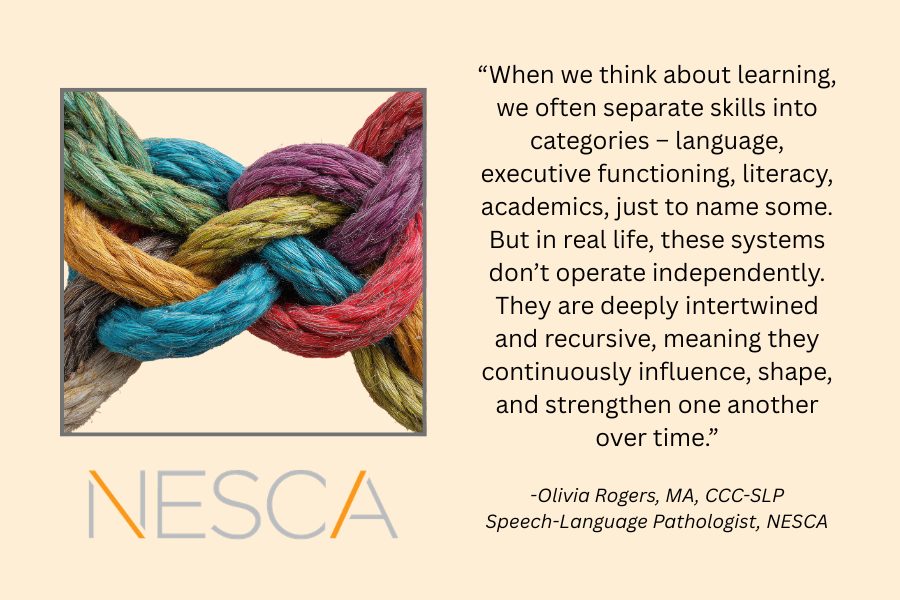
 

image of yarns intertwined representing EF and language skills being intertwined and a quote from Olivia Rogers, SLP at NESCA

Executive Functioning & Language: Intertwined and Recursive Systems of Learning

By | NESCA Notes 2026

image of yarns intertwined representing EF and language skills being intertwined and a quote from Olivia Rogers, SLP at NESCA

By Olivia Rogers, MA, CCC-SLP
Speech-Language Pathologist, NESCA

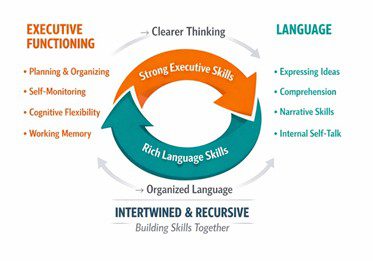
When we think about learning, we often separate skills into categories – language, executive functioning, literacy, academics, just to name some. But in real life, these systems don’t operate independently. They are deeply intertwined and recursive, meaning they continuously influence, shape, and strengthen one another over time.

What Is Executive Functioning?
Executive functioning refers to the brain’s management system. These skills help students plan and organize ideas, initiate tasks, hold information in working memory, monitor understanding, shift between strategies, and manage time and attention.

What Is Language?
Language includes understanding directions, expressing ideas clearly orally and in writing, narrative organization, comprehension of complex oral and written information, academic language use, and internal self-talk.

How Executive Functioning Depends on Language
Students rely on language to talk themselves through steps, plan written responses, explain reasoning, organize narratives, monitor comprehension, and use strategies independently.

How Language Depends on Executive Functioning
Producing and understanding language requires holding ideas in working memory, sequencing information, shifting between topics, inhibiting irrelevant details, revising messages, and planning written expression.

The Recursive Relationship image showing the recursive nature of EF and language skills
Growth in one area supports growth in the other. Stronger language supports clearer thinking, and better executive skills support more organized language.

The Big Picture
Integrated support helps students explain their thinking, plan before speaking or writing, use language as a strategy, monitor understanding, and become more independent learners. Executive functioning and language are overlapping systems that continuously shape each other. Supporting both together makes learning more accessible, meaningful, and transferable.

At NESCA, we view communication holistically. Our speech language pathologists use a comprehensive approach to treat the systems of learning as integrative, helping students develop valuable skills they can use in and out of the classroom! For more information on Speech and Language Therapy at NESCA, please complete our online Intake Form or email me directly at orogers@nesca-newton.com.


About the AuthorOlivia Rogers

Olivia Rogers is a licensed speech-language pathologist with experience in pediatric clinics and public schools, working with children from age 2 through young adulthood across a range of communication challenges. With a special interest in the connection between oral language and literacy, Ms. Rogers is trained in the Orton-Gillingham method and the Brain Frames program, supporting students in language comprehension, expression, and written organization. She is dedicated to making therapy engaging and personalized for each child.


To learn more about NESCA’s Speech and Language Services or schedule appointments, complete our online Intake Form or email orogers@nesca-newton.com.


NESCA is a pediatric neuropsychology and related services practice with offices in Newton, Plainville, and Hingham, Massachusetts; Londonderry, New Hampshire; and Coral Gables, Florida, serving clients from infancy through young adulthood and their families. For more information, please email info@nesca-newton.com or call 617-658-9800.
 

The SLP’s Role in Written Language Disorders

By | NESCA Notes 2022

By Olivia Rogers, MA., CCC- SLP
Speech-Language Pathologist, NESCA

A written language disorder is an impairment in fluent word reading (i.e., reading decoding and sight word recognition), reading comprehension, written spelling, and/or written expression (Ehri, 2000; Gough & Tunmer, 1986; Kamhi & Catts, 2012; Tunmer & Chapman, 2007, 2012). As written language disorders are quite complex, appropriate assessment and treatment often incorporates many members. Members of the interprofessional practice team may include, but are not limited to, reading specialists, occupational therapists, special educators, learning specialists, and more.

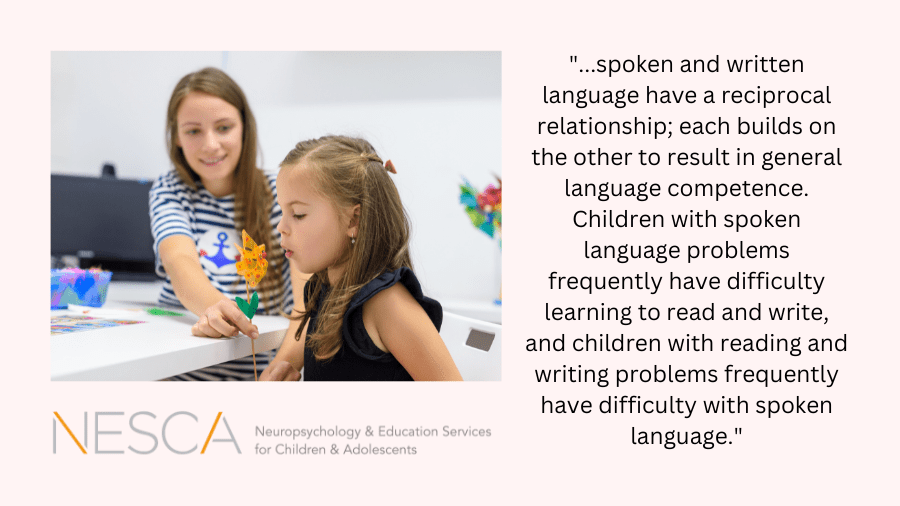
When you think of a speech-language pathologist (SLP), a few words probably come to mind; terms like articulation, language, or fluency. Often, SLPs are associated with spoken language only. Most people don’t think of reading or writing when they think of SLPs. However, in addition to the diagnosis and treatment of spoken language disorders, it is well within the scope of practice of a SLP to diagnose and treat written language disorders. In fact, spoken and written language have a reciprocal relationship; each builds on the other to result in general language competence. Children with spoken language problems frequently have difficulty learning to read and write, and children with reading and writing problems frequently have difficulty with spoken language. Children with speech and language deficits are at a higher risk for reading and writing difficulties. Higher rates of all forms of written language disorders have been documented in children with speech and/or language impairments. Take a look at these findings:

  1. Comorbidity between literacy difficulties and speech and language deficits occurred in as high as 50% of cases (Stoeckel et al. (2013).
  2. By the end of kindergarten, more than 25% of children with language impairment were reported to also be poor readers (Murphy et al., 2016).
  3. Approximately 20%-28% of children with speech sound disorders (SSD) have literacy difficulties (Overby, Trainin, Smit, Bernthal, and Nelson, 2012).

No matter the age, SLPs can assess and treat spoken and written language difficulties. SLPs bring knowledge of communication processes and disorders, and language acquisition to the literacy table. Additionally, SLPs are skilled in dynamic assessment and have clinical experience in developing individualized programs for children and adolescents. Here are just a few written language skills that SLPs work on:

Reading: Pre-reading Skills

Before a child can decode, or read, they must have an understanding that words are composed of smaller units and how these units operate separately and together. SLPs incorporate the following skills into sessions:

  • Rhyming (e.g., “flag and stag”)
  • Syllable segmenting (e.g., “student: stu/dent”)
  • Blending sounds into words (e.g., “sh/i/p says ‘ship’”)
  • Segmenting words into their sounds (e.g., “leg: l/e/g”)
  • Deleting sounds in words (e.g., “cup without the c is up”)
  • Substituting sounds in words (e.g., “change the ‘B’ in bat to an ‘M’”)

Reading: Language Comprehension

This is the biggest one for SLPs. To target language comprehension, we work on smaller goals, such as:

  • Grammar
  • Story Grammar Elements
  • Visualizing and Verbalizing
  • Vocabulary
  • Active Reading Strategies
  • Themes

Writing: Organization/Planning

Before writing, it is important to plan out what you will write. Many children with language disorders have trouble with these skills. Here are just a few ways that SLPs help children plan and develop their writing by:

  • Using visuals for story grammar components
  • Make and practice using graphic organizers
  • Teaching sentence, paragraph, and essay construction

Spelling

Yes, spelling! SLPs are equipped to work on spelling. After all, it is just another language skill. Some ways to target spelling include:

  • Working on phonological awareness and phonemic awareness
  • Teach students about morphology (the study of words and their parts)
  • Incorporation of working memory strategies, such as chunking, visualization, or mnemonics

If you have concerns about your child’s pre-literacy or literacy skills, or would like to support your child’s written language skills, please contact NESCA’s Olivia Rogers at orogers@nesca-newton.com or fill out our Intake Form, noting an interest in speech language pathology.


Sources:

Overby, Trainin, Smit, Bernthal, and Nelson, 2012) Preliteracy Speech Sound Production Skill and Later Literacy Outcomes: A Study Using the Templin Archive.

American Speech-Language-Hearing Association. (2001). Roles and responsibilities of speech-language pathologists with respect to reading and writing in children and adolescents [Position Statement]. Available from www.asha.org/policy.

Catts, H.W. & Weismer, S.E. (2006). Language Deficits in Poor Comprehenders: A Case for the Simple View of Reading. Journal of Speech, Language, and Hearing Research, 49, 278-293.


About the Author

Olivia Rogers received her Master of Arts in Speech-Language Pathology from the University of Maine, after graduating with a Bachelor of Arts in Communication Sciences and Disorders and concentrations in Childhood Development and Disability Studies.

Ms. Rogers has experience working both in the pediatric clinic setting as well as in public schools, evaluating and treating children 2-18 years of age presenting with a wide range of diagnoses (e.g., language delays and disorders, speech sound disorders, childhood apraxia of speech, autism spectrum disorder, social communication disorder, and Down syndrome). Ms. Rogers enjoys making sure therapy is fun and tailored to each client’s interests.

In her free time, she enjoys listening to podcasts and spending times with friends and families.


Neuropsychology & Education Services for Children & Adolescents (NESCA) is a pediatric neuropsychology practice and integrative treatment center with offices in Newton, Massachusetts, Plainville, Massachusetts, and Londonderry, New Hampshire, serving clients from preschool through young adulthood and their families. For more information, please email info@nesca-newton.com or call 617-658-9800.
 

To book an appointment with Olivia Rogers, please complete our Intake Form today. For more information about NESCA, please email info@nesca-newton.com or call 617-658-9800.


Skip to content