

By: Cynthia Hess, PsyD
Pediatric Neuropsychologist Fellow and Therapist
According to the APA Dictionary of Psychology, boredom is defined as:
A state of weariness or ennui resulting from a lack of engagement with stimuli in the environment. It is generally considered to be one of the least desirable conditions of daily life and is often identified by individuals as a cause of feeling depressed. It can be seen as the opposite of interest and surprise
In an APA podcast called Speaking of Psychology, Erin Westgate, PhD, a psychologist who studies boredom, suggests that boredom is an unpleasant emotion similar to anger, sadness, fear, and pain. In her efforts to understand and define boredom, Dr. Westgate explored the ways in which attention and meaning affect emotions and explain boredom. She opines that boredom may result from one’s inability to sustain attention, which may occur either when a task is too easy or too hard. It may help to understand why students describe a less preferred subject (e.g., math) as boring. Boredom may also be due to a sense that what we are doing lacks meaning. In both instances, the mind wanders and we are faced with that sense of being alone with our thoughts. Dr. Westgate notes that some thoughts are more engaging than others, and there are certain conditions under which people enjoy or do not enjoy their own thoughts. It has become increasingly difficult for people to sit and think, and consequently they search for ways to escape or avoid the boredom that results. However, boredom is not all bad. Like many things in life, it depends on how we manage it.
Similar to other negative emotions, boredom alerts us that something is wrong in our body, and it is human nature to want to escape or avoid it. When escape and avoidance become the only method to cope with boredom, individuals may begin experiencing chronic boredom, which can be detrimental to emotional and physical wellbeing. When boredom becomes chronic, it no longer works as a useful signal. Boredom can be more impactful than loneliness and is often mistaken for loneliness. When boredom is not well managed, it can lead to depression and self-destructive behaviors, such as self-harm and addiction. As alluded to above, the ability to sit with our thoughts and feelings without trying to avoid or escape them has become increasingly difficult. Perhaps related to the ease with which they can be avoided; for example, when our body sends out the first signal of discomfort, we can distract ourselves by reaching for our phone. An article in TIME magazine stated:
We’re trying to swipe and scroll the boredom away, but in doing that, we’re actually making ourselves more prone to boredom, because every time we get our phone out we’re not allowing our mind to wander and to solve our own boredom problems, Mann says, adding that people can become addicted to the constant dopamine hit of new and novel content that phones provide. Our tolerance for boredom just changes completely, and we need more and more to stop being bored.
Relying on electronics is only one example of a way to avoid and escape the discomfort of boredom. It is highly reinforcing because, in the short-term, it works. However, when it is one’s only tool in the toolbox, it may quickly undermine their ability for learning to manage uncomfortable thoughts and feelings and use them for creating positive change. Therefore, it is necessary to find a positive, opposite behavior to replace the maladaptive behavior. This often leads to an increased sense of purpose and agency, and improved self-esteem and self-concept.
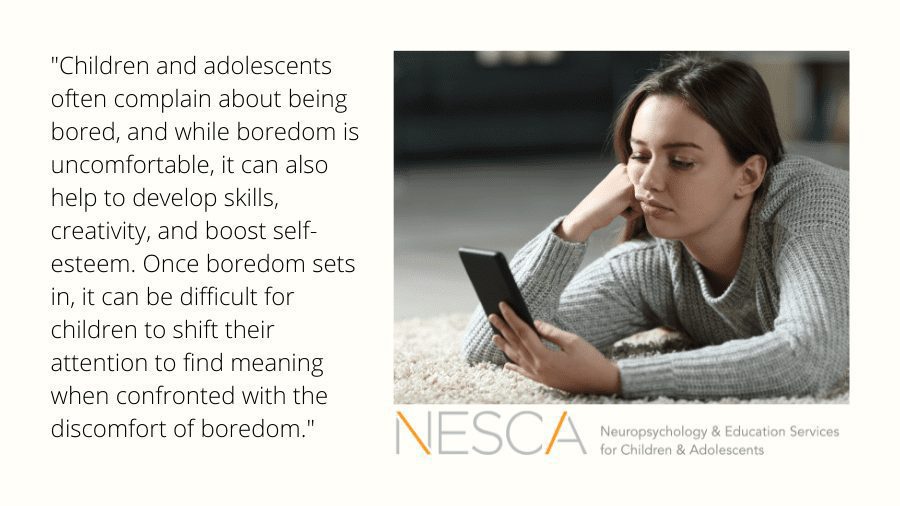
Children and adolescents often complain about being bored, and while boredom is uncomfortable, it can also help to develop skills, creativity, and boost self-esteem. Once boredom sets in, it can be difficult for children to shift their attention to find meaning when confronted with the discomfort of boredom. According to an article published by the Child Mind Institute, boredom can be a great way to teach children how to manage frustration and regulate emotions when things are boring or not going their way. It is not that boredom teaches the skills, but rather it is what they do when faced with boredom. There are many strategies outlined in the article to help parents nurture skills when their children are bored. In general, be aware that behaviors may be attention-seeking, and therefore, should not be reinforced. Otherwise, boredom offers an opportunity for children to do something meaningful that benefits them and those around them. When properly managed, it spurs creativity and innovation. Along the way, it is important to be realistic and recognize that there will be failure, and learning to manage the discomfort of failure is an added bonus.
About the Author
Dr. Cynthia Hess recently graduated from Rivier University with a PsyD in Counseling and School Psychology. Previously, she earned an  M.A. from Antioch New England in Applied Psychology. She also worked as an elementary school counselor and school psychologist for 15 years before embarking on her doctorate. During her doctorate, she did her pre-doctoral internship with RIT in Rochester, N.Y. where she worked with youth ages 5-17 who had experienced complex developmental trauma. Dr. Hess’s first post-doctoral fellowship was with The Counseling Center of New England where she provided psychotherapy and family therapy to children ages 5-18, their families and young adults. She also trained part-time with a pediatric neuropsychologist conducting neuropsychological evaluations.
To schedule an appointment with one of NESCA’s expert neuropsychologists, please complete our online intake form.
Neuropsychology & Education Services for Children & Adolescents (NESCA) is a pediatric neuropsychology practice and integrative treatment center with offices in Newton and Plainville, Massachusetts, and Londonderry, New Hampshire, serving clients from preschool through young adulthood and their families. For more information, please email info@nesca-newton.com or call 617-658-9800.

 Londonderry, NH office. She specializes in the evaluation of anxious children and teens, working to tease apart the various factors lending to their stress, such as underlying learning, attentional, or emotional challenges. She particularly enjoys working with the seemingly “unmotivated” child, as well as children who have “flown under the radar” for years due to their desire to succeed.
 unique pattern of strengths and weaknesses to best formulate a plan for intervention and success. With experiences providing therapy and assessments, Dr. Creedon bridges the gap between testing data and therapeutic services to develop a clear roadmap for change and deeper of understanding of individual needs.
 attention deficit disorders, communication disorders, intellectual disabilities, and learning disabilities. She particularly enjoys working with children and their families who have concerns regarding an autism spectrum disorder. Dr. Milana has received specialized training on the administration of the Autism Diagnostic Observation Schedule (ADOS).


 research and academia for over 30 years. She is a national consultant and speaker on program design and the inclusion of children and adolescents with special needs, especially those diagnosed with Autism Spectrum Disorder (ASD). Prior to joining NESCA, Ms. Lucci was the Principal of the Partners Program/EDCO Collaborative and previously the Program Director and Director of Consultation at MGH/Aspire for 13 years, where she built child, teen and young adult programs and established the 3-Ss (self-awareness, social competency and stress management) as the programming backbone. She also served as director of the Autism Support Center. Ms. Lucci was previously an elementary classroom teacher, special educator, researcher, school psychologist, college professor and director of public schools, a private special education school and an education collaborative.
 meaningful skills in order to reach their goals. She has spent the majority of her career working in a private school for students with ASD. She has also spent some time working in an inpatient mental health setting. Lyndsay uses occupation-based interventions and strategies to develop life skills, executive functioning, and emotional regulation. While completely her doctoral degree at MGH Institute of Health Professions, Lyndsay worked with the Boston Center for Independent Living to evaluate transition age services. She uses the results from her research to deliver services in a way that is most beneficial for clients. Specifically, she focuses on hands-on, occupation-based learning that is tailored the client’s goals and interests.


 delays, learning disabilities, attention difficulties and executive functioning challenges. She often works with children whose complex profiles are not easily captured by a single label or diagnosis. She particularly enjoys working with young children and helping parents through their “first touch” with mental health care or developmental concerns.

Connect with Us