

By: Jane Hauser
Director of Marketing & Outreach
In today’s blog, I have the pleasure of introducing you to NESCA Pediatric Neuropsychologist Maggie Rodriguez, Psy.D., who recently joined our team of expert clinicians.
How did you discover your interest in neuropsychology?
It was a long and winding road! I went into college, interested in a wide range of subject areas, including medicine. Eventually, I realized my area of interest was truly in psychology. I discovered that I really enjoyed neuropsychological evaluations, since they combined my interests in psychology, neuroscience, working with medical providers, educators, as well as writing and the creativity involved in making a child come alive in a report.
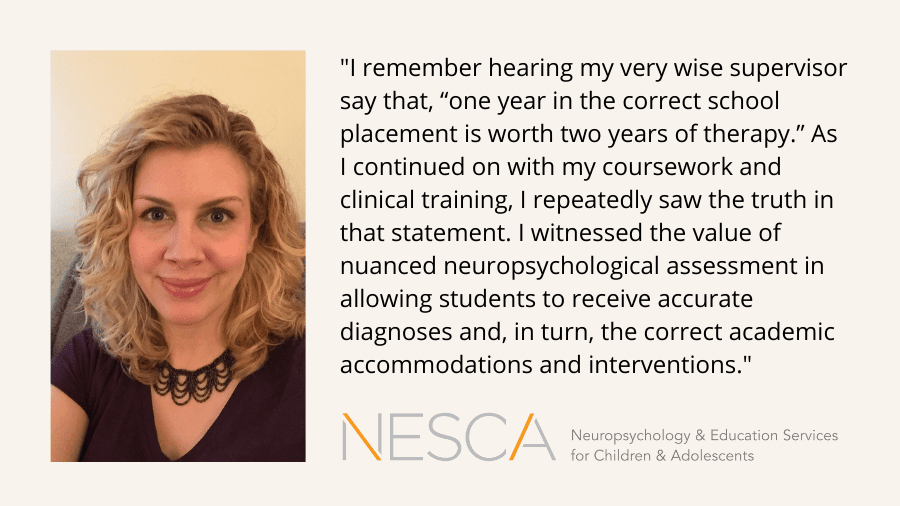
In graduate school, I was fortunate to learn from a number of extremely talented neuropsychologists in a variety of settings. While completing a placement at Children’s Hospital Boston, I remember hearing my very wise supervisor say that, “one year in the correct school placement is worth two years of therapy.” As I continued on with my coursework and clinical training, I repeatedly saw the truth in that statement. I witnessed the value of nuanced neuropsychological assessment in allowing students to receive accurate diagnoses and, in turn, the correct academic accommodations and interventions. I wanted to be part of that, not only to help children and teens succeed academically but to prevent the secondary effects that undiagnosed and untreated learning disorders, neurodevelopmental disorders, and cognitive challenges can have on emotional health, self-esteem, and social functioning.
On the personal side, my interest in neuropsychology was sparked again when I had my own child evaluated. It was surprisingly powerful to go through the process on the parent side, and after taking some time off to have a family, I knew that I wanted to get back into neuropsychology again!
Why did you choose to come to NESCA when re-entering your professional career?
There were several reasons that I looked into NESCA and ultimately opted to join its team. I learned about NESCA while researching neuropsychologists for my child’s evaluation and was impressed with what I saw. Additionally, one of my former testing supervisors told me NESCA is among the best in the business. Having that kind of endorsement from such a trusted source provided me with great confidence being part of NESCA.
I also was really drawn in by NESCA’s emphasis on the continued growth and learning for its clinicians. It was obvious that NESCA is comprised of a highly invested and collaborative team. Every one of us has a lot to learn still, and I valued the opportunity for not just a job, but the continued learning.
NESCA also offers a great work/life balance. Having a family of my own and parents who are approaching the stage where they also require care is a lot to balance. NESCA’s emphasis on supporting its staff in balancing work and life has made it very rewarding. I’ve seen several examples of how the culture of understanding is very much active.
On a very practical level, having clear protocols for handling day-to-day Covid strategies, like masking, cleaning, etc., has been comforting. Returning to clinical work in the midst of a pandemic has been a big transition, and knowing NESCA has put in place measures for keeping staff and clients safe is tremendously important to me. Seeing the creativity and agility in the way the team here tackled the larger challenges—evaluating clients safely and in-person—during Covid was inspiring and told me a lot about the team and culture. Learning that NESCA adapted its methods of testing via the two-office model demonstrated to me that they, as a practice, they are able to roll with those kinds of challenges. That was also very reassuring.
Finally, the interview process provided me with the chance to speak with a number of NESCA’s clinical staff. I was able to get a great feel for the culture and high standards the practice has, which made me confident that this was the right fit for me.
What kinds of concerns do you evaluate or enjoy the most?
I really enjoy working with kids of varying ages, but I do have a keen interest in working with families and children who are just hitting the adolescent years. I get the opportunity to help them understand how all the, sometimes confusing, pieces fit together.
I really enjoy working with kids who may be deemed as “complicated,” where things may have previously been overlooked. Maybe things were going fine for them until they hit a wall academically. Perhaps they got to middle school or high school or even college and began to wonder why things seemed to be falling apart for them. I enjoy the challenge of working with kids who are experiencing executive function deficits, social communication issues, kids whose disability or disabilities are not as straightforward. I like to tease apart whether there are executive function (EF) issues, Attention-Deficit/Hyperactivity Disorder (ADHD), or sensory integration challenges…or perhaps explore whether it could be something else altogether. Is a child’s rigidity due to anxiety, an Autism Spectrum Disorder (ASD), Obsessive-Compulsive Disorder (OCD), cognitive issues or a combination of overlapping challenges? I love teasing all of these things apart. I also work with children whose families have concerns about potential language-based learning disabilities (LBLD), communication issues and challenges with social pragmatics.
It’s incredibly rewarding when you are able to help families understand answers to these kinds of questions that they may have been grappling with for a long time.
About Pediatric Neuropsychologist Maggie Rodriguez, Psy.D.
Maggie Rodriguez, Psy.D., provides comprehensive evaluation services for children, adolescents, and young adults with often complex presentations. She particularly enjoys working with individuals who have concerns about attention and executive functioning, language-based learning disorders, and those with overlapping cognitive and social/emotional difficulties.
Prior to joining NESCA, Dr. Rodriguez worked in private practice, where she completed assessments with high-functioning students presenting with complex cognitive profiles whose areas of weakness may have gone previously undiagnosed. Dr. Rodriguez’s experience also includes pre- and post-doctoral training in the Learning Disability Clinic at Boston Children’s Hospital and the Neurodevelopmental Center at MassGeneral for Children/North Shore Medical Center. Dr. Rodriguez has spent significant time working with students in academic settings, including k-12 public and charter school systems and private academic programs, such as the Threshold Program at Lesley University.
Dr. Rodriguez earned her Psy.D. from William James College in 2012, where her coursework and practicum training focused on clinical work with children and adolescents and on assessment. Her doctoral thesis centered on cultural issues related to evaluation.
To book a neuropsychological evaluation with Dr. Rodriguez or another expert neuropsychologist at NESCA, complete NESCA’s online intake form.
Neuropsychology & Education Services for Children & Adolescents (NESCA) is a pediatric neuropsychology practice and integrative treatment center with offices in Newton and Plainville, Massachusetts, as well as Londonderry, New Hampshire. NESCA serves clients from preschool through young adulthood and their families. For more information, please email info@nesca-newton.com or call 617-658-9800.
 attention deficit disorders, communication disorders, intellectual disabilities, and learning disabilities. She particularly enjoys working with children and their families who have concerns regarding an autism spectrum disorder. Dr. Milana has received specialized training on the administration of the Autism Diagnostic Observation Schedule (ADOS).
 neuropsychologist who has been practicing for almost 20 years. In 1996, she jointly founded the Children’s Evaluation Center (CEC) in Newton, Massachusetts, serving as co-director there for almost ten years. During that time, CEC emerged as a leading regional center for the diagnosis and remediation of both learning disabilities and Autism Spectrum Disorders.
 Erin Gibbons, Ph.D.

 and academia for over 30 years. She is a national consultant and speaker on program design and the inclusion of children and adolescents with special needs, especially those diagnosed with Autism Spectrum Disorder (ASD). Prior to joining NESCA, Ms. Lucci was the Principal of the Partners Program/EDCO Collaborative and previously the Program Director and Director of Consultation at MGH/Aspire for 13 years, where she built child, teen and young adult programs and established the 3-Ss (self-awareness, social competency and stress management) as the programming backbone. She also served as director of the Autism Support Center. Ms. Lucci was previously an elementary classroom teacher, special educator, researcher, school psychologist, college professor and director of public schools, a private special education school and an education collaborative.


 Londonderry, NH office. She specializes in the evaluation of anxious children and teens, working to tease apart the various factors lending to their stress, such as underlying learning, attentional, or emotional challenges. She particularly enjoys working with the seemingly “unmotivated” child, as well as children who have “flown under the radar” for years due to their desire to succeed.
 meaningful skills in order to reach their goals. She has spent the majority of her career working in a private school for students with ASD. She has also spent some time working in an inpatient mental health setting. Lyndsay uses occupation-based interventions and strategies to develop life skills, executive functioning, and emotional regulation. While completely her doctoral degree at MGH Institute of Health Professions, Lyndsay worked with the Boston Center for Independent Living to evaluate transition age services. She uses the results from her research to deliver services in a way that is most beneficial for clients. Specifically, she focuses on hands-on, occupation-based learning that is tailored the client’s goals and interests.
 for something that “would get me back into movement.” She quickly fell in love with yoga and completed her 200-hour Yoga Teacher Training. In the meantime, she also completed her master’s degree in Marriage and Family Studies at Salem State University. With this combination of expertise, she is able to help children and adolescents become more in touch with their bodies and find their words through movement, breathing, and relaxation.

Connect with Us