 By Dot Lucci, M.Ed., CAGS
Director of Consultation and Psychoeducational Services, NESCA
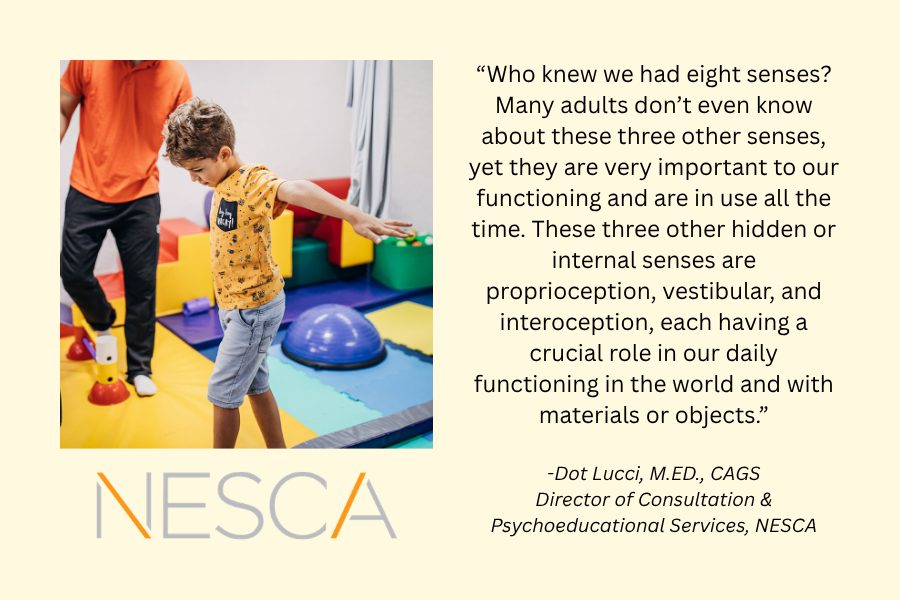
If you ask young children and adults to name their senses, they will typically name the five senses that are taught to all children in school – taste, smell, sight, hearing, and touch. Some of these senses “come on board” at birth while others continue to develop, refine, and mature into early adulthood. Then as we age, some of our senses may diminish – think eyesight and hearing, as well as fluidity of movement and balance. Most people wouldn’t think of fluidity of movement and balance as senses, but they are. These are considered part of our “hidden or internal senses,” and are connected to the three others. Who knew we had eight senses? Many adults don’t even know about these three other senses, yet they are very important to our functioning and are in use all the time. These three other hidden or internal senses are proprioception, vestibular, and interoception, each having a crucial role in our daily functioning in the world and with materials or objects.
Proprioception is often described as a sense of our body awareness in relation to the world around us. This system helps us integrate systems such as our musculoskeletal and central nervous systems. We get feedback from our muscles, ligaments, and joints so we know how to coordinate movements, sense where our body parts are in relation to our surroundings, and how to determine and apply the right amount of pressure or tension needed for certain tasks or movements. Proprioception is the secret ingredient that makes our motor skills intentional.
People with excellent proprioception are coordinated and may even be graceful. They rarely bump into things/people, don’t spill food on themselves, or misjudge how much pressure to use when touching someone else. They navigate their environment and materials well.
On the other hand, a person with poor proprioception may often bump into people, especially if the room/hallway is crowded. Or they may step on others’ toes while waiting in a line, stub their own toe, spill things on themselves, touch other people too hard or too lightly when playing tag, tear the paper when erasing, and so on. They may also experience difficulty with handwriting, using scissors, and doing other weight-bearing activities.
The vestibular system is located in the middle ear and is concerned with balance and gravitational awareness. I often use the term “sea legs” to describe this sense. If you are not familiar with “sea legs,” it is often used to describe a person’s ability to adjust their balance to a ship’s motion and not get seasick as well as the lingering sensation of movement or rocking when on land after disembarking a ship. It also is responsible for an awareness of gravity. Think of the astronauts who recently left the Artemis shuttle. They needed to be helped onto the “porch platform” and were then sat down as their bodies, having just been in space, had to adjust to the gravitational pull of the earth. This sense helps us to know if we are moving or stationary, how fast/slow we are moving, if we are standing still/speeding up, lying down, and more. Our vestibular system can be impacted by inner ear infections, head injuries, and other medical conditions. People with heightened vestibular systems may get dizzy often, suffer from car sickness, and dislike swinging, spinning, having their feet off the ground, or being upside down. On the flip side, some individuals have a hypo-responsive vestibular system. This can look like a constant hunger for movement. In this situation you may see someone excessively rocking back and forth, spinning for a long period of time without getting dizzy, happily swinging for hours, trying to reach the highest height, and have the constant need for high speed. People with “intact” vestibular system are seen as perfectly calibrated and can smoothly multitask balance, movement, and purposeful actions to move through the world with more ease.
Interoception is the third “hidden sense” and is related to what is happening inside our bodies – bringing our internal needs and awareness to our minds. This sense makes us aware of our internal organs, helping us to know when we are in pain, hungry, thirsty, or full, have to use the bathroom, are cold or hot, tired, ill, or have a fast heart rate. They can easily identify these sensations, whereas people with diminished awareness of their internal states have difficulty identifying feelings or sensations in their bodies. They may not notice when they are hungry, in pain, have to use the restroom, have a stomach or headache, are feeling their heart race, among other internal sensations. They may forget to drink or eat and get dehydrated or shake from low blood sugar, whereas people with heightened interoception may get “hangry” (hungry and angry) because they can’t tolerate hunger…and they recognize it. They may be overly sensitive to pain or temperature changes. Likewise, some foods are intolerable due to texture (smooth, chewy, etc.), and certain flavors (sweet, bitter, sour, etc.) may also not be tolerated. Therefore, they only eat bland foods.
People with impacted interoception “know they have a need or sensation,” but can’t identify it. This disrupts their quality of life as they may overeat or drink. People who are overly aware may become so anxious about these sensations that their anxiety may intensify until their need to handle the sensation is met.
Our senses and sensory profiles change with development, age, lifestyle, and health. Many of our senses work independently or behind the scenes, without our even thinking about them. However, if you try to walk on a balance beam versus just walking down the sidewalk, your balance may be challenged, requiring more conscious awareness. All of the senses work together to help us utilize, understand, and integrate sensory information to be in the world in a “functional way.” Many individuals with impacted sensory processing or integration systems may experience physical, mental, emotional, and social consequences as a result of an atypical sensory profile. Understanding one’s own sensory profile is important to living a full life. If warranted, an occupational and sensory evaluation may be necessary to help identify sensory-motor processing needs. This self-awareness and knowledge may help guide individuals to understand what they need, what they can and can’t do, what makes them comfortable, and what will help them better function and interact in the world. We are all sensory beings, and the better we are at knowing ourselves, the better we will be at advocating for ourselves.
If your child or teen can benefit from learning about their sensory system, complete NESCA’s online Inquiry/Intake Form for additional information or to book sessions with NESCA’s occupational therapists.
About the Author
NESCA’s Director of Consultation and Psychoeducational Services Dot Lucci has been active in the fields of education, psychology, research and academia for over 30 years. She is a national consultant and speaker on program design and the inclusion of children and adolescents with special needs, especially those diagnosed with Autism Spectrum Disorder (ASD). Prior to joining NESCA, Ms. Lucci was the Principal of the Partners Program/EDCO Collaborative and previously the Program Director and Director of Consultation at MGH/Aspire for 13 years, where she built child, teen and young adult programs and established the 3-Ss (self-awareness, social competency and stress management) as the programming backbone. She also served as director of the Autism Support Center. Ms. Lucci was previously an elementary classroom teacher, special educator, researcher, school psychologist, college professor and director of public schools, a private special education school and an education collaborative.
Ms. Lucci directs NESCA’s consultation services to public and private schools, colleges and universities, businesses and community agencies. She also provides psychoeducational counseling directly to students and parents. Ms. Lucci’s clinical interests include mind-body practices, positive psychology, and the use of technology and biofeedback devices in the instruction of social and emotional learning, especially as they apply to neurodiverse individuals.
To book a consultation with Ms. Lucci or one of our many expert clinicians, complete NESCA’s online intake form. Indicate whether you are seeking an “evaluation” or “consultation” and your preferred clinician/consultant/service in the referral line.
NESCA is a pediatric neuropsychology practice and related services center with offices in Newton, Plainville, and Hingham, Massachusetts; Londonderry, New Hampshire; and Coral Gables, Florida, serving clients from infancy through young adulthood and their families. For more information, please email info@nesca-newton.com or call 617-658-9800.






 About the Author
 delays, learning disabilities, attention difficulties and executive functioning challenges. She often works with children whose complex profiles are not easily captured by a single label or diagnosis. She particularly enjoys working with young children and helping parents through their “first touch” with mental health care or developmental concerns.
Connect with Us