


Director of Consultation and Psychoeducational Services, NESCA
Motivation can be elusive for many of our students especially for activities they don’t like, they don’t find interesting or they find challenging. In other blogs, I’ve written about the 3 S’s: self-awareness, stress management and social competency, as keys to thriving in life. For this blog, self-awareness and stress-management are relevant. Being able to handle failures, set-backs and challenges are a part of life whether you are a child or an adult. Developing internal-motivation and self-efficacy are two powerful ingredients to thriving in life. So, how do we help children tolerate distress, rebound from setbacks and stretch beyond their comfort zones?
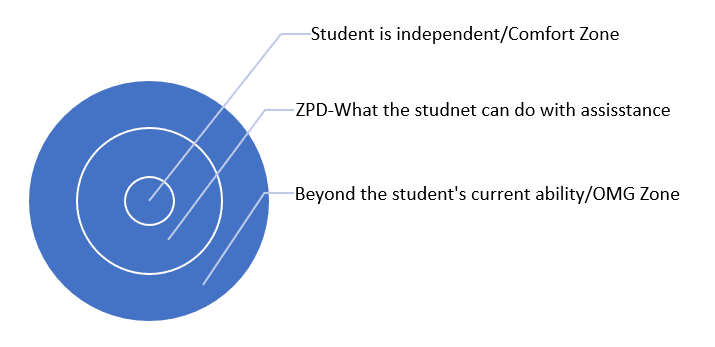
Russian psychologist Leo Vygotsky proposed a concept called the Zone of Proximal Development (ZPD). He defined ZPD as the area just beyond a student’s independent functioning level where he/she may need some assistance but isn’t too far out of reach. To hit the ZPD accurately, one has to assess the student’s knowledge and experiences accurately.
If we haven’t helped children recognize that new learning is challenging and takes effort, we have done them a disservice. When they struggle and haven’t learned that it is a part of learning, we see students push back with comments such as, “It’s too hard,” “I don’t know how to do it,” or “I can’t do it.”
Tasks in the student’s comfort zone don’t take much effort; they just “breeze through them” with little exertion or motivation. If adults raise the bar just beyond the student’s reach, but the student can reach it with minimal support, this develops efficacy, stamina and internal-motivation. Once they’ve reached the bar, there is often a sense of accomplishment and pride with the feeling of, “I did it!”
How do we encourage, support and guide students to “push themselves beyond their comfort zone”? The answers to this question are important, as they can backfire on us and discourage a student or encourage a student to move into their ZPD. In general, there are four approaches/steps:
- Adults model what it means to be in the ZPD
- Students imitate the adults
- Adults fade the support/instruction
- Adults offer feedback on the student’s effort and performance.
Adults model, guide, encourage and praise authentically. Think out loud about how you persevere. Provide support and guidance, such as, “I know this is hard for you, but let’s start with what you do know.” Or, “I like how you stuck with it even when you wanted to give up.” Finally, “You’re building tolerance and stamina for new learning.” As students become more comfortable in their ZPD, they become more self-motivated and develop greater self-efficacy.
Helping children get there can be a journey, but if the adults in their lives take the time and effort, the pay-off is worth it! When you give children guides to know when they are in each zone, it helps them know what to expect, how to think and what to do. For instance, when students are in their comfort zone you may hear, “I get it (and it is quick), “this is a breeze,” “this won’t take me any time,” or “I’m bored.” Little to no effort is required in this zone. In the ZPD, students may be saying, “I have to think,” “I have to work at this,” “I’ll get some wrong,” “I may get stuck,” or “It’s ok, I know some of it, so maybe I can do more.” It takes effort, thinking and the student feels challenged. And finally, in the OMG Zone, you may hear, “I don’t know where to begin,” “I can’t figure this out,” “I’m spinning my wheels; this makes no sense,” “I don’t care,” and “I’m frustrated and angry.” Adults are doing most of the work at this stage, and the student’s effort doesn’t pay off. He or she is not ready for this learning yet – it’s too far of a stretch. Helping students develop their comfort in their ZPD is paramount to developing self-motivation and self-efficacy.
Resources
Vygotskian Principles on the ZPD and Scaffolding
What is the Zone of Proximal Development
https://www.healthline.com/health/zone-of-proximal-development
About the Author
NESCA’s Director of Consultation and Psychoeducational Services Dot Lucci has been active in the fields of education, psychology, research and academia for over 30 years. She is a national consultant and speaker on program design and the inclusion of children and adolescents with special needs, especially those diagnosed with Autism Spectrum Disorder (ASD). Prior to joining NESCA, Ms. Lucci was the Principal of the Partners Program/EDCO Collaborative and previously the Program Director and Director of Consultation at MGH/Aspire for 13 years, where she built child, teen and young adult programs and established the 3-Ss (self-awareness, social competency and stress management) as the programming backbone. She also served as director of the Autism Support Center. Ms. Lucci was previously an elementary classroom teacher, special educator, researcher, school psychologist, college professor and director of public schools, a private special education school and an education collaborative.
Ms. Lucci directs NESCA’s consultation services to public and private schools, colleges and universities, businesses and community agencies. She also provides psychoeducational counseling directly to students and parents. Ms. Lucci’s clinical interests include mind-body practices, positive psychology, and the use of technology and biofeedback devices in the instruction of social and emotional learning, especially as they apply to neurodiverse individuals.
To book a consultation with Ms. Lucci or one of our many expert neuropsychologists, complete NESCA’s online intake form. Indicate whether you are seeking an “evaluation” or “consultation” and your preferred clinician/consultant in the referral line.
Neuropsychology & Education Services for Children & Adolescents (NESCA) is a pediatric neuropsychology practice and integrative treatment center with offices in Newton, Massachusetts, Plainville, Massachusetts, and Londonderry, New Hampshire, serving clients from preschool through young adulthood and their families. For more information, please email info@nesca-newton.com or call 617-658-9800.


 Londonderry, NH office. She specializes in the evaluation of anxious children and teens, working to tease apart the various factors lending to their stress, such as underlying learning, attentional, or emotional challenges. She particularly enjoys working with the seemingly “unmotivated” child, as well as children who have “flown under the radar” for years due to their desire to succeed.


 unique pattern of strengths and weaknesses to best formulate a plan for intervention and success. With experiences providing therapy and assessments, Dr. Creedon bridges the gap between testing data and therapeutic services to develop a clear roadmap for change and deeper of understanding of individual needs.


 Erin Gibbons, Ph.D.
Connect with Us