
Tag

alison burns Archives - NESCA

Subscribe to NESCA Notes

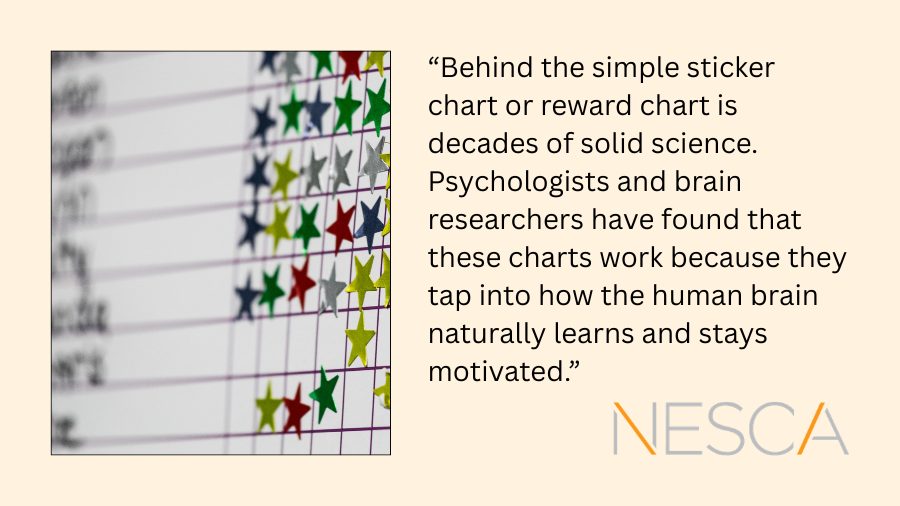
Image of a reward chart and quote from NESCA

“I’ve tried a sticker/reward chart, and it does not work!” – Strategies to Make Incentive Plans Actually Work

By | NESCA Notes 2026

Image of a reward chart and quote from NESCABy: Alison Burns, Ph.D.
Pediatric Neuropsychologist, NESCA

Behind the simple sticker chart or reward chart is decades of solid science. Psychologists and brain researchers have found that these charts work because they tap into how the human brain naturally learns and stays motivated. When a child gets a sticker or a point towards a reward immediately after doing a good job, their brain releases a tiny splash of dopamine, the “feel-good” chemical that helps us focus and feel successful. Decades of research, especially with kids who have ADHD, shows that rewards make boring or difficult tasks feel achievable. By focusing on positive rewards rather than nagging or punishment, these charts help shape behavior through slowly motivating changes which become habits or routines.

Incentive charts are highly versatile tools. While most commonly associated with young children, they are effective for anyone, including elementary-aged students and teenagers, who need help changing behaviors, building new habits, or staying motivated.

Despite these benefits, many parents I work with share the same frustration: “I’ve tried a sticker/reward chart, and it just didn’t work.”

When I dig a little deeper, I usually find that the incentive system wasn’t set up in a way that allowed the child, and the family, to succeed. I provide the following guidance to make their incentive plans more effective:

  1. Pick Your Battles: Focus on just 2 to 3 goals at a time (or even just one for very young kids). Ask yourself: What is the most pressing behavior change we need right now? Is it brushing teeth without an argument? Getting out the door on time for school? Stopping hitting or food-throwing? Trying to change too many things at once is a major reason why these charts fail. Think of it like New Year’s resolutions: when we try to overhaul our diet, go to sleep early, start a daily workout routine, complete a gratitude journal, and read a book a week all at the same time, we quickly burn out. It is simply too hard to maintain that much change long enough for new habits to stick. The same is true for your child. Keep it simple. Once your child masters one specific goal, you can “graduate” them from that goal and introduce a new one.
  2. State Goals Clearly and Positively: Tell your child exactly what you want them to do, rather than what you want them to stop doing. Instead of “Don’t be late for school,” phrase the goal as “Be ready with your shoes on and backpack packed by 7:20 AM.”
  3. Start with “Easy Wins”: Incentive plans often fail when parents set the bar too high right away; if a child goes several days without earning a reward, they will lose motivation and give up. Instead, start with an easy, highly achievable version of your goal and slowly raise the bar. For example, if your ultimate goal is for your child to have their shoes on and backpack packed by 7:20 AM, start by rewarding them just for having their shoes on by 7:20. Once that becomes a habit, you can raise the bar to include the backpack. Slowly shaping the behavior in these small, manageable steps keeps your child winning, building the momentum they need to succeed rather than setting the bar out of reach and causing them to throw in the towel.
  4. Reward the Behavior Immediately: Timing is everything. To help your child’s brain connect the good behavior with the reward, hand over the incentive right away. For timed tasks (like being ready by 7:20 AM), give the sticker, token, or point the second they finish. For all-day goals (like keeping hands to themselves), have a set time every day (like right after dinner) to hand out the reward. Connect the dots for them by saying: “Because you kept your hands to yourself today, you earned your sticker!” The more immediate or consistent the reward process is, the more likely the incentive system will be a success.
  5. Let Your Child Choose the Rewards: Children are far more motivated by rewards they actually care about. Sit down together and make a list of prizes. Remember, rewards do not have to be toys or cost money. Kids are highly motivated by quality time and special privileges, such as an extra bedtime story, 10 minutes of one-on-one time with a parent, choosing what’s for dinner, or picking the movie for family night.
  6. Make the “Exchange Rate” Clear: Make sure your child knows exactly what their stickers/points can buy. For young kids: Keep it simple. Placing the sticker on the chart might be enough, or they can “cash in” 3 stickers for a reward (like 10 minutes of screen time). For older kids, let them save up. They can earn points daily, but saving up 5 points might earn them a larger weekend reward (like a trip to get ice cream).
  7. Never Take Stickers Away: This is the golden rule of incentive charts. Once a sticker or point is earned, it is locked in. If your child has a great morning and earns a sticker/point, but has a meltdown in the afternoon, do not peel the morning sticker off or take away a point. Taking away earned rewards feels unfair to kids and ruins their motivation to keep trying. If they have a tough afternoon, simply say: “You didn’t earn your sticker/point for this afternoon, but you can try again tomorrow.”

Why Summer is the Perfect Time to Start

Summer is a fantastic time to introduce an incentive plan because it provides a light, predictable structure to those otherwise unstructured summer days. Furthermore, behavior change can be easier to accomplish when kids are relaxed and free from the daily stress of the school year. Making small, positive changes over the summer months can pay large dividends and set your family up for a smooth transition back to school in the fall. Not only will your child be accustomed to using a reward system by then, but they will also have already established several positive habits that will make the start of the school year much easier for everyone!


About the Author

Dr. Burns conducts comprehensive evaluations of school-aged children, adolescents, and young adults with a variety of developmental, learning, and emotional difficulties. She has expertise in the evaluation of individuals following a concussion/mild traumatic brain injury and particularly enjoys working with individuals with attention (ADHD) and executive functioning (EF) difficulties. Dr. Burns is passionate about helping individuals and their families better understand their areas of strength and weakness and provides tailored treatment recommendations based upon that unique profile to make the evaluation most helpful for each client.

To book a consultation with Dr. Burns or one of our many other expert neuropsychologists, complete NESCA’s online intake form.

NESCA is a pediatric neuropsychology practice and related services practice with offices in Newton, Plainville, and Hingham, Massachusetts; Londonderry, New Hampshire; and Coral Gables, Florida, serving clients from infancy through young adulthood and their families. For more information, please email info@nesca-newton.com or call 617-658-9800.

Image of a person's brain with gears working in sync, representing Executive functioning

Executive Functioning: What is it and how do we address weaknesses?

By | NESCA Notes 2026

Image of a person's brain with gears working in sync, representing Executive functioningBy: Alison Burns, Ph.D.
Pediatric Neuropsychologist, NESCA

Although the concept of executive functioning has existed since the 19th century, it began to gain significant attention in the fields of psychology, education, and neuroscience in the late 1990s and early 2000s. Executive functioning can be thought of as the brain’s “management system.” It enables us to plan ahead, stay organized, remember important information, initiate tasks, control impulses, adapt to changes, and manage our emotions. These skills help us get started on homework or chores, remember what we need to buy at the store, keep track of our schedules, stay calm when upset, switch gears when plans change, and finish tasks without getting distracted. When executive functioning skills are strong, individuals are able to juggle responsibilities, solve problems, and cope effectively with everyday challenges.

Executive functioning difficulties can arise from a variety of causes. Neurodevelopmental disorders such as Attention Deficit Hyperactivity Disorder (ADHD), Autism Spectrum Disorder, and learning disabilities frequently involve challenges with executive skills. Neurological conditions – including brain injury or stroke, particularly those affecting the frontal lobes – can impair executive functioning. Mental health disorders such as depression, anxiety, bipolar disorder, and schizophrenia may also impact these skills, making it harder to plan, organize, or regulate emotions. Environmental factors, including chronic stress, lack of sleep, poor nutrition, or substance use (alcohol or drugs), can temporarily or permanently weaken executive functioning. Additionally, some individuals may have a genetic predisposition to weaker executive functioning, and developmental delays due to prematurity, or early childhood adversity can further contribute to difficulties in these areas.

Fortunately, executive functioning weaknesses can be improved through targeted interventions. Direct interventions may include cognitive-behavioral therapy to enhance skills such as self-regulation, cognitive flexibility, and self-monitoring. Executive function coaching can also be beneficial, focusing on skills like planning, organization, and time management by identifying barriers and providing practical strategies for implementation.

In addition to direct intervention, accommodations can be provided to help individuals compensate for areas of challenge. Accommodations should be matched to an individual’s specific executive functioning weaknesses. Below are examples of accommodations for specific areas of challenge. This is not meant to be an exhaustive list, but rather to provide examples of the types of accommodations that may be recommended depending on an individual’s specific profile.

Planning & Organization

  • Use a paper planner, wall calendar, or smartphone app to record assignments, appointments, and deadlines. Review these tools daily to clearly see what needs to be done and when.
  • Divide complex assignments or larger projects into smaller, more manageable tasks, and set individual deadlines for each one. This approach will make the overall project less overwhelming and easier to tackle.
  • Use visual tools such as graphic organizers, outlines, or flow charts to organize ideas and information before beginning an assignment or task.
  • Use folders, color-coding, and binders to organize physical belongings. Use trial and error to identify what works best and take time every day to maintain organizational systems (i.e., put it away before it piles up and feels overwhelming).

Working Memory (the brain’s “scratch pad” where we hold and manipulate information)

  • Use detailed checklists for tasks that require memory of several steps to reduce the burden on working memory. Check off each step when completed. Apply this strategy to recurring tasks, such as morning or bedtime routines, but also schoolwork or chores that have multiple steps or components.
  • Give the individual verbal instructions more than once and ask them to repeat the instructions back to ensure they understand what needs to be done. Instructions should be provided in in small chunks, rather than all at once, so the individual can focus on one step before moving to the next.
  • Permit individuals to use audio recorders or AI technology to capture information during lectures or meetings, so they can replay and review content as needed.

Task Initiation

  • Define the first action required for a task, such as “open your book to page 10,” so it is clear exactly how to begin.
  • Sentence starters or example problems can be helpful in clarifying task expectations, and, in turn, improving task initiation.
  • Establish regular routines and schedules, such as starting homework at the same time each day, to make it easier to get started on tasks.

Inhibition (Impulse Control)

  • Have a teacher, supervisor, or caregiver nearby to provide quick feedback or reminders when impulsive behaviors occur.
  • Provide items like fidget spinners, putty, or doodling pads to give individuals a safe way to channel their energy and reduce impulsive actions. Allow individuals to take short movement breaks to help manage restlessness or impulsivity.
  • Provide praise or rewards when individuals demonstrate restraint or appropriate behavior, encouraging them to continue using impulse control strategies.

Cognitive Flexibility

  • Inform individuals ahead of time about changes in plans or schedules so they can mentally prepare and reduce stress. Give warnings ahead of transitions (e.g., “You have five minutes to finish up that essay) to assist in the transition from one activity to the next, particularly when shifting from a preferred to non-preferred task.
  • Using written or visual stories that describe upcoming events and expected behaviors will help individuals anticipate and cope with new experiences.
  • Teachers or supervisors should preview any partner and group work ahead of time, including carefully outlining roles and expectations.

Emotional Regulation

  • Offer designated quiet areas or allow breaks for individuals to calm down when feeling overwhelmed or upset.
  • Use charts, cards, or other visual tools to help individuals recognize and communicate their emotions.
  • Allow individuals a few minutes to reflect or calm down after an emotional incident before discussing their behavior or asking them to resume work or activities.

Self-Monitoring

  • Provide tools that allow individuals to evaluate their own work against specific criteria and track their progress over time. For example, an editing checklist for a writing assignment should include specifics such as a review of content, spelling, punctuation/capitalization, and grammar/run-ons. This would help shift the vague task of “check your work” into a more actionable task with greater success of being beneficial.
  • Schedule frequent reviews and provide constructive feedback to help individuals stay on track and make adjustments as needed.
  • Allow individuals extra time to double-check their work for errors or improvements before turning it in or finishing a task.

This vast network of skills, collectively referred to as executive functioning, plays a critical role in an individual’s ability to function in daily life. Comprehensive neuropsychological evaluations can provide valuable insight into specific areas of weakness and how they impact an individual’s functioning. This understanding allows for tailored, targeted recommendations that are more likely to be effective than implementing broad, non-specific executive functioning supports.

If your child or student can benefit from executive function coaching, complete NESCA’s online inquiry/intake form to receive additional information or book sessions.


About the Author

Dr. Burns conducts comprehensive evaluations of school-aged children, adolescents, and young adults with a variety of developmental, learning, and emotional difficulties. She has expertise in the evaluation of individuals following a concussion/mild traumatic brain injury and particularly enjoys working with individuals with attention (ADHD) and executive functioning (EF) difficulties. Dr. Burns is passionate about helping individuals and their families better understand their areas of strength and weakness and provides tailored treatment recommendations based upon that unique profile to make the evaluation most helpful for each client.

To book a consultation with Dr. Burns or one of our many other expert neuropsychologists, complete NESCA’s online intake form.

NESCA is a pediatric neuropsychology practice and related services practice with offices in Newton, Plainville, and Hingham, Massachusetts; Londonderry, New Hampshire; and Coral Gables, Florida, serving clients from infancy through young adulthood and their families. For more information, please email info@nesca-newton.com or call 617-658-9800.
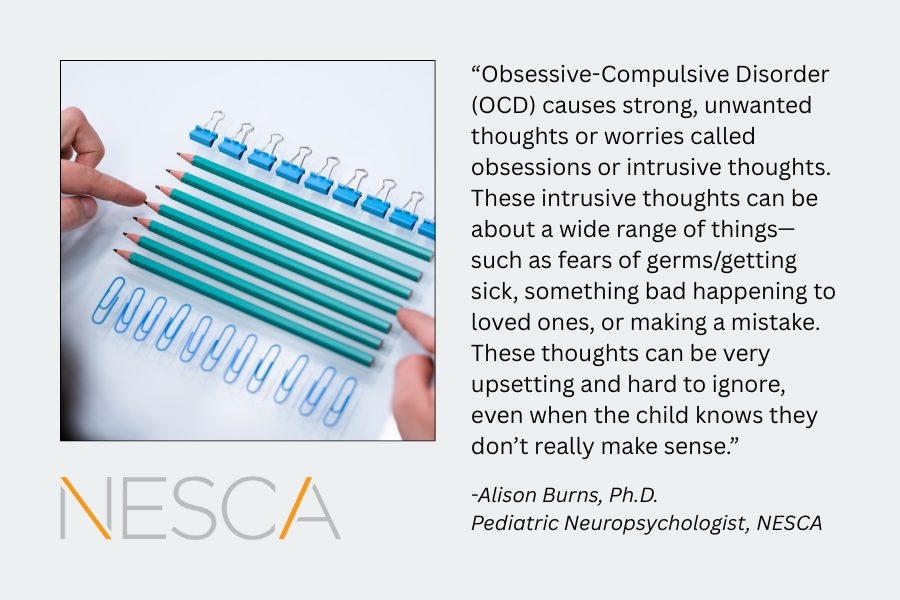
Image of pencils lined up perfectly, as a sign of OCD, along with a quote from Dr. Alison Burns

When Worry Becomes a Cycle: Understanding and Treating OCD in Children

By | NESCA Notes 2025

Image of pencils lined up perfectly, as a sign of OCD, along with a quote from Dr. Alison BurnsBy: Alison Burns, Ph.D.
Pediatric Neuropsychologist, NESCA

Obsessive-Compulsive Disorder (OCD) causes strong, unwanted thoughts or worries called obsessions or intrusive thoughts. These intrusive thoughts can be about a wide range of things—such as fears of germs/getting sick, something bad happening to loved ones, or making a mistake. These thoughts can be very upsetting and hard to ignore, even when the child knows they don’t really make sense. The anxiety caused by these intrusive thoughts can feel overwhelming and can take up a lot of mental energy.

To cope with these thoughts, children with OCD often develop compulsions—repetitive actions or mental rituals that they feel they must do to feel safe or to stop something bad from happening. These might include excessive cleaning, checking, counting, arranging items in a certain way, or asking for reassurance repeatedly. While these behaviors may temporarily relieve anxiety, they tend to reinforce the cycle of OCD and make it harder to break over time. Parents might notice their child spending a lot of time on these routines, getting very upset if interrupted, or struggling to keep up with school or social activities.

The good news is that OCD is treatable. The most effective therapy for children is a form of cognitive-behavioral therapy (CBT) called Exposure and Response Prevention (ERP), which helps them face their fears gradually while learning not to rely on compulsions. The Supportive Parenting for Anxious Childhood Emotions (SPACE) curriculum is a parent-focused program designed to help caregivers reduce accommodations of a child’s anxiety or OCD behaviors and promote healthy coping skills. Lastly, medication can also help reduce symptoms.

OCD must first be properly differentiated from other disorders that have overlapping symptoms, such as anxiety, autism spectrum disorder, or tic disorders. Anxiety disorders involve persistent worry, fear, or nervousness about real-life situations, whereas OCD is characterized by a cycle of obsessions and compulsions that the person feels compelled to perform. OCD and autism spectrum disorder can both involve repetitive behaviors or strict routines, but they differ in motivation, awareness, and broader patterns. In OCD, behaviors are driven by anxiety or fear. In autism, repetitive behaviors or routines are often comforting, sensory-driven, or based on special interests. Tics are sudden, brief, involuntary movements or vocalizations—such as blinking, throat clearing, or jerking—that are often preceded by a physical urge and relieved temporarily by performing the tic. While both tics and OCD can appear repetitive, tics are automatic and not driven by specific fears or beliefs, whereas OCD behaviors are purposeful responses to obsessive thoughts and aim to relieve anxiety. A comprehensive neuropsychological assessment will utilize a combination of interviews, observations, and standardized tools to understand the nature and impact of symptoms to ensure an accurate diagnosis and treatment plan.


About the Author

Dr. Burns conducts comprehensive evaluations of school-aged children, adolescents, and young adults with a variety of developmental, learning, and emotional difficulties. She has expertise in the evaluation of individuals following a concussion/mild traumatic brain injury and particularly enjoys working with individuals with attention (ADHD) and executive functioning (EF) difficulties. Dr. Burns is passionate about helping individuals and their families better understand their areas of strength and weakness and provides tailored treatment recommendations based upon that unique profile to make the evaluation most helpful for each client.

To book a consultation with Dr. Burns or one of our many other expert neuropsychologists, complete NESCA’s online intake form.

NESCA is a pediatric neuropsychology practice and integrative treatment center with offices in Newton, Plainville, and Hingham, Massachusetts; Londonderry, New Hampshire; the greater Burlington, Vermont region; and Coral Gables, Florida, serving clients from infancy through young adulthood and their families. For more information, please email info@nesca-newton.com or call 617-658-9800.

Inattentive student image and quote from Dr. Alison Burns

To Test or Not to Test (for ADHD)?

By | NESCA Notes 2025

Inattentive student image and quote from Dr. Alison BurnsBy: Alison Burns, Ph.D.
Pediatric Neuropsychologist, NESCA

Attention Deficit/Hyperactivity Disorder (ADHD) is a neurodevelopmental disorder that is characterized by difficulty with sustained attention, hyperactivity, and/or impulsivity. Some kids mostly have difficulty with attention (referred to as ADHD, Predominantly Inattentive Presentation, formerly called ADD), some kids mostly have symptoms of hyperactivity and impulsivity (referred to as ADHD, Predominantly Hyperactive-Impulsive Presentation), and some kids have difficulty with both attention and hyperactivity/impulsivity (referred to as ADHD, Combined Presentation).

The diagnosis of ADHD can be very straightforward for a subset of children. These kids may demonstrate highly impairing, overt symptoms of ADHD, often from a young age. These children tend to have symptoms of hyperactivity and impulsivity that are quickly noted by parents and preschool or kindergarten teachers. This group of children may appear as if they are driven by a motor or always on the go, and they have trouble paying attention within a very short period of time. The diagnosis of ADHD for this subset of children is frequently made by a pediatrician after parents and teachers complete a questionnaire (often the Vanderbilt Assessment Scale) and the child scores above a certain threshold.

However, the larger majority of children exhibit symptoms of inattention, hyperactivity, and impulsivity that are not as overt or clear cut. This may present as a lack of focus for certain tasks or in certain situations, daydreaming or distractibility, poor attention to detail or rushing through work, talking constantly, or fidgeting. Parent and teacher questionnaires may show levels of inattention and hyperactivity/impulsivity that are above the threshold, but this subset of children would greatly benefit from testing to confirm the diagnosis. That is because there are many other reasons why a child may be distracted, inattentive, rush through their work, not start a task independently, fidget, or chat excessively. Here are a few examples:

  • A child with anxiety may be distracted because they are focused on their worries (e.g., “I forgot to study for my next period’s test!” “What if people laugh at me when it’s my turn to read aloud?”). They may rush through their work because they are worried about completing the test in the allotted time period or have trouble starting a task as they “freeze.” They may fidget or talk excessively when feeling nervous.
  • A child with a learning disability may zone out or appear distracted when they are having trouble understanding a concept or completing an assignment. They may get bored or frustrated and begin to move around in their seat, and they may rush through their work to get it done as quickly as possible out of embarrassment. They may also have trouble starting a task independently as they do not know how to complete the work.
  • A child with a language disorder may become inattentive and distracted when they cannot understand what the teacher is saying. They may become fidgety and “check out,” and they may not start tasks independently as they did not understand the task instructions.

These example children (a child with ADHD, anxiety, a learning disability, and a language disorder) may all present in a similar fashion, with the same behaviors endorsed on a questionnaire (e.g., does he have trouble paying attention? Is he fidgety or restless?). But the reasons why these behaviors are occurring are fundamentally different. Making an accurate diagnosis is critical to getting the right treatment plan in place. We would not want to treat a child with a stimulant medication if the underlying cause of inattention is a language disorder, just as we would not recommend speech and language therapy for a child with ADHD (without language issues).

This is where testing comes into play. A neuropsychological assessment is an excellent tool for teasing out the underlying root cause behind the surface symptoms. A comprehensive neuropsychological assessment, such as the ones done at NESCA, assesses a child’s intellectual ability, academic skills (e.g., reading, writing, math), expressive and receptive language skills, visual-spatial skills, learning and memory style, fine motor skills, attention and executive functioning, social-emotional well-being, and adaptive living skills. This breadth and depth of testing can help to rule out alternative explanations and ensure that attention difficulties are truly caused by ADHD.

Testing also allows us to compare a child’s performance on testing to a sample of children the same age. This objective information is considered along with a host of other information (e.g., history given by the parents/caregivers, record review, questionnaires completed by parents and teachers, behavioral observations during testing). This comprehensive evaluation provides a great deal of information and increases the likelihood of an accurate diagnosis and effective treatment plan.


About the Author

Dr. Burns conducts comprehensive evaluations of school-aged children, adolescents, and young adults with a variety of developmental, learning, and emotional difficulties. She has expertise in the evaluation of individuals following a concussion/mild traumatic brain injury and particularly enjoys working with individuals with attention (ADHD) and executive functioning (EF) difficulties. Dr. Burns is passionate about helping individuals and their families better understand their areas of strength and weakness and provides tailored treatment recommendations based upon that unique profile to make the evaluation most helpful for each client.

To book a consultation with Dr. Burns or one of our many other expert neuropsychologists, complete NESCA’s online intake form.

NESCA is a pediatric neuropsychology practice and integrative treatment center with offices in Newton, Plainville, and Hingham, Massachusetts; Londonderry, New Hampshire; the greater Burlington, Vermont region; and Brooklyn, New York (coaching services only) serving clients from infancy through young adulthood and their families. For more information, please email info@nesca-newton.com or call 617-658-9800.

Neuropsychologist observing the behavior of a child being evaluated

The Importance of Behavioral Observations in Neuropsychological Evaluations

By | NESCA Notes 2024

Neuropsychologist observing the behavior of a child being evaluatedBy: Alison Burns, Ph.D.
Pediatric Neuropsychologist, NESCA

Neuropsychological evaluations integrate information collected from multiple sources: (1) history and presenting concerns obtained during clinical interviews with a parent/guardian and the patient, (2) information from a review of records (e.g., past testing reports, school plans, such as IEPs or 504 plans, medical documentation), and (3) neuropsychological and psychological test findings. While these sources of information are important components of an evaluation, behavioral observations are essential to truly understanding a child’s strengths and weaknesses.

Behavioral observations are the qualitative observations made by a clinician that help to understand the child’s unique set of strengths and weaknesses. This includes overall impressions of the child throughout the evaluation process, such as their cooperation level and general attentiveness, their mood/affect and interpersonal skills, any nuances noted in their expressive or receptive language skills, and their fine motor abilities. This provides a “big picture” context to help the interpretation of more specific test findings. For example, if a child appears depressed and, as a result, thinks and completes tasks slowly, this can provide context for test scores which indicate processing speed deficits. In addition, these “big picture” behavioral observations can highlight the daily life impact that results from a weakness. For example, a child may be observed having difficulty opening a food container during a snack break which relates to the fine motor weaknesses seen during direct testing. Lastly, observations during unstructured times (e.g., waiting room behavior, separation from parents, social chit chat in between tasks) can often contribute invaluable information that would otherwise not be elicited from structured standardized testing.

Behavioral observation during testing tasks is necessary to look for any factors that may help elucidate the specific strengths or challenges a child may be experiencing. For example, a child may receive a Low Average score on a “Block Design” task in which they are asked to use blocks to recreate a visual-spatial design within a time limit. However, this Low Average performance could occur for many reasons. First, it could be due to a child having a hard time perceiving the correct angles and shapes within the design, suggesting a visual-spatial deficit. Second, a child may answer all items correctly but had done so after the time limit, suggesting a processing speed weakness. Third, a child may make an error as they rush through each item, suggesting difficulties with attention to detail or impulsivity.

Behavioral observations allow the clinician to identify a child’s unique profile of strengths and weaknesses to a greater specificity, which, in turn, allows for more tailored treatment recommendations. For example, knowing a child has a fine motor weakness that results in difficulty opening food containers could suggest a more specific and targeted treatment goal for a school-based intervention plan or private occupational therapy than simply knowing the child scored below age expectations on a fine motor task. In addition, three children who performed similarly on a block design task would require very different treatment approaches (e.g., visual-spatial accommodations, extended time, attention/impulsivity accommodations). As such, good behavioral observations are the key to a comprehensive evaluation that can provide the most tailored treatment recommendations.


About the Author

Dr. Burns conducts comprehensive evaluations of school-aged children, adolescents, and young adults with a variety of developmental, learning, and emotional difficulties. She has expertise in the evaluation of individuals following a concussion/mild traumatic brain injury and particularly enjoys working with individuals with attention (ADHD) and executive functioning (EF) difficulties. Dr. Burns is passionate about helping individuals and their families better understand their areas of strength and weakness and provides tailored treatment recommendations based upon that unique profile to make the evaluation most helpful for each client.


To book a consultation with Dr. Burns or one of our many other expert neuropsychologists, complete NESCA’s online intake form.

NESCA is a pediatric neuropsychology practice and integrative treatment center with offices in Newton, Plainville, and Hingham, Massachusetts; Londonderry, New Hampshire; the greater Burlington, Vermont region; and Brooklyn, New York (coaching services only) serving clients from infancy through young adulthood and their families. For more information, please email info@nesca-newton.com or call 617-658-9800.

Child in bed suffering from a concussion, holding their head in pain

What School Supports Does My Child Need After A Concussion?

By | NESCA Notes 2024

Child in bed suffering from a concussion, holding their head in painBy: Alison Burns, Ph.D.
Pediatric Neuropsychologist, NESCA

Unfortunately, every year, many children and adolescents experience concussions. A concussion is a mild traumatic brain injury that occurs when an individual sustains a blow to the head or body that results in the brain moving rapidly back and forth. This causes the brain to stretch and strain, resulting in a vast array of possible symptoms. Symptoms of a concussion include:

list of physical, cognitive, emotional, and sleep concussion symptoms

Recent studies have shown that while it is important to rest for the initial few days after an injury, slowly reengaging in cognitive activities at a tolerable level helps to promote recovery. This period of rest followed by a slow increase in cognitive activity means that children are often out of school/slowly transitioning back to school for an unspecified period after injury. As such, many children will benefit from support and accommodation at school during the recovery period. Parents are encouraged to talk to their child’s academic team and school personnel to discuss the need for these supports. As children and adolescents experience differing sets of symptoms after an injury, the accommodations and supports should be tailored to the individual’s unique symptom profile.

Physical Symptoms: Students who experience headaches or fatigue may benefit from rest breaks or even a nap during the school day. Dizziness, balance problems, or nausea may necessitate the need for an elevator pass and it may be helpful for the student to transition to class before the bell rings when there are less people to navigate around in the hallway. Light and noise sensitivity can be particularly hard within the school setting. Students may need to wear sunglasses or a hat, be seated away from the window, and may need teacher notes as looking at a smartboard may be painful. In addition, computer-based work may need to be printed during the recovery period for light sensitive students. Students with noise sensitivity may need to wear ear plugs, avoid crowded and noisy areas, such as the lunchroom, assemblies, or music class, and they may need to transition to the next class before the bell rings and the hallway becomes noisy.

Cognitive Symptoms: A concussion can temporarily impact an individual’s attention, executive functioning skills, and processing speed. Therefore, it may be necessary to reduce a child’s workload (e.g., odd/even problems only, outline a paper instead of writing it fully, reduce homework load) and assign only essential work (i.e., waive non-essential assignments, quizzes, and tests). In addition, it may be helpful to break down tasks into smaller “chunks,” repeat information or instructions, and allow for extended time to complete essential classwork, quizzes, and tests. They may need access to teacher notes if they are unable to keep up with the pace of the instruction to take proper notes, and they may need information presented in a slower manner or repeated to ensure comprehension. Teachers should consider alternative ways to ensure mastery of information (e.g., oral discussion, multiple choice instead of open-ended questions) as students may not be able to demonstrate their true knowledge in standard ways while recovering from a concussion. Tests and quizzes should only be given if symptoms do not interfere, and the student is adequately prepared.

Emotional Symptoms: Emotional symptoms following concussion are often overlooked as they are not a commonly known symptom of concussion. Some children and adolescents may become overwhelmed about missing school and the accumulating workload, and they may feel isolated from their friends. This would also suggest the need to reduce a child’s workload for a short period of time, including waiving non-essential assignments, quizzes, or tests. Students should also be allowed to socialize with their peers as tolerated (e.g., quiet lunch setting with a few close friends).

Sleep Symptoms: A child or adolescent experiencing sleep difficulties as a result of their concussion may not have the energy to complete a full day of school. They may need a later start time or only be able to complete a half day of school. Some students with disrupted sleep may be able to complete a full school day, but they may require a nap in the nurse’s office.

In sum, a concussion presents in many ways and often has a significant impact on the day-to-day functioning of a child or adolescent. In particular, school is often disrupted after a concussion, even for children and adolescents who have a short recovery. School supports and accommodations should be tailored to the child’s individual profile of symptoms to best support them throughout their recovery.


About the Author

Dr. Burns conducts comprehensive evaluations of school-aged children, adolescents, and young adults with a variety of developmental, learning, and emotional difficulties. She has expertise in the evaluation of individuals following a concussion/mild traumatic brain injury and particularly enjoys working with individuals with attention (ADHD) and executive functioning (EF) difficulties. Dr. Burns is passionate about helping individuals and their families better understand their areas of strength and weakness and provides tailored treatment recommendations based upon that unique profile to make the evaluation most helpful for each client.


To book a consultation with Dr. Burns or one of our many other expert neuropsychologists, complete NESCA’s online intake form.

NESCA is a pediatric neuropsychology practice and integrative treatment center with offices in Newton, Plainville, and Hingham, Massachusetts; Londonderry, New Hampshire; the greater Burlington, Vermont region; and Brooklyn, New York (coaching services only) serving clients from infancy through young adulthood and their families. For more information, please email info@nesca-newton.com or call 617-658-9800.

Skip to content