NESCA’s Newton, MA location has immediate availability for neuropsychological evaluations. Our MA clinicians specialize in the following evaluations: Neuropsychological; Autism; and Emotional and Psychological, as well as Academic Achievement and Learning Disability Testing.

Visit www.nesca-newton.com/intake for more information or to book an evaluation.

Tag

children Archives - Page 4 of 5 - NESCA

Subscribe to NESCA Notes

Getting Back in the Swing of Things

By | NESCA Notes 2021

By Miranda Milana, Psy.D.
Pediatric Neuropsychologist

The past 22 months have brought more transitions and changes to our daily lives than ever before. Whether children and parents have had to transition from routine school breaks, or to unprecedented remote learning environments, we have all dealt with our fair share of the unexpected since the COVID-19 pandemic began. As we prepare to enter yet another transition with winter break ending (and February break not too far away), these changes in schedule and routine can be difficult adjustments for entire families. Not to mention the seemingly never-ending worries wondering whether virtual learning will resume once again. In order to help ease these times of transition, try utilizing the following tips:

Consider sticking to similar routines when possible. Sleeping in, unusual mealtimes, and later bedtimes are all tempting (and sometimes unavoidable!) when we don’t have our regular school or work routines during breaks and vacations. Try to implement some sort of routine whenever possible if routine is what works best for you and your family. It might mean that you can still sleep in, but mornings start consistently at 7am instead of 5am. Maybe dinner is no longer eaten at 7pm but at 6pm. Whatever the changes may be, consistency is key.

Schedule time for fun! As much as routine and schedules can be important, don’t forget to leave time for enjoyable activities! The holiday season can bring numerous obligations between holiday parties, visiting with family/friends, and previously scheduled extracurricular activities. Take some time to plan preferred family activities as well! After all, a break is supposed to be just that…a break!

Don’t wait to start transitioning back to school day routines until the morning of. Going back to work or school after extended time off can be really challenging. There is often a sense of dread and “Sunday Scaries” that accompany a return back to our daily responsibilities. Don’t wait until the night before or morning of to resume a typical bedtime and wakeup call. Instead, gradually shift the nighttime and early morning routine over a few days so that the night before/morning of doesn’t feel so daunting and overwhelming! By pushing back bedtime and setting the alarm 15 minutes earlier over the course of several days, the difference won’t seem as insurmountable.

Create visual calendars and talk about the transition ahead of time. Creating visuals can be crucial in helping children to prepare for what is to come. For younger children who do not yet have an appropriate conceptualization of time, a visual can be a particularly useful resource in preparing them for what to expect and when. Make reviewing the visual calendar a part of the nighttime or morning routine.

Provide validation and have patience with yourself. No matter how hard we try to prepare, seeing an increase in problematic behaviors, temper tantrums, and emotional outbursts is to be expected throughout times of change. Helpful strategies during times of dysregulation include naming the emotion, validating it, and creating space for safe and appropriate expression. Try using statements such as:

  • Labeling the emotion: “It looks like an earlier bedtime is really frustrating for you.”
  • Validating the feeling: “It’s okay to feel this way.”
  • Normalize the feeling: “Sometimes I feel overwhelmed when I have to do things I don’t like.”
  • Modeling appropriate strategies: “Something that can be helpful for me is deep breathing. Do you want to try and see if this is helpful for you, too?


About the Author

Dr. Miranda Milana provides comprehensive evaluation services for children and adolescents with a wide range of concerns, including attention deficit disorders, communication disorders, intellectual disabilities, and learning disabilities. She particularly enjoys working with children and their families who have concerns regarding an autism spectrum disorder. Dr. Milana has received specialized training on the administration of the Autism Diagnostic Observation Schedule (ADOS).

Dr. Milana places great emphasis on adapting her approach to a child’s developmental level and providing a testing environment that is approachable and comfortable for them. She also values collaboration with families and outside providers to facilitate supports and services that are tailored to a child’s specific needs.

Before joining NESCA, Dr. Milana completed a two-year postdoctoral fellowship at Boston Children’s Hospital in the Developmental Medicine department, where she received extensive training in the administration of psychological and neuropsychological testing. She has also received assessment training from Beacon Assessment Center and The Brenner Center. Dr. Milana graduated with her B.A. from the University of New England and went on to receive her doctorate from William James College (WJC). She was a part of the Children and Families of Adversity and Resilience (CFAR) program while at WJC. Her doctoral training also included therapeutic services across a variety of settings, including an elementary school, the Family Health Center of Worcester and at Roger Williams University.

Dr. Milana grew up in Maine and enjoys trips back home to see her family throughout the year. She currently resides in Wrentham, Massachusetts, with her husband and two golden retrievers. She also enjoys spending time with family and friends, reading, and cheering on the Patriots, Bruins, Red Sox, and Celtics.​


Neuropsychology & Education Services for Children & Adolescents (NESCA) is a pediatric neuropsychology practice and integrative treatment center with offices in Newton, Massachusetts, Plainville, Massachusetts, and Londonderry, New Hampshire, serving clients from preschool through young adulthood and their families. For more information, please email info@nesca-newton.com or call 617-658-9800.


To book an appointment with Dr. Miranda Milana, please complete our Intake Form today. For more information about NESCA, please email info@nesca-newton.com or call 617-658-9800.


Therapeutic Toy Guide to Promote Skill-building

By | NESCA Notes 2021

By: Jessica Hanna MS, OTR/L
Occupational Therapist, NESCA

It’s that time of year when parents and loved ones are looking for the perfect gift. As pediatric occupational therapists, we are often asked about our recommendations for the best toys and activities that encourage learning and the development of specific skills. During an occupational therapy session, toys and games are used with people across the life span for many reasons. The biggest reason is to bring joy and develop confidence while simultaneously working on skill-building in areas that require getting and maintaining attention in an effort to improve and develop independence in functional tasks.

Play and exploration of games and toys are for those of all ages. The right toy and game can be used to develop new skills and strengthen and refine learned skills.

Skills addressed through play and active exploration:

  • Attention and concentration
  • Balance
  • Coordination skills
  • Core strength
  • Executive functioning
  • Emotional regulation
  • Fine motor skills
  • Gross motor skills
  • Handwriting
  • Imaginative play
  • Motor planning
  • Sensory motor needs
  • Visual perceptual skills

How many times have you endlessly scrolled online looking for the best-fit gift, wondering if it will be one more item that ends up collecting dust on a shelf? How often do you wish a toy store existed like when we were kids, instead of walking down the same small toy aisle at the local department store and leaving with nothing? Or having to weed through page after page of online stores and catalogs?

Below is a helpful guide to therapeutic games and toys that focus on a couple of specific skill areas. Most of the games included can fall into more than one skill area, depending on how it’s used.

Coordination Skills – Skills that help develop body control and awareness. Bilateral coordination is the ability to use both sides of your body together in a coordinated way, and hand-eye coordination is when the eyes guide the hands in movement.

3 + years

  • EleFun (Hasbro)
  • Feed the Woozle
  • Kids Magnetic Fishing Games (iPlay, iLearn)
  • Instrument toys
  • Marble Run
  • Target activities
  • The Yoga Garden Game
  • Wooden Balance Board
  • Zoom Ball

6 + years

  • Bob it
  • BucketBall
  • Kan Jam
  • Klask
  • Rev balance board
  • Ring Toss
  • Simon
  • Spike Ball
  • Throw the Burrito
  • Twister

Executive Functioning Skills The ability to sustain attention, organize and plan, initiate and complete, problem solve and regulate emotions.

3 + years

  • Bee Genius (MUKIKIM)
  • Bunny Hop (Educational Insights)
  • Cootie
  • Create-A-Burger (Lakeshore)
  • Dino Escape
  • Don’t Break the Ice
  • Frankie’s Food Truck Fiasco Game
  • iPlay, iLearn Kids Magnetic Fishing Games
  • Hoot Owl Hoot
  • Movement Memory

 6+ years

  • Battleship
  • Checkers
  • Chess
  • DogPile
  • Distraction
  • Gravity Maze
  • Life Junior
  • Monopoly
  • Outfoxed
  • Rush Hour (Think Fun)

Fine Motor Skills – The ability to control the small muscles of the hands and fingers. Fine motor development contains many components. Some of those areas include pincer and pre-writing grasp development, hand strength, wrist stability, motor control, and separation of the sides of the hand.

3 + years

  • Alphabet Learning Locks
  • Bee Genius
  • Duplo Sets
  • Forest Friends Playset (Lakeshore)
  • Light table pegs and pegboard (Lakeshore)
  • Magnet Alphabet Maze
  • Noodle Knockout!
  • Pegcasso Build and Drill
  • Poke-a-Dot: Old MacDonald’s Farm
  • Pop the Pig
  • Woodpecker feeding game (iPlay, iLearn)
  • Snap Dinos (Lakeshore)

6+ years

  • Frankie’s Food Truck Fiasco Game
  • LEGOs
  • Light Brite
  • LiquiPen (Yoya Toys)
  • Mancala
  • Kanoodle
  • Operation
  • Perfection
  • Pictionary
  • Scratch Art
  • Shelby’s Snack Shack Game
  • Trouble

Sensory Play – The opportunity to receive sensory input through play. It can foster listening skills and body awareness, encourage tactile exploration and risk-taking, and promote a calming and alert state of being.

3+ years

  • Bean bags
  • Kinetic Sand
  • Monkey Noodle
  • What’s in Ned’s Head?
  • Playdoh
  • Pop Fidgets
  • Squishmellos
  • Scooter boards
  • Sit and Spin
  • Trampoline

6 + years

  • Aromatherapy
  • Bubble tubes
  • Color mix sensory tubes
  • Doorway Sensory Swing Kit (DreamGym Store)
  • Thinking Putty (scented/glow in the dark)
  • Tent
  • Tunnel
  • Water Beads
  • Weighted blanket
  • LiquiPen (Yoya Toys)

Visual Perception Skills – The ability to make sense of what is being seen. Skills are used to copy information from a board, manipulate items, identify, read, recall info, visually locate things, and write.

3 + years

  • Alphabet Bingo
  • CandyLand
  • Chutes and Ladders
  • Fox in the Box
  • Honeybee Tree
  • Magnatiles
  • Spot-it
  • Pete the Cat- I Love My Buttons Game
  • Puzzles
  • Zingo (Think Fun)

6+ years

  • Connect Four
  • DogPile
  • Guess Who
  • Jenga
  • Kanoodle
  • Klask
  • Let’s Go Code
  • Mancala
  • Perfection
  • Pixy Cubes

This list is just the tip of the iceberg of the many toys and games you will come across. Many toys and games can be therapeutically and easily graded to any individual, no matter the age. The trick is to find the just-right challenge to work on the skill area desired through fun and motivating means. We recommend reaching out to your occupational therapist if you require assistance with either new or older games and toys and how to create the just-right challenge for your child.


About the Author

Jessica Hanna has over 10 years of pediatric OT experience in conducting assessments and providing treatment of children and adolescents with a broad range of challenges and disabilities, including autism spectrum disorders, sensory processing disorders, visual impairments, cerebral palsy, executive function deficits and developmental disorders of motor function. Prior to joining NESCA, Jessica trained and worked in a variety of settings, including inpatient and outpatient hospital settings, private practice, schools and homes. She has served on interdisciplinary treatment teams and worked closely with schools, medical staff and other service providers in coordinating care. In addition, Jessica provided occupational therapy services at Perkins School for the Blind and Spaulding Rehabilitation Hospital pediatric inpatient unit, where she conducted comprehensive evaluations and interventions for children with a broad range of presentations.


To book an appointment or to learn more about NESCA’s Occupational Therapy Services, please fill out our online Intake Form, email info@nesca-newton.com or call 617-658-9800.


Neuropsychology & Education Services for Children & Adolescents (NESCA) is a pediatric neuropsychology practice and integrative treatment center with offices in Newton, Massachusetts, Plainville, Massachusetts, and Londonderry, New Hampshire, serving clients from preschool through young adulthood and their families. For more information, please email info@nesca-newton.com or call 617-658-9800.


Anxiety Reducers for Children and Teens with ASD

By | NESCA Notes 2021

By Renée Marchant, Psy.D.
Pediatric Neuropsychologist

Research indicates that children and teens with Autism Spectrum Disorders (ASD) are more sensitive to heightened physiological sympathetic arousal (the “fight or flight” response), including increased heart rate, breathing rate, feeling “on edge” and body-based tenseness. Heightened physiological arousal is neurologically connected to sensory processing and emotional responses. This is why some children with ASD have “high startle responses” or sensitivities to specific sensations, such as touch or sounds. This is also why some children and teens with ASD are vulnerable to feelings of anxiety, particularly within social situations and settings.

There is growing research focusing on possible strategies and interventions that reduce anxiety and “buffer” the “fight or flight” response that can be activated for many children and teens with ASD.

5 Research-driven Anxiety Reducers:

Animals: Include companion or therapy animals in social groups or social outings (particularly new social events). In one study, children with ASD showed a 43% decrease in skin conductance responses during free play with peers in the presence of animals, as compared to toys (O’Haire, McKenzie, Beck, & Slaughter, 2015).

Exercise: Make a plan to engage in a “warm up” body-based activity right before a social event when anxiety levels are increasing (e.g., jumping jacks, burpees, squats). Research indicates that exercise calms the amygdala and decreases physiological arousal.

Relax or Distract: Practice progressive muscle relaxation (PMR). Recent research has indicated that regular and routine engagement in PMR sessions can be a useful strategy for individuals with ASD. Distract yourself from the anxiety-producing situation for the short term (e.g., count by 3s, name three things you can see and hear in the room, repeat words from your favorite song in your head).

Plan to Take a Break: Children and teens can benefit from having a healthy “escape plan” to take a break from socially-demanding and sensory-demanding settings (e.g., a large event like a play or concert, a college lecture, an interview for a job). Research indicates that “rest breaks” during mentally demanding tasks result in increased alertness, decreased fatigue and heightened relaxation.

Social Stories: Social stories provide the opportunity to practice and prepare for stressful situations, decreasing “fight or flight” responses. Read more about examples and applications of social stories in my colleague, Dr. Erin Gibbons’ previous blog post.


About the Author:

Dr. Renée Marchant provides neuropsychological and psychological (projective) assessments for youth who present with a variety of complex, inter-related needs, with a particular emphasis on identifying co-occurring neurodevelopmental and psychiatric challenges. She specializes in the evaluation of developmental disabilities including autism spectrum disorder and social-emotional difficulties stemming from mood, anxiety, attachment and trauma-related diagnoses. She often assesses children who have “unique learning styles” that can underlie deficits in problem-solving, emotion regulation, social skills and self-esteem.

Dr. Marchant’s assessments prioritize the “whole picture,” particularly how systemic factors, such as culture, family life, school climate and broader systems impact diagnoses and treatment needs. She frequently observes children at school and participates in IEP meetings.

Dr. Marchant brings a wealth of clinical experience to her evaluations. In addition to her expertise in assessment, she has extensive experience providing evidence-based therapy to children in individual (TF-CBT, insight-oriented), group (DBT) and family (solution-focused, structural) modalities. Her school, home and treatment recommendations integrate practice-informed interventions that are tailored to the child’s unique needs.

Dr. Marchant received her B.A. from Boston College with a major in Clinical Psychology and her Psy.D. from William James College in Massachusetts. She completed her internship at the University of Utah’s Neuropsychiatric Institute and her postdoctoral fellowship at Cambridge Health Alliance, a Harvard Medical School teaching hospital, where she deepened her expertise in providing therapy and conducting assessments for children with neurodevelopmental disorders as well as youth who present with high-risk behaviors (e.g. psychosis, self-injury, aggression, suicidal ideation).

Dr. Marchant provides workshops and consultations to parents, school personnel and treatment professionals on ways to cultivate resilience and self-efficacy in the face of adversity, trauma, interpersonal violence and bullying. She is an expert on the interpretation of the Rorschach Inkblot Test and provides teaching and supervision on the usefulness of projective/performance-based measures in assessment. Dr. Marchant is also a member of the American Family Therapy Academy (AFTA) and continues to conduct research on the effectiveness of family therapy for high-risk, hospitalized patients.


To book an evaluation with Dr. Marchant or one of our many other expert neuropsychologists, complete NESCA’s online intake form. Click here to learn more about NESCA’s ASD Diagnostic Clinic.


Neuropsychology & Education Services for Children & Adolescents (NESCA) is a pediatric neuropsychology practice and integrative treatment center with offices in Newton and Plainville, Massachusetts, and Londonderry, New Hampshire, serving clients from preschool through young adulthood and their families. For more information, please email info@nesca-newton.com or call 617-658-9800.


When the Honeymoon Period Is Over: Signs of School Refusal

By | NESCA Notes 2021

By: Moira Creedon, Ph.D. 
Pediatric Neuropsychologist, NESCA

As we reach the end of our second month back to school, many of us may be reaching the end of that glorious honeymoon period – the phase when kids are excited to see friends, optimistic for the school year, and reviewing material they likely already know. For some, the return did not start this rosy; the bloom is falling off the rose and kids are getting tired. You and your child are not alone in this. My goal for today’s blog is to share with you some warning signs that your child may be struggling and ways to get support before they grow to become bigger problems. The biggest problem I want to avoid: school refusal.

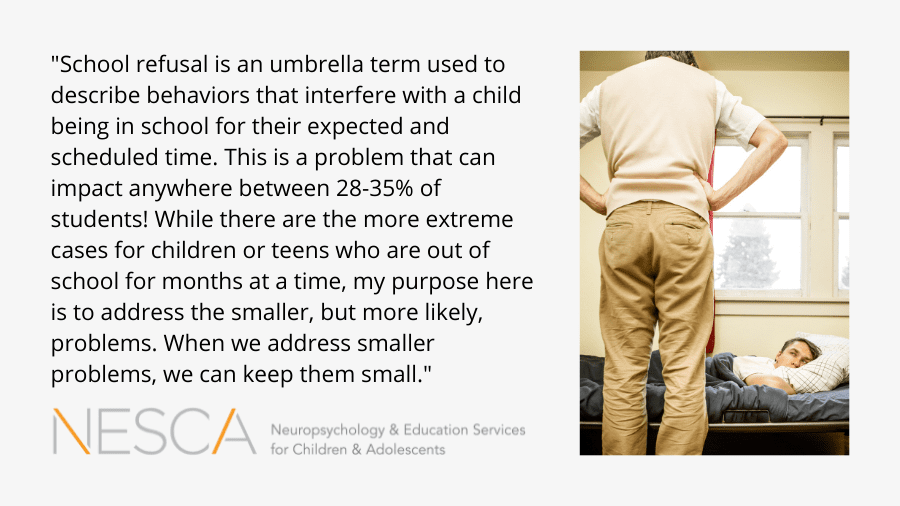
Have you heard this yet? – “My tummy hurts. I have to stay home.” Or, “I hate school. Please don’t make me go.” Or, “I’m not going!” Or perhaps these messages are communicated more subtly with covers over their heads in the morning, difficulty getting out the door on time, tantrums or disruptive behaviors in the mornings, missed buses, or the overwhelming frustration of homework that erupts into nightly battles. According to researcher Christopher Kearney, these are signs to pay attention to as they can evolve into what he terms “school refusal behavior.” School refusal is an umbrella term used to describe behaviors that interfere with a child being in school for their expected and scheduled time. This is a problem that can impact anywhere between 28-35% of students! While there are the more extreme cases for children or teens who are out of school for months at a time, my purpose here is to address the smaller, but more likely, problems. When we address smaller problems, we can keep them small.

Risky signs that your child is struggling with school:

  • Consistent statements of hating school, their teacher, or specific peers. A casual mention of a bad day is not cause for alarm. We all have bad days. If the statements keep coming and they get louder and stronger, then parents should pay attention.
  • The outward behaviors are getting bigger in the mornings before school or over homework. Behavior is a way for children to communicate with us how they are feeling. So, explosions over homework or tantrums in the morning that lead to tardiness are warning signs. The occasional homework meltdown or rushed morning is normal; we are all human! But, the problem is in the pattern.
  • Avoidance rears its ugly head. While some kids show on the outside that they are uncomfortable through their explosions, others communicate very clearly through their withdrawal. Some kids and teens struggle to get out of bed, are constantly tired, not completing work, falling asleep in class, or sharing every somatic complaint or symptom available on Google. If medical causes are ruled out, anxiety can be a culprit.
  • Consider the role of a major transition. According to Kearney, the riskiest time for a child to develop a pattern of school refusal is during times of significant transition – like starting kindergarten or changing schools from middle to high school. In addition to the social and emotional jump that these transitions bring, there is also a massive leap in demands for academic independence. It is very common for kids to struggle with the leap initially.

Oh no. So now what?

  • First and foremost, keep calm. It is far easier to keep small problems small when we have a clear-headed approach. Pull in anxiety management techniques like deep breathing, sleep, and exercise to support your own anxiety as a parent.
  • Reach out to your child’s teacher or school psychologist. Let them know your child is struggling with homework or coming to school. This is a great chance to gather information on what is going on in your child’s day and put your child on their teacher’s radar. This is critical as the only effective approach to remedy a problem with school refusal is a team approach.
  • Talk to your child honestly about what is going on. This has to include a chance for kids to talk about what might be happening to make them feel stressed or why they dislike school. Don’t shortcut this step. If your child has trouble explaining what is going on (which can be especially true for younger kids), try this approach: you and your child are both going to be detectives to learn together what is making school feel hard. We can’t solve a problem until we understand it. By joining with your child in gathering information, you are demonstrating great empathy and validating that their feelings are real.
  • Be careful of your language and conversation about school. It can be tempting to go too far in validating a child to give the message that the assignment really is stupid or their teacher really is unreasonable and mean. It’s best to stick to the feeling (“that must feel so frustrating”) without reinforcing negative messages about school.
  • Hold the line. As you gather more information, it is really important to maintain the message that it is your child’s job to go to school. It might feel conflicting to both validate the feelings of hating school and give the message to attend school. It might feel something like this: It’s either “I love and support my child OR I’m going to force them to go to school even when it’s hard.” Let’s change that OR to AND. Reframe the thought to: “I love and support my child AND they have to go to school AND they can do hard things.”

For more information, please check out:

Kearney, C.A. (2007). Getting your child to say “yes” to school: A guide for parents of youth with school refusal behavior. New York: Oxford University Press.


About the Author

Dr. Creedon has expertise in evaluating children and teens with a variety of presenting issues. She is interested in uncovering an individual’s unique pattern of strengths and weaknesses to best formulate a plan for intervention and success. With experiences providing therapy and assessments, Dr. Creedon bridges the gap between testing data and therapeutic services to develop a clear roadmap for change and deeper of understanding of individual needs.


If you are interested in booking an evaluation with Dr. Creedon or another NESCA neuropsychologist, please fill out and submit our online intake form


Neuropsychology & Education Services for Children & Adolescents (NESCA) is a pediatric neuropsychology practice and integrative treatment center with offices in Newton and Plainville, Massachusetts, and Londonderry, New Hampshire, serving clients from preschool through young adulthood and their families. For more information, please email info@nesca-newton.com or call 617-658-9800.
The Power of a List

By | NESCA Notes 2021

By Yvonne M. Asher, Ph.D. 
Pediatric Neuropsychologist

For so many children, adolescents, and young adults, I find myself recommending something that seems too simple to be of much use – a list. The power of lists has been identified and described in depth by several experts, such as Atul Gawande (The Checklist Manifesto – an excellent read). These books often discuss efficiency in the workplace, health and safety practices, and maintaining consistency in products or services. As adults, these are the things we often care about – ensuring that we are efficient, consistent, and getting things done.

In my practice, I recommend lists for different reasons. I recommend lists to teach executive functioning skills, such as planning, task initiation, organization, and task monitoring. Lists are also incredibly helpful for children who struggle to hold on to information. These children often miss information that is stated aloud, such as a parent giving directions or a teacher explaining instructions. Their brains often struggle to “keep up” with the pace of information presented in the world. Having the information written down in an organized manner, such a list, can help them access the information without time constraints.

Here is a quick example:

On a typical weekday morning, parents alternate checking on their 8-year-old as he gets ready for school. They give reminders of all the things left to do – “Brush your teeth!” “Get dressed!” “Put your homework in your backpack!” Time before the bus becomes shorter and shorter, as does everyone’s patience. Parents think, “We do the same things every single morning! Why is it so hard for him to remember?” Child thinks, “Why can’t they just leave me alone!” Voice volumes increase, tone shifts, and before anyone knows it or means to, there is a shouting match as the bus is pulling up.

Of course, a list won’t stop hurt feelings or eliminate frustration. However, if the child’s “morning routine” is posted somewhere easy to see, he may need far fewer reminders from his parents of all the tasks he has left to do. Frustration may be reduced, and the child can feel successful completing tasks with greater independence.

A list may be steps in a routine, as illustrated above. A list could also be of materials the child needs for baseball practice, the chores that should be done each week, or the limits and expectations around “screen time.” I often spend time with parents discussing the contents of a list, where the list should be placed, and the format it might take. For example, do you want checkboxes next to each item? Do you want the steps to be numbered? Maybe you love arts and crafts, and you want to laminate the list and have Velcro tabs with a “checkmark” that can be placed next to each completed task. The format and purpose vary, but lists are infinitely useful.

For many children, practice using lists is not only helping them to build skills in the moment, but is excellent practice for later life. Developing comfort with the tools and strategies that work best for you is an invaluable aspect of raising our children to become independent adults who can achieve their goals.


About the Author

Dr. Yvonne M. Asher enjoys working with a wide range of children and teens, including those with autism spectrum disorder, developmental delays, learning disabilities, attention difficulties and executive functioning challenges. She often works with children whose complex profiles are not easily captured by a single label or diagnosis. She particularly enjoys working with young children and helping parents through their “first touch” with mental health care or developmental concerns.

Dr. Asher’s approach to assessment is gentle and supportive, and recognizes the importance of building rapport and trust. When working with young children, Dr. Asher incorporates play and “games” that allow children to complete standardized assessments in a fun and engaging environment.

Dr. Asher has extensive experience working in public, charter and religious schools, both as a classroom teacher and psychologist. She holds a master’s degree in education and continues to love working with educators. As a psychologist working in public schools, she gained invaluable experience with the IEP process from start to finish. She incorporates both her educational and psychological training when formulating recommendations to school teams.

Dr. Asher attended Swarthmore College and the Jewish Theological Seminary. She completed her doctoral degree at Suffolk University, where her dissertation looked at the impact of starting middle school on children’s social and emotional wellbeing. After graduating, she completed an intensive fellowship at the MGH Lurie Center for Autism, where she worked with a wide range of children, adolescents and young adults with autism and related disorders.


Neuropsychology & Education Services for Children & Adolescents (NESCA) is a pediatric neuropsychology practice and integrative treatment center with offices in Newton, Massachusetts, Plainville, Massachusetts, and Londonderry, New Hampshire, serving clients from preschool through young adulthood and their families. For more information, please email info@nesca-newton.com or call 617-658-9800.


To book an appointment with Dr. Yvonne Asher, please complete our Intake Form today. For more information about NESCA, please email info@nesca-newton.com or call 617-658-9800.


Does Scatter Matter? How to Understand Your Child Better

By | NESCA Notes 2021

By: Moira Creedon, Ph.D. 
Pediatric Neuropsychologist, NESCA

Families often come to testing with questions like these: My child is so smart, why is reading so hard for them? If she can remember the smallest conversation from three years ago, why can’t she remember the two things I sent her upstairs to get? If he can do all of the calculations, why can’t my son solve a word problem? The answer can show itself in the scatter.

Assessment measures are based on statistical conversions, where the number of points a child or teen earns is “translated” into a scaled or standard score. This helps us to understand how your child performs compared to other children their same age. Tests are largely based on the idea that scores should “hang together” – meaning that if your child is average for his or her age on one task (e.g., visual-spatial skills) then they should be average on another (e.g., verbal knowledge). And while this may be true for many people, it certainly it not true for all people. Many people have “scatter,” meaning that there is a statistical difference between their scores.

I will spare you the controversy about scatter in our field, about whether a certain degree of scatter or difference between scores means that you cannot calculate certain other scores. There is also specific knowledge of scatter needed to diagnose specific learning disabilities (e.g., if your child has high average verbal skills, how far apart do their reading scores need to be in order to fit the diagnostic criteria). While those topics are incredibly important to the field, my focus today is to build a little empathy for how scatter can matter.

There are times when this scatter can lead us to a diagnostic decision. For example, a relatively common pattern that I see is that of a very bright teenager whose cognitive and problem-solving are at least above average, while their basic focus and attention is below average. With other evidence that corroborates it, this can mean ADHD. A big difference between a child’s verbal knowledge/language skills and their ability to use their language for social purposes can suggest an Autism Spectrum Disorder. In these instances, the scatter absolutely matters. But, scatter can be meaningful to a child’s daily experience even if it’s not statistically “big enough” to warrant diagnosis.

Imagine being your child for a moment. Perhaps your child has a knack for building complex Lego sets and can spend hours assembling structures that are intricate, detailed, and involve more small pieces that my adult fingers could tolerate (let alone our feet as we step on them!). Perhaps your child’s visual-spatial skills are incredible, scoring in the high average range compared to their friends. Then you place a book in their hands and ask them to read a page aloud, where they struggle to sound out words, track their eyes smoothly across the page, or understand the meaning of anything they are saying. While you are left scratching your head as a parent, imagine the frustration and disappointment your child must feel wondering: why can I work with Legos better than anyone I know, but decoding words is torture?

In my mind, scatter can mean frustration. To feel exceptionally strong and confident in one skill domain and then barely hang on in another can leave your child disappointed, angry, and self-critical. Imagine having a vocabulary and encyclopedia of facts in your mind and your hand simply cannot keep up with your thoughts as you try to take notes or write down ideas for an essay. For an adult, it can be a bit like sitting in front of your computer with too many browser windows open and programs running at once, slowing down the entire operating system to the point that you growl in frustration (anyone else?).

While it can be easy to get lost in the controversy over the technical and statistical nature of scatter, it is important that we all have some empathy for what this must feel like for your child or teen. Empathy for this experience is a critical part of building the roadmap forward: where we can use those strong skills to build up the weaker ones, to grow new and stronger neural connections, and to give ourselves a little grace and patience when those weaker muscles get challenged.


About the Author

Dr. Creedon has expertise in evaluating children and teens with a variety of presenting issues. She is interested in uncovering an individual’s unique pattern of strengths and weaknesses to best formulate a plan for intervention and success. With experiences providing therapy and assessments, Dr. Creedon bridges the gap between testing data and therapeutic services to develop a clear roadmap for change and deeper of understanding of individual needs.


If you are interested in booking an evaluation with Dr. Creedon or another NESCA neuropsychologist, please fill out and submit our online intake form


Neuropsychology & Education Services for Children & Adolescents (NESCA) is a pediatric neuropsychology practice and integrative treatment center with offices in Newton and Plainville, Massachusetts, and Londonderry, New Hampshire, serving clients from preschool through young adulthood and their families. For more information, please email info@nesca-newton.com or call 617-658-9800.

Don’t Let Summertime Chores Deflate Your Vibe

By | NESCA Notes 2021

By: Jessica Hanna MS, OTR/L
Occupational Therapist, NESCA

It’s summertime, and let’s face it, nobody wants to do chores. However, through learning about the benefits of chores in a previous NESCA blog post, we realized all that it can bring to the table to improve child development skills.

Nevertheless, let’s step back. No one ever said chores must be painful or that it is all business and no play. Even when it comes to chores, you can keep it fun! The beauty about chores is that in addition to learning personal responsibility, improved self-care skills, and teamwork, chores help children to incorporate and work on an array of skill sets, such as:

  • Visual perceptional skills
  • Executive functioning skills
  • Bilateral coordination skills
  • Fine motor skills
  • Upper body strength
  • Sensory regulation

Let’s take a closer look at exactly what that can look like:

 Water play chores

Stop what you’re thinking…yes, it can seem messy, but remember the goal: participation, have fun, work on important skills (bilateral coordination, sequencing, crossing midline, integrating sensory input).

  • Cleaning off sandy beach items Works on a 2-step or 3-step sequence and bilateral coordination skills.
    • 2-step sequence (rinse and dry using a water bucket or water hose)
    • 3-step sequence (rinse/dry/store back in beach bag)
  • Watering plants/flowers outside – Provides heavy work and promotes bilateral coordination to hold a water-hose and use upper body strength to maintain arms lifted above gravity.
  • Rinse dishes in the sink – Works on sequencing steps, crossing midline, upper body strength, and bilateral coordination.
  • Wipe down indoor/outdoor tables – Incorporates motor planning, crossing midline, and promotes upper body strength.
  • Clean reachable outdoor/indoor windows – Remember it is not about the streaks left behind. The task promotes and builds on upper body strength, hand strength, motor planning skills, and bilateral coordination skills.

Chores that work on visual perceptual skills

  • Sorting clean laundry – Play assembly line with clean clothes or turn it into a mini obstacle course. Sorting and putting away laundry can be a group effort for everyone in the family!   
    • Matching socks
    • Color coding clothing
    • Sorting by category (pants/shirts/undergarments)
  • Putting away groceries…what is more fun than playing store? – Have your child follow a pre-made visual or written checklist to make sure and check off all items purchased (e.g., create your shopping list on Prime Now or Peapod where visuals are supplied, and you print a copy for your child to follow and mark up).
  • Loading the dishwasher – When it comes to loading the dishwasher, we all know it can be a game of Tetris, even for adults! When helping your child load the dishwasher safely, make sure you place one item first in a designated area and see if they can sort items accordingly.
  • Cleaning up toys on a floor – When asking your child to pick up toys, reduce visual clutter, and be specific.
    • Place a perimeter (e.g., use a hoola hoop/painter’s tape) around toys that need to be picked up.
    • Use a visual checklist to identify toys to be picked up (e.g., books, Legos, crayons).
    • You can turn it into a scavenger hunt game (e.g., find 10 crayons on the floor).

Chores that promote regulation

Heavy work chores/activities help with sensory regulation through the act of pushing, pulling, and lifting heavy items.

  • Laundry – If you have a front-loading reachable washer and dryer, have your child pull wet clothes out of the washer, or dry clothes from the dryer. Or have your child (depending on size and strength) help carry a basket of clean or dirty clothes to and from the washer and dryer. (To add a fun twist, have them walk over items, around items, spin, bend, etc., with a basket of clothes).
  • Vacuuming/Swiffering – Make sure the size is appropriate. Little ones love handheld vacuum cleaners and dust pans if they cannot manipulate larger sized appliances. Handheld vacuums are fun for kids to use in helping to clean out the car! Turn it into a game to vacuum the treasures your car “ate” during those summer outings can be an adventure for them and a bonus for you!
  • Bed making – Have your child sit in the bed and help pull up those sheets and blankets from the sitting position. It’s fun when it fluffs up and gets tricky when you must sneak or crawl out without pulling the sheets down!

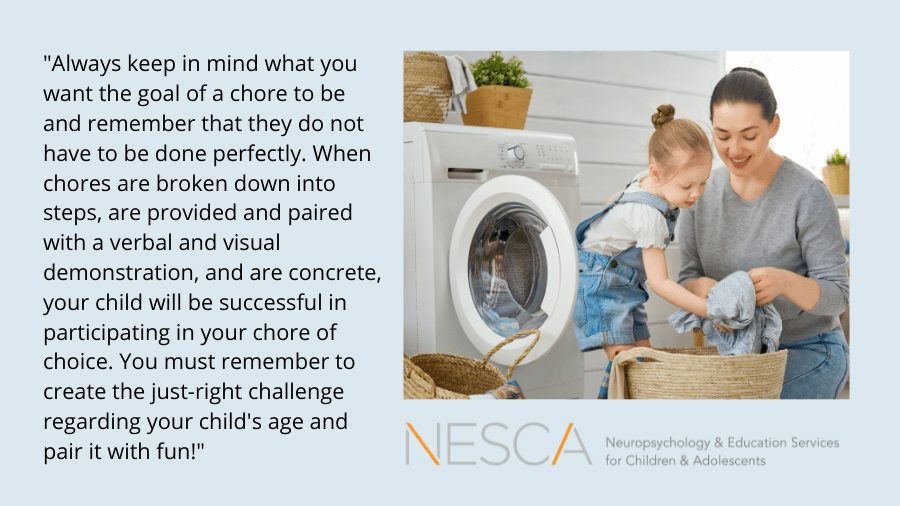
Always keep in mind what you want the goal of a chore to be and remember that they do not have to be done perfectly. When chores are broken down into steps, are provided and paired with a verbal and visual demonstration, and are concrete, your child will be successful in participating in your chore of choice. You must remember to create the just-right challenge regarding your child’s age and pair it with fun!


About the Author

Jessica Hanna has over 10 years of pediatric OT experience in conducting assessments and providing treatment of children and adolescents with a broad range of challenges and disabilities, including autism spectrum disorders, sensory processing disorders, visual impairments, cerebral palsy, executive function deficits and developmental disorders of motor function. Prior to joining NESCA, Jessica trained and worked in a variety of settings, including inpatient and outpatient hospital settings, private practice, schools and homes. She has served on interdisciplinary treatment teams and worked closely with schools, medical staff and other service providers in coordinating care. In addition, Jessica provided occupational therapy services at Perkins School for the Blind and Spaulding Rehabilitation Hospital pediatric inpatient unit, where she conducted comprehensive evaluations and interventions for children with a broad range of presentations.


To book an appointment or to learn more about NESCA’s Occupational Therapy Services, please fill out our online Intake Form, email info@nesca-newton.com or call 617-658-9800.


Neuropsychology & Education Services for Children & Adolescents (NESCA) is a pediatric neuropsychology practice and integrative treatment center with offices in Newton, Massachusetts, Plainville, Massachusetts, and Londonderry, New Hampshire, serving clients from preschool through young adulthood and their families. For more information, please email info@nesca-newton.com or call 617-658-9800.


Executive Function Skills in the Outdoors

By | NESCA Notes 2021

By Renée Marchant, Psy.D.
Pediatric Neuropsychologist

Executive functioning skills are a “family” of skills that operate in a “top-down” process, controlling and regulating brain regions associated with attention, impulse control, emotion regulation, and meta-cognition or “thinking about thinking.” For more information about executive function skills, please refer to my previous NESCA blog “Teenage Stress and Executive Functioning.” As an evaluator, I often emphasize two key points about executive function skills: (1) Developing executive function skills is a combination of brain development and life experience; and (2) These skills are built through interactions (with others and our world) and practice.

Now with more access to New England summer weather, there are plenty of opportunities for children and teens to grow executive function skills in interaction with the natural world. I recommend a “must-download” if you want to review practical, science-based activities and games for children from the ages of six months old through adolescence, “Enhancing and Practicing Executive Function Skills with Children from Infancy to Adolescence.” This is a wonderful resource that provides a clear list and description of practical activities to strengthen executive function skills based on a child’s age. This resource was developed by The Center on the Developing Child at Harvard University, a multidisciplinary team supporting research, policy, and practice for childhood development. Their website also provides excellent free resources for parents, clinicians, and educators related to topics such as stress, resiliency, play, and brain structure/development.

Here is a short list of outdoor summer executive function activities based on your child’s developmental age:

  1. 6-18 months-old: Peekaboo and Patty-Cake on the grass and other textures, such as dirt, mud, water, or wood (a multi-sensory experience), encourage joint attention and object focus by naming, pointing, and sustaining focus on natural objects at the beach or in the woods.
  2. 18-36 months-old: Match/sort natural objects, such as placing rocks in one bucket and flowers in another bucket, blow bubbles with a variety of wand shapes, pretend play as fishermen, construction workers, or farmers/gardeners.
  3. 3-5 years-old: Pretend to be an outdoor superhero in an obstacle course or race (e.g., running through Hula Hoops or around traffic cones), assist with cooking/preparing an outdoor picnic, or make a nature bracelet.
  4. 5-7 years-old: Play the I-Spy game and participate in scavenger hunts, use strategy board games (e.g., Uno, Concentration) on land or maybe even in the water, go on a sensory walk (name something you see, hear, smell, taste, and touch).
  5. 7-12 years-old: Star-gaze and find/name constellations, create a bird house or other wood structure through woodworking activities, garden one or more plants, play with a super soaker toy or laser/flashlight tag.
  6. Adolescents: Maintain a summer sketching and drawing journal of natural objects, participate in sunrise or sunset yoga or dance classes, outdoor animal-assistant yoga (e.g., Goat Yoga), or sports-oriented camps and activities.


About the Author:

Dr. Renée Marchant provides neuropsychological and psychological (projective) assessments for youth who present with a variety of complex, inter-related needs, with a particular emphasis on identifying co-occurring neurodevelopmental and psychiatric challenges. She specializes in the evaluation of developmental disabilities including autism spectrum disorder and social-emotional difficulties stemming from mood, anxiety, attachment and trauma-related diagnoses. She often assesses children who have “unique learning styles” that can underlie deficits in problem-solving, emotion regulation, social skills and self-esteem.
Dr. Marchant’s assessments prioritize the “whole picture,” particularly how systemic factors, such as culture, family life, school climate and broader systems impact diagnoses and treatment needs. She frequently observes children at school and participates in IEP meetings.

Dr. Marchant brings a wealth of clinical experience to her evaluations. In addition to her expertise in assessment, she has extensive experience providing evidence-based therapy to children in individual (TF-CBT, insight-oriented), group (DBT) and family (solution-focused, structural) modalities. Her school, home and treatment recommendations integrate practice-informed interventions that are tailored to the child’s unique needs.

Dr. Marchant received her B.A. from Boston College with a major in Clinical Psychology and her Psy.D. from William James College in Massachusetts. She completed her internship at the University of Utah’s Neuropsychiatric Institute and her postdoctoral fellowship at Cambridge Health Alliance, a Harvard Medical School teaching hospital, where she deepened her expertise in providing therapy and conducting assessments for children with neurodevelopmental disorders as well as youth who present with high-risk behaviors (e.g. psychosis, self-injury, aggression, suicidal ideation).

Dr. Marchant provides workshops and consultations to parents, school personnel and treatment professionals on ways to cultivate resilience and self-efficacy in the face of adversity, trauma, interpersonal violence and bullying. She is an expert on the interpretation of the Rorschach Inkblot Test and provides teaching and supervision on the usefulness of projective/performance-based measures in assessment. Dr. Marchant is also a member of the American Family Therapy Academy (AFTA) and continues to conduct research on the effectiveness of family therapy for high-risk, hospitalized patients.


To book an evaluation with Dr. Marchant or one of our many other expert neuropsychologists, complete NESCA’s online intake form


Neuropsychology & Education Services for Children & Adolescents (NESCA) is a pediatric neuropsychology practice and integrative treatment center with offices in Newton and Plainville, Massachusetts, and Londonderry, New Hampshire, serving clients from preschool through young adulthood and their families. For more information, please email info@nesca-newton.com or call 617-658-9800.


Dealing with End of the School Year Uncertainty

By | NESCA Notes 2021

By: Angela Currie, Ph.D.
Pediatric Neuropsychologist, NESCA
Director of Training and New Hampshire Operations

The end of the school year can bring a lot of emotions, such as excitement for summer activities, sadness about closing relationships, and anxiety related to change. Often, children are experiencing these mixed emotions without truly understanding them. The end of this particular school year may bring some unique emotions, as it is the second consecutive ending that “looks different,” be it because students were remote for all or some of the year, class parties and field days are not happening, or children cannot give their teacher an end of the year hug. The loss of such traditions may cause kids to feel a lack of closure. Further, this transition is happening at a time when the world is starting to change again. While the loosening of restrictions and return to a semblance of “normal” may be positive for most, children may not know how to cope with all of this simultaneous change.

Here are some tips for things that adults can do to help children cope with what may be a difficult or uncertain end to the current school year:

  • Watch for signs that your child may be struggling with this transition. This may include new sleep difficulties, low frustration tolerance, heightened emotions, meltdowns, reduced appetite, loss of interest, etc.
  • Talk about their feelings related to the end of the year in an open and responsive manner, validating their emotions (e.g., “I can see why that would make you feel sad,” rather than accidentally dismissing them (e.g., “Don’t worry.”).
  • Help provide some closure with their teacher, such as writing a card or letter about what they enjoyed, learned, or overcame together this year.
  • Using artwork or journaling, help your child reflect on their development, accomplishments, and experiences this past year.
  • Create a plan for how they can stay in touch with friends over the summer and schedule some specific playdates or events to reduce worry about losing touch.
  • Maintain your basic schedule, such as morning and bedtime routines.
  • To reduce worry related to uncertainty, provide some age-appropriate opportunities to feel a sense of control, such as allowing your child to design a new daily schedule for “home days,” choose individual or family activities, etc.

The end of any school year provides a great opportunity to teach children about transition and change. We can teach them that it is okay to celebrate their accomplishment while also simultaneously feeling discomfort about what is to come and sadness about saying goodbye. Particularly during a year that has been marked by adversity, learning how to recognize, “sit with,” and manage these mixed emotions will help to build resiliency for the future.


About the Author

Dr. Angela Currie is a pediatric neuropsychologist at NESCA. She conducts neuropsychological and psychological evaluations out of our Londonderry, NH office. She specializes in the evaluation of anxious children and teens, working to tease apart the various factors lending to their stress, such as underlying learning, attentional, or emotional challenges. She particularly enjoys working with the seemingly “unmotivated” child, as well as children who have “flown under the radar” for years due to their desire to succeed.


To book an evaluation with Dr. Currie or one of our many other expert neuropsychologists, complete NESCA’s online intake form. Indicate whether you are seeking an “evaluation” or “consultation” and your preferred clinician in the referral line.


Neuropsychology & Education Services for Children & Adolescents (NESCA) is a pediatric neuropsychology practice and integrative treatment center with offices in Londonderry, NH, Plainville, MA, and Newton, MA serving clients from preschool through young adulthood and their families. For more information, please email info@nesca-newton.com or call (603) 818-8526.

Why Kids Need to Outdoor Free Play

By | NESCA Notes 2020

By: Angela Currie, Ph.D.
Pediatric Neuropsychologist, NESCA
Director of Training and New Hampshire Operations

One of the best ways to make the most of your summer is to get outside and engage in lots of outdoor play. We live in a society where we tend to over-schedule ourselves and our children. Particularly during the school year, this makes it very difficult for children to get the amount of free play that they require. With this, I’m going to tell you five great reasons why you should throw away your schedule, put down the tablet, and get outside.

The first reason is probably the most obvious. Outdoor play provides great benefits to physical development. It improves motor coordination, strength, and balance, and it puts kids in an overall healthier position.

The next reason to play outside is that there are benefits for internal regulation. Not only does it make kids sleep better at night, but there is research to show that it aids attentional control and stress reduction. Being outdoors also provides kids with different sensory experiences – such as feeling the texture of sand and mud, or feeling the wind blow on your face – which will help to build children’s sensory tolerance.

The next reason to get outside is to improve cognitive development. Being outdoors provides a lot of opportunities to make observations, draw conclusions about things, see cause and effect, and be imaginative.

Next, playing outside aids emotional development. When we are over-scheduled, children do not have the opportunity to feel confident in their ability to step outside of their comfort zone or take risks. Experimenting and taking risks during outdoor play can help children understand that they have some control over what they can do within their environment, as well as begin to recognize boundaries.

Finally, the last reason to get outside is that it really bolsters social development. When there is no structure or there are no rules to follow, kids have to learn how to initiate their interactions, engage in conversation with each other, communicate, problem solve, and find ways to along, even when others have different ideas.

With all of the above benefits, outdoor free play is one of the best things you can give to your child. So as the weather is getting nicer and summer is fast approaching, if you are looking for something to do, sometimes it is best to just put down your schedule, get outside, and get dirty.


About the Author

Dr. Angela Currie is a pediatric neuropsychologist at NESCA. She conducts neuropsychological and psychological evaluations out of our Londonderry, NH office. She specializes in the evaluation of anxious children and teens, working to tease apart the various factors lending to their stress, such as underlying learning, attentional, or emotional challenges. She particularly enjoys working with the seemingly “unmotivated” child, as well as children who have “flown under the radar” for years due to their desire to succeed.


To book an evaluation with Dr. Currie or one of our many other expert neuropsychologists, complete NESCA’s online intake form. Indicate whether you are seeking an “evaluation” or “consultation” and your preferred clinician in the referral line.


Neuropsychology & Education Services for Children & Adolescents (NESCA) is a pediatric neuropsychology practice and integrative treatment center with offices in Londonderry, NH, Plainville, MA, and Newton, MA serving clients from preschool through young adulthood and their families. For more information, please email info@nesca-newton.com or call (603) 818-8526.

Skip to content