Tag

Disability Archives - Page 3 of 3 - NESCA

Subscribe to NESCA Notes

Autism Awareness Month

By | NESCA Notes 2021

By Dot Lucci, M.Ed., CAGS
Director of Consultation and Psychoeducational Services, NESCA

So what? What does it really mean to have an awareness month and a designated day? April is Autism Awareness month, and this year April 2 was World Autism Awareness Day, established by the United Nations (UN) in 2008. In general, these designations are meant to bring awareness to ”causes.” You will see a lot of blue in April as blue is the color of autism spectrum disorder (ASD) awareness. There will likely be many federal, state and local municipal buildings, private homes, as well as national and international monuments bathed in blue lights. People will wear blue, there will be blue autism products to buy, and our air waves will be flooded with autism awareness commercials. In a typical year, many commemorative and educational events would be held. It is usually a time of celebration for people with autism as well as their families and friends everywhere. For instance, in pre-pandemic years, sports teams, movie theatres, museums, Broadway and other venues would host ASD-friendly days. Autism Speaks has its “Light it Up Blue” initiative and is celebrating this year specifically with its #LightUpWithKindness campaign. The United Nations (UN) has a different theme every year, and this year’s theme is The Transition to Adulthood.

When the United Nations established April 2 as Autism Awareness Day, it had high hopes.

In 2008, the Convention on the Rights of Persons with Disabilities entered into force, reaffirming the fundamental principle of universal human rights for all. Its purpose is to promote, protect and ensure the full and equal enjoyment of all human rights and fundamental freedoms by all persons with disabilities, and to promote respect for their inherent dignity. It is a vital tool to foster an inclusive and caring society for all and to ensure that all children and adults with autism can lead full and meaningful lives.”

Well said…but far from the reality of many individuals with autism and their families. If only our schools, communities and societies were as inclusive, respectful and welcoming as this statement. If it were today’s reality, many people diagnosed with ASD and their families wouldn’t have to struggle as much as they do on a day to day basis with stigmatization, discrimination and a lack of respect and inclusive opportunities.

Autism is a lifelong neurological condition that originates in childhood, and its presentation changes over time. Autism is a spectrum with social, communication, sensory and behavioral differences manifested uniquely in each individual. While we have come a long way in understanding autism, recognizing the breadth and diversity of those with it; embracing their talents, unique abilities and strengths; and addressing the day to day challenges that autistic people face. The UN’s vision is still far from a reality, and there is still much work to do.

It is my hope that during Autism Awareness Month, you become more aware. If you support the “cause” and buy a shirt, bracelet or puzzle piece and shine a blue light on your porch, that’s great – spread the word.  Take the Autism Speaks #LightUpWithKindness” campaign to heart do something to create a world that is kinder, gentler, more respectful and inclusive of autistic people with autism. Watch a movie about ASD, read a book by an autistic author, take the time to educate yourself and your children. If your child has autism, educate your child’s classmates, neighbors, family members and community members. If a child with autism is in your child’s class or school, connect with them and their parents. You are modeling for your own kids and those around you, so spread kindness, acceptance and inclusiveness. If you are an employer, connect with your local school district and offer to partner with them to provide internships for transition-aged youth with autism and maybe even hire them as employees! While this is a financially challenging time for so many, if you do have the means, donate and give to an ASD agency (whether it be locally-, nationally-, medically- or research-based, etc.) – whatever brings you joy. Donate your time at an autism support center.  There are so many ways to recognize Autism Awareness Month that go beyond the color blue – choose something that resonates with you and be the light! Be the light that goes beyond Autism Awareness to Autism Action, Autism Acceptance, Autism Access and Autism Advancement.


About the Author

NESCA’s Director of Consultation and Psychoeducational Services Dot Lucci has been active in the fields of education, psychology, research and academia for over 30 years. She is a national consultant and speaker on program design and the inclusion of children and adolescents with special needs, especially those diagnosed with Autism Spectrum Disorder (ASD). Prior to joining NESCA, Ms. Lucci was the Principal of the Partners Program/EDCO Collaborative and previously the Program Director and Director of Consultation at MGH/Aspire for 13 years, where she built child, teen and young adult programs and established the 3-Ss (self-awareness, social competency and stress management) as the programming backbone. She also served as director of the Autism Support Center. Ms. Lucci was previously an elementary classroom teacher, special educator, researcher, school psychologist, college professor and director of public schools, a private special education school and an education collaborative.

Ms. Lucci directs NESCA’s consultation services to public and private schools, colleges and universities, businesses and community agencies. She also provides psychoeducational counseling directly to students and parents. Ms. Lucci’s clinical interests include mind-body practices, positive psychology, and the use of technology and biofeedback devices in the instruction of social and emotional learning, especially as they apply to neurodiverse individuals.


To book a consultation with Ms. Lucci or one of our many expert neuropsychologists, complete NESCA’s online intake form. Indicate whether you are seeking an “evaluation” or “consultation” and your preferred clinician/consultant in the referral line.


Neuropsychology & Education Services for Children & Adolescents (NESCA) is a pediatric neuropsychology practice and integrative treatment center with offices in Newton, Massachusetts, Plainville, Massachusetts, and Londonderry, New Hampshire, serving clients from preschool through young adulthood and their families. For more information, please email info@nesca-newton.com or call 617-658-9800.


Choosing a College – Key Considerations for Students with Disabilities

By | NESCA Notes 2025

By: Kelley Challen, Ed.M., CAS
Director of Transition Services; Assistant Director, NESCA

May 1st, often known as “College Decision Day,” marks the traditional deadline for students to submit their deposit and commit to colleges. With students applying to more colleges than ever—including multiple “safety schools”—many will spend the winter and spring months of their senior year carefully weighing their options.

This year in particular, students may be inclined to wait until the last minute to commit to a college as funding, staffing, and programming are a bit more uncertain.

There are some common variables that students learn to compare when researching and visiting colleges:

  • Location
  • Cost
  • Scholarships and Financial Aid
  • Size (campus size, number of undergraduate students, class sizes, etc.)
  • Strength and Availability of Majors
  • Retention and Graduation Rates
  • Internships
  • Gut feelings

But, for students with disabilities, there is often additional information that can be useful in making a decision to commit to a particular college. Below are five important factors that can be helpful to explore when researching, visiting, and communicating with colleges in order to make a final selection, if not earlier in the college application process:

  • Explore student clubs and organizations. Student participation in clubs and campus activities is known to contribute to the student’s retention, persistence, and success in college. Therefore, researching student groups should be an important aspect of the college selection process for every college student. However, for students with social, emotional, or other disabilities that impact communication and connection with others, participation in student clubs and organizations can also provide exactly the structure needed to assist the student in forging both initial and lasting relationships in college. Therefore, it’s important to research ahead of time and ensure that there are structured groups on campus you can see yourself being part of including hobby-based clubs, athletics, interest-based student organizations, and even disability advocacy groups.
  • Research foreign language and math requirements. If you received a foreign language waiver in high school or took alternative math courses, don’t assume the same will apply in college. College accommodations operate under different laws and policies, so it’s essential to verify foreign language and math requirements and whether course substitutions or other accommodations (e.g., pass/fail grading, adjustments to the class participation requirement, etc.) are permitted. It is important to realize that even colleges that allow substitutions may not be able to do so if the language is central to the student’s chosen major/course of study. If substitutions are not allowed, it is useful to ask about foreign language faculty on campus and to look for foreign languages that may be easier to learn, such as Latin or Greek, which are not spoken. If math is required, make sure you have a plan for tackling that requirement such as summer courses or tutoring assistance.
  • Meet with Disability Support Services (often called Student Accessibility Services or Student Success Services). Beyond inquiring about available accommodations and assistive technology, pay attention to how accessible the office is. Is it easy to locate on campus? Do staff members seem welcoming and knowledgeable? Scheduling an appointment can also give insight into how efficiently the office responds to student needs and how comfortable you will feel working with the staff. Navigating support services efficiently can make a significant difference in your college experience.
  • Understand the reduced course load policy. For students who struggle with processing speed, writing efficiency, anxiety, or other challenges that may impact workload management, it’s important to understand the college’s reduced course load policies. Sometimes, beginning college with a “reduced course load” or “underload” is exactly the ramp that students need to managing college routines. Other students may need this accommodation at more than one point in college. Students should therefore ask about the minimum credits required to maintain full-time status and financial aid eligibility, as well as whether freshmen can start with a reduced load or take summer courses to balance their schedule. Knowing whether there are limits on the number of semesters that a student is able to take a reduced course load is also important for many students. Clarifying these policies in advance can help ensure a manageable and successful transition to college-level coursework.
  • Contact the Office of Residential Life. Not all dorm life is created equal, especially for students with disabilities who require accommodations in college. Ask questions about the leadership structure within the dorms, the training/qualifications for residential directors and residential assistants in the freshman housing, how social relationships are fostered and facilitated within the dorm environment, and how dorm conflicts are resolved. For students who require a medical single (e.g., a single dorm room on the basis of documented social or emotional difficulties, allergies, etc.), elevator access, or a service/support animal, make sure that you confirm not only that these accommodations are available, but also where that housing is available on campus. For instance, single dorm rooms are sometimes only available within dorms or housing complexes that are traditionally reserved for upperclass students, reducing the opportunity for first-year bonding. Confirming housing details in advance can help you make an informed housing decision and ensure both your comfort and success in college.

Certainly, the college search and selection processes are different for each student, both with and without disabilities. But my hope is that this list of considerations helps students to make a more informed and confident decision about where they will thrive academically, socially, and personally. At the end of the day, it is important to remember that there is not just one perfect school for a student. There are lots of places where you can be successful and happy, and your job is just to make the best decision you can.


About the Author:

Kelley Challen, Ed.M., CAS, is NESCA’s Director of Transition Services, overseeing planning, consultation, evaluation, coaching, case management, training and program development services. She is also the Assistant Director of NESCA, working under Dr. Ann Helmus to support day-to-day operations of the practice. Ms. Challen began facilitating programs for children and adolescents with special needs in 2004. After receiving her Master’s Degree and Certificate of Advanced Study in Risk and Prevention Counseling from Harvard Graduate School of Education, Ms. Challen spent several years at the MGH Aspire Program where she founded an array of social, life and career skill development programs for teens and young adults with Asperger’s Syndrome and related profiles. She additionally worked at the Northeast Arc as Program Director for the Spotlight Program, a drama-based social pragmatics program, serving youth with a wide range of diagnoses and collaborating with several school districts to design in-house social skills and transition programs. Ms. Challen is co-author of the chapter “Technologies to Support Interventions for Social- Emotional Intelligence, Self-Awareness, Personality Style, and Self-Regulation” for the book Technology Tools for Students with Autism. She is also a proud mother of two energetic boys, ages six and three. While Ms. Challen has special expertise in supporting students with Autism Spectrum Disorders, she provides support to individuals with a wide range of developmental and learning abilities, including students with complex medical needs.

Neuropsychology & Education Services for Children & Adolescents (NESCA) is a pediatric neuropsychology practice and integrative treatment center with offices in Newton, Massachusetts, Plainville, Massachusetts, and Londonderry, New Hampshire, serving clients from preschool through young adulthood and their families. For more information, please email info@nesca-newton.com or call 617-658-9800.

Media’s Portrayal of our Differences

By | NESCA Notes 2021

By Dot Lucci, M.Ed., CAGS
Director of Consultation and Psychoeducational Services, NESCA

Media has portrayed all aspects of society’s strengths, as well as its ugliness, the diversities of its peoples and cultures, political topics, events in history and so much more for as long as television and movies have existed. Often, television and movies try to stay within norms, while, at other times, they push boundaries or raise controversial topics.

  • In 1952 on the “I Love Lucy” show, the episode, “Lucy is Enceinte,” aired in which Lucy learned she was pregnant. But the show never uttered the word, “pregnant,” and then she had the first child brought into a family on TV.
  • Prior to 1965, black actors did not have leading roles and were not portrayed favorably, until “I Spy” starred a black actor in a leading part.
  • Interracial relationships did not appear until 1968 when “Star Trek” aired the first interracial kiss.
  • In 1971, “All in the Family” had the first disclaimer for mature audiences due to its content and language.
  • In the 1950-60s, gays were portrayed in films but again not favorably. It wasn’t until after the Stonewall Riots in 1970 where “The Boys in the Band” depicted gay people in a more honest light. In 1997, Ellen DeGeneres announced on her sitcom, “Ellen,” that she was gay, making it the first prime time major TV sitcom with an openly gay lead character.

Did these shows “get it right?” Did they represent the people, cultural mores, times and issues accurately? You can be the judge. We each judge the shows we watch, and many of us have different criteria for what is right, good, funny, truthful, accurate, scary, etc. Media’s representation of society’s peoples is hard-pressed to “get it right” when it comes to portraying social groups, including most marginalized people (i.e., people with disabilities, races, genders, ethnic groups, LGBTQ, etc.). It is hard to get it right as we are not a monolith. So, even after research is done, movie producers, writers, directors, actors and actresses can still not quite get it right. When portraying a member of any of these groups, they often miss the mark by over-generalizing, simplifying, sugar-coating, missing the point or highlighting things that we wouldn’t highlight about ourselves. When weaving these characters into media, many factors play their own role in the plot – political climate, story line, social norms and monetary ratios, etc. Even with the best of intentions, movies and shows still miss the mark and offend.

Media has often portrayed these groups through stereotypical eyes, not capturing the depth and diversity within each group – even with the right due diligence in depicting these characters. So, how do they portray the breadth of us in ways that satisfy all of us with accurate representations – when each one of us is so uniquely different?

In 1990, on the series “Life Goes On,” Chris Burke, who has Down Syndrome, played the character Corky. He was the first person with Down Syndrome in a leading role. In 2018, Samantha Elisofon and Brandon Polansky – both autistic actors – were featured in a full-length feature called “Keep the Change.”

Over the years many actors/actresses have portrayed people whom they are not – it is what actors do as their job. In “Rainman,” Dustin Hoffman played an autistic savant. Did he get it right? Did he miss the mark? Did he act in ways that offended some and not others? The answer to these questions is yes and no. This has been happening for years – as long as TV and movies have existed. They portray gay people when they are straight, abused people when they have not been abused, killers when they are kind and gentle people.

Likewise, portrayals of people with disabilities have changed over the years, just like other aspects of our society. Historically, portrayals have often included characters who are one-dimensional, stereotypical and pity-provoking. Disability rights activists often use phrases like “inspirational-porn,” “super-crip,” or “cripping-up” to describe the attempts at representing them in media. Autism, like most disabilities, is challenging to portray. Over the years, representation has changed, but it may still be perceived as exaggerated, stereotyped or unrealistic (i.e., “Good Doctor,” “Big Bang Theory,” “Rainman,” etc.).

“Music,” a new movie about an autistic girl (not played by an autistic person) was recently released, sparking outrage among many people, especially within the autism community (Full disclosure – I have not seen the movie yet). The criticisms are that the character is one-dimensional, the girl is not played by an autistic person and there is the use of restraint to deal with aberrant behavior. No one movie or TV show can represent the breadth of those who are diagnosed with an autism spectrum disorder. As the saying goes, if you’ve met one person with autism, you’ve met one person with autism. Autism is a spectrum, and a movie character will not be able to hold the diversity of the population; just like a gay character portrayal cannot tell the whole gay experience. Perhaps even if an autistic person played the role, there might still be controversy. Just like when Chris Burke played Corky, there were people who praised the show and others who disliked it because it wasn’t their experience with Down Syndrome.

We have a long way to go in our society regarding equality, acceptance and inclusion of neurodiverse, racial, ethnic, sexual topics and people. So why do we expect movies and TV shows to be different? Our movie and television history demonstrates that we’ve come a long way, change can happen and media does “tackle” issues of the times. Is change slow? Yes, it is. Do we have a long way to go? You bet, especially when it comes to portrayal of people with disabilities and their inclusion in movies as actors and actresses.

I like to approach watching movies about these issues with a wide-angle lens and limited expectations. I view them as being made to inform; enlighten; open the door to others asking questions; promote thinking, awareness, inclusion, acceptance; mirrors to see ourselves in characters – fictional or otherwise; increase understanding and empathy; or share a perspective or different point of view. I also think that the intentions of most directors, actors/actresses, screen writers, etc. are coming from the right place (even if flawed). They are trying to make movies that make a point, share a perspective, increase awareness, promote inclusion, comfort, knowledge, etc. Movies that highlight sensitive topics, controversial topics and marginalized groups are good for us whether we agree with the portrayal or not. If we are outraged and we begin talking and sharing our opinions, especially our first-person opinions, we broaden awareness and knowledge. So even if you strongly dislike a movie, something good may come from it. By my writing this blog and mentioning the movie “Music,” my guess is I have piqued your curiosity if you didn’t know about it. And maybe you might check it out on Google, read the reviews and learn about the controversy. What’s wrong with that? If you do explore it, wherever you land – liking or disliking it – I’m glad you took the time to think about it, asked yourself questions, felt emotions and hopefully will continue to think about how marginalized groups are portrayed in movies.

References


https://www.insider.com/kate-hudson-responds-to-sia-music-movie-casting-criticism-2021-2
https://www.dazeddigital.com/film-tv/article/51253/1/autistic-person-responds-sia-film-music-maddie-ziegler-autism-speaks
https://www.teenvogue.com/story/trailer-for-sias-music-hurts-autistic-girls


About the Author

NESCA’s Director of Consultation and Psychoeducational Services Dot Lucci has been active in the fields of education, psychology, research and academia for over 30 years. She is a national consultant and speaker on program design and the inclusion of children and adolescents with special needs, especially those diagnosed with Autism Spectrum Disorder (ASD). Prior to joining NESCA, Ms. Lucci was the Principal of the Partners Program/EDCO Collaborative and previously the Program Director and Director of Consultation at MGH/Aspire for 13 years, where she built child, teen and young adult programs and established the 3-Ss (self-awareness, social competency and stress management) as the programming backbone. She also served as director of the Autism Support Center. Ms. Lucci was previously an elementary classroom teacher, special educator, researcher, school psychologist, college professor and director of public schools, a private special education school and an education collaborative.

Ms. Lucci directs NESCA’s consultation services to public and private schools, colleges and universities, businesses and community agencies. She also provides psychoeducational counseling directly to students and parents. Ms. Lucci’s clinical interests include mind-body practices, positive psychology, and the use of technology and biofeedback devices in the instruction of social and emotional learning, especially as they apply to neurodiverse individuals.


To book a consultation with Ms. Lucci or one of our many expert neuropsychologists, complete NESCA’s online intake form. Indicate whether you are seeking an “evaluation” or “consultation” and your preferred clinician/consultant in the referral line.


Neuropsychology & Education Services for Children & Adolescents (NESCA) is a pediatric neuropsychology practice and integrative treatment center with offices in Newton, Massachusetts, Plainville, Massachusetts, and Londonderry, New Hampshire, serving clients from preschool through young adulthood and their families. For more information, please email info@nesca-newton.com or call 617-658-9800.


Celebrate the Small Wins

By | NESCA Notes 2021

By: Tabitha Monahan, M.A., CRC
NESCA Transition Specialist/Counselor

In the moment, it can be hard to see the change. It can be hard to find the successes. This is true for any improvement we try to do, whether it is trying to have a healthier lifestyle or build the skills needed for postsecondary life. When looking at a student’s vision, it can feel like getting there is an impossible task. Maybe the student is the only one who believes they can get there. Perhaps they don’t understand all the pieces that need to be put in place. When the rest of the IEP team has doubts, those doubts will likely spread to the student. Objectives about SMART Goals might be added to help the student learn how to set realistic goals and build an understanding of setting small goals and determining specific objectives. However, when we look back to where the student was their freshman year or in elementary school, the progress they made may seem massive. Many small wins over time turn into big wins.

What are the small wins? It might be getting a better grade on a test in math. It might be fastening the buttons on a shirt without help. It could be understanding another’s point of view one time.  Maybe it was trying a bite of one new food. Maybe they were able to identify a coping skill that would have helped after having a rough day. By themselves, none of these seems like they will help a person reach success once they leave special education. But small wins build confidence. They build pride. If we celebrate the small wins, not only do we get reminded that progress is possible, but the student knows they accomplished something. An IEP is filled with areas where the student needs help and even at a young age – when the student is getting more help than their peers – they know it. They should know where they are succeeding, too.

So how can we help our student celebrate the small wins?

  • A high five and a “way to go”
  • Help your child create a list of successes and have them add each win to the list
  • Remind them of where they were at the beginning of the year
  • Pick a fun activity as a “reward”
  • Have your child add to one of their favorite hobbies (e.g., a small LEGO set, a new book, trading cards, collectibles, action figures)
  • Frame it! (If it’s not paper, make part of the celebration part art project)

What do you do to celebrate the small wins?


About the Author

Tabitha Monahan, M.A., CRC, is an experienced transition evaluator and vocational counselor. While she is well-versed in supporting a wide range of transition-aged youth, she is especially passionate and knowledgeable in helping clients and their families navigate the complex systems of adult services and benefits as well as medical and mental health systems. She is further adept in working individually with students of all abilities to empower self-advocacy and goal achievement.


To schedule an appointment with one of NESCA’s expert transition specialists or neuropsychologists, please complete our online intake form


Neuropsychology & Education Services for Children & Adolescents (NESCA) is a pediatric neuropsychology practice and integrative treatment center with offices in Newton and Plainville, Massachusetts, and Londonderry, New Hampshire, serving clients from preschool through young adulthood and their families. For more information, please email info@nesca-newton.com or call 617-658-9800.


Developing S-M-A-R-T Goals in 2021

By | NESCA Notes 2021

By: Tabitha Monahan, M.A., CRC
NESCA Transition Specialist/Counselor

Happy New Year! Now two weeks into 2021, maybe it’s time to revisit those New Year Resolutions.  French writer Antoine de Saint-Exupéry wrote: “a goal without a plan is just a wish.” This is true for resolutions, just as it is for any goal. How can we help our young people change their wishes, visions and dreams into goals? We teach them (and maybe ourselves while we’re at it) how to plan. One of my favorite strategies for both teaching and reaching goals is by creating SMART Goals. What is a Smart Goal?

Specific – The goal should be specific. I’ll increase the distance I run is vague. Will you increase the distance by 20 feet, 2 miles? Are you planning for a marathon? Instead, let’s take a look at step 2, making it measurable.

Measurable – There’s a good chance that if your goal is not specific enough, it will be hard to measure if you have succeeded in that goal. So, let’s make our exercise goal both specific and measurable. I’ll increase the distance I run from 1 mile to 3.2 miles (5k).

Attainable – Attainable is the hard one for many students who are still building awareness of their strengths and challenges. Let’s say a person who has never run wants to run in the Boston Marathon. This is likely not an attainable goal, even if it is specific and measurable. Couch to 5k training exists; I have not seen the couch to marathon training program. Having measurable steps also helps break down the goal into smaller pieces, which will be further discussed later.

Relevant – If I am trying to increase my social circle and group leisure skills, running is unlikely to get me there. However, if, like many people, we’re trying to improve our health in 2021 (or take off some of those quarantine pounds), increasing the distance we run certainly will get us there. Many young adults may need to bounce ideas off someone to ensure the goal is relevant to the area at hand.

Time-bound – Attainable and time-based work tightly together. If you do not give yourself a deadline, the goal may still be there come December 2021. Humans work best with deadlines. We need the motivation to complete a plan, and often motivation needs a sense of urgency.

Okay, so what does our SMART goal look like for increased health and wellness? I will increase the distance I run from 1 mile to 3.2 miles (5k) in ¼ mile increments by June 30, 2021.

We have all the pieces. It is specific, and we know precisely what the end goal will be and how we will get there. It’s measurable; there is something we can check off as complete, like a to-do list. It’s attainable and seems realistic. We are not trying to run the Boston Marathon course after only running a mile. We will start as a beginner runner and work towards a 5k, and we are not trying to do it tomorrow with no steps in between. It’s relevant; we are working on bettering our health in 2021. And it is time-based. We want to meet our goal by the end of June.

Now that we’ve refreshed our minds on SMART goals, how do we build these skills in transition-aged youth? Ask them. Ask your child, your students, your clients what they want for themselves in education, employment and independent living. We already have the starting points. We have their vision. We have the IEP TEAM’s goals and objectives.

The youth may have a far-reaching (and maybe seemingly unattainable) goal. Help them break that big goal down into smaller parts and work backward. Do they want to be an engineer? Engineers need a college degree. What does the student need to do to graduate college? They need to get into college. How do they get into college? They need to apply and graduate from high school. What do they need to do to graduate high school? They need to pass their science class. That seems like a reasonable starting place, and it is still related to the vision. What might a SMART goal look like for that student? I will receive a passing grade on my final exam by answering the end of chapter questions each week and asking for clarification from my teacher for any questions I got wrong by the end of the spring semester.

But how do we support them when they aren’t making progress? Many people have a hard time adjusting once they have made a plan. Whenever we set a goal, we need to look at our progress periodically. We need to check that the goal is still attainable by the deadline we gave ourselves. Are we making progress? If we are still running only a mile and it’s March, what adjustments do we need to make? Suppose a student is not finding answering the end of chapter questions helpful in confirming their knowledge of the material. What changes can they make to increase their understanding of the material? Maybe the student asks the teacher if they can work one-on-one twice a week to increase understanding? Frustration, when the plan doesn’t work, makes many give up on the goal. Learning how to adapt is just as essential as learning how to make a goal.

A person who has practiced SMART goals is a person who will have an increased understanding of the objectives and smaller steps they need to reach their vision. They will have more confidence in their abilities and more awareness of their challenges. A person who has goal-setting skills is a person who has control of their own life. What are your SMART goals for 2021?


About the Author

Tabitha Monahan, M.A., CRC, is an experienced transition evaluator and vocational counselor. While she is well-versed in supporting a wide range of transition-aged youth, she is especially passionate and knowledgeable in helping clients and their families navigate the complex systems of adult services and benefits as well as medical and mental health systems. She is further adept in working individually with students of all abilities to empower self-advocacy and goal achievement.


To schedule an appointment with one of NESCA’s expert transition specialists or neuropsychologists, please complete our online intake form


Neuropsychology & Education Services for Children & Adolescents (NESCA) is a pediatric neuropsychology practice and integrative treatment center with offices in Newton and Plainville, Massachusetts, and Londonderry, New Hampshire, serving clients from preschool through young adulthood and their families. For more information, please email info@nesca-newton.com or call 617-658-9800.


Building Gratitude in our Kids

By | NESCA Notes 2020

By: Tabitha Monahan, M.A., CRC
NESCA Transition Specialist/Counselor

Would it be November without a blog post about gratitude? Gratitude feels both more important and harder to come by this year with the slew of events bombarding people’s personal lives and something different appearing what feels like every news cycle. But there must be something to all this gratitude if everyone from Forbes Magazine to Psychology Today is writing about it?

So what does the science say?

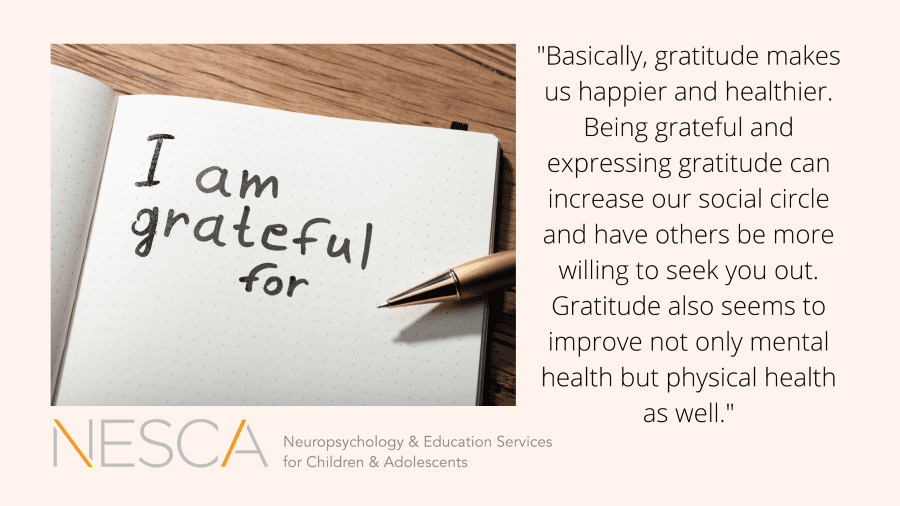
Basically, gratitude makes us happier and healthier. Being grateful and expressing gratitude can increase our social circle and have others be more willing to seek you out. Gratitude also seems to improve not only mental health but physical health as well. Studies show that grateful people take care of themselves better. They are more likely to exercise and more likely to follow up with medical personal. Studies show that writing in a gratitude journal before bed can even help you sleep better! (Morin, n.d.)

How can I help my child build gratitude?

Young people with disabilities, especially speech and language challenges, may have a hard time sharing their experiences at the end of the school day. Before my students left for the day, I would always ask them to go around the room and share one thing they enjoyed during their day. This way, no matter how challenging the day was, they ended it on a good note. Over time, the students began to look forward to sharing a positive experience from their day. Whether it was getting a compliment at their worksite or overcoming a challenge, they began to go looking for the positives.

Another wonderful way to build gratitude is to turn it into a scavenger hunt. Give each day a topic and share your gratitude topic at dinner. 

While we often think of a gratitude journal as something written, it doesn’t have to be. Have fun with it! Instead of writing down what you are thankful for today, take a picture with your phone or have your child make a drawing relating to the topic. Pinterest is full of great ideas, like the image below. Doing this for a month may turn you and your child a little more gleeful and find a brighter outlook on tomorrow.

Image Credit: Woman of Purpose (thepurposedwomanmag.com)

What are you grateful for today?


About the Author

Tabitha Monahan, M.A., CRC, is an experienced transition evaluator and vocational counselor. While she is well-versed in supporting a wide range of transition-aged youth, she is especially passionate and knowledgeable in helping clients and their families navigate the complex systems of adult services and benefits as well as medical and mental health systems. She is further adept in working individually with students of all abilities to empower self-advocacy and goal achievement.


To schedule an appointment with one of NESCA’s expert transition specialists or neuropsychologists, please complete our online intake form


Neuropsychology & Education Services for Children & Adolescents (NESCA) is a pediatric neuropsychology practice and integrative treatment center with offices in Newton and Plainville, Massachusetts, and Londonderry, New Hampshire, serving clients from preschool through young adulthood and their families. For more information, please email info@nesca-newton.com or call 617-658-9800.


What Is A Representative Payee?

By | NESCA Notes 2020

By: Tabitha Monahan, M.A., CRC
Transition Specialist/Counselor

Your child has turned 18. The application for Supplemental Security Insurance (SSI) has been submitted and approved. You’ve been assigned to be the representative payee to manage the SSI funds. How can you still help your child gain money management skills while managing the responsibilities as required by the Social Security Administration (SSA)?

What is a Representative Payee?

Many individuals with disabilities can safely and successfully manage their finances without assistance. However, due to their disability’s nature, many individuals are unable to manage their finances without help. In response to individuals who need assistance to ensure their needs are being met through their benefits, the SSA created representative payees. A representative payee is a person or organization assigned by the SSA to be responsible for the benefits that a person receives from the SSA and ensures that the beneficiary’s needs, such as housing, food and medical care are met. A representative payee can be a family member, friend or another person. When the representative payee is an organization, there is often a fee (determined by the SSA), but when the payee is a friend or family member, the payee provides this service at no cost to the beneficiary. The representative payee will make a budget for the beneficiary to ensure basic needs are met and provide money for savings and personal spending if funds allow.

A representative payee is responsible for tracking and keeping detailed records of how the funds are spent and must provide those records to the SSA when asked. Many payees also need to fill out an annual reporting to the SSA detailing how the funds from the previous year were used. Recent changes in the law amended who needed to fill out such reports. Now, parents and spouses who are representative payees and live with the beneficiary no longer need to fill out the annual report. However, they do still need to keep detailed financial records.

How can I support my child’s financial literacy as their representative payee?

I have been a representative payee for individuals with disabilities for the vast majority of my career. In that role, I also worked to increase the individual’s financial literacy skills and increase their understanding of their financial situation. Having the individual involved in the process has innumerable benefits, the most basic of being the respect for their human rights. By having the individuals involved as much as they are capable and is healthy for them, much of the animosity and much of the paternalism of having another person control their finances, can be dissipated. Some individuals will still choose to have minimal involvement in their finances due to anxiety, comprehension or individual priorities. But most will want a say. By meeting your child where they are in their financial journey, you can build their confidence, independence and autonomy.

The first step I like to take in building an understanding around finances is helping the person comprehend where their money is going. Maybe that will be showing your child a bank statement. Perhaps it will be showing receipts. For many young people, the amount they receive in SSI seems like a lot of money. Helping them understand the value of the funds they receive can be one of the most challenging tasks.

Another activity I like to do with the beneficiaries I assist is asking them to create their budget. How would they like to see their money spent? What are their financial goals? Do they want to live on their own someday? How much do they want to set aside for savings for more significant expenses or purchases, like first, last and security deposit; a car; a vacation? Below is a very basic budgeting form I like to use as a starting point.

Beneficiary Budget Month Year
Income
SSI $783.00
MA State Supplement $114.39
Total Income: $897.39
Expense
Rent $265.00
Groceries $200.00
Transportation $55.00
Electricity $60.00
Cable $105.00
Cell Phone $75.00
Medication $15.00
Personal Spending $75.00
Savings $25.00
Total Spending: $875.00

Within the last few years, ABLE accounts have been getting a lot of press – and for good reason. For individuals who became disabled at birth or at a young age, an ABLE account is a wonderful way for the individual to save money for important needs and not have those assets affect the essential financial and healthcare benefits they need. The IRS recently updated the rules for ABLE accounts. In the resources below is an article from Disability Scoop with information about these updates.

One of the best ways to increase your child’s money management skills is to have them be responsible for portions of their money. They are many ways to do this, and it may take some trial and error to find the best way for your child. It is important to remember that you are not allowed to give the beneficiary direct access to the bank account as the representative payee. That means you cannot just hand over the debit card to your child. However, many companies offer programs that help young people (and adults) manage their money. I tend not to use the word “allowance” for adults when managing their money. Instead, I use words like “personal spending” or “Flex Money.” Whether I write a check to the individual for these funds or reload a prepaid debit card, giving the individuals the remaining money after necessities have been met gives them the freedom to make their own spending choices, whether good or bad. And yes, I have worked with individuals who were without personal spending money within days of receiving their excess funds for the month. Still, I have worked with individuals who have, over time, been able to build some savings and a greater understanding of money management. I have listed some in the resources, but these are not ones I have personally used, so please review and see which ones you think would work best for your family.

Another method that I find beyond useful to help build financial independence and assess current money management skills is to transfer the responsibility of paying a bill over to the individual. This should be a lower priority bill, like the cable bill, a streaming service or a cell phone bill. As time goes on and the person can pay the bill on time without prompts, increase the number of accounts the person is responsible for paying. As they build their financial independence, increase their personal spending to include funds for necessities, such as groceries and prescription copays. And remember, once a person has a representative payee, it does not mean that they must have one for life. Suppose your child is able to build the financial management skills necessary to manage their finances independently. In that case, a representative payee can be removed. If your child now has the skills to manage their own money, talk to one of your child’s providers. They can fill out a form to return this right to your child.

Have you been working with your child on money management skills? How have you fostered financial independence?


Resources:

Social Security Administration Representative Payee Webpage

Disability Scoop: IRS Issues Final Rules on ABLE Accounts

The Balance: The Best Debit Cards for Teens

Capital One MONEY Account

Dough Roller: Best Prepaid Debit Cards for Teens

FAQs for Beneficiaries that have Representative Payees


About the Author

Tabitha Monahan, M.A., CRC, is an experienced transition evaluator and vocational counselor. While she is well-versed in supporting a wide range of transition-aged youth, she is especially passionate and knowledgeable in helping clients and their families navigate the complex systems of adult services and benefits as well as medical and mental health systems. She is further adept in working individually with students of all abilities to empower self-advocacy and goal achievement.


To schedule an appointment with one of NESCA’s expert transition specialists or neuropsychologists, please complete our online intake form


Neuropsychology & Education Services for Children & Adolescents (NESCA) is a pediatric neuropsychology practice and integrative treatment center with offices in Newton and Plainville, Massachusetts, and Londonderry, New Hampshire, serving clients from preschool through young adulthood and their families. For more information, please email info@nesca-newton.com or call 617-658-9800.


Voting Support for Individuals with Disabilities

By | NESCA Notes 2020

By: Tabitha Monahan, M.A., CRC
Transition Specialist/Counselor

General Election season is upon us. The major-party national conventions are over, and the Massachusetts primary results are in.

About 20% of eligible voters have a disabilitybut only 49.3% of individuals with disabilities voted in 2018. And that was an 8.5% increase from previous years among this increasingly important voting bloc. Campaigns, such as the REV UP Campaign by the American Association of People with Disabilities (AAPD), have launched voter registration drives, championed for disability rights and policies to be part of the political conversation, and to increase awareness and action to remove barriers that make it challenging for individuals with disabilities to vote.

So how can we help our young people with disabilities exercise their right to vote? In Massachusetts, even individuals with guardianship maintain their right to vote unless the court documents specifically state otherwise. There are many ways to support individuals, but it starts with helping them register. Massachusetts residents can register to vote online, when obtaining or renewing a driver’s license or state ID, or at the local registrar of voters’ office. Notices from MassHealth and the DTA also include voter registration forms.

Absentee/mail-in ballots have been in the news more than ever due to the pandemic. Still, they have long been an excellent strategy for individuals with disabilities who would have difficulty voting in person. Absentee ballots are a great option for individuals who may have difficulty navigating the multiple steps in person or have a lower processing speed.

All citizens are also allowed to bring a person to help them while they are at the polls. Encourage your young person that many people require assistance at the polls, and it is completely normal to have the help available if they need it. Each polling location should also have at least one AutoMARK Voter Assist Terminal, which helps individuals with visual impairments vote independently.

No one wants their vote not to be counted due to errors filling out their ballot. People can request a sample ballot in advance from their local registrar of voters (the Secretary of State’s website can give you the address and phone number of your local registrar). Practicing filling out ballots in advance (even ballots from previous elections) can help a new voter become comfortable with the form and is great fine motor skill practice for those who may need it!

The Massachusetts Secretary of State also creates a voter information booklet for each election regarding the ballot initiatives. These red booklets can be found at many community locations and frequently include the local library, post office and city/town hall. These booklets offer information on what a yay or nay vote would mean and have information from each initiative’s proponents and opponents. Use that sample ballot as a starting point for the different types of elected positions.

Help your young adult find out what the different boards do and why there is an election for things such as town selectman or zoning board. Help your young adult find the websites for candidates running for office and review the candidates’ stances on issues. Ask what issues they want to learn more about and are important to them.

Most importantly, remind them that their voice counts. As many disability rights activists have said, “nothing about us without us.” Individuals with disabilities are greatly affected by the policy decisions that occur in government at all levels. Since many individuals with disabilities have frequently experienced disenfranchisement, there are numerous groups working tirelessly to lessen and remove these barriers. How have you helped your young adult exercise their right to vote?


About the Author

Tabitha Monahan, M.A., CRC, is an experienced transition evaluator and vocational counselor. While she is well-versed in supporting a wide range of transition-aged youth, she is especially passionate and knowledgeable in helping clients and their families navigate the complex systems of adult services and benefits as well as medical and mental health systems. She is further adept in working individually with students of all abilities to empower self-advocacy and goal achievement.


To schedule an appointment with one of NESCA’s expert transition specialists or neuropsychologists, please complete our online intake form


Neuropsychology & Education Services for Children & Adolescents (NESCA) is a pediatric neuropsychology practice and integrative treatment center with offices in Newton and Plainville, Massachusetts, and Londonderry, New Hampshire, serving clients from preschool through young adulthood and their families. For more information, please email info@nesca-newton.com or call 617-658-9800.


When Grandparents Become Parents Again

By | NESCA Notes 2020

By Yvonne M. Asher, Ph.D. 

Pediatric Neuropsychologist

Grandparents can hold a special place for any child. For some, though, grandparents play a central role in their day-to-day lives. When grandparents raise a child, it is often related to parental challenges, tragic circumstances or government intervention. This brings inherent, understandable stressors for grandparents. Additionally, grandparents face the more typical challenges of child-rearing, such as managing educational experiences, ensuring emotional well-being and navigating health care.

When concerns with educational achievement, behavior, emotional or social functioning arise, there are many obstacles with which grandparents must wrestle. Feelings of guilt may arise, which can stem from a variety of sources. Grandparents may question their own parenting practices, worrying about past “mistakes” in raising their children. They may be especially sensitive to shielding their grandchildren from exposure to risky situations that their children may have faced without their knowledge. Grandparents may struggle when grandchildren are given diagnoses such as ADHD, autism or learning disabilities, wondering if their children faced these same challenges without formal diagnosis or intervention. Many grandparents express understandable fears around their grandchildren’s future, particularly their level of independence. While many caregivers have concerns with the independence of the children in their care, grandparents are often acutely aware of the limited time they will have to support, counsel and assist their grandchildren through their young adult years.

In navigating the special education and mental health care systems, grandparents can face many complex situations. Complexity may be increased if grandparents are in a caregiving role due to parents’ substance use or dependence. Depending on the timing and extent of substance use, there can be long-lasting impacts on grandchildren’s educational, cognitive or emotional health. This can substantially increase the difficulties that grandparents encounter, both in terms of accessing necessary services and supports, as well as coping with the stresses of caregiving.

There are also a number of strengths that grandparents can bring to their time as caregivers. They may be more aware of their rights as caregivers within the educational system, seeking out services and interventions when the “first signs” of difficulty arise. They may have a broader perspective on the school system, potentially having raised children who went through the same schools in the past. With the wisdom that comes in later adulthood, grandparents may be more discerning and skeptical about the opinions of professionals. They may ask more pointed questions, with less reserve or fear. Grandparents may also have built stronger support networks and have deeper connections to community organizations. These strengths can serve grandparents well in managing the complex systems that all caregivers face.

Several states have created advisory councils or legislation specifically designed to support grandparents raising grandchildren. In addition, there are many resources available to grandparents who are caring for and raising grandchildren, including:

https://www.helpguide.org/articles/parenting-family/grandparents-raising-grandchildren.htm

https://www.grandfamilies.org

http://www.massgrg.com/massgrg_2019/index.html

https://sixtyandme.com/resources-for-grandparents-raising-grandchildren/


About Pediatric Neuropsychologist Dr. Yvonne Asher:

Dr. Yvonne M. Asher enjoys working with a wide range of children and teens, including those with autism spectrum disorder, developmental delays, learning disabilities, attention difficulties and executive functioning challenges. She often works with children whose complex profiles are not easily captured by a single label or diagnosis. She particularly enjoys working with young children and helping parents through their “first touch” with mental health care or developmental concerns.

Dr. Asher’s approach to assessment is gentle and supportive, and recognizes the importance of building rapport and trust. When working with young children, Dr. Asher incorporates play and “games” that allow children to complete standardized assessments in a fun and engaging environment.

Dr. Asher has extensive experience working in public, charter and religious schools, both as a classroom teacher and psychologist. She holds a master’s degree in education and continues to love working with educators. As a psychologist working in public schools, she gained invaluable experience with the IEP process from start to finish. She incorporates both her educational and psychological training when formulating recommendations to school teams.

Dr. Asher attended Swarthmore College and the Jewish Theological Seminary. She completed her doctoral degree at Suffolk University, where her dissertation looked at the impact of starting middle school on children’s social and emotional wellbeing. After graduating, she completed an intensive fellowship at the MGH Lurie Center for Autism, where she worked with a wide range of children, adolescents and young adults with autism and related disorders.


Neuropsychology & Education Services for Children & Adolescents (NESCA) is a pediatric neuropsychology practice and integrative treatment center with offices in Newton, Massachusetts, Plainville, Massachusetts, and Londonderry, New Hampshire, serving clients from preschool through young adulthood and their families. For more information, please email info@nesca-newton.com or call 617-658-9800.


To book an appointment with Dr. Yvonne Asher, please complete our Intake Form today. For more information about NESCA, please email info@nesca-newton.com or call 617-658-9800.


When is it Actually Bullying?

By | NESCA Notes 2019

By Yvonne M. Asher, Ph.D. 
Pediatric Neuropsychologist

Autumn holds excitement for many students – heading back to school to see old friends, meet new teachers and learn new skills. However, for some, a new school year holds more apprehension than enthusiasm. Students worry that their teacher will be mean, their math homework will be hard or that their recess time cut short by bad weather. One fear that is described more and more often by parents and children is the fear of bullying.

What is bullying?

There is no single definition of bullying, but most researchers describe the following necessary and sufficient characteristics:

  • unwanted, intentionally aggressive behavior that is aimed at harming another person
  • carried out repeatedly
  • in a relationship where there is a power differential

The quintessential example of this is the hulking, five-foot-five elementary schooler who pushes, shoves and steals the lunch money of a short, scrawny younger child every day. Luckily, this kind of aggression is rare; however, the rarity of “classic” bullying requires us to be somewhat more mindful of what childhood behaviors are (and, are not) considered bullying.

First and foremost, behavior must be unwanted and intended to harm. This means that the rambunctious children rough-housing on the playground is generally not a bullying situation. Playful acts, or acts with the intent of friendly, physical play, are not bullying. Certainly, there are times when children may misunderstand the intent of their peers or friends and perceive an action as hurtful. In that case, a frank discussion of intended message versus experienced consequence is required, but there is no immediate concern for bullying. If a child did not intend to hurt their peer, bullying is not the issue.

When researchers use the term “aggressive behavior,” it should be clarified that aggression is not always physical. Aggression comes in three forms: physical, verbal and relational. Physical aggression is exactly what you are imagining – punching, kicking, hitting and similar behaviors. This kind of aggression occurs in very young children (think: toddlers), most often as a means of communication due to their limited verbal skills. By early childhood, kids rarely use physical aggression to communicate, as most children are able to talk and verbalize their wants, needs and feelings.

The second type of aggression is verbal aggression. This can involve things like yelling, screaming, swearing, threatening and name-calling. This kind of aggression occurs throughout childhood and adolescence, with the frequency decreasing as children mature.

The last form of aggression is the most complex. It is called relational aggression. Researcher Nicki Crick defined relational aggression as any act that uses the social relationships, social standing or social experiences of an individual to harm them. The stereotypical examples of relational aggression come from films like Mean Girls. Gossip, social exclusion, humiliation, embarrassment, rumor spreading and intentional ignoring are all examples of behaviors that fall into the category of relational aggression. This frequency of relational aggression generally increases as children develop, as relational aggression requires more sophisticated verbal and social skills to carry out. In addition, relational aggression is rarely noticed by adults and often does not carry the same disciplinary consequences as physical or verbal aggression. Children learn quickly that refusing to play with a peer or spreading a nasty rumor is unlikely to get them “in trouble,” making this type of aggression far more effective for older children and adolescents.

It is important to note that both boys and girls engage in aggressive behavior. Girls tend to start using relational aggression younger, and use it consistently throughout their lives. Boys tend to start out using physical aggression, and shift to relational aggression as they mature. However, both boys and girls engage in aggressive behavior at all developmental stages.

Back to our definition of bullying – the next element is “happens repeatedly.” Bullying is not a one-time occurrence. The behavior, or harm caused by the behavior, must happen over and over. Two children who are angry and get into a fight in the cafeteria may well be intending to harm one another. However, if the fight is a one-time occurrence, there is no immediate concern for bullying. One challenging aspect of this part of the definition is how we handle online or cyberbullying (i.e., bullying that happens through electronic media such as text or social media). Because posts to social media, texts and images online can be viewed multiple times by multiple people, a single act carried out online may meet the definition of bullying. For example, posting a message that conveys a nasty rumor about a peer to one classmate’s profile can have untold impact on the victim’s social relationships depending on how many times that post is forwarded, tagged, “liked,” discussed or otherwise shared across the social network.

The last part of the definition of bullying is that it occurs “in a relationship where there is a power differential.” Power differentials exist in many relationships – parent/child, teacher/student, employer/employee, landlord/renter, therapist/patient and so on. In children, power differentials may exist when a child is:

  • older
  • physically larger
  • more popular
  • more socially skilled

While this is not an exhaustive list, these are the most common situations where we find power differentials in children. Without a power differential present in the relationship, bullying is not an immediate concern. It is not uncommon for children to have challenges in their friendships, such as teasing, unwanted horseplay, sitting with other friends at lunch and choosing to work with a different partner on a project. However, these challenges typically do not meet the “power differential” criterion of bullying. They are better defined as normal, healthy obstacles in relationships that, when worked through productively, can help children develop more sophisticated social problem-solving skills.

What to do when it is bullying

We’ve discussed many examples of what is not bullying, so what should happen when behaviors are best characterized as bullying? First and foremost, assess your child’s safety. If physical aggression is part of the bullying, consider immediate action, such as talking to your child’s teacher or school administrator. Note that bullying is now a legal matter in many states, including Massachusetts. When talking to your child, remember that bullying comes with plenty of shame and anxiety, so make every effort to ask simple, clear, direct questions with as calm a tone as possible.

If your child’s safety is not a primary concern, ask your child if they want your help to solve the problem. If so, consider helping your child map out the social dynamics of what is happening. Who is saying what? To whom? Is it just you who is the victim, or are the bullies doing the same thing to other children? Does the teacher notice? If so, do the bullies get in trouble? Depending on the answers, help your child work toward a strategy to solve the problem. Younger children may require more adult intervention, such as a parent reaching out to the teacher. Older children and adolescents may be able to try out problem-solving strategies independently, with your support at home.

If your child does not want your help, consider letting them try to solve the problem on their own. Remind them that you love and trust them, and have confidence in their ability to figure out tough situations. Encourage your child to participate in other social activities where they experience more positive interactions, such as martial arts, Girl or Boy Scouts, team sports or clubs outside of school. Having strong, positive friendships is one of the most important resiliency factors when a child is the victim of bullying.

It may help to know that upwards of 90% of adults report having been the victim of bullying at least once in their lifetime. Interestingly, over 70% also report having bullied someone else.


About Pediatric Neuropsychologist Dr. Yvonne Asher:

Dr. Yvonne M. Asher enjoys working with a wide range of children and teens, including those with autism spectrum disorder, developmental delays, learning disabilities, attention difficulties and executive functioning challenges. She often works with children whose complex profiles are not easily captured by a single label or diagnosis. She particularly enjoys working with young children and helping parents through their “first touch” with mental health care or developmental concerns.

Dr. Asher’s approach to assessment is gentle and supportive, and recognizes the importance of building rapport and trust. When working with young children, Dr. Asher incorporates play and “games” that allow children to complete standardized assessments in a fun and engaging environment.

Dr. Asher has extensive experience working in public, charter and religious schools, both as a classroom teacher and psychologist. She holds a master’s degree in education and continues to love working with educators. As a psychologist working in public schools, she gained invaluable experience with the IEP process from start to finish. She incorporates both her educational and psychological training when formulating recommendations to school teams.

Dr. Asher attended Swarthmore College and the Jewish Theological Seminary. She completed her doctoral degree at Suffolk University, where her dissertation looked at the impact of starting middle school on children’s social and emotional wellbeing. After graduating, she completed an intensive fellowship at the MGH Lurie Center for Autism, where she worked with a wide range of children, adolescents and young adults with autism and related disorders.


Neuropsychology & Education Services for Children & Adolescents (NESCA) is a pediatric neuropsychology practice and integrative treatment center with offices in Newton, Massachusetts, Plainville, Massachusetts, and Londonderry, New Hampshire, serving clients from preschool through young adulthood and their families. For more information, please email info@nesca-newton.com or call 617-658-9800.


To book an appointment with Dr. Yvonne Asher, please complete our Intake Form today. For more information about NESCA, please email info@nesca-newton.com or call 617-658-9800.


Skip to content