
NESCA’s Newton, MA location has immediate availability for neuropsychological evaluations. Our MA clinicians specialize in the following evaluations: Neuropsychological; Autism; and Emotional and Psychological, as well as Academic Achievement and Learning Disability Testing.

Visit www.nesca-newton.com/intake for more information or to book an evaluation.

Tag

Erin Gibbons Archives - Page 2 of 2 - NESCA

Subscribe to NESCA Notes

The Importance of Self-care for Parents

By | NESCA Notes 2021

By: Erin Gibbons, Ph.D.
Pediatric Neuropsychologist, NESCA

As a working mother of two young children, I often feel as if I am being pulled in a million different directions. When I am at work, I want to be present for my clients and families and not distracted by personal problems. When I am at home, I want to leave my work at the office and be available to play with my children. In an ideal world, I would have the energy to be fully alert and attentive in both settings. In reality, I often find myself distracted and then the guilt sets in. If I’m thinking about my own kids while I’m sitting with a client, does that make me a bad psychologist? If I’m thinking about my clients while I’m with my children, does that make me a bad parent?

Parent guilt is not going to go away, but we can do things in our everyday lives to help combat it. Something that we all need to practice is self-care!

Self-care can take many different forms depending on what you find relaxing or enjoyable. Personally, I use exercise as my daily self-care routine. I subscribe to an online fitness program which means no hassle commuting to/from the gym, and I know I can commit to 30 minutes a day even when I’m busy. Some other examples of self-care might include:

  • Going to bed at a reasonable time every night
  • Scheduling a massage/manicure/pedicure/facial, etc. on a regular basis
  • Take a walk in the evening
  • Write in a journal
  • Meditate
  • Use a self-care app

Whatever you decide to try – remember that self-care is extremely important. We can’t be there for the ones we love if we are not taking care of ourselves. Further, by practicing self-care, we are teaching our children healthy habits that they will take with them and incorporate into their own lives as they grow up.


About the Author

Erin Gibbons, Ph.D. is a pediatric neuropsychologist with expertise in neurodevelopmental and neuropsychological assessment of infants,

children, and adolescents presenting with developmental disabilities including autism spectrum disorders, Down syndrome, intellectual disabilities, learning disabilities, and attention deficit disorders. She has a particular interest in assessing students with complex medical histories and/or neurological impairments, including those who are cognitively delayed, nonverbal, or physically disabled. Dr. Gibbons joined NESCA in 2011 after completing a two-year post-doctoral fellowship in the Developmental Medicine Center at Boston Children’s Hospital. She particularly enjoys working with young children, especially those who are transitioning from Early Intervention into preschool. Having been trained in administration of the Autism Diagnostic Observation Schedule (ADOS), Dr. Gibbons has experience diagnosing autism spectrum disorders in children aged 12 months and above.


If you are interested in booking an appointment for the ASD Diagnostic Clinic or an evaluation with a NESCA neuropsychologist/clinician, please fill out and submit our online intake form


Neuropsychology & Education Services for Children & Adolescents (NESCA) is a pediatric neuropsychology practice and integrative treatment center with offices in Newton and Plainville, Massachusetts, and Londonderry, New Hampshire, serving clients from preschool through young adulthood and their families. For more information, please email info@nesca-newton.com or call 617-658-9800.

Early Detection of Autism: NESCA’s New ASD Diagnostic Clinic

By | NESCA Notes 2020

By: Erin Gibbons, Ph.D.
Pediatric Neuropsychologist, NESCA

Children with autism spectrum disorder (ASD) vary widely in terms of the intensity of their symptoms as well as the age at which symptoms emerge. In some cases, signs of autism are apparent during infancy. For other children, concerns about autism might not arise until toddlerhood or even early childhood.

As neuropsychologists, we have become increasingly adept at detecting and diagnosing ASD using a combination of developmental history, clinical observation and standardized assessments. We are constantly learning more about ASD and fine-tuning the tools we have available to us to make a diagnosis.

One of the most important things we have learned through longitudinal research over the past 10 years is that early detection of ASD is a crucial part of a child’s prognosis. Young children who receive intensive services are much more likely to develop language, play and social skills. Because their brains are still in a state of rapid development, they are much quicker to acquire new skills and make progress in the areas where they are struggling. Children who receive early intervention for ASD are typically better able to participate in inclusion settings with same-age peers once they enter elementary school.

Unfortunately, many parents are told to “wait and see” when they express concerns about their child’s development – especially with children who are not yet in preschool. This is a risky and sometimes harmful approach as it leads to children with developmental disabilities not receiving the services they need.

In light of our understanding about the importance of early detection of ASD, NESCA is proud to introduce its ASD Diagnostic Clinic. The clinic offers testing that is targeted specifically at identifying ASD in children between the ages of 2 and 5. For children who do receive a diagnosis of ASD, the report will allow parents to start accessing services immediately. As with all of our families, we hope to establish a lifelong relationship and will be available for follow-up consults and additional evaluations at any time.


About the Author: 

Erin Gibbons, Ph.D. is a pediatric neuropsychologist with expertise in neurodevelopmental and neuropsychological assessment of infants,

children, and adolescents presenting with developmental disabilities including autism spectrum disorders, Down syndrome, intellectual disabilities, learning disabilities, and attention deficit disorders. She has a particular interest in assessing students with complex medical histories and/or neurological impairments, including those who are cognitively delayed, nonverbal, or physically disabled. Dr. Gibbons joined NESCA in 2011 after completing a two-year post-doctoral fellowship in the Developmental Medicine Center at Boston Children’s Hospital. She particularly enjoys working with young children, especially those who are transitioning from Early Intervention into preschool. Having been trained in administration of the Autism Diagnostic Observation Schedule (ADOS), Dr. Gibbons has experience diagnosing autism spectrum disorders in children aged 12 months and above.


If you are interested in booking an appointment for the ASD Diagnostic Clinic or an evaluation with a NESCA neuropsychologist/clinician, please fill out and submit our online intake form


Neuropsychology & Education Services for Children & Adolescents (NESCA) is a pediatric neuropsychology practice and integrative treatment center with offices in Newton and Plainville, Massachusetts, and Londonderry, New Hampshire, serving clients from preschool through young adulthood and their families. For more information, please email info@nesca-newton.com or call 617-658-9800.

How Do I Prepare My Child for a Neuropsychological Evaluation?

By | NESCA Notes 2020

By: Erin Gibbons, Ph.D.
Pediatric Neuropsychologist, NESCA

Parents often ask us what they should tell their child about their upcoming neuropsychological evaluation, especially when it is their first experience with testing. I advise parents to refer to the neuropsychologist using his or her first name, as the term “doctor” can be scary and raise fears about medical exams. I might also add that the visit will not involve any shots! In order to describe the evaluation itself; here is some helpful language:

  • They are going to ask you questions, and you just need to do your best to answer.
  • They might ask you to do some drawing or writing.
  • Some activities might feel like you’re in school; for example, reading stories or doing math problems.

It may also be helpful to create a simple social story prior to the evaluation to help preview what to expect for your child.

To explain the reasons for doing the evaluation, some key phrases to use with your child include:

  • We want to understand how you learn, because everybody learns differently.
  • We are going to be “brain detectives” and figure out how your brain works!
  • This will help us identify your strengths and areas that we need to work on. That way, we can help you with things that are harder for you.
  • This will help your teachers understand your learning style so they can help you better at school.
  • Just try your best!

Testing in the age of Covid-19 is different. It can be harder to help children feel at ease when everyone is wearing masks, and we can’t offer a high five for good work. But as we are all learning, children are often more resilient than adults. Prior to coming in for an evaluation, you might want to remind your child to wear their mask, wash their hands and not approach people too closely.

It is also important to understand that a neuropsychological evaluation is a lot of work for your child! Finding a way to reward them for their effort will go a long way in helping them stay motivated and positive. This could be as simple as swinging by the drive-thru for a donut or something more extravagant, like a new video game. Whatever you choose to do, create a plan with your child and let the neuropsychologist know. When I have a child in my office who is starting to fatigue, it’s always a great motivator to remind them of the special prize they’ll get at the end of the visit!


About the Author: 

Erin Gibbons, Ph.D. is a pediatric neuropsychologist with expertise in neurodevelopmental and neuropsychological assessment of infants,

children, and adolescents presenting with developmental disabilities including autism spectrum disorders, Down syndrome, intellectual disabilities, learning disabilities, and attention deficit disorders. She has a particular interest in assessing students with complex medical histories and/or neurological impairments, including those who are cognitively delayed, nonverbal, or physically disabled. Dr. Gibbons joined NESCA in 2011 after completing a two-year post-doctoral fellowship in the Developmental Medicine Center at Boston Children’s Hospital. She particularly enjoys working with young children, especially those who are transitioning from Early Intervention into preschool. Having been trained in administration of the Autism Diagnostic Observation Schedule (ADOS), Dr. Gibbons has experience diagnosing autism spectrum disorders in children aged 12 months and above.


If you are interested in booking an evaluation with Dr. Gibbons or another NESCA neuropsychologist, please fill out and submit our online intake form


Neuropsychology & Education Services for Children & Adolescents (NESCA) is a pediatric neuropsychology practice and integrative treatment center with offices in Newton and Plainville, Massachusetts, and Londonderry, New Hampshire, serving clients from preschool through young adulthood and their families. For more information, please email info@nesca-newton.com or call 617-658-9800.
Preparing our Kids to Reenter the Community

By | NESCA Notes 2020

By: Erin Gibbons, Ph.D.
Pediatric Neuropsychologist, NESCA

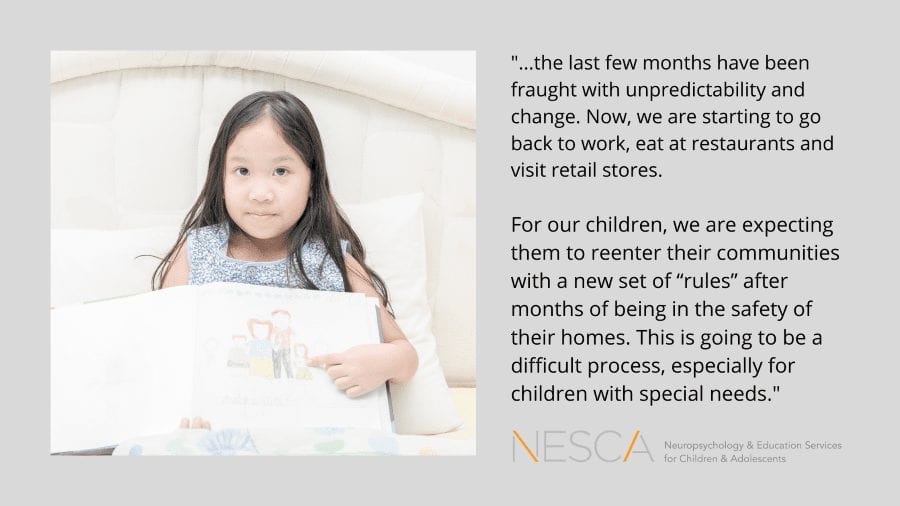
For many children, new experiences are frightening and anxiety-provoking. Children thrive on routine and predictability; when these get interrupted, it can be hard for them to understand what is happening. As we all know, the last few months have been fraught with unpredictability and change. Now, we are starting to go back to work, eat at restaurants and visit retail stores. As adults, we might have mixed feelings about this – relief to get out of the house but also fear about the ongoing pandemic. For our children, we are expecting them to reenter their communities with a new set of “rules” after months of being in the safety of their homes. This is going to be a difficult process, especially for children with special needs.

So how do we prepare children for all of the new experiences they are about to face?

One method that has been found to be effective is the use of Social Stories™. Social Stories were first developed in 1990 by Carol Gray, a special education teacher. In essence, Social Stories are used to explain situations and experiences to children at a developmentally appropriate level using pictures and simple text. In order to create materials that are considered a true Social Story, there are a set of criteria that must be used. More information can be found here: https://carolgraysocialstories.com/social-stories/what-is-it/.

While special educators or therapists are expected to use this high standard in their work, it is also relatively easy for parents to create modified versions of these stories to use at home. I was inspired by one of my clients recently who made a story for her son with Down syndrome to prepare him for the neuropsychological evaluation. During her parent intake, she took pictures of me and the office setting. At home, she created a short book that started with a picture of her son, a picture of their car, a picture of my office, a picture of me and so on. On each page, she wrote a simple sentence:

  • First we will get in the car
  • We will drive to Dr. Gibbons’ office
  • We will play some games with Dr. Gibbons
  • We will go pick a prize at Target
  • We will drive home

Throughout the evaluation, she referred to the book whenever her son became frustrated by the tests or needed a visual reminder of the day’s schedule. Something that probably only took a few minutes to create played an important role in helping her son feel comfortable and be able to complete the evaluation.

The options for creating similar types of stories are endless, giving parents a way to prepare their children for a scary experience.

Some examples of stories to create during the ongoing pandemic:

  • Wearing a mask when out of the house
  • Proper hand washing
  • Socially distant greetings (bubble hugs, elbow bumps, etc.)

Some examples of more general stories include:

  • Doctor’s visits
  • Going to the dentist
  • Getting a haircut
  • Riding in the car
  • First day of school

You can use stock photos from the internet or pictures of your child and the actual people/objects they will encounter. If you have a child who reads, you can include more text; if your child does not read, focus on pictures only. Read the story with the child several times in the days leading up to the event. For ongoing expectations (e.g., wearing a mask) – you can review the story as often as needed. Keep it short and simple. And have fun with it!


About the Author: 

Erin Gibbons, Ph.D. is a pediatric neuropsychologist with expertise in neurodevelopmental and neuropsychological assessment of infants,

children, and adolescents presenting with developmental disabilities including autism spectrum disorders, Down syndrome, intellectual disabilities, learning disabilities, and attention deficit disorders. She has a particular interest in assessing students with complex medical histories and/or neurological impairments, including those who are cognitively delayed, nonverbal, or physically disabled. Dr. Gibbons joined NESCA in 2011 after completing a two-year post-doctoral fellowship in the Developmental Medicine Center at Boston Children’s Hospital. She particularly enjoys working with young children, especially those who are transitioning from Early Intervention into preschool. Having been trained in administration of the Autism Diagnostic Observation Schedule (ADOS), Dr. Gibbons has experience diagnosing autism spectrum disorders in children aged 12 months and above.


If you are interested in booking an evaluation with Dr. Gibbons or another NESCA neuropsychologist, please fill out and submit our online intake form


Neuropsychology & Education Services for Children & Adolescents (NESCA) is a pediatric neuropsychology practice and integrative treatment center with offices in Newton and Plainville, Massachusetts, and Londonderry, New Hampshire, serving clients from preschool through young adulthood and their families. For more information, please email info@nesca-newton.com or call 617-658-9800.

What Does Autism Look Like? Exploring the Differences among Girls and Boys

By | NESCA Notes 2019


By: Erin Gibbons, Ph.D.
Pediatric Neuropsychologist, NESCA

In 2018, the Centers for Disease Control and Prevention (CDC) determined that approximately 1 in 59 children is diagnosed with Autism Spectrum Disorder (ASD). Boys are still four times more likely be diagnosed with ASD; however, research indicates that the diagnosis is often missed in girls, especially those who have average intelligence and “milder” forms of ASD. To understand why ASD is more often missed in girls, let’s explore the differences between boys and girls with ASD. This discussion will focus on children with average to above average intelligence (about 50% of all children diagnosed with ASD).


Boys Girls
Poor impulse control, more acting out Likely to be quiet and withdrawn
Disruptive behaviors in the classroom setting Tend to be reserved and cooperative at school
Frequent repetitive motor behaviors that are directly observable Lower frequency of these motor behaviors
Lack of interest in imaginary play Very much engaged in imaginary play
Restricted interests may seem unusual – e.g., train schedules, maps, windmills Restricted interests may seem “age appropriate” – e.g., horses, unicorns, ballet
Trouble making friends Might have a few friends
Likely to exhibit angry outbursts when frustrated/anxious Likely to engage in self-harm or other behaviors that are not observed by others when frustrated/anxious
Lack of awareness of being different or not fitting in More motivated to fit in and “hide” social difficulties – might try to imitate the behavior of a peer that is perceived as popular


Due to these differences, the diagnosis of ASD is often missed in young girls. Adults might agree that a girl is “odd” or “quirky,” but dismiss these concerns because she has good eye contact, has some friends, and does not engage in hand flapping or other unusual behaviors. Unfortunately, other girls might be misdiagnosed, which could lead to ineffective or inappropriate treatment interventions. Most commonly, they might be misdiagnosed with ADHD or Anxiety Disorder.

In many cases, girls with ASD have increasing difficulties with social interactions as they get older and demands get higher. A young girl with ASD might be able to “get by” in social interactions but by the time she reaches adolescence, she is not able to navigate the intricacies of the social milieu. This can lead to social isolation and high risk of being bullied or rejected by peers.

Unfortunately, a missed diagnosis of ASD for a young girl can have long-reaching ramifications. She might experience depression, anxiety and/or low self-esteem, wondering why she doesn’t “fit in” and “feels different” from other girls. She might start to struggle in school or disconnect from activities that she used to enjoy. Moreover, missing the diagnosis in childhood means that she did not receive services to support her social and peer interaction skills during her formative years.

As always, when parents or other caregivers have concerns about a child’s development, it is important to seek an evaluation from a professional. And if the findings do not feel quite right, parents should never feel uncomfortable about seeking a second opinion.


About the Author: 

Erin Gibbons, Ph.D. is a pediatric neuropsychologist with expertise in neurodevelopmental and neuropsychological assessment of infants,

children, and adolescents presenting with developmental disabilities including autism spectrum disorders, Down syndrome, intellectual disabilities, learning disabilities, and attention deficit disorders. She has a particular interest in assessing students with complex medical histories and/or neurological impairments, including those who are cognitively delayed, nonverbal, or physically disabled. Dr. Gibbons joined NESCA in 2011 after completing a two-year post-doctoral fellowship in the Developmental Medicine Center at Boston Children’s Hospital. She particularly enjoys working with young children, especially those who are transitioning from Early Intervention into preschool. Having been trained in administration of the Autism Diagnostic Observation Schedule (ADOS), Dr. Gibbons has experience diagnosing autism spectrum disorders in children aged 12 months and above.


If you are interested in booking an evaluation with Dr. Gibbons or another NESCA neuropsychologist, please fill out and submit our online intake form


Neuropsychology & Education Services for Children & Adolescents (NESCA) is a pediatric neuropsychology practice and integrative treatment center with offices in Newton and Plainville, Massachusetts, and Londonderry, New Hampshire, serving clients from preschool through young adulthood and their families. For more information, please email info@nesca-newton.com or call 617-658-9800.

Addressing Anxiety through the IEP Process

By | NESCA Notes 2019

By: Erin Gibbons, Ph.D.
Pediatric Neuropsychologist, NESCA

Anxiety disorders are becoming more and more common among children and adolescents. Recent data from the National Institute of Mental Health (NIMH) reported that 31.9% of adolescents between 13-19 have an identified anxiety disorder. Although fewer statistics are available, it is clear that students who have a developmental, learning, or attention disorder are at high risk for developing clinically significant anxiety in light of their struggles with academics, learning, and/or social development. Given the rising numbers of affected children and adolescents, it has become increasingly important that a student’s emotional health is addressed both at home through private counseling, as well as through the provision of school-based services. When students experience a high level of unmitigated anxiety throughout the day, they are less able to learn and meet their potential.

When parents are seeking services for anxiety through their school system, there are different levels of support. First, teachers can provide classroom supports and address emotional health with all students, whether or not they have an identified anxiety disorder. Some examples of useful classroom strategies include:

  • Create predictable routines and clear expectations.
  • Provide warnings about upcoming transitions.
  • Have a “cool down space” available in the classroom or another room in the school.
  • Incorporate movement into lessons throughout the day.

There are also programs designed to address emotional regulation that can be used throughout the school or district. For example:

If these supports are not sufficient to meet a student’s needs, then it is necessary to develop goals through the IEP process. In order to make needed progress, it is important that the goals and benchmarks in the IEP are specific. For example, a benchmark might state: “Johnny will show better emotional regulation in stressful situations.” A more specific benchmark might state: “When Johnny starts to shut down or refuse to participate during a math class, he will identify his current emotion(s) in 4 out of 5 opportunities.”

When parents seek supports for their child’s anxiety through the IEP, they should consider whether their child needs accommodations, specialized instruction or both.

Examples of accommodations for anxiety include:

  • Extra time in testing situations.
  • Opportunities to take tests in a quiet setting.
  • Access to breaks as needed.
  • Access to the school counselor as needed.
  • Student does not need to sign out of class to use the bathroom.
  • Student is prompted to take breaks when showing signs of distress.
  • Student has modified homework.
  • Teacher will check in with student before independent work blocks.
  • Specialized instruction can be provided in the classroom (push-in) or in a different setting (pull-out).

Push-in services might include:

  • Provision of an instructional aide to support emotion identification and regulation.
  • The school counselor/psychologist works with the entire class once or twice a month to discuss emotional health.

Pull-out services might include:

  • Regular sessions with the school counselor/psychologist.
  • Social skills groups.

Consultation services are also important, especially if a student participates in private therapy outside of school. Parents should consider giving permission for the private therapist to speak with the school counselor to discuss common treatment goals and ways in which the student’s coping skills can be supported and reinforced in school.

About the Author:

GibbonsErin Gibbons, Ph.D. is a pediatric neuropsychologist with expertise in neurodevelopmental and neuropsychological assessment of infants, children, and adolescents presenting with developmental disabilities including autism spectrum disorders, Down syndrome, intellectual disabilities, learning disabilities, and attention deficit disorders. She has a particular interest in assessing students with complex medical histories and/or neurological impairments, including those who are cognitively delayed, nonverbal, or physically disabled. Dr. Gibbons joined NESCA in 2011 after completing a two-year post-doctoral fellowship in the Developmental Medicine Center at Boston Children’s Hospital. She particularly enjoys working with young children, especially those who are transitioning from Early Intervention into preschool. Having been trained in administration of the Autism Diagnostic Observation Schedule (ADOS), Dr. Gibbons has experience diagnosing autism spectrum disorders in children aged 12 months and above.

Dr. Gibbons recently began serving clients in NESCA’s newest location in Plainville/Foxborough, MA. She is thrilled to bring her expertise in evaluating and supporting children with a wide range of abilities to this area of the state.


To book an evaluation with Dr. Gibbons or one of our many other expert neuropsychologists and transition specialists, complete NESCA’s online intake form.


Neuropsychology & Education Services for Children & Adolescents (NESCA) is a pediatric neuropsychology practice and integrative treatment center with offices in Newton, Massachusetts, Plainville, Massachusetts, and Londonderry, New Hampshire, serving clients from preschool through young adulthood and their families. For more information, please email info@nesca-newton.com or call 617-658-9800.


Interview with Erin Gibbons, NESCA Pediatric Neuropsychologist

By | NESCA Notes 2018


By:
Ashlee Cooper
Marketing and Outreach Coordinator, NESCA


What is neuropsychology? How did you get interested in this field?

My first introduction to neuropsychology was as a college student when I took coursework in neuroscience and cognition and found it to be fascinating. However, when I started graduate school, I was initially intimidated by neuropsychology courses as I feared they would be too “medical” or focused on research. I specialized in pediatric psychology, but always assumed I would become a therapist. It was not until I took an internship with a pediatric neuropsychologist that I really understood the field and fell in love with this work.

Although the field of neuropsychology is extensive, what we do at NESCA is focus on its practical applications. An evaluation is comprised of a set of tests that seek to assess students’ skills in a variety of areas such as intelligence, memory, organization, learning/academics, and social skills. The data being generated by those tests are then considered within the context of the student’s developmental history and current challenges. Ultimately, the goal is to provide parents with a complete picture of their child’s learning profile – helping to understand where their child might excel and where he or she might struggle. Moreover, recommendations will be provided in an effort to help each student meet his or her innate potential and to experience success.

What do you like about your job?

I love the opportunity to work with many different children and families from across the state and, in some cases, from other countries. Families place a lot of trust in me by sharing very difficult stories about their children’s struggles and I feel privileged to be a member of their team. For me, the most impactful part of the evaluation is often the parent feedback session when I explain the results of the testing and lay out my recommendations. Through this process, I hope to provide parents with an understanding of their child’s learning profile in a way that helps them establish a road map for the next several years. 

Do you have a specialty? What do you specialize in?

At NESCA, we see a wide variety of students presenting with all types of issues. My caseload is always varied and never boring! That said, I tend to see younger clients and have extensive training in evaluating children under 5 years of age. I also enjoy working with students who have developmental disabilities such as autism spectrum disorders or intellectual impairments. I often evaluate students who are considered “difficult to test; for example, those who are nonverbal, have vision impairments, or significant motor delays. 

What brought you to NESCA?

After completing my doctorate, I spent two years working in a hospital setting. Although I learned an extraordinary amount during my time there, I had very little opportunity to interact with parents as they were typically followed by their child’s physician. I really wanted to work in a place where I could see an evaluation through from start to finish, and working at NESCA allows me to do this. I also appreciate the opportunity to observe students in settings outside of the office and work closely with teachers and other providers. Through the entire process, I get to know each student very well, and I am also able to establish a meaningful relationship with their parents.

What do you enjoy about working at NESCA?

NESCA has a wonderful work culture that is extremely collaborative, supportive, and enriching. Everyone truly enjoys each other’s company and we often have social gatherings to celebrate milestones such as weddings, graduations, and births. Aside from that, our director Dr. Ann Helmus is committed to having all clinicians stay up to date on current research and treatment in the field of neuropsychology. Every other week, we have outside professionals provide staff training, allowing us to learn about local resources, which we can then share with our clients. We also frequently share new information with one another as we attend conferences or read new articles.

What do you think sets NESCA apart? Why should a parent bring their child here when there are so many other neuropsychologists in Massachusetts and New Hampshire?

Every clinician at NESCA is extraordinarily dedicated to providing the best care to their clients. We have case conferences every week during which clinicians discuss challenging cases and seek input from our colleagues. With each new presentation, it is clear that the clinician has genuine compassion for the child and family and is striving to help in every way possible.

Further, our evaluations are remarkably in depth, and we often ask students to return for additional appointments if we feel that we need more information to help round out our understanding of a particular case. Every clinician conducts school or community observations on a regular basis as well; these are often essential in order to see how a student is functioning on a daily basis since test scores do not always tell the “whole story.” Along with these very detailed evaluations, the reports that are provided by NESCA clinicians are outstanding. I have the opportunity to read many, many neuropsychological reports, and I can honestly say that I believe NESCA reports are the best. They describe the student as a whole, including both strengths and weaknesses. Recommendations are consistently specific, detailed, and thoughtful. I often hear parents say that after reading the report, they have a better understanding of their own child.

What advice do you have for parents who are not sure if a neuropsychological evaluation is needed for their child?

The best first step is to have a consult with one of our clinicians. These one-hour appointments give parents the opportunity to describe their concerns and seek advice on next steps. While a neuropsychological evaluation might be necessary in order to answer their specific questions and address their concerns, this is not always the case. Having the chance to talk things out with an expert can be extremely helpful in terms of creating the most sensible plan.


We are very excited to announce that on October 1, 2018, NESCA will open a bright new, satellite office in Plainville, MA! To schedule an appointment with Dr. Erin Gibbons in Plainville, please complete our online intake form: https://nesca-newton.com/intake-form/  The address of NESCA-Plainville is 60 Man Mar Drive, Suite 8, Plainville, MA 02762.


About the Author: 

As Marketing and Outreach Coordinator, Ashlee oversees marketing campaigns and develops community relationships through various programming activities – all of which expand NESCA’s well-respected reputation in New England. Ashlee brings a wide range of marketing, design and communications experience in the social service and non-profit industry. She lives in Newton with her husband and their beloved dog, Winnie. In her free time, she enjoys doing yoga, watching documentaries and promoting her and her husband’s housewares startup.

Get in touch with Ashlee with any questions you may have about NESCA’s programs and events at acooper@nesca-newton.com. She looks forward to hearing from you!


Neuropsychology & Education Services for Children & Adolescents (NESCA) is a pediatric neuropsychology practice and integrative treatment center with offices in Newton, Massachusetts, and Londonderry, New Hampshire, serving clients from preschool through young adulthood and their families. For more information, please email info@nesca-newton.com or call 617-658-9800.

Neurodevelopmental Evaluations – Where and When to Start

By | NESCA Notes 2018

By: Erin Gibbons, Ph.D.
Pediatric Neuropsychologist, NESCA

Parenthood is a daunting task to say the least. Not only must we worry about keeping our children healthy and safe, but we are constantly bombarded with information about potentially harmful foods, chemicals, toys, etc. Many parents also have concerns about whether their children are meeting developmental milestones on time and/or whether they should worry about certain behaviors their children are displaying.

When concerns arise about older children, parents are often advised to seek a neuropsychological evaluation to rule out possible attention, learning, or developmental challenges. However, parents of children under 5 are often urged to “wait and see” or might be told it is “too early” to seek an evaluation. The truth of the matter is that it is never too early to have your child evaluated when you are worried about his or her development.

Where do I start?

If you have concerns about your child’s development, it is always a good idea to start with your pediatrician. Describe what you are seeing at home and any difficulties you have noticed. Your pediatrician might recommend that you seek a comprehensive neurodevelopmental evaluation to assess for any developmental delays.

What is a neurodevelopmental evaluation?

This is a comprehensive set of tests designed to assess all aspects of your child’s development, including cognition, language, motor, and social skills. This type of evaluation is conducted by a pediatric neuropsychologist. First, you will be asked to provide information about your child’s developmental and medical histories. Your child will then be asked to participate in a series of activities over the course of 2 or 3 hours. For example, he/she will have to solve simple puzzles, label pictures, or play with different types of toys.

Why is a neurodevelopmental evaluation useful?

After completing the evaluation, the neuropsychologist will analyze all of the information and develop a comprehensive picture of your child’s developmental profile. In addition to helping you understand your child’s strengths and weaknesses, the neuropsychologist will also identify any developmental delays that require intervention.

What happens next?

An evaluation will identify developmental delays that need to be treated in order to help your child catch up with peers. Some examples include speech/language therapy, occupational therapy, physical therapy or applied behavior analysis (ABA).

For children under 3, this means they can start receiving Early Intervention services right away. Early Intervention is a system of services for babies and toddlers who have developmental delays or disabilities and is available in every state in the US.

For children over 3, parents can seek services privately, or can work with their local school district to develop an Individualized Education Program (IEP) for their child. Having an independent evaluation completed prior to your child’s transition to public education is extremely useful as it provides the district with the child’s type of disability and informs the process of developing necessary services.

Where can I go?

Neurodevelopmental evaluations are available at many local area hospitals as well as private neuropsychology clinics. Parents can also contact their insurance company for a list of providers or search through the Massachusetts Neuropsychological Society: https://www.massneuropsych.org/i4a/pages/index.cfm?pageID=3309.

At NESCA, we are proud to offer neurodevelopmental evaluations for children ages 1-5 and will provide parents with a comprehensive report, extensive recommendations for services, and ongoing consultation through the years. Our clinicians are able to do observations of children in their natural environments (e.g., day care, preschool) to gain a full picture of the child and provide environmental recommendations that would be most supportive. Moreover, we are available to attend meetings with early intervention specialists and special educators to help a child’s team fully understand their individual learning and service needs.

If you are interested in scheduling a consultation or evaluation at NESCA, please complete our on-line intake form: https://nesca-newton.com/intake-form/.

About the Author:

GibbonsErin Gibbons, Ph.D. is a pediatric neuropsychologist with expertise in neurodevelopmental and neuropsychological assessment of infants, children, and adolescents presenting with developmental disabilities including autism spectrum disorders, Down syndrome, intellectual disabilities, learning disabilities, and attention deficit disorders. She has a particular interest in assessing students with complex medical histories and/or neurological impairments, including those who are cognitively delayed, nonverbal, or physically disabled. Dr. Gibbons joined NESCA in 2011 after completing a two-year post-doctoral fellowship in the Developmental Medicine Center at Boston Children’s Hospital. She particularly enjoys working with young children, especially those who are transitioning from Early Intervention into preschool. Having been trained in administration of the Autism Diagnostic Observation Schedule (ADOS), Dr. Gibbons has experience diagnosing autism spectrum disorders in children aged 12 months and above.


Skip to content