Tag

nesca newton ma Archives - Page 11 of 14 - NESCA

Subscribe to NESCA Notes

Teens Online: Participation vs. Observation

By | NESCA Notes 2021

By Yvonne M. Asher, Ph.D. 
Pediatric Neuropsychologist

As we enter the beginning of 2021, the COVID-19 pandemic continues to shape our world. More and more, events, activities and interactions are pushed online – onto videoconferencing apps, social media and academic learning  platforms. Online social interactions are not new, and they won’t disappear anytime soon. With this, how do we, as adults, understand and navigate these oddly draining electronically-mediated gatherings, and how do we help our teens do the same?

One unique characteristic of online interaction is the ability to be present without being visible. In traditional social settings, to be present with the group is to be seen and, often times, noticed. Joining a Zoom or Google Meet offers one the ability to listen, watch and take the information presented without offering anything of yourself – no one has to see you, hear you, know where you are or know what you are doing. As many adults have noticed, this gives incredible freedom to the multi-taskers – listen to your meetings while getting the dishes done or the laundry folded.

For some adolescents, though, this is an opportunity to bypass many of the core tasks of social development, while still engaging with the material needed to accomplish one’s academic goals. A high schooler, acutely aware of how they are perceived and what others think of them, can sit silently, invisibly in social studies class. They can hone in on the economic impacts of World War I without the crushing anxiety of worrying about being teased or ostracized. However, that same high schooler may never have to confront the developmentally-expected challenges of venturing out of their “comfort zone” socially. They may not learn to ask someone out on a date, explore a new friendship or show up to the first meeting of a club.

How can we help our teens learn to take the best from online interactions while also pushing them to fully engage with others? There is no one, clear-cut answer – no “10 things…” or similar checklist. In any situation, we must look holistically at the teen, the context and the goals, and, from there, determine the best path forward. Sometimes, the anonymity of the online world is a welcome respite for teens looking to explore a new facet of their identity. Other times, it undercuts the core tasks of adolescence – building deep bonds with peers, taking responsibility for one’s social relationships and developing independence. Having direct, open conversations with our teens helps them understand and begin to own the challenges of the online world. If cameras are always off and microphones are always on mute, maybe it is time for a chat about participation versus observation.


About the Author

Dr. Yvonne M. Asher enjoys working with a wide range of children and teens, including those with autism spectrum disorder, developmental delays, learning disabilities, attention difficulties and executive functioning challenges. She often works with children whose complex profiles are not easily captured by a single label or diagnosis. She particularly enjoys working with young children and helping parents through their “first touch” with mental health care or developmental concerns.

Dr. Asher’s approach to assessment is gentle and supportive, and recognizes the importance of building rapport and trust. When working with young children, Dr. Asher incorporates play and “games” that allow children to complete standardized assessments in a fun and engaging environment.

Dr. Asher has extensive experience working in public, charter and religious schools, both as a classroom teacher and psychologist. She holds a master’s degree in education and continues to love working with educators. As a psychologist working in public schools, she gained invaluable experience with the IEP process from start to finish. She incorporates both her educational and psychological training when formulating recommendations to school teams.

Dr. Asher attended Swarthmore College and the Jewish Theological Seminary. She completed her doctoral degree at Suffolk University, where her dissertation looked at the impact of starting middle school on children’s social and emotional wellbeing. After graduating, she completed an intensive fellowship at the MGH Lurie Center for Autism, where she worked with a wide range of children, adolescents and young adults with autism and related disorders.


Neuropsychology & Education Services for Children & Adolescents (NESCA) is a pediatric neuropsychology practice and integrative treatment center with offices in Newton, Massachusetts, Plainville, Massachusetts, and Londonderry, New Hampshire, serving clients from preschool through young adulthood and their families. For more information, please email info@nesca-newton.com or call 617-658-9800.


To book an appointment with Dr. Yvonne Asher, please complete our Intake Form today. For more information about NESCA, please email info@nesca-newton.com or call 617-658-9800.


Changes in Transitioning from School-based Services to DDS Adult Services during COVID-19

By | NESCA Notes 2021

By: Kelley Challen, Ed.M., CAS
Director of Transition Services; Assistant Director, NESCA

Transitioning from public education to adult human service supports is a complicated process that we have covered in several blogs over the years here at NESCA, including the two recent resources linked below:

As with many aspects of life, the existence of a global pandemic has complicated the transition process even more. In Massachusetts, Chapter 688 referrals (the referrals that help adult agencies to request the appropriate amount of funding from the state for supporting students with disabilities after they turn 22) were down by as much as 75% in September 2020. Additionally, referral processes that often were carried out in 2-4 months are taking much longer. In fact, at a team meeting I attended last week, a special education administrator shared that it had taken approximately 9 months to complete a recent referral to the Department of Developmental Services (DDS) for a student seeking adult autism services.

[For those unfamiliar with DDS, this is the agency that offers services and supports for individuals with intellectual and developmental disabilities including Autism Spectrum Disorder (ASD).]

To better support transitioning families, DDS recently developed an information sheet that highlights some of the potential changes and challenges families may experience when preparing for their transition to DDS adult service supports during COVID-19. In addition to modified referral timelines, the information sheet touches on changes in how families learn about day and residential programs (e.g., virtual tours) and the ways in which programs may have changed their approaches to service delivery as a result of COVID-19 (e.g., changes to community employment, remote and in-person offerings, visitor policies, etc.).

This DDS information sheet is helpful for professionals and families and is available in several languages on the state’s web site: https://www.mass.gov/lists/transition-considerations-during-covid-19.


For families who are struggling to navigate the transition from high school to adult service support, to understand available resources and benefits during or after public education, to create an effective plan for their child during a lapse in service delivery, or with any other transition planning issues, NESCA transition consultation and planning services are here to support you. Visit our transition services page and our transition FAQs or fill out an Intake Form to schedule an appointment with one of our expert transition specialists today.


About the Author:

Kelley Challen, Ed.M., CAS, is NESCA’s Director of Transition Services, overseeing planning, consultation, evaluation, coaching, case management, training and program development services. She is also the Assistant Director of NESCA, working under Dr. Ann Helmus to support day-to-day operations of the practice. Ms. Challen began facilitating programs for children and adolescents with special needs in 2004. After receiving her Master’s Degree and Certificate of Advanced Study in Risk and Prevention Counseling from Harvard Graduate School of Education, Ms. Challen spent several years at the MGH Aspire Program where she founded an array of social, life and career skill development programs for teens and young adults with Asperger’s Syndrome and related profiles. She additionally worked at the Northeast Arc as Program Director for the Spotlight Program, a drama-based social pragmatics program, serving youth with a wide range of diagnoses and collaborating with several school districts to design in-house social skills and transition programs. Ms. Challen is co-author of the chapter “Technologies to Support Interventions for Social- Emotional Intelligence, Self-Awareness, Personality Style, and Self-Regulation” for the book Technology Tools for Students with Autism. She is also a proud mother of two energetic boys, ages six and three. While Ms. Challen has special expertise in supporting students with Autism Spectrum Disorders, she provides support to individuals with a wide range of developmental and learning abilities, including students with complex medical needs.

Neuropsychology & Education Services for Children & Adolescents (NESCA) is a pediatric neuropsychology practice and integrative treatment center with offices in Newton, Massachusetts, Plainville, Massachusetts, and Londonderry, New Hampshire, serving clients from preschool through young adulthood and their families. For more information, please email info@nesca-newton.com or call 617-658-9800.

When Gaming Is No Longer A Game

By | NESCA Notes 2021

By: Cynthia Hess, PsyD
Pediatric Neuropsychologist and Therapist

Many parents are wrestling with how much time their children are engaging with screens, and finding themselves wondering how much is too much. Children who experience difficulty related to symptoms of ADHD are especially drawn to the stimulation of screens. And children with ADHD tend to require frequent and immediate rewards, making them especially drawn to screen-time activities. While a specific cause for ADHD has not been identified, there is some consensus that a shortage of dopamine could be to blame. Dopamine not only plays a role in how we feel pleasure, it is also significant in the uniquely human ability to think and plan.

Part of the allure of gaming – and social media – is that each new level reached and each new “like,” instantly releases a small dose of dopamine directly into the brain’s reward center. If you have ever had to fight with your child to get off technology, this is likely why. A deficit in dopamine is easily fed by screen-time activities, leading children to want more. This has led to a demand for content, resulting in tens of millions of dollars having been made by YouTubers whose entire platform is gaming, and children love watching them. They are entertaining, and kids learn tips for improving their own gaming.

Children worship gaming YouTubers, and many strive to be one someday. It is challenging for parents to keep up with the content their children are accessing largely because YouTube has created an algorithm in the system that suggests what to watch next based on frequent views or recent searches. YouTube’s recommendation system is specifically engineered to maximize watch time and often “up next” videos play automatically. In fact, this feature is responsible for more than 70 percent of all time spent on the site, indicating that children, and others, are consistently and reliably exploring recommended “up next” content. It is important for parents to do their research and know who their children are watching and following on YouTube, as they may be drawn into content that could be highly influential and contrary to family values. While many YouTubers are harmless, there are those who include brief, perhaps undetectable messages (e.g., PewDiePie) that influence what shows up next. Children are curious, and YouTube’s goal is to keep them engaged, which can turn into the perfect storm.

YouTube consists of a business model that rewards provocative videos with large sums of money. They strive to attract viewers by leading them down paths meant to keep people engaged. While much of the content may seem innocuous, there are reasons to be cautious as things aren’t always as innocent as they seem. Provocative content creates intrigue. It piques interest and may be especially attractive to older children and adolescents. As individuals strive to create the next viral video, putting forth extreme beliefs and violent content may be their pathway to becoming a celebrity. For these reasons, and as technology becomes increasingly embedded in children’s lives, it is important for parents to do their research and stay informed.

Some helpful resources include:

https://www.pewresearch.org/internet/2020/07/28/parenting-children-in-the-age-of-screens/

https://chadd.org/wp-content/uploads/2018/06/ATTN_06_15_TooMuchScreenTime.pdf

https://childmind.org/article/healthy-limits-on-video-games/


About the Author

Dr. Cynthia Hess recently graduated from Rivier University with a PsyD in Counseling and School Psychology. Previously, she earned an M.A. from Antioch New England in Applied Psychology. She also worked as an elementary school counselor and school psychologist for 15 years before embarking on her doctorate. During her doctorate, she did her pre-doctoral internship with RIT in Rochester, N.Y. where she worked with youth ages 5-17 who had experienced complex developmental trauma. Dr. Hess’s first post-doctoral fellowship was with The Counseling Center of New England where she provided psychotherapy and family therapy to children ages 5-18, their families and young adults. She also trained part-time with a pediatric neuropsychologist conducting neuropsychological evaluations.


To schedule an appointment with one of NESCA’s expert neuropsychologists, please complete our online intake form


Neuropsychology & Education Services for Children & Adolescents (NESCA) is a pediatric neuropsychology practice and integrative treatment center with offices in Newton and Plainville, Massachusetts, and Londonderry, New Hampshire, serving clients from preschool through young adulthood and their families. For more information, please email info@nesca-newton.com or call 617-658-9800.


Developing S-M-A-R-T Goals in 2021

By | NESCA Notes 2021

By: Tabitha Monahan, M.A., CRC
NESCA Transition Specialist/Counselor

Happy New Year! Now two weeks into 2021, maybe it’s time to revisit those New Year Resolutions.  French writer Antoine de Saint-Exupéry wrote: “a goal without a plan is just a wish.” This is true for resolutions, just as it is for any goal. How can we help our young people change their wishes, visions and dreams into goals? We teach them (and maybe ourselves while we’re at it) how to plan. One of my favorite strategies for both teaching and reaching goals is by creating SMART Goals. What is a Smart Goal?

Specific – The goal should be specific. I’ll increase the distance I run is vague. Will you increase the distance by 20 feet, 2 miles? Are you planning for a marathon? Instead, let’s take a look at step 2, making it measurable.

Measurable – There’s a good chance that if your goal is not specific enough, it will be hard to measure if you have succeeded in that goal. So, let’s make our exercise goal both specific and measurable. I’ll increase the distance I run from 1 mile to 3.2 miles (5k).

Attainable – Attainable is the hard one for many students who are still building awareness of their strengths and challenges. Let’s say a person who has never run wants to run in the Boston Marathon. This is likely not an attainable goal, even if it is specific and measurable. Couch to 5k training exists; I have not seen the couch to marathon training program. Having measurable steps also helps break down the goal into smaller pieces, which will be further discussed later.

Relevant – If I am trying to increase my social circle and group leisure skills, running is unlikely to get me there. However, if, like many people, we’re trying to improve our health in 2021 (or take off some of those quarantine pounds), increasing the distance we run certainly will get us there. Many young adults may need to bounce ideas off someone to ensure the goal is relevant to the area at hand.

Time-bound – Attainable and time-based work tightly together. If you do not give yourself a deadline, the goal may still be there come December 2021. Humans work best with deadlines. We need the motivation to complete a plan, and often motivation needs a sense of urgency.

Okay, so what does our SMART goal look like for increased health and wellness? I will increase the distance I run from 1 mile to 3.2 miles (5k) in ¼ mile increments by June 30, 2021.

We have all the pieces. It is specific, and we know precisely what the end goal will be and how we will get there. It’s measurable; there is something we can check off as complete, like a to-do list. It’s attainable and seems realistic. We are not trying to run the Boston Marathon course after only running a mile. We will start as a beginner runner and work towards a 5k, and we are not trying to do it tomorrow with no steps in between. It’s relevant; we are working on bettering our health in 2021. And it is time-based. We want to meet our goal by the end of June.

Now that we’ve refreshed our minds on SMART goals, how do we build these skills in transition-aged youth? Ask them. Ask your child, your students, your clients what they want for themselves in education, employment and independent living. We already have the starting points. We have their vision. We have the IEP TEAM’s goals and objectives.

The youth may have a far-reaching (and maybe seemingly unattainable) goal. Help them break that big goal down into smaller parts and work backward. Do they want to be an engineer? Engineers need a college degree. What does the student need to do to graduate college? They need to get into college. How do they get into college? They need to apply and graduate from high school. What do they need to do to graduate high school? They need to pass their science class. That seems like a reasonable starting place, and it is still related to the vision. What might a SMART goal look like for that student? I will receive a passing grade on my final exam by answering the end of chapter questions each week and asking for clarification from my teacher for any questions I got wrong by the end of the spring semester.

But how do we support them when they aren’t making progress? Many people have a hard time adjusting once they have made a plan. Whenever we set a goal, we need to look at our progress periodically. We need to check that the goal is still attainable by the deadline we gave ourselves. Are we making progress? If we are still running only a mile and it’s March, what adjustments do we need to make? Suppose a student is not finding answering the end of chapter questions helpful in confirming their knowledge of the material. What changes can they make to increase their understanding of the material? Maybe the student asks the teacher if they can work one-on-one twice a week to increase understanding? Frustration, when the plan doesn’t work, makes many give up on the goal. Learning how to adapt is just as essential as learning how to make a goal.

A person who has practiced SMART goals is a person who will have an increased understanding of the objectives and smaller steps they need to reach their vision. They will have more confidence in their abilities and more awareness of their challenges. A person who has goal-setting skills is a person who has control of their own life. What are your SMART goals for 2021?


About the Author

Tabitha Monahan, M.A., CRC, is an experienced transition evaluator and vocational counselor. While she is well-versed in supporting a wide range of transition-aged youth, she is especially passionate and knowledgeable in helping clients and their families navigate the complex systems of adult services and benefits as well as medical and mental health systems. She is further adept in working individually with students of all abilities to empower self-advocacy and goal achievement.


To schedule an appointment with one of NESCA’s expert transition specialists or neuropsychologists, please complete our online intake form


Neuropsychology & Education Services for Children & Adolescents (NESCA) is a pediatric neuropsychology practice and integrative treatment center with offices in Newton and Plainville, Massachusetts, and Londonderry, New Hampshire, serving clients from preschool through young adulthood and their families. For more information, please email info@nesca-newton.com or call 617-658-9800.


Transition Assessment: What is it anyway? How is it different from neuropsychological evaluation?

By | NESCA Notes 2020

By: Kelley Challen, Ed.M., CAS
Director of Transition Services; Assistant Director, NESCA

If you have a child who receives special education services or work in education, you are likely familiar with the Individuals with Disabilities Education Improvement Act of 2004 (IDEA 2004). This is the law that guarantees students with disabilities the right to free appropriate public education (FAPE) and that dictates that the purpose of special education and related services is to prepare students with disabilities for further education, employment, and independent living.

IDEA 2004 mandates that students have measurable postsecondary goals written in their individualized educational programs (IEPs), that describe the outcomes that a team expects for the student to achieve after exiting public education and that these goals must be “based upon age-appropriate transition assessments related to training, education, employment, and where appropriate, independent living skills.”[1] But, IDEA 2004 does not specifically define transition assessment.

Instead, the best and most commonly accepted definition for transition assessment comes from the Division on Career Development and Transition (DCDT). DCDT defines transition assessment as an “…ongoing process of collecting data on the individual’s needs, preferences, and interests as they relate to the demands of current and future working, educational, living, and personal and social environments.”[2]

Transition assessment can include formal testing, such as a standardized, published tests that compare students to others by age or grade or informal activities, such as interviewing or observing a student. Most students who are transition-aged (i.e., 14 or older in Massachusetts; 16 by federal law) have already had some assessments that will inform their transition planning, such as school evaluations, private evaluations, standardized academic testing, report cards, or even activities that happen within their guidance curriculum (e.g., assessment of strengths, learning style, personality type, career interests). But often, there will still be some testing needed to help better determine a student’s strengths and aptitudes, their preferences and interests for postsecondary adult life, and the gaps between their current knowledge and abilities and the requirements of the living, learning, and working environments in which they plan to function when they exit high school.

At NESCA, transition assessment is a highly individualized process that is designed to get a better sense of a student’s postsecondary living, learning, social, and vocational goals, to determine the strengths the student has that will help them reach those goals as well as the skills a student needs to develop to get there. While it is rare for two students to have the same assessment battery, transition assessment at NESCA often evaluates abilities, such as self-care, self-direction, self-advocacy, career interests, career aptitudes, communication, community use, functional academics, health and safety, domestic skills, leisure, readiness for college or other forms of postsecondary learning and training, transferrable work skills and readiness for employment. Once the student’s profile is understood, specific recommendations, aimed at readying that student for transition from high school to the next phase of life, are provided.

Often parents of transition-aged students are familiar with the term “neuropsychological evaluation“ and a student may have even had this type of private evaluation. But there can be some confusion regarding the difference between these two types of comprehensive testing. Neuropsychological evaluation focuses primarily on a student’s learning profile and the fit of that learner within their current academic setting. A good neuropsychological evaluation is a comprehensive assessment of a child’s functioning in many domains, including communication, visual-spatial ability, problem solving, memory, attention, social skills, and emotional status. The assessment of these functions is based upon information obtained from the child’s history, clinical observations, and testing results. Moreover, one of the most important aspects of a neuropsychological evaluation is the integration of all the information about a child into a meaningful profile of functioning that describes “The Whole Child.”

In contrast, a transition assessment evaluates the fit between a student and their future preferred learning, living, and employment activities and environments. While information from a neuropsychological evaluation about a student’s learning profile is greatly informative, a transition assessment gives equal weight to a student’s daily living skills, social skills, coping skills, pre-vocational skills, career interests and preferences, and self-advocacy skills. While transition assessments provide detailed recommendations related to current educational programming and transition services, a strong focus of transition assessment is an emphasis on what will be needed now, and in the near future, to assist a student in functioning, and, actually being successful and satisfied, in their postsecondary adult life.

For more information about transition assessment at NESCA, visit our transition services page and our transition FAQs.

[1] 34 CFR § 300.320(b)

[2] Division on Career Development and Transition (DCDT) of the Council for Exceptional Children, 1997, p. 70-71


About the Author:

Kelley Challen, Ed.M., CAS, is NESCA’s Director of Transition Services, overseeing planning, consultation, evaluation, coaching, case management, training and program development services. She is also the Assistant Director of NESCA, working under Dr. Ann Helmus to support day-to-day operations of the practice. Ms. Challen began facilitating programs for children and adolescents with special needs in 2004. After receiving her Master’s Degree and Certificate of Advanced Study in Risk and Prevention Counseling from Harvard Graduate School of Education, Ms. Challen spent several years at the MGH Aspire Program where she founded an array of social, life and career skill development programs for teens and young adults with Asperger’s Syndrome and related profiles. She additionally worked at the Northeast Arc as Program Director for the Spotlight Program, a drama-based social pragmatics program, serving youth with a wide range of diagnoses and collaborating with several school districts to design in-house social skills and transition programs. Ms. Challen is co-author of the chapter “Technologies to Support Interventions for Social- Emotional Intelligence, Self-Awareness, Personality Style, and Self-Regulation” for the book Technology Tools for Students with Autism. She is also a proud mother of two energetic boys, ages six and three. While Ms. Challen has special expertise in supporting students with Autism Spectrum Disorders, she provides support to individuals with a wide range of developmental and learning abilities, including students with complex medical needs.

Neuropsychology & Education Services for Children & Adolescents (NESCA) is a pediatric neuropsychology practice and integrative treatment center with offices in Newton, Massachusetts, Plainville, Massachusetts, and Londonderry, New Hampshire, serving clients from preschool through young adulthood and their families. For more information, please email info@nesca-newton.com or call 617-658-9800.

Building Gratitude in our Kids

By | NESCA Notes 2020

By: Tabitha Monahan, M.A., CRC
NESCA Transition Specialist/Counselor

Would it be November without a blog post about gratitude? Gratitude feels both more important and harder to come by this year with the slew of events bombarding people’s personal lives and something different appearing what feels like every news cycle. But there must be something to all this gratitude if everyone from Forbes Magazine to Psychology Today is writing about it?

So what does the science say?

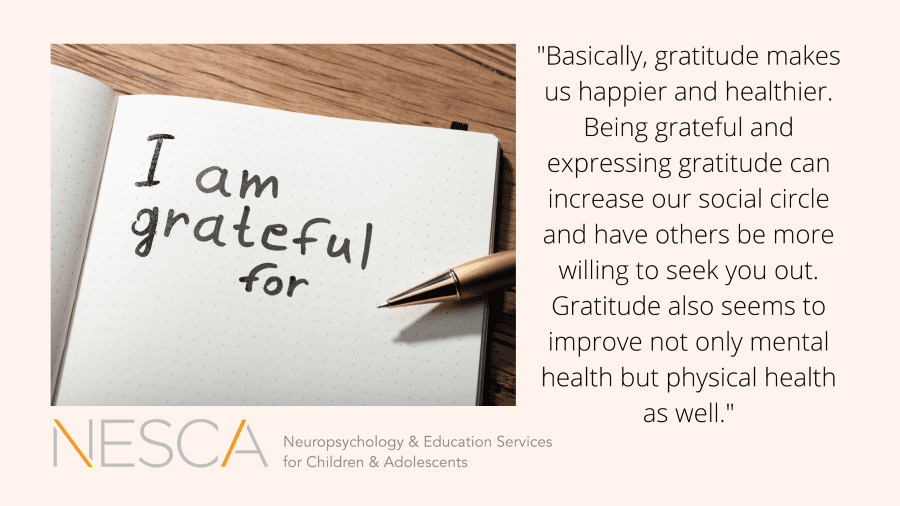
Basically, gratitude makes us happier and healthier. Being grateful and expressing gratitude can increase our social circle and have others be more willing to seek you out. Gratitude also seems to improve not only mental health but physical health as well. Studies show that grateful people take care of themselves better. They are more likely to exercise and more likely to follow up with medical personal. Studies show that writing in a gratitude journal before bed can even help you sleep better! (Morin, n.d.)

How can I help my child build gratitude?

Young people with disabilities, especially speech and language challenges, may have a hard time sharing their experiences at the end of the school day. Before my students left for the day, I would always ask them to go around the room and share one thing they enjoyed during their day. This way, no matter how challenging the day was, they ended it on a good note. Over time, the students began to look forward to sharing a positive experience from their day. Whether it was getting a compliment at their worksite or overcoming a challenge, they began to go looking for the positives.

Another wonderful way to build gratitude is to turn it into a scavenger hunt. Give each day a topic and share your gratitude topic at dinner. 

While we often think of a gratitude journal as something written, it doesn’t have to be. Have fun with it! Instead of writing down what you are thankful for today, take a picture with your phone or have your child make a drawing relating to the topic. Pinterest is full of great ideas, like the image below. Doing this for a month may turn you and your child a little more gleeful and find a brighter outlook on tomorrow.

Image Credit: Woman of Purpose (thepurposedwomanmag.com)

What are you grateful for today?


About the Author

Tabitha Monahan, M.A., CRC, is an experienced transition evaluator and vocational counselor. While she is well-versed in supporting a wide range of transition-aged youth, she is especially passionate and knowledgeable in helping clients and their families navigate the complex systems of adult services and benefits as well as medical and mental health systems. She is further adept in working individually with students of all abilities to empower self-advocacy and goal achievement.


To schedule an appointment with one of NESCA’s expert transition specialists or neuropsychologists, please complete our online intake form


Neuropsychology & Education Services for Children & Adolescents (NESCA) is a pediatric neuropsychology practice and integrative treatment center with offices in Newton and Plainville, Massachusetts, and Londonderry, New Hampshire, serving clients from preschool through young adulthood and their families. For more information, please email info@nesca-newton.com or call 617-658-9800.


Key Facts about Early Diagnosis of Autism Spectrum Disorder (ASD)

By | NESCA Notes 2020

By Renée Marchant, Psy.D.
Pediatric Neuropsychologist

Early diagnosis is a catalyst for propelling children on positive trajectories. If a family and child identify and focus on areas of growth earlier rather than later, there is more time and more possibility of change and improvement. This tenant is particularly critical for diagnosing ASD in toddlerhood and early childhood.

Here are critical facts about the diagnosis of ASD in early childhood and the positive impact of early diagnosis on youngsters as they age into adulthood.

  1. Most children with ASD are not diagnosed until approximately 4 years-old, yet ASD can be reliably identified by the age of 2. There is also expanding research on early identification of infants who may be at risk for ASD. Early detection is possible.
  2. Genes play an important role in ASD. A child’s odds of having an ASD diagnosis increases if he/she has a sibling or parent with ASD, attention deficit hyperactivity disorder (ADHD), intellectual disability, schizophreniadepression, bipolar disorder or anxiety. Family medical history is an important factor for families considering a diagnostic evaluation.
  3. Co-occurring disorders (such as anxiety and depression) are more likely in individuals with ASD than the general population. Identifying emotion regulation issues in early childhood is thus essential.
  4. Neuroplasticity matters. Because ASD is a neurodevelopmental disorder, early treatment improves neuroplastic brain functioning and subsequent behavior. As a child develops, his/her brain becomes less plastic.
  5. Interventions geared at a child’s “first relationships” with their caregivers may exert a strong positive effect on the developmental trajectories of toddlers at high-risk of ASD and also have a positive impact on a child’s social skills with peers as they age.
  6. Research indicates that parent-child interactions in early childhood predict long-term gains in language skills into adulthood for individuals with diagnoses of ASD. Acquiring communicative, pragmatic and useful language by kindergarten has also been identified as a strong predictor of adaptive or functional “real life” skills, which are needed to navigate the environment in adolescence and adulthood.
  7. Social skills instruction in a child’s early years increases competency with peers in school. This social competency is associated with greater adaptive independence in children with ASD.
  8. Working with a “diagnostic navigator” early in your child’s life improves outcomes. Research clearly indicates that social support is vital to relieve stress associated with caregiving for a child with ASD and that a positive parent–professional relationship is helpful in alleviating family stress.

If you suspect your child has or is at higher risk for ASD and you are looking for a “diagnostic navigator” for your child, consider an evaluation with NESCA.  While early diagnosis of ASD can make a positive impact on a child’s trajectory, obtaining the accurate diagnosis and recommendations for interventions at any age is critical.


References:

Elder JH, Kreider CM, Brasher SN, Ansell M. Clinical impact of early diagnosis of autism on the prognosis and parent-child relationships. Psychol Res Behav Manag. 2017;10:283-292. Published 2017 Aug 24. doi:10.2147/PRBM.S117499.

Dawson G, Jones EJ, Merkle K, Venema K, Lowy R, Faja S, Kamara D, Murias M, Greenson J, Winter J, Smith M, Rogers SJ, Webb SJ. Early behavioral intervention is associated with normalized brain activity in young children with autism. J Am Acad Child Adolesc Psychiatry. 2012 Nov;51(11):1150-9. doi: 10.1016/j.jaac.2012.08.018. PMID: 23101741; PMCID: PMC3607427.

Jokiranta-Olkoniemi E, Cheslack-Postava K, Sucksdorff D, Suominen A, Gyllenberg D, Chudal R, Leivonen S, Gissler M, Brown AS, Sourander A. Risk of Psychiatric and Neurodevelopmental Disorders Among Siblings of Probands With Autism Spectrum Disorders. JAMA Psychiatry. 2016 Jun 1;73(6):622-9. doi: 10.1001/jamapsychiatry.2016.0495. PMID: 27145529.

Kasari C, Siller M, Huynh LN, Shih W, Swanson M, Hellemann GS, Sugar CA. Randomized controlled trial of parental responsiveness intervention for toddlers at high risk for autism. Infant Behav Dev. 2014 Nov;37(4):711-21. doi: 10.1016/j.infbeh.2014.08.007. Epub 2014 Sep 26. PMID: 25260191; PMCID: PMC4355997.

Mayo, J., Chlebowski, C., Fein, D.A. et al. Age of First Words Predicts Cognitive Ability and Adaptive Skills in Children with ASD. J Autism Dev Disord 43, 253–264 (2013). https://doi.org/10.1007/s10803-012-1558-0.

Siller, M., Swanson, M., Gerber, A., Hutman, T., & Sigman, M. (2014). A parent-mediated intervention that targets responsive parental behaviors increases attachment behaviors in children with ASD: results from a randomized clinical trial. Journal of Autism and Developmental Disorders, 44(7), 1720-1732.

Xie S, Karlsson H, Dalman C, Widman L, Rai D, Gardner RM, Magnusson C, Schendel DE, Newschaffer CJ, Lee BK. Family History of Mental and Neurological Disorders and Risk of Autism. JAMA Netw Open. 2019 Mar 1;2(3):e190154. doi: 10.1001/jamanetworkopen.2019.0154. PMID: 30821823; PMCID: PMC6484646.


About the Author:

Dr. Renée Marchant provides neuropsychological and psychological (projective) assessments for youth who present with a variety of complex, inter-related needs, with a particular emphasis on identifying co-occurring neurodevelopmental and psychiatric challenges. She specializes in the evaluation of developmental disabilities including autism spectrum disorder and social-emotional difficulties stemming from mood, anxiety, attachment and trauma-related diagnoses. She often assesses children who have “unique learning styles” that can underlie deficits in problem-solving, emotion regulation, social skills and self-esteem.

Dr. Marchant’s assessments prioritize the “whole picture,” particularly how systemic factors, such as culture, family life, school climate and broader systems impact diagnoses and treatment needs. She frequently observes children at school and participates in IEP meetings.

Dr. Marchant brings a wealth of clinical experience to her evaluations. In addition to her expertise in assessment, she has extensive experience providing evidence-based therapy to children in individual (TF-CBT, insight-oriented), group (DBT) and family (solution-focused, structural) modalities. Her school, home and treatment recommendations integrate practice-informed interventions that are tailored to the child’s unique needs.

Dr. Marchant received her B.A. from Boston College with a major in Clinical Psychology and her Psy.D. from William James College in Massachusetts. She completed her internship at the University of Utah’s Neuropsychiatric Institute and her postdoctoral fellowship at Cambridge Health Alliance, a Harvard Medical School teaching hospital, where she deepened her expertise in providing therapy and conducting assessments for children with neurodevelopmental disorders as well as youth who present with high-risk behaviors (e.g. psychosis, self-injury, aggression, suicidal ideation).

Dr. Marchant provides workshops and consultations to parents, school personnel and treatment professionals on ways to cultivate resilience and self-efficacy in the face of adversity, trauma, interpersonal violence and bullying. She is an expert on the interpretation of the Rorschach Inkblot Test and provides teaching and supervision on the usefulness of projective/performance-based measures in assessment. Dr. Marchant is also a member of the American Family Therapy Academy (AFTA) and continues to conduct research on the effectiveness of family therapy for high-risk, hospitalized patients.


To book an evaluation with Dr. Marchant or one of our many other expert neuropsychologists, complete NESCA’s online intake form.


Neuropsychology & Education Services for Children & Adolescents (NESCA) is a pediatric neuropsychology practice and integrative treatment center with offices in Newton and Plainville, Massachusetts, and Londonderry, New Hampshire, serving clients from preschool through young adulthood and their families. For more information, please email info@nesca-newton.com or call 617-658-9800.


Linking Strengths and Interests to College Majors and Careers: The MassHire Career Information System

By | NESCA Notes 2020

By: Kelley Challen, Ed.M., CAS
Director of Transition Services; Assistant Director, NESCA

Due to Covid-19, many schools are functioning in a hybrid or remote learning status, making access to school-based guidance counselors, college counselors and transition personnel more complicated. Consequently, I am working with an unusually high number of high school students and families to provide assistance with the college selection and admissions process this year. For these students and others, working with a private transition specialist or college consultant/coach provides the structure and consistent support needed to ensure the student is able to find colleges that will be a great match, highlight the student’s strengths as a college applicant and complete the application process efficiently. Most importantly, the added support reduces anxiety—which is a natural response to the college process as well as living through a pandemic.

There are so many factors to consider when choosing a college—size, religion, location, tuition and fees, availability of internships, academic support, etc.—and one of the most important differentiating factors is often the availability of majors that a student is interested in. As such, career exploration is a very important part of my work with college-bound students. There are certainly many online resources that are useful for career exploration—YouScience, O*NET OnLine, Naviance, Khan Academy, Dr. Kit, CareerOneStop, etc.—but my personal favorite site to help teenagers learn to use is MassHire Career Information System (Previously MassCIS; https://portal.masscis.intocareers.org/).

MassHire CIS is a portal that any individual, from middle school to adulthood, can access for free by logging in with their Massachusetts City or Town Name and their Zip Code. Once inside, users can complete assessments related to their interests, skills and values, preferred lifestyle and more. The site also allows students to link results from previously taken career assessments to information about occupations and occupation categories within MassHire CIS.

Using career interests, from assessments or just a self-reported interest (e.g., photographer, elementary school teacher, personal trainer), users can research occupations and find out everything from the tasks associated with the occupation, to helpful high school courses that relate to the job, and expected future wages and occupational outlook. Users can also watch videos to learn more about occupations.

Importantly, users can easily click from careers of interest to programs of study and ultimately to Massachusetts Schools or other US Colleges and Universities that offer majors leading to occupations of interest.

MassHire CIS is one of my favorite resources to share with teens, young adults and families as part of a college transition process—but also when students are building career awareness at other times or seeking a different path to employment. I hope that by spotlighting this in my blog, more families, educators and professionals will also explore and adopt this resource as a favorite!


About the Author:

Kelley Challen, Ed.M., CAS, is NESCA’s Director of Transition Services, overseeing planning, consultation, evaluation, coaching, case management, training and program development services. She is also the Assistant Director of NESCA, working under Dr. Ann Helmus to support day-to-day operations of the practice. Ms. Challen began facilitating programs for children and adolescents with special needs in 2004. After receiving her Master’s Degree and Certificate of Advanced Study in Risk and Prevention Counseling from Harvard Graduate School of Education, Ms. Challen spent several years at the MGH Aspire Program where she founded an array of social, life and career skill development programs for teens and young adults with Asperger’s Syndrome and related profiles. She additionally worked at the Northeast Arc as Program Director for the Spotlight Program, a drama-based social pragmatics program, serving youth with a wide range of diagnoses and collaborating with several school districts to design in-house social skills and transition programs. Ms. Challen is co-author of the chapter “Technologies to Support Interventions for Social- Emotional Intelligence, Self-Awareness, Personality Style, and Self-Regulation” for the book Technology Tools for Students with Autism. She is also a proud mother of two energetic boys, ages six and three. While Ms. Challen has special expertise in supporting students with Autism Spectrum Disorders, she provides support to individuals with a wide range of developmental and learning abilities, including students with complex medical needs.

Neuropsychology & Education Services for Children & Adolescents (NESCA) is a pediatric neuropsychology practice and integrative treatment center with offices in Newton, Massachusetts, Plainville, Massachusetts, and Londonderry, New Hampshire, serving clients from preschool through young adulthood and their families. For more information, please email info@nesca-newton.com or call 617-658-9800.

Positive Coping Strategies for Stress, Anxiety and Trauma During Times of Crisis

By | NESCA Notes 2020

By Renée Marchant, Psy.D.
Pediatric Neuropsychologist

Amidst the global pandemic, children, their caregivers, their teachers and therapists are naturally experiencing heightened stress and anxiety. We are more likely to be sent into “fight, flight, freeze, mode” – the body and brain’s critical survival strategy to prepare and deal with perceived threat. For example, when you see a Grizzly Bear on your hiking trail, you instinctually run, fight back or hide.

However, we can become “stuck” or more sensitive to this instinctual urge, which is not adaptive and can negatively impact physical, emotional and social health. For example, chronic deployment of the “flight, flight, freeze” response occurs for individuals who experience post-traumatic stress disorder. Chronic deployment of “fight, flight, freeze” responses is also more likely amidst a global pandemic, such as COVID-19. Importantly, chronic deployment of “fight, flight, freeze” responses also occurs for individuals and communities who experience chronic racial injustice and oppression.

Under chronic experiences of stress and threat, our body remains activated and hyper-aroused, even when deploying this response is not helpful. For example, children may shut down or dysregulate when faced with even small stressors – making an error on a math worksheet or even accidentally spilling something on the table. Children and teens may be more irritable, defiant or isolative. Overall, chronic deployment of the “fight, flight, freeze” response heightens anxiety, stress and general feelings of malaise.

So, what can we do? What can we do to “turn off” or lessen this stress response? What are some ways to positively cope during these difficult times?

  1. Research shows that the #1 resiliency factor is the reliable presence of at least one supportive relationship with an adult. Build connection and community through shared activities and conversations about your experiences. Remember to always take care of yourself before taking care of others – self-care is critical.
  2. Focus on validation first; problem-solving second. Validating, acknowledging and accepting pain, distress, hurt and the like builds communication and naturally decreases tension and stress. Validation is the essential first step prior to action, problem-solving and positive coping.
  3. In order to grow positive coping, it is helpful to build mastery and self-expression. Strategies that can help to both organize and “release” feelings and stressful experiences rather than “bottle them up” include:
  • Use your body to heal your mind: play, do yoga, engage with nature, exercise;
  • Engage in shared action to promote communication and change at a community and systemic level. Volunteer or advocate for a cause of importance. Contact your local legislators and express your concerns;
  • Write or draw about your experience. Use collages, images or videos to express your goals, experiences and fears;
  • Engage in therapeutic movement. Create a music playlist for various emotions. Dance or engage in rhythmic actions (e.g. knitting, pottery);
  • Identify your strengths and what you value in life. Happiness is fleeting – goals and values last longer and support positive coping. For a free strengths and values survey, check out: https://www.viacharacter.org/;
  • Connect with community resources available in your area, such as therapists, mentors, religious organizations, support groups, local-nonprofits, etc.; and
  • Be kind to yourself and practice self-compassion.


About the Author:

Dr. Renée Marchant provides neuropsychological and psychological (projective) assessments for youth who present with a variety of complex, inter-related needs, with a particular emphasis on identifying co-occurring neurodevelopmental and psychiatric challenges. She specializes in the evaluation of developmental disabilities including autism spectrum disorder and social-emotional difficulties stemming from mood, anxiety, attachment and trauma-related diagnoses. She often assesses children who have “unique learning styles” that can underlie deficits in problem-solving, emotion regulation, social skills and self-esteem.

Dr. Marchant’s assessments prioritize the “whole picture,” particularly how systemic factors, such as culture, family life, school climate and broader systems impact diagnoses and treatment needs. She frequently observes children at school and participates in IEP meetings.

Dr. Marchant brings a wealth of clinical experience to her evaluations. In addition to her expertise in assessment, she has extensive experience providing evidence-based therapy to children in individual (TF-CBT, insight-oriented), group (DBT) and family (solution-focused, structural) modalities. Her school, home and treatment recommendations integrate practice-informed interventions that are tailored to the child’s unique needs.

Dr. Marchant received her B.A. from Boston College with a major in Clinical Psychology and her Psy.D. from William James College in Massachusetts. She completed her internship at the University of Utah’s Neuropsychiatric Institute and her postdoctoral fellowship at Cambridge Health Alliance, a Harvard Medical School teaching hospital, where she deepened her expertise in providing therapy and conducting assessments for children with neurodevelopmental disorders as well as youth who present with high-risk behaviors (e.g. psychosis, self-injury, aggression, suicidal ideation).

Dr. Marchant provides workshops and consultations to parents, school personnel and treatment professionals on ways to cultivate resilience and self-efficacy in the face of adversity, trauma, interpersonal violence and bullying. She is an expert on the interpretation of the Rorschach Inkblot Test and provides teaching and supervision on the usefulness of projective/performance-based measures in assessment. Dr. Marchant is also a member of the American Family Therapy Academy (AFTA) and continues to conduct research on the effectiveness of family therapy for high-risk, hospitalized patients.


To book an evaluation with Dr. Marchant or one of our many other expert neuropsychologists, complete NESCA’s online intake form.


Neuropsychology & Education Services for Children & Adolescents (NESCA) is a pediatric neuropsychology practice and integrative treatment center with offices in Newton and Plainville, Massachusetts, and Londonderry, New Hampshire, serving clients from preschool through young adulthood and their families. For more information, please email info@nesca-newton.com or call 617-658-9800.


Kids Want to Do Well and Would If They Could

By | NESCA Notes 2020

By: Cynthia Hess, PsyD
Pediatric Neuropsychologist Fellow and Therapist

Ross Greene, Ph.D., is the author of several books including The Explosive Child, Lost at School, Lost and Found, and his most recent book, Raising Human Beings. He also is the founder of Lives in the Balance, a non-profit dedicated to supporting families with behaviorally challenging children. The foundation of his approach is that all kids want to do well and would if they could. Dr. Greene emphasizes using a collaborative problem-solving approach, which he calls Collaborative and Proactive Solutions (CPS). This model is based on the assertion that challenging behaviors arise when a child is faced with expectations that exceed their capacity to respond adaptively. Thus, adults are encouraged to take a collaborative, proactive approach to managing challenging behavior as opposed to relying on punishment and rewards.

The focus of collaborative problem-solving is not on the child’s challenging behavior, which could range from crying and whining, to hitting and biting, but rather on the expectations the child is having difficulty meeting. Adults work to identify the problematic expectations and the skills the child is lacking to meet the expectations. Dr. Greene refers to unmet expectations as “unsolved problems.” The goal is to solve those problems rather than modify behavior. Dr. Greene describes the CPS model as non-punitive and non-adversarial, and as such, it decreases the likelihood of conflict, enhances relationships and improves communication.

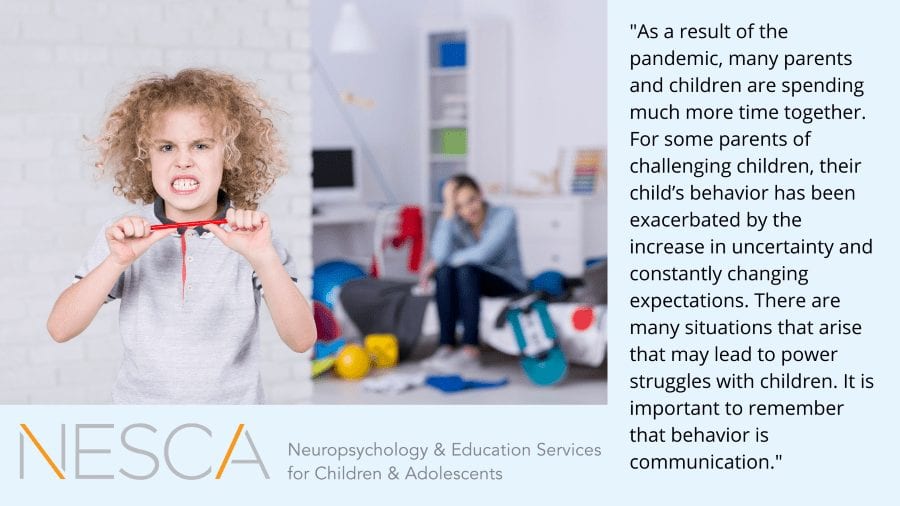
As a result of the pandemic, many parents and children are spending much more time together. For some parents of challenging children, their child’s behavior has been exacerbated by the increase in uncertainty and constantly changing expectations. There are many situations that arise that may lead to power struggles with children. It is important to remember that behavior is communication. Families are encouraged to reconsider their expectations and work collaboratively with their children to solve problems, especially when faced with extraordinary circumstances.

The specifics of collaborative problem-solving are much more detailed than there is space in this blog, and I encourage you to check out the resources listed below. While the consequences of the pandemic are certainly very stressful, they also present a good opportunity for families to enhance communication, uncover unsolved problems, teach skills and foster resilience.


Books for families by Dr. Greene:

The Explosive Child

Raising Human Beings

Website – contains educational videos and free resources for families and educators: https://www.livesinthebalance.org/about-cps

There are many YouTube videos available about CPS, but this one is pertinent to our current circumstances


About the Author

Dr. Cynthia Hess recently graduated from Rivier University with a PsyD in Counseling and School Psychology. Previously, she earned an M.A. from Antioch New England in Applied Psychology. She also worked as an elementary school counselor and school psychologist for 15 years before embarking on her doctorate. During her doctorate, she did her pre-doctoral internship with RIT in Rochester, N.Y. where she worked with youth ages 5-17 who had experienced complex developmental trauma. Dr. Hess’s first post-doctoral fellowship was with The Counseling Center of New England where she provided psychotherapy and family therapy to children ages 5-18, their families and young adults. She also trained part-time with a pediatric neuropsychologist conducting neuropsychological evaluations. Currently, Dr. Hess is a second-year post-doctoral fellow in pediatric neuropsychological assessment, working with NESCA Londonderry’s Dr. Angela Currie.


To schedule an appointment with one of NESCA’s expert neuropsychologists, please complete our online intake form


Neuropsychology & Education Services for Children & Adolescents (NESCA) is a pediatric neuropsychology practice and integrative treatment center with offices in Newton and Plainville, Massachusetts, and Londonderry, New Hampshire, serving clients from preschool through young adulthood and their families. For more information, please email info@nesca-newton.com or call 617-658-9800.


Skip to content