
Tag

nesca newton ma Archives - Page 10 of 14 - NESCA

Subscribe to NESCA Notes

Why Work Matters for Teens

By | NESCA Notes 2021

By: Kelley Challen, Ed.M., CAS
Director of Transition Services; Transition Specialist, NESCA

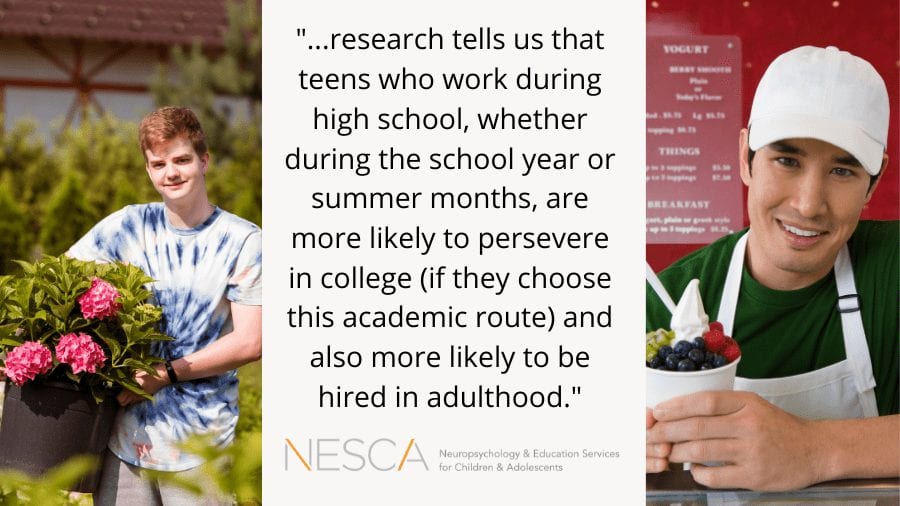
“The share of teens participating in the labor force peaked 40 years ago and has declined ever since.”[1] There are many reasons why employment rates among teens ages 16-19 have declined, such as increased schoolwork and graduations requirements, summer program and extracurricular opportunities, and work competition. Now, roughly only one-third of youth in this age range are part of the workforce. But research tells us that teens who work during high school, whether during the school year or summer months, are more likely to persevere in college (if they choose this academic route) and also more likely to be hired in adulthood. For teenagers with disabilities, a population of young people who face a high risk for unemployment in adulthood, work experience in high school is even more critical.

Some of the benefits of paid employment for all students include:

  1. A new sense of identity—as a worker
  2. Learning workplace norms and expectations
  3. Developing important executive functioning skills, like time and task management
  4. Building social skills by collaborating and negotiating with other workers and/or customers
  5. Improving self-awareness through receiving coworker and employer feedback
  6. Reading a paycheck and learning to manage earned money
  7. Starting to identify learning and career goals (“I never want to do this again, so I am going to need to get a degree or some training.”) and/or gaining experience in a field of interest

Even failed work experiences—and failed application processes—are extremely valuable tools for learning the above skills as well as building coping and problem-solving skills.

And since it is almost summer and teenagers are finishing, or have finished, their classes for the school year, this is a great time to make a plan for summer employment. Teens can look in traditional places such as grocery stores, retailers, and fast-food restaurants, or may want to pursue something non-traditional like doing yard work, dog walking/pet sitting, cleaning/detailing, or odd jobs for family friends and neighbors. Those 18 and over with driver’s licenses may enjoy the flexibility of working with a delivery service like Instacart or Uber Eats.

Because work—whether a summer, part-time, traditional or non-traditional job—is such a critical aspect of transition planning, NESCA has authored many blogs related to career assessment, career planning, and career counseling. Some of these include:

We hope you will enjoy reading these blogs. More importantly, we hope you will help teenagers in your life get out there and work!

Reference:

[1] https://www.cnbc.com/2019/10/06/why-so-few-teenagers-have-jobs-anymore.html


About the Author
Kelley Challen, Ed.M., CAS, is NESCA’s Director of Transition Services, overseeing planning, consultation, evaluation, coaching, case management, training and program development services. Ms. Challen also provides expert witness testimony in legal proceedings related to special education. She is also the Assistant Director of NESCA, working under Dr. Ann Helmus to support day-to-day operations of the practice. Ms. Challen began facilitating programs for children and adolescents with special needs in 2004. After receiving her Master’s Degree and Certificate of Advanced Study in Risk and Prevention Counseling from Harvard Graduate School of Education, Ms. Challen spent several years at the MGH Aspire Program where she founded an array of social, life and career skill development programs for teens and young adults with Asperger’s Syndrome and related profiles. She additionally worked at the Northeast Arc as Program Director for the Spotlight Program, a drama-based social pragmatics program, serving youth with a wide range of diagnoses and collaborating with several school districts to design in-house social skills and transition programs. Ms. Challen is co-author of the chapter “Technologies to Support Interventions for Social- Emotional Intelligence, Self-Awareness, Personality Style, and Self-Regulation” for the book Technology Tools for Students with Autism. She is also a proud mother of two energetic boys, ages six and three. While Ms. Challen has special expertise in supporting students with Autism Spectrum Disorders, she provides support to individuals with a wide range of developmental and learning abilities, including students with complex medical needs.


Neuropsychology & Education Services for Children & Adolescents (NESCA) is a pediatric neuropsychology practice and integrative treatment center with offices in Newton, Massachusetts, Plainville, Massachusetts, and Londonderry, New Hampshire, serving clients from preschool through young adulthood and their families. For more information, please email info@nesca-newton.com, call 617-658-9800 or complete our online Intake Form.

Why Taking Competency Tests, like the MCAS, can be Critical for Transition and College Planning

By | NESCA Notes 2021

By: Kelley Challen, Ed.M., CAS
Director of Transition Services; Transition Specialist, NESCA

Most states require some form of competency testing for students, particularly students who will graduate with a state standard diploma. But in the past year, standardized competency testing has become more complicated, if not impossible, to carry out.

In Massachusetts, graduation requirements have been altered for several grades of students. Students graduating in 2021-2023 are being offered alternative options for meeting state competency determination in one or more of the required subject areas (e.g., science and technology/engineering, mathematics, English Language Arts). For more details about those alternatives, see MA Graduation Requirements and Related Guidance on the Massachusetts Department of Elementary and Secondary Education (DESE) website.

The opportunity for students in the Class of 2022 to graduate without ever sitting for 10th grade MCAS is something that many students, parents, and teachers are excited about. While I understand, and even agree with, criticisms of standardized testing, there are also many reasons that I am disappointed for the students who are missing out on the opportunity to sit for this testing. These students, especially those with disabilities, are missing out on a vital transition planning activity.

Preparing for, and sitting for, (and coping with,) high stakes tests is an important part of life. Whether you pass or fail, being able to show up and perform your best in a high-pressure situation is a valuable life skill. Moreover, being able to demonstrate competency in a test situation is a reasonable and necessary college and career skill.

Additionally, standardized tests like MCAS provide objective feedback regarding the student’s level of achievement with high school material. Grades can be tremendously subjective, and are highly dependent on the teachers and types of classes that the student is exposed to during high school. In contrast, students participating in honors, college prep, and functional math classes all sit for the same standardized math tests. This is especially important when students in all three of those classes are interested in heading off to college after high school, and when we want to get a sense of their readiness for handling college coursework. Generally, students who do not earn passing scores (i.e., students who score in the “Needs Improvement” or “Partially Meeting Expectations” categories) on the MCAS, especially by 12th grade, will struggle with college placement exams, such as the Accuplacer, and may end up needing to take remedial coursework at the start of college. Students have a right to know how ready they are for the academic rigors of college as they are making their college plans, and standardized testing results can be helpful information (although they are by no means the whole picture).

With the new competency determination options, many students in Massachusetts view sitting for MCAS as something that is only worth doing if they are possible candidates for the John and Abigail Adams Scholarship (a merit-based state scholarship program). However, I hope students will also consider the other positive reasons I have listed above when deciding whether to sit for the test. For college-bound students who do choose not to sit for MCAS, I strongly recommend sitting for other standardized exams during high school, such as SAT, ACT, Accuplacer, etc. These experiences are important opportunities to build confidence in high stakes situations, to assess college readiness skills, and to identify skill gaps that may need shoring up.

Certainly, there are many legitimate concerns about standardized test contents and validity, including significant equity issues. I also believe that competency tests and college placement tests provide important information for many college-bound students. They are one metric, among many, that are worth having for transition and college planning.


About the Author
Kelley Challen, Ed.M., CAS, is NESCA’s Director of Transition Services, overseeing planning, consultation, evaluation, coaching, case management, training and program development services. Ms. Challen also provides expert witness testimony in legal proceedings related to special education. She is also the Assistant Director of NESCA, working under Dr. Ann Helmus to support day-to-day operations of the practice. Ms. Challen began facilitating programs for children and adolescents with special needs in 2004. After receiving her Master’s Degree and Certificate of Advanced Study in Risk and Prevention Counseling from Harvard Graduate School of Education, Ms. Challen spent several years at the MGH Aspire Program where she founded an array of social, life and career skill development programs for teens and young adults with Asperger’s Syndrome and related profiles. She additionally worked at the Northeast Arc as Program Director for the Spotlight Program, a drama-based social pragmatics program, serving youth with a wide range of diagnoses and collaborating with several school districts to design in-house social skills and transition programs. Ms. Challen is co-author of the chapter “Technologies to Support Interventions for Social- Emotional Intelligence, Self-Awareness, Personality Style, and Self-Regulation” for the book Technology Tools for Students with Autism. She is also a proud mother of two energetic boys, ages six and three. While Ms. Challen has special expertise in supporting students with Autism Spectrum Disorders, she provides support to individuals with a wide range of developmental and learning abilities, including students with complex medical needs.


Neuropsychology & Education Services for Children & Adolescents (NESCA) is a pediatric neuropsychology practice and integrative treatment center with offices in Newton, Massachusetts, Plainville, Massachusetts, and Londonderry, New Hampshire, serving clients from preschool through young adulthood and their families. For more information, please email info@nesca-newton.com or call 617-658-9800.

Cyberbullying and Autism Spectrum Disorders

By | NESCA Notes 2021

By Yvonne M. Asher, Ph.D. 
Pediatric Neuropsychologist

I recently had the opportunity to attend a webinar by Justin Patchin, Ph.D., one of the foremost cyberbullying researchers. I have used his work myself in designing both my master’s thesis and doctoral dissertation research, so it was wonderful to hear him speak. He began with a story about his childhood and some of the rules he was taught – don’t meet up with strangers that you meet online, don’t get into anyone’s car if you don’t know them well – lessons I was also taught as a child. These are the kind of rules that individuals with Autism Spectrum Disorders (ASD) often crave – black and white, clear, no middle ground. The online world, he argued, does not allow for such stark and rigid rules. Rather, he says, it calls for “guidelines.” Working with children with ASD, when I hear “guidelines,” I think, “grey,” “fuzzy,” and “it depends.” These can be some of the toughest situations for an individual who is not neurotypical.

I think he’s right. The online world is fast, fluid, ever-changing, and highly dependent on specific circumstances. It calls for the kind of flexible thinking and evaluation of context that kids with ASD are so often challenged by. Yet, as the adults parenting, educating, and supporting these young people, these are exactly the skills that they need. The online world is not going anywhere anytime soon, and it is not likely to slow down either.

Cyberbullying is one of the difficult online phenomena to manage, as youth who are bullied online are most frequently also bullied in “real life,” usually at school. The bullies are often peers they know and must see on a regular basis. For children with social challenges, navigating bullying that is occurring across settings is an especially difficult task. And the solution is not to take away technology. Now more than ever, children need access to technology for homework, classwork, enjoyable peer activities, and hobbies. Where does that leave us?

Unfortunately, Dr. Patchin did not give any practical advice for how to support individuals with autism around cyberbullying. I think that one important starting point is to help these individuals learn to check in with themselves. Time and time again, I hear from students, “I’m not really sure what was going on, but I think they were being mean.” (In fact, I hear this from children who are decidedly not on the autism spectrum, especially when bullying is occurring by older peers.) Bullying is hurtful (intentionally so), and recognizing that hurt is an important first step. Once children and adolescents identify that something is hurtful, adults can help and support them in navigating through the situation.

Whether bullying, cyberbullying, or a misunderstanding, it is important for adults to listen carefully when children come to us with social concerns. In addition, we must have a solid understanding of the online world in which students are living, learning, and engaging. Social media shifts rapidly, with new platforms becoming wildly popular in a matter of weeks. Working with youth requires us to keep as current as we can, making certain that we understand the “ins and outs” of each platform. It is also incumbent upon us to ensure that all children and adolescents (not just those with an autism diagnosis) learn guidelines that will allow them to safely make their way through a constantly evolving world of platforms, apps, and services. Safety online is as critical as safety in person.


About the Author

Dr. Yvonne M. Asher enjoys working with a wide range of children and teens, including those with autism spectrum disorder, developmental delays, learning disabilities, attention difficulties and executive functioning challenges. She often works with children whose complex profiles are not easily captured by a single label or diagnosis. She particularly enjoys working with young children and helping parents through their “first touch” with mental health care or developmental concerns.
Dr. Asher’s approach to assessment is gentle and supportive, and recognizes the importance of building rapport and trust. When working with young children, Dr. Asher incorporates play and “games” that allow children to complete standardized assessments in a fun and engaging environment.

Dr. Asher has extensive experience working in public, charter and religious schools, both as a classroom teacher and psychologist. She holds a master’s degree in education and continues to love working with educators. As a psychologist working in public schools, she gained invaluable experience with the IEP process from start to finish. She incorporates both her educational and psychological training when formulating recommendations to school teams.

Dr. Asher attended Swarthmore College and the Jewish Theological Seminary. She completed her doctoral degree at Suffolk University, where her dissertation looked at the impact of starting middle school on children’s social and emotional wellbeing. After graduating, she completed an intensive fellowship at the MGH Lurie Center for Autism, where she worked with a wide range of children, adolescents and young adults with autism and related disorders.


Neuropsychology & Education Services for Children & Adolescents (NESCA) is a pediatric neuropsychology practice and integrative treatment center with offices in Newton, Massachusetts, Plainville, Massachusetts, and Londonderry, New Hampshire, serving clients from preschool through young adulthood and their families. For more information, please email info@nesca-newton.com or call 617-658-9800.


To book an appointment with Dr. Yvonne Asher, please complete our Intake Form today. For more information about NESCA, please email info@nesca-newton.com or call 617-658-9800.


Diplomas, Graduation Dates and IEP Transition Services Revisited

By | NESCA Notes 2021

By: Kelley Challen, Ed.M., CAS
Director of Transition Services; Assistant Director, NESCA

Three years ago, on March 26, 2019, the Massachusetts Department of Elementary and Secondary Education (DESE) sent out an important administrative advisory regarding transition services and graduating with a high school diploma (Administrative Advisory SPED 2018-2: Secondary Transition Services and Graduation with a High School Diploma). At the time, I wrote a blog about the advisory, wanting to bring attention to the much-needed guidance clarifying when and how students with IEPs (Individualized Education Programs) should be issued a high school diploma.

Today, more than a year into the COVID-19 pandemic, seems like a very important time to revisit what it means for a student on an IEP to be ready to graduate high school with a diploma this June. Given the lengthy school shutdown in Spring 2020—followed by ongoing limitations in social contact, community engagement, employment opportunities, and more—many students and their families are questioning whether they are ready for graduation. In fact, I sat in a team meeting last week where a special educator asked an adult student whether they would like to take their diploma or “refuse” their diploma in June. [This phrasing, “refusing” or “rejecting” a diploma, is often used but is inaccurate as a student is not refusing to take their diploma. Rather, the team is instead delaying or deferring graduation in certain circumstances.]

As a parent and professional regularly involved in the IEP process, a comfort throughout this pandemic is that while education has been reinvented several times, and community safety and engagement is highly variable, special education laws (including the Individuals with Disabilities Education Act of 2004, which outlines the requirement for school districts to provide transition services) remain the same. The decision for a student receiving special education services to take a diploma, or defer taking a diploma, continues to be based primarily on the same variables:

  1. Meeting local graduation requirements;
  2. Passing the state Competency Determination (CD); and
  3. Receiving Free and Appropriate Public Education (FAPE) that includes secondary transition services based on age-appropriate transition assessment.

Prior to COVID-19, passing the state CD in Massachusetts typically involved passing on-demand tests in English Language Arts (ELA), Mathematics and Science or successfully completing an alternate assessment competency portfolio. For students who have an anticipated graduation date prior to October 1, 2021 (as noted in their most recent signed IEP), something that has changed during the pandemic is that there are now Modified CD requirements that allow for CD in ELA and mathematics to be awarded upon district certification that the student earned full credit for a relevant course aligned to the curriculum framework in the subject matter and demonstrated competency in that subject. A similar Modified CD requirement for science is also available for students graduating in classes of 2021-2023. Therefore, a student who did not pass on-demand MCAS testing in 2019 may be eligible to graduate with a diploma using the Modified CD requirements.

However, as students, their parents, and their education teams ponder June 2021 graduation dates, it is important to keep focus on the same variables that we have always used for considering whether a student is ready to accept a local diploma. Here are some questions that may help when considering these variables.

  1. Has the student met all local graduation requirements? Did they complete the core courses required by the district? Or, were they given credit for courses/activities that varied greatly from courses that general education students completed? What about attendance requirements? Did the student stop attending classes or have a significantly lower rate of attendance than general education peers in the past year? Did the student meet requirements for community service hours or a capstone project if those were required of general education students?
  2. Did the student pass the state Competency Determination? Did the student have the opportunity to participate in MCAS on-demand testing? If they did not, did the student have a track record of passing MCAS tests? Was the student scheduled to graduate this June or did someone from the school district propose changing the student’s graduation date to take advantage of the Modified CD requirements currently being used by the department of education due to COVID-19?
  3. Did the student receive FAPE including secondary transition services based on age-appropriate transition assessment while in high school? Is there a Transition Planning Form (28M/9) that the team has been updating annually? Are there appropriate measurable postsecondary goals in the student’s IEP vision statement that are based on transition assessment (PLEASE remember that interview is an important assessment tool for many students)? Was the student’s voice part of team meetings where transition services were discussed? Does the student’s IEP have measurable goals that will reasonably help the student to progress toward their IEP vision statement? Has the student made effective progress on the goals outlined in the IEP over the past year? Has the student been able to engage in transition services that were described in the IEP? Was the student’s graduation date supposed to be this June or was it “TBD”? And, if appropriate, was a representative of an adult human service agency (e.g., Department of Mental Health, Department of Developmental Services, Massachusetts Rehabilitation Commission, Massachusetts Commission for the Blind, Massachusetts Commission for the Deaf and Hard of Hearing) involved in one or more IEP meetings?

Having missed out on school and community-based activities in the past year can create an immediate concern that a student needs to hang on to their special education protections and should not graduate this June. But the truth is that the pandemic created opportunities for students to generalize skills and practice functional skills, and some students are more ready than ever to move on from special education. And, as I stated in my previous blog, there is no universal set of skills or level of knowledge that deems a student on an IEP “ready” to graduate. In fact, students on IEPs, just as with mainstream students, graduate all the time without being ready for many adult activities (e.g., apartment hunting, changing jobs, applying for a bank loan, comparing health insurance plans).

When you are considering whether the student has received FAPE, it is important to remember that every student missed some typical high school planning steps over the past year. When school buildings closed down and community engagement came to a halt, educators and special educators had to pivot many times. Transition planning steps may have been missed or services may not have been delivered in originally anticipated ways without any clear fault or person to blame. If a student’s progress towards their measurable postsecondary goals was substantially halted, this might be important for the team to discuss. But there are many circumstances where students continued to make progress in spite of the missed opportunities. Perhaps the pandemic even created new opportunities for progress that would not typically be available until a student exits high school (e.g., a paid job, increased self-direction through participation in remote learning, easier access to pre-employment transition services, increased communication with peers through technology, etc.).

Regardless, as you are thinking about graduation, please remember that the most important question to ask is not, “Is my child/student ready to graduate?” Instead, the critical question to ask when a student approaches their graduation date is, “Has the student received a Free and Appropriate Public Education (FAPE)?” If the answer is “yes,” it is vital to give the student the opportunity to step into adult postsecondary life and begin applying the skills they have learned through their education and special education. Although the pandemic has created a lot of anxiety and uncertainty, let’s not fall victim to a pattern of rejecting IEPs (essentially rejecting/refusing diplomas) out of fear.

If you are interested in working with a transition specialist at NESCA for consultation, planning, or evaluation, please complete our online intake form: https://nesca-newton.com/intake-form/.

Resources:

Transition Resources and Advisories from MA Department of Elementary and Secondary Education:

While this blog includes some specific content that applies only to families of students in IEPs in Massachusetts, the requirement to deliver transition services for students on IEP is a federal mandate and impacts graduation in all states.


About the Author
Kelley Challen, Ed.M., CAS, is NESCA’s Director of Transition Services, overseeing planning, consultation, evaluation, coaching, case management, training and program development services. Ms. Challen also provides expert witness testimony in legal proceedings related to special education. She is also the Assistant Director of NESCA, working under Dr. Ann Helmus to support day-to-day operations of the practice. Ms. Challen began facilitating programs for children and adolescents with special needs in 2004. After receiving her Master’s Degree and Certificate of Advanced Study in Risk and Prevention Counseling from Harvard Graduate School of Education, Ms. Challen spent several years at the MGH Aspire Program where she founded an array of social, life and career skill development programs for teens and young adults with Asperger’s Syndrome and related profiles. She additionally worked at the Northeast Arc as Program Director for the Spotlight Program, a drama-based social pragmatics program, serving youth with a wide range of diagnoses and collaborating with several school districts to design in-house social skills and transition programs. Ms. Challen is co-author of the chapter “Technologies to Support Interventions for Social- Emotional Intelligence, Self-Awareness, Personality Style, and Self-Regulation” for the book Technology Tools for Students with Autism. She is also a proud mother of two energetic boys, ages six and three. While Ms. Challen has special expertise in supporting students with Autism Spectrum Disorders, she provides support to individuals with a wide range of developmental and learning abilities, including students with complex medical needs.


Neuropsychology & Education Services for Children & Adolescents (NESCA) is a pediatric neuropsychology practice and integrative treatment center with offices in Newton, Massachusetts, Plainville, Massachusetts, and Londonderry, New Hampshire, serving clients from preschool through young adulthood and their families. For more information, please email info@nesca-newton.com or call 617-658-9800.

Resilience, Covid and College Admissions

By | NESCA Notes 2021

By: Tabitha Monahan, M.A., CRC
NESCA Transition Specialist/Counselor

It’s been a year since schools across the nation closed their doors and moved education to the world wide web. Teachers, many of whom have never received training to teach in a virtual format, were now providing lessons remotely. The challenges of teaching remotely highlighted many of the disparities that affect our students. Students did not always have the technology or literal bandwidth to learn from home. Students with learning differences and disabilities faced even more challenges in receiving their support in a format not conducive to their needs. However, there were some silver linings. Students had more opportunities to practice executive function skills and become more familiar with software programs outside of video games, social media and YouTube videos.

As students – and, well, all of us – adjusted to the pandemic and what that meant for our daily lives, mental health concerns increased. Faced with uncertainty, constant changes and fear, anxiety, stress and depression increased among students. In response, they built coping skills.  Not all coping mechanisms are positive, but our kids survived this past year. As we work our way back to some semblance of normalcy, what does that mean for our students who were planning to move on to postsecondary education? Extracurricular activities are considered a relatively important part of the admissions process, but those weren’t available last spring and are barely available now. What should colleges use instead to find students that would be a good fit?

Resilience.

Resilience, the ability to adjust and adapt to changes and adversity, is an important factor necessary to reach goals, especially once a person faces a challenge. We encourage students to build resilience by setting high expectations of them and assisting them in creating challenging goals. We help students process what to do when they reach a roadblock. As students build coping skills and learning strategies, they are building resilience. How does resilience help in college? College is a different environment than high school. Many students experience challenges as they adjust to their newfound freedom and responsibilities. Students now find themselves responsible for scheduling their classes, getting to those classes and figuring out how to manage their schedules.

As colleges receive applications in a year unlike any in recent history, students may want to consider how they can show the colleges how they persevered. Matthew Pietrafetta of Academic Approach suggests students use the college admission essay as an opportunity to present the college with their stories that demonstrate how they became more resilient. Recommendations may also provide another factor for colleges to consider. Teachers and counselors understand the challenges that the student experienced and can share how they overcame adversity. Our students have already overcome additional challenges than many of their general education peers have not. Their past successes are the reason colleges should consider their admission. Test scores and grades are only one part of the picture. The next generation of college students has already built the resilience that will help them succeed. The past year has only exemplified this point further. Our students have proven that they can adapt and meet whatever challenges come their way. What a better way to prove to the colleges that they have what it takes?

Sources:

https://www.ncbi.nlm.nih.gov/pmc/articles/PMC7473764/

https://admissions.usf.edu/blog/do-extracurriculars-matter-in-the-college-admissions-process

https://www.insidehighered.com/admissions/views/2021/02/16/covid-19-era-college-admissions-officers-should-pay-attention-resilience?fbclid=IwAR3MNIb9ABfUJgVMZnyuJqKoF0HhBsOmYTB_ms4JZUbExvG9G_BbDUOn-gw


About the Author

Tabitha Monahan, M.A., CRC, is an experienced transition evaluator and vocational counselor. While she is well-versed in supporting a wide range of transition-aged youth, she is especially passionate and knowledgeable in helping clients and their families navigate the complex systems of adult services and benefits as well as medical and mental health systems. She is further adept in working individually with students of all abilities to empower self-advocacy and goal achievement.


To schedule an appointment with one of NESCA’s expert transition specialists or neuropsychologists, please complete our online intake form


Neuropsychology & Education Services for Children & Adolescents (NESCA) is a pediatric neuropsychology practice and integrative treatment center with offices in Newton and Plainville, Massachusetts, and Londonderry, New Hampshire, serving clients from preschool through young adulthood and their families. For more information, please email info@nesca-newton.com or call 617-658-9800.


The Uncertainty, Stress and Anxiety About What School Will Look Like

By | NESCA Notes 2020

*This blog post was originally published prior to the start of in-person school last fall for some. While many students have returned to their school buildings, many others are just now returning or will be in the coming weeks. 

By: Cynthia Hess, PsyD
Pediatric Neuropsychologist Fellow and Therapist

Much of adjusting to the world in the midst of a global pandemic has been learning to live with nearly constant uncertainty. Undoubtedly, this pandemic and ensuing uncertainty has caused significant stress for youth and their families. The experience of persistent stress can result in increased vulnerability to anxiety and depression. Symptoms may become magnified in those who already faced mental health challenges. There is little doubt that there will be increases in mental and behavior health problems for children and families both in anticipating the re-opening of schools, and when schools reopen their physical buildings.

We all wonder what school will look like in the fall. The anticipation of returning to school can be especially stressful, and will likely be so for most youth. Given that students will not have been in schools with their peers for several months, it can be anticipated that they might feel a heighted sense of insecurity and uncertainty. Even in “normal times,” returning to the complex social and educational environment of school can be worrisome for many children and adolescents.

Each individual child will have had their own experiences while schools were closed. Some children and/or staff members may have been impacted by COVID-19 and some families and/or staff may be experiencing financial hardship due to parental unemployment or loss of household income. It is important to realize that regardless of their experience, each individual will have a unique response. It is helpful to recognize the signs of stress and help children learn positive ways of coping with it.

Signs of stress in preschool children include, but are not limited to, anger, nervousness, eating and sleeping problems (including nightmares), fear of being alone, irritability and uncontrollable crying.

In elementary age children, stress may manifest as increased complaining of headaches and stomachaches, feeling insecure, reduced appetite and difficulty sleeping, withdrawal and worrying about the future.

Signs of stress in pre-teens and teens may include anger, disillusionment, distrust of the world, low self-esteem, stomachaches and headaches, panic attacks and rebellious behavior.

As each person works through this very challenging situation, it is more important than ever to adopt a position of acceptance, as we never truly know what another person is experiencing or has experienced. The following are offered as suggestions on how to help children and teens cope with stress.

  • Help them identify how they are feeling and acknowledge and validate those feelings.
  • Encourage them to talk about what is bothering them.
  • Share strategies you use to cope with stress.
  • Talk openly and, as appropriate, share stories about stress in your day.
  • Find a physical activity and/or hobby that they enjoy and encourage them to participate.
  • Encourage them to eat healthy foods and emphasize the importance of a healthy lifestyle, especially as it relates to stress.
  • Make sure they get plenty of sleep.
  • Set clear expectations, without being overly rigid, and allow for “down” time.
  • Spend time outdoors, encourage them to do something they love – read a book, ride their bike, bake, etc.
  • Learn and teach your children relaxation skills, such as breathing exercises, muscle relaxation exercises, meditating, yoga, drawing or writing.

Our world will have changed by the time children re-enter their classrooms. No matter what happens in the fall, when it is time for school to start, it will inevitably be stressful. Learning to cope with and manage stress is important for physical and emotional health. However, if you are concerned about your child or are struggling yourself, seek help and support for yourself, your child or anyone in your family who is struggling.

Below are some helpful resources:

https://www.apa.org/topics/children-teens-stress

https://nesca-newton.com/helping-your-anxious-child-through-covid-19/

https://childmind.org/article/how-to-ask-what-kids-are-feeling-during-stressful-times/

https://healthy.kaiserpermanente.org/health-wellness/health-encyclopedia/he.stress-in-children-and-teens.ug1832


About the Author

Dr. Cynthia Hess recently graduated from Rivier University with a PsyD in Counseling and School Psychology. Previously, she earned an M.A. from Antioch New England in Applied Psychology. She also worked as an elementary school counselor and school psychologist for 15 years before embarking on her doctorate. During her doctorate, she did her pre-doctoral internship with RIT in Rochester, N.Y. where she worked with youth ages 5-17 who had experienced complex developmental trauma. Dr. Hess’s first post-doctoral fellowship was with The Counseling Center of New England where she provided psychotherapy and family therapy to children ages 5-18, their families and young adults. She also trained part-time with a pediatric neuropsychologist conducting neuropsychological evaluations. Currently, Dr. Hess is a second-year post-doctoral fellow in pediatric neuropsychological assessment, working with NESCA Londonderry’s Dr. Angela Currie.


To schedule an appointment with one of NESCA’s expert neuropsychologists, please complete our online intake form


Neuropsychology & Education Services for Children & Adolescents (NESCA) is a pediatric neuropsychology practice and integrative treatment center with offices in Newton and Plainville, Massachusetts, and Londonderry, New Hampshire, serving clients from preschool through young adulthood and their families. For more information, please email info@nesca-newton.com or call 617-658-9800.


Choosing a College – Key Considerations for Students with Disabilities

By | NESCA Notes 2025

By: Kelley Challen, Ed.M., CAS
Director of Transition Services; Assistant Director, NESCA

May 1st, often known as “College Decision Day,” marks the traditional deadline for students to submit their deposit and commit to colleges. With students applying to more colleges than ever—including multiple “safety schools”—many will spend the winter and spring months of their senior year carefully weighing their options.

This year in particular, students may be inclined to wait until the last minute to commit to a college as funding, staffing, and programming are a bit more uncertain.

There are some common variables that students learn to compare when researching and visiting colleges:

  • Location
  • Cost
  • Scholarships and Financial Aid
  • Size (campus size, number of undergraduate students, class sizes, etc.)
  • Strength and Availability of Majors
  • Retention and Graduation Rates
  • Internships
  • Gut feelings

But, for students with disabilities, there is often additional information that can be useful in making a decision to commit to a particular college. Below are five important factors that can be helpful to explore when researching, visiting, and communicating with colleges in order to make a final selection, if not earlier in the college application process:

  • Explore student clubs and organizations. Student participation in clubs and campus activities is known to contribute to the student’s retention, persistence, and success in college. Therefore, researching student groups should be an important aspect of the college selection process for every college student. However, for students with social, emotional, or other disabilities that impact communication and connection with others, participation in student clubs and organizations can also provide exactly the structure needed to assist the student in forging both initial and lasting relationships in college. Therefore, it’s important to research ahead of time and ensure that there are structured groups on campus you can see yourself being part of including hobby-based clubs, athletics, interest-based student organizations, and even disability advocacy groups.
  • Research foreign language and math requirements. If you received a foreign language waiver in high school or took alternative math courses, don’t assume the same will apply in college. College accommodations operate under different laws and policies, so it’s essential to verify foreign language and math requirements and whether course substitutions or other accommodations (e.g., pass/fail grading, adjustments to the class participation requirement, etc.) are permitted. It is important to realize that even colleges that allow substitutions may not be able to do so if the language is central to the student’s chosen major/course of study. If substitutions are not allowed, it is useful to ask about foreign language faculty on campus and to look for foreign languages that may be easier to learn, such as Latin or Greek, which are not spoken. If math is required, make sure you have a plan for tackling that requirement such as summer courses or tutoring assistance.
  • Meet with Disability Support Services (often called Student Accessibility Services or Student Success Services). Beyond inquiring about available accommodations and assistive technology, pay attention to how accessible the office is. Is it easy to locate on campus? Do staff members seem welcoming and knowledgeable? Scheduling an appointment can also give insight into how efficiently the office responds to student needs and how comfortable you will feel working with the staff. Navigating support services efficiently can make a significant difference in your college experience.
  • Understand the reduced course load policy. For students who struggle with processing speed, writing efficiency, anxiety, or other challenges that may impact workload management, it’s important to understand the college’s reduced course load policies. Sometimes, beginning college with a “reduced course load” or “underload” is exactly the ramp that students need to managing college routines. Other students may need this accommodation at more than one point in college. Students should therefore ask about the minimum credits required to maintain full-time status and financial aid eligibility, as well as whether freshmen can start with a reduced load or take summer courses to balance their schedule. Knowing whether there are limits on the number of semesters that a student is able to take a reduced course load is also important for many students. Clarifying these policies in advance can help ensure a manageable and successful transition to college-level coursework.
  • Contact the Office of Residential Life. Not all dorm life is created equal, especially for students with disabilities who require accommodations in college. Ask questions about the leadership structure within the dorms, the training/qualifications for residential directors and residential assistants in the freshman housing, how social relationships are fostered and facilitated within the dorm environment, and how dorm conflicts are resolved. For students who require a medical single (e.g., a single dorm room on the basis of documented social or emotional difficulties, allergies, etc.), elevator access, or a service/support animal, make sure that you confirm not only that these accommodations are available, but also where that housing is available on campus. For instance, single dorm rooms are sometimes only available within dorms or housing complexes that are traditionally reserved for upperclass students, reducing the opportunity for first-year bonding. Confirming housing details in advance can help you make an informed housing decision and ensure both your comfort and success in college.

Certainly, the college search and selection processes are different for each student, both with and without disabilities. But my hope is that this list of considerations helps students to make a more informed and confident decision about where they will thrive academically, socially, and personally. At the end of the day, it is important to remember that there is not just one perfect school for a student. There are lots of places where you can be successful and happy, and your job is just to make the best decision you can.


About the Author:

Kelley Challen, Ed.M., CAS, is NESCA’s Director of Transition Services, overseeing planning, consultation, evaluation, coaching, case management, training and program development services. She is also the Assistant Director of NESCA, working under Dr. Ann Helmus to support day-to-day operations of the practice. Ms. Challen began facilitating programs for children and adolescents with special needs in 2004. After receiving her Master’s Degree and Certificate of Advanced Study in Risk and Prevention Counseling from Harvard Graduate School of Education, Ms. Challen spent several years at the MGH Aspire Program where she founded an array of social, life and career skill development programs for teens and young adults with Asperger’s Syndrome and related profiles. She additionally worked at the Northeast Arc as Program Director for the Spotlight Program, a drama-based social pragmatics program, serving youth with a wide range of diagnoses and collaborating with several school districts to design in-house social skills and transition programs. Ms. Challen is co-author of the chapter “Technologies to Support Interventions for Social- Emotional Intelligence, Self-Awareness, Personality Style, and Self-Regulation” for the book Technology Tools for Students with Autism. She is also a proud mother of two energetic boys, ages six and three. While Ms. Challen has special expertise in supporting students with Autism Spectrum Disorders, she provides support to individuals with a wide range of developmental and learning abilities, including students with complex medical needs.

Neuropsychology & Education Services for Children & Adolescents (NESCA) is a pediatric neuropsychology practice and integrative treatment center with offices in Newton, Massachusetts, Plainville, Massachusetts, and Londonderry, New Hampshire, serving clients from preschool through young adulthood and their families. For more information, please email info@nesca-newton.com or call 617-658-9800.

Helping Your Anxious Child through COVID-19

By | NESCA Notes 2020


Almost a year into Covid-19, many of us can use this blog as a reminder when our children exhibit signs of anxiety from learning of new developments with the pandemic; friends, family or others testing positive for Covid-19; or returning to school. The guidance shared in this blog still holds true, nearly one year since many of us went into lockdown and schools shuttered. 


By Yvonne M. Asher, Ph.D. 
Pediatric Neuropsychologist

A recent New York Times article by Jessica Grose discusses ways to support your child, specifically helping them to feel less anxious, during the COVID-19 situation. Their “top 4” suggestions are great ones – validate their feelings, manage your own anxiety, aim for some kind of predictable routine and try mindfulness or progressive muscle relaxation activities.

The larger consideration in this case is this: anxiety, particularly in the current situation, is normal. We can label it with clinical words, give you our best clinical tools and recommend that you seek help (and please do!). At the same time, if we take a large step back, being anxious right now is exactly how we are meant to feel. We are social beings, designed to live in the community and support one another through face-to-face social interactions. When something threatens our safety, or the safety of our families, it is normal to respond with fear, worry and hypervigilance. Everyday interactions that would typically result in no response, like hearing someone nearby cough or sneeze, all of a sudden have become indicators of a threat. Even having others in close proximity to us is now a threat, meaning that the social communities in which we are supposed to thrive have now become potentially dangerous places. In this new environment, our bodies, well-attuned and primed to handle threats, are doing what they should do – they are putting us on “hyper-alert mode,” keeping us exceedingly sensitive to these threats so that we can avoid them and preserve our safety.

Children are in this mode, too, albeit with far fewer resources to help mitigate their fear and worry. As adults, we have far more lived experience with threats, anxiety, fear and worry, and we can use this experience to manage our responses to this novel situation. For children, this may be the first time they are struggling with persistent worry and fear. Or, they may have struggled to cope with other fears and worries for a long time, and this new stressor has overwhelmed their system. In either case, it is important to normalize fear and anxiety, in addition to the myriad of other emotions that children may be experiencing.

The key is balance. We have to balance validating and normalizing feelings with reinforcing unhealthy habits. What does that look like? One dimension to consider is time – validating and normalizing feelings is a short acknowledgement that the child is heard, understood and believed. On the other hand, repeatedly discussing the same questions or topics, engaging in persistent conversations about the threats and explaining “adult” information to children (especially dire predictions, long-term impacts, etc.) is not healthy. These behaviors may appear to decrease anxiety in the short-term, but over time, can be detrimental.

Another important consideration is space – focusing on what is happening in the present is important to help children process and understand the radical changes that are impacting their day-to-day lives. However, if you find that your conversations linger on the past or the future, try to shift back to the present. Your mind may be filled with regrets from the past (e.g., “I knew we should have stocked up on their favorite snack last time we were at the store”) or fears for the future (e.g., “My parents are elderly and at high risk”), and these thoughts are entirely normal. At the same time, when talking with children, it is important to try as much as possible to focus on the here and now. Of course, it is important to give children the space to express their fears for the future, and we can and should acknowledge and validate these fears. We can also, simultaneously, bring children’s focus back to the present and back to tangible, concrete things that they can do (e.g., “I know you are really worried about grandma, and it’s sad that we can’t see her right now. Everyone is working hard to keep her safe, and we are going to call and talk to her later today”).

For some children, advanced intellectual abilities may allow them to understand (at least, in some sense) a great deal of the information that is portrayed on the television and news media. However, it is important to remember that, while their cognitive abilities are years ahead of their peers, their emotional development is not. It may be necessary to closely monitor their online activity, as they may be seeking out information (which is a normal response to fears, especially fear of the unknown) without having the critical thinking abilities to understand the source or potential biases in the way the information is presented. On the other hand, some children may struggle to understand the situation, either because of their young age, learning disability or other developmental delays. If this describes your child, consider putting together a story, with pictures and words, to help them understand some basic information (e.g., why we can’t go to school right now, why we can’t go play with friends). This is often referred to as a “social story,” and clinicians at NESCA can help you create one specifically for your child.

Last, and most certainly not least, seek help and support for yourself, your child or anyone in your family who is struggling. While experiencing anxiety during these times is normal, when these thoughts and feelings are taking over your child’s daily life (or your own), it may be time to look for assistance. Many clinicians, including here at NESCA, are available via phone or videoconferencing, and we can assist with a range of concerns. Whether you want a brief consultation to help you respond to persistent questions from your child or whether your child has a pre-existing anxiety disorder that is exacerbated by these challenging times, we are here to help.


About Pediatric Neuropsychologist Dr. Yvonne Asher:

Dr. Yvonne M. Asher enjoys working with a wide range of children and teens, including those with autism spectrum disorder, developmental delays, learning disabilities, attention difficulties and executive functioning challenges. She often works with children whose complex profiles are not easily captured by a single label or diagnosis. She particularly enjoys working with young children and helping parents through their “first touch” with mental health care or developmental concerns.

Dr. Asher’s approach to assessment is gentle and supportive, and recognizes the importance of building rapport and trust. When working with young children, Dr. Asher incorporates play and “games” that allow children to complete standardized assessments in a fun and engaging environment.

Dr. Asher has extensive experience working in public, charter and religious schools, both as a classroom teacher and psychologist. She holds a master’s degree in education and continues to love working with educators. As a psychologist working in public schools, she gained invaluable experience with the IEP process from start to finish. She incorporates both her educational and psychological training when formulating recommendations to school teams.

Dr. Asher attended Swarthmore College and the Jewish Theological Seminary. She completed her doctoral degree at Suffolk University, where her dissertation looked at the impact of starting middle school on children’s social and emotional wellbeing. After graduating, she completed an intensive fellowship at the MGH Lurie Center for Autism, where she worked with a wide range of children, adolescents and young adults with autism and related disorders.


Neuropsychology & Education Services for Children & Adolescents (NESCA) is a pediatric neuropsychology practice and integrative treatment center with offices in Newton, Massachusetts, Plainville, Massachusetts, and Londonderry, New Hampshire, serving clients from preschool through young adulthood and their families. For more information, please email info@nesca-newton.com or call 617-658-9800.


To book an appointment with Dr. Yvonne Asher, please complete our Intake Form today. For more information about NESCA, please email info@nesca-newton.com or call 617-658-9800.


Celebrate the Small Wins

By | NESCA Notes 2021

By: Tabitha Monahan, M.A., CRC
NESCA Transition Specialist/Counselor

In the moment, it can be hard to see the change. It can be hard to find the successes. This is true for any improvement we try to do, whether it is trying to have a healthier lifestyle or build the skills needed for postsecondary life. When looking at a student’s vision, it can feel like getting there is an impossible task. Maybe the student is the only one who believes they can get there. Perhaps they don’t understand all the pieces that need to be put in place. When the rest of the IEP team has doubts, those doubts will likely spread to the student. Objectives about SMART Goals might be added to help the student learn how to set realistic goals and build an understanding of setting small goals and determining specific objectives. However, when we look back to where the student was their freshman year or in elementary school, the progress they made may seem massive. Many small wins over time turn into big wins.

What are the small wins? It might be getting a better grade on a test in math. It might be fastening the buttons on a shirt without help. It could be understanding another’s point of view one time.  Maybe it was trying a bite of one new food. Maybe they were able to identify a coping skill that would have helped after having a rough day. By themselves, none of these seems like they will help a person reach success once they leave special education. But small wins build confidence. They build pride. If we celebrate the small wins, not only do we get reminded that progress is possible, but the student knows they accomplished something. An IEP is filled with areas where the student needs help and even at a young age – when the student is getting more help than their peers – they know it. They should know where they are succeeding, too.

So how can we help our student celebrate the small wins?

  • A high five and a “way to go”
  • Help your child create a list of successes and have them add each win to the list
  • Remind them of where they were at the beginning of the year
  • Pick a fun activity as a “reward”
  • Have your child add to one of their favorite hobbies (e.g., a small LEGO set, a new book, trading cards, collectibles, action figures)
  • Frame it! (If it’s not paper, make part of the celebration part art project)

What do you do to celebrate the small wins?


About the Author

Tabitha Monahan, M.A., CRC, is an experienced transition evaluator and vocational counselor. While she is well-versed in supporting a wide range of transition-aged youth, she is especially passionate and knowledgeable in helping clients and their families navigate the complex systems of adult services and benefits as well as medical and mental health systems. She is further adept in working individually with students of all abilities to empower self-advocacy and goal achievement.


To schedule an appointment with one of NESCA’s expert transition specialists or neuropsychologists, please complete our online intake form


Neuropsychology & Education Services for Children & Adolescents (NESCA) is a pediatric neuropsychology practice and integrative treatment center with offices in Newton and Plainville, Massachusetts, and Londonderry, New Hampshire, serving clients from preschool through young adulthood and their families. For more information, please email info@nesca-newton.com or call 617-658-9800.


Anxiety Reducers for Children and Teens with ASD

By | NESCA Notes 2021

By Renée Marchant, Psy.D.
Pediatric Neuropsychologist

Research indicates that children and teens with Autism Spectrum Disorders (ASD) are more sensitive to heightened physiological sympathetic arousal (the “fight or flight” response), including increased heart rate, breathing rate, feeling “on edge” and body-based tenseness. Heightened physiological arousal is neurologically connected to sensory processing and emotional responses. This is why some children with ASD have “high startle responses” or sensitivities to specific sensations, such as touch or sounds. This is also why some children and teens with ASD are vulnerable to feelings of anxiety, particularly within social situations and settings.

There is growing research focusing on possible strategies and interventions that reduce anxiety and “buffer” the “fight or flight” response that can be activated for many children and teens with ASD.

5 Research-driven Anxiety Reducers:

Animals: Include companion or therapy animals in social groups or social outings (particularly new social events). In one study, children with ASD showed a 43% decrease in skin conductance responses during free play with peers in the presence of animals, as compared to toys (O’Haire, McKenzie, Beck, & Slaughter, 2015).

Exercise: Make a plan to engage in a “warm up” body-based activity right before a social event when anxiety levels are increasing (e.g., jumping jacks, burpees, squats). Research indicates that exercise calms the amygdala and decreases physiological arousal.

Relax or Distract: Practice progressive muscle relaxation (PMR). Recent research has indicated that regular and routine engagement in PMR sessions can be a useful strategy for individuals with ASD. Distract yourself from the anxiety-producing situation for the short term (e.g., count by 3s, name three things you can see and hear in the room, repeat words from your favorite song in your head).

Plan to Take a Break: Children and teens can benefit from having a healthy “escape plan” to take a break from socially-demanding and sensory-demanding settings (e.g., a large event like a play or concert, a college lecture, an interview for a job). Research indicates that “rest breaks” during mentally demanding tasks result in increased alertness, decreased fatigue and heightened relaxation.

Social Stories: Social stories provide the opportunity to practice and prepare for stressful situations, decreasing “fight or flight” responses. Read more about examples and applications of social stories in my colleague, Dr. Erin Gibbons’ previous blog post.


About the Author:

Dr. Renée Marchant provides neuropsychological and psychological (projective) assessments for youth who present with a variety of complex, inter-related needs, with a particular emphasis on identifying co-occurring neurodevelopmental and psychiatric challenges. She specializes in the evaluation of developmental disabilities including autism spectrum disorder and social-emotional difficulties stemming from mood, anxiety, attachment and trauma-related diagnoses. She often assesses children who have “unique learning styles” that can underlie deficits in problem-solving, emotion regulation, social skills and self-esteem.

Dr. Marchant’s assessments prioritize the “whole picture,” particularly how systemic factors, such as culture, family life, school climate and broader systems impact diagnoses and treatment needs. She frequently observes children at school and participates in IEP meetings.

Dr. Marchant brings a wealth of clinical experience to her evaluations. In addition to her expertise in assessment, she has extensive experience providing evidence-based therapy to children in individual (TF-CBT, insight-oriented), group (DBT) and family (solution-focused, structural) modalities. Her school, home and treatment recommendations integrate practice-informed interventions that are tailored to the child’s unique needs.

Dr. Marchant received her B.A. from Boston College with a major in Clinical Psychology and her Psy.D. from William James College in Massachusetts. She completed her internship at the University of Utah’s Neuropsychiatric Institute and her postdoctoral fellowship at Cambridge Health Alliance, a Harvard Medical School teaching hospital, where she deepened her expertise in providing therapy and conducting assessments for children with neurodevelopmental disorders as well as youth who present with high-risk behaviors (e.g. psychosis, self-injury, aggression, suicidal ideation).

Dr. Marchant provides workshops and consultations to parents, school personnel and treatment professionals on ways to cultivate resilience and self-efficacy in the face of adversity, trauma, interpersonal violence and bullying. She is an expert on the interpretation of the Rorschach Inkblot Test and provides teaching and supervision on the usefulness of projective/performance-based measures in assessment. Dr. Marchant is also a member of the American Family Therapy Academy (AFTA) and continues to conduct research on the effectiveness of family therapy for high-risk, hospitalized patients.


To book an evaluation with Dr. Marchant or one of our many other expert neuropsychologists, complete NESCA’s online intake form. Click here to learn more about NESCA’s ASD Diagnostic Clinic.


Neuropsychology & Education Services for Children & Adolescents (NESCA) is a pediatric neuropsychology practice and integrative treatment center with offices in Newton and Plainville, Massachusetts, and Londonderry, New Hampshire, serving clients from preschool through young adulthood and their families. For more information, please email info@nesca-newton.com or call 617-658-9800.


Skip to content