NESCA’s Newton, MA location has immediate availability for neuropsychological evaluations. Our MA clinicians specialize in the following evaluations: Neuropsychological; Autism; and Emotional and Psychological, as well as Academic Achievement and Learning Disability Testing.

Visit www.nesca-newton.com/intake for more information or to book an evaluation.

Tag

NESCA Archives - Page 15 of 34 - NESCA

Subscribe to NESCA Notes

Technology to Relieve Holiday Stress – Really?

By | NESCA Notes 2022

By Dot Lucci, M.Ed., CAGS
Director of Consultation and Psychoeducational Counseling Services, NESCA

During this holiday season, life for most people gets a bit more hectic. Many of us feel more stressed, busy, and overwhelmed with everyday life as well as preparing for the holidays. Our children are stressed as well, as they feel our stress. Older students feel the end of semester stress of papers being due and final exams looming.

A client, who is a college student, called me the other day and said, “I am just so stressed and angry, I couldn’t wait ‘til my appointment. I am angry at nothing and everything. I am being hard on myself and others.” I reflected on these feelings, and we discussed that, at this time of year, many people feel more stress and have a “shorter fuse.” I reminded him that being angry at himself for being angry wasn’t the solution/remedy; that just intensifies the feeling. Instead, we talked about normalizing his feelings, remembering to focus on his breath, and have compassion. When we focus on our breath, we shift our attention away from the thoughts and feelings that make us spiral. This client plays video games, so introducing him to stress management apps/games was a “no brainer.” I reminded him to use the app at least once a day for a few minutes, especially during this holiday season. This practice helps him and can help all of us to establish a new habit of stress reduction to help us remember how to focus on our breath and shift our attention.

Since most adults and children are using technology daily, let’s focus on spending some of that screen time for managing our mental health and stress levels. Experiment with free versions of apps and find one that resonates with you or your children, then practice it every day. Make it a part of your daily routine for at least 5 minutes. Pick the time that works for you. It is something that can even be done as a family. We establish routines for reading at night, let’s establish a routine of stress management at night, whether it’s an app or another method. Prioritize the time; it will make all your lives better! This habit and skill development will ultimately help us develop stress management skills and be able to use them when we are stressed. The development of these skills also helps us feel less stressed in general. Instead of feeling stress during the holidays, let’s feel the joy, love, and gratitude that abounds.

Listed below are a sampling of several stress management apps related to mindfulness, emotional recognition and regulation, and anxiety/depression to help you and/or your children manage the stress of the upcoming holiday season. Hopefully one of them will resonate with you and your children so that you all may experience more resilience and peace when stress does happen.

Headspace (Children through Adult) is a mindfulness/meditation app that helps people reconnect with their breath. Headspace for Kids focuses on five areas: Calm, Focus, Kindness, Sleep, and Wake Up.

Calm (Children through Adult) is an app that focuses on mindfulness, yoga, guided meditation, breathing programs, improving focus, calming and relaxing music, and more.

Insight Timer (Children through Adult) is an app that includes lessons/classes, talks, music, and more on a variety of topics, such as mindfulness, stress reduction, achieving better sleep, anxiety, yoga, and other areas.

Super Better (Age 13 through Adult) is an app that uses games to build resilience, change mindset, emotional control, mental flexibility, achieve goals – even with challenges – and helps with anxiety, depression, chronic pain, and more.

Mindshift CBT (Teens through Adult) is an app that focuses on anxiety reduction, including worry, perfectionism, social anxiety, panic, phobias, and more.

Breathe2Relax (Teens through Adult) is an app that focuses on diaphragmatic breathing and stress reduction.

Smiling Mind  (Ages 7 through 18) is part of a broader collection of tools/curriculum that focuses on mental health for children and adults (teachers and parent). It focuses on mindfulness, deep breathing, body scan, gratitude, and more.

Positive Penguins (Ages 4 through 11) is an app that helps children understand how their feelings and thoughts are connected and to develop more positive thinking.

Resilient Family, Happy Child (Ages 4 through Adult) is an app that uses simple mindfulness- based movement to support the development of resilience and self-regulation.

Mightier (Ages 6 through 14) is a biofeedback tool that uses a heart sensor to help children understand their emotions and teaches them calming strategies.

HeartMath (Ages PreK through Adult) is a company that has many tools, games, music, curriculum, books, and more that focu on stress reduction. They have biofeedback apps and desktop computer versions for single users, classes, or multiple clients. They all use a heart sensor. Inner Balance is the app it uses within the program.

DreamyKid (Ages 9 through 18) is an app that uses guided visualizations, meditations, and affirmations related to mindfulness.

WellBeyond Meditation for Kids (Ages 4 through 8) is like DreamyKid but is geared towards younger kids with guided meditations, visualizations, and breathing exercises.

Breathe Think Do Sesame (Ages 2 through 5) is an app that helps children learn deep breathing, problem solving, an emotional vocabulary, positive thinking habits, and more through guided meditations, visualizations, stories, breathing exercises, and more.

Mindful Powers for Kids (Ages 5 through 10) Through play, games, stories, and more, kids learn about emotions, mindfulness, positive thinking, body scanning, and more. It uses Acceptance and Commitment Therapy (ACT) as a guiding principle of its platform.


About the Author

NESCA’s Director of Consultation and Psychoeducational Services Dot Lucci has been active in the fields of education, psychology, research and academia for over 30 years. She is a national consultant and speaker on program design and the inclusion of children and adolescents with special needs, especially those diagnosed with Autism Spectrum Disorder (ASD). Prior to joining NESCA, Ms. Lucci was the Principal of the Partners Program/EDCO Collaborative and previously the Program Director and Director of Consultation at MGH/Aspire for 13 years, where she built child, teen and young adult programs and established the 3-Ss (self-awareness, social competency and stress management) as the programming backbone. She also served as director of the Autism Support Center. Ms. Lucci was previously an elementary classroom teacher, special educator, researcher, school psychologist, college professor and director of public schools, a private special education school and an education collaborative.

Ms. Lucci directs NESCA’s consultation services to public and private schools, colleges and universities, businesses and community agencies. She also provides psychoeducational counseling directly to students and parents. Ms. Lucci’s clinical interests include mind-body practices, positive psychology, and the use of technology and biofeedback devices in the instruction of social and emotional learning, especially as they apply to neurodiverse individuals.


To book a consultation with Ms. Lucci or one of our many expert clinicians, complete NESCA’s online intake form. Indicate whether you are seeking an “evaluation” or “consultation” and your preferred clinician/consultant/service in the referral line.


Neuropsychology & Education Services for Children & Adolescents (NESCA) is a pediatric neuropsychology practice and integrative treatment center with offices in Newton, Massachusetts, Plainville, Massachusetts, and Londonderry, New Hampshire, serving clients from preschool through young adulthood and their families. For more information, please email info@nesca-newton.com or call 617-658-9800.


Low Motivation-based Procrastination: Tips for getting over the hurdle

By | NESCA Notes 2022

By: Lyndsay Wood, OTD, OTR/L
NESCA Transition Specialist & Occupational Therapist

Procrastination is affecting a lot of us these days. There is a wide variety of reasons that people put things off until the last minute. In a previous blog, I discussed tips for anxiety-based procrastination which you can read here. Today I would like to talk about procrastination related to low motivation.

Have you ever had a day where you cannot get off the couch, and you want to keep binge watching your favorite show? Or, maybe you have noticed your child cannot seem to get off TikTok to do their homework. These are all examples of procrastination as a result of low motivation.

It can be extremely challenging to find the motivation to do things we don’t want to, especially when it means transitioning away from the things that bring us joy. You may have noticed this getting worse as the weather turns colder and the sun sets earlier each day. Many people find that their mood and motivation hit a low during these fall and winter months. So, how do you overcome this feeling?

Here are five strategies to get over the procrastination hurdle when motivation is low.

1. Momentum Stairs – Do you remember learning about Newton’s Laws of Motion? The Law of Inertia says an object at rest will stay at rest, and an object in motion will stay in motion. Makes sense, right? If you have been sitting still and engaging in an activity you enjoy (I’m looking at you, Netflix), it can be extremely difficult to transition to the task you have been putting off.

Sometimes, the best thing to do is to start with an activity that is more enjoyable just so you can get moving. For example, if you need to write a paper, but you can’t get off the couch, build your momentum by making yourself a cup of tea. That gets you off the couch and away from the TV, and once you are up, maybe you complete a small chore that isn’t too difficult (watering your house plants, wiping the counter, etc.) then you can move on to start writing your paper.

To initiate that movement, it is easiest to start with something easy and work your way toward the task that you have been procrastinating. Some folks find it helpful to picture a set of stairs; the activity they enjoy is at the top and the uninteresting task is at the bottom. You must take small steps down the stairs to build momentum toward the activity at the bottom of the stairs.

2. Habit Stacking – Habit stacking is a great strategy to help build routines out of existing habits and overcome low motivation. Once a routine is in place, it takes a lot less energy and motivation to complete those regular activities since they have become automatic.

The principle behind this strategy is that you slowly add to existing habits until you have formed a routine. For example, let’s say you eat breakfast every morning, but have not been good about taking your vitamins. By habit stacking, you could start taking your vitamins every day as soon as you finish breakfast, thereby accomplishing two things much more easily than having to remember to take your vitamins separately later in the day.

It may be helpful to place your vitamins in your pantry so there is always a visual reminder when you are making breakfast. Stacking habits in this way can make it much easier to form new routines that help you get past low motivation and accomplish bigger goals.

3. Reduce Barriers – Another helpful strategy for low motivation is to reduce the barriers needed to start the activity. Sometimes it can feel overwhelming to think about cooking that homemade meal you have been wanting to try, or to deep clean an area of your house that you can never get to. That results in low motivation, and the best way to overcome it is to reduce any barriers to initiating the activity.

One suggestion is to take all the materials you will need to complete the task out the day or night before. That can help reduce the barriers to getting started when you are feeling tired later in the day. You could also create checklists for yourself to reduce the cognitive load for certain chores. For example, a house cleaning checklist. Follow this checklist each time you have to clean so that you do not need to use as much brain power. When you can reduce the barriers to starting an activity, it will be so much easier to get up the motivation to complete it.

4. Pairing – Try pairing an activity you must do with something you enjoy doing. When motivation is low, sometimes the only way we can get ourselves up and moving is by combining the activity we have been putting off with something enjoyable. The key to making an effective and lasting pair is to ensure you only engage in the specific fun activity while completing the unpreferred task.

For example, if one of your goals it to take a daily walk to improve your health, but you cannot find the motivation to do it each day, it might help to pair it with a new audiobook that you are really excited about. Only allow yourself to listen when you are walking because that will transform the walk itself into a reward, and you will likely stop dreading it.

5. Five-minute Max – The five-minute max strategy is excellent for low motivation – and it’s easy to accomplish. Set a five-minute timer and start the activity you have been putting off. Tell yourself that you can stop the activity after five minutes. More than likely, once you start, you will be able to keep going, but you have the option to stop after just five minutes. Knowing that you only have to work for five minutes can help when motivation is low and make a task seem a lot less exhausting.

There is no perfect strategy that works for everyone in every situation, but adding these strategies to your toolbox can help you experiment with which methods work best for you. See if you can find just one tool to help you in those moments when low motivation is impacting your ability to get moving.


About Lyndsay Wood, OTD, OTR/L

Lyndsay Wood, OTD, OTR/L, is an occupational therapist who focuses on helping students and young adults with disabilities to build meaningful skills in order to reach their goals. She has spent the majority of her career working in a private school for students with ASD. She has also spent some time working in an inpatient mental health setting. Lyndsay uses occupation-based interventions and strategies to develop life skills, executive functioning, and emotional regulation. While completely her doctoral degree at MGH Institute of Health Professions, Lyndsay worked with the Boston Center for Independent Living to evaluate transition age services. She uses the results from her research to deliver services in a way that is most beneficial for clients. Specifically, she focuses on hands-on, occupation-based learning that is tailored the client’s goals and interests.


To book coaching and transition services at NESCA, complete NESCA’s online intake form

Neuropsychology & Education Services for Children & Adolescents (NESCA) is a pediatric neuropsychology practice and integrative treatment center with offices in Newton and Plainville, Massachusetts, as well as Londonderry, New Hampshire. NESCA serves clients from preschool through young adulthood and their families. For more information, please email info@nesca-newton.com or call 617-658-9800.

Paying Proper Attention to Inattention

By | NESCA Notes 2022

By: Maggie Rodriguez, Psy.D.
Pediatric Neuropsychologist, NESCA

One of the most common referral questions I see in my work as a neuropsychologist is, “Does my child have ADHD?” When a child has trouble focusing, Attention-Deficit/Hyperactivity Disorder, or ADHD, is one of the first things that comes to mind, and for good reason. However, ADHD is only one potential underlying cause of inattention. In fact, there are many cases in which attentional difficulties are present as part of another underlying issue. Some of these include:

  1. Anxiety—On a physiological level, anxiety involves activation of the “fight or flight” response. This adaptive process is designed to alter attention in order to prioritize survival. When the brain senses a threat, it tunes out everything else so it can focus on dealing with the danger at hand. This is extremely useful when the threat is something like a wild animal chasing you. In that case, you need to momentarily shift all of your attention to survival. It’s the worst possible time to be distracted by anything that could divert your attention from escaping a dangerous situation. But when students are anxious, especially for extended periods of time, the same process can make it difficult to focus on day-to-day tasks, including learning.
  2. Learning Disorder—Students who lack the academic skills to engage with the curriculum can appear to be simply not paying attention. If a student’s reading skills, for instance, are several grade levels below expectations, they won’t be able to actively engage with written assignments or materials in class.
  3. Communication Disorder—Deficits in receptive and/or expressive language often manifest in ways that mimic inattention. If a child cannot grasp what is being communicated, they will have significant difficulty following verbal instructions, answering questions, and retaining important information. This can easily be misinterpreted as a sign of an attentional issue when, in reality, the underlying problem has to do with communication.
  4. Autism Spectrum Disorders (ASD)—Many individuals on the Autism spectrum tend to be more attuned and focused on internal experiences (e.g., their own thoughts and specific interests) than to the external environment. As a result, they can miss important information, ranging from social cues to expectations communicated at home or within the classroom.
  5. Other neurocognitive disorders—Weaknesses in other cognitive functions, particularly those we refer to as “cognitive proficiency” skills (e.g., processing speed) and executive functions (e.g., working memory, organization) can also result in apparent inattention. Students who cannot process information quickly are sometimes unable to keep up with the pace of instruction, which causes a diminished ability to comprehend and retain information. Similarly, students who cannot hold information in working memory or organize ideas and concepts can demonstrate reduced comprehension.

There is a range of other issues that can contribute to children or adolescents appearing inattentive. Some of these include trauma, absence seizures, hearing impairments, thought disorders and/or hallucinations, and Tourette’s Syndrome. It is important to thoroughly evaluate the potential causes of inattention and to consider an individual’s full history and presentation.  Because different underlying issues will necessitate different treatment approaches, getting to the root of the issue can be tremendously important.


About the Author

Maggie Rodriguez, Psy.D., provides comprehensive evaluation services for children, adolescents, and young adults with often complex presentations. She particularly enjoys working with individuals who have concerns about attention and executive functioning, language-based learning disorders, and those with overlapping cognitive and social/emotional difficulties.

Prior to joining NESCA, Dr. Rodriguez worked in private practice, where she completed assessments with high-functioning students presenting with complex cognitive profiles whose areas of weakness may have gone previously undiagnosed. Dr. Rodriguez’s experience also includes pre- and post-doctoral training in the Learning Disability Clinic at Boston Children’s Hospital and the Neurodevelopmental Center at MassGeneral for Children/North Shore Medical Center. Dr. Rodriguez has spent significant time working with students in academic settings, including k-12 public and charter school systems and private academic programs, such as the Threshold Program at Lesley University.

Dr. Rodriguez earned her Psy.D. from William James College in 2012, where her coursework and practicum training focused on clinical work with children and adolescents and on assessment. Her doctoral thesis centered on cultural issues related to evaluation.

Dr. Rodriguez lives north of Boston with her husband and three young children.  She enjoys spending time outdoors hiking and bike riding with her family, practicing yoga, and reading.


To book a consultation with Dr. Rodriguez or one of our many other expert neuropsychologists, complete NESCA’s online intake form.

Neuropsychology & Education Services for Children & Adolescents (NESCA) is a pediatric neuropsychology practice and integrative treatment center with offices in Newton, Massachusetts, Plainville, Massachusetts, and Londonderry, New Hampshire, serving clients from preschool through young adulthood and their families. For more information, please email info@nesca-newton.com or call 617-658-9800.

College Myth Buster: Four-Year College Degrees Are Most Often Not Completed in Four Years

By | NESCA Notes 2022

By: Kelley Challen, Ed.M., CAS
Director of Transition Services; Transition Specialist, NESCA

One of the biggest challenges in supporting students with disabilities, and their families, as they contemplate the transition from high school to college is combatting the many “myths” that exist in our culture and brains about college. Chief among those myths is the expectation that a 17- or 18-year-old should be able to:

  • Select “the right” college—which is a “fit” for their interests and personality during a period of time when they are quickly changing and forming a new view of themselves and their identity.
  • Easily bridge the transition from high school to college—even though the expectations for time management, class and study hours, life skills, extracurricular participation, meeting graduation requirements, etc., are completely different.
  • And, successfully complete 120 or more college credit hours within just four years.

The reality is that the majority of students who enroll at a “four-year” college in the United States will not finish their bachelor’s degree in four years. Instead, according to the National Center for Education Statistics, just 49 percent of first-time, full-time college students earn a bachelor’s degree in four years. To rephrase, the majority of students who enroll at a college expecting to graduate with a bachelor’s degree in four years will be disappointed, although there are some differences in retention at public and private institutions. Given that colleges are excellent at marketing, you may notice when researching schools, that it is far more common for public and private universities to advertise their “six-year” graduation rate, rather than the four-year rate. Even so, the National Student Clearhouse Research Center data indicates that the six-year completion rate for full-time undergraduate students in 2023 in the United States was 62.2 percent overall—which is effectively unchanged since 2015. There is essentially a more than one in three chance that a student who enrolls at a particular college, will not end up with a degree from that college six years later.

While these numbers can be somewhat startling, it is important to go into the college process with eyes wide open and to pay attention to each college’s retention rates from freshman to sophomore year as well as their four-year and six-year graduation rates. There is also a great opportunity here to rethink college planning and college paths. Rather than trying to find “the right” college for seeking a bachelor’s degree, students might instead look for “the right” college to start being a college student at. Sometimes, this is the community college right down the street where the student can trial classes of interest to narrow down their choices of major and also trial classes in areas of challenge (such as math, or a lab science) if the student is worried about being able to pass such classes at a four-year college. Another possibility for students with learning disabilities can be to start at a college that is designed for students with learning disabilities or that has a great learning disabilities program. We have the opportunity to help students forge a college path that looks a lot more like a career path, starting with an “entry-level” school and working up to a school that offers the student the rigor and academic concentration that reflects the student’s highest potential. For students interested in this type of planning, familiarity with transfer rates and transfer agreements between colleges can be an important part of the college research process. Financial planning is also critical—rather than a student needing to fund six years of college at a private institution, participation in a community college as a starter school or taking classes at a community college or public college during the summer might help to curb overall college costs.

In addition to thinking creatively about college planning, I think it is important to talk earnestly about college retention and graduation rates with teenagers—to let students know that there is actually a good chance they might not like the college they choose, might decide to change colleges, or might not graduate in four years. These are the facts of college, and we need to normalize the experience of trying college and deciding it’s not the right school or right time, needing to take a semester off for mental health reasons, or simply needing more time to get through it. Because that is what’s normal!


About the Author
Kelley Challen, Ed.M., CAS, is NESCA’s Director of Transition Services, overseeing planning, consultation, evaluation, coaching, case management, training and program development services. Ms. Challen also provides expert witness testimony in legal proceedings related to special education. She is also the Assistant Director of NESCA, working under Dr. Ann Helmus to support day-to-day operations of the practice. Ms. Challen began facilitating programs for children and adolescents with special needs in 2004. After receiving her Master’s Degree and Certificate of Advanced Study in Risk and Prevention Counseling from Harvard Graduate School of Education, Ms. Challen spent several years at the MGH Aspire Program where she founded an array of social, life and career skill development programs for teens and young adults with Asperger’s Syndrome and related profiles. She additionally worked at the Northeast Arc as Program Director for the Spotlight Program, a drama-based social pragmatics program, serving youth with a wide range of diagnoses and collaborating with several school districts to design in-house social skills and transition programs. Ms. Challen is co-author of the chapter “Technologies to Support Interventions for Social- Emotional Intelligence, Self-Awareness, Personality Style, and Self-Regulation” for the book Technology Tools for Students with Autism. She is also a proud mother of two energetic boys, ages six and three. While Ms. Challen has special expertise in supporting students with Autism Spectrum Disorders, she provides support to individuals with a wide range of developmental and learning abilities, including students with complex medical needs.


Neuropsychology & Education Services for Children & Adolescents (NESCA) is a pediatric neuropsychology practice and integrative treatment center with offices in Newton, Massachusetts, Plainville, Massachusetts, and Londonderry, New Hampshire, serving clients from preschool through young adulthood and their families. For more information, please email info@nesca-newton.com, call 617-658-9800 or complete our online Intake Form.

Pediatric Neuropsychologist Ferne Pinard, Ph.D., Joins NESCA

By | NESCA Notes 2022

By: Jane Hauser
Director of Marketing & Outreach

I recently had the opportunity to learn more about Pediatric Neuropsychologist Ferne Pinard, Ph.D., who joined NESCA in this August. We are thrilled to have her on board and hope you learn more about her background and specialty areas in today’s blog interview.

How did you choose pediatric neuropsychology as a profession?

I’ve had an interesting journey to get to where I am today professionally. I started working with adolescents in the West Indies as a high school teacher. There I quickly learned that meant not just teaching to the curriculum, but also looking at each student as a whole person – often along with their parents – providing counseling to them and additional academic support as needed to meet their needs. That sparked my initial interest in working to support children.

That spark turned into a deep interest in psychology. In college I decided to major in psychology. I became involved in research examining various aspects of child development and learned about statistical methods.

In graduate school, I worked with my mentor on research projects that involved administration of neuropsychological tests and examining how performance on these tests were related to various outcomes (e.g., academic performance, externalizing behaviors). I enjoyed doing assessment as part of the research project and other training experiences. Although I toyed with the idea of becoming a therapist – as I was trained to provide therapy and conduct assessment – I decided to further my knowledge in the brain/behavior relationship

How have your previous work experiences prepared you to be a neuropsychologist with NESCA?

I spent the last 11 years at Boston Children’s Hospital, first as a post-doctorate fellow and later as an attending neuropsychologist.

As a fellow at Boston Children’s, I had the opportunity to work in various specialty clinics, gaining exposure to patients with a range of medical and genetic conditions, including neurofibromatosis, cancer, etc.

Later, I went on to gain specialty experience in the Pediatric Neuro-immunology and Learning Disabilities programs. As an attending neuropsychologist, I worked with, trained, and supervised pre-doctorate psychology interns and post-doctoral fellows.

As part of the neuroimmunology program, you assisted with research on the impact of post-acute sequelae of COVID-19 (PASC) – also known as Long Haul Covid – on children and their education. Tell us about that.

Yes, I had the opportunity to provide consultation to a previous colleague examining the cognitive impact of Long Covid. I also conducted a few assessments of adolescent struggling with persistent symptoms after being diagnosed with Covid. Difficulties with attention, mood, executive functioning (e.g., working memory and slow processing speed), and fatigue are commonly reported among individuals with Long Covid. These students also experienced disruption in school due to their illness then ongoing symptoms and understandably find it difficult to keep up and meet academic expectations. So many young people were sadder and more anxious throughout Covid…layer Long Haul Covid on top of that, and it’s a huge problem.

How do you see your previous work experiences translating to the families we work with at NESCA?

I bring a lot of knowledge and evaluation experience to NESCA, but most importantly, I bring expertise and compassion in working with families – creating and maintaining relationships with them. The greatest thing I can do for a family is to listen to their concerns, let them feel heard, and allow them to express their feelings about what they and their child are going through. This helps the parents and the child’s school gain a better understanding of the child.

How do you tailor your evaluations for different children, say an anxious child?

Patience and validation are key. I think it is also important to include the child and their caregiver in the discussion. Perhaps I add additional structure to the evaluation (e.g., use of a checklist, breaks at predetermined times), integrate strategies to reduce anxiety (e.g., deep breathing, use of fidgets), or modify the evaluation to take place over three sessions instead of two. Sometimes, the child is allowed to have the parent in the room with them throughout the evaluation. There are different approaches that can be taken based on each individual, and it’s my role to work with the child and caregiver to identify what would work best for the child.

You’ve had a lot of experience evaluating medically complex children and children who are dealing with medical conditions that many think only affect adults. Tell us about that.

It’s true. I’ve worked closely with children who have gone through cancer treatments, including chemotherapy, radiation, and surgery. These are always very touching experiences. These children have been through so much medically that sometimes the medical experiences lead to mental health challenges. They may have gotten through the cancer itself, but there can be residual and sometimes long-term fears of a reoccurrence. Often, there is an intensely emotional component to these assessments because of what the children and their families have endured. I’ve heard the fear in the voices of both the children and their parents’ voices. It’s my job to listen and provide them with a safe space.

Some of the children seen may not be able to maintain engagement for a typical evaluation due to fatigue related to their medical condition and treatment, for example. In these cases, the evaluation will need to be carefully tailored to address the referral question (s). And again, the approach to the evaluation would have to be modified to meet the child where they are.

I’ve also worked with children who have been diagnosed with Multiple Sclerosis and other autoimmune conditions. With these children, I always factor in the amount of stress they are experiencing in life and school as well as the fears they have about how MS may impact them later in life. The stress they feel, whether at school or based on their diagnosis, can have a negative impact on their symptoms. There’s a cascading effect from the brain and all of its thoughts and worries, and that is what we help them deal with. I am always eager to advocate for these children who bear such a heavy load.

What is the most rewarding part of your job as a neuropsychologist?

I feel that I have added value to a child’s life, when I can provide them and their families with a meaningful and comprehensive understanding of their profile—one that includes strengths, not just a focus on weaknesses. I think this is essential as it enables the family and child to advocate for their needs.

Why did you want to be part of NESCA’s team?

Initially, I was really drawn to the integrative approach to care for the children who are with NESCA. Coordination of care, whenever possible, and consultation among professionals involved in a child’s care leads to better outcomes. I was also excited to work with the professionals who specialize in different areas than I am accustomed to working with, such as postsecondary transition. The team here is very willing to collaborate so we can all teach and learn from each other. While I know I will gain great knowledge from the group, it really best serves the families with whom we work.


About Pediatric Neuropsychologist Ferne Pinard, Ph.D.

Dr. Pinard provides comprehensive evaluation services for children, adolescents, and young adults with learning disabilities, attention deficit/hyperactivity disorders (ADHD), and psychiatric disorders as well as complex medical histories and neurological conditions. She has expertise in assessing children and adolescents with childhood cancer as well as neuro-immunological disorders, including opsoclonus-myoclonus-ataxia syndrome (“dancing eyes syndrome”), central nervous system vasculitis, Hashimoto’s encephalopathy, lupus, auto-immune encephalitis, multiple sclerosis (MS), acute disseminated encephalomyelitis (ADEM), and acute transverse myelitis (ATM), and optic neuritis.

To book a neuropsychological evaluation with Dr. Pinard or another expert neuropsychologist at NESCA, complete NESCA’s online intake form

Neuropsychology & Education Services for Children & Adolescents (NESCA) is a pediatric neuropsychology practice and integrative treatment center with offices in Newton and Plainville, Massachusetts, as well as Londonderry, New Hampshire. NESCA serves clients from preschool through young adulthood and their families. For more information, please email info@nesca-newton.com or call 617-658-9800.

The Importance of SMEDMERTS

By | NESCA Notes 2022

By: Ann Helmus, Ph.D.
NESCA Founder/Director; Clinical Neuropsychologist

While supporting a friend who was recently diagnosed with bipolar disorder, I have come to appreciate how challenging it is for people with this disorder to maintain a stable mood state. One of the most helpful resources I discovered in my search for information to help me support my friend was a TEDx talk by Ellen Forney, an author who has successfully managed her bipolar disorder for two decades by following SMEDMERTS, an acronym for: Sleep, Medication, Eat Well, Doctor/therapy, Mindfulness/Meditation, Exercise, Routine, Tools (coping), and Support System. I was struck that only 25% of the solution for managing her mental illness involves the mental health system: medication and doctor. The bulk of her treatment system relates to lifestyle choices.

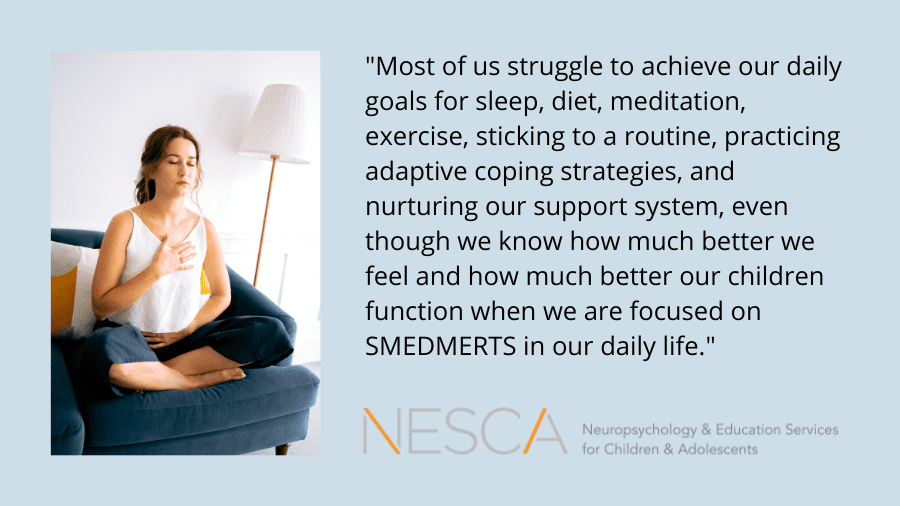
While attention to SMEDMERTS is important for all of us, especially in these stressful times, consistent focus on these lifestyle choices is particularly critical for the many children and adolescents who we see at NESCA presenting with anxiety, mood disorders, ADHD, and behavioral issues. Most of us struggle to achieve our daily goals for sleep, diet, meditation, exercise, sticking to a routine, practicing adaptive coping strategies, and nurturing our support system, even though we know how much better we feel and how much better our children function when we are focused on SMEDMERTS in our daily life. While the impact of medications and doctors on functioning is largely outside of our control, we can control our lifestyle choices, which are critical to the success of managing any mental health issue.

How can we help the children in our lives to embrace SMEDMERTS?

  • Modeling it for them. As Robert Fulgham said, “Don’t worry that your children never listen to you; worry that they are always watching you.”
  • Praising their efforts. Offer positive feedback, such as, “Great idea to get up early to go for a run,” or, “I like how you called a friend when you were upset to get some advice.”
  • Enlisting the help of a coach. NESCA offers real-life skills coaching, executive functioning coaching, and health coaching to help children, adolescents, and young adults build and maintain habits to support positive lifestyle choices.

Health coaching is available to parents of NESCA clients who are seeking support in developing positive health habits, such as exercise, diet, stress management, and meditation.

If you are interested in coaching services at NESCA to support your quest for SMEDMERTS, please contact Crystal Jean: cjean@nesca-newton.com or fill out our intake form at www.nesca-newton.com.


About the Author
NESCA Founder/Director Ann Helmus, Ph.D. is a licensed clinical neuropsychologist who has been practicing for almost 20 years. In 1996, she jointly founded the  Children’s Evaluation Center (CEC) in Newton, Massachusetts, serving as co-director there for almost ten years. During that time, CEC emerged as a leading regional center for the diagnosis and remediation of both learning disabilities and Autism Spectrum Disorders.

In September of 2007, Dr. Helmus established NESCA (Neuropsychology & Education Services for Children & Adolescents), a client and family-centered group of seasoned neuropsychologists and allied staff, many of whom she trained, striving to create and refine innovative clinical protocols and dedicated to setting new standards of care in the field.

Dr. Helmus specializes in the evaluation of children with learning disabilities, attention and executive function deficits and primary neurological disorders. In addition to assessing children, she also provides consultation and training to both public and private school systems. She frequently makes presentations to groups of parents, particularly on the topics of non-verbal learning disability and executive functioning.

To book an evaluation with one of NESCA’s many expert neuropsychologists, complete NESCA’s online intake form

Neuropsychology & Education Services for Children & Adolescents (NESCA) is a pediatric neuropsychology practice and integrative treatment center with offices in Newton and Plainville, Massachusetts, as well as Londonderry, New Hampshire. NESCA serves clients from preschool through young adulthood and their families. For more information, please email info@nesca-newton.com or call 617-658-9800.

October is Dyslexia Awareness Month

By | NESCA Notes 2022

By: Alissa Talamo, PhD
Pediatric Neuropsychologist, NESCA

According to the International Dyslexia Association (IDA), “Dyslexia is a language-based learning disability. Dyslexia refers to a cluster of symptoms, which result in people having difficulties with specific language skills, particularly reading. Students with dyslexia usually experience difficulties with other language skills such as spelling, writing, and pronouncing words. Dyslexia affects individuals throughout their lives; however, its impact can change at different stages in a person’s life. It is referred to as a learning disability because dyslexia can make it very difficult for a student to succeed academically in the typical instructional environment, and in its more severe forms, will qualify a student for special education, special accommodations, or extra support services.” Also, it is important to recognize that dyslexia is not due to either a lack of intelligence or a lack of desire to learn, and with appropriate and sufficient teaching methods, students with dyslexia can learn successfully.

Fortunately, there are effective strategies to help students with dyslexia. However, some common approaches to teaching reading (e.g., guided reading, balanced literacy) have not been found to be effective enough for the struggling reader. What research has found to be most effective is Structured Literacy. Structured Literacy instruction includes specific elements that are necessary for a dyslexic reader to make reading progress. Such elements include phonemic awareness (the ability to notice, think about, and work with individual sounds in words, such as separating the spoken word “cat” into three distinct phonemes), phonological awareness (the ability to recognize and manipulate the spoken parts of sentences and words), sound-symbol association (e.g., identify printed letters and what sounds they make), syllable instruction, morphology (smallest unit of meaning in the language), syntax (e.g., grammar), and semantics (meaning). In order to be most effective, students with dyslexia need to be taught using an explicit instruction method, with a teacher trained in a program that meets that student’s specific needs, the instruction needs to be taught in a logical order (basic concepts before more difficult ones), and each step needs to be based on previously learned concepts (cumulative).

According to the IDA, a comprehensive evaluation to assess for dyslexia, as well as to assess for any other potential language challenges or learning disabilities, should include intellectual and academic achievement testing, as well as assessment of critical underlying language skills that are closely linked to dyslexia, such as receptive and expressive language skills, phonology (phonological awareness, phonemic awareness), and rapid naming (e.g., quickly reading single letters or numbers). Additionally, a full evaluation should assess a student’s ability to read a list of unrelated real words as well as a list of pseudowords (made up pretend words to assess a child’s ability to apply reading rules), in addition to a student’s ability to read in context (e.g., stories). If a student is found to demonstrate that they meet criteria for a diagnosis of dyslexia, a specialized program should be developed by the school in order to provide appropriate services and accommodations.

Sources:

https://dyslexiaida.org/dyslexia-basics-2

https://dyslexiaida.org/effective-reading-instruction-for-students-with-dyslexia

www.readingrockets.org


About the Author

With NESCA since its inception in 2007, Dr. Talamo had previously practiced for many years as a child and adolescent clinical psychologist before completing postdoctoral re-training in pediatric neuropsychology at the Children’s Evaluation Center.

After receiving her undergraduate degree from Columbia University, Dr. Talamo earned her doctorate in clinical health psychology from Ferkauf Graduate School of Psychology and the Albert Einstein College of Medicine at Yeshiva University.

She has given a number of presentations, most recently on “How to Recognize a Struggling Reader,” “Supporting Students with Working Memory Limitations,” (with Bonnie Singer, Ph.D., CCC-SLP of Architects for Learning), and “Executive Function in Elementary and Middle School Students.”

Dr. Talamo specializes in working with children and adolescents with language-based learning disabilities including dyslexia, attentional disorders, and emotional issues. She is also interested in working with highly gifted children.

Her professional memberships include MAGE (Massachusetts Association for Gifted Education), IDA (International Dyslexia Association), MABIDA (the Massachusetts division of IDA) and MNS (the Massachusetts Neuropsychological Society).

She is the mother of one teenage girl.


To book a consultation with Dr. Talamo or one of our many other expert neuropsychologists, complete NESCA’s online intake form.

Neuropsychology & Education Services for Children & Adolescents (NESCA) is a pediatric neuropsychology practice and integrative treatment center with offices in Newton, Massachusetts, Plainville, Massachusetts, and Londonderry, New Hampshire, serving clients from preschool through young adulthood and their families. For more information, please email info@nesca-newton.com or call 617-658-9800.

College Freshman and Executive Function: The Often Unexpected Demands

By | NESCA Notes 2022

By: Sophie Bellenis, OTD, OTR/L
Occupational Therapist; Real-life Skills Program Manager and Coach, NESCA

It is no surprise that the experience of a high school student is vastly different than that of a college student. This transition is seen as a pivotal step towards independence as we send students off to learn, grow, and explore in an often substantially less supported and less controlled environment. The hope is that after 13 years of K-12 education, our students have developed the academic, communication, and organization skills needed for success in school. They know the tricks of the trade. They have systems to employ and even more systems to fall back on if needed. They have become experts at learning, and they know the drill. But what happens when students get to college and everything, from the style of instruction, to the flow of coursework, all the way to the demands outside of learning are just…a little bit different? For some students, this is a welcome opportunity to rise to the challenge, but for others, this is a daunting, overwhelming, and seemingly impossible ask. As an occupational therapist specializing in executive function, I have spent the last few years directly supporting those college freshman – the ones who look at the new demands and think, “I was never prepared for this, I don’t know if I can do this.” And I don’t blame them for feeling that way! The demands and expectations truly change. Here are a few that stand out:

  • Time management – High school schedules are rigid. Students are expected to arrive at a specific time, follow a block schedule, and make it to each of their classes (generally all in one building). If they forget what period it is, they can ask a friend, teacher, or almost anyone in the hallway. Conversely, every student in college has their own schedule that they are expected to track and manage. On Monday, they may be in class from 10am-2pm, while on Tuesday they are in class from 3pm-5pm on the other side of campus. There is no one to quickly ask or check in with regarding when and where they are supposed to be and consistency is rare. This trouble is further compounded by the fact that college coursework requires a substantial amount of work to be done outside of the classroom that must be planned for and built into the weekly schedule.
  • Reading a syllabus – While “reading a syllabus” may sound simple, these documents are often over 20 pages long, providing information about course content, course expectations, professor’s preferred method of communication, grading systems, and a full schedule of what is due and when. Additionally, each of these documents uses a different format and is frequently amended during the semester. High school students are used to an online portal that is consistently used by their teachers and provides built-in reminders and updates. Syllabi are tricky, and many students skim them without absorbing.
  • Assignment tracking – As mentioned above, college portals are nowhere near as comprehensive, up-to-date, or accurate as most ex-high school students expect. Professors may change a due date in class without updating a syllabus or expect students to keep track of a paper that is due more than a month away. Many college students need support putting a system in place to quickly consolidate due dates, set internal deadlines, and track what they need to hand in. This is especially important when breaking down large assignments into manageable chunks or learning to prepare in advance to for busy times in the semester, such as midterms or finals week.
  • Communicating with instructors – Many college students need support in pushing themselves to attend office hours, reach out early and often via email if they have questions about classwork or assignments, and even introduce themselves to their professors.
  • Developing healthy habits and routines – On top of academic executive function demands, college students are dealing with an increase in life-based executive function demands. They are managing their own eating habits, morning routines, evening routines, and organizing all of their personal belongings in their own space. Completing all of this while maintaining life balance can be tricky, and may require some support.
  • Accessing accommodations – The accommodation process at a college level is vastly different from the IEP or 504 process in high school. While this topic could be a blog on its own, the biggest takeaway for me is the level of responsibility that falls on the students. They are in charge of letting each professor, at the beginning of every semester, know about their accommodations for sitting in classes, taking exams, or turning in assignments. This requires a level of self-advocacy and functional communication that they may not have had to demonstrate in high school. This demand does not disappear throughout the semester, as they often need to remind professors a week before an exam about their needs or independently book a room to take their test.

While this may seem like a lot, the good news is that our students have learned how to learn. Their systems may need updating, and their strategies may need fine tuning, but with guidance I have found college success to be a truly achievable goal. I often find that once provided with a foundation and tips for how to be successful, my college freshmen do rise to the challenge and eventually build the ability to do all of this independently. If you feel that your student could benefit from some executive function support as they embark on their college journey, please reach out about NESCA’s EF Coaching Program!


About the Author
Sophie Bellenis is a Licensed Occupational Therapist in Massachusetts, specializing in educational OT and functional life skills development. Bellenis joined NESCA in the fall of 2017 to offer community-based skills coaching services as a part of the Real-life Skills Program within NESCA’s Transition Services team. Bellenis graduated from the MGH Institute of Health Professions with a Doctorate in Occupational Therapy, with a focus on pediatrics and international program evaluation. She is a member of the American Occupational Therapy Association, as well as the World Federation of Occupational Therapists. Having spent years delivering direct services at the elementary, middle school and high school levels, Bellenis has extensive background with school-based occupational therapy services.  She believes that individual sensory needs and visual skills must be taken into account to create comprehensive educational programming.


To book an appointment or to learn more about NESCA’s Executive Function Coaching Services, please fill out our online Intake Form, email info@nesca-newton.com or call 617-658-9800.


Neuropsychology & Education Services for Children & Adolescents (NESCA) is a pediatric neuropsychology practice and integrative treatment center with offices in Newton, Massachusetts, Plainville, Massachusetts, and Londonderry, New Hampshire, serving clients from preschool through young adulthood and their families. For more information, please email info@nesca-newton.com or call 617-658-9800.


When the Honeymoon Period Is Over: Signs of School Refusal

By | NESCA Notes 2021

By: Moira Creedon, Ph.D. 
Pediatric Neuropsychologist, NESCA

As we reach the end of our first month back to school, many of us may be reaching the end of that glorious honeymoon period – the phase when kids are excited to see friends, optimistic for the school year, and reviewing material they likely already know. For some, the return did not start this rosy; the bloom is falling off the rose and kids are getting tired. You and your child are not alone in this. My goal for today’s blog is to share with you some warning signs that your child may be struggling and ways to get support before they grow to become bigger problems. The biggest problem I want to avoid: school refusal.

Have you heard this yet? – “My tummy hurts. I have to stay home.” Or, “I hate school. Please don’t make me go.” Or, “I’m not going!” Or perhaps these messages are communicated more subtly with covers over their heads in the morning, difficulty getting out the door on time, tantrums or disruptive behaviors in the mornings, missed buses, or the overwhelming frustration of homework that erupts into nightly battles. According to researcher Christopher Kearney, these are signs to pay attention to as they can evolve into what he terms “school refusal behavior.” School refusal is an umbrella term used to describe behaviors that interfere with a child being in school for their expected and scheduled time. This is a problem that can impact anywhere between 28-35% of students! While there are the more extreme cases for children or teens who are out of school for months at a time, my purpose here is to address the smaller, but more likely, problems. When we address smaller problems, we can keep them small.

Risky signs that your child is struggling with school:

  • Consistent statements of hating school, their teacher, or specific peers. A casual mention of a bad day is not cause for alarm. We all have bad days. If the statements keep coming and they get louder and stronger, then parents should pay attention.
  • The outward behaviors are getting bigger in the mornings before school or over homework. Behavior is a way for children to communicate with us how they are feeling. So, explosions over homework or tantrums in the morning that lead to tardiness are warning signs. The occasional homework meltdown or rushed morning is normal; we are all human! But, the problem is in the pattern.
  • Avoidance rears its ugly head. While some kids show on the outside that they are uncomfortable through their explosions, others communicate very clearly through their withdrawal. Some kids and teens struggle to get out of bed, are constantly tired, not completing work, falling asleep in class, or sharing every somatic complaint or symptom available on Google. If medical causes are ruled out, anxiety can be a culprit.
  • Consider the role of a major transition. According to Kearney, the riskiest time for a child to develop a pattern of school refusal is during times of significant transition – like starting kindergarten or changing schools from middle to high school. In addition to the social and emotional jump that these transitions bring, there is also a massive leap in demands for academic independence. It is very common for kids to struggle with the leap initially.

Oh no. So now what?

  • First and foremost, keep calm. It is far easier to keep small problems small when we have a clear-headed approach. Pull in anxiety management techniques like deep breathing, sleep, and exercise to support your own anxiety as a parent.
  • Reach out to your child’s teacher or school psychologist. Let them know your child is struggling with homework or coming to school. This is a great chance to gather information on what is going on in your child’s day and put your child on their teacher’s radar. This is critical as the only effective approach to remedy a problem with school refusal is a team approach.
  • Talk to your child honestly about what is going on. This has to include a chance for kids to talk about what might be happening to make them feel stressed or why they dislike school. Don’t shortcut this step. If your child has trouble explaining what is going on (which can be especially true for younger kids), try this approach: you and your child are both going to be detectives to learn together what is making school feel hard. We can’t solve a problem until we understand it. By joining with your child in gathering information, you are demonstrating great empathy and validating that their feelings are real.
  • Be careful of your language and conversation about school. It can be tempting to go too far in validating a child to give the message that the assignment really is stupid or their teacher really is unreasonable and mean. It’s best to stick to the feeling (“that must feel so frustrating”) without reinforcing negative messages about school.
  • Hold the line. As you gather more information, it is really important to maintain the message that it is your child’s job to go to school. It might feel conflicting to both validate the feelings of hating school and give the message to attend school. It might feel something like this: It’s either “I love and support my child OR I’m going to force them to go to school even when it’s hard.” Let’s change that OR to AND. Reframe the thought to: “I love and support my child AND they have to go to school AND they can do hard things.”

For more information, please check out:

Kearney, C.A. (2007). Getting your child to say “yes” to school: A guide for parents of youth with school refusal behavior. New York: Oxford University Press.


About the Author

Dr. Creedon has expertise in evaluating children and teens with a variety of presenting issues. She is interested in uncovering an individual’s unique pattern of strengths and weaknesses to best formulate a plan for intervention and success. With experiences providing therapy and assessments, Dr. Creedon bridges the gap between testing data and therapeutic services to develop a clear roadmap for change and deeper of understanding of individual needs.


If you are interested in booking an evaluation with Dr. Creedon or another NESCA neuropsychologist, please fill out and submit our online intake form


Neuropsychology & Education Services for Children & Adolescents (NESCA) is a pediatric neuropsychology practice and integrative treatment center with offices in Newton and Plainville, Massachusetts, and Londonderry, New Hampshire, serving clients from preschool through young adulthood and their families. For more information, please email info@nesca-newton.com or call 617-658-9800.

Meet Pediatric Neuropsychologist Lauren Halladay, Ph.D.

By | NESCA Notes 2022

By: Jane  Hauser

Director of Marketing & Outreach, NESCA

I recently had the opportunity to learn more about Pediatric Neuropsychologist Lauren Halladay, Ph.D., who joins NESCA in September. Learn more about her background and specialties in today’s blog interview.

How did you choose pediatric neuropsychology as a profession?

My interest was originally piqued when I was younger, as early as my high school years. I volunteered at a therapeutic riding program for kids with disabilities. That’s what initially sparked my desire to work with kids, and those with disabilities, in particular. My mother was a third grade teacher, which also imparted the desire to work with kids and help them overcome their challenges at school.

I went on to major in psychology and had a strong interest in pediatrics for the reasons I mentioned previously. Based on some of the work I did in graduate school, I learned that I really enjoyed the assessment piece, especially with the younger kids, helping them in life by identifying the right diagnosis (when applicable) and helping to put the right interventions in place for them to build skills that will equip them for the future.

How have your previous work experiences prepared you to be a neuropsychologist?

I’ve had a wide breadth of work experiences where I was supervised by neuropsychologists, whether it be in satellite health systems, the hospital setting, etc. While in those clinics, I had the opportunity to work with a variety of populations and presentations, including those who have experienced trauma, or have developmental or learning disabilities.

Having worked in several states throughout the country, including Oregon, Ohio, New York and Massachusetts, I’ve had the pleasure of working closely with a variety of families who present with unique backgrounds, experiences, and cultural values, which I always consider when making diagnostic decisions and developing recommendations.

What areas of neuropsychology have you most enjoyed to date? What would you consider your specialty area?

There are several areas that I am very passionate about. I really enjoy working with young kids, those under the ages of five or six. I also have a great interest in working with families who have concerns about their child potentially having an autism spectrum disorder or an intellectual or developmental disability. In addition, I find it incredibly rewarding to work with and help families whose children are medically complex or have moderate to severe cognitive impairments.

Regardless of how the child or student presents or what challenges they may have, I always individualize my approach so that I can meet the needs of each child. This is especially true in cases where families have had a hard time getting assessments done in the school setting or even privately in the past.

What is the most rewarding experience in neuropsychology that you’ve had to date?

I find it rewarding to hear from families when the strategies I’ve recommended are or are not working for them. For example, hearing that parents achieve success in implementing behavior management strategies, accessing support in the community, and/or learning about their child’s diagnosis and how to create an environment that suits their needs is a wonderful feeling. On the other hand, when the initial recommendations are not as helpful as intended, I enjoy approaching the problem-solving process together and discussing alternate approaches.

I also find it incredibly rewarding to offer parents and caregivers a deeper perspective on a child who has a moderate to severe cognitive impairment or is medically complex. Being able to give them a sense of where their child is developmentally in relation to their peers can be enlightening. Additionally, having more information about a child’s developmental level can help families and school staff establish appropriate, and individualized, expectations that set the child up for success. I strive to make a difference in these cases by developing strong partnerships with families, as well as serving as a trusted resource and advocate as they navigate how to best access supports in the community and in school.

What benefits, having been trained in a school psychology department, do you bring to families at NESCA?

My school psychology background allows me to bring a deep awareness and perspective on how the IEP process works. My experience and knowledge of special education rights allows me to be a true partner to families who are trying to navigate and understand the IEP process. I am able to share that knowledge and better advocate for my clients in Team meetings.

Why did you decide to join the team at NESCA?

I knew that in my next career move, I wanted to be part of a collaborative community that puts an emphasis on work/life balance—I feel that both allow clinicians to produce the highest quality work. At NESCA, I will also have the opportunity to use my school psychology skills and be an active participant in the IEP process on behalf of our clients.

NESCA is known for creating and building long-lasting relationships with the families they work with. I look forward to working with families and their schools/districts for the long-term, helping students to build skills along the way that will help them throughout their lives.

Finally, not being a native Bostonian, I am excited to learn more about and partner with the different school systems on behalf of the families and students we work with at NESCA.


About Lauren Halladay, Ph.D.

Dr. Halladay conducts comprehensive evaluations of toddlers, preschoolers, and school-aged children with a wide range of developmental, behavioral, and emotional concerns. She particularly enjoys working with individuals with Autism Spectrum Disorder, Intellectual and Developmental Disabilities, and complex medical conditions. She has experience working in schools, as well as outpatient and inpatient hospital settings. She is passionate about optimizing outcomes for children with neurodevelopmental disabilities by providing evidence-based, family-oriented care.


If you are interested in booking an appointment for an evaluation with a NESCA neuropsychologist/clinician, please fill out and submit our online intake form


Neuropsychology & Education Services for Children & Adolescents (NESCA) is a pediatric neuropsychology practice and integrative treatment center with offices in Newton and Plainville, Massachusetts, and Londonderry, New Hampshire, serving clients from preschool through young adulthood and their families. For more information, please email info@nesca-newton.com or call 617-658-9800.

Skip to content