

By: Sophie Bellenis, OTD, OTR/L
Occupational Therapist; Real-life Skills Program Manager and Coach, NESCA
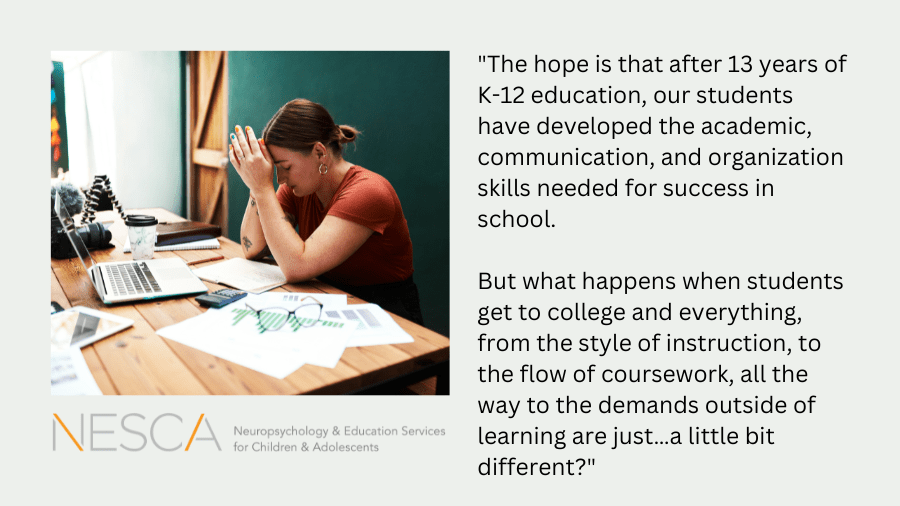
It is no surprise that the experience of a high school student is vastly different than that of a college student. This transition is seen as a pivotal step towards independence as we send students off to learn, grow, and explore in an often substantially less supported and less controlled environment. The hope is that after 13 years of K-12 education, our students have developed the academic, communication, and organization skills needed for success in school. They know the tricks of the trade. They have systems to employ and even more systems to fall back on if needed. They have become experts at learning, and they know the drill. But what happens when students get to college and everything, from the style of instruction, to the flow of coursework, all the way to the demands outside of learning are just…a little bit different? For some students, this is a welcome opportunity to rise to the challenge, but for others, this is a daunting, overwhelming, and seemingly impossible ask. As an occupational therapist specializing in executive function, I have spent the last few years directly supporting those college freshman – the ones who look at the new demands and think, “I was never prepared for this, I don’t know if I can do this.” And I don’t blame them for feeling that way! The demands and expectations truly change. Here are a few that stand out:
- Time management – High school schedules are rigid. Students are expected to arrive at a specific time, follow a block schedule, and make it to each of their classes (generally all in one building). If they forget what period it is, they can ask a friend, teacher, or almost anyone in the hallway. Conversely, every student in college has their own schedule that they are expected to track and manage. On Monday, they may be in class from 10am-2pm, while on Tuesday they are in class from 3pm-5pm on the other side of campus. There is no one to quickly ask or check in with regarding when and where they are supposed to be and consistency is rare. This trouble is further compounded by the fact that college coursework requires a substantial amount of work to be done outside of the classroom that must be planned for and built into the weekly schedule.
- Reading a syllabus – While “reading a syllabus” may sound simple, these documents are often over 20 pages long, providing information about course content, course expectations, professor’s preferred method of communication, grading systems, and a full schedule of what is due and when. Additionally, each of these documents uses a different format and is frequently amended during the semester. High school students are used to an online portal that is consistently used by their teachers and provides built-in reminders and updates. Syllabi are tricky, and many students skim them without absorbing.
- Assignment tracking – As mentioned above, college portals are nowhere near as comprehensive, up-to-date, or accurate as most ex-high school students expect. Professors may change a due date in class without updating a syllabus or expect students to keep track of a paper that is due more than a month away. Many college students need support putting a system in place to quickly consolidate due dates, set internal deadlines, and track what they need to hand in. This is especially important when breaking down large assignments into manageable chunks or learning to prepare in advance to for busy times in the semester, such as midterms or finals week.
- Communicating with instructors – Many college students need support in pushing themselves to attend office hours, reach out early and often via email if they have questions about classwork or assignments, and even introduce themselves to their professors.
- Developing healthy habits and routines – On top of academic executive function demands, college students are dealing with an increase in life-based executive function demands. They are managing their own eating habits, morning routines, evening routines, and organizing all of their personal belongings in their own space. Completing all of this while maintaining life balance can be tricky, and may require some support.
- Accessing accommodations – The accommodation process at a college level is vastly different from the IEP or 504 process in high school. While this topic could be a blog on its own, the biggest takeaway for me is the level of responsibility that falls on the students. They are in charge of letting each professor, at the beginning of every semester, know about their accommodations for sitting in classes, taking exams, or turning in assignments. This requires a level of self-advocacy and functional communication that they may not have had to demonstrate in high school. This demand does not disappear throughout the semester, as they often need to remind professors a week before an exam about their needs or independently book a room to take their test.
While this may seem like a lot, the good news is that our students have learned how to learn. Their systems may need updating, and their strategies may need fine tuning, but with guidance I have found college success to be a truly achievable goal. I often find that once provided with a foundation and tips for how to be successful, my college freshmen do rise to the challenge and eventually build the ability to do all of this independently. If you feel that your student could benefit from some executive function support as they embark on their college journey, please reach out about NESCA’s EF Coaching Program!
About the Author
Sophie Bellenis is a Licensed Occupational Therapist in Massachusetts, specializing in educational OT and functional life skills development. Bellenis joined NESCA in the fall of 2017 to offer community-based skills coaching services as a part of the Real-life Skills Program within NESCA’s Transition Services team. Bellenis graduated from the MGH Institute of Health Professions with a Doctorate in Occupational Therapy, with a focus on pediatrics and international program evaluation. She is a member of the American Occupational Therapy Association, as well as the World Federation of Occupational Therapists. Having spent years delivering direct services at the elementary, middle school and high school levels, Bellenis has extensive background with school-based occupational therapy services. She believes that individual sensory needs and visual skills must be taken into account to create comprehensive educational programming.
Neuropsychology & Education Services for Children & Adolescents (NESCA) is a pediatric neuropsychology practice and integrative treatment center with offices in Newton, Massachusetts, Plainville, Massachusetts, and Londonderry, New Hampshire, serving clients from preschool through young adulthood and their families. For more information, please email info@nesca-newton.com or call 617-658-9800.
 unique pattern of strengths and weaknesses to best formulate a plan for intervention and success. With experiences providing therapy and assessments, Dr. Creedon bridges the gap between testing data and therapeutic services to develop a clear roadmap for change and deeper of understanding of individual needs.


 Erin Gibbons, Ph.D.
 M.A. from Antioch New England in Applied Psychology. She also worked as an elementary school counselor and school psychologist for 15 years before embarking on her doctorate. During her doctorate, she did her pre-doctoral internship with RIT in Rochester, N.Y. where she worked with youth ages 5-17 who had experienced complex developmental trauma. Dr. Hess’s first post-doctoral fellowship was with The Counseling Center of New England where she provided psychotherapy and family therapy to children ages 5-18, their families and young adults. She also trained part-time with a pediatric neuropsychologist conducting neuropsychological evaluations.
 By
By  Londonderry, NH office. She specializes in the evaluation of anxious children and teens, working to tease apart the various factors lending to their stress, such as underlying learning, attentional, or emotional challenges. She particularly enjoys working with the seemingly “unmotivated” child, as well as children who have “flown under the radar” for years due to their desire to succeed.

 No matter what style you are, you are giving it your best shot. Each of the styles has much written about them and their impact on child development – some good some not so good. Parents may change their style(s) depending upon a variety of factors and adopt new ways. Try to be aware of your style and its impact on your kids – this realization may happen as you go. That’s okay. You are learning this job as you go, and we all know there is no manual. You are just doing it, living each and every day with what it brings to you. Most parents do not think about what parenting style they are going to use in the moment. Sometimes you may “catch yourself,“ see your child’s reaction, and adjust your style. Perhaps you are the “softie” most of the time, but then turn on the “tough love” style when needed.
 and academia for over 30 years. She is a national consultant and speaker on program design and the inclusion of children and adolescents with special needs, especially those diagnosed with Autism Spectrum Disorder (ASD). Prior to joining NESCA, Ms. Lucci was the Principal of the Partners Program/EDCO Collaborative and previously the Program Director and Director of Consultation at MGH/Aspire for 13 years, where she built child, teen and young adult programs and established the 3-Ss (self-awareness, social competency and stress management) as the programming backbone. She also served as director of the Autism Support Center. Ms. Lucci was previously an elementary classroom teacher, special educator, researcher, school psychologist, college professor and director of public schools, a private special education school and an education collaborative.


Connect with Us