

By: Lyndsay Wood, OTD, OTR/L
NESCA Transition Specialist & Occupational Therapist
Do you, your child or your loved one deal with frequent anxiety? Stress? Panic? Sometimes it may feel like you are spinning out of control. With so much going on in the world, in our own lives, and in our own head, it can feel like an impossible task to quiet the mind and calm the body. However, there are things we can do to regulate the nervous system, thereby relaxing the body and reducing the effects of anxiety. Below is a list of these strategies, but they are not one-size-fits all. Try each of them and see what works best for you or your loved one.
- 5, 4, 3, 2, 1 Grounding Technique: This technique is helpful to ground yourself in the present moment. Often, we can get stuck in our own head, and our worries and fears spiral out of control. This strategy is helpful to pull yourself out of those thoughts and into the present moment. The procedure is as follows:
- Identify five things you can see. Feel free to describe them. What color are they? What are their shapes?
- Identify four things you can touch. Get up and actually touch them! How do they feel? Are they soft? Hard? Squishy? Wet?
- Identify three things you can hear. Is there a car driving by? Are the noises loud or soft?
- Name two things you can smell. Are the smells pleasant? Neutral? Familiar?
- Finally, name one thing you can taste. Can you taste the remnants of dinner on your tongue? Perhaps you have a piece of candy nearby you want to put in your mouth and describe.
Hopefully, completing this technique helps break the anxiety spiral. Feel free to repeat it as many times as you need. You can try to identify new items and sensations each time.
-
- Weighted blanket or deep pressure: Deep pressure activates the parasympathetic nervous system, which is responsible for relaxing your body. Therefore, if you are feeling anxious, try sitting with a weighted blanket. Alternatively, if you have a pet, put them on your lap. Both the pressure of their body and the act of petting them is great for relaxing. You could also try giving yourself a hand massage or tight hug.
- Box breathing: This is a breathing technique that also activates the parasympathetic nervous system and relaxes the body. The steps of this technique are as follows:
- Take a slow breath in through your nose (if possible) for four seconds
- Hold that breath for four seconds
- Slowly breathe out for four seconds
- Hold your breath again for four seconds
- Repeat this cycle three or four times
- Funny videos: Sometimes it can be helpful to distract the mind with a funny video. Animal videos can be great! Or perhaps you have a favorite comedian that will always make you laugh.
- Progressive Muscle Relaxation: This technique involves tightening different muscle groups and then letting them go. It helps to relax the body and reduce tension. You can find a guided YouTube video to walk you through the process, or you can also try it on your own by moving from head to toe, tightening different muscle groups. You may start by tightening all of the muscles in your face for 5-to-10 seconds as you inhale and relaxing the face muscles as you exhale. Give yourself 10-to-20 seconds to relax before moving on to the next muscle group.
About the Author
Lyndsay Wood, OTD, OTR/L, is an occupational therapist who focuses on helping students and young adults with disabilities to build meaningful skills in order to reach their goals. She has spent the majority of her career working in a private school for students with ASD. She has also spent some time working in an inpatient mental health setting. Lyndsay uses occupation-based interventions and strategies to develop life skills, executive functioning, and emotional regulation. While completely her doctoral degree at MGH Institute of Health Professions, Lyndsay worked with the Boston Center for Independent Living to evaluate transition age services. She uses the results from her research to deliver services in a way that is most beneficial for clients. Specifically, she focuses on hands-on, occupation-based learning that is tailored the client’s goals and interests.
To book coaching and transition services at NESCA, complete NESCA’s online intake form.
Neuropsychology & Education Services for Children & Adolescents (NESCA) is a pediatric neuropsychology practice and integrative treatment center with offices in Newton and Plainville, Massachusetts, as well as Londonderry, New Hampshire. NESCA serves clients from preschool through young adulthood and their families. For more information, please email info@nesca-newton.com or call 617-658-9800.




 M.A. from Antioch New England in Applied Psychology. She also worked as an elementary school counselor and school psychologist for 15 years before embarking on her doctorate. During her doctorate, she did her pre-doctoral internship with RIT in Rochester, N.Y. where she worked with youth ages 5-17 who had experienced complex developmental trauma. Dr. Hess’s first post-doctoral fellowship was with The Counseling Center of New England where she provided psychotherapy and family therapy to children ages 5-18, their families and young adults. She also trained part-time with a pediatric neuropsychologist conducting neuropsychological evaluations.
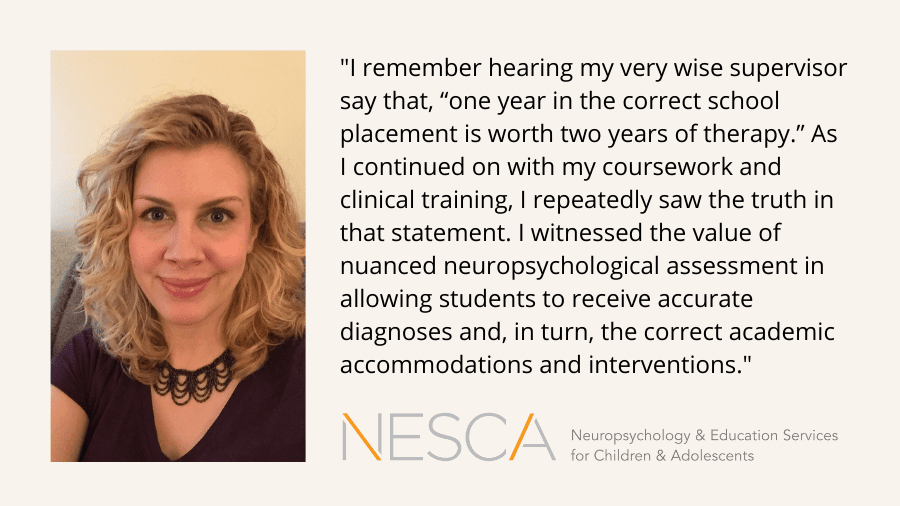

 neuropsychologist who has been practicing for almost 20 years. In 1996, she jointly founded the Children’s Evaluation Center (CEC) in Newton, Massachusetts, serving as co-director there for almost ten years. During that time, CEC emerged as a leading regional center for the diagnosis and remediation of both learning disabilities and Autism Spectrum Disorders.
 Erin Gibbons, Ph.D.

 and academia for over 30 years. She is a national consultant and speaker on program design and the inclusion of children and adolescents with special needs, especially those diagnosed with Autism Spectrum Disorder (ASD). Prior to joining NESCA, Ms. Lucci was the Principal of the Partners Program/EDCO Collaborative and previously the Program Director and Director of Consultation at MGH/Aspire for 13 years, where she built child, teen and young adult programs and established the 3-Ss (self-awareness, social competency and stress management) as the programming backbone. She also served as director of the Autism Support Center. Ms. Lucci was previously an elementary classroom teacher, special educator, researcher, school psychologist, college professor and director of public schools, a private special education school and an education collaborative.
Connect with Us