NESCA’s Newton, MA location has immediate availability for neuropsychological evaluations. Our MA clinicians specialize in the following evaluations: Neuropsychological; Autism; and Emotional and Psychological, as well as Academic Achievement and Learning Disability Testing.

Visit www.nesca-newton.com/intake for more information or to book an evaluation.

Tag

NESCA Archives - Page 18 of 34 - NESCA

Subscribe to NESCA Notes

Yoga Therapy for Children and Adolescents

By | NESCA Notes 2022

By:  Stephanie Monaghan-Blout, Psy.D.
Pediatric Neuropsychologist

As a pediatric neuropsychologist, I often recommend yoga therapy for children with anxiety, impulse control, and/or motor/coordination/sensory issues, as well as issues that alienate them from their body (e.g., eating disorders and trauma). Another group for which a body-focused therapy like yoga would be helpful is children with language challenges who are not equipped to manage the challenge of “talking” therapy.

Yoga is a 4,000-year-old practice that originated in what is now known as India. The word means “yoke” or “union,” and the practice of yoga aims to quiet the mind in order to find the unity within ourselves and with the world around us. This ancient practice was developed to facilitate development and integration of the human body, mind, and breath to produce a strong and flexible body free of pain, a balanced autonomic nervous system with all physiological systems functioning optimally, and a calm, clear, and tranquil mind (1). As we make this transformation in ourselves, we hope to affect the larger world. This is done through a variety of elements, but the western world tends to focus on movement (asanas), breathwork (pranayamas), and meditation (dhyanas).

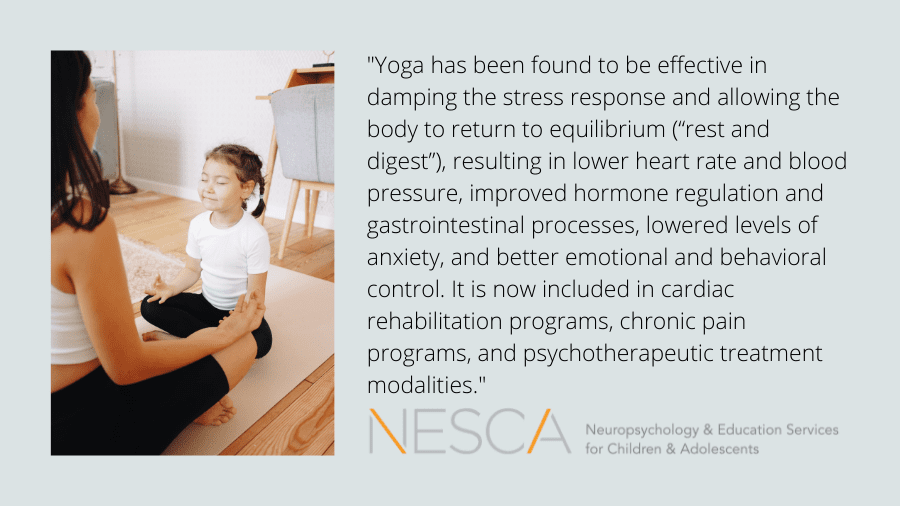
Yoga was introduced to the west in the 19th century and has become a popular form of physical fitness and injury rehabilitation. More recently, we have begun to investigate its impact on physiological function, specifically the autonomic nervous system which controls vital life functions and regulates our stress response and return to equilibrium. Research has shown that chronic activation of the stress response (“fight/flight/freeze”) is strongly associated with increased risk of cardiovascular problems and autoimmune disorders (including diabetes), as well as psychiatric conditions, such as anxiety and depression. Yoga has been found to be effective in damping the stress response and allowing the body to return to equilibrium (“rest and digest”), resulting in lower heart rate and blood pressure, improved hormone regulation and gastrointestinal processes, lowered levels of anxiety, and better emotional and behavioral control. It is now included in cardiac rehabilitation programs, chronic pain programs, and psychotherapeutic treatment modalities.

Recently, I became curious with what exactly happens in yoga therapy and decided to talk with the new yoga therapist at NESCA, Danielle Sugrue, M.S. An athlete throughout high school and college, Danielle became involved with yoga about 15 years ago because she was looking for something that “would get me back into movement.” She quickly fell in love with yoga and completed her 200-hour Yoga Teacher Training. In the meantime, she also completed her master’s degree in Marriage and Family Studies at Salem State University. With this combination of expertise, she is able to help children and adolescents become more in touch with their bodies and find their words through movement, breathing, and relaxation.

I asked Danielle what a yoga therapy session with a child would look like. She quickly assured me that interventions with young children hold little resemblance to adult yoga classes. Danielle described her sessions with children as a playful movement exercise to learn to come to their breathing when things get challenging. If a child becomes dysregulated, she helps them tap into their senses to ground them and begin to put words on the feelings. A session may start by spreading cards with animals doing various poses out on the floor and asking the child to pick the card that looks like how s/he is feeling. Based on the cards selected, Danielle may develop a flow of postures based on those selections. The poses and concepts are taught through stories and games using mythical characters, like Ganesh, the Hindu elephant god who clears obstacles and paves the way for us to move forward in life.

The sessions for adolescents tend to take a more direct approach to the issues of concern as described by the teenager. Learning breathing techniques tends to be a key element; because of body issues, many teenage girls don’t breathe deeply (belly breathing) because it makes their stomach stick out. This kind of shallow breathing activates the stress response, making the person feel more anxious, while deep breathing “turns on” the rest and relax function. Moving freely without self-consciousness is another big challenge for teens—and developing a flow that allows them to feel themselves moving with ease but also makes them feel capable of holding a pose just a little longer than they thought they could—helps with developing self-confidence. Directly addressing mindset (self-love and self-compassion) also tends to be an important focus of work with teens and may involve activities such as a mirror challenge of looking at oneself and identifying what s/he likes about themselves.

Yoga therapy usually involves purchasing a 10-session package of once weekly meetings of an hour’s length. If you are interested in having your child work with Danielle, please contact her directly at: dsugrue@nesca-newton.com or complete an online Intake Form at: https://hipaa.jotform.com/220393954666062.

In addition to her work at NESCA, Danielle also teaches yoga at Power Yoga Evolution in North Andover. Dr. Monaghan-Blout is in the process of completing her own 200-hour yoga teacher training.

  1. Kayley-Isley, L., Peterson , J, Fischer, C, and Peterson, E. Yoga as a Complementary Therapy for Children and Adolescents, Psychiatry 2010; 7(8): 20-32.
  2. Nourollahimoghadam, E., Gorji, S., Ghadiri M., Therapeutic Role of Yoga in Neuropsychological Disorders., World Journal of Psychiatry 2021, October 19; 11 (10): 754-773
  3. Permission to Unplug: the Health Benefits of Yoga for Kids. https://www.healthychildren.org, the American Academy of Pediatrics
  4. Barkataki, Susanna. Embrace Yoga’s Roots; Courageous Ways to Deepen Your Yoga Practice 2020, Orlando, FLA, Ignite Yoga and Wellness Institute


About the Author:

Formerly an adolescent and family therapist, Dr. Stephanie Monaghan-Blout is a senior clinician who joined NESCA at its inception in 2007. Dr. Monaghan-Blout specializes in the assessment of clients with complex learning and emotional issues. She is proficient in the administration of psychological (projective) tests, as well as in neuropsychological testing. Her responsibilities at NESCA also include acting as Clinical Coordinator, overseeing psycho-educational and therapeutic services. She has a particular interest in working with adopted children and their families, as well as those impacted by traumatic experiences. She is a member of the Trauma and Learning Policy Initiative (TLPI) associated with Massachusetts Advocates for Children and the Harvard Law Clinic, and is working with that group on an interdisciplinary guide to trauma sensitive evaluations.

To book an evaluation with one of our many expert neuropsychologists and transition specialists, complete NESCA’s online intake form.

Neuropsychology & Education Services for Children & Adolescents (NESCA) is a pediatric neuropsychology practice and integrative treatment center with offices in Newton, Massachusetts, Plainville, Massachusetts, and Londonderry, New Hampshire, serving clients from preschool through young adulthood and their families. For more information, please email info@nesca-newton.com or call 617-658-9800.

Executive Function and Goal Setting

By | NESCA Notes 2022

By: Sophie Bellenis, OTD, OTR/L
Occupational Therapist; Real-life Skills Program Manager and Coach, NESCA

Personal, professional, and academic goals are a large part of what drives us as we transition from one stage of life to the next. They also provide direction as we choose and maintain the habits and routines that we feel are important to daily life. Determining what our goals are is a big step, one that students are often working on with their families, school supports, and friends as they start to figure out their next steps in life. But once these goals are solidified, what’s next? How  do we get there? As an executive function coach working with high school and college students, I can attest that this can unexpectedly be the most difficult step in the process. Let’s talk about some ways that we can support students in these endeavors.

  1. Break down goals into manageable chunks. Many goals tend to be large or long-term and can feel daunting and amorphous. For example, a common goal for high school seniors might be, “I will apply to five colleges by their application deadlines.” We can help students by breaking a goal like this down and creating step by step lists, such as: put together a list of preferences for my ideal school, research schools that fit these preferences, meet with guidance counselor to review my research, finalize list of five schools, ask teachers for letters of recommendations, fill out each section of the Common App, write personal essay, have English teacher or other support person review personal essay and give feedback, etc. This list is not comprehensive, but it does show how much goes into the seemingly simple initial goal.
  2. Help them prioritize. Once students have created a comprehensive list of steps, help them to understand what steps need to be attended to right away and which can wait. Continuing with the example of applying to college, figure out what steps need to happen before the Thanksgiving or winter break! It may also be helpful to figure out which steps seem difficult for your specific student. For some, this may be writing the personal essay; for others, it may be building up the courage to ask a favorite teacher to write them a recommendation. Busy students who are already taking multiple classes may have trouble figuring out how to add the steps needed to reach another goal into their schedule.
  3. Put together a plan. Set a timeline. Put internal deadlines into a calendar. Figure out specific times to work towards the goal. Find people who can be solid supports and help to make things happen.
  4. Check in on them. Offer to check in along the way. Some students will love having a partner to track their progress with, while others simply need help setting the foundation.

While this example is very concrete and includes working towards a specific predetermined deadline, not all goals need to be. Whether your student’s goal is to find a summer job they enjoy, get an average of a B in all of their classes, or find a new hobby that makes them happy, using these strategies can help to make a goal feel more manageable.

Finally, you might notice that these steps are quite similar to some of the strategies for completing specific academic tasks, and you would be right! Take, for example, writing a research paper. We want students to break that task down into smaller pieces, such as finding sources, creating an outline, writing a rough draft, and developing a final draft. We then help them to prioritize which steps will need more time to complete and eventually put together a plan so they dedicate sufficient time to each section and submit a final draft on time. Many of the academic executive function tasks that we learn in school create processes and roadmaps for how to tackle life skills that require similar executive function skills. However, not all students can transfer these skills to setting goals without some direct support or help seeing the similarities in the process.


To learn more about Executive Function from Dr. Bellenis, join her along with Dan Levine from Engaging Minds, for a free webinar, “Executive Function in the Covid Era: Managing School and Life (Kindergarten through High School),” on March 8 at 7:00PM ET.

Register now: https://engagingmindsonline.zoom.us/webinar/register/WN_vWNlilZkS36imBqvr4IMZQ


About the Author
Sophie Bellenis is a Licensed Occupational Therapist in Massachusetts, specializing in educational OT and functional life skills development. Bellenis joined NESCA in the fall of 2017 to offer community-based skills coaching services as a part of the Real-life Skills Program within NESCA’s Transition Services team. Bellenis graduated from the MGH Institute of Health Professions with a Doctorate in Occupational Therapy, with a focus on pediatrics and international program evaluation. She is a member of the American Occupational Therapy Association, as well as the World Federation of Occupational Therapists. Having spent years delivering direct services at the elementary, middle school and high school levels, Bellenis has extensive background with school-based occupational therapy services.  She believes that individual sensory needs and visual skills must be taken into account to create comprehensive educational programming.


To book an appointment or to learn more about NESCA’s Occupational Therapy Services, please fill out our online Intake Form, email info@nesca-newton.com or call 617-658-9800.


Neuropsychology & Education Services for Children & Adolescents (NESCA) is a pediatric neuropsychology practice and integrative treatment center with offices in Newton, Massachusetts, Plainville, Massachusetts, and Londonderry, New Hampshire, serving clients from preschool through young adulthood and their families. For more information, please email info@nesca-newton.com or call 617-658-9800.


Neuropsychological Evaluation Results: What, When and How to Share with Children and Teens

By | NESCA Notes 2022

By: Moira Creedon, Ph.D. 
Pediatric Neuropsychologist, NESCA

During intake and feedback meetings with families, I find the same question comes up often from parents: what do I tell my child about all of this? NESCA’s Dr. Erin Gibbons gracefully tackled how to prepare your child for their neuropsychological evaluation. After an evaluation is done, you as a parent now have more than 20 pages of historical information, test descriptions, tables, summaries, and recommendations. How do you translate that information into something a child or teen will actually understand? It does not need to be a secret code or a hidden message. Feedback about a child’s strengths and weakness can be an incredibly powerful intervention.

Let’s take a page from Carol Dweck’s work and use a growth mindset to frame the experience. A growth mindset tells us that skills can be learned and neural connections can be strengthened. I advise parents to tell children and teens that testing is a chance for a “healthy check-up” for our brain and our learning, just the same way that the pediatrician performs a yearly healthy check-up for our bodies. The same way that a doctor pays attention to how all of our systems grow and interact with each other, a neuropsychologist can see how a child or teen is growing and how parts of the brain can talk to each other. I shape the dialogue right away that this kind of evaluation can tell us how strong some of the parts of our learning are, like a super strong muscle that has been exercised and practiced with gusto. The evaluation can also tell us what muscles or parts of our learning are a little weaker and need some more “exercise.” Pulling in a growth mindset, we can set the frame that any weakness can be made stronger if we have the right types of exercise, the right amount of practice, the right coaches, and a willingness to work hard. Most children and teens are pretty savvy and can often predict what their weak muscles are (e.g., “math is so hard!”; “I can’t spell!”; or “I can’t pay attention in school and I’m always in trouble for getting out of my seat!”).

Now, back to those 20-plus pages of dense text. It’s rarely helpful for a child or teen to read each page. There are parts of the normal curve, standard scores, confidence intervals, on and on that children and teens have not even learned yet! Those scores are an incredibly important source of information for schools, pediatricians, psychiatrists, therapists, and other neuropsychologists. They are not nearly as helpful when sharing information with children and teens, so do not stress about trying to translate it for kids. It is also not as helpful to have this conversation with your children when you are late for a meeting or they cannot find a soccer cleat on the way to practice. Plan your conversation for a time when your stress level is low as a parent and your child or teen is also more relaxed.

Your neuropsychologist can help you in your personal feedback meeting to identify a few important strengths to share with your child or teen – from your child’s positive attitude, to their strong decoding of new words, to their memory for things they see, to their ability to make and keep friends. With a sense of confidence about their strengths, I share what the “weaker muscle” is using language like, “I can see that word problems can be harder for you,” or “Keeping your anxious thoughts quiet when you are at school so you can concentrate on schoolwork is really hard.” Most of the time, children and teens find this validating rather than shaming – finally someone sees that their struggle is not their fault, not because their brain is wrong or bad, not because they are not trying hard enough. They just need more of the right kind of practice.

Knowing their strengths and their weaknesses, it is much easier to shape the game plan for the future. I tell children and teens that the good news is that we know what strategies can help make that weaker area even stronger. So choose your metaphor: coaches have different plays or practices, music teachers have different pieces for someone to play, artists can try out a new medium or set of supplies, or gamers practice different strategies and read tips and tricks from other gamers. By choosing a relatable experience for your child or teen in that moment, we can make the information both relevant and accessible. Your neuropsychologist can speak with you about how you as a parent can share this information with your child, or they can arrange a time to share the information directly from neuropsychologist to client. It is helpful for you to listen, too, so you can hear the language used by the neuropsychologist. Be prepared that these meetings are not very long to suit a child or teen’s attention span. Children and teens need time to process the information the same way adults do. You might expect a child to return to you a few days later with questions, or for the topic to more organically arise when your teen faces a challenge. Feedback is a unique chance for your child to feel validated, encouraged, and empowered!


About the Author

Dr. Creedon has expertise in evaluating children and teens with a variety of presenting issues. She is interested in uncovering an individual’s unique pattern of strengths and weaknesses to best formulate a plan for intervention and success. With experiences providing therapy and assessments, Dr. Creedon bridges the gap between testing data and therapeutic services to develop a clear roadmap for change and deeper of understanding of individual needs.


If you are interested in booking an evaluation with Dr. Creedon or another NESCA neuropsychologist, please fill out and submit our online intake form


Neuropsychology & Education Services for Children & Adolescents (NESCA) is a pediatric neuropsychology practice and integrative treatment center with offices in Newton and Plainville, Massachusetts, and Londonderry, New Hampshire, serving clients from preschool through young adulthood and their families. For more information, please email info@nesca-newton.com or call 617-658-9800.

When the Struggle with Writing is Real

By | NESCA Notes 2022

By: Alissa Talamo, PhD
Pediatric Neuropsychologist, NESCA

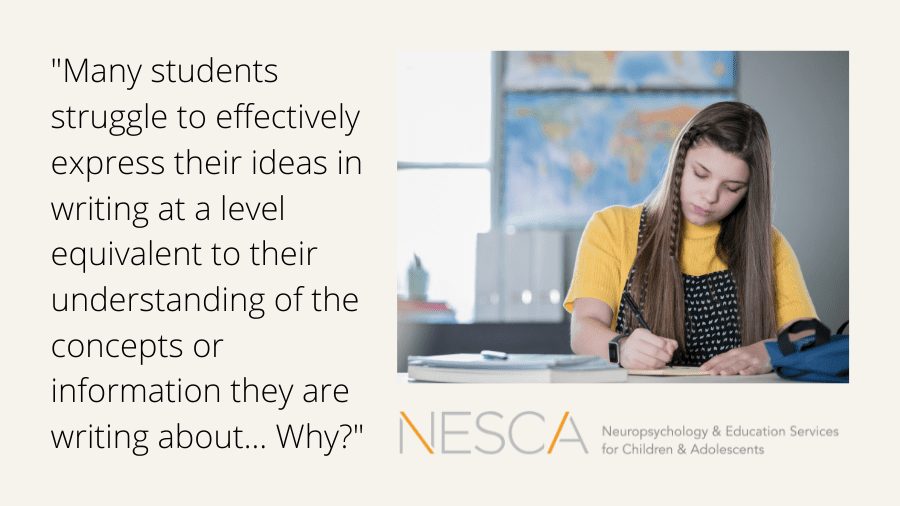
Many students struggle to effectively express their ideas in writing at a level equivalent to their understanding of the concepts or information they are writing about… Why?

There are many reasons a student may struggle with academic (expository) writing. Such writing requires a student to evaluate evidence, expand upon ideas, and demonstrate knowledge in a clear and concise way. In order to write effectively, a student must access and implement several higher order processes simultaneously, including but not limited to:

  • thinking
  • organization of ideas
  • retrieval of needed information
  • being able to remember an idea long enough to write it down…

while at the same time, the student also needs to think about writing mechanics (e.g., handwriting, spelling, punctuation).

All of these sub-components need to be pulled together for a student to create a well-written product. As a result, students often avoid writing or write only the minimal amount necessary.

Students with both language-based learning disabilities (LBLD) and AD/HD are at particular risk to struggle, as student with LBLD often have difficulty with word retrieval, syntax, and spelling to name a few, while students diagnosed with AD/HD inherently struggle with task initiation, planning, distractibility, and are vulnerable to reduced handwriting skills and careless errors.

In order to support all students, we need to help them develop more efficient skills. Research has shown that students can be taught to organize their language and ideas. Graphic organizers are an example of an organizational strategy. Some well-researched and effective programs include “Brain Frames,” a set of six graphical patterns that students draw to organize their language and ideas (www.architectsforlearning.com) and “Thinking Maps,” a set of eight visual patterns that correlate to specific cognitive processes (www.thinkingmaps.com). Another benefit of the graphic organizers is that the skills learned can be applied to more than just writing, but as writing is a critical skill necessary for school success as well as in the workforce, it is important that we help our students develop these skills and recognize that they do have the ability to demonstrate their knowledge in written form.

If your child is having difficulty with writing, let us know by completing our online Intake Form.

Resources used for this blog include:

  • Architectsforlearning.com
  • Thinkingmaps.com
  • PBS.org
  • adlit.org


About the Author

With NESCA since its inception in 2007, Dr. Talamo had previously practiced for many years as a child and adolescent clinical psychologist before completing postdoctoral re-training in pediatric neuropsychology at the Children’s Evaluation Center.

After receiving her undergraduate degree from Columbia University, Dr. Talamo earned her doctorate in clinical health psychology from Ferkauf Graduate School of Psychology and the Albert Einstein College of Medicine at Yeshiva University.

She has given a number of presentations, most recently on “How to Recognize a Struggling Reader,” “Supporting Students with Working Memory Limitations,” (with Bonnie Singer, Ph.D., CCC-SLP of Architects for Learning), and “Executive Function in Elementary and Middle School Students.”

Dr. Talamo specializes in working with children and adolescents with language-based learning disabilities including dyslexia, attentional disorders, and emotional issues. She is also interested in working with highly gifted children.

Her professional memberships include MAGE (Massachusetts Association for Gifted Education), IDA (International Dyslexia Association), MABIDA (the Massachusetts division of IDA) and MNS (the Massachusetts Neuropsychological Society).

She is the mother of one teenage girl.


To book a consultation with Dr. Talamo or one of our many other expert neuropsychologists, complete NESCA’s online intake form.

Neuropsychology & Education Services for Children & Adolescents (NESCA) is a pediatric neuropsychology practice and integrative treatment center with offices in Newton, Massachusetts, Plainville, Massachusetts, and Londonderry, New Hampshire, serving clients from preschool through young adulthood and their families. For more information, please email info@nesca-newton.com or call 617-658-9800.

Avoiding Burn-out

By | NESCA Notes 2022

By: Moira Creedon, Ph.D. 
Pediatric Neuropsychologist, NESCA

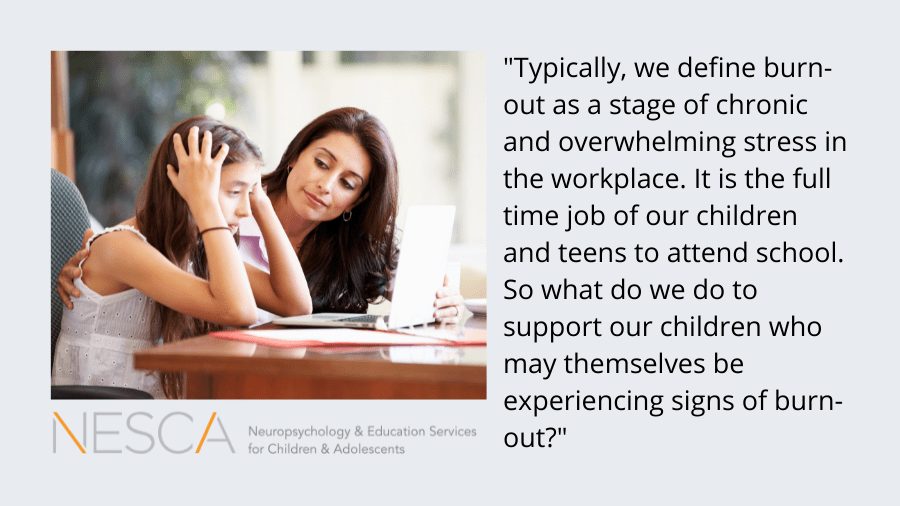
We have hit our third calendar year of COVID. It’s season 3 of this drama series during our Junior Year of COVID. As my colleagues in front line health care discuss ways to avoid burn-out in this lengthy experience, it’s inspired me to think of ways for our kids and teens to avoid burn-out. Typically, we define burn-out as a stage of chronic and overwhelming stress in the workplace. It is the full time job of our children and teens to attend school. So what do we do to support our children who may themselves be experiencing signs of burn-out?

First, let’s understand some signs of burn-out, including:

  • A sense of fatigue or low energy to engage with school or personal activities
  • A sense of “distance” from school, which can include statements such as, “I don’t care,” or withdrawal from activities
  • Negative feelings about school or academic achievement, which can sometimes look like irritability and hatred of school
  • Doubts that school is “worth it” or a sense that what is learned in school is never applicable to real life
  • Reduced efficiency so that tasks take far longer than usual

Given the constant stress of close contact notifications, masking requirements, fears of infection, and disappointment about canceled activities (to name a few), it is not surprising that kids may feel this sense of burn-out. Let’s consider 5 tips to support children and teens with a sense of burn out:

  1. Give it a name. It might feel like a relief to recognize and label the experience for children and teens. Giving the experience the name of “burn-out” can provide some distance from the problem, rather than feeling consumed by it.
  2. Practice mindfulness. It can be easy to get caught up considering the “before-COVID” good old days. It can also be hard to imagine the uncertain future and when one might get to the other side. Practice focusing on this moment of this day. Encourage children to notice any physical signs of stress in their bodies. These moments can pass as the sensation is not permanent. Using meditation and deep breathing can help children to stay rooted in the present moment.
  3. Manage the calendar. It is easy to feel overwhelmed by due dates, projects, and additional activities. As a parent, this may mean that you will have to take over as the “gate keeper” of the calendar. Help to prioritize the necessary and eliminate what is not needed. Protect personal time carefully so that school tasks do not consume all areas of the weekend.
  4. Practice self-care. Self-care can look different for everyone – from vigorous physical activity for one teen to a day of relaxation for another. Encourage discussion about what your child might need and consider ways to change up the ordinary. For example, consider assigning a “home spa day” of relaxation or a warm bath. Consider outside activities for the active child who needs to run or exercise to feel good. Sleep, exercise, and good nutrition are critical ways to care for our bodies when facing chronic stress.
  5. Leave room for the fun. When school feels boring or challenging for children, it can be hard to motivate children and remain committed. Work with your child to identify a staff member or friend who they look forward to seeing. Consider an after-school activity that sparks joy so there is something to look forward to at the end of the day.


About the Author

Dr. Creedon has expertise in evaluating children and teens with a variety of presenting issues. She is interested in uncovering an individual’s unique pattern of strengths and weaknesses to best formulate a plan for intervention and success. With experiences providing therapy and assessments, Dr. Creedon bridges the gap between testing data and therapeutic services to develop a clear roadmap for change and deeper of understanding of individual needs.


If you are interested in booking an evaluation with Dr. Creedon or another NESCA neuropsychologist, please fill out and submit our online intake form


Neuropsychology & Education Services for Children & Adolescents (NESCA) is a pediatric neuropsychology practice and integrative treatment center with offices in Newton and Plainville, Massachusetts, and Londonderry, New Hampshire, serving clients from preschool through young adulthood and their families. For more information, please email info@nesca-newton.com or call 617-658-9800.

Meet NESCA Transition Specialist & Occupational Therapist Lyndsay Wood, OTD, OTR/L

By | NESCA Notes 2022

By: Jane Hauser
Director of Marketing & Outreach

NESCA is thrilled to have welcomed a new Occupational Therapist who is serving as a Transition Specialist on the Transition Services Team. Learn more about Lyndsay Wood, OTD, OTR/L, in my interview with her below.

How did you become interested in Occupational Therapy, specifically for transition-aged students?

Right after college, I worked in an assisted living center in an administrative role. I got to know the Occupational Therapist (OT) there, who was amazing at what she did. She helped people with the skills they needed to do on a daily basis. I asked to shadow her so I could learn more about the profession and what kind of skills she was teaching the residents to do. Energized by what I learned, I then became a Teaching Assistant (TA) in the CASE Collaborative’s high school program. This is where I started to learn about the needs of transition-aged students and how Occupational Therapy played a role in that area. Again, I was fortunate to learn so much from another talented OT, particularly around the importance of transition, with our students who are often underserved on that front. Moving into adulthood is so challenging, and it’s even harder when coupled with a disability. I found that the environments these students encountered every day just aren’t set up for them to succeed. I was able to help them move into adulthood and practice skills they would need to achieve their goals within these environments.

What made you realize that you wanted to work as a Transition Specialist?

I had already developed a passion for working with transition-aged students in the school setting both during my time as a TA and as an occupational therapist at The League School of Greater Boston. I loved working with the students on life skills, emotional regulation, and executive functioning. I found that I most enjoyed working with the students on hands-on, real-life learning. It seemed to be the most important and most effective way that, as an OT, I could help young adults and teens become more self-determined and thrive. They were able to see what they were able to do, and that was exciting!

Why did you join NESCA?

I loved working with students, but I wanted the opportunity to work with transition-aged youth out in the community. It’s often really difficult for this group to generalize what they learn in the school setting to the experiences they face in the community or even at home. I wanted to help them do just that.

I was thrilled to learn that NESCA offers Transition and Coaching services since I didn’t know anything like that existed outside of an academic setting. I initially joined NESCA as an Occupational Therapist; Executive Function and Real-life Skills Coach on a per diem basis during the summer of 2021. I got to take the skills our teens and young adults learn in school and tailor them to be put into place in the community in a hands-on way. We’re able to teach clients skills like grocery shopping, using the subway or Uber to get to where they need to go, making a deposit at the bank and any other skills they may need to succeed in real life. Having recently moved into a full-time Occupational Therapist; Transition Specialist position here, I look forward to doing much more of these kinds of activities!

What is the most rewarding part of what you do?

The most rewarding aspect of what I do is when I actually get to see the client perform the skill(s) that they have had a hard time with and that they have been working toward for so long. Watching them accomplish their goal is so gratifying. When you see that success, it’s a wonderful feeling!

I also love that I am able to do what I do – not only within the walls of a classroom or school – but in the outside world. I always wanted my students to practice the skills that we were working on in the school environment out in the real world so I knew they would be prepared for experiences they were likely to face in their daily lives. This could be anything from placing an order at Starbucks, riding the bus or refilling a prescription. I get to do that with them here at NESCA…and so much more.

What’s your specialty area? Who do you most enjoy working with?

My passion is working with those who are on their way to adulthood. I am definitely where I want to be with the transition-aged youth and young adults! When working with teens, you get to see them prosper and make monumental changes that can help them build a high quality of life, allowing them to be successful and happy for a greater portion of their lifespan.

I really enjoy working with a wide population of clients, including those with mental health challenges, Autism Spectrum Disorders (ASD) and Attention-Deficit/Hyperactivity Disorder (ADHD). I especially find it rewarding to work with young adults with mental health issues, such as anxiety or depression, to help manage those challenges and lead a fulfilling life.

Tell us a little about yourself. What do you like to do in your spare time?

I grew up in Acton, Massachusetts, and I’m a big outdoors person. I like to spend most weekends in Vermont or New Hampshire, exploring new places to hike. I also enjoy skiing, kayaking and most other outdoor activities. I also like to read, play weekly board games and dance when I get the chance!


About Lyndsay Wood, OTD, OTR/L

Lyndsay Wood, OTD, OTR/L, is an occupational therapist who focuses on helping students and young adults with disabilities to build meaningful skills in order to reach their goals. She has spent the majority of her career working in a private school for students with ASD. She has also spent some time working in an inpatient mental health setting. Lyndsay uses occupation-based interventions and strategies to develop life skills, executive functioning, and emotional regulation. While completely her doctoral degree at MGH Institute of Health Professions, Lyndsay worked with the Boston Center for Independent Living to evaluate transition age services. She uses the results from her research to deliver services in a way that is most beneficial for clients. Specifically, she focuses on hands-on, occupation-based learning that is tailored the client’s goals and interests.


To book coaching and transition services at NESCA, complete NESCA’s online intake form

Neuropsychology & Education Services for Children & Adolescents (NESCA) is a pediatric neuropsychology practice and integrative treatment center with offices in Newton and Plainville, Massachusetts, as well as Londonderry, New Hampshire. NESCA serves clients from preschool through young adulthood and their families. For more information, please email info@nesca-newton.com or call 617-658-9800.

Boredom: The Good, the Bad, and the Ugly

By | NESCA Notes 2021

By: Cynthia Hess, PsyD
Pediatric Neuropsychologist Fellow and Therapist

According to the APA Dictionary of Psychology, boredom is defined as:

A state of weariness or ennui resulting from a lack of engagement with stimuli in the environment. It is generally considered to be one of the least desirable conditions of daily life and is often identified by individuals as a cause of feeling depressed. It can be seen as the opposite of interest and surprise

In an APA podcast called Speaking of Psychology, Erin Westgate, PhD, a psychologist who studies boredom, suggests that boredom is an unpleasant emotion similar to anger, sadness, fear, and pain. In her efforts to understand and define boredom, Dr. Westgate explored the ways in which attention and meaning affect emotions and explain boredom. She opines that boredom may result from one’s inability to sustain attention, which may occur either when a task is too easy or too hard. It may help to understand why students describe a less preferred subject (e.g., math) as boring. Boredom may also be due to a sense that what we are doing lacks meaning. In both instances, the mind wanders and we are faced with that sense of being alone with our thoughts. Dr. Westgate notes that some thoughts are more engaging than others, and there are certain conditions under which people enjoy or do not enjoy their own thoughts. It has become increasingly difficult for people to sit and think, and consequently they search for ways to escape or avoid the boredom that results. However, boredom is not all bad. Like many things in life, it depends on how we manage it.

Similar to other negative emotions, boredom alerts us that something is wrong in our body, and it is human nature to want to escape or avoid it. When escape and avoidance become the only method to cope with boredom, individuals may begin experiencing chronic boredom, which can be detrimental to emotional and physical wellbeing. When boredom becomes chronic, it no longer works as a useful signal. Boredom can be more impactful than loneliness and is often mistaken for loneliness. When boredom is not well managed, it can lead to depression and self-destructive behaviors, such as self-harm and addiction. As alluded to above, the ability to sit with our thoughts and feelings without trying to avoid or escape them has become increasingly difficult. Perhaps related to the ease with which they can be avoided; for example, when our body sends out the first signal of discomfort, we can distract ourselves by reaching for our phone. An article in TIME magazine stated:

We’re trying to swipe and scroll the boredom away, but in doing that, we’re actually making ourselves more prone to boredom, because every time we get our phone out we’re not allowing our mind to wander and to solve our own boredom problems, Mann says, adding that people can become addicted to the constant dopamine hit of new and novel content that phones provide. Our tolerance for boredom just changes completely, and we need more and more to stop being bored.

Relying on electronics is only one example of a way to avoid and escape the discomfort of boredom. It is highly reinforcing because, in the short-term, it works. However, when it is one’s only tool in the toolbox, it may quickly undermine their ability for learning to manage uncomfortable thoughts and feelings and use them for creating positive change. Therefore, it is necessary to find a positive, opposite behavior to replace the maladaptive behavior. This often leads to an increased sense of purpose and agency, and improved self-esteem and self-concept.

Children and adolescents often complain about being bored, and while boredom is uncomfortable, it can also help to develop skills, creativity, and boost self-esteem. Once boredom sets in, it can be difficult for children to shift their attention to find meaning when confronted with the discomfort of boredom. According to an article published by the Child Mind Institute, boredom can be a great way to teach children how to manage frustration and regulate emotions when things are boring or not going their way. It is not that boredom teaches the skills, but rather it is what they do when faced with boredom. There are many strategies outlined in the article to help parents nurture skills when their children are bored. In general, be aware that behaviors may be attention-seeking, and therefore, should not be reinforced. Otherwise, boredom offers an opportunity for children to do something meaningful that benefits them and those around them. When properly managed, it spurs creativity and innovation. Along the way, it is important to be realistic and recognize that there will be failure, and learning to manage the discomfort of failure is an added bonus.


About the Author

Dr. Cynthia Hess recently graduated from Rivier University with a PsyD in Counseling and School Psychology. Previously, she earned an M.A. from Antioch New England in Applied Psychology. She also worked as an elementary school counselor and school psychologist for 15 years before embarking on her doctorate. During her doctorate, she did her pre-doctoral internship with RIT in Rochester, N.Y. where she worked with youth ages 5-17 who had experienced complex developmental trauma. Dr. Hess’s first post-doctoral fellowship was with The Counseling Center of New England where she provided psychotherapy and family therapy to children ages 5-18, their families and young adults. She also trained part-time with a pediatric neuropsychologist conducting neuropsychological evaluations.


To schedule an appointment with one of NESCA’s expert neuropsychologists, please complete our online intake form


Neuropsychology & Education Services for Children & Adolescents (NESCA) is a pediatric neuropsychology practice and integrative treatment center with offices in Newton and Plainville, Massachusetts, and Londonderry, New Hampshire, serving clients from preschool through young adulthood and their families. For more information, please email info@nesca-newton.com or call 617-658-9800.


Assessing Work Motivation and Values

By | NESCA Notes 2021

By: Kelley Challen, Ed.M., CAS
Director of Transition Services; Transition Specialist, NESCA

Over the past few months, my colleague Tabitha Monahan and I have dedicated several of our blog entries to vocational assessment as a critical tool for helping students learn about employment and set career goals for themselves. Previous blogs have provided an overview of vocational assessment as well as an in depth look at career interest inventories, vocational aptitude testing, and real-life experiences, such as informational interviews and job shadows. However, there is another type of vocational assessment that we have not yet discussed that can be an invaluable tool for helping students to learn about their “vocational selves” and ultimately choosing occupations that are a good fit—a work motivation or work value assessment.

Work motivations or values are the qualities, principles, or standards that really matter to a person as a worker. Essentially, if you are going to get out of bed every day and go to a job, what are the characteristics that your job needs to have in order for you to feel that going to work is worthwhile? Certainly, money can be an important characteristic of a job, but is that more important to you than helping others, creativity, or recognition? Each of us has a different set of values that will drive us to make choices and take action in our lives, and having an occupation that satisfies those values is just as important as having a job that aligns with our interests and skills.

Similar to career interest inventories, work motivation and value assessments come in many shapes and sizes, some formal (e.g., lengthy and standardized) and some informal (e.g., short checklists or rating scales). Also, similar to career interest inventories, it can be helpful to administer or self-administer more than one of these assessment tools to get a sense of how clear one’s work motivations and values are (i.e., how often an individual responds to assessments with a similar pattern of expressed values). Additionally, it is recommended that students not just take assessments, but that educators and career counselors engage students in qualitative conversations about their results so that students have the opportunity to clarify their values as well as more quantitative exercises, such as comparing work values with career interests.

While there are many different work motivation and value classification systems, I’m choosing to highlight the four work motive categories and eight value constructs from one of my favorite assessment tools, the Work Motivation Scale below.

Fulfillment Motives: The need for work that provides the individual with opportunities to reach their maximum potential. Creativity, curiosity, foresight, and competence are attributes that are often observed in individuals with high fulfillment motives. Fulfillment motives are comprised of the following work value constructs:

  • Success Orientation: Individuals scoring high on this construct are motivated toward accomplishing career goals and reaching their full potential through their work. Passionate about their work, they are willing to endure periods of hardship to be successful.
  • Mission Orientation: Individuals scoring high on this construct are oriented toward seeing the big picture and tend to be less concerned with details. Goal directed, they recognize how their current work fits into and contributes to the overall direction of the organization.

Self-Esteem Motives: The need for achievement, responsibility, and challenging and meaningful work tasks. Links between leadership and achievement are usually present for individuals with high self-esteem motives. Self-esteem motives are comprised of the following work value constructs:

  • Managing Others: Individuals scoring high on this construct value opportunities to direct and supervise the work of others. They willingly take responsibility for worker  performance and the productivity of a work unit, department, or work function.
  • Task Orientation: Individuals scoring high on this construct are oriented toward completing tasks. Planning their work, making the most of resources, and maintaining their focus are important to them. They may hesitate to perform functions outside of those tied to a specific job description.

Affiliation Motives: The need for the acceptance and support of coworkers and supervisors. Cooperation and collaboration toward meeting work goals are sought by individuals with high affiliation motives. Affiliation motives are comprised of the following work value constructs:

  • Supervisor Relations: Individuals scoring high on this construct feel that cooperating with and relating to their supervisor are important. They strive to meet their supervisor’s expectations and highly appreciate their supervisor’s recognition and support.
  • Coworker Relations: Individuals scoring high on this construct feel that relating to peers is important. They prefer to be actively involved in employee related organizations at work and outside of work. They highly value collaboration and teamwork.

Survival and Safety Motives: The need for employment with an adequate livable wage and a safe and secure work environment. The need for favorable benefits packages is also valued by individuals with high survival and safety motives. Survival and safety motives are comprised of the following work value constructs:

  • Working Conditions: Individuals scoring high on this construct believe that a good work environment and creature comforts (climate control, privacy, adequate lighting) are important. They value having the materials, equipment, and resources to do their work effectively and efficiently.
  • Earnings and Benefits: Individuals scoring high on this construct value salary, raises, health insurance plans, pensions, and retirement planning. Vacation, sick leave, personal days, and family leave policy are important considerations in their employment choices as well.

Definitions provided by/taken from the Work Motivation Scale Administrator’s Guide.

Understanding which of these constructs and categories matter most to a student, and a student understanding this about themselves, can have a huge impact on helping a young person to find fulfilling work.

To read more about vocational assessment, check out the following blog entries:

For more information about vocation assessment and transition assessment at NESCA, visit our transition services page and our transition FAQs.


About the Author
Kelley Challen, Ed.M., CAS, is NESCA’s Director of Transition Services, overseeing planning, consultation, evaluation, coaching, case management, training and program development services. Ms. Challen also provides expert witness testimony in legal proceedings related to special education. She is also the Assistant Director of NESCA, working under Dr. Ann Helmus to support day-to-day operations of the practice. Ms. Challen began facilitating programs for children and adolescents with special needs in 2004. After receiving her Master’s Degree and Certificate of Advanced Study in Risk and Prevention Counseling from Harvard Graduate School of Education, Ms. Challen spent several years at the MGH Aspire Program where she founded an array of social, life and career skill development programs for teens and young adults with Asperger’s Syndrome and related profiles. She additionally worked at the Northeast Arc as Program Director for the Spotlight Program, a drama-based social pragmatics program, serving youth with a wide range of diagnoses and collaborating with several school districts to design in-house social skills and transition programs. Ms. Challen is co-author of the chapter “Technologies to Support Interventions for Social- Emotional Intelligence, Self-Awareness, Personality Style, and Self-Regulation” for the book Technology Tools for Students with Autism. She is also a proud mother of two energetic boys, ages six and three. While Ms. Challen has special expertise in supporting students with Autism Spectrum Disorders, she provides support to individuals with a wide range of developmental and learning abilities, including students with complex medical needs.


Neuropsychology & Education Services for Children & Adolescents (NESCA) is a pediatric neuropsychology practice and integrative treatment center with offices in Newton, Massachusetts, Plainville, Massachusetts, and Londonderry, New Hampshire, serving clients from preschool through young adulthood and their families. For more information, please email info@nesca-newton.com, call 617-658-9800 or complete our online Intake Form.
Occupational Therapists and Transition Assessment, A Natural Fit!

By | NESCA Notes 2021

By: Sophie Bellenis, OTD, OTR/L
Occupational Therapist; Real-life Skills Program Manager and Coach, NESCA

Being an occupational therapist (OT) often means working in a profession that many people do not have extensive experience with or knowledge about. It can be hard to give one definition of this profession when OTs are at hospitals and schools, working on advocacy in DC, running mental health groups, and in some cases even responding to natural disasters. We are all around! Despite the broad range of settings, OTs are all guided by the Occupational Therapy Practice Framework: Domain and Process (AOTA, 2020), an ever-evolving framework that describes the central concepts, foundational views, and basic tenets of the profession. As an occupational therapist who has worked in schools with a huge focus on access to the curriculum, functional skill building, and increasing students’ overall participation, I frequently reference the document to ensure I am staying true to my profession and using my lens to help support clients’ goals in the most effective ways possible. As a member of the transition team here at NESCA, I have been fascinated by the natural fit between occupational therapy and transition assessment. Both of these require a holistic lens, consideration for the client as well as their environment, and an ability to focus on multiple different aspects of a person’s life simultaneously.

While occupation is sometimes considered a synonym for “job,” OTs focus on the broader definition of occupations as, “the everyday activities that people do as individuals, in families, and with communities to occupy time and bring meaning and purpose to life. Occupations include things people need to, want to, and are expected to do” (WFOT, 2012). We consider nine separate “areas of occupation,” which include: Activities of Daily Living (bathing, showering toileting, etc.), Instrumental Activities of Daily Living (driving, financial management, meal preparation, etc.), Health Management (medication management, social and emotional health promotion, physical activity, etc.), Rest and Sleep, Education, Work, Play, Leisure, and Social Participation. We want to make sure that individuals have balance, are meeting their personal goals, and feel fulfilled by the activities of life. OTs both assess and provide direct intervention around all of these areas.

Similar to occupational therapy, transition assessment is complex and broad, and it is best thought of as an ongoing process incorporating a wide range of formal and informal assessment of a student’s strengths, interests, and preferences. When developing recommendations for transition assessments, we work in accordance with the federal law (as well as the Massachusetts Student-Driven Transition Model core areas of transition planning) to relate our findings to the demands of transition planning areas: Education/Training, Employment, Independent Living, and Community Participation. Each of these areas needs to be considered as a part of the transition planning process and plays a substantial role in putting together a comprehensive vision for a student.

As I compare the areas of occupation with the core areas of transition planning, I am struck by the similarities and constant overlap. There is an emphasis on functional independence, especially in daily living skills. There is the belief that connection and community are integral parts of life. There is also a need for purposeful activity, whether that be through work, continuing education, play, or all of the above. Each of the areas that OTs so passionately feel guide our work are areas that should be assessed and considered during transition assessment and planning. The lens through which OTs are taught to assess and evaluate clients lends itself perfectly to assessing students as they plan for their futures and transition out of high school. While there are many different ways that I could have applied my OT training, I am glad to be able to apply my expertise to transition assessment at NESCA as one of the ways we help youth and young adults achieve their goals and carry out fulfilling lives.

References

American Occupational Therapy Association. (2020). Occupational therapy practice framework: Domain and process (4th ed.). American Journal of Occupational Therapy74(Suppl. 2), Article 7412410010. https://doi.org/10.5014/ajot.2020.74S2001

Massachusetts Department of Elementary and Secondary Education. (2021). Massachusetts student-driven transition model. Retrieved from https://www.doe.mass.edu/sped/secondary-transition/resources-materials.html.

World Federation of Occupational Therapy. (2012) Definition of occupational therapy. Retrieved from https://wfot.org/about/about-occupational-therapy


About the Author
Sophie Bellenis is a Licensed Occupational Therapist in Massachusetts, specializing in educational OT and functional life skills development. Bellenis joined NESCA in the fall of 2017 to offer community-based skills coaching services as a part of the Real-life Skills Program within NESCA’s Transition Services team. Bellenis graduated from the MGH Institute of Health Professions with a Doctorate in Occupational Therapy, with a focus on pediatrics and international program evaluation. She is a member of the American Occupational Therapy Association, as well as the World Federation of Occupational Therapists. Having spent years delivering direct services at the elementary, middle school and high school levels, Bellenis has extensive background with school-based occupational therapy services.  She believes that individual sensory needs and visual skills must be taken into account to create comprehensive educational programming.


To book an appointment or to learn more about NESCA’s Occupational Therapy Services, please fill out our online Intake Form, email info@nesca-newton.com or call 617-658-9800.


Neuropsychology & Education Services for Children & Adolescents (NESCA) is a pediatric neuropsychology practice and integrative treatment center with offices in Newton, Massachusetts, Plainville, Massachusetts, and Londonderry, New Hampshire, serving clients from preschool through young adulthood and their families. For more information, please email info@nesca-newton.com or call 617-658-9800.


Skip to content