NESCA’s Newton, MA location has immediate availability for neuropsychological evaluations. Our MA clinicians specialize in the following evaluations: Neuropsychological; Autism; and Emotional and Psychological, as well as Academic Achievement and Learning Disability Testing.

Visit www.nesca-newton.com/intake for more information or to book an evaluation.

Tag

neuropsychology and education services for children and adolescents Archives - Page 9 of 13 - NESCA

Subscribe to NESCA Notes

When Gaming Is No Longer A Game

By | NESCA Notes 2021

By: Cynthia Hess, PsyD
Pediatric Neuropsychologist and Therapist

Many parents are wrestling with how much time their children are engaging with screens, and finding themselves wondering how much is too much. Children who experience difficulty related to symptoms of ADHD are especially drawn to the stimulation of screens. And children with ADHD tend to require frequent and immediate rewards, making them especially drawn to screen-time activities. While a specific cause for ADHD has not been identified, there is some consensus that a shortage of dopamine could be to blame. Dopamine not only plays a role in how we feel pleasure, it is also significant in the uniquely human ability to think and plan.

Part of the allure of gaming – and social media – is that each new level reached and each new “like,” instantly releases a small dose of dopamine directly into the brain’s reward center. If you have ever had to fight with your child to get off technology, this is likely why. A deficit in dopamine is easily fed by screen-time activities, leading children to want more. This has led to a demand for content, resulting in tens of millions of dollars having been made by YouTubers whose entire platform is gaming, and children love watching them. They are entertaining, and kids learn tips for improving their own gaming.

Children worship gaming YouTubers, and many strive to be one someday. It is challenging for parents to keep up with the content their children are accessing largely because YouTube has created an algorithm in the system that suggests what to watch next based on frequent views or recent searches. YouTube’s recommendation system is specifically engineered to maximize watch time and often “up next” videos play automatically. In fact, this feature is responsible for more than 70 percent of all time spent on the site, indicating that children, and others, are consistently and reliably exploring recommended “up next” content. It is important for parents to do their research and know who their children are watching and following on YouTube, as they may be drawn into content that could be highly influential and contrary to family values. While many YouTubers are harmless, there are those who include brief, perhaps undetectable messages (e.g., PewDiePie) that influence what shows up next. Children are curious, and YouTube’s goal is to keep them engaged, which can turn into the perfect storm.

YouTube consists of a business model that rewards provocative videos with large sums of money. They strive to attract viewers by leading them down paths meant to keep people engaged. While much of the content may seem innocuous, there are reasons to be cautious as things aren’t always as innocent as they seem. Provocative content creates intrigue. It piques interest and may be especially attractive to older children and adolescents. As individuals strive to create the next viral video, putting forth extreme beliefs and violent content may be their pathway to becoming a celebrity. For these reasons, and as technology becomes increasingly embedded in children’s lives, it is important for parents to do their research and stay informed.

Some helpful resources include:

https://www.pewresearch.org/internet/2020/07/28/parenting-children-in-the-age-of-screens/

https://chadd.org/wp-content/uploads/2018/06/ATTN_06_15_TooMuchScreenTime.pdf

https://childmind.org/article/healthy-limits-on-video-games/


About the Author

Dr. Cynthia Hess recently graduated from Rivier University with a PsyD in Counseling and School Psychology. Previously, she earned an M.A. from Antioch New England in Applied Psychology. She also worked as an elementary school counselor and school psychologist for 15 years before embarking on her doctorate. During her doctorate, she did her pre-doctoral internship with RIT in Rochester, N.Y. where she worked with youth ages 5-17 who had experienced complex developmental trauma. Dr. Hess’s first post-doctoral fellowship was with The Counseling Center of New England where she provided psychotherapy and family therapy to children ages 5-18, their families and young adults. She also trained part-time with a pediatric neuropsychologist conducting neuropsychological evaluations.


To schedule an appointment with one of NESCA’s expert neuropsychologists, please complete our online intake form


Neuropsychology & Education Services for Children & Adolescents (NESCA) is a pediatric neuropsychology practice and integrative treatment center with offices in Newton and Plainville, Massachusetts, and Londonderry, New Hampshire, serving clients from preschool through young adulthood and their families. For more information, please email info@nesca-newton.com or call 617-658-9800.


Developing S-M-A-R-T Goals in 2021

By | NESCA Notes 2021

By: Tabitha Monahan, M.A., CRC
NESCA Transition Specialist/Counselor

Happy New Year! Now two weeks into 2021, maybe it’s time to revisit those New Year Resolutions.  French writer Antoine de Saint-Exupéry wrote: “a goal without a plan is just a wish.” This is true for resolutions, just as it is for any goal. How can we help our young people change their wishes, visions and dreams into goals? We teach them (and maybe ourselves while we’re at it) how to plan. One of my favorite strategies for both teaching and reaching goals is by creating SMART Goals. What is a Smart Goal?

Specific – The goal should be specific. I’ll increase the distance I run is vague. Will you increase the distance by 20 feet, 2 miles? Are you planning for a marathon? Instead, let’s take a look at step 2, making it measurable.

Measurable – There’s a good chance that if your goal is not specific enough, it will be hard to measure if you have succeeded in that goal. So, let’s make our exercise goal both specific and measurable. I’ll increase the distance I run from 1 mile to 3.2 miles (5k).

Attainable – Attainable is the hard one for many students who are still building awareness of their strengths and challenges. Let’s say a person who has never run wants to run in the Boston Marathon. This is likely not an attainable goal, even if it is specific and measurable. Couch to 5k training exists; I have not seen the couch to marathon training program. Having measurable steps also helps break down the goal into smaller pieces, which will be further discussed later.

Relevant – If I am trying to increase my social circle and group leisure skills, running is unlikely to get me there. However, if, like many people, we’re trying to improve our health in 2021 (or take off some of those quarantine pounds), increasing the distance we run certainly will get us there. Many young adults may need to bounce ideas off someone to ensure the goal is relevant to the area at hand.

Time-bound – Attainable and time-based work tightly together. If you do not give yourself a deadline, the goal may still be there come December 2021. Humans work best with deadlines. We need the motivation to complete a plan, and often motivation needs a sense of urgency.

Okay, so what does our SMART goal look like for increased health and wellness? I will increase the distance I run from 1 mile to 3.2 miles (5k) in ¼ mile increments by June 30, 2021.

We have all the pieces. It is specific, and we know precisely what the end goal will be and how we will get there. It’s measurable; there is something we can check off as complete, like a to-do list. It’s attainable and seems realistic. We are not trying to run the Boston Marathon course after only running a mile. We will start as a beginner runner and work towards a 5k, and we are not trying to do it tomorrow with no steps in between. It’s relevant; we are working on bettering our health in 2021. And it is time-based. We want to meet our goal by the end of June.

Now that we’ve refreshed our minds on SMART goals, how do we build these skills in transition-aged youth? Ask them. Ask your child, your students, your clients what they want for themselves in education, employment and independent living. We already have the starting points. We have their vision. We have the IEP TEAM’s goals and objectives.

The youth may have a far-reaching (and maybe seemingly unattainable) goal. Help them break that big goal down into smaller parts and work backward. Do they want to be an engineer? Engineers need a college degree. What does the student need to do to graduate college? They need to get into college. How do they get into college? They need to apply and graduate from high school. What do they need to do to graduate high school? They need to pass their science class. That seems like a reasonable starting place, and it is still related to the vision. What might a SMART goal look like for that student? I will receive a passing grade on my final exam by answering the end of chapter questions each week and asking for clarification from my teacher for any questions I got wrong by the end of the spring semester.

But how do we support them when they aren’t making progress? Many people have a hard time adjusting once they have made a plan. Whenever we set a goal, we need to look at our progress periodically. We need to check that the goal is still attainable by the deadline we gave ourselves. Are we making progress? If we are still running only a mile and it’s March, what adjustments do we need to make? Suppose a student is not finding answering the end of chapter questions helpful in confirming their knowledge of the material. What changes can they make to increase their understanding of the material? Maybe the student asks the teacher if they can work one-on-one twice a week to increase understanding? Frustration, when the plan doesn’t work, makes many give up on the goal. Learning how to adapt is just as essential as learning how to make a goal.

A person who has practiced SMART goals is a person who will have an increased understanding of the objectives and smaller steps they need to reach their vision. They will have more confidence in their abilities and more awareness of their challenges. A person who has goal-setting skills is a person who has control of their own life. What are your SMART goals for 2021?


About the Author

Tabitha Monahan, M.A., CRC, is an experienced transition evaluator and vocational counselor. While she is well-versed in supporting a wide range of transition-aged youth, she is especially passionate and knowledgeable in helping clients and their families navigate the complex systems of adult services and benefits as well as medical and mental health systems. She is further adept in working individually with students of all abilities to empower self-advocacy and goal achievement.


To schedule an appointment with one of NESCA’s expert transition specialists or neuropsychologists, please complete our online intake form


Neuropsychology & Education Services for Children & Adolescents (NESCA) is a pediatric neuropsychology practice and integrative treatment center with offices in Newton and Plainville, Massachusetts, and Londonderry, New Hampshire, serving clients from preschool through young adulthood and their families. For more information, please email info@nesca-newton.com or call 617-658-9800.


Meet Abigael Gray, NESCA’s Speech-Language Pathologist & Feeding Specialist

By | NESCA Notes 2020

This Fall, NESCA debuted its new feeding, speech and language and direct sensory/motor occupational therapy services. Leading NESCA’s feeding and speech and language therapy is Abigael Gray, MS, CCC-SLP. In today’s blog, we sat down with Abbey to learn about her role as a Feeding Specialist; Speech-Language Pathologist.

What led you to your interest in speech and language and feeding, in particular?

I received an undergraduate degree in psychology from Syracuse University. After graduating, I worked in a preschool for children with autism and developmental delays. This is really what made me interested in speech and language pathology (SLP), since all of the children there were receiving speech-language therapy. While I was working there, I observed quite a bit and decided I wanted to learn and do more in this area. After five years of working there, I enrolled at Emerson College to earn my Master’s in Communications Sciences and Disorders. While there, I discovered that Emerson has a great program for feeding. Many schools don’t have a focus on swallowing and feeding in pediatrics, like Emerson does. I had a placement with one of my professors at her practice in Needham. I eventually took a position with this clinic and received great training in pediatric feeding therapy there during my clinical fellowship. This is where I became passionate about feeding therapy. I eventually moved into a multidisciplinary practice for two more years and then joined the team at NESCA.

Why were you attracted to NESCA?

I saw this as a great opportunity to bring speech-language pathology and feeding therapy to NESCA. I loved the  multidisciplinary aspect to the practice and thought I could strengthen what NESCA already offers by adding feeding and SLP to it. I like how all of the various services are built into one practice right here. Many of the  kids being seen at NESCA can also benefit from the therapies that I offer. Having those services available to parents and children right in the same location is a huge plus for them.

After meeting Ann Helmus, Ph.D., NESCA’s founder and director, I knew that it was the right cultural fit for me, being so collaborative. It also gave me the opportunity to continue to work with Julie Robinson, OT, who oversees this new clinical offering. It’s great to be able to continue with my working relationships with the occupational therapists who also joined when I did. The seamless communication between all of us in the clinical therapy practice makes for really well-rounded therapy for the children we treat as well as more convenient for their parents/caregivers.

What are the most exciting and the most challenging parts of your role?

The most exciting part of my new role at NESCA is being able to offer speech-language and feeding  services in-house. Often the recommendations from neuropsychologists through their assessment is to have some SLP support, whether it’s having to do with reading, writing, social skills, expression or comprehension. Being able to offer that right in the same practice allows for continuity of care among clinicians on behalf of the child. It’s exciting for me because I can go back to the neuropsychologist or other clinician at NESCA who referred the client with any new observations or questions I may have. This makes the process much smoother for the parents and our clinicians. There’s just a lot less “red tape” to go through to be able to communicate and collaborate.

It’s also exciting to build this service offering from the ground up. I can take all of the experiences I have had and knowledge I’ve gained through my years in various positions and make our services our own at NESCA.

As far as challenges go, right now as we build out this new service, I am currently the only SLP on board. While that is the case for now, I have a great network of past colleagues and friends who are SLPs to bounce thoughts off of. Our plan is to have other SLPs join our team as we grow the practice.

What are your clinical interests?

Feeding is my big passion area. Within feeding, I am currently completing a lactation counseling training to become a certified lactation counselor. Babies can struggle with breast feeding, then can have even more difficulties transitioning from the breast to solid foods. I love working with infants and toddlers, and having this certification will round out my knowledge about feeding for this age range.

Within speech, I love working on articulation with kids who have speech sound disorders, phonological disorders and childhood apraxia of speech. Within language, I really enjoy working on social pragmatic communication with kids who are on the higher functioning side of the autism spectrum, or Asperger’s, or those who have social pragmatics difficulties.

I also really enjoy working on early literacy skills, sound letters, identification, rhyming and phonological awareness. When it comes to kids who may be in their older elementary school or early middle school years, I love to work on writing skills with them.

One characteristic among NESCA clinicians is that they are all lifelong learners. In what ways are you a lifelong learner?

I loved that having the curiosity to continue to learn is a draw here at NESCA! That’s really important to me. Right now, I’m currently working my way through three different courses:

  • The lactation counseling certification that I mentioned previously
  • A “Feed the Peds” course, which is a refresher course on feeding therapy with some new approaches in the areas of tethered oral tissues (i.e., tongue ties, lip ties) and how those impact feeding. The course covers how to assess and treat these issues. What’s interesting is that these new approaches are appropriate for people across the lifespan – not just for young children. There is also a module on treating those with medical complexities. Often times, medically complex patients have issues with feeding and/or are tube-fed, and can then go on to have challenges progressing through age-appropriate feeding skills or transitioning off of tube-feeding.
  • The third area I am currently in training for is with orofacial myofunctional disorders, including tethered oral tissues and the impact on speech and feeding. This covers anything that structurally or functionally impairs speech, the airway or feeding. This is a growing area in our field, so it’s important to be current and well-informed on this topic.

How has Covid-19 impacted the way you treat patients and families?

Right now, we are delivering speech-language and feeding therapy via teletherapy. While it’s always great to work with a child and/or family in-person, the plus side of teletherapy is that we get to see the child in their natural home environment as well as how the child communicates with family members. Sometimes, when we see the child in this setting, we can detect and observe a feeding or speech-language issue as the family sees it on a regular basis. It’s also nice to be able to work with parents in their own setting. We can better understand their priorities for therapy since we are talking directly with them. It also allows the child to generalize the skills they would normally learn in the clinic setting right into their home. As therapists, we can see what a typical meal at home looks like, which is obviously a more natural setting than the clinic. We used to have to ask parents to send us videos of mealtimes. Now, it’s like we are at a meal with them over Zoom!

Covid-19 was the catalyst for us to offer teletherapy, which has helped parents who work and have to travel to get to therapy tremendously. They are now able to be more hands-on in the therapy sessions. Also, for some medically complex kids, it’s just hard to get out of the house and drive to therapy. And, parents don’t have to cancel appointments if a sibling is home sick or even quarantining. And, we can stay on track with therapy via telehealth even in inclement weather that makes it challenging to drive to the clinic.

Covid-19 has certainly had its drawbacks, but we’re seeing some of the upsides in teletherapy as well.


About the Author

Abigael Gray has over six years of experience in assessment and treatment of a variety of disorders, including dysphagia, childhood apraxia of speech, speech sound disorder, receptive and expressive language disorder, autism spectrum disorder and attention deficit hyperactivity disorder. She has a special interest and experience in working with children with feeding and swallowing disorders, including transitioning infants to solid foods, weaning from tube feeding, improving sensory tolerance, developing chewing skills, increasing variety and volume of nutritional intake and reducing avoidance behaviors during mealtimes.


If you are interested in learning more about NESCA’s speech-language therapy or feeding therapy, please complete our online intake form, or email NESCA’s Director of Clinical Services Julie Robinson at jrobinson@nesca-newton.com.


Neuropsychology & Education Services for Children & Adolescents (NESCA) is a pediatric neuropsychology practice and integrative treatment center with offices in Newton, Massachusetts, Plainville, Massachusetts, and Londonderry, New Hampshire, serving clients from preschool through young adulthood and their families. For more information, please email info@nesca-newton.com or call 617-658-9800.


Digital Literacy, Executive Function and Remote Learning

By | NESCA Notes 2020

By: Sophie Bellenis, OTD, OTR/L

Occupational Therapist; Real-life Skills Program Manager and Coach, NESCA

The experience of watching a small child who is only two or three years old pick up a smartphone, quickly type in a passcode (as they have memorized the pattern) and open up their favorite game can be jarring for adults who remember the days of dial-up internet and who learned to use technology as it staggeringly evolved. For many of today’s children, handheld electronics have always been a fundamental part of their world. Flipping between apps, using their pointer finger to manipulate games and opening a screen using facial recognition all feel like second nature to many in the current generation of school age children. We assume that children have higher digital literacy than we do and intrinsically understand technology in a way that many of us never will. But what do our children actually know? And, are they missing out on vastly important direct instruction when adults make an assumption that they are already tiny experts in the digital field?

Over the past six months, a time fraught with a monumental shift in education, I have worked one-on-one with a widely diverse group of learners. If I had to pinpoint one theme that comes up over and over, across ages, levels of ability and school systems, it is frustration, confusion and lack of problem-solving strategies as they relate to technology. Statements I have heard during this period of remote learning include:

  • “I don’t turn off my Chromebook. I lose everything, and I’m actually not quite sure that I know how to turn it back on.” – High school honors student
  • “I didn’t know that Google Slide and PowerPoint were different things. I lost so much trying to switch between them.” – High school senior
  • “Hardware or software? I didn’t realize there was a difference.” – Middle school student
  • “I just save my document with whatever my computer suggests as a title. I guess it does make it tricky to find things later.” – High school junior

As an occupational therapist focused on making sure our students can access their curriculum, comments like these teach me a few incredibly important lessons.

  1. Students are lacking information on the basics. The same student who is not sure how to turn off his Chromebook can quickly navigate Google Classroom without any support, both uploading files and opening modules with ease. We need to focus on teaching the fundamentals of technology. What are hardware and software and how to they interact? What options exist within the system preferences of a particular device? How is an iPad different from a Chromebook, a Windows laptop or a MacBook? Why do we need to power down devices sometimes? What are the downsides to never restarting a computer or updating an operating system?
  2. Successful digital organization does not come naturally. Students are typically taught specific systems for organizing physical space and materials, such as color-coded folders, binders and labels. Teaching students to organize their digital space and their digital materials is equally, if not even more, important. Learning to create folders for each class and systematic ways of labeling documents saves students time and energy, and this often decreases frustration in the moment.
  3. Academic and professional tools are not particularly intuitive (a stark contrast to entertainment tools). There are incredible programs designed to help students create presentations, synthesize data and put documents together. These include, but are not limited to, the Microsoft Suite and Google Workspace. These tools can be tricky to manipulate and many middle and high school students would benefit from taking an introductory course, watching online tutorials or working directly with teachers to explore their functionality before layering on assignments requiring competent use of the tools.
  4. Students are often completely unaware of their gaps in knowledge. This is potentially due to the fact that today’s students are so impressive when it comes to using technology for leisure purposes. They seamlessly transition from an iPad, to a Chromebook, to a Samsung phone and can access games or social media without difficulty on each device. Unfortunately, very few schools have programs focused on teaching computing skills or digital literacy in the academic context. Our students piece together enough information to get by for a short while, but often come up against challenges later. Students also may believe they have built competency because they have some exposure to a tool. For instance, I have worked with students who are building resumes and including claims such as, “Proficient in Excel, PowerPoint and Word” but score poorly when tested on these computer abilities.

So, what do can we do?

The first step towards ensuring that a child or adolescent has adequate digital literacy skills is to actually assess how much they already know. Some students do have these skills mastered and others will have unexpected deficits or gaps. This assessment can be done formally or informally. A starting point I often use is to sit down with a student at a computer and ask how they organize, how they navigate, how they save files, etc. I also like using online assessment resources, such as TypingClub.com and Northstar Digital Literacy.

Once the skills that a student needs to grow are identified, there are many opportunities available to teach them. A few options include:

  • Online courses in specific software programs. Sites, such as Coursera, LinkedIn and Udemy, have comprehensive courses focused on specific programs for all different levels of learners.
  • Free online videos. A quick search on YouTube often leads to short, accurate videos and tutorials filmed by teachers or professionals. If your student learns well through video format, these can be a great tool.
  • Ask your school for support. Often, students learn better with direct instruction. If a student’s team is aware of their lack of knowledge regarding technology, there are many professionals at school who may be able to teach these skills during a free period, study hall or meeting.


About the Author

Dr. Sophie Bellenis is a Licensed Occupational Therapist in Massachusetts, specializing in educational OT and functional life skills development. Dr. Bellenis joined NESCA in the fall of 2017 to offer community-based skills coaching services as a part of the Real-life Skills Program within NESCA’s Transition Services team. Dr. Bellenis graduated from the MGH Institute of Health Professions with a Doctorate in Occupational Therapy, with a focus on pediatrics and international program evaluation. She is a member of the American Occupational Therapy Association, as well as the World Federation of Occupational Therapists. Having spent years delivering direct services at the elementary, middle school and high school levels, Dr. Bellenis has extensive background with school-based occupational therapy services.  She believes that individual sensory needs and visual skills must be taken into account to create comprehensive educational programming.


To book an appointment or to learn more about NESCA’s Occupational Therapy Services, please fill out our online Intake Form, email info@nesca-newton.com or call 617-658-9800.


Neuropsychology & Education Services for Children & Adolescents (NESCA) is a pediatric neuropsychology practice and integrative treatment center with offices in Newton, Massachusetts, Plainville, Massachusetts, and Londonderry, New Hampshire, serving clients from preschool through young adulthood and their families. For more information, please email info@nesca-newton.com or call 617-658-9800.


I Can Tell You a Story…I Just Can’t Write It

By | NESCA Notes 2020

By: Alissa Talamo, PhD
Pediatric Neuropsychologist, NESCA

According to understood.org, “Written expression disorder is a learning disability that results in a person having trouble expressing their thoughts in writing… They might have the greatest ideas, but their writing is disorganized and full of grammar and punctuation mistakes.” Experts believe that between 8 and 15 percent of people have a written expression disorder and it often co-occurs with other learning challenges, with two of the most common being dyslexia and attention-deficit/hyperactivity disorder (AD/HD).

Writing is difficult because it depends upon many separate components that need to be integrated into a complex whole. For example, to write well, a person needs to have acquired knowledge about the topic, retrieve needed vocabulary and express the information in a way that can be followed by the reader. At the same time, the writer needs to be able to self-monitor their progress, including switching between the main idea and writing mechanics, such as spelling, punctuation and grammar. People with written expression disorder might be able to tell an organized and interesting story, but struggle when asked to recreate that information in written form. Receiving a formal diagnosis can help a child receive extra help at school or even specialized instruction. Also, a diagnosis can possibly lead to accommodations at college.

There are also several methods of instruction that can help a student organize their writing. These programs help a student visualize or represent abstract ideas by using visually-based templates. While many of these methods are copyrighted and cannot be reproduced in this blog, some examples are programs such as Thinking maps by David Hyerle, Ed.D. or “Brain Frames.” These programs have developed specific graphic organizers to help a student with a variety of writing assignments (e.g., comparing and contrasting, ordering and sequencing) and provide specialized instruction that can help a student greatly improve their ability to express their ideas in writing.

If you believe that your child may be experiencing difficulties in the area of writing, one step is to determine the root of the difficulty. For example, does the student have an underlying learning disability or reduced self-regulation that may be negatively impacting their progress? Receiving a neuropsychological evaluation could be a useful tool in determining the appropriate supports and services to best help your child.

Sources:

https://www.understood.org/en/learning-thinking-differences

http://www.ldonline.org/article/33079/

http://www.thinkingmaps.com

http://www.architectsforlearning.com


About the Author:

With NESCA since its inception in 2007, Dr. Talamo had previously practiced for many years as a child and adolescent clinical psychologist before completing postdoctoral re-training in pediatric neuropsychology at the Children’s Evaluation Center.

After receiving her undergraduate degree from Columbia University, Dr. Talamo earned her doctorate in clinical health psychology from Ferkauf Graduate School of Psychology and the Albert Einstein College of Medicine at Yeshiva University.

She has given a number of presentations, most recently on “How to Recognize a Struggling Reader,” “Supporting Students with Working Memory Limitations,” (with Bonnie Singer, Ph.D., CCC-SLP of Architects for Learning), and “Executive Function in Elementary and Middle School Students.”

Dr. Talamo specializes in working with children and adolescents with language-based learning disabilities including dyslexia, attentional disorders, and emotional issues. She is also interested in working with highly gifted children.

Her professional memberships include MAGE (Massachusetts Association for Gifted Education), IDA (International Dyslexia Association), MABIDA (the Massachusetts division of IDA) and MNS (the Massachusetts Neuropsychological Society).

She is the mother of one teenage girl.


To book a consultation with Dr. Talamo or one of our many other expert neuropsychologists, complete NESCA’s online intake form.

Neuropsychology & Education Services for Children & Adolescents (NESCA) is a pediatric neuropsychology practice and integrative treatment center with offices in Newton, Massachusetts, Plainville, Massachusetts, and Londonderry, New Hampshire, serving clients from preschool through young adulthood and their families. For more information, please email info@nesca-newton.com or call 617-658-9800.

When No One Looks Like Me

By | NESCA Notes 2020

By:  Stephanie Monaghan-Blout, Psy.D.

Coordinator of Therapy Services; Trauma-informed Therapist; Pediatric Neuropsychologist

We form our sense of identity by “trying on” aspects of other people to see how their ideas, tastes and values “fit,” keeping those things that seem to resonate and discarding those that don’t. We find those models for identification in our families, schools and community. We also find those sources in the books we read, the news we catch and the movies we see – the larger community in which we live. This larger community offers many models who may offer something that resonates with us.

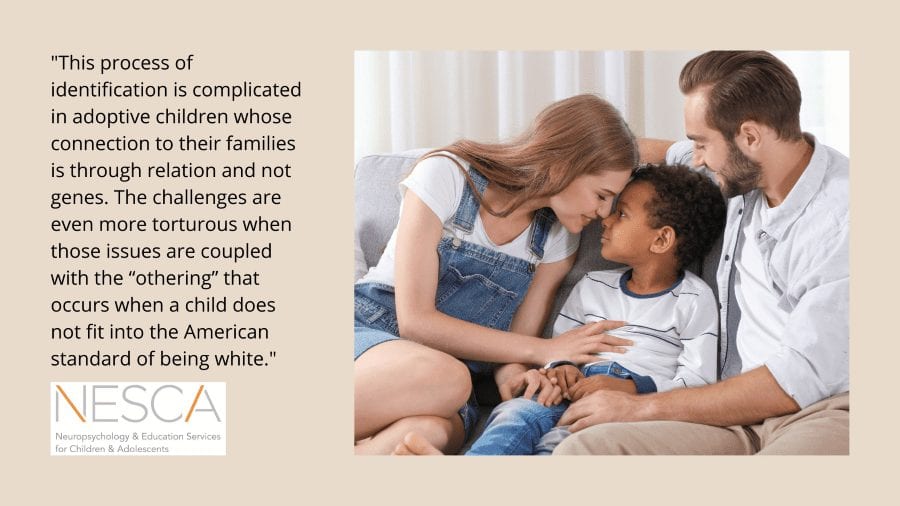
This process of identification is complicated in adoptive children whose connection to their families is through relation and not genes. The challenges are even more torturous when those issues are coupled with the “othering” that occurs when a child does not fit into the American standard of being white. In my neuropsychological practice assessing adoptive children, my own little bubble of white privilege has been pricked many times by a child saying, sometimes to me or sometimes through their parent, that “no one looks like me.” The loneliness of this statement is palpable, but the cost goes beyond to indicate impediments to the healthy development of identity, which includes that of racial identity.

In an article for Time Magazine written by the parent of a transracially adopted child and with the help of adoptees and their parents, the following four “comforting but dangerous” myths about race and difference were identified:

Myth 1: Color doesn’t matter. Oh, but it does; just ask the child who has been called the “N” word or the one who is assumed to be a math whiz because they are Asian. Adopted children who are raised by a Caucasian family and in a Caucasian community will tend to think of themselves as white – sort of – until they hit the wall of the way others perceive them. People have expectations about others based on race and ethnicity and insisting that people “should” be colorblind is ignoring reality. It leaves no room for the child to ask questions about what makes them the person that they are and prevents the parent from giving them what they most need – a caring listener when they are hurt or confused.

Myth 2: If I talk to my kids about race, I’m just creating an issue. As parents, we cannot protect our children from the verbal and physical assaults of others, but we can prepare them for how to handle it if it happens. One adoptee and current adoption advocate asks parents if they would not teach their children how to safely cross a street because they may become frightened of being hit by a car. This includes having “the talk” with our African American boys about how to handle themselves with police officers and other authority figures.

Myth 3: No matter what, a “good” school is best for my child. This is the source of the “No one looks like me” plaint of many of my clients but it is the toughest of all myths to unpack for most white parents to whom education has been touted as pretty much the solution for everything. A “good school” may be the one with high test scores and good real estate value, but it is unlikely to be the school with a diverse student and teacher population that could provide a non-white child with a rich source of role models and narratives to use in the development of their own identity. Other sources of identification include churches, community groups and cultural organizations, such as language schools and adoptive family groups. Lacking these sources, the child’s options for racial identity are determined by those who know nothing about their culture.

Myth 4: You are the hero of your child’s story. As someone who has heard many terrible and tragic origin stories and stood in awe of the efforts adoptive parents have made to help their children, I have often been guilty of encouraging this kind of thinking without considering the consequence to the child who has been rescued. The burden of “forced gratitude” is emotionally crippling and prevents the child from asking questions about their biological parents or fantasizing (in the way that all children do) about what it would have been like to be in a different family. Conversely, the concept of “saving” a child feeds into the parental fantasy that if we just love our child enough and do all the right things, we can protect them from being hurt by the loss of adoption and the ugly reality of racism. This is also an ultimately futile effort. As Martha Crawford, psychotherapist and mother of two transracially adopted children, stated, “An adoptive parent’s job is to be a sturdy scaffold for kids to do their own work, not to tell them how to construct their own identities.”


About the Author:

Dr. Stephanie Monaghan-Blout is a senior clinician who joined NESCA at its inception in 2007. She specializes in the neuropsychological and psychological assessment of children and adolescents with complex learning and emotional issues and enjoys consulting to schools on these issues. Her responsibilities at NESCA also include acting as Clinical Coordinator, overseeing therapeutic services, providing therapy and psychoeducational counseling and, in the time of the COVID-19 crisis, providing teletherapy to parents and teens.

In her early career as an adolescent and family therapist, Dr. Monaghan-Blout became very interested in the needs of those contending with traumatic experiences. She brought that interest to her work as a pediatric neuropsychologist and continues to be passionate about treating this population. She has developed an expertise in working with adoptive children and others who have experienced early trauma. She is a longtime member of the Trauma and Learning Policy Initiative (TLPI) associated with Massachusetts Advocates for Children and the Harvard Law Clinic and presents nationally and regionally on assessment and treatment of children with complex/developmental trauma.

Dr. Monaghan-Blout graduated from Bowdoin College and received a Master’s Degree in Counselor Education from Boston University. She obtained her Doctorate in Clinical Psychology from Antioch New England Graduate School with a dissertation entitled, “A Different Kind of Parent; Resisting the Intergenerational Legacy of Maltreatment.” She completed an internship in pediatric neuropsychology and child psychology at North Shore University Hospital in New York, and a postdoctoral fellowship at HealthSouth/Braintree Rehabilitation Hospital.

She joined Dr. Ann Helmus at Children’s Evaluation Center in 2003, and again at NESCA in 2007. A member of the Massachusetts Neuropsychological Society Board of Directors from 2010 – 2013 and from 2014-2017, Dr. Monaghan-Blout served in many capacities, including as President. Dr. Monaghan-Blout is the mother and stepmother of four children and the grandmother of six. She is also an avid ice hockey player, cook, gardener and devotee of urban fantasy.


To book therapy services with Dr. Monaghan-Blout or an evaluation with one of our many expert neuropsychologists and transition specialists, complete NESCA’s online intake form.


Neuropsychology & Education Services for Children & Adolescents (NESCA) is a pediatric neuropsychology practice and integrative treatment center with offices in Newton, Massachusetts, Plainville, Massachusetts, and Londonderry, New Hampshire, serving clients from preschool through young adulthood and their families. For more information, please email info@nesca-newton.com or call 617-658-9800.

Movement Breaks – Part 2

By | NESCA Notes 2020

By: Julie Robinson, OT

Director of Clinical Services; Occupational Therapist, NESCA

In our last blog, we delved into ideas and suggestions to help preschoolers stay on track with remote and hybrid learning through movement breaks. In this week’s OT Tuesday blog, we move up to our elementary school-aged kids. How do we keep them focused on online learning throughout their long days at home in front of a computer?

Again, here are some suggestions that require minimal equipment, generally using things you can find around your home.


Gross Motor for Elementary-age Children

A movement break for 5- to 10-minutes every hour and a half to 2 hours is recommended.

Hopscotch – Draw with chalk or use painter’s tape and play this old school game! Begin by throwing a beanie baby, rock or bean bag so it lands in the first square. Hop over it and jump on all the other squares. At the end, turn around and come back and try to pick up the object while trying to balance on one foot! The next time, throw the object to square 2 and repeat through all the numbers!


Photo Credit: sciencebuddies.org

Homemade Hockey Sticks – Use a long wrapping paper roll or tape together paper towel rolls as the handle. Cut a long strip of cardboard and tape to the handle or use an old plastic water bottle. Enjoy playing this game with a balloon or tennis ball. Mark goals with tape, chalk or use empty cardboard boxes.


Stack the Cardboard Boxes – Got empty boxes? Have the child stack them up high and knock them over by running into them, or rolling/kicking a soccer ball into them. To make it a little silly, place a tennis ball in the leg of a pair of stockings and the waistband over your child’s head. Use the tennis ball to knock over boxes or cans, with their head upside down.


Photo Credit: Hands On As We Grow®

Stair Bean Bag Toss – Try to get bean bags to land on different steps. More points for the higher they land!


Tic Tac Toe – Make a big board with sidewalk chalk or painter’s tape. Use bean bags, frisbees, paper plates or crumpled up paper and throw into boxes for a fun spin. Get creative with items around the house – even food!


Photo Credit: OT Plan

Belly Catch – Have your child lay on their belly with feet or legs resting on a couch and hands on the floor (plank style). Roll balls or balloons and have them play catch with you, a great exercise to work on core and upper extremity strength.


 Fine Motor for Elementary-age Children

Photo Credit: Hoglets.org

Monster Feet – Grab some old tissue boxes or cardboard and make your own monster feet. Decorate the toe nails with markers, pom poms or however else you’d like! For an added challenge, try wearing them by using string to tie the child’s feet to them. Or tape their shoes to them and walk around like a monster!


Photo Credit: kidsactivitiesblog.com

Homemade Tennis Racquets – Cut slits in a paper plate or punch holes. String yarn through the holes and attach to a paper towel roll, spatula or wooden spoon/popsicle stick. Use it to keep a ball or balloon in the air!


Hangman! – Or for an added twist, play Melting snowman! Draw a snowman, and each time someone guesses a letter incorrectly, erase a part of the snowman until he is fully melted!


Make Your Own Quicksand – Mix roughly equal parts cornstarch and play sand. Add water until it is the desired consistency.

●       If you don’t have play sand, add 1 cup of water to a bowl and slowly add 1-½ cup of cornstarch and stir.

●       Put toys into quicksand and watch them sink!


Paint Pinecones – As the weather gets colder, collect some pine cones or rocks and paint them! Make kindness rocks by writing messages on them with a Sharpie. Leave them out along a wooded trail for others to find.


About the Author

Julie Robinson is an occupational therapist with over 25 years of experience as a clinician. The work Julie does is integral to human development, wellness and a solid family unit. She particularly enjoys supporting families through the process of adoption and in working with children who are victims of trauma. Julie has extensive experience working with children diagnosed with an Autism Spectrum Disorder (ASD), or who have learning or emotional disabilities. She provides services that address Sensory Processing Disorder (SPD) and self-regulation challenges, as well as development of motor and executive functioning skills.

To book an appointment or to learn more about NESCA’s Occupational Therapy Services, please fill out our online Intake Form, email info@nesca-newton.com or call 617-658-9800.


Neuropsychology & Education Services for Children & Adolescents (NESCA) is a pediatric neuropsychology practice and integrative treatment center with offices in Newton, Massachusetts, Plainville, Massachusetts, and Londonderry, New Hampshire, serving clients from preschool through young adulthood and their families. For more information, please email info@nesca-newton.com or call 617-658-9800.


Movement Breaks – Part 1

By | NESCA Notes 2020

By: Julie Robinson, OT

Director of Clinical Services; Occupational Therapist, NESCA

Many parents are overwhelmed, juggling homeschooling, childcare and work from home. And now that the cold weather has arrived, many parents are looking for activities they can do indoors with their children as movement breaks to support online learning or just to pass some time and get the wiggles out. Here are some suggestions that require minimal equipment, generally using things you can find around your home.

In this week’s OT Tuesday blog, we provide suggestions on both gross and fine motor activities for preschoolers. In our second part of the blog series, we will offer ideas to target fine and gross motor activities for elementary school-age students during movement breaks.


Gross Motor Activities for Preschoolers

A 5- to 10-minute movement break is suggested every hour to hour and a half for children in this age group.

Balloon Games – Blow up and see how many times your child can hit the balloon in the air! Use a fly swatter or tennis/badminton racquet to mix it up a little.
Mazes – Use painter’s tape indoors or sidewalk chalk outdoors in the driveway to make mazes for your child to follow. You can even use the lines as a balance beam for added balance practice, draw feet to jump in, make curly lines to indicate twirling around, etc.! If you are looking for ideas, research sensory paths online. You can also draw crazy roads for toy cars or ride-on toys.
Bowling – Fill up old plastic water or soda bottles and have kids knock them over by rolling a ball towards them! You can add stuffed animals on top to make it more enticing.
The Floor Is Lava – Pretend the floor is lava and have the child walk around without touching the ground by walking on pillows and other objects!
Shape Games – Draw shapes, letters or numbers with sidewalk chalk or painter’s tape and try throwing stuffed animals into the shapes an adult calls out. Make it more challenging by increasing the number of shapes, throwing from further away or trying to balance on one foot while throwing.


Fine Motor Activities for Preschoolers

Hide Beads In Playdough! – Grab some putty or playdough and hide beads in it. Once all the beads are hidden, encourage your child to try to get them out! This is a great exercise to work on hand strength. It can also be fun to put raw spaghetti into the dough and “string” the beads onto them for working on fine motor precision.
Make Your Own Stamps! – Use household items, such as wine corks, water bottle caps, toilet paper rolls or anything else you can find. Dip them in paint and press onto paper. Enjoy the different shapes you create! For picky eaters, it can be fun to use foods, such as applesauce, yogurt or dips for paint.
Clothespin Activities – Use clothespins to pick up pom poms and put them in containers, such as an ice cube tray. This is a great activity for practicing a tripod grasp.
Shaving Cream Play – Use a tray or large plate and put shaving cream or other messy play materials on it. Allow your child to practice writing their letters with their fingers and have fun with it! To simplify, you can encourage your child to imitate shapes, letters or numbers after you have written them.
Noodle Necklaces – String noodles onto string to make a noodle necklace. Use noodles and put on a string or a pipe cleaner to make a necklace. Color or paint noodles, or soak cooked noodles in food coloring and allow them to dry for more interesting patterns.
 

About the Author

Julie Robinson is an occupational therapist with over 25 years of experience as a clinician. The work Julie does is integral to human development, wellness and a solid family unit. She particularly enjoys supporting families through the process of adoption and in working with children who are victims of trauma. Julie has extensive experience working with children diagnosed with an Autism Spectrum Disorder (ASD), or who have learning or emotional disabilities. She provides services that address Sensory Processing Disorder (SPD) and self-regulation challenges, as well as development of motor and executive functioning skills.

To book an appointment or to learn more about NESCA’s Occupational Therapy Services, please fill out our online Intake Form, email info@nesca-newton.com or call 617-658-9800.


Neuropsychology & Education Services for Children & Adolescents (NESCA) is a pediatric neuropsychology practice and integrative treatment center with offices in Newton, Massachusetts, Plainville, Massachusetts, and Londonderry, New Hampshire, serving clients from preschool through young adulthood and their families. For more information, please email info@nesca-newton.com or call 617-658-9800.


Building Gratitude in our Kids

By | NESCA Notes 2020

By: Tabitha Monahan, M.A., CRC
NESCA Transition Specialist/Counselor

Would it be November without a blog post about gratitude? Gratitude feels both more important and harder to come by this year with the slew of events bombarding people’s personal lives and something different appearing what feels like every news cycle. But there must be something to all this gratitude if everyone from Forbes Magazine to Psychology Today is writing about it?

So what does the science say?

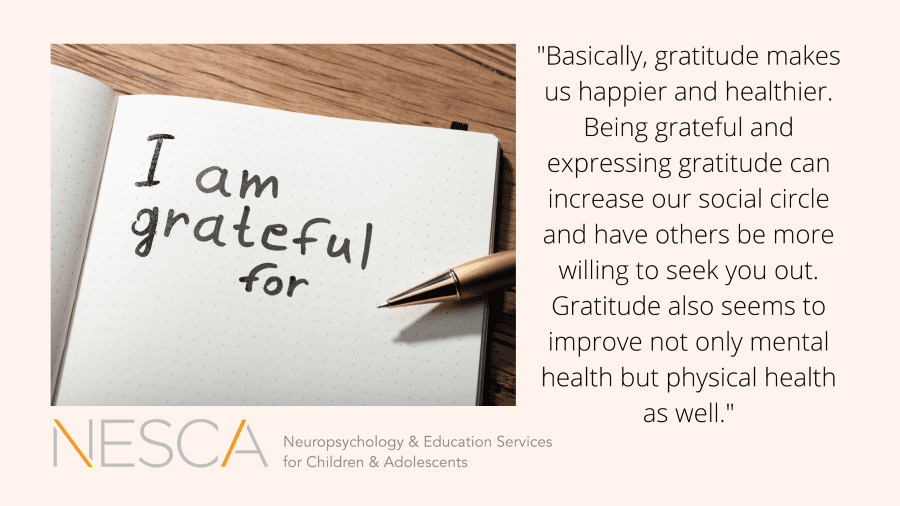
Basically, gratitude makes us happier and healthier. Being grateful and expressing gratitude can increase our social circle and have others be more willing to seek you out. Gratitude also seems to improve not only mental health but physical health as well. Studies show that grateful people take care of themselves better. They are more likely to exercise and more likely to follow up with medical personal. Studies show that writing in a gratitude journal before bed can even help you sleep better! (Morin, n.d.)

How can I help my child build gratitude?

Young people with disabilities, especially speech and language challenges, may have a hard time sharing their experiences at the end of the school day. Before my students left for the day, I would always ask them to go around the room and share one thing they enjoyed during their day. This way, no matter how challenging the day was, they ended it on a good note. Over time, the students began to look forward to sharing a positive experience from their day. Whether it was getting a compliment at their worksite or overcoming a challenge, they began to go looking for the positives.

Another wonderful way to build gratitude is to turn it into a scavenger hunt. Give each day a topic and share your gratitude topic at dinner. 

While we often think of a gratitude journal as something written, it doesn’t have to be. Have fun with it! Instead of writing down what you are thankful for today, take a picture with your phone or have your child make a drawing relating to the topic. Pinterest is full of great ideas, like the image below. Doing this for a month may turn you and your child a little more gleeful and find a brighter outlook on tomorrow.

Image Credit: Woman of Purpose (thepurposedwomanmag.com)

What are you grateful for today?


About the Author

Tabitha Monahan, M.A., CRC, is an experienced transition evaluator and vocational counselor. While she is well-versed in supporting a wide range of transition-aged youth, she is especially passionate and knowledgeable in helping clients and their families navigate the complex systems of adult services and benefits as well as medical and mental health systems. She is further adept in working individually with students of all abilities to empower self-advocacy and goal achievement.


To schedule an appointment with one of NESCA’s expert transition specialists or neuropsychologists, please complete our online intake form


Neuropsychology & Education Services for Children & Adolescents (NESCA) is a pediatric neuropsychology practice and integrative treatment center with offices in Newton and Plainville, Massachusetts, and Londonderry, New Hampshire, serving clients from preschool through young adulthood and their families. For more information, please email info@nesca-newton.com or call 617-658-9800.


Skip to content