
NESCA’s Newton, MA location has immediate availability for neuropsychological evaluations. Our MA clinicians specialize in the following evaluations: Neuropsychological; Autism; and Emotional and Psychological, as well as Academic Achievement and Learning Disability Testing.

Visit www.nesca-newton.com/intake for more information or to book an evaluation.

Tag

neuropsychology and education services for children and adolescents Archives - Page 8 of 13 - NESCA

Subscribe to NESCA Notes

Resilience, Covid and College Admissions

By | NESCA Notes 2021

By: Tabitha Monahan, M.A., CRC
NESCA Transition Specialist/Counselor

It’s been a year since schools across the nation closed their doors and moved education to the world wide web. Teachers, many of whom have never received training to teach in a virtual format, were now providing lessons remotely. The challenges of teaching remotely highlighted many of the disparities that affect our students. Students did not always have the technology or literal bandwidth to learn from home. Students with learning differences and disabilities faced even more challenges in receiving their support in a format not conducive to their needs. However, there were some silver linings. Students had more opportunities to practice executive function skills and become more familiar with software programs outside of video games, social media and YouTube videos.

As students – and, well, all of us – adjusted to the pandemic and what that meant for our daily lives, mental health concerns increased. Faced with uncertainty, constant changes and fear, anxiety, stress and depression increased among students. In response, they built coping skills.  Not all coping mechanisms are positive, but our kids survived this past year. As we work our way back to some semblance of normalcy, what does that mean for our students who were planning to move on to postsecondary education? Extracurricular activities are considered a relatively important part of the admissions process, but those weren’t available last spring and are barely available now. What should colleges use instead to find students that would be a good fit?

Resilience.

Resilience, the ability to adjust and adapt to changes and adversity, is an important factor necessary to reach goals, especially once a person faces a challenge. We encourage students to build resilience by setting high expectations of them and assisting them in creating challenging goals. We help students process what to do when they reach a roadblock. As students build coping skills and learning strategies, they are building resilience. How does resilience help in college? College is a different environment than high school. Many students experience challenges as they adjust to their newfound freedom and responsibilities. Students now find themselves responsible for scheduling their classes, getting to those classes and figuring out how to manage their schedules.

As colleges receive applications in a year unlike any in recent history, students may want to consider how they can show the colleges how they persevered. Matthew Pietrafetta of Academic Approach suggests students use the college admission essay as an opportunity to present the college with their stories that demonstrate how they became more resilient. Recommendations may also provide another factor for colleges to consider. Teachers and counselors understand the challenges that the student experienced and can share how they overcame adversity. Our students have already overcome additional challenges than many of their general education peers have not. Their past successes are the reason colleges should consider their admission. Test scores and grades are only one part of the picture. The next generation of college students has already built the resilience that will help them succeed. The past year has only exemplified this point further. Our students have proven that they can adapt and meet whatever challenges come their way. What a better way to prove to the colleges that they have what it takes?

Sources:

https://www.ncbi.nlm.nih.gov/pmc/articles/PMC7473764/

https://admissions.usf.edu/blog/do-extracurriculars-matter-in-the-college-admissions-process

https://www.insidehighered.com/admissions/views/2021/02/16/covid-19-era-college-admissions-officers-should-pay-attention-resilience?fbclid=IwAR3MNIb9ABfUJgVMZnyuJqKoF0HhBsOmYTB_ms4JZUbExvG9G_BbDUOn-gw


About the Author

Tabitha Monahan, M.A., CRC, is an experienced transition evaluator and vocational counselor. While she is well-versed in supporting a wide range of transition-aged youth, she is especially passionate and knowledgeable in helping clients and their families navigate the complex systems of adult services and benefits as well as medical and mental health systems. She is further adept in working individually with students of all abilities to empower self-advocacy and goal achievement.


To schedule an appointment with one of NESCA’s expert transition specialists or neuropsychologists, please complete our online intake form


Neuropsychology & Education Services for Children & Adolescents (NESCA) is a pediatric neuropsychology practice and integrative treatment center with offices in Newton and Plainville, Massachusetts, and Londonderry, New Hampshire, serving clients from preschool through young adulthood and their families. For more information, please email info@nesca-newton.com or call 617-658-9800.


Mind the Gap: Why You Should Consider Summer OT and Speech Services at NESCA

By | NESCA Notes 2021

By: Julie Robinson, OT
Director of Clinical Services; Occupational Therapist, NESCA

It has been a challenging school year, with ever-changing schedules, routines, and unfortunately with a good deal of inconsistency in the provision of therapeutic services through the schools, due to the many impacts of COVID. Parents, caregivers and students have all experienced differing levels of anxiety about what progress has been and is being made, with many children experiencing some level of regression with regard to behavior, self-regulation, motor skills or language development. In anticipation of many of our children returning to school in-person in April, parents have expressed concerns that their children may be lagging behind or that they have not had ample support throughout the earlier parts of their school year to ensure they can keep up with the other children in their class. Over the months of April, May and June, we will all get to see firsthand where the gaps might arise. And then when school is over, many of us might be concerned that the gains of just a few short months will be lost again over summer. This is why those of us at NESCA perceive that the benefits of summer services will be an important part of ensuring progress and the ability to jump right back into learning – as we hope all school will be in-person again in the fall.

NESCA is available to provide summer services, as we do consistently for our weekly patients. In addition, we are offering short-term services to those children who may not qualify for them through their school systems, or for those families who would simply like to supplement what their children are receiving in-district to give them a boost before school begins again in the fall.

Our occupational therapists (OTs) can work on the following areas of focus with your child:

  • self-regulation and coping skills
  • how best to transition from the quiet of home to the multiple stimuli of a classroom full of children
  • how to cope with longer hours of wearing a mask
  • how to follow social distancing requirements, when they long for a closer physical connection with their peers

We can also help to ease the anxiety some children may have about becoming sick or how NOT to feel fearful of getting back into the classroom when sensory processing issues push them to feel uneasy. Our OTs can continue work on handwriting and motor development work started throughout the school year to ensure there is no regression or to improve the speed and automaticity of written expression and legibility. We can teach organizational and executive functioning skills to encourage kids to be independent, prioritize assignments and manage their time. OTs can address self-care skills of dressing, shoe tying, feeding and hygiene, which are likely to require more independence with social distancing requirements. While it’s summer, we help build outdoor skills, such as bike riding and greater self-confidence on the playground to elicit more social connections with peers. Our OTs are providing services in-person in our Newton and Plainville, Massachusetts clinics, by teletherapy or outdoors in the community as appropriate.

Our speech therapists at NESCA can also help to continue and supplement the hard work children have been putting in throughout the school year. They can work on social pragmatics and help with the skills needed to transition from so much time alone, to being in groups with their peers once again. NESCA’s speech therapists can support children on how to:

  • initiate play
  • find shared interests
  • be flexible thinkers
  • communicate with kindness and an appropriate level of voice
  • read gestures and non-verbal communication (especially while wearing masks, which can impede the ability to properly read another person’s mood, reactions or emotions)

We can continue to work on the established goals from school, regarding both expressive and receptive communication, language articulation and language as it pertains to written communication. Our speech therapists are currently providing all services via teletherapy while we work on a transition back to in-person therapy.

If you are interested in seeking out summer services at NESCA, or any of our assessments and services, please contact NESCA’s Director of Clinical Services Julie A. Robinson. She can be reached at jrobinson@nesca-newton.org and will conduct a phone intake with you to help you best determine your needs.


About the Author

Julie Robinson is an occupational therapist with over 25 years of experience as a clinician. The work Julie does is integral to human development, wellness and a solid family unit. She particularly enjoys supporting families through the process of adoption and in working with children who are victims of trauma. Julie has extensive experience working with children diagnosed with an Autism Spectrum Disorder (ASD), or who have learning or emotional disabilities. She provides services that address Sensory Processing Disorder (SPD) and self-regulation challenges, as well as development of motor and executive functioning skills.

To book an appointment or to learn more about NESCA’s Occupational Therapy Services or other clinical therapies, please fill out our online Intake Form, email info@nesca-newton.com or call 617-658-9800.


Neuropsychology & Education Services for Children & Adolescents (NESCA) is a pediatric neuropsychology practice and integrative treatment center with offices in Newton, Massachusetts, Plainville, Massachusetts, and Londonderry, New Hampshire, serving clients from preschool through young adulthood and their families. For more information, please email info@nesca-newton.com or call 617-658-9800.


Facilitating Language Growth at Home

By | NESCA Notes 2021

By: Abigael Gray, MS, CCC-SLP
NESCA Speech-Language Pathologist

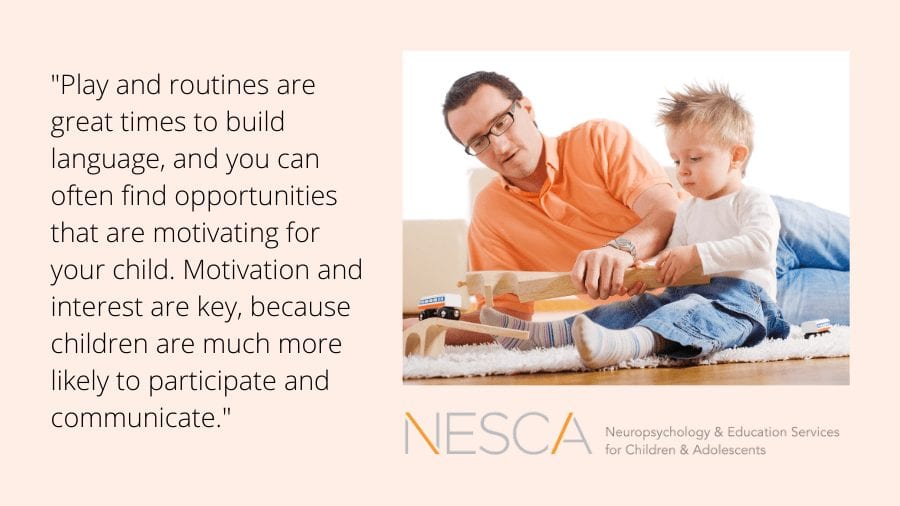
I recently got to spend time with my 18-month-old nephew, after not having seen him in a year and a half due to the pandemic. It got me thinking about practical ways to help facilitate language throughout the day without feeling like you’re doing anything extra. Play and routines are great times to build language, and you can often find opportunities that are motivating for your child. Motivation and interest are key, because children are much more likely to participate and communicate. Below, I discuss tips to incorporate into your daily routine at home.

Five ways to facilitate language growth at home:

  1. Play!
    • Play the way your child is playing and imitate what they’re doing.
    • Even if you had a plan, don’t be afraid to change it to focus on their interests (i.e., follow their lead, as explained below).
    • Use fun sounds, words and gestures to go with what you’re doing (e.g., “beep beep” when playing with cars, “pop” when popping bubbles, “yummy/mmm” and rubbing your stomach when pretending to eat play food).
  2. Follow your child’s lead
    • Observe what they’re interested in, wait until they initiate or continue interaction, and listen to their words and sounds.
    • Get on their level so they know you are joining in.
    • If they are doing something unsafe, explain why it’s unsafe in simple terms and redirect them to a safe activity.
  3. Get silly
    • Repeat actions they think are funny.
    • Switch up routines in a silly way (e.g., “forget” their favorite bath toy, give them a fork with their yogurt). This encourages language when your child notices and wants to tell you something is different or missing.
    • Change song lyrics or words in stories to be about your child, their interests and/or what is happening around you in the moment.
  4. Pause
    • Slowly sing familiar nursery rhymes and songs and then pause at key words to encourage them to fill in a word or gesture.
    • Pause a familiar activity, such as pushing the swing, and wait for them to ask you to continue using words or gestures (e.g., “more,” “again,” “go”).
    • When looking for a response, stop talking, lean forward and look at them expectantly. You can count slowly to 10 silently, which gives your child time to respond.
  5. Expand
    • When your child uses one to two words, turn it into a short sentence. For example, if they say “up” wanting you to pick them up, you could say, “Ok, I’ll pick you up.”
    • Be sure to use correct grammar when expanding their message, even if your child is still using immature grammar.
    • Use a variety of words (e.g., describing words, action words, words for feelings, location words, etc.). Start with words your child would want to say to talk about the things they are interested in.

Many of these ideas are things you may already be doing throughout the day, but it is good to think about how doing so helps your child learn to understand and use language. If you feel that your child may be behind in their language understanding or production, it is helpful to schedule an evaluation with a speech-language pathologist. If therapy is warranted, your speech-language pathologist can make recommendations specific to your child and family and show you how to best encourage language growth in the home environment.

References:
Weitzman, E. (2017). It takes two to talk: A practical guide for parents of children with language delays (5th ed.). Toronto: Hanen Centre.


About the Author

Abigael Gray has over six years of experience in assessment and treatment of a variety of disorders, including dysphagia, childhood apraxia of speech, speech sound disorder, receptive and expressive language disorder, autism spectrum disorder and attention deficit hyperactivity disorder. She has a special interest and experience in working with children with feeding and swallowing disorders, including transitioning infants to solid foods, weaning from tube feeding, improving sensory tolerance, developing chewing skills, increasing variety and volume of nutritional intake and reducing avoidance behaviors during mealtimes.


To book an appointment with or to learn more about NESCA’s Speech & Language Therapy, please fill out our online Intake Form, email NESCA’s Director of Clinical Services Julie Robinson or call 617-658-9800.


Neuropsychology & Education Services for Children & Adolescents (NESCA) is a pediatric neuropsychology practice and integrative treatment center with offices in Newton, Massachusetts, Plainville, Massachusetts, and Londonderry, New Hampshire, serving clients from preschool through young adulthood and their families. For more information, please email info@nesca-newton.com or call 617-658-9800.
 

Giftedness – What does it mean, and how do I know if my child is gifted?

By | NESCA Notes 2021

By: Alissa Talamo, PhD
Pediatric Neuropsychologist, NESCA

All children have learning strengths and weaknesses, and as parents we are proud of all our children. However, there are some children who are precocious and seem to learn many skills early and with ease. According to the National Association of Gifted Children, there are certain characteristics that parents will often notice and wonder if their child is gifted. Some of these characteristics include:

  • Unusual alertness, even in infancy
  • advanced vocabulary
  • heightened sensitivity
  • remarkable memory
  • rapid and constant learning from their environment
  • seeming to know things without the effort required to learn it
  • longer attention spans and intense concentration skills; yet at the same time they can become preoccupied with their own thoughts, often being labeled as “daydreamers”
  • demonstrate a wide range of interests
  • display a highly developed level of curiosity and ask probing questions
  • vivid imaginations (often including imaginary playmates during pre-school years)

However, there are also some challenges for gifted children as they tend to be highly sensitive, and they feel things deeply and respond with intense feelings and reactions. When a child demonstrates advanced cognitive abilities, that does not mean that they are emotionally mature enough to manage the information they are able to access. For example, a young child who can read at an advanced level is not necessarily mature enough to read books intended for older children, as the content is beyond their ability to process emotionally. This discrepancy is referred to as asynchronous development. Often highly gifted children will be advanced in many academic areas but may lag behind their peers in their development of social skills. They can also demonstrate perfectionism and anxiety, often as a result of their asynchronous development.

Unfortunately, at this time, Massachusetts does not have a definition of giftedness and does not collect data on gifted students. However, if you believe that your child is gifted, there are many things you can do to support them. For example,

  • allow them to dive deeply into subjects of interest to them
  • encourage them to take risks and make mistakes, as this will allow them to develop coping strategies as well as improved problem-solving skills
  • provide opportunities outside of school, such as enrichment programs in their areas of interest
  • consider participating in opportunities for activities that occur with like-minded peers, that teach in depth, encourage creative problem-solving and are fun (e.g., those provided by the Massachusetts Association for Gifted Education, MAGE)

Finally, early identification improves the likelihood that a child’s gifts will develop into talents. If you suspect that your child is gifted, consider both objective testing (e.g., IQ testing, academic achievement tests) as well as collecting subjective information (e.g., teacher observation and rating forms, parent reports, examples of child’s work).

NESCA’s comprehensive neuropsychological evaluations provide a highly-detailed description of an individual’s developmental status, thinking patterns and learning style based upon a very careful integration of findings from developmental history, observations by parents, teachers and clinician(s), and data from NESCA’s own testing. These evaluations, which seek to paint a recognizable portrait of the whole person, assess the underlying reasons they may be struggling academically, socially or emotionally and offer parents and teachers a set of tools for supporting the individual’s development.

If you are interested in learning more about NESCA’s Neuropsychological Evaluations, email: info@nesca-newton.com or complete our online intake form.


SOURCES

Davidson Institute – (www.davidsongifted.org/)
National Association for Gifted Children (www.nagc.org)


About the Author

With NESCA since its inception in 2007, Dr. Talamo had previously practiced for many years as a child and adolescent clinical psychologist before completing postdoctoral re-training in pediatric neuropsychology at the Children’s Evaluation Center.

After receiving her undergraduate degree from Columbia University, Dr. Talamo earned her doctorate in clinical health psychology from Ferkauf Graduate School of Psychology and the Albert Einstein College of Medicine at Yeshiva University.

She has given a number of presentations, most recently on “How to Recognize a Struggling Reader,” “Supporting Students with Working Memory Limitations,” (with Bonnie Singer, Ph.D., CCC-SLP of Architects for Learning), and “Executive Function in Elementary and Middle School Students.”

Dr. Talamo specializes in working with children and adolescents with language-based learning disabilities including dyslexia, attentional disorders, and emotional issues. She is also interested in working with highly gifted children.

Her professional memberships include MAGE (Massachusetts Association for Gifted Education), IDA (International Dyslexia Association), MABIDA (the Massachusetts division of IDA) and MNS (the Massachusetts Neuropsychological Society).

She is the mother of one teenage girl.

To book a consultation with Dr. Talamo or one of our many other expert neuropsychologists, complete NESCA’s online intake form.

Neuropsychology & Education Services for Children & Adolescents (NESCA) is a pediatric neuropsychology practice and integrative treatment center with offices in Newton, Massachusetts, Plainville, Massachusetts, and Londonderry, New Hampshire, serving clients from preschool through young adulthood and their families. For more information, please email info@nesca-newton.com or call 617-658-9800.

Appreciating and Responding to The New York Times article, For Some Teens, It’s Been a Year of Anxiety and Trips to the E.R. by Benedict Carey

By | NESCA Notes 2021

By: Sophie Bellenis, OTD, OTR/L
Occupational Therapist; Real-life Skills Program Manager and Coach, NESCA

As an occupational therapist working almost exclusively with teenagers and young adults over the past year, the title of Benedict Carey’s article jumped out at me like a tired and worn flag, waving frantically for acknowledgement. Our teens are anxious, tired, and dealing with living through the proverbial “unprecedented times” without the developmental capabilities needed to quickly adapt in this era of remote learning, remote social interaction, and remote extracurriculars. Remote everything!

It is important for me to note that I really enjoy working with teenagers. I find myself in constant awe of their resiliency, their willingness to confront hard truths that many of us shy away from, and their ability to push forward despite having huge questions about who they truly are. All of these things are tough and require immense emotional fortitude, but this year many of these challenges feel impossible.

Carey has taken the time to gather perspectives from multiple stakeholders. He provides a platform for parents, educators, professors, therapists, pediatricians, and directors of hospital programs to explain the struggles of supporting these kids without adequate resources. Parents describe the fear of supporting their children as they struggle with mental health. Doctors discuss the frustration of having inadequate resources and support in emergency rooms around the country. Carey highlights that, according to the Centers for Disease Control and Prevention (CDC), the proportion of adolescent emergency admissions for mental problems, like panic and anxiety, is up 31 percent. Some of my clients add to this statistic and are navigating their own path through chaotic hospitalizations and overwhelmed support systems. Carey’s article is absolutely worth taking the time to read, if only to see the ubiquity of these issues and how they are happening all around our country. Simply put, we have a clear problem. Less clear, is the solution.

When meeting with adolescents and young adults themselves, I hear three main fears popping up week after week. Here are a few thoughts and suggestions on how to support these specific fears or feelings.

  1. “I can’t get this done, (and therefore) I am going to completely ruin my future.”

When looking at future success through a transition lens, we consider the areas of independent living, community participation, post-secondary education, and employment. In the school setting, most students’ curricula are focused solely on academic success. Sometimes, we do a poor job of teaching students about multiple intelligences or emphasizing the importance of hard work. While grades are important, they are not everything, and while standardized testing is returning to students’ schedules, they should not serve as students’ measure of self-worth. We know this, but do they? We have to teach our children that if they are hardworking, kind, and truly doing their best, the threat of “ruining their future” is much less likely than they fear. Let’s highlight the undeniably true narrative that everyone’s path can look different and still lead to success.

  1. “I’m so tired. All of the time.”

Many of my clients tell me they are not sleeping. If they are sleeping, they fall asleep late with a phone in their hand, constantly refreshing apps or trying to maintain communication with their peers. In our current remote world, the phone can feel like a lifeline. Sleep is a foundational need for mental and physical health. Students who are 15 or 16 years old often have a limited understanding of how holistic the effects of decreased sleep can be. Sleep is not their priority. Recently, I have seen parents disable the internet or have their teenagers put their phones into a lockbox from midnight until 6:00am. This new boundary is often met with anger or frustration at the beginning, but then these students start to sleep. They are better able to manage their emotions. They have more energy. They start to see the benefits despite their skepticism. If a tech break doesn’t feel quite right for your family, it is still worth opening up a conversation about the need for strong sleep hygiene and modeling a routine that promotes calming down by limiting screens before bed, which can have hugely positive effects.

  1. “This is never going to end.”

In many ways, a year feels much longer to a 17 year-old than it does to an older adult. Working at a job for four years never feels as long or as formative as the four years of high school. And objectively, a year to a 17 year-old is over five percent of their life, while it’s only two percent of 50 year old’s life. Let’s acknowledge that. Let’s verbalize the fact that teenage years are also full of milestones that have been constantly cancelled or changed to fit social distancing recommendations and safety precautions. There is a sense of loss and grief surrounding many events that these students have been looking forward to since elementary school. Encourage students to do their own research into what the next six months may look like as we start to open back up. Help them to understand the vaccine rollout and the pitfalls and successes that we have had as a nation tackling a novel disease.

Adolescent mental health is going to be an on-going challenge that we tackle as a community. As we slowly forge out of isolation, let’s center our conversations around the mental health of our teens and honestly acknowledge the unique position that they have found themselves in.

References

Carey, B. (2021, February 23). For some teens, it’s been a year of anxiety and trips to the e.r. The New York Times. https://www.nytimes.com/2021/02/23/health/coronavirus-mental-health-teens.html

Leeb, R.T., Radhakrishnan, L., Martinez, P., Njaj, R., Holland, K.M. (2020, October 27). Mental health-related emergency department visits among children aged <18 during the covid-19 pandemic. MMWR Morbidity and Mortality Weekly Report 2020:1675-1680. DOI: http://dx.doi.org/10.15585/mmwr.mm6945a3


About the Author

Sophie Bellenis is a Licensed Occupational Therapist in Massachusetts, specializing in educational OT and functional life skills development. Bellenis joined NESCA in the fall of 2017 to offer community-based skills coaching services as a part of the Real-life Skills Program within NESCA’s Transition Services team. Bellenis graduated from the MGH Institute of Health Professions with a Doctorate in Occupational Therapy, with a focus on pediatrics and international program evaluation. She is a member of the American Occupational Therapy Association, as well as the World Federation of Occupational Therapists. Having spent years delivering direct services at the elementary, middle school and high school levels, Bellenis has extensive background with school-based occupational therapy services.  She believes that individual sensory needs and visual skills must be taken into account to create comprehensive educational programming.


To book an appointment or to learn more about NESCA’s Occupational Therapy Services, please fill out our online Intake Form, email info@nesca-newton.com or call 617-658-9800.


Neuropsychology & Education Services for Children & Adolescents (NESCA) is a pediatric neuropsychology practice and integrative treatment center with offices in Newton, Massachusetts, Plainville, Massachusetts, and Londonderry, New Hampshire, serving clients from preschool through young adulthood and their families. For more information, please email info@nesca-newton.com or call 617-658-9800.


The Uncertainty, Stress and Anxiety About What School Will Look Like

By | NESCA Notes 2020

*This blog post was originally published prior to the start of in-person school last fall for some. While many students have returned to their school buildings, many others are just now returning or will be in the coming weeks. 

By: Cynthia Hess, PsyD
Pediatric Neuropsychologist Fellow and Therapist

Much of adjusting to the world in the midst of a global pandemic has been learning to live with nearly constant uncertainty. Undoubtedly, this pandemic and ensuing uncertainty has caused significant stress for youth and their families. The experience of persistent stress can result in increased vulnerability to anxiety and depression. Symptoms may become magnified in those who already faced mental health challenges. There is little doubt that there will be increases in mental and behavior health problems for children and families both in anticipating the re-opening of schools, and when schools reopen their physical buildings.

We all wonder what school will look like in the fall. The anticipation of returning to school can be especially stressful, and will likely be so for most youth. Given that students will not have been in schools with their peers for several months, it can be anticipated that they might feel a heighted sense of insecurity and uncertainty. Even in “normal times,” returning to the complex social and educational environment of school can be worrisome for many children and adolescents.

Each individual child will have had their own experiences while schools were closed. Some children and/or staff members may have been impacted by COVID-19 and some families and/or staff may be experiencing financial hardship due to parental unemployment or loss of household income. It is important to realize that regardless of their experience, each individual will have a unique response. It is helpful to recognize the signs of stress and help children learn positive ways of coping with it.

Signs of stress in preschool children include, but are not limited to, anger, nervousness, eating and sleeping problems (including nightmares), fear of being alone, irritability and uncontrollable crying.

In elementary age children, stress may manifest as increased complaining of headaches and stomachaches, feeling insecure, reduced appetite and difficulty sleeping, withdrawal and worrying about the future.

Signs of stress in pre-teens and teens may include anger, disillusionment, distrust of the world, low self-esteem, stomachaches and headaches, panic attacks and rebellious behavior.

As each person works through this very challenging situation, it is more important than ever to adopt a position of acceptance, as we never truly know what another person is experiencing or has experienced. The following are offered as suggestions on how to help children and teens cope with stress.

  • Help them identify how they are feeling and acknowledge and validate those feelings.
  • Encourage them to talk about what is bothering them.
  • Share strategies you use to cope with stress.
  • Talk openly and, as appropriate, share stories about stress in your day.
  • Find a physical activity and/or hobby that they enjoy and encourage them to participate.
  • Encourage them to eat healthy foods and emphasize the importance of a healthy lifestyle, especially as it relates to stress.
  • Make sure they get plenty of sleep.
  • Set clear expectations, without being overly rigid, and allow for “down” time.
  • Spend time outdoors, encourage them to do something they love – read a book, ride their bike, bake, etc.
  • Learn and teach your children relaxation skills, such as breathing exercises, muscle relaxation exercises, meditating, yoga, drawing or writing.

Our world will have changed by the time children re-enter their classrooms. No matter what happens in the fall, when it is time for school to start, it will inevitably be stressful. Learning to cope with and manage stress is important for physical and emotional health. However, if you are concerned about your child or are struggling yourself, seek help and support for yourself, your child or anyone in your family who is struggling.

Below are some helpful resources:

https://www.apa.org/topics/children-teens-stress

https://nesca-newton.com/helping-your-anxious-child-through-covid-19/

https://childmind.org/article/how-to-ask-what-kids-are-feeling-during-stressful-times/

https://healthy.kaiserpermanente.org/health-wellness/health-encyclopedia/he.stress-in-children-and-teens.ug1832


About the Author

Dr. Cynthia Hess recently graduated from Rivier University with a PsyD in Counseling and School Psychology. Previously, she earned an M.A. from Antioch New England in Applied Psychology. She also worked as an elementary school counselor and school psychologist for 15 years before embarking on her doctorate. During her doctorate, she did her pre-doctoral internship with RIT in Rochester, N.Y. where she worked with youth ages 5-17 who had experienced complex developmental trauma. Dr. Hess’s first post-doctoral fellowship was with The Counseling Center of New England where she provided psychotherapy and family therapy to children ages 5-18, their families and young adults. She also trained part-time with a pediatric neuropsychologist conducting neuropsychological evaluations. Currently, Dr. Hess is a second-year post-doctoral fellow in pediatric neuropsychological assessment, working with NESCA Londonderry’s Dr. Angela Currie.


To schedule an appointment with one of NESCA’s expert neuropsychologists, please complete our online intake form


Neuropsychology & Education Services for Children & Adolescents (NESCA) is a pediatric neuropsychology practice and integrative treatment center with offices in Newton and Plainville, Massachusetts, and Londonderry, New Hampshire, serving clients from preschool through young adulthood and their families. For more information, please email info@nesca-newton.com or call 617-658-9800.


Celebrate the Small Wins

By | NESCA Notes 2021

By: Tabitha Monahan, M.A., CRC
NESCA Transition Specialist/Counselor

In the moment, it can be hard to see the change. It can be hard to find the successes. This is true for any improvement we try to do, whether it is trying to have a healthier lifestyle or build the skills needed for postsecondary life. When looking at a student’s vision, it can feel like getting there is an impossible task. Maybe the student is the only one who believes they can get there. Perhaps they don’t understand all the pieces that need to be put in place. When the rest of the IEP team has doubts, those doubts will likely spread to the student. Objectives about SMART Goals might be added to help the student learn how to set realistic goals and build an understanding of setting small goals and determining specific objectives. However, when we look back to where the student was their freshman year or in elementary school, the progress they made may seem massive. Many small wins over time turn into big wins.

What are the small wins? It might be getting a better grade on a test in math. It might be fastening the buttons on a shirt without help. It could be understanding another’s point of view one time.  Maybe it was trying a bite of one new food. Maybe they were able to identify a coping skill that would have helped after having a rough day. By themselves, none of these seems like they will help a person reach success once they leave special education. But small wins build confidence. They build pride. If we celebrate the small wins, not only do we get reminded that progress is possible, but the student knows they accomplished something. An IEP is filled with areas where the student needs help and even at a young age – when the student is getting more help than their peers – they know it. They should know where they are succeeding, too.

So how can we help our student celebrate the small wins?

  • A high five and a “way to go”
  • Help your child create a list of successes and have them add each win to the list
  • Remind them of where they were at the beginning of the year
  • Pick a fun activity as a “reward”
  • Have your child add to one of their favorite hobbies (e.g., a small LEGO set, a new book, trading cards, collectibles, action figures)
  • Frame it! (If it’s not paper, make part of the celebration part art project)

What do you do to celebrate the small wins?


About the Author

Tabitha Monahan, M.A., CRC, is an experienced transition evaluator and vocational counselor. While she is well-versed in supporting a wide range of transition-aged youth, she is especially passionate and knowledgeable in helping clients and their families navigate the complex systems of adult services and benefits as well as medical and mental health systems. She is further adept in working individually with students of all abilities to empower self-advocacy and goal achievement.


To schedule an appointment with one of NESCA’s expert transition specialists or neuropsychologists, please complete our online intake form


Neuropsychology & Education Services for Children & Adolescents (NESCA) is a pediatric neuropsychology practice and integrative treatment center with offices in Newton and Plainville, Massachusetts, and Londonderry, New Hampshire, serving clients from preschool through young adulthood and their families. For more information, please email info@nesca-newton.com or call 617-658-9800.


Executive Function Tools: The Calendar

By | NESCA Notes 2021

By: Sophie Bellenis, OTD, OTR/L
Occupational Therapist; Real-life Skills Program Manager and Coach, NESCA

When working with young adults and adolescents to build up executive function skills, my main goal is to find systems and strategies that are truly helpful, easily accessed and that will eventually be used independently. While there are many fabulous apps that have been developed to target specific organizational skills, such as medication management, creating to-do lists and taking notes, I would argue that the number one, most important tool is an accurate, up-to-date calendar. The format of a digital calendar provides three hugely important supports.

  1. Visual Map of Time – Time management is tricky, and for many of our students, the concept of time itself is quite abstract. A calendar that has chunks of time visually blocked out helps to concretize an abstract concept. Additionally, having a calendar can help students plan their work. If a student has five different assignments to work on in a given week, looking at a calendar to find available segments of time will often help them realize that leaving everything until the last minute will not be possible. Notably, this requires guidance at first. Asking students questions, such as, “how long does an assignment like this generally take you?” or “would that available hour on Tuesday give you enough time for your problem set?” will help them start to internally ask themselves the right questions.
  2. Built-in Notification Systems – Some students use the alarms on their phone as reminders that they need to complete academic or daily living tasks. For example, they may have an alarm at 7:00pm every evening as a prompt to take their medication. Digital calendar apps allow for notifications to be linked to an event or task. Sometimes a simple reminder 10 minutes before a meeting or class is plenty, and our students can arrive on time with that quick prompt. For other appointments, I have students set two separate notifications, one in the morning and one at the time they would need to start getting ready or prepared for an appointment. For example, if a student has a doctor’s appointment two months in the future, a student could benefit from setting a notification eight hours and 1 hour before the appointment. This way, they start their morning with an acute awareness of their responsibility that afternoon and are reminded again when they need to start getting ready to leave.
  3. Constant Access when Synced across Devices – Calendars, such as the Google Calendar, sync seamlessly across digital devices. The same calendar can be accessed from a phone, a tablet, a laptop or a desktop quickly and easily. Students can refer to their phone when they are out and about or their computer if they are focused in class.

Research shows us that building executive function skills requires direct instruction and the opportunity to practice (Semenov & Zelazo, 2019). While using a calendar may seem like a simple skill, many of the systems provided in high schools take away the opportunity for students to practice setting up and maintaining their own calendar. Online portals have calendars that are immediately synced to the teacher’s schedule with assignments and due dates already entered. Additionally, many of our students rely on their parents to keep track of any and all appointments (medical or otherwise), meetings and other scheduled activities. This means that when starting a more independent schedule – whether at a university, vocational program or first job – these students often find themselves overwhelmed by the deadlines and the number of responsibilities that they must track. I urge parents to slowly increase the number of appointment and activities that students are in charge of remembering on their own. Helping a student enter doctor or dentist appointments, vacation details, such as flight or bus times, and deadlines into their personal calendar helps them start to build this habit and provides opportunity for practice. We have the tools to help students make this transition more easily, and with small, intentional changes to expectations of responsibility and independence, we can provide students with tools in their back pockets so they are ready to support (and schedule) themselves!

References

Semenov A, D, Zelazo P, D: Mindful Family Routines and the Cultivation of Executive Function Skills in Childhood. Human Development 2019;63:112-131. doi: 10.1159/000503822


About the Author

Sophie Bellenis is a Licensed Occupational Therapist in Massachusetts, specializing in educational OT and functional life skills development. Bellenis joined NESCA in the fall of 2017 to offer community-based skills coaching services as a part of the Real-life Skills Program within NESCA’s Transition Services team. Bellenis graduated from the MGH Institute of Health Professions with a Doctorate in Occupational Therapy, with a focus on pediatrics and international program evaluation. She is a member of the American Occupational Therapy Association, as well as the World Federation of Occupational Therapists. Having spent years delivering direct services at the elementary, middle school and high school levels, Bellenis has extensive background with school-based occupational therapy services.  She believes that individual sensory needs and visual skills must be taken into account to create comprehensive educational programming.


To book an appointment or to learn more about NESCA’s Occupational Therapy Services, please fill out our online Intake Form, email info@nesca-newton.com or call 617-658-9800.


Neuropsychology & Education Services for Children & Adolescents (NESCA) is a pediatric neuropsychology practice and integrative treatment center with offices in Newton, Massachusetts, Plainville, Massachusetts, and Londonderry, New Hampshire, serving clients from preschool through young adulthood and their families. For more information, please email info@nesca-newton.com or call 617-658-9800.


The Benefits of Sensory-based Play

By | NESCA Notes 2021

By: Madelyn (Maddie) Girardi, OTD, OTR/L
Occupational Therapist, NESCA

The importance of play for child development

Play is considered an essential aspect of child development as it contributes to cognitive, physical, social and emotional well-being. As a pediatric occupational therapist, play is an integral part of my job. When children have opportunities to play, this allows them to build their creativity and imagination, resolve conflicts and learn self-advocacy skills. Through play, children develop new abilities that lead to enhanced confidence and resiliency, skills crucial for navigating day to day challenges. Play allows kids to practice decision-making skills, discover areas of interest and engage in passions. (Ginsburg, 2007).

 What is sensory-based play?

Sensory play can be described as any play activity that stimulates an individual’s sensory system. The sensory system includes touch (tactile), smell (olfactory), taste (gustatory), sight (visual), hearing (auditory), balance (vestibular) and movement (proprioception). Common examples include sensory bin or sandbox play, play with shaving cream, finger paint and/or food, use of a balance beam, ball pit, and/or swings, sound tubes, and so much more!

Why is sensory play beneficial?

While we know that play is a critical part of child development, incorporating a multi-sensory approach into play activities can be particularly beneficial. When activities are fun and meaningful – our senses are engaged – we learn best!

  • Promotes learning – children who engage multiple senses to accomplish a task are better able to remember and recall learned information.
  • Facilitates exploration, creativity and curiosity in children who may be seeking, or avoiding, certain types of stimuli.
  • Allows for strengthening of the brain pathways and connections that allow for efficient sensory integration.
  • Promotes self-regulation by allowing for interaction with different mediums that may be calming for the child (Educational Playcare, 2016).

What kinds of OT skills can be targeted through sensory play?

  • Sensory processing skills
  • Fine motor skills
  • Gross motor skills
  • Feeding skills
  • Body awareness
  • Motor planning
  • Visual perceptual skills
  • Communication and play skills
  • Self-regulation and coping skills

References:

Educational Playcare. (2016, October 27). Why Sensory Play is Important for Development.
https://www.educationalplaycare.com/blog/sensory-play-important-development/#:~:text=Sensory%20play%20includes%20any%20activity,%2C%20create%2C%20investigate%20and%20explore

Ginsburg, K. R. (2007). The importance of play in promoting healthy child development and
maintaining strong parent-child bonds. Pediatrics119(1), 182-191.

To learn more about Maddie Girardi, watch this video interview between NESCA Occupational Therapists Sophie Bellenis, OTD, OTR/L, and Maddie Girardi, OTD, OTR/L.

About the Author
Madelyn (Maddie) Girardi is a Licensed Occupational Therapist in Massachusetts with experience in both school-based and outpatient pediatric settings. Maddie received her undergraduate degree in Exercise Science/Kinesiology at The College of Charleston in South Carolina and  earned her Doctorate degree in Occupational Therapy from The MGH Institute of Health Professions in Boston.

Maddie is a passionate therapist with professional interest in working with young children with neurodevelopmental disorders, fine and gross motor delays and Autism Spectrum Disorder (ASD).

To book an appointment or to learn more about NESCA’s Occupational Therapy Services, please fill out our online Intake Form, email info@nesca-newton.com or call 617-658-9800.


Neuropsychology & Education Services for Children & Adolescents (NESCA) is a pediatric neuropsychology practice and integrative treatment center with offices in Newton, Massachusetts, Plainville, Massachusetts, and Londonderry, New Hampshire, serving clients from preschool through young adulthood and their families. For more information, please email info@nesca-newton.com or call 617-658-9800.


Literacy-based Speech Therapy: Winter Edition

By | NESCA Notes 2021

By: Abigael Gray, MS, CCC-SLP

NESCA Speech-Language Pathologist

Books are a great speech-language therapy tool. They can be used to target many different goals for a variety of ages and profiles. With books, children are given context for learning vocabulary, concepts and important story elements. Literacy-based therapy is not only more fun, but research also supports its use in teaching children with speech and language disorders:

  • Teaching story elements has been shown to improve oral language production and reading comprehension.
  • Teaching within a narrative context can make language learning less demanding, more meaningful and more authentic.
  • Students’ comprehension and story retelling/generation skills improved more with contextualized (literacy-based) intervention than decontextualized intervention.

Books can easily be incorporated into life at home, if they are not already a part of the daily routine. Just grab your or your child’s favorite book, or find a YouTube read aloud of it, and have your child help you read it! Be sure to pause throughout the book to talk about the pictures, make inferences about why events are happening and ask a few questions. Don’t be afraid to change the words to match your child’s level of understanding or interests.

My top three favorite winter books to use in speech-language therapy are:

  1. Sneezy the Snowman by Maureen Wright

A story about a cold and sneezy snowman who melts several times while trying to get warm. His human friends help him by rebuilding him and sharing their winter clothes.

Amazon: https://www.amazon.com/Sneezy-Snowman-Maureen-Wright/dp/1477810544

YouTube Read Aloud: https://youtu.be/iUsHnKSyDH0

Skills that I target and can be incorporated into shared book reading at home:

  • Producing subject-verb-object or complex sentences to talk about what is happening.
  • Predicting what will happen before and throughout reading (e.g., “Sneezy is drinking hot chocolate, what do you think will happen?”).
  • Answering detail (what, where, who, when) and inferential (why) questions.
  • Discussing story parts (e.g., characters, setting, problem, solution) and retelling the story.
  • Writing using different prompts, such as “My snowman melted because…” or “When I’m cold, I…”.
  1. The Mitten by Jan Brett

A traditional story about a boy whose grandmother knits him new mittens. He loses one mitten when he is outside playing, and many different animals climb inside to stay warm.

Amazon: https://www.amazon.com/Mitten-Jan-Brett/dp/0399231099

YouTube Read Aloud: https://youtu.be/duhj0Op_slo

Skills that I target and can be incorporated into shared book reading at home:

  • Sequencing events by talking about the order of animals that climbed into the mitten.
  • Creating a craft by printing a mitten and animals, coloring the animals and putting them inside the mitten as you retell the story.
  • Watching a different rendition of The Mitten on Vooks.com and comparing and contrasting the two stories using a Venn diagram.
  • Producing past tense verbs to describe what happened.
  • Making inferences about characters’ emotions and motivations.
  1. The Snowy Day by Ezra Jack Keats

A Caldecott Medal-winning book about a boy’s adventures in the snow when he puts on his snowsuit and goes outside to play.

Amazon: https://www.amazon.com/Snowy-Day-Board-Book/dp/0670867330

YouTube Read Aloud: https://youtu.be/FmZCQfeWjeQ

Skills that I target and can be incorporated into shared book reading at home:

  • Telling an original story together by covering up the words on the pages.
  • Finding words that contain the child’s target speech sound (i.e., if your child is working on producing the “R” sound, find all the words that contain “R” and practice those).
  • Describing character traits of Peter, the main character.
  • Discussing cause and effect (e.g., cause: Peter smacked a snow-covered tree, effect: snow fell on Peter’s head).
  • Writing using different prompts, such as “On a snowy day, I like to…” or “I can save a snowball by…”.


References:

Davies, P., Shanks, B., & Davies, K. (2004). Improving narrative skills in young children with delayed language development. Educational Review, 56, 271 – 286.

Gillam, S. L., Gillam, R. B., & Reece, K. (2012). Language outcomes of contextualized and decontextualized language intervention: results of an early efficacy study. Language, speech, and hearing services in schools43(3), 276–291. https://doi.org/10.1044/0161-1461(2011/11-0022)

Tomasello, M. (2003). Constructing a language. A usage-based theory of language acquisition. Cambridge, MA: Harvard University Press


About the Author

Abigael Gray has over six years of experience in assessment and treatment of a variety of disorders, including dysphagia, childhood apraxia of speech, speech sound disorder, receptive and expressive language disorder, autism spectrum disorder and attention deficit hyperactivity disorder. She has a special interest and experience in working with children with feeding and swallowing disorders, including transitioning infants to solid foods, weaning from tube feeding, improving sensory tolerance, developing chewing skills, increasing variety and volume of nutritional intake and reducing avoidance behaviors during mealtimes.


To book an appointment or to learn more about NESCA’s Speech & Language Therapy, please fill out our online Intake Form, email NESCA’s Director of Clinical Services Julie Robinson or call 617-658-9800.

Neuropsychology & Education Services for Children & Adolescents (NESCA) is a pediatric neuropsychology practice and integrative treatment center with offices in Newton, Massachusetts, Plainville, Massachusetts, and Londonderry, New Hampshire, serving clients from preschool through young adulthood and their families. For more information, please email info@nesca-newton.com or call 617-658-9800.


Skip to content