

By: Sophie Bellenis, OTD, OTR/L
Occupational Therapist; Real-life Skills Program Manager and Coach, NESCA
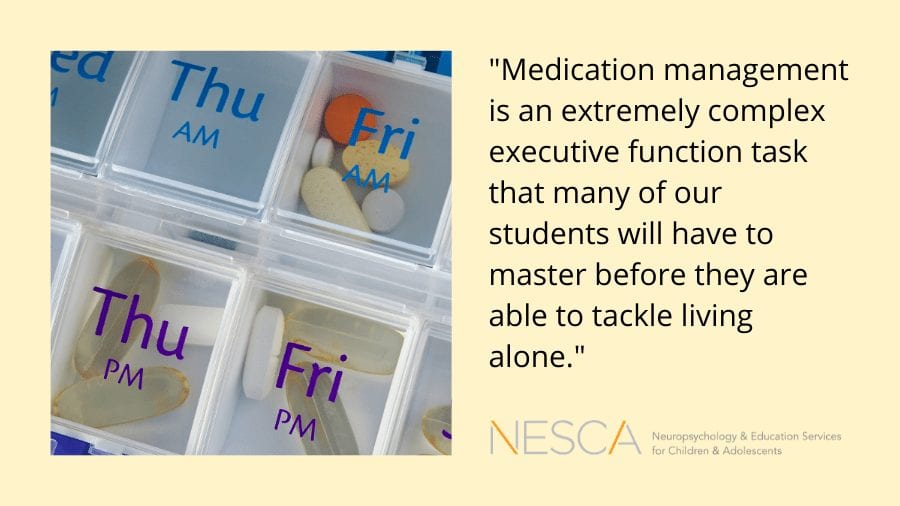
Medication management is an extremely complex executive function task that many of our students will have to master before they are able to tackle living alone. While there are many executive function tools available to help organize and remind individuals about their medication, there are also some long-term teaching strategies and opportunities for habit building throughout a students’ middle and high school career that parents may want to capitalize on before their children leave the home. Today we will explore some of the commonly used tools to help with medication adherence and touch on a few tips and suggestions to help adolescents develop a base of knowledge around their own health status and need for medication.
Tools
Seven Day Pillbox – The most ubiquitous tool to help individuals keep track of medication is a weekly pillbox. This may seem like a simple tool, but pillboxes are hugely varied and have many different additional features. Make sure to consider how many boxes there are per day (morning, afternoon, evening, etc.), whether there is a need for different colors to help with visual discrimination, and whether an audible or vibrating alarm could be beneficial. All of these are potential options that are built into the different pillbox options provided below:
Automatic Pill Dispenser – Some individuals may benefit from having the added support of a pill dispenser that automatically dispenses the correct prescriptions at the time they should be taken. Here is one example of this tool:
The Calendar – Those who have read my previous blog regarding the wonders of a functional digital calendar are likely unsurprised by this suggestion, but make use of this fabulous tool! Adding in an appointment to refill pillboxes, marking down anticipated dates to refill prescriptions, and setting notifications or alarms to go off when it is time to take medication each day can help students remember each step of the process.
Tips
Involve children in filling their pillboxes as early as possible. Many children will enjoy sitting down with a parent to place the pills in each little box and feel special when they are given some responsibility. When this is normalized as a typical part of a week, it becomes an expected activity of daily living for children. Make sure to point out the things that you notice as you fill the box. For example, stating, “Oh! I only count five pills left, that means I need to call and refill the prescription today,” each month will help your child to associate a nearly empty bottle with the need to problem solve.
Set a specific time or day of the week to refill pillboxes. Many children will continue to stick to routines and habits that they built up through childhood once they venture out of the home. Consider designating a specific time of the week to fill a pillbox together. For example, if Sunday after dinner works consistently, make this part of the family routine.
Pair medication with a daily task. Some individuals enjoy using alarms as reminders; however, others feel much more empowered by simply building medication into their routine. Pairing medication with an activity that happens daily anyways, such as brushing teeth in the morning, makes it easier to remember without direct prompting.
Help your child or adolescent put together a medication chart. Many of our children do not know the reasons for their medication. They are unaware of the intent, potential side effects, exact dosage, or name of the medication itself. The more our children and adolescents understand, the better they are able to advocate for themselves to doctors or other health professionals. Putting together a one-page medication chart that outlines all of this important information – in terms that can be easily understood and communicated to others by the child – can help children feel empowered in their conversation about their health. Consider adding a picture of each pill or capsule if they routinely appear the same. At times, pharmacies may unexpectedly need to fill generic prescriptions from different manufacturers, based on availability or other factors, therefore lending to a different appearance of the same generic prescription. This medication chart can also be a helpful tool to reference when adolescents start to independently fill their pillboxes.
Refill prescriptions together. While refilling prescriptions at the pharmacy is often a task that needs to be led and managed by adults, it’s still possible to include adolescents so that they start to learn the process. A great first step is to call the pharmacy on speaker phone and allow your child to listen in for a few months in a row.
About the Author
Sophie Bellenis is a Licensed Occupational Therapist in Massachusetts, specializing in educational OT and functional life skills development. Bellenis joined NESCA in the fall of 2017 to offer community-based skills coaching services as a part of the Real-life Skills Program within NESCA’s Transition Services team. Bellenis graduated from the MGH Institute of Health Professions with a Doctorate in Occupational Therapy, with a focus on pediatrics and international program evaluation. She is a member of the American Occupational Therapy Association, as well as the World Federation of Occupational Therapists. Having spent years delivering direct services at the elementary, middle school and high school levels, Bellenis has extensive background with school-based occupational therapy services. She believes that individual sensory needs and visual skills must be taken into account to create comprehensive educational programming.
Neuropsychology & Education Services for Children & Adolescents (NESCA) is a pediatric neuropsychology practice and integrative treatment center with offices in Newton, Massachusetts, Plainville, Massachusetts, and Londonderry, New Hampshire, serving clients from preschool through young adulthood and their families. For more information, please email info@nesca-newton.com or call 617-658-9800.


 pediatric settings. Maddie received her undergraduate degree in Exercise Science/Kinesiology at The College of Charleston in South Carolina and earned her Doctorate degree in Occupational Therapy from The MGH Institute of Health Professions in Boston.


 Photo Credit: sciencebuddies.org
 Photo Credit: Hands On As We Grow®
 Photo Credit: OT Plan
 Photo Credit: Hoglets.org
 Photo Credit: kidsactivitiesblog.com



 Balloon Games – Blow up and see how many times your child can hit the balloon in the air! Use a fly swatter or tennis/badminton racquet to mix it up a little.
 Mazes – Use painter’s tape indoors or sidewalk chalk outdoors in the driveway to make mazes for your child to follow. You can even use the lines as a balance beam for added balance practice, draw feet to jump in, make curly lines to indicate twirling around, etc.! If you are looking for ideas, research sensory paths online. You can also draw crazy roads for toy cars or ride-on toys.
 Bowling – Fill up old plastic water or soda bottles and have kids knock them over by rolling a ball towards them! You can add stuffed animals on top to make it more enticing.
 The Floor Is Lava – Pretend the floor is lava and have the child walk around without touching the ground by walking on pillows and other objects!
 Shape Games – Draw shapes, letters or numbers with sidewalk chalk or painter’s tape and try throwing stuffed animals into the shapes an adult calls out. Make it more challenging by increasing the number of shapes, throwing from further away or trying to balance on one foot while throwing.
 Hide Beads In Playdough! – Grab some putty or playdough and hide beads in it. Once all the beads are hidden, encourage your child to try to get them out! This is a great exercise to work on hand strength. It can also be fun to put raw spaghetti into the dough and “string” the beads onto them for working on fine motor precision.
 Make Your Own Stamps! – Use household items, such as wine corks, water bottle caps, toilet paper rolls or anything else you can find. Dip them in paint and press onto paper. Enjoy the different shapes you create! For picky eaters, it can be fun to use foods, such as applesauce, yogurt or dips for paint.
 Clothespin Activities – Use clothespins to pick up pom poms and put them in containers, such as an ice cube tray. This is a great activity for practicing a tripod grasp.
 Shaving Cream Play – Use a tray or large plate and put shaving cream or other messy play materials on it. Allow your child to practice writing their letters with their fingers and have fun with it! To simplify, you can encourage your child to imitate shapes, letters or numbers after you have written them.
 Noodle Necklaces – String noodles onto string to make a noodle necklace. Use noodles and put on a string or a pipe cleaner to make a necklace. Color or paint noodles, or soak cooked noodles in food coloring and allow them to dry for more interesting patterns.
Connect with Us