Real-life Skills Coaching Alert!

NESCA now has two Occupational Therapists offering in-person, community-based Real-life Skills Coaching in the Newton area. To learn more or book sessions, complete our Inquiry/Intake Form.

Tag

OT Archives - Page 5 of 7 - NESCA

Subscribe to NESCA Notes

OTs’ Remote Learning Equipment Tips!

By | NESCA Notes 2020

Co-authored by: Sophie Bellenis OTD, OTR/L and Jessica Hanna MSOT, OTR/L

With the momentous shift in education this year, many families are looking for support with the remote learning or hybrid learning process. Children are facing new barriers to education, such as inability to focus within the home setting, inappropriate work space and lack of independence with attention, initiation and motivation. Fortunately, many fabulous educators are stepping up to the plate, acknowledging these struggles and advocating on behalf of their students. Many families are working to help in their efforts by finding new products, tricks, tools or strategies to help promote learning and access to curriculums. Some of these products are gimmicky tools promising a “quick fix.” Some of these new tricks and tools may be beneficial, but today we are going to advocate for getting back to the basics and truly analyzing how best to use, set up and care for the foundational tools that children currently employ for learning. If using these tips feels difficult or is not helping your child to achieve the level of focus and commitment to learning that they need, we recommend reaching out to your school-based occupational therapist or getting an occupational therapy evaluation.

Things to Consider:

Laptops/Tablets

  • Basic Functionality – Your child is never too young to be part of the process. Teaching your child basic functionalities of their computer and tablet, as well as specific platform features is hugely important. Your child may find a visual checklist helpful to recall what basic features do, where to find them and when it is ok to use them.
  • Keep Screens Clean – As expected, kids often touch everything and anything, including computer and tablet screens. Make sure to check and wipe down screens to limit glare and distortion caused by sticky little fingers. Encourage your child to respect and handle their device with care.
  • Screen Height – According to the American Optometric Association, most people find looking at screens more comfortable when their gaze is pointed slightly down. Ideally, try to set up a computer screen with the center of the screen about 15-20 degrees below eye level (AOA, n.d.). This may be especially tricky with little learners, who tend to crane their necks up to look at a monitor or laptop screen, or students who tend to set their laptop way down on their lap.
  • Screen Distance – To decrease eye strain, try to position a screen about 20-28 inches away from the eyes (AOA, n.d.). Recent evidence shows that there is a significant increase in visual symptoms, such red eyes, blurriness and visual fatigue in individuals who look at screens from a distance of 10 inches or less (Chiemeke, Akhahowa, & Ajayi, 2007). While it is easy to set a computer a certain distance away, make sure that children are not holding an iPad or phone right up to their face during the school day.
  • Simplify Access to School Webpages and Links – Make sure that when your child opens up the computer, they can quickly and easily access all of their school websites and links for Zoom, Google Classroom, etc. One easy way to do this is by creating shortcuts on the desktop or having a visual guide printed next to them for exactly how to access their work.
  • Limit Access to Distracting Apps or Webpages – Is there a way to disable your child’s access to games and apps during school hours? While our students are working hard to attend to remote learning, the pull of distracting digital fun may be too enticing to pass up. Consider looking into some of parental control options on your device.
  • Learn the Limitations of Chromebooks – Due to the digital demands of remote learning, many school districts and community organizations are providing Chromebooks for students to use at home. While this is excellent and allows students access to the curriculum, some of these devices have limitations, such as not allowing communication to certain website or software platforms. Consider reaching out to your district if you need your child’s device to allow communication with an outside therapist or service provider.
  • Back Up Your Personal Work – Many families are sharing one computer or device between multiple family members. It is important to make sure that any important documents, folders or programs are fully backed up before giving a computer to your student. Accidents happen, and children can quickly delete files without meaning to! Creating a separate user login for each family member allows different privileges for each user and helps keep work separate and organized.
  • Say No to Open Drinks! – Water bottles with a lid will help to prevent any hardware damage from spills.

 Extra Equipment

  • Invest in a Mouse – Using a touchpad often requires substantially more fine motor precision and finger isolation than using a mouse. Most devices can connect with a mouse either through a USB port or a Bluetooth connection.
  • Headphones – Different children may benefit from different types of headphones. Some of our learners need earbuds or overhead headphones during Zoom meetings to help them attend to the class going on virtually. Some of our students may prefer being in a quiet space and listening to their teacher and classmates out loud. Additionally, some students may benefit from wearing noise cancelling headphones during independent work to limit the distraction from noises in their environment.
  • External Camera – Using an external camera that is not embedded in a computer or laptop may be helpful for our students who need movement or want to look at a screen while a teacher or therapist observes their work. An external camera pointed down at a student’s hand during an activity can help a therapist to evaluate a child’s fine and gross motor movements, while the student still sees a friendly face up on the screen.
  • Chargers – Help your children remember to keep their devices fully charged and to transport their charger between school and home if necessary. Many students benefit from a visual checklist when packing their bag for the next day. Chargers are hugely important for students who need to access their curriculum and may be especially difficult for students learning in a hybrid model.


References

American Optometric Association. (n.d.). Computer vision syndrome. Retrieved from https://www.aoa.org/patients-and-public/ caring-for-your-vision/protecting-your-vision/ computer-vision-syndrome?sso=y

Chiemeke S.C., Akhahowa A.E., Ajayi O.B. (2007) Evaluation of vision-related problems amongst computer users: a case study of university of Benin, Nigeria. Proceedings of the World Congress on Engineering. London: International Association of Engineers.


About the Co-authors:

Dr. Sophie Bellenis is a Licensed Occupational Therapist in Massachusetts, specializing in educational OT and functional life skills development. Dr. Bellenis joined NESCA in the fall of 2017 to offer community-based skills coaching services as a part of the Real-life Skills Program within NESCA’s Transition Services team. Dr. Bellenis graduated from the MGH Institute of Health Professions with a Doctorate in Occupational Therapy, with a focus on pediatrics and international program evaluation. She is a member of the American Occupational Therapy Association, as well as the World Federation of Occupational Therapists. Having spent years delivering direct services at the elementary, middle school and high school levels, Dr. Bellenis has extensive background with school-based occupational therapy services.  She believes that individual sensory needs and visual skills must be taken into account to create comprehensive educational programming.


Jessica Hanna has over 10 years of pediatric OT experience in conducting assessments and providing treatment of children and adolescents with a broad range of challenges and disabilities, including autism spectrum disorders, sensory processing disorders, visual impairments, cerebral palsy, executive function deficits and developmental disorders of motor function. Prior to joining NESCA, Jessica trained and worked in a variety of settings, including inpatient and outpatient hospital settings, private practice, schools and homes. She has served on interdisciplinary treatment teams and worked closely with schools, medical staff and other service providers in coordinating care. In addition, Jessica provided occupational therapy services at Perkins School for the Blind and Spaulding Rehabilitation Hospital pediatric inpatient unit, where she conducted comprehensive evaluations and interventions for children with a broad range of presentations.


To book an appointment or to learn more about NESCA’s Occupational Therapy Services, please fill out our online Intake Form, email info@nesca-newton.com or call 617-658-9800.


Neuropsychology & Education Services for Children & Adolescents (NESCA) is a pediatric neuropsychology practice and integrative treatment center with offices in Newton, Massachusetts, Plainville, Massachusetts, and Londonderry, New Hampshire, serving clients from preschool through young adulthood and their families. For more information, please email info@nesca-newton.com or call 617-658-9800.


The Ideal Remote Learning Workspace

By | NESCA Notes 2020

Co-authored by: Sophie Bellenis OTD, OTR/L and Jessica Hanna MSOT, OTR/L

Designated Space for Schoolwork – Make sure to set up a workspace with intention. While it may be easy to have children hop on the couch or sit at the kitchen table, having a space that is specifically used for academics will help them to compartmentalize and associate the space with focus and learning. There should be a concrete difference between a place to work and a place of rest. Ensure that this space is distraction-free and set away from the hustle and bustle of the home. Give your child some autonomy by allowing them to decorate their space and take ownership. A small desk, a card table in a quiet corner or a small bedside table set up in a private space are all options for workstations that children can make their own.

Remove Distractions – Take a moment to sit down at your child’s workstation and note any potential distractions. Some will jump right out, such as a TV or box of enticing toys within their line of sight, but some may be less obvious. Are they near a window facing a busy street or a dog park? Is there a substantial amount of visual clutter around their desk, such as busy posters or a family photo collage? Is their desk covered in mail, knickknacks, or arts and crafts supplies? If removing items is not an option, consider creating a physical barrier between your child and any environmental distractions by using a desktop study carrel/shield. Taking these distractions away will help a student to focus their energy on attending to school, as opposed to ignoring it and resisting distractions.

Organize Materials – Depending on your child’s age, they may need help organizing their workspace to be prepared for the day. For our young students, consider using toolboxes or tabletop organizers to hold their materials. A toolbox may have crayons, markers, scissors, pencils, erasers and glue sticks. If your child benefits from sensory supports, consider a toolbox with manipulatives, as appropriate per occupational therapy (OT) recommendations. Children are often very visual learners and may benefit from color-coded or designated folders for each subject or class they are taking. If a workspace is shared, keep your child’s personal materials all in one location, such as a personalized storage container that is easily portable, accessible and organized. Finally, remember to consider digital organization. Students are often told how to label and save documents by teachers at school. With the move to remote learning, children may need assistance organizing documents, folders and classwork on their computer so that they can easily find everything in the moment.

Adequate Lighting – Assess the lighting in your student’s workspace by checking to see whether there is any glare from the sun on the screen, whether they could benefit from a desk lamp to better illuminate their paper and determine whether there is a specific location with good natural light. If natural light is preferred, it’s best practice to position your electronic at a right angle to the light so the light is neither in front nor behind the screen. Avoid fluorescent light bulbs whenever possible. One more thing to consider is the fact since this past March, students and professionals alike have noticed an increase in headaches and visual fatigue due to spending substantial portions of the day in front of a screen. Technology is visually straining. Consider investing in a pair of blue light-reducing glasses, a newly popular solution to this problem that has shown promise for improving adolescent sleep, mood and activity levels (Algorta et al., 2018).

The Rule of 90 Degrees – When sitting at a table, children’s hips, knees and elbows should all be positioned at 90 degrees. Feet must be firmly planted on the floor. This helps to create a solid foundation. When children have a strong foundation and postural stability, they are set up to freely and accurately use their fine motor skills. Being grounded allows for easier writing, typing, cutting and manipulation of all the tools necessary for learning.

Appropriate Furniture – To meet the Rule of 90, it is important to consider the furniture that your student is using. Furniture needs to be the correct size or be modified to help children fit comfortably. If a desk/table is positioned too high, it will cause extra strain and fatigue. If your child’s feet do not reach the floor, consider using a step stool or fortified box for their feet. With regard to the chair itself, avoid options that spin and slide around as they are often distracting and make it difficult for children to pay attention.


References

Perez Algorta, G., Van Meter, A., Dubicka, B. et al. Blue blocking glasses worn at night in first year higher education students with sleep complaints: a feasibility study. Pilot Feasibility Stud 4, 166 (2018). https://doi.org/10.1186/s40814-018-0360-y


About the Co-authors:

Dr. Sophie Bellenis is a Licensed Occupational Therapist in Massachusetts, specializing in educational OT and functional life skills development. Dr. Bellenis joined NESCA in the fall of 2017 to offer community-based skills coaching services as a part of the Real-life Skills Program within NESCA’s Transition Services team. Dr. Bellenis graduated from the MGH Institute of Health Professions with a Doctorate in Occupational Therapy, with a focus on pediatrics and international program evaluation. She is a member of the American Occupational Therapy Association, as well as the World Federation of Occupational Therapists. Having spent years delivering direct services at the elementary, middle school and high school levels, Dr. Bellenis has extensive background with school-based occupational therapy services.  She believes that individual sensory needs and visual skills must be taken into account to create comprehensive educational programming.


Jessica Hanna has over 10 years of pediatric OT experience in conducting assessments and providing treatment of children and adolescents with a broad range of challenges and disabilities, including autism spectrum disorders, sensory processing disorders, visual impairments, cerebral palsy, executive function deficits and developmental disorders of motor function. Prior to joining NESCA, Jessica trained and worked in a variety of settings, including inpatient and outpatient hospital settings, private practice, schools and homes. She has served on interdisciplinary treatment teams and worked closely with schools, medical staff and other service providers in coordinating care. In addition, Jessica provided occupational therapy services at Perkins School for the Blind and Spaulding Rehabilitation Hospital pediatric inpatient unit, where she conducted comprehensive evaluations and interventions for children with a broad range of presentations.


To book an appointment or to learn more about NESCA’s Occupational Therapy Services, please fill out our online Intake Form, email info@nesca-newton.com or call 617-658-9800.


Neuropsychology & Education Services for Children & Adolescents (NESCA) is a pediatric neuropsychology practice and integrative treatment center with offices in Newton, Massachusetts, Plainville, Massachusetts, and Londonderry, New Hampshire, serving clients from preschool through young adulthood and their families. For more information, please email info@nesca-newton.com or call 617-658-9800.


Sensory and Motor Strategies to Support Online Learning

By | NESCA Notes 2020

By: Julie Robinson, OT

Director of Clinical Services; Occupational Therapist, NESCA

For many families, this spring’s experience of remote learning and receiving integrated services was challenging, to say the least. As parents begin to think about their children returning to school this fall questions and concerns arise, not only about regression, but also how they will keep their children engaged in online learning.

For children with sensory processing difficulties and/or motor delays, there may be additional challenges in participating in Zoom classes and remote group learning. Some may have difficulty sustaining their attention, settling their body down to sit in front of a screen, managing the visual challenges of a screen, engaging socially or transitioning from a desired task to an academic one. Below are some suggested strategies, from an OT perspective, that may help your child participate in academics with less stress.

Regulation Strategies

The term “regulation” refers to someone’s ability to match their level of alertness (or arousal) to the environment and an activity. Throughout the day, our brain and our bodies are working to either increase or decrease our arousal levels for us to feel regulated and feel “just right” for the situation.

Sometimes children may have trouble with regulating themselves, causing them to experience dysregulation. Dysregulation can look very different depending on the child and can present as low levels of arousal or high level of arousal. This state may make it challenging for the child to be engaged and participate in certain activities, such as online learning. Sensory strategies are ways to help a child either increase arousal or lower arousal to match the needs of the task of online learning.

If a child is experiencing a low level of arousal, or their engine is running low, they should use a sensory strategy to help feel more alert. These include activities that have fast movement and increase heart rate. Taking movement breaks throughout the day is key! This could mean:

  • Jumping Jacks
  • Frog jumps or jumping on a trampoline
  • Playing at an outdoor playground
  • Creating an obstacle course
  • Doing something as simple as taking a walk around the house
  • Using a sit and spin or bouncing on a therapy ball
  • Hanging from a chin-up bar

If a child is experiencing a high level of arousal and their engine is running high, a sensory strategy to help them feel calm is beneficial. Calming strategies tend to be slower and more rhythmic. Ways to help slow down a child’s engine include:

  • “Heavy work,” such as wall push-ups, carrying books, laundry or groceries, wheelbarrow walk or crab walk can do the trick.
  • Yoga poses. Cosmic Kids Yoga on YouTube has some good videos with stories to encourage young children.
  • Creating a “sensory space” that is quiet and free from distractions. This could be a beanbag chair in the corner, a pop-up tent or a space behind a piece of furniture.
  • Using a weighted/heavy blanket or doing work on the ground with pillows underneath while spending time online may help your child to settle his or her body down. Explore the use of a therapy ball, T-stool, Move and Sit cushion or bike pedals that go under a chair to help kids who have difficulty sitting still.
  • Tactile play can be very calming for some children. Make a bucket of beans and hide small objects in it. Working with Playdough, shaving cream or water play can also help.
  • Encourage deep breathing to promote relaxation. Blow soap bubbles with a straw, pretend to blow out candles or blow a pinwheel.
  • An icy drink or popsicle can prove calming for many children. Or allow them to chew gum while learning to facilitate attention.

Strategies for Transition into Online Learning

As the new school year approaches, the change of routine into online learning may be a challenge for some kids. Here are some strategies to help your child adjust:

  • Create a clear schedule for your child that they can follow throughout the day (and make sure to schedule in plenty of breaks!). It may be helpful to use visuals or pictures, similar to a preschool schedule to help structure the time.
  • Make time for movement breaks around the house or outside. It may help to engage in a movement activity for 10-15 minutes before settling into an online class.
  • Use timers when needed (apps that have a visual timer, such as “Time Timer,” can be beneficial).
  • Create a designated space for the child to do their learning and make it their own.
  • Factor in a reward for good participation at the end of a virtual learning session, particularly for a child who seems resistant to remote learning.
  • Practice some brief online learning opportunities before school begins and slowly increase the time incrementally. Conduct Zoom calls with grandparents or other relatives where they read to the child to help maintain their attention. Search on YouTube together for some craft activities to follow along with. Khan Academy and Outschool have all kinds of online lessons for kids of all ages.

 Preventing Visual Fatigue in Online Learning

Along with the many challenges that come with online learning, the constant staring at electronics can cause strain or fatigue on the eyes. Eye strain can present as headaches, blurry vision, tired eyes and neck aches. In this world of virtual learning, it is more important than ever to help kids with strategies to prevent digital eye strain. Here are some strategies:

  • Turn down the screen brightness and turn up the contrast on screen settings.
  • Every 15-20 minutes, make sure to take a break from looking at the screen; set timers if needed. Sometimes placing your hands over your eyes and staring into them with open eyes can help. No matter what the day’s schedule is, always encourage a break from looking at the screen when needed.
  • Zoom in when text is too small.
  • Set limits for recreational use of electronics and avoid electronics before bed.
  • Sit in an ergonomically proper position when using the computer. This means keeping feet flat on the floor, lower back supported and shoulders related, and arms at a right angle.
  • Position the screen to avoid glare and use natural lighting as much as possible.
  • For a child who may have difficulty looking back and forth from a screen to paper, it may help to place the paper on a contrasting background of red or yellow.


About the Author

Julie Robinson is an occupational therapist with over 25 years of experience as a clinician. The work Julie does is integral to human development, wellness and a solid family unit. She particularly enjoys supporting families through the process of adoption and in working with children who are victims of trauma. Julie has extensive experience working with children diagnosed with an Autism Spectrum Disorder (ASD), or who have learning or emotional disabilities. She provides services that address Sensory Processing Disorder (SPD) and self-regulation challenges, as well as development of motor and executive functioning skills.

To book an appointment or to learn more about NESCA’s Occupational Therapy Services, please fill out our online Intake Form, email info@nesca-newton.com or call 617-658-9800.


Neuropsychology & Education Services for Children & Adolescents (NESCA) is a pediatric neuropsychology practice and integrative treatment center with offices in Newton, Massachusetts, Plainville, Massachusetts, and Londonderry, New Hampshire, serving clients from preschool through young adulthood and their families. For more information, please email info@nesca-newton.com or call 617-658-9800.


NESCA’s New OT, Speech & Language and Feeding Services

By | NESCA Notes 2020

An interview between Sophie Bellenis, OTD, OTR/L, NESCA Occupational Therapist; Real-life Skills Program Manager and Coach, and Julie Robinson, OT, NESCA

NESCA just announced that it has expanded its Occupational Therapy (OT) services to include Direct Sensory-/Motor-based OT for its existing and new clients.

As you may know, NESCA already offers educational OT assessments and consultation along with Executive Functioning (EF) and Real-life Skills Coaching, mainly for those students in grades 6 and up. Now, NESCA broadens the range of students it can provide with OT, feeding, speech, language and social skills.

To introduce NESCA families and community members to the new team and its services, NESCA’s Sophie Bellenis, OTD, OTR/L, sat down for an interview with Julie Robinson, OT, to learn more.

What is the main focus of the new OT services that we are adding here at NESCA?

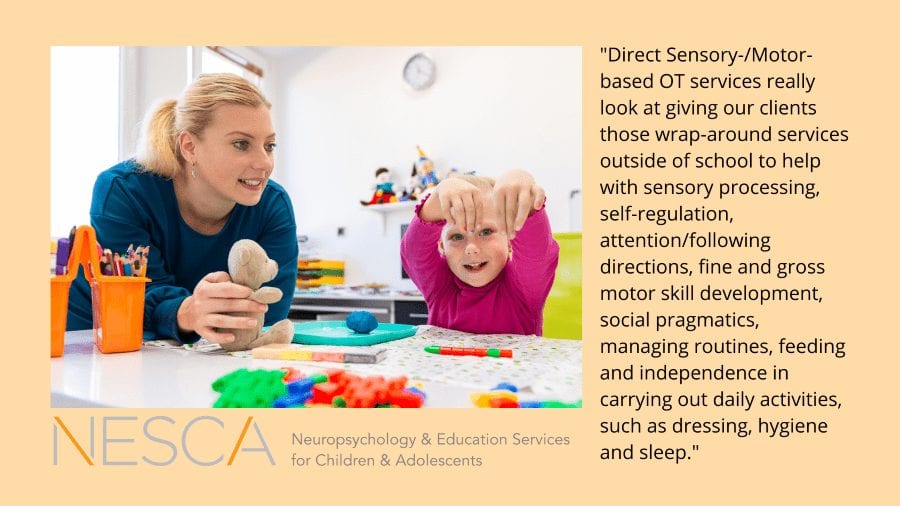
We are so excited to be on board and collaborating with the existing clinical team at NESCA to bring these new services to our community. The main focus of the new OT services is to provide instruction and practice, through teletherapy, and when appropriate at the home or in the community, in order to promote the best functionality kids can achieve on a daily basis. Where academic-based occupational therapy is focused on accessing the curriculum and receiving services while at school, Direct Sensory-/Motor-based OT services really look at giving our clients those wrap-around services outside of school to help with sensory processing, self-regulation, attention/following directions, fine and gross motor skill development, social pragmatics, managing routines, feeding and independence in carrying out daily activities, such as dressing, hygiene and sleep.

Who is a candidate for these new OT services?

We work with children of all ages, but our team typically works with children who are in the fifth grade or below. Many of the skills we are working on are skills that should be targeted and developed early on. Ideally, we are working with children from a young age or as soon as the challenges noted above come to light. Children with motor delays or sensory processing disorders, delays with play skills, and/or feeding difficulties are appropriate for these services.

How does the process of getting OT services start?

We usually start with an OT assessment that is focused on function. Insurance typically covers a 45-minute in-office screening. We would typically conduct a phone intake with the family, then look at the child’s skills using standardized tests for motor/sensory performance. With COVID-19, we are gathering sensory information from The Sensory Processing Measure and assessing other skill levels through interviews and checklists from parents, as well as 1:1 observation either virtually or in-person, as determined through the phone intake.

After an initial assessment is conducted, we work with families on a once or twice weekly basis. Each OT session is 45 minutes long and generally either begins or ends with a conversation with parents.

How do the services work?

We would typically provide services in-person inside the OT clinic at NESCA. Due to COVID-19, we are primarily providing services through telehealth, on a HIPAA-compliant virtual platform on a weekly basis. Sessions are 45 minutes each, with parents involved in part of each session to facilitate engagement of the child, to be coached by the clinician and for education about activities to incorporate in the days before the next session for follow through.

A small number of patients are being seen outdoors at their home or in the community, mainly when online engagement is too challenging, and when it can fit accordingly into clinician schedules. All patients are being seen individually for their services.

How do you set goals for the children you work with?

We get some of our background information for goal-setting from the assessment, but much of the real information on goals, strengths and weaknesses is revealed through observation during our sessions.

From the initial evaluation, we develop a brief report identifying the areas that we need to work on and collaborate with the parents to help achieve those goals and potentially target other areas that arise through ongoing observation and informal assessment during sessions and in parent consults.

When can families expect to see progress with goals being achieved?

We like to see our established goals being achieved in a three to six month time period. While every child is different, many kids go on to work with us for approximately 12 to 18 months, focusing on various goals throughout that period.

What are the related services that have just been introduced at NESCA?

Along with our new occupational therapy services, we are also now providing assessment and treatment of a variety of Speech & Language disorders, including dysphagia, childhood apraxia of speech, phonology/articulation disorder, receptive and expressive language disorder, social pragmatic communication disorder, autism spectrum disorder and language-based learning disabilities.

In addition, our therapists work with children with feeding and swallowing disorders, including transitioning infants to solid foods, weaning from tube feeding, improving sensory tolerance, developing chewing skills, increasing variety and volume of nutritional intake, and reducing avoidance behaviors during mealtimes. Our feeding therapists work with families to make mealtimes easier and more enjoyable for everyone using a systematic desensitization approach to increase sensory comfort with foods. We also employ the TR-eat®—Transdisciplinary Effective Assessment and Treatment—method for highly challenging feeding and eating issues.

Does NESCA accept insurance for its new services?

Direct Sensory-/Motor-based OT at NESCA (not academically-focused), is covered by BCBS and AllWays. Speech therapy at NESCA is covered by BCBS, AllWays and Harvard Pilgrim.

NESCA can provide receipts for Direct Sensory-/Motor-based OT sessions for clients to attempt to submit to their insurance carrier, should they not have insurance through the above carriers. NESCA does not submit claims to any carrier other than those outlined above and cannot guarantee any reimbursement when claims are submitted to them by the client.

It is also worth noting that Educational OT assessment, consultation and treatment is less often, or less completely, covered by insurance because insurance carriers typically only cover treatments that are deemed “medically necessary.” However, this can be a vital service because students spend such a significant amount of their day and week in school programming.

To learn more about NESCA’s Occupational Therapy and Related Services, please click here.


About the Interviewer

Dr. Sophie Bellenis is a Licensed Occupational Therapist in Massachusetts, specializing in educational OT and functional life skills development. Dr. Bellenis joined NESCA in the fall of 2017 to offer community-based skills coaching services as a part of the Real-life Skills Program within NESCA’s Transition Services team. Dr. Bellenis graduated from the MGH Institute of Health Professions with a Doctorate in Occupational Therapy, with a focus on pediatrics and international program evaluation. She is a member of the American Occupational Therapy Association, as well as the World Federation of Occupational Therapists. Having spent years delivering direct services at the elementary, middle school and high school levels, Dr. Bellenis has extensive background with school-based occupational therapy services.  She believes that individual sensory needs and visual skills must be taken into account to create comprehensive educational programming.

About the Interviewee
Julie Robinson is an occupational therapist with over 25 years of experience as a clinician. The work Julie does is integral to human development, wellness and a solid family unit. She particularly enjoys supporting families through the process of adoption and in working with children who are victims of trauma. Julie has extensive experience working with children diagnosed with an Autism Spectrum Disorder (ASD), or who have learning or emotional disabilities. She provides services that address Sensory Processing Disorder (SPD) and self-regulation challenges, as well as development of motor and executive functioning skills.


To book an appointment or to learn more about NESCA’s Occupational Therapy Services, please fill out our online Intake Form, email info@nesca-newton.com or call 617-658-9800.


Neuropsychology & Education Services for Children & Adolescents (NESCA) is a pediatric neuropsychology practice and integrative treatment center with offices in Newton, Massachusetts, Plainville, Massachusetts, and Londonderry, New Hampshire, serving clients from preschool through young adulthood and their families. For more information, please email info@nesca-newton.com or call 617-658-9800.


Sitting Down to Work – Tips for Proper Set-up and Posture

By | NESCA Notes 2020

By: Sophie Bellenis, OTD, OTR/L

Occupational Therapist; Real-life Skills Program Manager and Coach

When working from home, it’s easy to ignore the important things that most people know about maintaining proper posture. The draw of a bed covered in pillows or a cozy nook on the couch can outweigh the rational knowledge that sitting with good posture will help us to stay focused, decrease back or joint pain, and help build a strong core. When it comes to children, they are often unaware of the ways that posture can affect their bodies and their work. They need cues, reminders and examples of the best way to sit to stay focused and be productive. In our last OT Tuesday blog, we discussed the importance of a child’s physical foundation, the core. When it comes to learning, a strong core helps with postural stability. As the start of a new school year draws near, let’s review some important things to consider about the environment and physical set-up for learning and the best positions for our students’ bodies.

Creating a space for learning helps to differentiate between school and home activities that, for many students, are currently happening in the same building. Here are some tips for setting up this space:

  • Find appropriately sized furniture. Children should have their feet on the ground when sitting at their desk! Tables should be at an appropriate height. Tables that are too tall tend to prompt children to hunch their shoulders or sit on their feet, while tables that are too small cause children to slouch and lean their heads on their hands.
  • Help them organize. Classrooms are built to help students grow their executive function skills, as teachers constantly help set up organizational systems and use tricks to keep students on track. Your child may benefit from color coded folders for each subject, a hard copy of their daily schedule (with pictures for younger kids!) or a visual timer.

There are also a few important things to remember to help with proper seated posture.

  • Use visual reminders. Your child may benefit from a picture of someone using proper seated position posted near their workspace. While they may still need a reminder every so often, having an image gives children a model to mimic.
  • The Rule of 90 Degrees. When sitting at a table, children’s hips, knees and ankles should all be positioned at 90 degrees. This helps to create a solid foundation. When children have a strong foundation and postural stability, they are set up to freely and accurately use their fine motor skills. Being grounded allows for easier writing, typing, cutting and manipulation of all the tools necessary for learning. Ideally, children’s elbows will also create a 90 degree angle.
  • Consider a slant board. Placing a computer or a paper on a slanted board can help students realize that they need to sit up straight, promote proper wrist placement and angle, and draw their eye gaze up from the desk. Writing on a vertical or slanted surface in general can help with the development of handwriting skills.
  • Stabilize that paper. Reminding students to use their non-dominant hand to hold their paper helps with precision and accuracy.
  • Allow them to switch it up! Some tasks really require a child to be sitting up straight, grounded and engaged. For example, a student who is hand-writing a final copy of their paragraph or using scissors for an art class will want to be cognizant of their bodies and how they are seated. In contrast, some activities provide opportunities to move around and change positions. If a student is reading a book for English Language Arts, they may want to lie on their belly or sit in a beanbag chair.
  • Take breaks. No matter how perfect a child’s seated posture is, they will benefit from movement and stretching breaks. Little bodies are built to move, bounce and wiggle!

Prioritizing posture as a child helps to build good habits, evenly distribute stress on the body’s muscle ligaments and joints, and create a strong, grounded foundation.


About the Author

Dr. Sophie Bellenis is a Licensed Occupational Therapist in Massachusetts, specializing in educational OT and functional life skills development. Dr. Bellenis joined NESCA in the fall of 2017 to offer community-based skills coaching services as a part of the Real-life Skills Program within NESCA’s Transition Services team. Dr. Bellenis graduated from the MGH Institute of Health Professions with a Doctorate in Occupational Therapy, with a focus on pediatrics and international program evaluation. She is a member of the American Occupational Therapy Association, as well as the World Federation of Occupational Therapists. Having spent years delivering direct services at the elementary, middle school and high school levels, Dr. Bellenis has extensive background with school-based occupational therapy services.  She believes that individual sensory needs and visual skills must be taken into account to create comprehensive educational programming.

To book an appointment or to learn more about NESCA’s Occupational Therapy Services, please fill out our online Intake Form, email info@nesca-newton.com or call 617-658-9800.


Neuropsychology & Education Services for Children & Adolescents (NESCA) is a pediatric neuropsychology practice and integrative treatment center with offices in Newton, Massachusetts, Plainville, Massachusetts, and Londonderry, New Hampshire, serving clients from preschool through young adulthood and their families. For more information, please email info@nesca-newton.com or call 617-658-9800.


Core Strength and Stability: The Physical Foundation

By | NESCA Notes 2020

By: Sophie Bellenis, OTD, OTR/L

Occupational Therapist; Real-life Skills Program Manager and Coach

As our country heads into a period of unique learning, whether through a remote learning experience, a hybrid model or an in-person option with heightened rules and regulations, I find myself focusing on foundation. Foundation, simply defined, means, “the basis upon which something stands or is supported.” Currently, we are looking at a huge shift in how programs will run, how teachers will teach and how schools will support our children, but these principles are rooted in strong foundations. Our educators have knowledge, proven methods and an evidence base that allows for creativity, flexibility and evolution.

With regard to our students, foundational skills are the basics that help them feel secure and grounded enough to tackle the more individualized and creative aspects of learning. It is, in part, due to these foundational skills that many of our surprisingly resilient children have handled the COVID-19 pandemic with more flexibility and grace than the adults in their lives.

Today, let’s highlight the physical foundation that supports a child throughout their day, the core. Anatomically, the core refers to the transverse abdominis, internal and external oblique muscles, rectus abdominis, and the multifidus and erector spinae. This group of muscles holds a child upright when they are sitting at their seat, standing in line and running around on the playground. It is one of the foundational elements that promotes healthy motor development. Having a strong and active core makes it easier for a child to use their fine motor muscles with intent, stay alert for the duration of a class or a Zoom session, and develop healthy postural habits. Occupational therapists are trained to determine whether these activities are being affected by a weak core and if there is a need for intervention. Teachers and parents who spend substantial time with our children may want to be aware of and look out for the clues and signals of core instability, which include:

  • Compensatory strategies for stability – These are the subconscious ways that children compensate for core weakness. Essentially, they are bad habits that initially help to keep kids from getting too fatigued to participate in activities, but can have negative long-term effects. Some common examples include “W-sitting” and holding a breath during activities that require strength.
  • Leaning on anything and everything – Some children sit and lean their head on their hands or the desk when they write, lean against adults when standing up or sitting on a couch, and lean on furniture or tables when they are standing at home. These same students often slouch down in their seats and hunch their shoulders forward when they stand. This could signify a weak core.
  • Difficulty with balance – The inability to stay balanced and upright may be due to core instability. Many children are still developing the ability to run, jump, walk across a balance beam and stand on one foot, but if they seem to be falling over or losing control of their body more frequently than their peers, a weak core may be the culprit. These balance issues may also be apparent when a child is doing daily activities, such as getting dressed, putting on shoes or getting in and out of a car.
  • Difficulty with fine motor tasks – Sometimes children have a strong core and still have weak fine motor skills; however, often a weak core is exacerbating fine motor deficits. There is a little phrase that goes, “proximal stability for distal mobility” that is used by therapists, yogis and personal trainers alike. This means that it is important to have strength and stability at the core to easily move and control the muscles in our arms and legs.

Notably, helping a child to build their core is not always as simple as doing a few targeted exercises. While pure muscle strength may be the root cause of instability, it is not the only possibility. Other causes include poor alignment of the ribcage and pelvis, the need for some neuromuscular reeducation to help children engage the right muscles, and breathing habits that interfere with proper muscle use. If you feel like core weakness may be interfering with your child’s success, it may be worth seeking an occupational therapy assessment or speaking to your school’s occupational therapist about how to help them feel secure, sturdy and grounded. We can all benefit from a strong foundation.


About the Author

Dr. Sophie Bellenis is a Licensed Occupational Therapist in Massachusetts, specializing in educational OT and functional life skills development. Dr. Bellenis joined NESCA in the fall of 2017 to offer community-based skills coaching services as a part of the Real-life Skills Program within NESCA’s Transition Services team. Dr. Bellenis graduated from the MGH Institute of Health Professions with a Doctorate in Occupational Therapy, with a focus on pediatrics and international program evaluation. She is a member of the American Occupational Therapy Association, as well as the World Federation of Occupational Therapists. Having spent years delivering direct services at the elementary, middle school and high school levels, Dr. Bellenis has extensive background with school-based occupational therapy services.  She believes that individual sensory needs and visual skills must be taken into account to create comprehensive educational programming.

To book an appointment or to learn more about NESCA’s Occupational Therapy Services, please fill out our online Intake Form, email info@nesca-newton.com or call 617-658-9800.


Neuropsychology & Education Services for Children & Adolescents (NESCA) is a pediatric neuropsychology practice and integrative treatment center with offices in Newton, Massachusetts, Plainville, Massachusetts, and Londonderry, New Hampshire, serving clients from preschool through young adulthood and their families. For more information, please email info@nesca-newton.com or call 617-658-9800.


Interoception: Helping Children Develop their “Hidden Sense”

By | NESCA Notes 2020

By: Sophie Bellenis, OTD, OTR/L

Occupational Therapist; Real-life Skills Program Manager and Coach

In our last OT Tuesday, we reviewed the sense of interoception, the ability to perceive information coming from inside the body. From basic human experiences, such as hunger and fatigue, to more complex internal emotions, such as anxiety and fear, interoception allows us to perceive and understand the sensations coming from our own bodies. As with other senses, this sense develops as children grow and, like the rest of us, will all have varied abilities. Some of our kids are naturally in tune with their bodies – they take to potty training without a hitch, recognize when they need a snack or a drink of water, and intuitively understand what their bodies are trying to tell them. Unsurprising, these exceptionally well regulated kids are not the majority, and most of our children benefit from some guidance, modelling and direct education on how to interpret the signals and sensations they are experiencing. Let’s discuss some tips and strategies for helping children to perceive, understand and appropriately respond to this internal information. Many of these tips are simple ideas to build into daily life and ways to take advantage of naturally occurring teachable moments.

Language – Incorporating language that teaches children to acknowledge internal cues and body sensations helps them to naturally and consistently notice the clues they are receiving from their bodies.

  • Verbally describe the choices that you make based on your own sense of interoception.
    • “I am going to put on a jacket because when I stepped outside this morning, I felt really cold.”
    • “My mouth feels dry and I’m starting to get a bit of a headache, I am going to have some water because my body is telling me that I am thirsty.”
  • Link requests that your child makes to how they may be feeling inside.
    • “You asked me for a snack. Are you hungry? How is your belly telling you that you’re hungry?”
  • Point out physical clues that hint at internal sensations.
    • “I notice you are having a hard time keeping your eyes open. That tells me you are feeling tired.”
    • “You are crossing your legs and dancing around a bit while you are coloring that picture. I think that your body is giving signals that you have to pee. It is important to pay attention to those signals so that you don’t wet your pants.”

Activities

  • Check Your Pulse! – Have your child sit quietly and teach them how to feel their pulse or heartbeat. Ask them to describe it – is it slow, fast, moving, hitting their fingers, etc.? Then have them run in place and do the same thing. How has it changed? Have them describe it now. Once children understand how their heartrate may be affected by physical activity, a next step would be pointing out that strong emotions, such as anger or excitement, can also affect one’s heartrate. This is a simple activity that provides some biofeedback and teaches children how their actions can affect their bodies.
  • Mindfulness – Zen Master, Thich Nhat Hanh defines mindfulness by stating, “Mindfulness shows us what is happening in our bodies, our emotions, our minds, and in the world.” While not all mindfulness activities focus on interoception, many of the principles and activities build this skill. If you are looking for some resources to work on mindfulness with your child, explore these sites: org, susankaisergreenland.org, mindful.org, and drchristopherwillard.com. Additionally, consider some apps to use with your child: Mindful Powers, Smiling Mind, Breathe Think Do with Sesame and Headspace.
  • Breathing exercises – Breathing exercises are common in mindfulness and can help children to relax. If apps are not for you, consider researching breathing exercises, such as: five-finger breathing, lazy 8 breathing or bumblebee breathing.
  • Progressive muscle relaxation – This practice involves alternating tension and relaxation in different muscle groups in the body. Dr. Monica Fitzgerald provides an excellent script to use with children working to relax here. If you are interested in exploring this practice with children with disabilities, many resources can be found at org.
  • Yoga – Yoga focuses on intentionally moving the body, pairing body movement and breathing, and increasing the mind-body connection. There are many apps and online videos that make yoga accessible to children. Some options include Simply Yoga, Gaia.com and Cosmic Kids Yoga. For some of our children who may need yoga broken down and presented differently, consider com or childlightyoga.com.


About the Author

Dr. Sophie Bellenis is a Licensed Occupational Therapist in Massachusetts, specializing in educational OT and functional life skills development. Dr. Bellenis joined NESCA in the fall of 2017 to offer community-based skills coaching services as a part of the Real-life Skills Program within NESCA’s Transition Services team. Dr. Bellenis graduated from the MGH Institute of Health Professions with a Doctorate in Occupational Therapy, with a focus on pediatrics and international program evaluation. She is a member of the American Occupational Therapy Association, as well as the World Federation of Occupational Therapists. Having spent years delivering direct services at the elementary, middle school and high school levels, Dr. Bellenis has extensive background with school-based occupational therapy services.  She believes that individual sensory needs and visual skills must be taken into account to create comprehensive educational programming.

To book an appointment or to learn more about NESCA’s Occupational Therapy Services, please fill out our online Intake Form, email info@nesca-newton.com or call 617-658-9800.


Neuropsychology & Education Services for Children & Adolescents (NESCA) is a pediatric neuropsychology practice and integrative treatment center with offices in Newton, Massachusetts, Plainville, Massachusetts, and Londonderry, New Hampshire, serving clients from preschool through young adulthood and their families. For more information, please email info@nesca-newton.com or call 617-658-9800.


Interoception: The “Hidden Sense”

By | NESCA Notes 2020

By: Sophie Bellenis, OTD, OTR/L

Occupational Therapist; Real-life Skills Program Manager and Coach

Conventionally, children are taught that there are five different senses, and that these senses help them to experience and understand the world around them. These five senses are sight, sound, smell, taste and touch. Clinically, we refer to these sensory systems as the visual, auditory, olfactory, gustatory and tactile systems. Each system provides unique information and works to alert the brain about the environment around them. Children all develop these systems differently, and all have unique preferences, strengths and interpretations of the world around them. As adults, a sommelier likely has an incredibly refined gustatory system, while a classical musician’s strength lies in their auditory system.

As knowledge about the human body continues to expand, two additional sensory systems have started to make their way into the common lexicon—the vestibular system and the proprioceptive system—both of which describe body awareness. The vestibular system gathers information from the inner ear and tells us where our body is in space. It monitors movement, acceleration and deceleration, balance and any changes in position. A gymnast uses this sense constantly as they flip across a mat or balance on the beam. The proprioceptive system gathers information from our muscles and joints and tells our brains about our position in space and any strength or force that we are using. Proprioception allows us to touch our noses with our eyes closed! These seven senses are all generally acknowledged and frequently assessed by occupational therapists. But what is interoception? And why is it referred to as the hidden sense?

Interoception refers to the perception of information coming from inside the body. Organ systems and the autonomic nervous system provide information about heart rate, hunger, thirst, temperature, respiration and even emotion (Vaitl, 1996). This sense of interoception helps us meet our most basic needs, such as knowing when we need food and water, realizing that it is time to use the restroom and putting on a jacket if it is cold outside. It also helps us to gain a more nuanced understanding of ourselves, such as realizing that an activity is making us anxious by acknowledging heightened heart rate and perspiration. This sensory system is often referred to as the “hidden sense,” because it is completely unique to each individual and no one knows exactly what someone else is feeling internally.

Children develop this sense slowly, with the most basic cues, such as hunger being recognized first. As they continue to grow, different internal signals are more easily understood and start to impact behavior. For example, around the age of two or three, most children start the process of potty training when they begin to recognize what it feels like to have a full bladder. As children continue to grow through their elementary, middle and high school years, this sense continues to be refined. As is expected, this is easier for some children than others.

Recent research shows that there is a strong connection between interoception and emotional/self-regulation. Individuals with low interoception often have more difficulty with both understanding and regulating their bodies and emotions (Zamariola et al., 2019). It appears that the ability to truly understand our body allows us to more intentionally control our responses. Luckily, as with other sensory systems, there are ways to increase interoceptive awareness and help children to notice the information that their bodies are feeding to their brains. In our next OT Tuesday blog, we will discuss some tips and strategies for helping children to perceive, understand and appropriately respond to this internal information.


References

Vaitl D. (1996). Interoception. Biol. Psychol. 42 1–27. 10.1016/0301-0511(95)05144-9

Zamariola G., Frost N., Van Oost A., Corneille O., Luminet O. (2019). Relationship between interoception and emotion regulation: new evidence from mixed methods. J Affect Disord  246:480–5. doi: 10.1016/j.jad.2018.12.101

About the Author

Dr. Sophie Bellenis is a Licensed Occupational Therapist in Massachusetts, specializing in educational OT and functional life skills development. Dr. Bellenis joined NESCA in the fall of 2017 to offer community-based skills coaching services as a part of the Real-life Skills Program within NESCA’s Transition Services team. Dr. Bellenis graduated from the MGH Institute of Health Professions with a Doctorate in Occupational Therapy, with a focus on pediatrics and international program evaluation. She is a member of the American Occupational Therapy Association, as well as the World Federation of Occupational Therapists. Having spent years delivering direct services at the elementary, middle school and high school levels, Dr. Bellenis has extensive background with school-based occupational therapy services.  She believes that individual sensory needs and visual skills must be taken into account to create comprehensive educational programming.

To book an appointment or to learn more about NESCA’s Occupational Therapy Services, please fill out our online Intake Form, email info@nesca-newton.com or call 617-658-9800.


Neuropsychology & Education Services for Children & Adolescents (NESCA) is a pediatric neuropsychology practice and integrative treatment center with offices in Newton, Massachusetts, Plainville, Massachusetts, and Londonderry, New Hampshire, serving clients from preschool through young adulthood and their families. For more information, please email info@nesca-newton.com or call 617-658-9800.


YES! COVID-19 May be Making Basic Daily Tasks More Difficult: The Link Between Executive Function Difficulties and Anxiety/Stress

By | NESCA Notes 2020

By: Sophie Bellenis, OTD, OTR/L

Occupational Therapist; Real-life Skills Program Manager and Coach

As our country continues to adapt to life in the era of COVID-19, it is quite well established that there has been a rise in anxiety and stress among our population. According to the Centers for Disease Control and Prevention (CDC), the mental health effects of the current pandemic have been substantial and include difficulty sleeping, worsening chronic health problems, changes in eating patterns, fear about personal health and the health of loved ones, and increased use of tobacco and alcohol (CDC, 2020). Many of these fears and new challenges are expected and understandable. They are responses that intuitively make sense to us as humans, as many of us experience them on a small scale throughout a typical year. Most people can name a time when they could not fall asleep before a big test or did not take excellent care of their physical health when they were hugely stressed or anxious. However, one effect of this newly heightened stress and anxiety that is less frequently mentioned is the decrease in executive function skills.

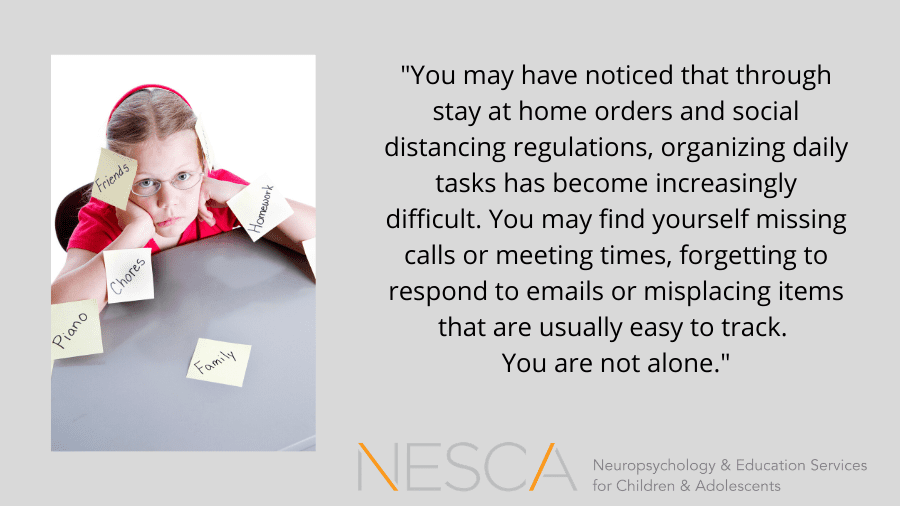
The term executive function refers to the brain processes that allow someone to stay organized, initiate tasks, maintain focus and attention, and manipulative information in their mind. As NESCA Pediatric Neuropsychologist Dr. Alissa Talamo describes in her piece, “What is Executive Function?,” this group of skills can be thought of as the conductor of the brain, similar to the conductor of an orchestra. They are keeping time, telling us when to start and stop tasks and helping us to stay regulated through the ups and downs of the day. You may have noticed that through stay at home orders and social distancing regulations, organizing daily tasks has become increasingly difficult. You may find yourself missing calls or meeting times, forgetting to respond to emails or misplacing items that are usually easy to track. You are not alone. Some people have started to describe a brain fog and a perceived inability to stay focused on a task for more than a short period of time.

While maybe not as intuitive as a lack of sleep, this decrease in executive function is to be expected as we collectively move through this stressful experience. Substantial research has described the correlation between depression, anxiety and stress, and executive function deficits. This seems to be particularly strong for adolescents with depressive and anxious symptoms, who have trouble with cognitive flexibility (Han, Helm, Iucha, Zahn-Waxler & Hastings, 2016). Similarly, university students are another population vulnerable to these effects, as described by Ajilchi and Nejati in 2017, who found specific difficulties with sustained attention and decision making. It is no surprise that one diagnostic criteria for generalized anxiety disorder is “difficulty concentrating or mind going blank” (APA, 2013). When reviewing the literature, it is clear that the brain fog and inability to focus through COVID-19 is not only unsurprising, for many people, it was inevitable.

So, what do we do? How do we soldier on through this incredibly unique time, despite the feeling that everything takes just a bit more time and effort?

It is increasingly important to cut ourselves some slack and stop expecting perfection. Focusing on self-care and taking care of each other emotionally will potentially lead to a natural return to successful executive function. By creating habits and routines that promote positive mental health, we are more likely to mitigate the feelings of being overwhelmed and the potential for burnout. Additionally, using technology and digital reminders to help take over the tasks of initiation and organization can give our over-extended brains a bit of a rest.

Finally, it is imperative that we think about the adolescents and students in our communities who are just starting to build these skills. Building executive function skills comes from a combination of direct instruction and opportunity to practice. Currently, students are being provided ample opportunity to practice, with limited direct instruction and guidance. Consider teaching your children and adolescents the tricks that you have learned to stay organized, prepared and productive. If you feel like teaching these skills is outside of your wheelhouse, or at all daunting, look into the prospect of an executive function coach. With all of the uncertainty about what education will look like this fall, helping students feel ready to tackle learning is one way to mitigate the anxiety and stress of this transitional time.


References

Ajilchi, B., & Nejati, V. (2017). Executive Functions in Students with Depression, Anxiety, and Stress Symptoms. Basic and clinical neuroscience8(3), 223–232. https://doi.org/10.18869/nirp.bcn.8.3.223

American Psychiatric Association. (2013). Diagnostic and statistical manual of mental disorders (5th ed.). Arlington, VA: American Psychiatric Publishing.

Center for Disease Control and Prevention. (2020) Coronavirus disease 2019: Coping with stress. Retrieved from: https://www.cdc.gov/coronavirus/2019-ncov/daily-life-coping/managing-stress-anxiety.html

Han, G., Helm, J., Iucha, C., Zahn-Waxler, C., Hastings, P. D., & Klimes-Dougan, B. (2016). Are Executive Functioning Deficits Concurrently and Predictively Associated with Depressive and Anxiety Symptoms in Adolescents?. Journal of clinical child and adolescent psychology : the official journal for the Society of Clinical Child and Adolescent Psychology, American Psychological Association, Division 5345(1), 44–58. https://doi.org/10.1080/15374416.2015.1041592


About the Author

Dr. Sophie Bellenis is a Licensed Occupational Therapist in Massachusetts, specializing in educational OT and functional life skills development. Dr. Bellenis joined NESCA in the fall of 2017 to offer community-based skills coaching services as a part of the Real-life Skills Program within NESCA’s Transition Services team. Dr. Bellenis graduated from the MGH Institute of Health Professions with a Doctorate in Occupational Therapy, with a focus on pediatrics and international program evaluation. She is a member of the American Occupational Therapy Association, as well as the World Federation of Occupational Therapists. Having spent years delivering direct services at the elementary, middle school and high school levels, Dr. Bellenis has extensive background with school-based occupational therapy services.  She believes that individual sensory needs and visual skills must be taken into account to create comprehensive educational programming.

To book an appointment or to learn more about NESCA’s Occupational Therapy Services, please fill out our online Intake Form, email info@nesca-newton.com or call 617-658-9800.


Neuropsychology & Education Services for Children & Adolescents (NESCA) is a pediatric neuropsychology practice and integrative treatment center with offices in Newton, Massachusetts, Plainville, Massachusetts, and Londonderry, New Hampshire, serving clients from preschool through young adulthood and their families. For more information, please email info@nesca-newton.com or call 617-658-9800.


From School to Summer – Life Rolls Along in the Era of COVID19

By | NESCA Notes 2020

By: Sophie Bellenis, OTD, OTR/L

Occupational Therapist; Real-life Skills Program Manager and Coach

This past March, families were thrown into the world of remote learning, Zoom classrooms, digital assignments and school at home. With little to no time to prepare, teachers and parents alike have worked tirelessly to provide a sense of routine and academic focus, while handling the social and emotional fallout of the COVID19 pandemic. As schools start to wrap up their years and families start to look ahead at what is sure to be a notably unique summer, there is a bit more time to plan, think proactively and chart a positive course for our children.

As summer camps, childcare options, volunteer opportunities, and internships are either cancelled, transitioning to an online format, or significantly limiting capacity, the need for children to manage and plan self-directed activities is becoming more and more apparent. With such an extended period of time ahead of us, let’s highlight some ways that we can create environments that allow our children autonomy while building important skills and leavings lots of room for fun.

Set Firm Boundaries

There is evidence that tells us our children most successfully build and demonstrate their executive function skills when they are allowed freedom and opportunities to make their own choices, within boundaries and limits set by their parents (Schroeder & Kelley, 2010). Consider what aspects of summer life are non-negotiable for your family. This may be a certain limit on hours of screen time per day, a time that all children are expected to be up and out of bed, or chores and expectations that they must meet as a part of the family unit. Make sure that these are clearly communicated and agreed upon by everyone in the home.

Set Goals

Helping children set and work on completing goals can provide a concrete representation of the accomplishments that they have achieved over the summer. There are many ways to organize and format this process, but one consistent theme should be creating goals that are measurable, achievable and specific. Consider the SMART goal format as a template. One way to help children to choose their goals is to have them focus on three categories: personal, family and community. Some examples are:

  1. Personal Goals – Develop a consistent exercise routine; try out a new form of exercise, such as running, yoga or Pilates; incorporate a mindfulness meditation into a weekly schedule; consistently wake up independently with an alarm; or drink the recommended amount of water per day for their age, etc.
  2. Goal to Benefit the Family – Cook dinner for the family once a week; commit to weeding a family garden; deep clean one room per week; learn which cleaning supplies are used for the bathroom and for the kitchen; add a new chore each week; or teach a grandparent or family friend how to use a new technology, etc.
  3. Goal to Benefit the Community – Collect box-tops from all of the food items in the home to give to their school once it’s back in session; take a walk and pick up trash on a road or beach; do a food drive for a local pantry; mow the lawn for a neighbor; or reach out to vulnerable people in the community and ask if they can do anything to help, etc.

Create an Activity Bank

Pediatric Neuropsychologist Dr. Angela Currie of NESCA recently explained why telling kids to simply, “find something to do,” rarely leads to positive results (Currie, 2020). One suggestion that Dr. Currie gives is to create an activity bank or “menu.” It is often difficult to come up with suggestions in the moment when a child mentions that they are bored or feel there is little to do. Take the proactive step of creating a list of activities that your child can go to when they are having a hard time deciding how to fill their time. This makes it easy to prompt them to independently choose something to do. The response, “Why don’t you go take a look at the activities bank and see if there is something that would be a great choice for today?” gives a child a concrete first step. Some families have used creative ways to help children decide between options, such as an activity dice, an activity grab-bag or a personal activity “menu” with specific options for each child.

Encourage Independent Learning

The old adage states that anyone can be an expert at something, if they spend 10,000 hours practicing. Teach this theory to your children and ask them what truly makes them feel excited and curious. What would they like to explore? Children are used to viewing themselves through the lens of a student; however, they rarely make decisions about exactly what they would like to learn. Help your child explore their personal interests and choose something they would like to learn about over the course of the summer. This could look like a 1st grader collecting sea shells at the beach and bringing them home to draw; a 5th grader spending a couple of hours a week researching underwater caves; an 8th grader learning how to keep a sourdough starter alive and bake bread; or a junior in high school doing a deep dive into the current cultural shift developing in the United States. The topic should be completely chosen by the child, with suggestions and support facilitated by their parents.


References

Currie, A. (2020). Why “find something to do” doesn’t work – Teaching independent play skills during quarantine, NESCA Notes. Retrieved from https://nesca-newton.com/why-find-something-to-do-doesnt-work-teaching-independent-play-skills-during-quarantine/

Schroeder, V. & Kelley, M. (2010) Family environment and parent‐child relationships as related to executive functioning in children, Early Child Development and Care, 180:10, 1285-1298, DOI: 10.1080/03004430902981512


About the Author

Dr. Sophie Bellenis is a Licensed Occupational Therapist in Massachusetts, specializing in educational OT and functional life skills development. Dr. Bellenis joined NESCA in the fall of 2017 to offer community-based skills coaching services as a part of the Real-life Skills Program within NESCA’s Transition Services team. Dr. Bellenis graduated from the MGH Institute of Health Professions with a Doctorate in Occupational Therapy, with a focus on pediatrics and international program evaluation. She is a member of the American Occupational Therapy Association, as well as the World Federation of Occupational Therapists. Having spent years delivering direct services at the elementary, middle school and high school levels, Dr. Bellenis has extensive background with school-based occupational therapy services.  She believes that individual sensory needs and visual skills must be taken into account to create comprehensive educational programming.

To book an appointment or to learn more about NESCA’s Occupational Therapy Services, please fill out our online Intake Form, email info@nesca-newton.com or call 617-658-9800.


Neuropsychology & Education Services for Children & Adolescents (NESCA) is a pediatric neuropsychology practice and integrative treatment center with offices in Newton, Massachusetts, Plainville, Massachusetts, and Londonderry, New Hampshire, serving clients from preschool through young adulthood and their families. For more information, please email info@nesca-newton.com or call 617-658-9800.


Skip to content