NESCA’s Newton, MA location has immediate availability for neuropsychological evaluations. Our MA clinicians specialize in the following evaluations: Neuropsychological; Autism; and Emotional and Psychological, as well as Academic Achievement and Learning Disability Testing.

Visit www.nesca-newton.com/intake for more information or to book an evaluation.

Tag

pediatric neuropsychology Archives - Page 16 of 18 - NESCA

Subscribe to NESCA Notes

School’s Out For Summer

By | NESCA Notes 2020

By: Amity Kulis, PsyD
Pediatric Neuropsychologist, NESCA

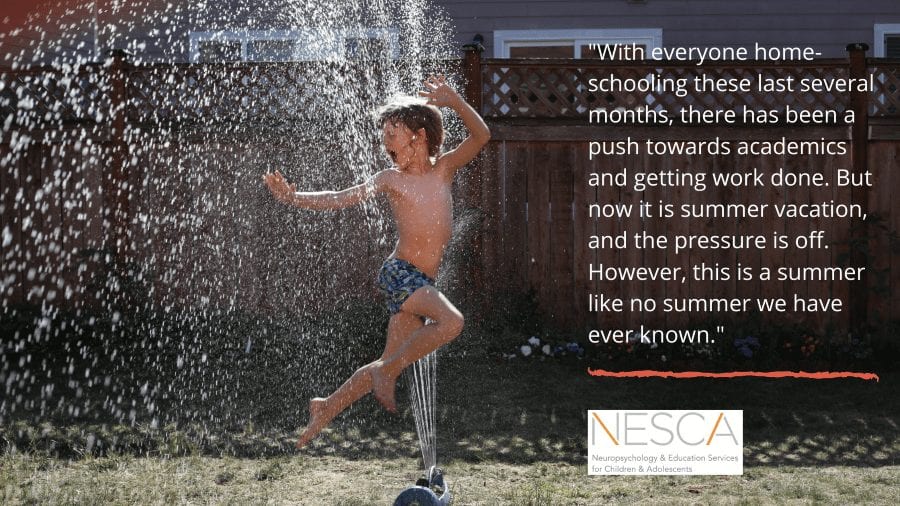
With everyone home-schooling these last several months, there has been a push towards academics and getting work done. But now it is summer vacation, and the pressure is off. However, this is a summer like no summer we have ever known. Many families are continuing to spend more time at home, many activities are still closed, or at the very least, they are more limited. It can be hard to figure out what to do with all of this time.

The summer can be a great time to engage multiple aspects of our minds. I am often reminded of Gardner’s theory of multiple intelligences. His theory proposes there are eight aspects of human intelligence, each representing different ways of processing information. Without getting into the deep specifics of his theory, I think it is important to consider the many different ways that our brains interact with the world. When trying to plan out activities or experiences for our kids this summer, taking these multiple aspects of functioning into consideration might help to stir up some great ideas.

Visual-Spatial: This can include activities such as drawing and other art activities using maps, puzzles and patterning tasks. Young children can practice making patterns and completing puzzles while our older children can create using Legos or planning out a family outing on a map. The possibilities are endless.

Linguistic-Verbal: This can include reading, writing and speaking. Children and families can enjoy reading books together or creating stories. Even conversations at the dinner table can be a form of engaging these verbal skills.

Logical-Mathematical: Activities that tap into this skillset can involve the use of numbers and relationships using patterns. Science or experiment-based activities can fall into this category. Young children love creating volcanos with vinegar and baking soda. Allowing them to measure materials out and add food coloring is always a fun idea. Older children may enjoy cooking or other activities that involve numbers and measurement.

Bodily-Kinesthetic: These activities engage the body and can involve strength and physical control. During the summer, the options are endless: nature walks, running through the sprinkler, dancing, biking, scootering, etc. Anything that gets the body moving! These activities can be enjoyed by the whole family.

Musical: Think about rhythms and sounds. Activities can include singing and playing musical instruments. While certainly traditional tools like the piano come to mind, you can also turn pots upside down, get some spoons and create a drum circle. Or possibly work as a family to turn the lyrics of a favorite song into something silly or more meaningful to your family. This summer could also be a great time to learn a new instrument with plenty of music instructors offering virtual lessons throughout the summer.

Interpersonal: This one may be a little harder as many people continue to distance themselves. While our health remains a priority, we do have to acknowledge that practicing social skills is important for everyone. This can involve calling or virtually meeting with family members, possibly a distanced activity with others outside, or leaving notes for friends and neighbors. Anything that gets your child thinking about others, their own thoughts and feelings, and finding ways to stay connected is important. Embracing the relationships within your family during this time is also a great idea.

Naturalistic: This means being in tune with nature and exploring the environment. These types of activities involve being outside, interacting with plants and animals. Perhaps you start a family garden or go for regular walks in the woods. Focusing on bugs, sounds and smells within your environment. Outdoor activities are probably the most readily available during this time.

Intrapersonal: Personal enrichment and being in tune with oneself is so important during this time. Taking time to calm our own frustrations and anxieties is essential for our overall health as well as setting a good example for children. Numerous mindfulness activities aimed at improving self-regulation can be found online. Being more aware of what is going on in our bodies and minds is so important to help us get through this time.

The summer is a time to relax and enjoy being a family. This can be a jumping off point to get the creativity flowing then allow the kids to jump in and help find fun ways to spend this summer—one that is unlike any other we have experienced.


About the Author:

Dr. Amity Kulis joined NESCA in 2012 after earning her doctoral degree in clinical psychology from the Massachusetts School of Professional Psychology, with a concentration in Children, Adolescents and Families (CAF). She completed post-doctoral training in pediatric neuropsychology with an emphasis on treating children with developmental, intellectual, learning and executive functioning challenges. She also has extensive training psychological (projective) testing and has conducted individual and group therapies for children of all ages. Before joining NESCA, Dr. Kulis worked in private practices, clinics, and schools, conducting comprehensive assessments on children ranging from toddlers through young adults. In addition, Dr. Kulis has had the opportunity to consult with various school systems, conducting observations of programs, and providing in-service trainings for staff. Dr. Kulis currently conducts neuropsychological and psychological (projective) assessments for school-aged children through young adulthood. She regularly participates in transition assessments (focusing on the needs of adolescents as they emerge into adulthood) and has a special interest in working with complex learners that may also struggle with emotional challenges and psychiatric conditions. In addition to administering comprehensive and data-driven evaluations, Dr. Kulis regularly conducts school-based observations and participates in school meetings to help share her findings and consultation with a student’s TEAM.


To book an evaluation with Dr. Kulis or one of our many other expert neuropsychologists and transition specialists, complete NESCA’s online intake form.


Neuropsychology & Education Services for Children & Adolescents (NESCA) is a pediatric neuropsychology practice and integrative treatment center with offices in Newton, Massachusetts, and Londonderry, New Hampshire, serving clients from preschool through young adulthood and their families. For more information, please email info@nesca-newton.com or call 617-658-9800.


Testing at NESCA during COVID-19

By | NESCA Notes 2020

By: Ann Helmus, Ph.D.
NESCA Founder/Director

I’m sure you can agree, it’s been an interesting time due to the onset of COVID-19. Our worlds, livelihoods and professional lives have been turned upside down. At NESCA, where our entire business revolves around the in-person evaluations, assessments, coaching and treatment of children, adolescents and young adults, much of our “In Real Life (IRL)” activity had to be put on hold to prevent the risk of infection among our clients and staff.

After making the decision to temporarily close our physical offices, our clinical and administrative staff swiftly geared up to provide as many services as possible remotely. While we were considered an “essential” business by the State of Massachusetts, we opted to pause our neuropsychological testing for the safety of all involved while initiating research into how we could conduct this critical service to our families. We are keenly aware of the long wait times for testing and the associated stress that puts on parents while they seek out answers about their children’s behavior or learning differences—all the while making children who need supports earlier than later wait in the wings as well. We also knew there would be an increased need for testing because of the impact COVID-19 was and is likely to have on the mental health of children and teens; schools would eventually be inundated with a back-log of evaluations already in the works as well requests for new evaluations that, by law, have to be conducted within a specific time period; and to help fulfill the ever-present need to assist schools and parents in providing support to children with special needs.

Knowing our pause of testing was not a long-term, viable option, after careful consideration and much intense research, we identified several options on how we could bring our neuropsychological evaluation services back to the NESCA community. The options we identified as possibilities included conducting teletherapy, using a partial plexiglass screen (akin to what you would see protecting a store cashier), observing social distancing and constructing a two-office model. We examined the risk to both clients and clinicians, privacy and technology constraints, ethics surrounding the validity of the test findings and legal issues concerning the credibility of evaluation findings/diagnosis among other topics.

While we determined that teletherapy has a role in the testing process, including parent intake and feedback sessions, we ultimately decided that it would not be a solution for NESCA to adopt for the actual evaluation of a child. Next, the partial plexiglass shield did not provide enough risk mitigation for the child or evaluator, and it may not have been a secure enough physical barrier for some of the more aggressive children we test to keep both parties properly distanced.

So, where does that leave us? We do have social distancing in the mix as a potential option. While it does not provide maximum risk reduction, some families see it as the most natural option. The child, and if necessary, a parent helper, are at one end of a long conference table, and the evaluator is at the other end, at least six feet away at all times. All people in the room wear masks to further reduce risk. All testing materials are set up in advance for the child or parent helper. Most tests can be conducted on an iPad, which is controlled by the evaluator’s computer.

Since we were very aware that some parents would not be comfortable with this model, we continued our exploration and education, landing on an innovative two-office model. The two-office set-up involves a four foot by eight foot clear plexiglass window to be installed between two offices. This allows for clear observation of the child by the evaluator, the ability for the child and evaluator to communicate with each other via a high-quality intercom system and for the evaluator to visually demonstrate activities that the child is asked to perform during testing. A parent helper can be allowed in the room with the child should they need support during the session. Again, many of the tests would be administered via an iPad, which is controlled by the evaluator in the adjoining room. All additional test materials are organized and arranged in the office where the child is prior to testing.

NESCA’s two-office approach was piloted in our Londonderry, N.H. office by Dr. Angela Currie. Due to its maximum risk reduction for all parties and its similarity to the standard testing experience, NESCA expanded its testing capabilities with this model to the Newton office, where there are currently two of these testing areas available. While it does have some limitations, it is working very well with our families.

Along with the new testing models implemented, NESCA is, of course, taking all precautions available to reduce risk of exposure. We require risk assessment questionnaires, temperature checks and hand sanitizing; implemented a “touchless” check-in process; limit the number of people to a total of eight at one time in the 7,000 square foot Newton office, with testing being done at opposite ends of the office; provide private waiting rooms for parents who are not involved in the child’s testing; and sanitize all equipment and rooms used both before and after every appointment. We continue to follow the CDC and State’s guidelines for re-opening requirements.

We are very proud of our ability to continue to serve parents, children, families and schools during this extremely difficult time. I am once again so grateful to the cohesive and collaborative team we have in place here at NESCA and for its creativity, innovation, determination and dedication. The needs of families with children who have special needs never stop. While we may be forced to pause, NESCA will do everything in its power not to stop either.

Resources/Notes:

  • To view the Federation for Children with Special Needs webinar with Dr. Ann Helmus, visit Testing in the Age of Remote Learning
  • Dr. Helmus will present, “Testing in the Time of Covid,” to the Massachusetts Urban Project, a statewide network of special education leaders from 15 urban school districts across the state, on June 9.
  • Dr. Helmus will present on this topic in conjunction with Massachusetts Advocated for Children in June TBD.


About the Author: 

NESCA Founder/Director Ann Helmus, Ph.D. is a licensed clinical neuropsychologist who has been practicing for almost 20 years. In 1996, she jointly founded the  Children’s Evaluation Center (CEC) in Newton, Massachusetts, serving as co-director there for almost ten years. During that time, CEC emerged as a leading regional center for the diagnosis and remediation of both learning disabilities and Autism Spectrum Disorders.

In September of 2007, Dr. Helmus established NESCA (Neuropsychology & Education Services for Children & Adolescents), a client and family-centered group of seasoned neuropsychologists and allied staff, many of whom she trained, striving to create and refine innovative clinical protocols and dedicated to setting new standards of care in the field.

Dr. Helmus specializes in the evaluation of children with learning disabilities, attention and executive function deficits and primary neurological disorders. In addition to assessing children, she also provides consultation and training to both public and private school systems. She frequently makes presentations to groups of parents, particularly on the topics of non-verbal learning disability and executive functioning.

To book an evaluation with Dr. Helmus, NESCA Founder and Director, or one of our many other expert neuropsychologists, complete NESCA’s online intake form

Neuropsychology & Education Services for Children & Adolescents (NESCA) is a pediatric neuropsychology practice and integrative treatment center with offices in Newton and Plainville, Massachusetts, as well as Londonderry, New Hampshire. NESCA serves clients from preschool through young adulthood and their families. For more information, please email info@nesca-newton.com or call 617-658-9800.

Making Decisions in Adulthood: Some Options

By | NESCA Notes 2020

By: Kelley Challen, Ed.M., CAS
Director of Transition Services; Transition Specialist

As a transition specialist working with students from middle school through young adulthood, one of the biggest transitions that students make is “turning 18” or when they reach the Age of Majority (i.e., the legal age established by state law at which the person is no longer a minor) and gain the rights and responsibilities for making educational, medical, financial and other legal decisions. For students who have had a tremendous amount of support at home and in school, this transition can be challenging. Some students are not ready to make competent decisions for themselves, and other students may never be capable of making competent and informed decisions independently. If your child or a student you are working with needs help making decisions in adulthood, there are several options for organizing decision-making in adulthood. Because I am not a legal agent, I do always suggest that families consult with experts, such as special needs attorneys, financial planners and medical experts, as they work toward determining the best legal decision-making arrangement for their child.

Here are some basic descriptions of decision-making options you may consider for your child:

Power of Attorney (POA): A written authorization that allows a person to represent or act on another’s behalf. There are different types of POAs, and they can be written specific to whatever acts the individual wants the agent to be able to perform (e.g., private affairs, business, financial, medical or some other legal matter).

Health Care Proxy: A legal instrument with which the individual appoints a healthcare agent to make healthcare decisions on behalf of the individual when he or she is incapable of making and executing the healthcare decisions stipulated in the proxy. One way this is different from a POA is that the healthcare agent is only able to make medical decisions for the individual during the time when that individual is incapacitated. However, some healthcare professionals may view a healthcare proxy as a desire to share medical decision-making even though that is not exactly the letter of the law.

Guardianship/Conservatorship: A court-ordered arrangement whereby one or more persons are given legal authority to make decisions on behalf of another person. Guardianship and conservatorship are used when the person’s decision-making capacity is so impaired that the person is unable to care for his or her own personal safety or to provide for his or her necessities of life. Guardians and conservators may have limited decision-making power or general broad control. While POAs and health care proxies are arrangements that might be considered mainstream as they can be accessed by any adult with or without a disability, guardianship and conservatorship are more extreme options as a guardian is taking full or partial control over an individual’s affairs and taking away some of that person’s legal and civil rights.

Supported Decision-Making (SDM): SDM is an alternative to guardianship whereby the individual with a disability selects supporters who will assist the individual in making their own decisions. It allows an individual with a disability to make his or her own decisions about life choices with the support of a designated person or team of trusted supporters. This is an alternative to guardianship which is becoming more popular in Massachusetts and many other states across the country. To learn more about SDM, check out the National Resource Center for Supported Decision-Making and the Supported Decisions Site from the Center for Public Representation.

If you are looking for more information about special needs legal planning specific to Massachusetts, these are a handful of resources you may want to explore:


If you are interested in working with a transition specialist at NESCA for consultation, coaching, planning or evaluation, please complete our online intake form: https://nesca-newton.com/intake-form/.


About the Author:

Kelley Challen, Ed.M., CAS, is NESCA’s Director of Transition Services, overseeing planning, consultation, evaluation, coaching, case management, training and program development services. She is also the Assistant Director of NESCA, working under Dr. Ann Helmus to support day-to-day operations of the practice. Ms. Challen began facilitating programs for children and adolescents with special needs in 2004. After receiving her Master’s Degree and Certificate of Advanced Study in Risk and Prevention Counseling from Harvard Graduate School of Education, Ms. Challen spent several years at the MGH Aspire Program where she founded an array of social, life and career skill development programs for teens and young adults with Asperger’s Syndrome and related profiles. She additionally worked at the Northeast Arc as Program Director for the Spotlight Program, a drama-based social pragmatics program, serving youth with a wide range of diagnoses and collaborating with several school districts to design in-house social skills and transition programs. Ms. Challen is co-author of the chapter “Technologies to Support Interventions for Social- Emotional Intelligence, Self-Awareness, Personality Style, and Self-Regulation” for the book Technology Tools for Students with Autism. She is also a proud mother of two energetic boys, ages six and three. While Ms. Challen has special expertise in supporting students with Autism Spectrum Disorders, she provides support to individuals with a wide range of developmental and learning abilities, including students with complex medical needs.

Neuropsychology & Education Services for Children & Adolescents (NESCA) is a pediatric neuropsychology practice and integrative treatment center with offices in Newton, Massachusetts, Plainville, Massachusetts, and Londonderry, New Hampshire, serving clients from preschool through young adulthood and their families. For more information, please email info@nesca-newton.com or call 617-658-9800.

How to Talk to Your Kids about Racial Inequality and Current Events

By | NESCA Notes 2020

By: Cynthia Hess, PsyD
Pediatric Neuropsychologist Fellow and Therapist

It is old news that parents and children have been experiencing an increased sense of uncertainty and vulnerability due to COVID-19. That vulnerability may be exacerbated by the news of violent protests that were sparked by anger over police brutality against black men and women. News of widespread violence around the country spread rapidly in a country already stressed to its capacity in dealing with a global pandemic and the resulting economic hardship. In the aftermath of these recent tragedies, parents should be aware that children may be experiencing collateral consequences, such as fear, anxiety and confusion. Rhea Boyd, MD, MPH, stated, “Whether from social media accounts, conversations with peers or caregivers, overheard conversations, or the distress they witness in the faces of those they love, children know what is going on. And without the guidance and validation of their caregivers, they may be navigating their feelings alone.” So, what do we do?

First, take care of yourself. Now is a good time to practice self-compassion and selfcare. The stress of watching traumatic events on television and smartphones “lingers within our bodies and minds,” states developmental pediatrician Dr. Jenny Radesky. Recognize that vicarious trauma is real, and even if you have not been directly affected, you may be experiencing heightened anxiety, difficulty sleeping, fatigue or increased irritability. Practice accepting your own feelings, instead of controlling them. Go for a walk, talk with a friend, practice relaxation techniques or do something you enjoy.

It is important to consider how we talk with children. While children from birth to age three do not understand what is happening, they can feel it through the reactions of the adults around them. You may notice that your young child has become more irritable, or perhaps crying more than usual. In addition to calming your child, limit the amount of time you spend accessing unsettling news reports in the presence of young children.

With elementary children, it is wise to begin your discussion with, “tell me what you know.” By elementary age, children have a good idea about what is happening. Asking children what they know and following up with any questions they might have will help you to provide age appropriate information. It is important to keep channels of communication open, because as time passes it is likely more questions will arise. Children may want to know that they are safe and, if they ask, provide reassurance. With that being said, limit their exposure to media, be it on television, tablet or smartphone. If they are accessing media, be aware of what they are watching and learning. Answer questions as appropriate and, as with all ages, validate their feelings and assure them that whatever they are feeling, it is okay.

It is probable that teenage youth have seen the images and been involved in learning about the events that precipitated the violence that unfolded. They may even be getting involved in activism by posting and re-posting social media messages. Teenagers often process events by talking with their peers, and it can, at times, be difficult to engage them in conversation. Approach the topic with your teen from a position of curiosity. What do they know? How do they know it? How do they feel about it? It is also a good time for you and your teen to become more educated about the history of racism in our country and how it has been perpetuated through generations of people. A broader societal context of racism will help youth have a better understanding of the anger seen in the demonstrations. A documentary called “13th,” about the 13th amendment, takes an in-depth look at the prison system in the United States and how it mirrors the nation’s history of racial inequality. It is both educational and provides a starting point for having conversations about race with your teen. Additionally, as much as possible, be aware of your teen’s online activity. There is a lot of misinformation and inflammatory rhetoric on social media, and teens need guidance on how to be thoughtful and responsible consumers of all types of media.

Given that the recent unrest was sparked by anger over police brutality against black people, it is important take this opportunity to have these conversations with children about race and racism. By age four, children have begun to internalize cultural attitudes and values, thus, it is not too early to introduce your child to the concepts of race and inequality. Books that include multi-racial characters are a good way to introduce children to people of color in a positive light. Common Sense Media has a list of books appropriate for kids of all ages beginning in infancy, and the link is provided below.

Experts stress that parents also need to give their children the broader societal context of racism to try to explain the rage of protestors filling the streets of cities across the nation. Doing so helps build empathy and teach perspective-taking, shifting the focus from the child’s specific fears. Helping children to view events from different perspectives provides understanding and promotes empathy. When your child sees something on television, YouTube or social media, employ a sense of curiosity. Ask them what they saw, how they felt about what they saw, and have them think about and share how they think different people involved in the situation felt. Dr. Radesky suggests, “Instead of focusing on questions the child may have about concrete things, ask them questions like ‘How do you think those people were feeling? Do you know why they were angry? What do you do when you feel like something is unfair?’” We all have our different perspectives regarding racism and the complex history of race in our country. Providing space for children to ask questions, discuss their feelings and process the world around them will help them cope with the myriad emotions that may arise due to current events and the sense of helplessness and fear they may be experiencing.


Some helpful resources:

https://www.pbs.org/parents/authors/jenny-radesky-md

https://www.commonsensemedia.org/lists/books-with-characters-of-color

https://www.commonsensemedia.org/blog/black-history-movies-that-tackle-racism

https://www.commonsensemedia.org/lists/movies-that-inspire-kids-to-change-the-world

https://pediatrics.aappublications.org/content/144/2/e20191765

https://raisingequity.org/


About the Author

Dr. Cynthia Hess recently graduated from Rivier University with a PsyD in Counseling and School Psychology. Previously, she earned an M.A. from Antioch New England in Applied Psychology. She also worked as an elementary school counselor and school psychologist for 15 years before embarking on her doctorate. During her doctorate, she did her pre-doctoral internship with RIT in Rochester, N.Y. where she worked with youth ages 5-17 who had experienced complex developmental trauma. Dr. Hess’s first post-doctoral fellowship was with The Counseling Center of New England where she provided psychotherapy and family therapy to children ages 5-18, their families and young adults. She also trained part-time with a pediatric neuropsychologist conducting neuropsychological evaluations. Currently, Dr. Hess is a second-year post-doctoral fellow in pediatric neuropsychological assessment, working with NESCA Londonderry’s Dr. Angela Currie.


To schedule an appointment with one of NESCA’s expert neuropsychologists, please complete our online intake form


Neuropsychology & Education Services for Children & Adolescents (NESCA) is a pediatric neuropsychology practice and integrative treatment center with offices in Newton and Plainville, Massachusetts, and Londonderry, New Hampshire, serving clients from preschool through young adulthood and their families. For more information, please email info@nesca-newton.com or call 617-658-9800.


The Uncertainty, Stress and Anxiety About What School Will Look Like

By | NESCA Notes 2020

By: Cynthia Hess, PsyD
Pediatric Neuropsychologist Fellow and Therapist

Much of adjusting to the world in the midst of a global pandemic has been learning to live with nearly constant uncertainty. Undoubtedly, this pandemic and ensuing uncertainty has caused significant stress for youth and their families. The experience of persistent stress can result in increased vulnerability to anxiety and depression. Symptoms may become magnified in those who already faced mental health challenges. There is little doubt that there will be increases in mental and behavior health problems for children and families both in anticipating the re-opening of schools, and when schools reopen their physical buildings.

We all wonder what school will look like in the fall. The anticipation of returning to school can be especially stressful, and will likely be so for most youth. Given that students will not have been in schools with their peers for several months, it can be anticipated that they might feel a heighted sense of insecurity and uncertainty. Even in “normal times,” returning to the complex social and educational environment of school can be worrisome for many children and adolescents.

Each individual child will have had their own experiences while schools were closed. Some children and/or staff members may have been impacted by COVID-19 and some families and/or staff may be experiencing financial hardship due to parental unemployment or loss of household income. It is important to realize that regardless of their experience, each individual will have a unique response. It is helpful to recognize the signs of stress and help children learn positive ways of coping with it.

Signs of stress in preschool children include, but are not limited to, anger, nervousness, eating and sleeping problems (including nightmares), fear of being alone, irritability and uncontrollable crying.

In elementary age children, stress may manifest as increased complaining of headaches and stomachaches, feeling insecure, reduced appetite and difficulty sleeping, withdrawal and worrying about the future.

Signs of stress in pre-teens and teens may include anger, disillusionment, distrust of the world, low self-esteem, stomachaches and headaches, panic attacks and rebellious behavior.

As each person works through this very challenging situation, it is more important than ever to adopt a position of acceptance, as we never truly know what another person is experiencing or has experienced. The following are offered as suggestions on how to help children and teens cope with stress.

  • Help them identify how they are feeling and acknowledge and validate those feelings.
  • Encourage them to talk about what is bothering them.
  • Share strategies you use to cope with stress.
  • Talk openly and, as appropriate, share stories about stress in your day.
  • Find a physical activity and/or hobby that they enjoy and encourage them to participate.
  • Encourage them to eat healthy foods and emphasize the importance of a healthy lifestyle, especially as it relates to stress.
  • Make sure they get plenty of sleep.
  • Set clear expectations, without being overly rigid, and allow for “down” time.
  • Spend time outdoors, encourage them to do something they love – read a book, ride their bike, bake, etc.
  • Learn and teach your children relaxation skills, such as breathing exercises, muscle relaxation exercises, meditating, yoga, drawing or writing.

Our world will have changed by the time children re-enter their classrooms. No matter what happens in the fall, when it is time for school to start, it will inevitably be stressful. Learning to cope with and manage stress is important for physical and emotional health. However, if you are concerned about your child or are struggling yourself, seek help and support for yourself, your child or anyone in your family who is struggling.

Below are some helpful resources:

https://www.apa.org/topics/children-teens-stress

https://nesca-newton.com/helping-your-anxious-child-through-covid-19/

https://childmind.org/article/how-to-ask-what-kids-are-feeling-during-stressful-times/

https://healthy.kaiserpermanente.org/health-wellness/health-encyclopedia/he.stress-in-children-and-teens.ug1832


About the Author

Dr. Cynthia Hess recently graduated from Rivier University with a PsyD in Counseling and School Psychology. Previously, she earned an M.A. from Antioch New England in Applied Psychology. She also worked as an elementary school counselor and school psychologist for 15 years before embarking on her doctorate. During her doctorate, she did her pre-doctoral internship with RIT in Rochester, N.Y. where she worked with youth ages 5-17 who had experienced complex developmental trauma. Dr. Hess’s first post-doctoral fellowship was with The Counseling Center of New England where she provided psychotherapy and family therapy to children ages 5-18, their families and young adults. She also trained part-time with a pediatric neuropsychologist conducting neuropsychological evaluations. Currently, Dr. Hess is a second-year post-doctoral fellow in pediatric neuropsychological assessment, working with NESCA Londonderry’s Dr. Angela Currie.


To schedule an appointment with one of NESCA’s expert neuropsychologists, please complete our online intake form


Neuropsychology & Education Services for Children & Adolescents (NESCA) is a pediatric neuropsychology practice and integrative treatment center with offices in Newton and Plainville, Massachusetts, and Londonderry, New Hampshire, serving clients from preschool through young adulthood and their families. For more information, please email info@nesca-newton.com or call 617-658-9800.


Life Skills for College to Work on Now – Part 2

By | NESCA Notes 2020

By: Kelley Challen, Ed.M., CAS
Director of Transition Services; Transition Specialist

In Massachusetts, we are more than five weeks into home-based learning and looking toward another two months (or more) of schools and childcare facilities being closed. Unfortunately, this is taking a particularly large social and emotional toll on our teenagers and young adults. One strategy for coping with current conditions is to focus on concrete ways that we can control our daily lives and to set short-term tangible goals. With that in mind, I am writing a second blog focusing on the opportunity teenagers are being given to build daily living and executive functioning skills that will ultimately help them live away from home and self-direct their lives. Last week, I discussed four important skills that are critical for attending residential colleges: getting up on time each morning, doing laundry, having basic kitchen skills, and using basic tools for assembling and fixing things around home. This week, I am offering another four skills. For any young person, I always suggest letting the student pick the skill(s) they want to work on first. When you have a lot to work on, you may as well pick the starting point that feels most important and motivating!

  • Medications: For students who have been on medication during high school, keeping that medication regimen stable is typically a must during the transition to college. Students need to have the knowledge, preparation and organizational skills needed to maintain their own medication regimen. Often a good way to start this process is to purchase a 7-day pill organizer and have teens be responsible for dispensing their own medication for the week. Certainly, a smartphone or smartwatch with several alarms can be useful for remembering medications at needed times. For more information about medication management expectations in college, check out this article by Rae Jacobson. He makes some useful recommendations, such as using a unique alarm tone for medication reminders and putting pills in highly or frequently visible locations (e.g., next to your toothbrush that you routinely use).
  • Money: Students in early stages of high school may be too young for their own bank accounts and credit cards. However, some banks do offer accounts that are specially tailored for minors. Students can open a joint bank account as a minor with a parent or legal guardian. Teens can also practice managing plastic through use of traditional prepaid debit cards, Amazon.com or store gift cards, or a debit card made especially for minors like Greenlight. From home, teens can practice making necessary online purchases, tracking payments and shipping, checking account balances, and using a software like Microsoft Excel or Google Sheets to keep a record of purchases. There are also plenty of great free web-based financial literacy resources that teens can use to learn about banking and consumer skills from home; a few resources that my colleague Becki Lauzon, M.A., CRC, and I like include:
  • Building an Exercise Routine: Believe it or not, basic fundamentals like healthy eating, sleep hygiene and regular vigorous exercise are strong predictors of college success and satisfaction. As we are living in a period of time where team sports are not accessible, this may be exactly the right time for teenagers to build their own individual exercise routine that can be carried out at home and in one’s local neighborhood. A good baseline to strive for is a routine that includes exercise sessions at least three days per week. With decreased time factors in our lives, students can play around with morning, afternoon or evening exercise to see what feels best for their bodies and brains. If brisk dog-walking, jogging/running or biking activities are not appealing, there are plenty of great YouTube exercise videos (e.g., dance, yoga, strength training, cardio training, etc.) that require no equipment and are calibrated for all kinds of bodies and levels of fitness. Setting a schedule for weekly workouts will help to ensure that exercise becomes more routine and tracking progress with that schedule (e.g., journaling, marking a calendar, using an app like Strava or Aaptiv, etc.) helps to build and sustain motivation. Some teens (and adults) also find that they are more able to stick to an exercise routine if they use a smartwatch to help track, celebrate and prompt their progress.
  • Using a Calendar System for Scheduling: The alarm clock mentioned in last week’s blog is certainly an important time management tool that is vital to master prior to attending college. Another critical time management tool for college (and life beyond) is a calendar system for managing one’s schedule. When starting to build time management skills, simply asking your teen to write down their schedule can be a good place to start. What do they know they have to do each day of the week? What appointments or activities are missing? Teens may have a calendar system that they are already accustomed to using for checking the date, but may not be using that tool to manage their entire schedule. Some common calendar app tools include iCal, Google Calendar and Outlook, but some teens may do better with paper-based systems. If a teen benefits from a paper copy of their schedule, I would still recommend that they learn to use something electronic, then just print off their daily, weekly or monthly schedule based on preference and need. Practice inputting activities that are happening right now, such as assignments, remote classes, meals, therapy, etc. Teens can also play around with reminder settings to see what feels best for prompting participation in activities. Sometimes 15 minutes is too much time, but 5 or 10 is just right. Other times, more than one reminder is needed.

To read more about the Life Skills recommendations from last week’s Transition Thursday blog, click here!


If you are interested in working with a transition specialist at NESCA for consultation, coaching, planning or evaluation, please complete our online intake form: https://nesca-newton.com/intake-form/.


About the Author:

Kelley Challen, Ed.M., CAS, is NESCA’s Director of Transition Services, overseeing planning, consultation, evaluation, coaching, case management, training and program development services. She is also the Assistant Director of NESCA, working under Dr. Ann Helmus to support day-to-day operations of the practice. Ms. Challen began facilitating programs for children and adolescents with special needs in 2004. After receiving her Master’s Degree and Certificate of Advanced Study in Risk and Prevention Counseling from Harvard Graduate School of Education, Ms. Challen spent several years at the MGH Aspire Program where she founded an array of social, life and career skill development programs for teens and young adults with Asperger’s Syndrome and related profiles. She additionally worked at the Northeast Arc as Program Director for the Spotlight Program, a drama-based social pragmatics program, serving youth with a wide range of diagnoses and collaborating with several school districts to design in-house social skills and transition programs. Ms. Challen is co-author of the chapter “Technologies to Support Interventions for Social- Emotional Intelligence, Self-Awareness, Personality Style, and Self-Regulation” for the book Technology Tools for Students with Autism. She is also a proud mother of two energetic boys, ages six and three. While Ms. Challen has special expertise in supporting students with Autism Spectrum Disorders, she provides support to individuals with a wide range of developmental and learning abilities, including students with complex medical needs.

Neuropsychology & Education Services for Children & Adolescents (NESCA) is a pediatric neuropsychology practice and integrative treatment center with offices in Newton, Massachusetts, Plainville, Massachusetts, and Londonderry, New Hampshire, serving clients from preschool through young adulthood and their families. For more information, please email info@nesca-newton.com or call 617-658-9800.

Life Skills for College to Work on Now – Part 1

By | NESCA Notes 2020

By: Kelley Challen, Ed.M., CAS
Director of Transition Services; Transition Specialist

As a transition specialist working with students who have the cognitive and academic potential for college but have sometimes missed opportunities to develop life skills while keeping up with rigorous academic and extracurricular schedules, I am encouraging families to think of this time as a gift. Students, especially those in 8th-10th grade, have a novel opportunity to build life skills that can help them to live away from home and self-direct their schedules. Without school closures, this opportunity likely would not have come until after 12th grade. With that in mind, here is a list of 4 life skills that are critical for attending residential college that I am recommending some of my students work on:

  • Getting up “on time” each morning: We all know that teenage sleep schedules are rarely in alignment with traditional high school hours. Without transportation time, there is a new opportunity to practice using an alarm clock and build a sleep schedule and that is a little closer to teenage physiological needs. If teens are using a cell phone alarm, it is helpful to put the phone in airplane mode and plug it in away from the bed. With an alarm clock, some experts recommend clocks with blue numbers and facing the clock away from the bed. Good sleep hygiene depends on many factors, such as diet, caffeine intake, exercise, temperature, clothing and electronics use, so teens may want to organize their own “sleep study” to figure out what helps them personally to build a successful sleep routine. Teens can also play around with the sound an app or alarm clock makes to find something that is effective in waking them up without startling.
  • Laundry: When building new skills, I always recommend that students learn and practice the skills to the point of automaticity. Given the amount of time that we are now spending at home, this is the perfect opportunity to learn to do laundry, including reading labels, sorting clothing/linens and running the washer and dryer. If a teen is not interested in learning from a parent, YouTube is a great resource for learning steps to manage laundry and how to operate practically any model of washer or dryer. Teens will learn more quickly if they are practicing the skills multiple times per week, so consider building a schedule that takes into account repeated practice (e.g., clothing is washed midweek, and sheets and towels are washed on the weekend).
  • Basic kitchen skills: While colleges do have meal plans available, many students will still choose to cook a least one meal a day or week for themselves. Being able to cook some basic breakfast, lunch and dinner foods allows students to save money and time, be creative or enjoy a preferred taste/food that they are missing. If a student enjoys cooking and wants to learn to cook for others, that is a great social skill—food is definitely a way to build community (I still have college friends who request I make them grilled cheeses when we get together). I recently came across this parenting piece in The Washington Post highlighting 7 kitchen skills kids need before they leave for college, and now is certainly a good time to work on some of these skills. The article highlights wielding a knife, boiling water, sautéing, baking and roasting, using a slow cooker, planning meals and doing the dishes. But you may want to just start with planning and prepping preferred cold foods or microwave safety. Teens should consider their favorite basic foods and go from there.
  • Using basic tools: You don’t need to know every household maintenance skill to live in a college dorm. But being able to assemble things, fix loose screws and make other basic repairs is important for setting up your dorm or apartment space and saving time (and energy) chasing down maintenance. Some of the basic tools that are useful to be familiar with include a hammer, screwdrivers, measuring tape, pliers, a level, Allen keys and even some wrenches. There are lots of ways to start building familiarity with tools, such as inventorying current household tools, tightening screws on cabinet and drawer handles, hammering down loose nails on a porch, etc. As home repairs need to be tackled, use this as a life skills lesson and include teens in the process. One additional maintenance task that does not require tools is replacing lightbulbs—students should know how to safely remove bulbs from floor and table lamps and check the size, shape and wattage of the bulb, and shop for replacement bulbs.

Stay tuned for additional Life Skills recommendations in next week’s Transition Thursday blog!


If you are interested in working with a transition specialist at NESCA for consultation, coaching, planning or evaluation, please complete our online intake form: https://nesca-newton.com/intake-form/.


About the Author:

Kelley Challen, Ed.M., CAS, is NESCA’s Director of Transition Services, overseeing planning, consultation, evaluation, coaching, case management, training and program development services. She is also the Assistant Director of NESCA, working under Dr. Ann Helmus to support day-to-day operations of the practice. Ms. Challen began facilitating programs for children and adolescents with special needs in 2004. After receiving her Master’s Degree and Certificate of Advanced Study in Risk and Prevention Counseling from Harvard Graduate School of Education, Ms. Challen spent several years at the MGH Aspire Program where she founded an array of social, life and career skill development programs for teens and young adults with Asperger’s Syndrome and related profiles. She additionally worked at the Northeast Arc as Program Director for the Spotlight Program, a drama-based social pragmatics program, serving youth with a wide range of diagnoses and collaborating with several school districts to design in-house social skills and transition programs. Ms. Challen is co-author of the chapter “Technologies to Support Interventions for Social- Emotional Intelligence, Self-Awareness, Personality Style, and Self-Regulation” for the book Technology Tools for Students with Autism. She is also a proud mother of two energetic boys, ages six and three. While Ms. Challen has special expertise in supporting students with Autism Spectrum Disorders, she provides support to individuals with a wide range of developmental and learning abilities, including students with complex medical needs.

Neuropsychology & Education Services for Children & Adolescents (NESCA) is a pediatric neuropsychology practice and integrative treatment center with offices in Newton, Massachusetts, Plainville, Massachusetts, and Londonderry, New Hampshire, serving clients from preschool through young adulthood and their families. For more information, please email info@nesca-newton.com or call 617-658-9800.

7 Ways to Build Work-readiness from Your Couch

By | NESCA Notes 2020

By: Kelley Challen, Ed.M., CAS
Director of Transition Services; Transition Specialist

With schools across the country closed, special education and transition services are on hold for millions of young people. Fortunately, there are options for teenagers and young adults of all abilities to build important career planning, work readiness and even paid employment experience from home. Here are some suggestions for teens and young adults to build employment skills from the comfort of home:

  1. Use this time to draft your first resume (or edit an existing one). Even students with no work experience have plenty of information to put on a resume. Minimally, your resume should include your contact information, education to date and any volunteer, informal work activities or paid work experiences you have had. It is also appropriate to include skills and personal qualities, school accomplishments, and extracurricular activities that are nonwork related. Learn more about writing a resume for a part-time job at: https://www.thebalancecareers.com/part-time-job-resume-example-for-a-teen-2063248 and https://www.thebalancecareers.com/high-school-resume-examples-and-writing-tips-2063554.
  2. Take an online career interest test (or 10). There are a number of great free career interest tests available online for students with a variety of reading abilities. Some of the most common free tests include O*Net Interest Profiler, The Holland Code Interest Test and CareerOneStop’s Interest Assessment. Residents in Massachusetts can access many assessments online at the MassHire Career Information System. When inventory results are provided, each web site typically includes information about exploring ideas and careers further.
  3. Remotely learn about jobs of interest. Many students learn best experientially and, while current times prevent activities like job shadowing and internships, you can still virtually explore jobs of interest by watching career videos. Some web sites that offer a wide range of employment videos include Career One Stop Career Cluster Video Series, DrKit.org or MassCIS locally.
  4. Practice phone and video skills, including interview skills. While text messaging and social media communications may be better for connecting with friends, phone and video conferencing skills are increasingly important for seeking and maintaining employment. Take this opportunity to pick up the phone and call family members and friends. Build and practice video conference skills with platforms like Facetime, Skype, Google Duo and zoom.us. You can also download apps like Job Interview Question-Answer to work on video interview skills.
  5. Use the time to improve typing and digital literacy skills. Even if you have been taking notes on an iPad, Chromebook or computer for years, you can further improve your typing skills. One free web site that we like is com. To build Google or Microsoft Suite skills, check out other free resources like GFCGlobal and https://usefyi.com/g-suite-training/. You may even want to enroll in certification courses to build your credentials.
  6. Become a virtual volunteer. Whether you are trying to keep moving on your school’s volunteer hours requirement, looking for a meaningful way to spend time or want to beef up your resume, virtual volunteerism offers a great opportunity to use time at home meaningfully. To learn more about virtual volunteerism, check out this blog by GoodWill Industries or this lengthy resource assembled by Jayne Cravens at Finding Online Volunteering.
  7. Apply for a remote job. While employment trends are not clear, there are still companies hiring across the globe. Research and apply for remote and work-from-home positions, such as the examples listed here on The Penny Hoarder.


If you are interested in working with a transition specialist at NESCA for consultation, coaching, planning or evaluation, please complete our online intake form: https://nesca-newton.com/intake-form/.

About the Author:

Kelley Challen, Ed.M., CAS, is NESCA’s Director of Transition Services, overseeing planning, consultation, evaluation, coaching, case management, training and program development services. She is also the Assistant Director of NESCA, working under Dr. Ann Helmus to support day-to-day operations of the practice. Ms. Challen began facilitating programs for children and adolescents with special needs in 2004. After receiving her Master’s Degree and Certificate of Advanced Study in Risk and Prevention Counseling from Harvard Graduate School of Education, Ms. Challen spent several years at the MGH Aspire Program where she founded an array of social, life and career skill development programs for teens and young adults with Asperger’s Syndrome and related profiles. She additionally worked at the Northeast Arc as Program Director for the Spotlight Program, a drama-based social pragmatics program, serving youth with a wide range of diagnoses and collaborating with several school districts to design in-house social skills and transition programs. Ms. Challen is co-author of the chapter “Technologies to Support Interventions for Social- Emotional Intelligence, Self-Awareness, Personality Style, and Self-Regulation” for the book Technology Tools for Students with Autism. She is also a proud mother of two energetic boys, ages six and three. While Ms. Challen has special expertise in supporting students with Autism Spectrum Disorders, she provides support to individuals with a wide range of developmental and learning abilities, including students with complex medical needs.

Neuropsychology & Education Services for Children & Adolescents (NESCA) is a pediatric neuropsychology practice and integrative treatment center with offices in Newton, Massachusetts, Plainville, Massachusetts, and Londonderry, New Hampshire, serving clients from preschool through young adulthood and their families. For more information, please email info@nesca-newton.com or call 617-658-9800.

How to Help Children Grieve

By | NESCA Notes 2020

By: Angela Currie, Ph.D.
Pediatric Neuropsychologist, NESCA
Director of Training and New Hampshire Operations

and

Cynthia Hess, Psy.D.
Pediatric Neuropsychologist Fellow, NESCA

Oftentimes, the loss of a celebrity may be a child or adolescent’s first experience with loss or grief. Many this week who grew up admiring the talents of Kobe Bryant are unfortunately finding themselves in this group. Even when a child has never met the celebrity who perishes, they may feel as though they just lost a good friend.

If you are looking for guidance on how to help manage your child’s grief as it relates to the loss of a “hero,” we have some pointers to share with you. Most of these tips are also appropriate for the loss of a family member or close friend.

  • Talk about your child’s feelings openly, but try to let them approach you first. Normalize their feelings and validate them.
  • They will have questions about what took place, so be prepared to answer them and provide information to a developmentally appropriate degree.
  • Answer questions directly and truthfully, trying not to overly soften the information, as this can be confusing for children (e.g. “gone to heaven” is abstract, “died” is clear and concrete).
  • When it comes to celebrities or public figures who die, set limits around how much information your child is accessing within the media (i.e. keep access to television news limited, monitor internet use, etc.). An important aim is to not only control the influx of information, but also control the visuals that they are exposed to – preventing exposure to video clips and images that may be scary and difficult to let go of. With today’s 24-hour news cycle and on-demand access, there is just too much available to watch, so stay on top of what they see.
  • Be sure to pay tribute to the person who has died. It is important to share memories of that person. Let your child know that it is okay to talk about them.
  • While a death or tragedy is thankfully not a common occurrence, try to maintain the typical schedule that your child is accustomed to. Adhering to a “normal” routine will help them feel a sense of stability while learning to cope with loss.

Resources:

Talking With Children About Loss; Words, Strategies, and Wisdom to help Children Cope with Death Divorce and Other Difficult Times by Maria Trozzi

For loss of pets: All Dogs Go To Heaven by Lu Pierro and The Tenth Good Thing About Barney by Judith Viorst

https://www.nypl.org/blog/2017/07/21/childrens-books-about-loss-and-grieving

https://www.scholastic.com/parents/books-and-reading/raise-a-reader-blog/7-touching-books-to-help-kids-understand-death-and-grief.html

https://childmind.org/article/helping-children-deal-grief/

https://childmind.org/guide/helping-children-cope-grief/


About the Authors:

Dr. Angela Currie is a pediatric neuropsychologist at NESCA. She conducts neuropsychological and psychological evaluations out of our Londonderry, NH office. She specializes in the evaluation of anxious children and teens, working to tease apart the various factors lending to their stress, such as underlying learning, attentional, or emotional challenges. She particularly enjoys working with the seemingly “unmotivated” child, as well as children who have “flown under the radar” for years due to their desire to succeed.


Dr. Cynthia Hess recently graduated from Rivier University with a Psy.D. in Counseling and School Psychology. Previously, she earned an M.A. from Antioch New England in Applied Psychology. She also worked as an elementary school counselor and school psychologist for 15 years before embarking on her doctorate. During her doctorate, she did her pre-doctoral internship with RIT in Rochester, N.Y. where she worked with youth ages 5-17 who had experienced complex developmental trauma. Dr. Hess’s first post-doctoral fellowship was with The Counseling Center of New England where she provided psychotherapy and family therapy to children ages 5-18, their families and young adults. She also trained part-time with a pediatric neuropsychologist conducting neuropsychological evaluations. Currently, Dr. Hess is a second-year post-doctoral fellow in pediatric neuropsychological assessment, working with NESCA Londonderry’s Dr. Angela Currie and Dr. Jessica Geragosian.


To book an evaluation with Dr. Currie or one of our many other expert neuropsychologists, complete NESCA’s online intake form. Indicate whether you are seeking an “evaluation” or “consultation” and your preferred clinician in the referral line.


Neuropsychology & Education Services for Children & Adolescents (NESCA) is a pediatric neuropsychology practice and integrative treatment center with offices in Londonderry, NH, Plainville, MA, and Newton, MA serving clients from preschool through young adulthood and their families. For more information, please email info@nesca-newton.com or call (603) 818-8526.

Transition Planning at IEP Team Meetings – The Good, The Fun and The Beautiful

By | NESCA Notes 2019

By: Kelley Challen, Ed.M., CAS
Director of Transition Services; Transition Specialist

Transition planning is a complicated process for schools, families and related service professionals. It is not something that can be done well without key ingredients, such as open minds, collaboration and creative brain power… not to mention time. But when good transition planning happens in the context of a team meeting, it is a really powerful and awesome process – and even, dare I say, fun!

I recently worked with a young woman – let us call her Julie – who had spent four years of high school in a small therapeutic program. It took Julie, with great support from her team, a lot of effort to get through the academic demands of high school while simultaneously managing and remediating social and emotional complexities. As Julie progressed through her senior year, her school team recognized that she had not had the time or opportunities to build some critical life skills, including the self-advocacy and executive function skills she would need to manage post-secondary, real-world activities. Everyone agreed that she needed another year to build and generalize the functional skills that are essential for being a student in a post-secondary learning environment and to be deemed employable. With no option available for Julie to continue in her therapeutic school program, the team agreed to set up a meeting to create a new IEP that focused largely on Julie’s remaining transition-focused needs. Due to time constraints, the team meeting occurred at the start of this school year.

I was fortunate to be invited to consult at this meeting. After introductions, we dug in together to review Julie’s most recent transition evaluation. Julie had a thorough evaluation that had been completed by the school district, which provided a lot of information about her disability-related needs as well as her vision and interests. We talked about the most pressing areas to address in developing the IEP goals and debated options for creatively writing the annual goals in the IEP document (i.e. whether to focus annual goals on life, vocational and college participation skills with objectives related to social, emotional, executive functioning and self-advocacy issues in each arena or whether to employ a more traditional IEP format with seven goal areas).

We discussed objectives that would be most useful in the context of Julie’s long-term goals – attaining a college degree and working as a nutritionist. Julie’s mom had done a great deal of work prior to the team meeting, helping Julie apply to Massachusetts Rehabilitation Commission (MRC) Vocational Rehabilitation (VR) Services, connecting with the local agency contracted to provide Pre-Employment Transition Services (Pre-ETS), and setting up Julie’s first internship experience for the summer. She also helped Julie to sign up for an adaptive driver’s education class to occur on weekends throughout the fall. Julie’s mother had also researched options for college classes that Julie might be able to participate in, even though she had missed the start of many fall classes.

Julie’s Special Education Director had worked equally hard in looking into resources within the school district and community that could provide Julie with meaningful activities and experiences and assist her in making progress with the skills outlined in the transition assessment. One such resource identified by Julie’s Special Education Director was a non-profit social skills group. Another resource was a coach who could provide hands-on support on a college campus and was already in place as part of a postgraduate program run through a nearby district. The Director also identified several staff withing the school district who were experienced in supporting transition-age students – the school social worker and lead teacher within the school’s therapeutic program – who could work with Julie.

We gathered in a room together not to talk about a program that already existed, but to design the individualized, unique transition program that Julie required. We brainstormed options for shoring up her writing skills with such approaches as drafting an independent research paper on being a nutritionist and participating in a dual enrollment college writing class. We thought of ways to build money management skills through an online personal finance class with school support and real-life practice by visiting her local bank and several ATMs with her school’s occupational therapist.

When we left the meeting, we had designed a brand new program for Julie that would satisfy her needs in the areas of social, emotional, self-advocacy, executive functioning, adaptive and vocational skills development through a combination of school-, community- and home-based activities, with defined support from the school district, community agencies and her family. Everyone left the meeting ready to carry out the next steps of planning for Julie, with roles and responsibilities clearly outlined to initiate the activities that would hopefully propel Julie toward greater independence and satisfaction in her adult life.

This is just one example of a great team meeting that I have been a part of this school year. Over the years, I’ve been fortunate to have had the opportunity to contribute to many of these meetings as well as some of the more challenging ones. After this meeting, I drove all the way home smiling about how much can be accomplished in a 75-minute team meeting when everyone comes to the table thinking about the student, willing to brainstorm, interested in collaborative problem-solving, thinking outside the box, and eager to share responsibility in supporting the student.

Certainly, there are many times when a school district or local collaborative already has a great program and peer group that will work for a student’s post-12th-grade needs, but, as a Transition Specialist, it is truly a lot of fun when everyone is ready to roll their sleeves up and pitch in to create a new tailored individualized education program that taps into the internal resources available to the student and school, while adding community supports and services as appropriate.

In thinking about what makes transition planning at IEP team meetings, such as Julie’s, notably successful, the following “ingredients” stand out:

  • The meeting focuses on the student, with the student’s vision presented at the start of the meeting (ideally by the student), and the team is in agreement about supporting that vision;
  • Team members come to the table eager to work with one another, willing to problem-solve, ask questions, listen to feedback and build on one another’s ideas;
  • There is good assessment data to inform the team process, whereby the team has a good sense of the student’s strengths, preferences and needs, and works together to prioritize what has to be addressed through the IEP; and
  • Team members come to the table knowing what resources exist inside and outside of the school program, with parents and educators having researched and reached out to invite new team members who may know about internal and external resources.

If you are interested in working with a transition specialist at NESCA for consultation, planning or evaluation, please complete our online intake form: https://nesca-newton.com/intake-form/.

About the Author:

Kelley Challen, Ed.M., CAS, is NESCA’s Director of Transition Services, overseeing planning, consultation, evaluation, coaching, case management, training and program development services. She is also the Assistant Director of NESCA, working under Dr. Ann Helmus to support day-to-day operations of the practice. Ms. Challen began facilitating programs for children and adolescents with special needs in 2004. After receiving her Master’s Degree and Certificate of Advanced Study in Risk and Prevention Counseling from Harvard Graduate School of Education, Ms. Challen spent several years at the MGH Aspire Program where she founded an array of social, life and career skill development programs for teens and young adults with Asperger’s Syndrome and related profiles. She additionally worked at the Northeast Arc as Program Director for the Spotlight Program, a drama-based social pragmatics program, serving youth with a wide range of diagnoses and collaborating with several school districts to design in-house social skills and transition programs. Ms. Challen is co-author of the chapter “Technologies to Support Interventions for Social- Emotional Intelligence, Self-Awareness, Personality Style, and Self-Regulation” for the book Technology Tools for Students with Autism. She is also a proud mother of two energetic boys, ages six and three. While Ms. Challen has special expertise in supporting students with Autism Spectrum Disorders, she provides support to individuals with a wide range of developmental and learning abilities, including students with complex medical needs.

Neuropsychology & Education Services for Children & Adolescents (NESCA) is a pediatric neuropsychology practice and integrative treatment center with offices in Newton, Massachusetts, Plainville, Massachusetts, and Londonderry, New Hampshire, serving clients from preschool through young adulthood and their families. For more information, please email info@nesca-newton.com or call 617-658-9800.

Skip to content