NESCA’s Londonderry, NH location has immediate availability for neuropsychological evaluations. Our NH clinicians specialize in the following evaluations: Neuropsychological; Autism; and Emotional and Psychological, as well as Academic Achievement and Learning Disability Testing. Our NH clinicians also conduct evaluations for students who are at boarding schools, and two of our NH clinicians have PsyPACT authorization, allowing them to conduct evaluations out-of-state.

Visit www.nesca-newton.com/intake for more information or to book an evaluation.

Tag

school Archives - Page 2 of 2 - NESCA

Subscribe to NESCA Notes

IEP or 504: What Do They Mean and How Can They Apply to My Child?

By | NESCA Notes 2022

By Miranda Milana, Psy.D.
Pediatric Neuropsychologist

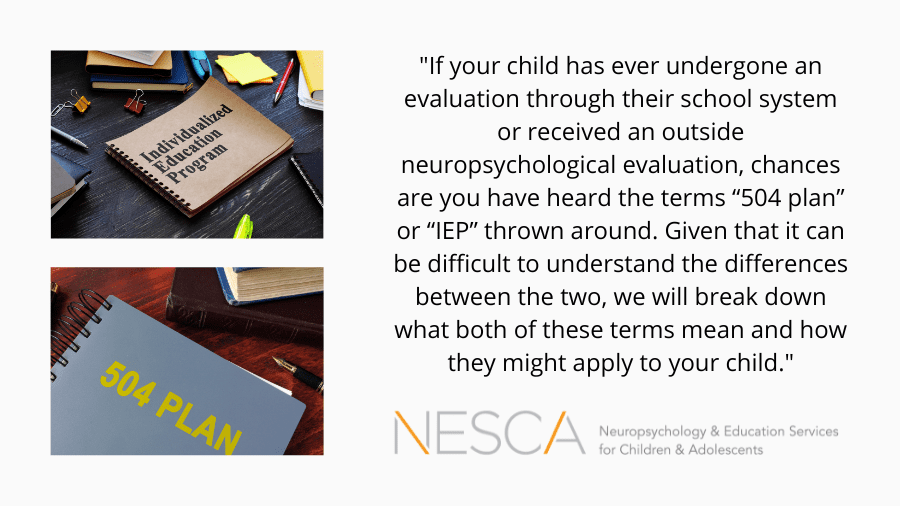
If your child has ever undergone an evaluation through their school system or received an outside neuropsychological evaluation, chances are you have heard the terms “504 plan” or “IEP” thrown around. Given that it can be difficult to understand the differences between the two, we will break down what both of these terms mean and how they might apply to your child.

What is an IEP?

IEP stands for Individualized Education Program and provides specialized instruction, program modification, and accommodations through the public school system based on a student’s disability and how it impacts access to the curriculum. IEPs must include:

  • Annual goals that are measurable via benchmarks
  • Progress reports of the student’s current performance
  • Descriptions of how services will be provided
  • Outlined transition services as the child ages

In addition, IEPs must detail what academic environment would be the least restrictive, and therefore, most suitable for the student to appropriately access the educational curriculum.

Who is eligible for an IEP?

In order to qualify for an IEP, students must receive an evaluation either through the school system or through an outside provider that outlines the student’s disability status and how it negatively impacts accessing the educational curriculum. Importantly, a diagnosed disability is not enough to quality for an IEP on its own. Instead, the disability must be impacting the student’s ability to make effective progress in the general education program, which includes both academic and non-academic offerings of the district. Some examples of qualifying diagnoses include (but are not limited to):

  • Autism
  • Emotional Disturbance
  • Intellectual Disability
  • Specific Learning Disability

A parent or caregiver may ask what happens if  their child has a diagnosed disability but does not require special education services? Instead, the team may determine, through the eligibility process, that the student only requires accommodations, such as extended time on tests.

This is a perfect example of when a student might not qualify for an IEP and would instead be considered for a 504 plan. Simply put, IEPs and 504 plans both provide accommodations; however, 504 plans do NOT provide for specialized instruction or program modifications.

 What is a 504 plan?

A 504 plan is referred to as such because it is covered under Section 504 of a federal civil rights law called the Rehabilitation Act. This law works to ensure that students receive appropriate supports and accommodations within the academic setting. 504 plans outline accommodations for students which can include some of the following (but again, accommodations are not limited to the following):

  • Preferential seating
  • Extended time on tests and quizzes
  • Reduced distraction testing environments
  • Access to class notes
  • The use of a calculator during exams

As you can see, none of these accommodations is modifying the curriculum or providing a student with educational services as would be the case with an IEP.

Who is eligible for a 504 plan?

Any student with a disability impairing functioning in one or more areas is eligible for a 504 plan. One common example would be a student with diagnosed Attention Deficit Hyperactivity Disorder (ADHD) who requires distraction-reduced testing environments and/or other associated accommodations but does NOT require specialized academic instruction.

Another example is a parent of a child with an autism spectrum diagnosis may find that their child was found to be ineligible for an IEP through the special education eligibility determination process. Shouldn’t the student qualify for an IEP based on the autism disability?

The answer is not necessarily. If a student has a diagnosis of autism but is showing no signs of impairment within the academic setting (i.e., making appropriate academic progress, showing no signs of emotional distress, doing well with their peers, etc.), an IEP would not be warranted. Instead, a 504 plan would likely be considered (but again, is not guaranteed if academic functioning is not impaired).

If you feel your child requires a 504 plan or IEP and you are not sure where to start, contact your child’s special education program at their school. You may also wish to consult with an educational advocate or attorney who has a thorough understanding of special education laws.

References:

Massachusetts Department of Elementary and Secondary Education. (2018, June 29). Education Laws and Regulations. 603 CMR 28.00: Special Education – Education Laws and Regulations. Retrieved August, 2022, from https://www.doe.mass.edu/lawsregs/603cmr28.html?section=05

Massachusetts Department of Elementary and Secondary Education. (2014, July 14). Section 504 and the Americans with disabilities act. Section 504 – Special Education. Retrieved August, 2022, from https://www.doe.mass.edu/sped/links/sec504.html


About the Author

Dr. Miranda Milana provides comprehensive evaluation services for children and adolescents with a wide range of concerns, including attention deficit disorders, communication disorders, intellectual disabilities, and learning disabilities. She particularly enjoys working with children and their families who have concerns regarding an autism spectrum disorder. Dr. Milana has received specialized training on the administration of the Autism Diagnostic Observation Schedule (ADOS).

Dr. Milana places great emphasis on adapting her approach to a child’s developmental level and providing a testing environment that is approachable and comfortable for them. She also values collaboration with families and outside providers to facilitate supports and services that are tailored to a child’s specific needs.

Before joining NESCA, Dr. Milana completed a two-year postdoctoral fellowship at Boston Children’s Hospital in the Developmental Medicine department, where she received extensive training in the administration of psychological and neuropsychological testing. She has also received assessment training from Beacon Assessment Center and The Brenner Center. Dr. Milana graduated with her B.A. from the University of New England and went on to receive her doctorate from William James College (WJC). She was a part of the Children and Families of Adversity and Resilience (CFAR) program while at WJC. Her doctoral training also included therapeutic services across a variety of settings, including an elementary school, the Family Health Center of Worcester and at Roger Williams University.

Dr. Milana grew up in Maine and enjoys trips back home to see her family throughout the year. She currently resides in Wrentham, Massachusetts, with her husband and two golden retrievers. She also enjoys spending time with family and friends, reading, and cheering on the Patriots, Bruins, Red Sox, and Celtics.​


Neuropsychology & Education Services for Children & Adolescents (NESCA) is a pediatric neuropsychology practice and integrative treatment center with offices in Newton, Massachusetts, Plainville, Massachusetts, and Londonderry, New Hampshire, serving clients from preschool through young adulthood and their families. For more information, please email info@nesca-newton.com or call 617-658-9800.


To book an appointment with Dr. Miranda Milana, please complete our Intake Form today. For more information about NESCA, please email info@nesca-newton.com or call 617-658-9800.


Are We Working With a Full Deck of Cards? Why Neuropsychologists Want Results from Previous Evaluations

By | NESCA Notes 2022

By: Moira Creedon, Ph.D. 
Pediatric Neuropsychologist, NESCA

Neuropsychological testing is a tremendous undertaking in time and effort for a family. It involves intake documents, questionnaires, financial paperwork, insurance information, teacher forms, and the list goes on. I promise this paperwork is meaningful and helpful, a way to get the most out of the time and investment in a neuropsychological evaluation. Over the next few weeks, several of NESCA’s neuropsychologists will tackle a few common questions that we face that will help you prepare for neuropsychological testing.

The first topic to tackle relates to the need for previous records. It can feel time consuming to track down documents from years ago, particularly if your child has grown and changed over time. There are many reasons why it is critical to provide these records so your provider has the full deck of cards as they build an individualized evaluation for your child. I’ll tackle the three most important reasons to me:

First, pediatric neuropsychologists want to understand the development of your child over time. For example, if we are evaluating learning problems, I want to know what it was like in kindergarten and early elementary school when your child learned to read. I want to know when the attention problems started or problems interacting with peers were first noticeable to those around them. As we build a developmental timeline, it can help to conceptualize where it all began to help us get at the magical “root cause” that parents often seek. Understanding development over time also helps us to build a better treatment plan. For example, if I can see that a child struggled to develop early reading skills and then years later is extremely anxious about attending school, it helps guide recommendations in both domains.

Secondly, records are critical so we do not risk “practice effects.” “Practice effects” refer to the improvement in scores that happens simply from being exposed to the task before. While guidelines are not as set in stone as some may think, it is generally advised not to repeat many neuropsychological measures within a year of testing. There may be reasons to speed up this timeline that are client-specific, but we cannot make that determination unless we see the documents. Research says practice effects diminish over a few months to a year. We want to eliminate any interfering factors that would make it harder to draw conclusions about the data in the current evaluation. With the time and investment you make in testing as a parent, I can only imagine how frustrating it would feel to hear that something we can manage interfered with the process. Access to records helps us to choose the right measures for the right moment.

Thirdly, providing previous records also allows us to track skill development over time. This is particularly important if we want to see if an intervention (e.g., reading instruction, therapy, attending social skill groups) is working to build the skills. Put simply, it tells us if a problem is getting better or getting worse. Even if you do not agree with the final conclusions drawn by the previous professional, the scores still provide critical data points in development. For more information on seeking a second opinion when you disagree with results, sit tight – that blog post is coming!

I often use the metaphor with kids and families that neuropsychological testing can help us to develop a type of “instructional manual” for how their brain works. With younger kids, I tell them that I am writing the LEGO instructional manual for which steps to take in what order and with what pieces. Without the prior records, I’m missing a bag of pieces. That is almost as frustrating as stepping on the actual LEGOs!

Please come back over the next several weeks to hear more from my colleagues about how to make the most of your child’s neuropsychological evaluation!


About the Author

Dr. Creedon has expertise in evaluating children and teens with a variety of presenting issues. She is interested in uncovering an individual’s unique pattern of strengths and weaknesses to best formulate a plan for intervention and success. With experiences providing therapy and assessments, Dr. Creedon bridges the gap between testing data and therapeutic services to develop a clear roadmap for change and deeper of understanding of individual needs.
 

If you are interested in booking an evaluation with Dr. Creedon or another NESCA neuropsychologist, please fill out and submit our online intake form


Neuropsychology & Education Services for Children & Adolescents (NESCA) is a pediatric neuropsychology practice and integrative treatment center with offices in Newton and Plainville, Massachusetts, and Londonderry, New Hampshire, serving clients from preschool through young adulthood and their families. For more information, please email info@nesca-newton.com or call 617-658-9800.

Managing Stress while Navigating the Initial IEP Referral Process

By | NESCA Notes 2022

By: Angela Currie, Ph.D.
Pediatric Neuropsychologist, NESCA
Director of Training and New Hampshire Operations

The special education process is naturally stressful, particularly when submitting a first request for eligibility. It is difficult to watch your child struggle in school, and while the IEP process may bring hope for things improving, there are complex procedures and timelines, as well as feelings of anxiety and uncertainty, that must first be navigated. Luckily, there are some things that families can do to help manage the stress that comes with the IEP eligibility process:

  • Acknowledge from the onset that the process will be stressful and that stress is okay. Stress is telling you that something is important and requires your attention. Try to accept stress as part of the process and use that to help prepare yourself.
  • Build a team. Allow yourself to just be the caregiver, and find professionals who can take on other duties. This may include hiring an educational advocate or attorney who can help you understand special education laws as well as advocate for your child’s needs at meetings. This may also include seeking a private evaluation to obtain an expert opinion on your child’s needs and inviting this individual to participate in the meeting. The goal is to divide responsibilities, focus on your child, and speak to your concerns as the caregiver.
  • If you had an evaluation and are working through a new diagnosis, take in information at a pace that you can handle. Ask your evaluator for clarifying information when needed, and try to reduce your Googling and online research. Do not get yourself stuck in a rabbit hole of online information that may or may not pertain to your child. If you feel uncertain about things, use your team and ask questions.
  • Maintain effective communication with your IEP team. Know your goal for each meeting and plan your input ahead of time. Be concise but include observations or history to support your point, and state your specific goals for each meeting.
  • Manage your expectations. Concerns and requests may not be entirely resolved within one meeting, and there may be many steps you have to go through before a plan is in place.
  • For children who “fly under the radar” at school, take some basic notes of what you observe at home, such as difficulty with homework, “meltdowns” after school, etc., which you can share with the team. That said, only take these notes for a manageable time frame (e.g., two weeks), allowing you to maintain your sanity.
  • Lastly, engage in self-care. While this may sound cliché, it is indeed important to take time to yourself and do activities that bring you some peace and enjoyment while navigating through these stressful procedures.


About the Author

Dr. Angela Currie is a pediatric neuropsychologist at NESCA. She conducts neuropsychological and psychological evaluations out of our Londonderry, NH office. She specializes in the evaluation of anxious children and teens, working to tease apart the various factors lending to their stress, such as underlying learning, attentional, or emotional challenges. She particularly enjoys working with the seemingly “unmotivated” child, as well as children who have “flown under the radar” for years due to their desire to succeed.
 

To book an evaluation with Dr. Currie or one of our many other expert neuropsychologists, complete NESCA’s online intake form. Indicate whether you are seeking an “evaluation” or “consultation” and your preferred clinician in the referral line.


Neuropsychology & Education Services for Children & Adolescents (NESCA) is a pediatric neuropsychology practice and integrative treatment center with offices in Londonderry, NH, Plainville, MA, and Newton, MA serving clients from preschool through young adulthood and their families. For more information, please email info@nesca-newton.com or call (603) 818-8526.

Avoiding Burn-out

By | NESCA Notes 2022

By: Moira Creedon, Ph.D. 
Pediatric Neuropsychologist, NESCA

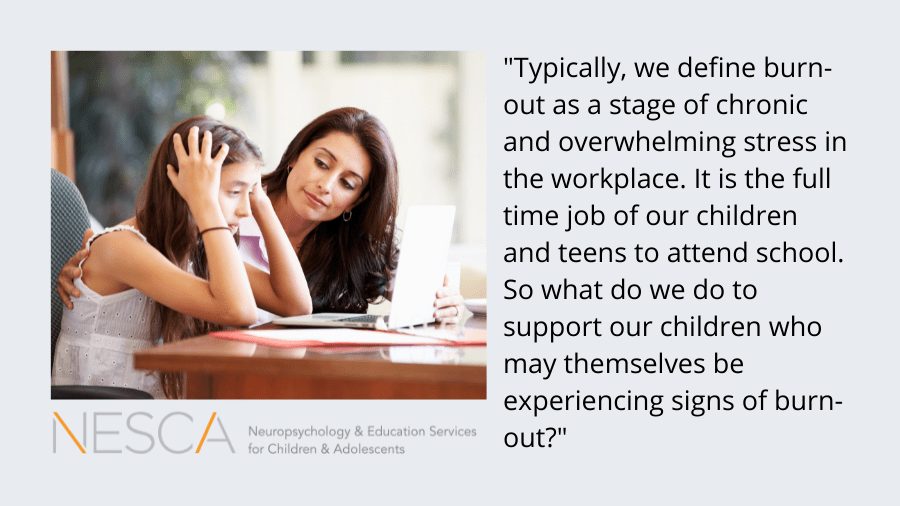
We have hit our third calendar year of COVID. It’s season 3 of this drama series during our Junior Year of COVID. As my colleagues in front line health care discuss ways to avoid burn-out in this lengthy experience, it’s inspired me to think of ways for our kids and teens to avoid burn-out. Typically, we define burn-out as a stage of chronic and overwhelming stress in the workplace. It is the full time job of our children and teens to attend school. So what do we do to support our children who may themselves be experiencing signs of burn-out?

First, let’s understand some signs of burn-out, including:

  • A sense of fatigue or low energy to engage with school or personal activities
  • A sense of “distance” from school, which can include statements such as, “I don’t care,” or withdrawal from activities
  • Negative feelings about school or academic achievement, which can sometimes look like irritability and hatred of school
  • Doubts that school is “worth it” or a sense that what is learned in school is never applicable to real life
  • Reduced efficiency so that tasks take far longer than usual

Given the constant stress of close contact notifications, masking requirements, fears of infection, and disappointment about canceled activities (to name a few), it is not surprising that kids may feel this sense of burn-out. Let’s consider 5 tips to support children and teens with a sense of burn out:

  1. Give it a name. It might feel like a relief to recognize and label the experience for children and teens. Giving the experience the name of “burn-out” can provide some distance from the problem, rather than feeling consumed by it.
  2. Practice mindfulness. It can be easy to get caught up considering the “before-COVID” good old days. It can also be hard to imagine the uncertain future and when one might get to the other side. Practice focusing on this moment of this day. Encourage children to notice any physical signs of stress in their bodies. These moments can pass as the sensation is not permanent. Using meditation and deep breathing can help children to stay rooted in the present moment.
  3. Manage the calendar. It is easy to feel overwhelmed by due dates, projects, and additional activities. As a parent, this may mean that you will have to take over as the “gate keeper” of the calendar. Help to prioritize the necessary and eliminate what is not needed. Protect personal time carefully so that school tasks do not consume all areas of the weekend.
  4. Practice self-care. Self-care can look different for everyone – from vigorous physical activity for one teen to a day of relaxation for another. Encourage discussion about what your child might need and consider ways to change up the ordinary. For example, consider assigning a “home spa day” of relaxation or a warm bath. Consider outside activities for the active child who needs to run or exercise to feel good. Sleep, exercise, and good nutrition are critical ways to care for our bodies when facing chronic stress.
  5. Leave room for the fun. When school feels boring or challenging for children, it can be hard to motivate children and remain committed. Work with your child to identify a staff member or friend who they look forward to seeing. Consider an after-school activity that sparks joy so there is something to look forward to at the end of the day.


About the Author

Dr. Creedon has expertise in evaluating children and teens with a variety of presenting issues. She is interested in uncovering an individual’s unique pattern of strengths and weaknesses to best formulate a plan for intervention and success. With experiences providing therapy and assessments, Dr. Creedon bridges the gap between testing data and therapeutic services to develop a clear roadmap for change and deeper of understanding of individual needs.


If you are interested in booking an evaluation with Dr. Creedon or another NESCA neuropsychologist, please fill out and submit our online intake form


Neuropsychology & Education Services for Children & Adolescents (NESCA) is a pediatric neuropsychology practice and integrative treatment center with offices in Newton and Plainville, Massachusetts, and Londonderry, New Hampshire, serving clients from preschool through young adulthood and their families. For more information, please email info@nesca-newton.com or call 617-658-9800.

Why Does My Child Have to Read 20 Minutes Per Night After Being in School All Day?

By | NESCA Notes 2021

By: Alissa Talamo, PhD
Pediatric Neuropsychologist, NESCA

Reading 20 minutes per day has been shown to have many positive benefits. Did you know…?

  • Children who read 20 minutes a day/5 days a week are exposed to 1.8 million words in one school year. Compare this to students who read 5 minutes per day – they will be exposed to 282,000 words per school year.
  • Reading helps foster empathy – a child experiences “walking in someone else’s shoes.”
  • Children are exposed to different ideas and cultures.
  • Reading also improves critical thinking.
  • Reading increases knowledge of correct syntax and grammar, along with robust vocabulary knowledge, resulting in improved writing skills.
  • Students who read 20 minutes per day score significantly higher on standardized tests of reading.
  • Reading with your child, or having them read independently before bed, can help them to relax and wind down from their day.

It is important to recognize that despite all our good intentions, sometimes students are reluctant to read on their own. This reluctance can come from different reasons, such as difficulty reading, not yet knowing the types of books they would enjoy, or even that they would simply rather be playing video games or be on social media. To help make reading more attractive to your child, there are several things you can try:

  • Let the child choose what they are reading – help them find books that are about an area of high interest to them (anything from sports to fashion to history – all is fair game!).
  • If the book they are interested in is above their reading level, you can read to them (model the page) and then have them read it back to you.
  • Allow them access to audio books, and they can follow along with the text.
  • Encourage different types of reading material (comics, graphic novels, magazines, traditional books, etc.).
  • Look for book series – once they enjoy one, they will often want to read the rest!

Getting your child to read is not always easy. However, allowing them to read high interest material, asking them questions to help them interact with the text, and modeling that reading can be fun is a great start!

If your child demonstrates difficulties improving their reading skills, reach out to their teacher and discuss if there are any underlying concerns (visual issues, such as difficulty tracking; reading challenges, such as reduced phonemic awareness, etc.). If you continue to have concerns, consider having your child evaluated by a reading specialist or pediatric neuropsychologist to ensure that such an important skill is supported and developed as your child continues through school and beyond.

Sources

https://www.honorsgradu.com/importance-of-reading-20-minutes-a-day/

The Surprising Benefits of Reading 20 Minutes a Day

https://www.k12reader.com/why-read-20-minutes-a-day/

https://www.understood.org/articles/en/14-ways-to-encourage-your-grade-schooler-to-read


About the Author

With NESCA since its inception in 2007, Dr. Talamo had previously practiced for many years as a child and adolescent clinical psychologist before completing postdoctoral re-training in pediatric neuropsychology at the Children’s Evaluation Center.

After receiving her undergraduate degree from Columbia University, Dr. Talamo earned her doctorate in clinical health psychology from Ferkauf Graduate School of Psychology and the Albert Einstein College of Medicine at Yeshiva University.

She has given a number of presentations, most recently on “How to Recognize a Struggling Reader,” “Supporting Students with Working Memory Limitations,” (with Bonnie Singer, Ph.D., CCC-SLP of Architects for Learning), and “Executive Function in Elementary and Middle School Students.”

Dr. Talamo specializes in working with children and adolescents with language-based learning disabilities including dyslexia, attentional disorders, and emotional issues. She is also interested in working with highly gifted children.

Her professional memberships include MAGE (Massachusetts Association for Gifted Education), IDA (International Dyslexia Association), MABIDA (the Massachusetts division of IDA) and MNS (the Massachusetts Neuropsychological Society).

She is the mother of one teenage girl.


To book a consultation with Dr. Talamo or one of our many other expert neuropsychologists, complete NESCA’s online intake form.

Neuropsychology & Education Services for Children & Adolescents (NESCA) is a pediatric neuropsychology practice and integrative treatment center with offices in Newton, Massachusetts, Plainville, Massachusetts, and Londonderry, New Hampshire, serving clients from preschool through young adulthood and their families. For more information, please email info@nesca-newton.com or call 617-658-9800.

Going with the Flow

By | NESCA Notes 2021

By Dot Lucci, M.Ed., CAGS
Director of Consultation and Psychoeducational Services, NESCA

It’s September, and a new school year has already begun for most children. We had hoped that Covid would be behind us and the start of this school year would begin with a greater semblance of the old normal. Sigh…it has not. We are still wearing masks, keeping our distance and washing hands amongst other health considerations. Many students are eager to get back to school and in-person learning even though they have to wear masks. Many are accustomed to it, and it is no big deal. However, there are those students who preferred virtual learning and have grown more and more anxious at the thought of going back to in-person learning.

Back at the start of the pandemic, I wrote a blog about going with the flow, and it seemed appropriate to reintroduce the topic again as we start another school year still with so much uncertainty. Will there be outbreaks of the new variants at school? Will there be quarantines happening again? Will someone in my family, class, school get sick and how serious will it be?  We don’t know the answers to these questions, and worrying about them doesn’t help us be in the moment. In Bostonia’s current cover piece, “The kids are stressed, anxious, lonely, struggling, learning, grateful, adapting, alright,” Eric Moskowitz summed it up accurately. What researchers found is that children who were at a disadvantage before the pandemic suffered the most – which is not surprising – yet overall kids are resilient.

In  Angela Currie’s recent blog, “Helping Students Transition Back to School,” she covers the essentials of establishing bed time/morning routines, connecting with teachers, mask wearing routines and many more. I would like to add to her list with the psychological, social and emotional routines and ways of being that will also make the transition smoother.

Education Week offers a few social-emotional checklists that are good to review to help you set your student off on the right foot as they start this school year.

  • First check in with yourself and your own emotions/feelings. If you are feeling anxious, do something to help calm your emotions and gain some centeredness. Take care of yourself so you can take care of others.
  • Establish those all so important sleep, eating and exercise routines.
  • Establish a calming routine that the family can do together for a few minutes (i.e., yoga, mindful minute, deep breathing, etc.).
  • Acknowledge the breadth of feelings your child may have and how rapidly they may change. Point this out to him/her when they are calm. Introduce the realization that thoughts are connected to feelings, and they can change their thoughts to help their feelings change. Be understanding, supportive and empathetic yet also encourage your student to use their “past data” to support their progress forward through their feelings.
  • As Angela said, establish routines and predictability at home but also model and help your child know that things don’t always go as planned. Have routines yet be flexible, adaptable and a “go with the flow” mindset will be essential as s/he enters this school year. There are always Plans B, C, and D when Plan A doesn’t work. For instance, you may insist your child wear a mask and another child in his class, or afterschool activity/sport, may not. Preview this possible scenario so your child can adept and accept. Or, a student starts the year in-person, but then hybrid (hopefully not) happens…again. You get the idea about teaching flexibility.
  • Stay positive even in the midst of uncertainty, as this helps create the right biochemical mix that allows you to think more clearly.
  • Be aware of your thoughts and help your child be aware of their thoughts. Thoughts influence our mood, feelings and behavior, and we can exert control over them.
  • Be grateful (end the night with a gratitude moment).
  • Be supportive. Acknowledge the efforts, tasks, feelings, etc. that your kids are taking on and experiencing. It helps them develop self-confidence, self-esteem, self-efficacy, pride and a sense of competence.
  • Be hopeful. Yesterday is history (don’t dwell there), tomorrow is a mystery (don’t worry about it) and today is a gift (even if you don’t feel like it is). Be present and allow whatever feelings come up (positive or negative) to flow through you so you can make way for new feelings.

Wishing everyone a smooth start to the 2021-2022 school year, and may the force be with us as we continue to combat Covid.

Resources

https://www.bu.edu/bostonia/

https://www.edweek.org/leadership/preparing-for-in-person-learning-a-covid-19-checklist-for-parents/2021/08?utm_source=nl&utm_medium=eml&utm_campaign=eu&M=63136722&U=1970318&UUID=f2e19d19dbb5bd4e92068a32311b141c


About the Author

NESCA’s Director of Consultation and Psychoeducational Services Dot Lucci has been active in the fields of education, psychology, research and academia for over 30 years. She is a national consultant and speaker on program design and the inclusion of children and adolescents with special needs, especially those diagnosed with Autism Spectrum Disorder (ASD). Prior to joining NESCA, Ms. Lucci was the Principal of the Partners Program/EDCO Collaborative and previously the Program Director and Director of Consultation at MGH/Aspire for 13 years, where she built child, teen and young adult programs and established the 3-Ss (self-awareness, social competency and stress management) as the programming backbone. She also served as director of the Autism Support Center. Ms. Lucci was previously an elementary classroom teacher, special educator, researcher, school psychologist, college professor and director of public schools, a private special education school and an education collaborative.

Ms. Lucci directs NESCA’s consultation services to public and private schools, colleges and universities, businesses and community agencies. She also provides psychoeducational counseling directly to students and parents. Ms. Lucci’s clinical interests include mind-body practices, positive psychology, and the use of technology and biofeedback devices in the instruction of social and emotional learning, especially as they apply to neurodiverse individuals.


To book a consultation with Ms. Lucci or one of our many expert neuropsychologists, complete NESCA’s online intake form. Indicate whether you are seeking an “evaluation” or “consultation” and your preferred clinician/consultant in the referral line.


Neuropsychology & Education Services for Children & Adolescents (NESCA) is a pediatric neuropsychology practice and integrative treatment center with offices in Newton, Massachusetts, Plainville, Massachusetts, and Londonderry, New Hampshire, serving clients from preschool through young adulthood and their families. For more information, please email info@nesca-newton.com or call 617-658-9800.


Rating Scales/Questionnaires – Why Do We Give Them and Why Do They Matter?

By | NESCA Notes 2021

By Yvonne M. Asher, Ph.D. 
Pediatric Neuropsychologist

When you request a neuropsychological evaluation, you are undoubtably inundated with paperwork. Consent forms, confidentiality forms, COVID forms, and credit card forms. Then, to your surprise, you bring your child to their first appointment, and the neuropsychologist hands you…more forms! Why? What are these forms for, and what will you do with the information? These are great questions, and always feel free to ask your neuropsychologist. Here are some answers I give when I am asked:

Why do you need so many forms?

Our goal in completing a neuropsychological evaluation is to have as comprehensive picture of a child as possible. This means gathering information from many sources, including what you and/or others are noticing that is raising concerns (what we discuss in the intake appointment), prior evaluations and documentation (e.g., their IEP, testing done at school), your child’s performance on our assessment measures (what they do when they come to the office), and important people’s perceptions of your child’s functioning in daily settings – this is what we assess through the rating scales (also called questionnaires). The parent/teacher rating scales are an important source of information because they not only capture your concerns, but also show us how your concerns may be similar to or different from parents (or teachers) of same-age children. For example, concerns with “attention and focus” are common for us to hear. Attentional skills develop gradually over time, and having a standardized rating scale that evaluates your concerns (or your child’s teacher’s concerns) with attention helps us understand how far off your child’s skills are from what is expected for their age.

What do the forms ask about?

This depends on why your child is being referred for a neuropsychological evaluation. For example, if your child is referred for a question around autism, you will likely be given forms that ask about their social functioning, such as how they do at playdates, birthday parties, the playground, or other community spaces with peers. Your child’s teacher would also likely be given forms to evaluate how your child interacts with peers at school, such as how they do during lunch, snack, and recess; how well they work in groups; and if they have been successful in forming strong friendships. If the concerns are more related to mental health, you may be given forms that ask about their symptoms of anxiety, depression, etc.

What will you do with the forms?

We will take your ratings (or your child’s teacher’s ratings) and compare them to normative data. This is a fancy way of saying “we will see how your child compares to kids their age.” Then, we will take that information to help us form a more comprehensive picture of your child’s profile and our recommendations for how to best help and support them. For example, something I see often is a concern with kids following directions, remembering what they are told to do, and finishing all the steps necessary for a task or project (e.g., getting ready for school or bed). This can be (though certainly isn’t always) a difficulty with working memory or, holding information in mind. We assess working memory in many ways during testing. However, we can’t always see the deficits that parents and teachers see, because testing is inherently different from “real life.” So, rating scales serve as an important source of information in understanding what is going on day-to-day, which helps us to make more comprehensive recommendations.

How do I fill these out?

Please, please, please – read the directions carefully! Each form is meant to evaluate something different. For example, some ask you about your child’s emotional state “in general,” others ask about how they have been behaving over the last two weeks, and others ask about how well they can complete tasks independently (i.e., without any help or guidance). Do your best to complete each question – skipping questions that seem “irrelevant” or “inappropriate” may impact how well we can use the information later on. We realize that not every question will apply to every child – we are using the best tools we have, and some are designed to assess a wide range of children. If you have questions about the wording or phrasing, please ask your neuropsychologist – we really don’t mind!

I have a teenager. Why don’t you just ask them about how they are feeling?

If your child is old enough, we will absolutely talk to them about their perceptions of what is going on, what their concerns are, and what has been helpful for them. Many rating scales have a “child” or “self-report” version, and we may have them complete those, in addition to talking more conversationally about how they are doing.


About the Author

Dr. Yvonne M. Asher enjoys working with a wide range of children and teens, including those with autism spectrum disorder, developmental delays, learning disabilities, attention difficulties and executive functioning challenges. She often works with children whose complex profiles are not easily captured by a single label or diagnosis. She particularly enjoys working with young children and helping parents through their “first touch” with mental health care or developmental concerns.

Dr. Asher’s approach to assessment is gentle and supportive, and recognizes the importance of building rapport and trust. When working with young children, Dr. Asher incorporates play and “games” that allow children to complete standardized assessments in a fun and engaging environment.

Dr. Asher has extensive experience working in public, charter and religious schools, both as a classroom teacher and psychologist. She holds a master’s degree in education and continues to love working with educators. As a psychologist working in public schools, she gained invaluable experience with the IEP process from start to finish. She incorporates both her educational and psychological training when formulating recommendations to school teams.

Dr. Asher attended Swarthmore College and the Jewish Theological Seminary. She completed her doctoral degree at Suffolk University, where her dissertation looked at the impact of starting middle school on children’s social and emotional wellbeing. After graduating, she completed an intensive fellowship at the MGH Lurie Center for Autism, where she worked with a wide range of children, adolescents and young adults with autism and related disorders.


Neuropsychology & Education Services for Children & Adolescents (NESCA) is a pediatric neuropsychology practice and integrative treatment center with offices in Newton, Massachusetts, Plainville, Massachusetts, and Londonderry, New Hampshire, serving clients from preschool through young adulthood and their families. For more information, please email info@nesca-newton.com or call 617-658-9800.


To book an appointment with Dr. Yvonne Asher, please complete our Intake Form today. For more information about NESCA, please email info@nesca-newton.com or call 617-658-9800.


Dealing with End of the School Year Uncertainty

By | NESCA Notes 2021

By: Angela Currie, Ph.D.
Pediatric Neuropsychologist, NESCA
Director of Training and New Hampshire Operations

The end of the school year can bring a lot of emotions, such as excitement for summer activities, sadness about closing relationships, and anxiety related to change. Often, children are experiencing these mixed emotions without truly understanding them. The end of this particular school year may bring some unique emotions, as it is the second consecutive ending that “looks different,” be it because students were remote for all or some of the year, class parties and field days are not happening, or children cannot give their teacher an end of the year hug. The loss of such traditions may cause kids to feel a lack of closure. Further, this transition is happening at a time when the world is starting to change again. While the loosening of restrictions and return to a semblance of “normal” may be positive for most, children may not know how to cope with all of this simultaneous change.

Here are some tips for things that adults can do to help children cope with what may be a difficult or uncertain end to the current school year:

  • Watch for signs that your child may be struggling with this transition. This may include new sleep difficulties, low frustration tolerance, heightened emotions, meltdowns, reduced appetite, loss of interest, etc.
  • Talk about their feelings related to the end of the year in an open and responsive manner, validating their emotions (e.g., “I can see why that would make you feel sad,” rather than accidentally dismissing them (e.g., “Don’t worry.”).
  • Help provide some closure with their teacher, such as writing a card or letter about what they enjoyed, learned, or overcame together this year.
  • Using artwork or journaling, help your child reflect on their development, accomplishments, and experiences this past year.
  • Create a plan for how they can stay in touch with friends over the summer and schedule some specific playdates or events to reduce worry about losing touch.
  • Maintain your basic schedule, such as morning and bedtime routines.
  • To reduce worry related to uncertainty, provide some age-appropriate opportunities to feel a sense of control, such as allowing your child to design a new daily schedule for “home days,” choose individual or family activities, etc.

The end of any school year provides a great opportunity to teach children about transition and change. We can teach them that it is okay to celebrate their accomplishment while also simultaneously feeling discomfort about what is to come and sadness about saying goodbye. Particularly during a year that has been marked by adversity, learning how to recognize, “sit with,” and manage these mixed emotions will help to build resiliency for the future.


About the Author

Dr. Angela Currie is a pediatric neuropsychologist at NESCA. She conducts neuropsychological and psychological evaluations out of our Londonderry, NH office. She specializes in the evaluation of anxious children and teens, working to tease apart the various factors lending to their stress, such as underlying learning, attentional, or emotional challenges. She particularly enjoys working with the seemingly “unmotivated” child, as well as children who have “flown under the radar” for years due to their desire to succeed.


To book an evaluation with Dr. Currie or one of our many other expert neuropsychologists, complete NESCA’s online intake form. Indicate whether you are seeking an “evaluation” or “consultation” and your preferred clinician in the referral line.


Neuropsychology & Education Services for Children & Adolescents (NESCA) is a pediatric neuropsychology practice and integrative treatment center with offices in Londonderry, NH, Plainville, MA, and Newton, MA serving clients from preschool through young adulthood and their families. For more information, please email info@nesca-newton.com or call (603) 818-8526.

There Is No Wrong Decision

By | NESCA Notes 2020

By:  Alissa Talamo, Ph.D.
Pediatric Neuropsychologist

We are living in an unprecedented time. As such, parents are faced with decisions that they have never faced before. For example, families are facing the challenging decision about whether or not to send their children back to school for in-person classes in the middle of the COVID-19 pandemic. Parents have to wrestle with the idea that, on the one hand, sending children to school could increase the risk of COVID-19 among children and family members; while on the other hand, children who don’t return to in-person school may experience disruptions in their education and may miss out on the social interaction and community feeling within the school building. In addition, some families simply don’t have a choice because they need to go to work or a family member at home is immunocompromised.

What is most important is to recognize is that whether or not to send a child to school in the fall means something different to everybody. It is imperative that, as parents, you give yourself permission to feel whatever it is that you are feeling, and that you do what feels right for you and your family. It may be difficult to accept, but we have little control over much of what is happening around us right now. While it is important to acknowledge how you are feeling, it is equally important to remember that, in fact, any reactions are normal under the current circumstances.

How you respond to stress during the COVID-19 pandemic can depend on your background, your financial situation, your health and emotional background, your social support system, the community you live in and many other factors. When it comes to parenting, every day can be a challenge, and the coronavirus has made an already scary world feel even more menacing.  Remember to “ignore the noise” and give yourself credit for taking care of yourself and your family.


About the Author:

With NESCA since its inception in 2007, Dr. Talamo had previously practiced for many years as a child and adolescent clinical psychologist before completing postdoctoral re-training in pediatric neuropsychology at the Children’s Evaluation Center.

After receiving her undergraduate degree from Columbia University, Dr. Talamo earned her doctorate in clinical health psychology from Ferkauf Graduate School of Psychology and the Albert Einstein College of Medicine at Yeshiva University.

She has given a number of presentations, most recently on “How to Recognize a Struggling Reader,” “Supporting Students with Working Memory Limitations,” (with Bonnie Singer, Ph.D., CCC-SLP of Architects for Learning), and “Executive Function in Elementary and Middle School Students.”

Dr. Talamo specializes in working with children and adolescents with language-based learning disabilities including dyslexia, attentional disorders, and emotional issues. She is also interested in working with highly gifted children.

Her professional memberships include MAGE (Massachusetts Association for Gifted Education), IDA (International Dyslexia Association), MABIDA (the Massachusetts division of IDA) and MNS (the Massachusetts Neuropsychological Society).

She is the mother of one teenage girl.

To book a consultation with Dr. Talamo or one of our many other expert neuropsychologists, complete NESCA’s online intake form.

Neuropsychology & Education Services for Children & Adolescents (NESCA) is a pediatric neuropsychology practice and integrative treatment center with offices in Newton, Massachusetts, Plainville, Massachusetts, and Londonderry, New Hampshire, serving clients from preschool through young adulthood and their families. For more information, please email info@nesca-newton.com or call 617-658-9800.

Skip to content