NESCA’s Londonderry, NH location has immediate availability for neuropsychological evaluations. Our NH clinicians specialize in the following evaluations: Neuropsychological; Autism; and Emotional and Psychological, as well as Academic Achievement and Learning Disability Testing. Our NH clinicians also conduct evaluations for students who are at boarding schools, and two of our NH clinicians have PsyPACT authorization, allowing them to conduct evaluations out-of-state.

Visit www.nesca-newton.com/intake for more information or to book an evaluation.

Category

NESCA Notes 2020

Subscribe to NESCA Notes

Sensory and Motor Strategies to Support Online Learning

By | NESCA Notes 2020

By: Julie Robinson, OT

Director of Clinical Services; Occupational Therapist, NESCA

For many families, this spring’s experience of remote learning and receiving integrated services was challenging, to say the least. As parents begin to think about their children returning to school this fall questions and concerns arise, not only about regression, but also how they will keep their children engaged in online learning.

For children with sensory processing difficulties and/or motor delays, there may be additional challenges in participating in Zoom classes and remote group learning. Some may have difficulty sustaining their attention, settling their body down to sit in front of a screen, managing the visual challenges of a screen, engaging socially or transitioning from a desired task to an academic one. Below are some suggested strategies, from an OT perspective, that may help your child participate in academics with less stress.

Regulation Strategies

The term “regulation” refers to someone’s ability to match their level of alertness (or arousal) to the environment and an activity. Throughout the day, our brain and our bodies are working to either increase or decrease our arousal levels for us to feel regulated and feel “just right” for the situation.

Sometimes children may have trouble with regulating themselves, causing them to experience dysregulation. Dysregulation can look very different depending on the child and can present as low levels of arousal or high level of arousal. This state may make it challenging for the child to be engaged and participate in certain activities, such as online learning. Sensory strategies are ways to help a child either increase arousal or lower arousal to match the needs of the task of online learning.

If a child is experiencing a low level of arousal, or their engine is running low, they should use a sensory strategy to help feel more alert. These include activities that have fast movement and increase heart rate. Taking movement breaks throughout the day is key! This could mean:

  • Jumping Jacks
  • Frog jumps or jumping on a trampoline
  • Playing at an outdoor playground
  • Creating an obstacle course
  • Doing something as simple as taking a walk around the house
  • Using a sit and spin or bouncing on a therapy ball
  • Hanging from a chin-up bar

If a child is experiencing a high level of arousal and their engine is running high, a sensory strategy to help them feel calm is beneficial. Calming strategies tend to be slower and more rhythmic. Ways to help slow down a child’s engine include:

  • “Heavy work,” such as wall push-ups, carrying books, laundry or groceries, wheelbarrow walk or crab walk can do the trick.
  • Yoga poses. Cosmic Kids Yoga on YouTube has some good videos with stories to encourage young children.
  • Creating a “sensory space” that is quiet and free from distractions. This could be a beanbag chair in the corner, a pop-up tent or a space behind a piece of furniture.
  • Using a weighted/heavy blanket or doing work on the ground with pillows underneath while spending time online may help your child to settle his or her body down. Explore the use of a therapy ball, T-stool, Move and Sit cushion or bike pedals that go under a chair to help kids who have difficulty sitting still.
  • Tactile play can be very calming for some children. Make a bucket of beans and hide small objects in it. Working with Playdough, shaving cream or water play can also help.
  • Encourage deep breathing to promote relaxation. Blow soap bubbles with a straw, pretend to blow out candles or blow a pinwheel.
  • An icy drink or popsicle can prove calming for many children. Or allow them to chew gum while learning to facilitate attention.

Strategies for Transition into Online Learning

As the new school year approaches, the change of routine into online learning may be a challenge for some kids. Here are some strategies to help your child adjust:

  • Create a clear schedule for your child that they can follow throughout the day (and make sure to schedule in plenty of breaks!). It may be helpful to use visuals or pictures, similar to a preschool schedule to help structure the time.
  • Make time for movement breaks around the house or outside. It may help to engage in a movement activity for 10-15 minutes before settling into an online class.
  • Use timers when needed (apps that have a visual timer, such as “Time Timer,” can be beneficial).
  • Create a designated space for the child to do their learning and make it their own.
  • Factor in a reward for good participation at the end of a virtual learning session, particularly for a child who seems resistant to remote learning.
  • Practice some brief online learning opportunities before school begins and slowly increase the time incrementally. Conduct Zoom calls with grandparents or other relatives where they read to the child to help maintain their attention. Search on YouTube together for some craft activities to follow along with. Khan Academy and Outschool have all kinds of online lessons for kids of all ages.

 Preventing Visual Fatigue in Online Learning

Along with the many challenges that come with online learning, the constant staring at electronics can cause strain or fatigue on the eyes. Eye strain can present as headaches, blurry vision, tired eyes and neck aches. In this world of virtual learning, it is more important than ever to help kids with strategies to prevent digital eye strain. Here are some strategies:

  • Turn down the screen brightness and turn up the contrast on screen settings.
  • Every 15-20 minutes, make sure to take a break from looking at the screen; set timers if needed. Sometimes placing your hands over your eyes and staring into them with open eyes can help. No matter what the day’s schedule is, always encourage a break from looking at the screen when needed.
  • Zoom in when text is too small.
  • Set limits for recreational use of electronics and avoid electronics before bed.
  • Sit in an ergonomically proper position when using the computer. This means keeping feet flat on the floor, lower back supported and shoulders related, and arms at a right angle.
  • Position the screen to avoid glare and use natural lighting as much as possible.
  • For a child who may have difficulty looking back and forth from a screen to paper, it may help to place the paper on a contrasting background of red or yellow.


About the Author

Julie Robinson is an occupational therapist with over 25 years of experience as a clinician. The work Julie does is integral to human development, wellness and a solid family unit. She particularly enjoys supporting families through the process of adoption and in working with children who are victims of trauma. Julie has extensive experience working with children diagnosed with an Autism Spectrum Disorder (ASD), or who have learning or emotional disabilities. She provides services that address Sensory Processing Disorder (SPD) and self-regulation challenges, as well as development of motor and executive functioning skills.

To book an appointment or to learn more about NESCA’s Occupational Therapy Services, please fill out our online Intake Form, email info@nesca-newton.com or call 617-658-9800.


Neuropsychology & Education Services for Children & Adolescents (NESCA) is a pediatric neuropsychology practice and integrative treatment center with offices in Newton, Massachusetts, Plainville, Massachusetts, and Londonderry, New Hampshire, serving clients from preschool through young adulthood and their families. For more information, please email info@nesca-newton.com or call 617-658-9800.


Encouraging Your Child to Read

By | NESCA Notes 2020

By: Alissa Talamo, PhD
Clinical Neuropsychologist, NESCA

According to Sally Shaywitz M.D., (Audrey G. Ratner Professor of Pediatrics-Neurology; Co-Director, Yale Center for Dyslexia & Creativity), dyslexia is highly prevalent, affecting one in five people, and it represents over 80% of all learning disabilities.

Even when a child does not meet the criteria for dyslexia, they may be a reluctant reader. Children who do not practice reading perform poorly on reading tests relative to children who do read on a regular basis. In addition, reduced reading time results in exposure to fewer words. In general, people use limited vocabulary during conversation compared to the language one is exposed to while reading. As such, a reluctant reader is at risk to have poorly developed vocabulary knowledge compared to same-age peers. They are also less likely to improve their reading skills over time. In her book, Overcoming Dyslexia (2003), Dr. Shaywitz shared the following information:

Through reading, a child is introduced to new concepts and information. In addition, the more a child is exposed to literature, the more likely reading will become an integral part of their daily life. However, how does a parent encourage a reluctant reader? Here are some ideas:

1.  Read a story to your child. Then ask them to talk about their favorite parts of the story.

2. Be ready to read or listen to books over and over again – this is how children learn. FYI – Did you know you can listen to the audio version of Mrs. Piggle-Wiggle (a series of children’s books by Betty MacDonald originally published in 1947) four times in a row on a drive from Boston to Maryland and four times in a row on the way back? I did this with my daughter when she was 4-years-old (she is now 16) and I do believe that, to this day, I can still quote parts of the book!

3.  Surround your children with reading material – this can be comprised of books, graphic novels, or magazines, anything that is of interest to your child.

4.  Let your child take out their own library card and go with you to the library to pick out their own reading material. Allowing a child to read for pleasure is the best way to create a more engaged reader. However, it is also important to make sure the child is choosing an age-appropriate book. A librarian can be very helpful in providing recommendations based on a child’s age and areas of interest.

 5.  Have your children practice reading whenever possible. Baking a cake? Ask them to help you read the instructions (perhaps your hands are too messy to turn the page!). Ordering food? Let them read the menu aloud to a younger sibling.

6. Use technology to your advantage. For example, I worked with a 14-year old boy with dyslexia who was intimidated by the size of the first Harry Potter book. However, I mentioned to him that, on the iPad, the book is no bigger than the iPad itself. He was more willing to carry an I-pad around and read at his own pace. Another advantage is that with an e-reader the child can place as much or as little text on a page as they wish, another way to reduce reading stress.

 7. Take advantage of audiobooks. This technology is a huge benefit for students who struggle to access books that are written for children their age but beyond their current independent reading level. The child can simply listen along, or they can hold the book and follow along with the text while listening. There are several ways to access audiobooks, including downloading them from your library for free!

8. Finally, model good reading habits. If your child never sees you reading, but you insist that they read, they will see reading as a chore rather than a pleasure. If you are not a strong reader, that is ok, you, too, can listen to audiobooks!

While these recommendations will hopefully help your child experience increased reading pleasure and exposure to literature, it is still important to find out the reason why your child is struggling to read. If your child has not had a thorough reading evaluation, you can ask your child’s school to complete such an assessment. In addition, you may wish to have your child evaluated by an independent evaluator.


This blog was previously published in NESCA Notes. 


About the Author:

With NESCA since its inception in 2007, Dr. Talamo had previously practiced for many years as a child and adolescent clinical psychologist before completing postdoctoral re-training in pediatric neuropsychology at the Children’s Evaluation Center.

After receiving her undergraduate degree from Columbia University, Dr. Talamo earned her doctorate in clinical health psychology from Ferkauf Graduate School of Psychology and the Albert Einstein College of Medicine at Yeshiva University.

She has given a number of presentations, most recently on “How to Recognize a Struggling Reader,” “Supporting Students with Working Memory Limitations,” (with Bonnie Singer, Ph.D., CCC-SLP of Architects for Learning), and “Executive Function in Elementary and Middle School Students.”

Dr. Talamo specializes in working with children and adolescents with language-based learning disabilities including dyslexia, attentional disorders, and emotional issues. She is also interested in working with highly gifted children.

Her professional memberships include MAGE (Massachusetts Association for Gifted Education), IDA (International Dyslexia Association), MABIDA (the Massachusetts division of IDA) and MNS (the Massachusetts Neuropsychological Society).

She is the mother of one teenage girl.


To book a consultation with Dr. Talamo or one of our many other expert neuropsychologists, complete NESCA’s online intake form.

Neuropsychology & Education Services for Children & Adolescents (NESCA) is a pediatric neuropsychology practice and integrative treatment center with offices in Newton, Massachusetts, Plainville, Massachusetts, and Londonderry, New Hampshire, serving clients from preschool through young adulthood and their families. For more information, please email info@nesca-newton.com or call 617-658-9800.

Adapting Academic Accommodations for Return to Learning

By | NESCA Notes 2020

By: Angela Currie, Ph.D.
Pediatric Neuropsychologist, Director of Training and New Hampshire Operations, NESCA

As students with disabilities return to learning, the accommodations provided through their 504 Plan or Individualized Education Program (IEP) may no longer meet their needs within the structure and limitations of remote learning and/or return to school protocols. For example, when remote learning, teachers are not as readily available to provide “in the moment” redirection, check-ins for understanding or modifications to the presentation or length of assignments. When at school, many students are at the same desk all day, for academics, “specials,” snack and lunch, meaning teachers have to identify new ways to provide movement and sensory breaks while maintaining social distancing. For hybrid learners, teachers have to consider how to provide structure and predictability in the face of frequent transition and increased demands on independent work.

Within all return to learning plans, parents and school teams are having to be more creative than ever before, working to quickly and flexibly identify and implement new accommodations to address a range of new challenges. While this is new territory for all, there is fortunately an increasing number of online resources to aid this process, some of which are listed below. Foundational to the success of any COVID-era accommodations plan will be the team’s ability to regularly assess its feasibility and effectiveness, engage in open communication between home and school, and steadfastly and flexibly adapt the accommodation plan as individual needs and/or school instructional plans change.

See the following websites for information about how to implement accommodations during COVID-19:

In IEP Accommodations During Distance Learning, Amanda Morin of www.understood.org presents a list of many standard accommodations for presentation of information, assignment completion and daily management/organization, with ways to adapt each for remote instruction, giving specific consideration of available tools within Microsoft and Google suites.

Socially Distant Sensory and Movement Break Ideas by Katie McKenna, M.S., ORT/L, of The Autism Helper provides a range of creative solutions for meeting regulation needs for a wide range of students.

The State Educational Technology Directors Association (SETDA) eLearning Coalition website provides webinars and a host of information regarding the development and implementation of accessible educational materials during remote learning.


About the Author:

Dr. Angela Currie is a pediatric neuropsychologist at NESCA. She conducts neuropsychological and psychological evaluations out of our Londonderry, NH office. She specializes in the evaluation of anxious children and teens, working to tease apart the various factors lending to their stress, such as underlying learning, attentional, or emotional challenges. She particularly enjoys working with the seemingly “unmotivated” child, as well as children who have “flown under the radar” for years due to their desire to succeed.


To book an evaluation with Dr. Currie or one of our many other expert neuropsychologists, complete NESCA’s online intake form. Indicate whether you are seeking an “evaluation” or “consultation” and your preferred clinician in the referral line.


Neuropsychology & Education Services for Children & Adolescents (NESCA) is a pediatric neuropsychology practice and integrative treatment center with offices in Londonderry, NH, Plainville, MA, and Newton, MA serving clients from preschool through young adulthood and their families. For more information, please email info@nesca-newton.com or call (603) 818-8526.

NESCA’s New OT, Speech & Language and Feeding Services

By | NESCA Notes 2020

An interview between Sophie Bellenis, OTD, OTR/L, NESCA Occupational Therapist; Real-life Skills Program Manager and Coach, and Julie Robinson, OT, NESCA

NESCA just announced that it has expanded its Occupational Therapy (OT) services to include Direct Sensory-/Motor-based OT for its existing and new clients.

As you may know, NESCA already offers educational OT assessments and consultation along with Executive Functioning (EF) and Real-life Skills Coaching, mainly for those students in grades 6 and up. Now, NESCA broadens the range of students it can provide with OT, feeding, speech, language and social skills.

To introduce NESCA families and community members to the new team and its services, NESCA’s Sophie Bellenis, OTD, OTR/L, sat down for an interview with Julie Robinson, OT, to learn more.

What is the main focus of the new OT services that we are adding here at NESCA?

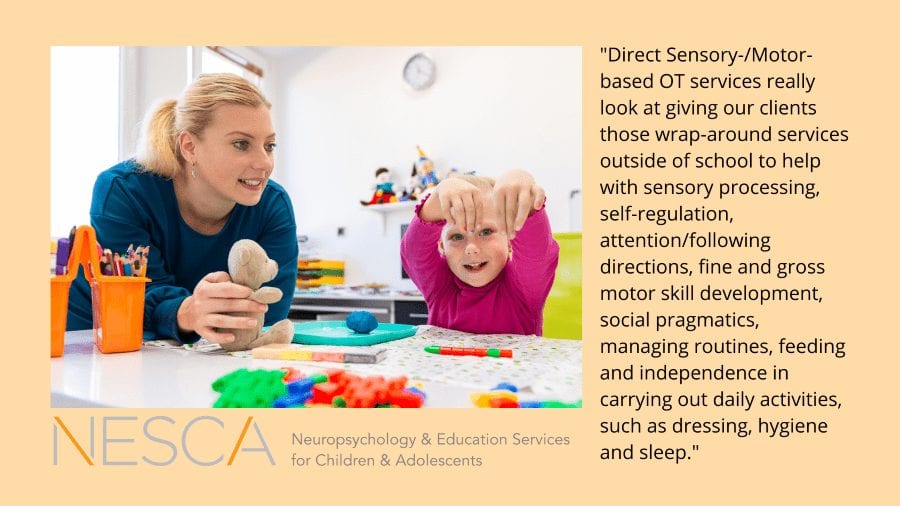
We are so excited to be on board and collaborating with the existing clinical team at NESCA to bring these new services to our community. The main focus of the new OT services is to provide instruction and practice, through teletherapy, and when appropriate at the home or in the community, in order to promote the best functionality kids can achieve on a daily basis. Where academic-based occupational therapy is focused on accessing the curriculum and receiving services while at school, Direct Sensory-/Motor-based OT services really look at giving our clients those wrap-around services outside of school to help with sensory processing, self-regulation, attention/following directions, fine and gross motor skill development, social pragmatics, managing routines, feeding and independence in carrying out daily activities, such as dressing, hygiene and sleep.

Who is a candidate for these new OT services?

We work with children of all ages, but our team typically works with children who are in the fifth grade or below. Many of the skills we are working on are skills that should be targeted and developed early on. Ideally, we are working with children from a young age or as soon as the challenges noted above come to light. Children with motor delays or sensory processing disorders, delays with play skills, and/or feeding difficulties are appropriate for these services.

How does the process of getting OT services start?

We usually start with an OT assessment that is focused on function. Insurance typically covers a 45-minute in-office screening. We would typically conduct a phone intake with the family, then look at the child’s skills using standardized tests for motor/sensory performance. With COVID-19, we are gathering sensory information from The Sensory Processing Measure and assessing other skill levels through interviews and checklists from parents, as well as 1:1 observation either virtually or in-person, as determined through the phone intake.

After an initial assessment is conducted, we work with families on a once or twice weekly basis. Each OT session is 45 minutes long and generally either begins or ends with a conversation with parents.

How do the services work?

We would typically provide services in-person inside the OT clinic at NESCA. Due to COVID-19, we are primarily providing services through telehealth, on a HIPAA-compliant virtual platform on a weekly basis. Sessions are 45 minutes each, with parents involved in part of each session to facilitate engagement of the child, to be coached by the clinician and for education about activities to incorporate in the days before the next session for follow through.

A small number of patients are being seen outdoors at their home or in the community, mainly when online engagement is too challenging, and when it can fit accordingly into clinician schedules. All patients are being seen individually for their services.

How do you set goals for the children you work with?

We get some of our background information for goal-setting from the assessment, but much of the real information on goals, strengths and weaknesses is revealed through observation during our sessions.

From the initial evaluation, we develop a brief report identifying the areas that we need to work on and collaborate with the parents to help achieve those goals and potentially target other areas that arise through ongoing observation and informal assessment during sessions and in parent consults.

When can families expect to see progress with goals being achieved?

We like to see our established goals being achieved in a three to six month time period. While every child is different, many kids go on to work with us for approximately 12 to 18 months, focusing on various goals throughout that period.

What are the related services that have just been introduced at NESCA?

Along with our new occupational therapy services, we are also now providing assessment and treatment of a variety of Speech & Language disorders, including dysphagia, childhood apraxia of speech, phonology/articulation disorder, receptive and expressive language disorder, social pragmatic communication disorder, autism spectrum disorder and language-based learning disabilities.

In addition, our therapists work with children with feeding and swallowing disorders, including transitioning infants to solid foods, weaning from tube feeding, improving sensory tolerance, developing chewing skills, increasing variety and volume of nutritional intake, and reducing avoidance behaviors during mealtimes. Our feeding therapists work with families to make mealtimes easier and more enjoyable for everyone using a systematic desensitization approach to increase sensory comfort with foods. We also employ the TR-eat®—Transdisciplinary Effective Assessment and Treatment—method for highly challenging feeding and eating issues.

Does NESCA accept insurance for its new services?

Direct Sensory-/Motor-based OT at NESCA (not academically-focused), is covered by BCBS and AllWays. Speech therapy at NESCA is covered by BCBS, AllWays and Harvard Pilgrim.

NESCA can provide receipts for Direct Sensory-/Motor-based OT sessions for clients to attempt to submit to their insurance carrier, should they not have insurance through the above carriers. NESCA does not submit claims to any carrier other than those outlined above and cannot guarantee any reimbursement when claims are submitted to them by the client.

It is also worth noting that Educational OT assessment, consultation and treatment is less often, or less completely, covered by insurance because insurance carriers typically only cover treatments that are deemed “medically necessary.” However, this can be a vital service because students spend such a significant amount of their day and week in school programming.

To learn more about NESCA’s Occupational Therapy and Related Services, please click here.


About the Interviewer

Dr. Sophie Bellenis is a Licensed Occupational Therapist in Massachusetts, specializing in educational OT and functional life skills development. Dr. Bellenis joined NESCA in the fall of 2017 to offer community-based skills coaching services as a part of the Real-life Skills Program within NESCA’s Transition Services team. Dr. Bellenis graduated from the MGH Institute of Health Professions with a Doctorate in Occupational Therapy, with a focus on pediatrics and international program evaluation. She is a member of the American Occupational Therapy Association, as well as the World Federation of Occupational Therapists. Having spent years delivering direct services at the elementary, middle school and high school levels, Dr. Bellenis has extensive background with school-based occupational therapy services.  She believes that individual sensory needs and visual skills must be taken into account to create comprehensive educational programming.

About the Interviewee
Julie Robinson is an occupational therapist with over 25 years of experience as a clinician. The work Julie does is integral to human development, wellness and a solid family unit. She particularly enjoys supporting families through the process of adoption and in working with children who are victims of trauma. Julie has extensive experience working with children diagnosed with an Autism Spectrum Disorder (ASD), or who have learning or emotional disabilities. She provides services that address Sensory Processing Disorder (SPD) and self-regulation challenges, as well as development of motor and executive functioning skills.


To book an appointment or to learn more about NESCA’s Occupational Therapy Services, please fill out our online Intake Form, email info@nesca-newton.com or call 617-658-9800.


Neuropsychology & Education Services for Children & Adolescents (NESCA) is a pediatric neuropsychology practice and integrative treatment center with offices in Newton, Massachusetts, Plainville, Massachusetts, and Londonderry, New Hampshire, serving clients from preschool through young adulthood and their families. For more information, please email info@nesca-newton.com or call 617-658-9800.


Simple Executive Functioning Strategies When The World Is Anything But Simple

By | NESCA Notes 2020

By: Moira Creedon, Ph.D. 
Pediatric Neuropsychologist, NESCA

Whether your children have returned to school full-time, on a hybrid model or fully virtual learning, we are all juggling. Juggling work demands, family demands, household demands and educational demands in a time of remarkable uncertainty. The start of the school year typically brings the smell of fresh school supplies and our best organizational efforts, but many of us may feel hesitant to use organizing strategies to manage our lives. Why? Because our lives are unpredictable and anything but typical these days. If you’re hesitating to use pen on a calendar, I hear you!

The ability to plan and employ organizational strategies is a key task of our executive functioning system. It’s what allows us to coordinate multiple schedules, dance and sports practices, projects at work, PTO bake sale reminders, and get out the door each day on time. I have been hesitant to adopt routines because I recall vividly how all those plans imploded in March when the world stood still. I hear the buzz about how school will end up fully remote so “put it all down in pencil before it all changes.”  Maybe that will prove true, but in the meantime, let’s consider the ways that we can rally our executive systems to do what they do best: plan, organize and regulate. Some suggestions for how to do this now while the world is unpredictable:

  1. Adopt the Sunday Game Plan. Put information in a family or personal calendar once a week. Spend a few moments on Sunday night catching up on plans for the coming week. Even if we end up transitioning from “hybrid” to “remote” (or all remote), this planning routine can still be adopted. Conclude your Sunday Game Plan by previewing what may be coming the week after in the event of long-term projects. While the content of your game plan may change, the structure can remain consistent.
  2. Keep a consistent schedule for sleep for the family. When we were all in school and work, we had set times to wake up in the morning. We should adopt more consistent bed times at least from Sunday through Thursday nights. Engage kids and teens in a conversation about the plan for sleep. If there are days when children are not waking up to physically attend school, try to keep wake up times no more than an hour off to allow for more consistency in our overall sleep regulation.
  3. As part of your weekly plan, set aside time for exercise. This is particularly important for children who will have reduced physical education activities. Research about the positive impact of exercise on mood, anxiety and attention underscores how important movement is in the day.
  4. Work together with your child to identify a consistent work space. Needing a work space at home is not suddenly and dramatically forced on all of us like it was in the spring. Take the time to arrange a space that is as distraction-free as you can make it. It’s not necessary to run out and buy things as minimal distractions can allow your child to focus on their school work. Keep the supplies nearby in their own bin, basket or box top.
  5. Help your child to create visual schedules or checklists for the day. Include times for virtual school, times for completing assignments and steps to submit the work either electronically or packed for the next day in school. Keep checklists consistent throughout the week when possible.
  6. Plan and schedule breaks. For young kids, try to plan breaks from tasks for every 15-20 minutes. Incorporate movement or stretching when possible to improve focus. For older students, try to plan breaks every 30 minutes of sustained effort. Try to take a full break from screens rather than replacing a tablet/computer screen with a phone or video game.

Children and teens develop their executive functioning skills over time. Keep this in mind as you set up routines and expectations for your whole family as what is expected for a second grader should and will differ from a seventh grader. Again, the content can differ but the structure of using a checklist, planning a break, or working at a desk or table is the same.

Please remember: the pandemic has depleted our executive functioning systems, so it’s important that we are gentle and kind to ourselves. Think about simple and reasonable systems to organize yourself and your family.  And be flexible when we have to go back to the drawing board.


Resources:

Positive impact of exercise:

https://www.sciencedirect.com/science/article/abs/pii/S0022347612009948

Executive Functioning tips and sample schedules:

https://www.smartbutscatteredkids.com/


About the Author: 

Dr. Creedon has expertise in evaluating children and teens with a variety of presenting issues. She is interested in uncovering an individual’s unique pattern of strengths and weaknesses to best formulate a plan for intervention and success. With experiences providing therapy and assessments, Dr. Creedon bridges the gap between testing data and therapeutic services to develop a clear roadmap for change and deeper of understanding of individual needs.


If you are interested in booking an evaluation with Dr. Creedon or another NESCA neuropsychologist, please fill out and submit our online intake form


Neuropsychology & Education Services for Children & Adolescents (NESCA) is a pediatric neuropsychology practice and integrative treatment center with offices in Newton and Plainville, Massachusetts, and Londonderry, New Hampshire, serving clients from preschool through young adulthood and their families. For more information, please email info@nesca-newton.com or call 617-658-9800.

Voting Support for Individuals with Disabilities

By | NESCA Notes 2020

By: Tabitha Monahan, M.A., CRC
Transition Specialist/Counselor

General Election season is upon us. The major-party national conventions are over, and the Massachusetts primary results are in.

About 20% of eligible voters have a disabilitybut only 49.3% of individuals with disabilities voted in 2018. And that was an 8.5% increase from previous years among this increasingly important voting bloc. Campaigns, such as the REV UP Campaign by the American Association of People with Disabilities (AAPD), have launched voter registration drives, championed for disability rights and policies to be part of the political conversation, and to increase awareness and action to remove barriers that make it challenging for individuals with disabilities to vote.

So how can we help our young people with disabilities exercise their right to vote? In Massachusetts, even individuals with guardianship maintain their right to vote unless the court documents specifically state otherwise. There are many ways to support individuals, but it starts with helping them register. Massachusetts residents can register to vote online, when obtaining or renewing a driver’s license or state ID, or at the local registrar of voters’ office. Notices from MassHealth and the DTA also include voter registration forms.

Absentee/mail-in ballots have been in the news more than ever due to the pandemic. Still, they have long been an excellent strategy for individuals with disabilities who would have difficulty voting in person. Absentee ballots are a great option for individuals who may have difficulty navigating the multiple steps in person or have a lower processing speed.

All citizens are also allowed to bring a person to help them while they are at the polls. Encourage your young person that many people require assistance at the polls, and it is completely normal to have the help available if they need it. Each polling location should also have at least one AutoMARK Voter Assist Terminal, which helps individuals with visual impairments vote independently.

No one wants their vote not to be counted due to errors filling out their ballot. People can request a sample ballot in advance from their local registrar of voters (the Secretary of State’s website can give you the address and phone number of your local registrar). Practicing filling out ballots in advance (even ballots from previous elections) can help a new voter become comfortable with the form and is great fine motor skill practice for those who may need it!

The Massachusetts Secretary of State also creates a voter information booklet for each election regarding the ballot initiatives. These red booklets can be found at many community locations and frequently include the local library, post office and city/town hall. These booklets offer information on what a yay or nay vote would mean and have information from each initiative’s proponents and opponents. Use that sample ballot as a starting point for the different types of elected positions.

Help your young adult find out what the different boards do and why there is an election for things such as town selectman or zoning board. Help your young adult find the websites for candidates running for office and review the candidates’ stances on issues. Ask what issues they want to learn more about and are important to them.

Most importantly, remind them that their voice counts. As many disability rights activists have said, “nothing about us without us.” Individuals with disabilities are greatly affected by the policy decisions that occur in government at all levels. Since many individuals with disabilities have frequently experienced disenfranchisement, there are numerous groups working tirelessly to lessen and remove these barriers. How have you helped your young adult exercise their right to vote?


About the Author

Tabitha Monahan, M.A., CRC, is an experienced transition evaluator and vocational counselor. While she is well-versed in supporting a wide range of transition-aged youth, she is especially passionate and knowledgeable in helping clients and their families navigate the complex systems of adult services and benefits as well as medical and mental health systems. She is further adept in working individually with students of all abilities to empower self-advocacy and goal achievement.


To schedule an appointment with one of NESCA’s expert transition specialists or neuropsychologists, please complete our online intake form


Neuropsychology & Education Services for Children & Adolescents (NESCA) is a pediatric neuropsychology practice and integrative treatment center with offices in Newton and Plainville, Massachusetts, and Londonderry, New Hampshire, serving clients from preschool through young adulthood and their families. For more information, please email info@nesca-newton.com or call 617-658-9800.


How Do I Prepare My Child for a Neuropsychological Evaluation?

By | NESCA Notes 2020

By: Erin Gibbons, Ph.D.
Pediatric Neuropsychologist, NESCA

Parents often ask us what they should tell their child about their upcoming neuropsychological evaluation, especially when it is their first experience with testing. I advise parents to refer to the neuropsychologist using his or her first name, as the term “doctor” can be scary and raise fears about medical exams. I might also add that the visit will not involve any shots! In order to describe the evaluation itself; here is some helpful language:

  • They are going to ask you questions, and you just need to do your best to answer.
  • They might ask you to do some drawing or writing.
  • Some activities might feel like you’re in school; for example, reading stories or doing math problems.

It may also be helpful to create a simple social story prior to the evaluation to help preview what to expect for your child.

To explain the reasons for doing the evaluation, some key phrases to use with your child include:

  • We want to understand how you learn, because everybody learns differently.
  • We are going to be “brain detectives” and figure out how your brain works!
  • This will help us identify your strengths and areas that we need to work on. That way, we can help you with things that are harder for you.
  • This will help your teachers understand your learning style so they can help you better at school.
  • Just try your best!

Testing in the age of Covid-19 is different. It can be harder to help children feel at ease when everyone is wearing masks, and we can’t offer a high five for good work. But as we are all learning, children are often more resilient than adults. Prior to coming in for an evaluation, you might want to remind your child to wear their mask, wash their hands and not approach people too closely.

It is also important to understand that a neuropsychological evaluation is a lot of work for your child! Finding a way to reward them for their effort will go a long way in helping them stay motivated and positive. This could be as simple as swinging by the drive-thru for a donut or something more extravagant, like a new video game. Whatever you choose to do, create a plan with your child and let the neuropsychologist know. When I have a child in my office who is starting to fatigue, it’s always a great motivator to remind them of the special prize they’ll get at the end of the visit!


About the Author: 

Erin Gibbons, Ph.D. is a pediatric neuropsychologist with expertise in neurodevelopmental and neuropsychological assessment of infants,

children, and adolescents presenting with developmental disabilities including autism spectrum disorders, Down syndrome, intellectual disabilities, learning disabilities, and attention deficit disorders. She has a particular interest in assessing students with complex medical histories and/or neurological impairments, including those who are cognitively delayed, nonverbal, or physically disabled. Dr. Gibbons joined NESCA in 2011 after completing a two-year post-doctoral fellowship in the Developmental Medicine Center at Boston Children’s Hospital. She particularly enjoys working with young children, especially those who are transitioning from Early Intervention into preschool. Having been trained in administration of the Autism Diagnostic Observation Schedule (ADOS), Dr. Gibbons has experience diagnosing autism spectrum disorders in children aged 12 months and above.


If you are interested in booking an evaluation with Dr. Gibbons or another NESCA neuropsychologist, please fill out and submit our online intake form


Neuropsychology & Education Services for Children & Adolescents (NESCA) is a pediatric neuropsychology practice and integrative treatment center with offices in Newton and Plainville, Massachusetts, and Londonderry, New Hampshire, serving clients from preschool through young adulthood and their families. For more information, please email info@nesca-newton.com or call 617-658-9800.

Sitting Down to Work – Tips for Proper Set-up and Posture

By | NESCA Notes 2020

By: Sophie Bellenis, OTD, OTR/L

Occupational Therapist; Real-life Skills Program Manager and Coach

When working from home, it’s easy to ignore the important things that most people know about maintaining proper posture. The draw of a bed covered in pillows or a cozy nook on the couch can outweigh the rational knowledge that sitting with good posture will help us to stay focused, decrease back or joint pain, and help build a strong core. When it comes to children, they are often unaware of the ways that posture can affect their bodies and their work. They need cues, reminders and examples of the best way to sit to stay focused and be productive. In our last OT Tuesday blog, we discussed the importance of a child’s physical foundation, the core. When it comes to learning, a strong core helps with postural stability. As the start of a new school year draws near, let’s review some important things to consider about the environment and physical set-up for learning and the best positions for our students’ bodies.

Creating a space for learning helps to differentiate between school and home activities that, for many students, are currently happening in the same building. Here are some tips for setting up this space:

  • Find appropriately sized furniture. Children should have their feet on the ground when sitting at their desk! Tables should be at an appropriate height. Tables that are too tall tend to prompt children to hunch their shoulders or sit on their feet, while tables that are too small cause children to slouch and lean their heads on their hands.
  • Help them organize. Classrooms are built to help students grow their executive function skills, as teachers constantly help set up organizational systems and use tricks to keep students on track. Your child may benefit from color coded folders for each subject, a hard copy of their daily schedule (with pictures for younger kids!) or a visual timer.

There are also a few important things to remember to help with proper seated posture.

  • Use visual reminders. Your child may benefit from a picture of someone using proper seated position posted near their workspace. While they may still need a reminder every so often, having an image gives children a model to mimic.
  • The Rule of 90 Degrees. When sitting at a table, children’s hips, knees and ankles should all be positioned at 90 degrees. This helps to create a solid foundation. When children have a strong foundation and postural stability, they are set up to freely and accurately use their fine motor skills. Being grounded allows for easier writing, typing, cutting and manipulation of all the tools necessary for learning. Ideally, children’s elbows will also create a 90 degree angle.
  • Consider a slant board. Placing a computer or a paper on a slanted board can help students realize that they need to sit up straight, promote proper wrist placement and angle, and draw their eye gaze up from the desk. Writing on a vertical or slanted surface in general can help with the development of handwriting skills.
  • Stabilize that paper. Reminding students to use their non-dominant hand to hold their paper helps with precision and accuracy.
  • Allow them to switch it up! Some tasks really require a child to be sitting up straight, grounded and engaged. For example, a student who is hand-writing a final copy of their paragraph or using scissors for an art class will want to be cognizant of their bodies and how they are seated. In contrast, some activities provide opportunities to move around and change positions. If a student is reading a book for English Language Arts, they may want to lie on their belly or sit in a beanbag chair.
  • Take breaks. No matter how perfect a child’s seated posture is, they will benefit from movement and stretching breaks. Little bodies are built to move, bounce and wiggle!

Prioritizing posture as a child helps to build good habits, evenly distribute stress on the body’s muscle ligaments and joints, and create a strong, grounded foundation.


About the Author

Dr. Sophie Bellenis is a Licensed Occupational Therapist in Massachusetts, specializing in educational OT and functional life skills development. Dr. Bellenis joined NESCA in the fall of 2017 to offer community-based skills coaching services as a part of the Real-life Skills Program within NESCA’s Transition Services team. Dr. Bellenis graduated from the MGH Institute of Health Professions with a Doctorate in Occupational Therapy, with a focus on pediatrics and international program evaluation. She is a member of the American Occupational Therapy Association, as well as the World Federation of Occupational Therapists. Having spent years delivering direct services at the elementary, middle school and high school levels, Dr. Bellenis has extensive background with school-based occupational therapy services.  She believes that individual sensory needs and visual skills must be taken into account to create comprehensive educational programming.

To book an appointment or to learn more about NESCA’s Occupational Therapy Services, please fill out our online Intake Form, email info@nesca-newton.com or call 617-658-9800.


Neuropsychology & Education Services for Children & Adolescents (NESCA) is a pediatric neuropsychology practice and integrative treatment center with offices in Newton, Massachusetts, Plainville, Massachusetts, and Londonderry, New Hampshire, serving clients from preschool through young adulthood and their families. For more information, please email info@nesca-newton.com or call 617-658-9800.


What In-person School Looks Like During COVID-19

By | NESCA Notes 2020

By: Tabitha Monahan, M.A., CRC
Transition Specialist/Counselor

Fall is approaching, and school is starting. As a student, I always knew summer was close to ending when Staples started their “Most Wonderful Time of the Year” commercial. The joy that parents and the community feel as fall approaches and another year of learning begins is understandably absent this year. Many parents, teachers and students are still unsure if they will be remote, in-person or both. All are too aware that even if students and teachers return to the school building, school will not look as it did in the fall of 2019. The comradery that our children experience through recess and interactive group work will be limited. Lunch will not be the boisterous room of students comparing who is in each class and what teachers are giving homework the first week.

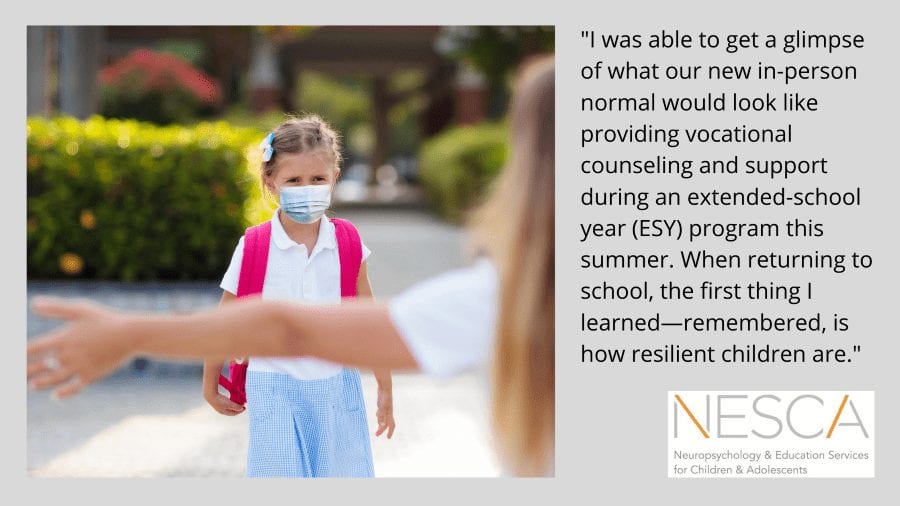
What can we expect then–especially our students who need the small in-person support they have received from their special education teachers, teaching assistants and related service providers? I was able to get a glimpse of what our new in-person normal would look like providing vocational counseling and support during an extended-school year (ESY) program this summer. When returning to school, the first thing I learned—remembered, is how resilient children are. Most students in the programs had very few issues with masks. For those who did, more frequent mask breaks and workarounds, such as face shields, greater distance between them and other students or neck scarves let them still participate in much needed in-person support. Hand-washing and sanitizer have become the norm, and staff and students had frequent opportunities to use both. Social Skills groups still occurred but were modified to continue to be possible. Community-based opportunities were limited, but again, teachers and service providers have long been accustomed to finding out of the box solutions for their students.

Yes, the first day was nerveracking. How were the students going to tolerate wearing a mask for hours on end? How were my co-workers and I going to wear a mask all day long? How was I going to get a drink safely while wearing a mask? But we did. Staff and students alike remained diligent with hand-washing, and the students were ready to learn. Teachers and teaching assistants (TAs) were available and came together for short periods to help students understand challenging tasks. Some of our children and students have behaviors or need activities of daily living (ADL) support that may have us more uneasy with their health and safety returning to in-person learning. Teachers and TAs were prepared for that, too. Whether it was a face shield with a mask, an extra set of clothes to change into or an additional layer of PPE, the student’s needs were met, and we all returned the next day.

Every district seems to have its own approach and plan. Still, in the end, each plan’s goal is the same: have every student continue to learn and prepare for life after high school and have each person return home safe and healthy.


About the Author

Tabitha Monahan, M.A., CRC, is an experienced transition evaluator and vocational counselor. While she is well-versed in supporting a wide range of transition-aged youth, she is especially passionate and knowledgeable in helping clients and their families navigate the complex systems of adult services and benefits as well as medical and mental health systems. She is further adept in working individually with students of all abilities to empower self-advocacy and goal achievement.


To schedule an appointment with one of NESCA’s expert transition specialists or neuropsychologists, please complete our online intake form


Neuropsychology & Education Services for Children & Adolescents (NESCA) is a pediatric neuropsychology practice and integrative treatment center with offices in Newton and Plainville, Massachusetts, and Londonderry, New Hampshire, serving clients from preschool through young adulthood and their families. For more information, please email info@nesca-newton.com or call 617-658-9800.


Core Strength and Stability: The Physical Foundation

By | NESCA Notes 2020

By: Sophie Bellenis, OTD, OTR/L

Occupational Therapist; Real-life Skills Program Manager and Coach

As our country heads into a period of unique learning, whether through a remote learning experience, a hybrid model or an in-person option with heightened rules and regulations, I find myself focusing on foundation. Foundation, simply defined, means, “the basis upon which something stands or is supported.” Currently, we are looking at a huge shift in how programs will run, how teachers will teach and how schools will support our children, but these principles are rooted in strong foundations. Our educators have knowledge, proven methods and an evidence base that allows for creativity, flexibility and evolution.

With regard to our students, foundational skills are the basics that help them feel secure and grounded enough to tackle the more individualized and creative aspects of learning. It is, in part, due to these foundational skills that many of our surprisingly resilient children have handled the COVID-19 pandemic with more flexibility and grace than the adults in their lives.

Today, let’s highlight the physical foundation that supports a child throughout their day, the core. Anatomically, the core refers to the transverse abdominis, internal and external oblique muscles, rectus abdominis, and the multifidus and erector spinae. This group of muscles holds a child upright when they are sitting at their seat, standing in line and running around on the playground. It is one of the foundational elements that promotes healthy motor development. Having a strong and active core makes it easier for a child to use their fine motor muscles with intent, stay alert for the duration of a class or a Zoom session, and develop healthy postural habits. Occupational therapists are trained to determine whether these activities are being affected by a weak core and if there is a need for intervention. Teachers and parents who spend substantial time with our children may want to be aware of and look out for the clues and signals of core instability, which include:

  • Compensatory strategies for stability – These are the subconscious ways that children compensate for core weakness. Essentially, they are bad habits that initially help to keep kids from getting too fatigued to participate in activities, but can have negative long-term effects. Some common examples include “W-sitting” and holding a breath during activities that require strength.
  • Leaning on anything and everything – Some children sit and lean their head on their hands or the desk when they write, lean against adults when standing up or sitting on a couch, and lean on furniture or tables when they are standing at home. These same students often slouch down in their seats and hunch their shoulders forward when they stand. This could signify a weak core.
  • Difficulty with balance – The inability to stay balanced and upright may be due to core instability. Many children are still developing the ability to run, jump, walk across a balance beam and stand on one foot, but if they seem to be falling over or losing control of their body more frequently than their peers, a weak core may be the culprit. These balance issues may also be apparent when a child is doing daily activities, such as getting dressed, putting on shoes or getting in and out of a car.
  • Difficulty with fine motor tasks – Sometimes children have a strong core and still have weak fine motor skills; however, often a weak core is exacerbating fine motor deficits. There is a little phrase that goes, “proximal stability for distal mobility” that is used by therapists, yogis and personal trainers alike. This means that it is important to have strength and stability at the core to easily move and control the muscles in our arms and legs.

Notably, helping a child to build their core is not always as simple as doing a few targeted exercises. While pure muscle strength may be the root cause of instability, it is not the only possibility. Other causes include poor alignment of the ribcage and pelvis, the need for some neuromuscular reeducation to help children engage the right muscles, and breathing habits that interfere with proper muscle use. If you feel like core weakness may be interfering with your child’s success, it may be worth seeking an occupational therapy assessment or speaking to your school’s occupational therapist about how to help them feel secure, sturdy and grounded. We can all benefit from a strong foundation.


About the Author

Dr. Sophie Bellenis is a Licensed Occupational Therapist in Massachusetts, specializing in educational OT and functional life skills development. Dr. Bellenis joined NESCA in the fall of 2017 to offer community-based skills coaching services as a part of the Real-life Skills Program within NESCA’s Transition Services team. Dr. Bellenis graduated from the MGH Institute of Health Professions with a Doctorate in Occupational Therapy, with a focus on pediatrics and international program evaluation. She is a member of the American Occupational Therapy Association, as well as the World Federation of Occupational Therapists. Having spent years delivering direct services at the elementary, middle school and high school levels, Dr. Bellenis has extensive background with school-based occupational therapy services.  She believes that individual sensory needs and visual skills must be taken into account to create comprehensive educational programming.

To book an appointment or to learn more about NESCA’s Occupational Therapy Services, please fill out our online Intake Form, email info@nesca-newton.com or call 617-658-9800.


Neuropsychology & Education Services for Children & Adolescents (NESCA) is a pediatric neuropsychology practice and integrative treatment center with offices in Newton, Massachusetts, Plainville, Massachusetts, and Londonderry, New Hampshire, serving clients from preschool through young adulthood and their families. For more information, please email info@nesca-newton.com or call 617-658-9800.


Skip to content