

By: Kelley Challen, Ed.M., CAS
Director of Transition Services, NESCA
Students with disabilities often have challenges with executive function skills. These may include difficulties with organization, planning and prioritization, time management, task initiation, attention and effort, working memory, self-regulation, self-monitoring, and mental flexibility. Being successful as a college student often depends on using and integrating these skills. Therefore, it’s no surprise that most of the IEPs I read when working with teenage and young adult students have goals or objectives aimed at remediating executive function (EF) skills. However, many students on IEPs have these “EF” goals for years and still don’t effectively develop the skills they need to successfully manage executive functioning tasks as college students.
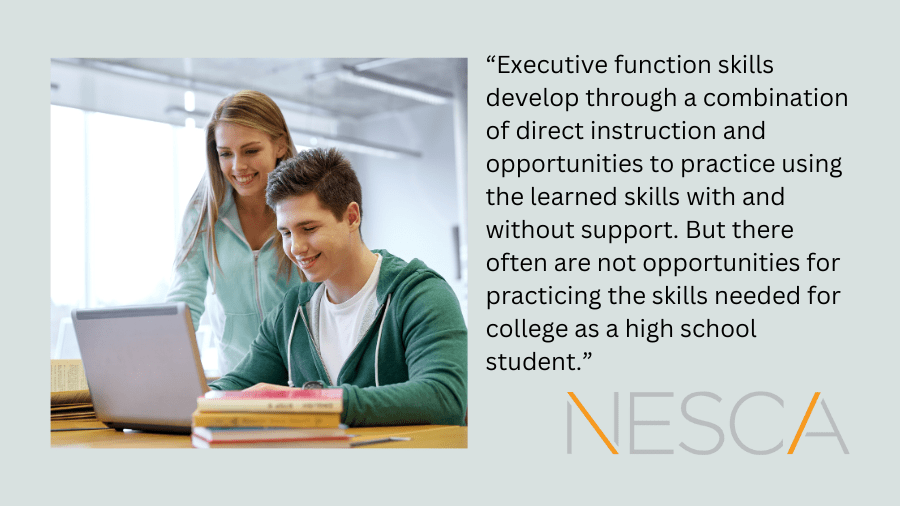
One of the reasons for the remaining skill gap when students matriculate to college is because high school student responsibilities are pretty radically different from college student responsibilities. While research indicates that individuals can continue developing executive function skills throughout the lifespan, this requires a very particular set of activities. Executive function skills develop through a combination of direct instruction and opportunities to practice using the learned skills with and without support. But there often are not opportunities for practicing the skills needed for college as a high school student.
Below is a list of executive function supports that exist in high school, but often disappear in college:
- Classes are small and always taught by teachers
- Class material is centralized in books or on the board in the classroom
- Time is structured by the school
- Students are told what they need to learn from homework
- Students are reminded of assignments and due dates
- Completed homework is checked by teachers
- Reading is discussed in classes
- Studying is limited to a few hours per week
- Testing is frequent and covers small amounts of material
- Teachers approach students who need help
- Schools are required to find students with disabilities who need specialized instruction and accommodations
- Parents and teachers will remind students of their responsibilities
- Parents and teachers will help to set priorities (or simply set them for the student)
- Parents and teachers will correct students when behavior is unexpected
In college, students may have large classes taught by other students or experts in their fields who aren’t experts on teaching. They have to use syllabi, manage their own schedules (with large swaths of unscheduled time), integrate academic materials from a wide range of sources, and self-direct long hours of reading and studying. They also have to be responsible for advocating for themselves, knowing when they need help, and knowing what they are responsible for (academically, socially, and in their dorms) and getting those things done without parent and teacher reminders. For students who have strengths with executive functioning, often the transition to college still presents a steep learning curve. But for those who have vulnerabilities in these areas, it can be critical to recognize that the gaps are large between these two learning environments, and sometimes additional support and instruction is necessary while students are taking college classes. Some students will still need to build effective academic and executive function skills, and practice and master those executive function skills, while they are in college and managing this new set of demands.
NESCA offers many services designed to help students bridge the transition from high school to college, including executive function coaching, pre-college coaching, transition planning, and neuropsychological evaluation. To learn more specifically about our coaching services, visit: https://nesca-newton.com/coaching-services/ . To schedule an appointment with one of our expert clinicians or coaches, please complete our intake at: https://nesca-newton.com/intake/ .
Reference:
Many of the bulleted items of executive function supports that exist in high school are adapted from this high school versus college comparison by King’s College: https://www.kings.edu/admissions/high_school_vs_college
About the Author
Kelley Challen, Ed.M., CAS, is an expert transition specialist and national speaker who has been engaged in evaluation, development, and direction of transition-focused programming for teenagers and young adults with a wide array of developmental and learning abilities since 2004. While Ms. Challen has special expertise in working with youth with autism, she enjoys working with students with a range of cognitive, learning, communication, social, emotional and/or behavioral needs.
Ms. Challen joined NESCA as Director of Transition Services in 2013. She believes that the transition to postsecondary adulthood activities such as learning, living, and working is an ongoing process–and that there is no age too early or too late to begin planning. Moreover, any transition plan should be person-centered, individualized and include steps beyond the completion of secondary school.
Through her role at NESCA, Ms. Challen provides a wide array of services including individualized transition assessment, planning, consultation, training, and program development services, as well as pre-college coaching. She is particularly skilled in providing transition assessment and consultation aimed at determining optimal timing for a student’s transition to college, technical training, adult learning, and/or employment as well as identifying and developing appropriate programs and services necessary for minimizing critical skill gaps.
Ms. Challen is one of the only professionals in New England who specializes in assisting families in selecting or developing programming as a steppingstone between special education and college participation and has a unique understanding of local postgraduate, pre-college, college support, college transition, postsecondary transition, and 18-22 programs. She is additionally familiar with a great number of approved high school and postsecondary special education placements for students from Massachusetts including public, collaborative, and private programs.
Ms. Challen enjoys the creative and collaborative problem-solving process necessary for successfully transitioning students with complex profiles toward independent adulthood. As such, she is regularly engaged in IEP Team Meetings, program consultations, and case management or student coaching as part of individualized post-12th grade programming. Moreover, she continually works to enhance and expand NESCA’s service offerings in order to meet the growing needs of the families, schools and communities we serve.
When appropriate, Ms. Challen has additionally provided expert witness testimony for families and school districts engaged in due process hearings or engaged in legal proceedings centering on transition assessment, services and/or programming—locally and nationally.
Nearly two decades ago, Ms. Challen began her work with youth with special needs working as a counselor for children and adolescents at Camp Good Times, a former program of Milestones Day School. She then spent several years at the Aspire Program (a Mass General for Children program; formerly YouthCare) where she founded an array of social, life and career skill development programs for teens and young adults with Asperger’s Syndrome and related profiles. Also, she worked at the Northeast Arc as Program Director for the Spotlight Program, a drama-based social pragmatics program, serving youth with a wide range of diagnoses and collaborating with several school districts to design in-house social skill and transition programs.
Ms. Challen received her Master’s Degree and Certificate of Advanced Graduate Study in Risk and Prevention Counseling from the Harvard University Graduate School of Education. While training and obtaining certification as a school guidance counselor, she completed her practicum work at Boston Latin School focusing on competitive college counseling.
Ms. Challen has worked on multiple committees involved in the Massachusetts DESE IEP Improvement Project, served as a Mentor for the Transition Leadership Program at UMass Boston, participated as a member of B-SET Boston Workforce Development Task Force, been an ongoing member of the Program Committee for the Association for Autism and Neurodiversity (AANE), and is a member of the New Hampshire Transition State Community of Practice (COP).
She is also co-author of the chapter, “Technologies to Support Interventions for Social-Emotional Intelligence, Self-Awareness, Personality Style, and Self-Regulation,” for the book Technology Tools for Students with Autism: Innovations that Enhance Independence and Learning.
To schedule an appointment with one of NESCA’s transition specialists, please complete our online intake form.
NESCA is a pediatric neuropsychology practice and integrative treatment center with offices in Newton, Plainville, and Hingham, Massachusetts; Londonderry, New Hampshire; the greater Burlington, Vermont region; and Brooklyn, NY (coaching services only) serving clients from infancy through young adulthood and their families. For more information, please email info@nesca-newton.com or call 617-658-9800.

 unique pattern of strengths and weaknesses to best formulate a plan for intervention and success. With experiences providing therapy and assessments, Dr. Creedon bridges the gap between testing data and therapeutic services to develop a clear roadmap for change and deeper of understanding of individual needs.

 staff at Johns Hopkins University and trained at the University of California, Los Angeles (UCLA). She provides comprehensive neuropsychological evaluations of children, adolescents, and young adults who have learning, behavioral, and socio-emotional challenges. Her areas of expertise include Autism Spectrum Disorder and other conditions that usually co-occur with this diagnosis; Attention-Deficit/Hyperactivity Disorder; Dyslexia and other Specific Learning Disabilities; and Anxiety/Depression. She thinks that the best part of being a pediatric neuropsychologist is helping change the trajectory of children’s lives.
 extensive experience working with children and adolescents with a range of learning and social/emotional abilities. Kristen’s strengths lie in her communication and advocacy skills as well as her strengths-based approach. She is passionate about developing students’ self-awareness, goal-setting abilities, and vision through student-centered counseling, psychoeducation, social skills instruction, and executive functioning coaching. Mrs. Simon has particular interests working with children and adolescents on the Autism spectrum as well as individuals working to manage stress or anxiety-related challenges.
 research and academia for over 30 years. She is a national consultant and speaker on program design and the inclusion of children and adolescents with special needs, especially those diagnosed with Autism Spectrum Disorder (ASD). Prior to joining NESCA, Ms. Lucci was the Principal of the Partners Program/EDCO Collaborative and previously the Program Director and Director of Consultation at MGH/Aspire for 13 years, where she built child, teen and young adult programs and established the 3-Ss (self-awareness, social competency and stress management) as the programming backbone. She also served as director of the Autism Support Center. Ms. Lucci was previously an elementary classroom teacher, special educator, researcher, school psychologist, college professor and director of public schools, a private special education school and an education collaborative.


 working with children and young adults with complex emotional and behavioral profiles. She is skilled at evaluating social and emotional challenges as well as a range of learning profiles. Her experience allows her to guide families in understanding the supports and services their child requires to be successful in school.
 Erin Gibbons, Ph.D.
Connect with Us