NESCA’s Londonderry, NH location has immediate availability for neuropsychological evaluations. Our NH clinicians specialize in the following evaluations: Neuropsychological; Autism; and Emotional and Psychological, as well as Academic Achievement and Learning Disability Testing. Our NH clinicians also conduct evaluations for students who are at boarding schools, and two of our NH clinicians have PsyPACT authorization, allowing them to conduct evaluations out-of-state.

Visit www.nesca-newton.com/intake for more information or to book an evaluation.

Tag

behavior Archives - Page 2 of 2 - NESCA

Subscribe to NESCA Notes

Is It Sensory? Or Is It Behavior?

By | NESCA Notes 2021

By: Julie Robinson, OT
Director of Clinical Services; Occupational Therapist, NESCA

As parents or other caregivers of children with special needs, we can often find ourselves confused between what is a sensory response and what is behavior. Although this is often a complex question, and one without a straightforward answer, there are some tools of the trade that OTs use to help us determine just what is going on with these children. What makes this so complex is that each child is an individual, with their own unique ways of responding to sensory stimuli, to social interactions, and when out in varied settings in their community or with family. Children may also present differently from minute to minute or day to day, depending on sleep, hunger, and fluctuations in mood. But we can often look closely for patterns that may help to guide us in finding the answers.

When working with a child who seems to be in a meltdown, one of the best things you can do is take a quick scan of the environment. Is there a loud or distracting sound in the background? Did someone touch the child unexpectedly? Is the overall environment too busy and overstimulating, such as at party or a restaurant? Sometimes just naming or removing the stimuli, if possible, is enough to help get things back under control. If you know a triggering situation might arise that provokes a meltdown, see if you can give the child a warning and a plan of where to go for comfort. “We will be having a fire drill in 10 minutes, so when it happens you can hold _____’s hand, or we can get you some headphones to cover your ears to make you more comfortable” is one example. Find something soothing from a sensory perspective to help the child settle: a quiet corner with books, some tactile play or fidgets, calming music, a tight squeeze ( but only if tolerated and given permission to do so ). If you know you are entering a highly stimulating environment, it may be best to go in for short periods, with frequent breaks built in for your child every 10 minutes or so to take a walk, use the bathroom, or get a drink.

If you do not see something sensory in your environment creating the discomfort or the meltdown, then behavior and emotions are more likely at play. You child may feel confused about a social interaction, about expectations, or what may be coming next in a transition. Your child may feel a lack of confidence or anxiety in a situation, that although may be seemingly simple and straight forward to you, may not to him or to her. An academic task may feel misunderstood, and not knowing how to start can result in a meltdown for many of our children.

When you see that the child you are caring for is beginning to ramp up, that is the best time to intervene. Once a meltdown has begun, language processing will be limited, and the child may not be reachable for a period of time in order to settle down. The best thing you can do in those moments, is to help the child to stop. I often use a stop sign to hold up in my therapy sessions, that cues the child to take a quick break from interacting with me when I see things starting to spin out of control. I limit my language, provide a calming sensory activity, then we can talk about the upset once I have the child back in my court.

Here are some things to think about and questions you might ask yourself to help guide your interactions and expectations when you, as the adult, are confused about whether this is sensory or behavior:

  1. What are the undesirable behaviors that my child observes when he or she is upset or uncomfortable? Are they different when there is sensory discomfort, in comparison to when he or she is upset with a person or a demand? Notice quality of voice, bodily tension, inability to stay still or focused, aggression, flight or an attempt to get away, shutdown or inability to interact. You may start to see patterns in behavior when you look at them in relation to a sensory event or something that is more emotionally-laden.
  2. What occurred just before this behavior appeared? Was there a sensory distraction or discomfort or was he or she upset with a person or a demand?
  3. How did the child behave during this episode?
  4. How did adults or peers interact with my child during the episode? Did it calm the child, or make him or her more agitated?
  5. List sensations that may have triggered a meltdown: tactile, auditory, visual, smell, taste, movement. Were they loud, distracting, uncomfortable? Was the child in a space that may have been too small or too large? Was the child able to get away from the uncomfortable stimuli, or did he or she feel stuck in the moment?

It will be beneficial for team members to share information and write these things down, perhaps in a format of a journal, so that the team can work together to uncover the patterns, find strategies that are successful, and provide consistency across the board. We all know consistency for these children is one of the most effective tools for learning, and although it may take some extra work up front for caregivers, the pay off on the other side is often so rewarding that it is worth the effort.

If you would like to explore this topic further with NESCA OT Julie Robinson, join us for a free webinar on this topic on September 13, 2021 at 10:30 am ET. Register in advance for this webinar at:

https://nesca-newton.zoom.us/webinar/register/WN_-edHNIwkRBKnjk0gq6-bUw


About the Author

Julie Robinson is an occupational therapist with over 25 years of experience as a clinician. The work Julie does is integral to human development, wellness and a solid family unit. She particularly enjoys supporting families through the process of adoption and in working with children who are victims of trauma. Julie has extensive experience working with children diagnosed with an Autism Spectrum Disorder (ASD), or who have learning or emotional disabilities. She provides services that address Sensory Processing Disorder (SPD) and self-regulation challenges, as well as development of motor and executive functioning skills.

To book an appointment or to learn more about NESCA’s Occupational Therapy Services or other clinical therapies, please fill out our online Intake Form, email info@nesca-newton.com or call 617-658-9800.


Neuropsychology & Education Services for Children & Adolescents (NESCA) is a pediatric neuropsychology practice and integrative treatment center with offices in Newton, Massachusetts, Plainville, Massachusetts, and Londonderry, New Hampshire, serving clients from preschool through young adulthood and their families. For more information, please email info@nesca-newton.com or call 617-658-9800.


Mind the Gap: Why You Should Consider Summer OT and Speech Services at NESCA

By | NESCA Notes 2021

By: Julie Robinson, OT
Director of Clinical Services; Occupational Therapist, NESCA

It has been a challenging school year, with ever-changing schedules, routines, and unfortunately with a good deal of inconsistency in the provision of therapeutic services through the schools, due to the many impacts of COVID. Parents, caregivers and students have all experienced differing levels of anxiety about what progress has been and is being made, with many children experiencing some level of regression with regard to behavior, self-regulation, motor skills or language development. In anticipation of many of our children returning to school in-person in April, parents have expressed concerns that their children may be lagging behind or that they have not had ample support throughout the earlier parts of their school year to ensure they can keep up with the other children in their class. Over the months of April, May and June, we will all get to see firsthand where the gaps might arise. And then when school is over, many of us might be concerned that the gains of just a few short months will be lost again over summer. This is why those of us at NESCA perceive that the benefits of summer services will be an important part of ensuring progress and the ability to jump right back into learning – as we hope all school will be in-person again in the fall.

NESCA is available to provide summer services, as we do consistently for our weekly patients. In addition, we are offering short-term services to those children who may not qualify for them through their school systems, or for those families who would simply like to supplement what their children are receiving in-district to give them a boost before school begins again in the fall.

Our occupational therapists (OTs) can work on the following areas of focus with your child:

  • self-regulation and coping skills
  • how best to transition from the quiet of home to the multiple stimuli of a classroom full of children
  • how to cope with longer hours of wearing a mask
  • how to follow social distancing requirements, when they long for a closer physical connection with their peers

We can also help to ease the anxiety some children may have about becoming sick or how NOT to feel fearful of getting back into the classroom when sensory processing issues push them to feel uneasy. Our OTs can continue work on handwriting and motor development work started throughout the school year to ensure there is no regression or to improve the speed and automaticity of written expression and legibility. We can teach organizational and executive functioning skills to encourage kids to be independent, prioritize assignments and manage their time. OTs can address self-care skills of dressing, shoe tying, feeding and hygiene, which are likely to require more independence with social distancing requirements. While it’s summer, we help build outdoor skills, such as bike riding and greater self-confidence on the playground to elicit more social connections with peers. Our OTs are providing services in-person in our Newton and Plainville, Massachusetts clinics, by teletherapy or outdoors in the community as appropriate.

Our speech therapists at NESCA can also help to continue and supplement the hard work children have been putting in throughout the school year. They can work on social pragmatics and help with the skills needed to transition from so much time alone, to being in groups with their peers once again. NESCA’s speech therapists can support children on how to:

  • initiate play
  • find shared interests
  • be flexible thinkers
  • communicate with kindness and an appropriate level of voice
  • read gestures and non-verbal communication (especially while wearing masks, which can impede the ability to properly read another person’s mood, reactions or emotions)

We can continue to work on the established goals from school, regarding both expressive and receptive communication, language articulation and language as it pertains to written communication. Our speech therapists are currently providing all services via teletherapy while we work on a transition back to in-person therapy.

If you are interested in seeking out summer services at NESCA, or any of our assessments and services, please contact NESCA’s Director of Clinical Services Julie A. Robinson. She can be reached at jrobinson@nesca-newton.org and will conduct a phone intake with you to help you best determine your needs.


About the Author

Julie Robinson is an occupational therapist with over 25 years of experience as a clinician. The work Julie does is integral to human development, wellness and a solid family unit. She particularly enjoys supporting families through the process of adoption and in working with children who are victims of trauma. Julie has extensive experience working with children diagnosed with an Autism Spectrum Disorder (ASD), or who have learning or emotional disabilities. She provides services that address Sensory Processing Disorder (SPD) and self-regulation challenges, as well as development of motor and executive functioning skills.

To book an appointment or to learn more about NESCA’s Occupational Therapy Services or other clinical therapies, please fill out our online Intake Form, email info@nesca-newton.com or call 617-658-9800.


Neuropsychology & Education Services for Children & Adolescents (NESCA) is a pediatric neuropsychology practice and integrative treatment center with offices in Newton, Massachusetts, Plainville, Massachusetts, and Londonderry, New Hampshire, serving clients from preschool through young adulthood and their families. For more information, please email info@nesca-newton.com or call 617-658-9800.


Behavior Happens! But Does It Have To?

By | NESCA Notes 2020

By Dot Lucci, M.Ed., CAGS

Director of Consultation and Psychoeducational Services, NESCA

Recently, I’ve written a few blogs about behavior management and meltdowns and being a behavior detective. I thought I’d end the behavior series with a blog on how to prevent meltdowns from occurring, or at least try to prevent them! Obviously, preventing meltdowns is the best option if at all possible. No one likes to be around a meltdown, and the child doesn’t like it either.

There are many different experts with their own methods and strategies, but most start with common principles. Know yourself, know your child, meet him/her where they are, know what makes them tick and what works for them, as every child is different. It’s the behavior that is unacceptable, not the child. The child is still valued and loved; the behavior isn’t.

Kids will be kids, and they will lose control. Hopefully, over time, they learn self-control and emotional regulation. But the brain’s frontal lobes which control executive function, which includes behavioral control, don’t fully develop until the child I in his or her late 20’s…so buckle up as it’s going to be a long ride! Remember a meltdown is a child’s best attempt in the moment. It is the fight, flight and fright/freeze response. Trying to prevent these from happening are good for the child and the whole family. Life isn’t perfect and meltdowns will occur, but let’s try to lessen their frequency by employing some of the following:

  • Pick your battles—What’s negotiable and what’s non-negotiable? Make sure your kids know the list of “have-to’s” or non-negotiables. Simplify rules and make them realistic to the age of your child. Don’t make a rule/consequence that you cannot be consistent with or follow through with.
  • Keep calm in the eye of the storm.
  • Catch ‘em being good and let them know you saw them behaving well.
  • Tell your child what you want him or her to do, not what you don’t want them to do. Kids do the best they can in the moment.
  • Whenever possible, limit the amount of times you say the word “No.” Leave “No” for safety concerns. Instead, give information, and acknowledge and accept your child’s feelings/opinions. Substitute a “yes” for a “no” and use fantasy talk. “Yes, I wish you could stay up late, too, but we have to get up early tomorrow.”
  • Don’t phrase things so kids can say ‘no’ if the answer “no” isn’t an option. Wording and phrasing matters. Sometimes indirect requests get better results than directives. Explain your reason for non-negotiables (even if they don’t agree or like them). Do some tasks together that are problematic for your child. Shared ownership is better than no ownership.
  • Allow choice and control whenever possible. Don’t get into power struggles you will lose.
  • Having agency and mastery helps all kids grow and learn.
  • Consistency, Structure and Predictability are providers of Stability and Simplicity that enable your child to Anticipate, which is a means to enhance independence.
  • Clear rules, expectations and consequences provide organization, safety, structure and limits while enhancing mastery, self-control and improved self-efficacy.
  • Children don’t have the same sense of time or urgency as adults do, so allow for extra time to complete tasks when possible and use timers to help them organize their time.
  • Use humor and distraction to achieve desired results.
  • Compromise, Flexibility and Negotiation done proactively can go a long way. Work with your child to solve problems before they occur. Be flexible when necessary and make a compromise. Provide your reasoning for the compromise. This is not bribing; rather this approach teaches valuable lessons in win-win solution making, negotiation, compromise, flexibility, fairness and trust. Use this approach next time, and your child will hopefully, over time, learn these valuable lessons/skills.
  • Know your child’s triggers and be prepared. Try to eliminate/lessen them if possible. If they can’t be lessened, teach your child  the necessary tools to cope with them during more calm moments.
  • Know your child’s limits regarding experiences (i.e. downtime, waiting, loosing at games, etc., sensory needs (i.e. hunger, tiredness, sensitivities, etc.) and take these and other areas into consideration. Be prepared and think ahead.


Resources to consider:


About the Author

NESCA’s Director of Consultation and Psychoeducational Services Dot Lucci has been active in the fields of education, psychology, research and academia for over 30 years. She is a national consultant and speaker on program design and the inclusion of children and adolescents with special needs, especially those diagnosed with Autism Spectrum Disorder (ASD). Prior to joining NESCA, Ms. Lucci was the Principal of the Partners Program/EDCO Collaborative and previously the Program Director and Director of Consultation at MGH/Aspire for 13 years, where she built child, teen and young adult programs and established the 3-Ss (self-awareness, social competency and stress management) as the programming backbone. She also served as director of the Autism Support Center. Ms. Lucci was previously an elementary classroom teacher, special educator, researcher, school psychologist, college professor and director of public schools, a private special education school and an education collaborative.

Ms. Lucci directs NESCA’s consultation services to public and private schools, colleges and universities, businesses and community agencies. She also provides psychoeducational counseling directly to students and parents. Ms. Lucci’s clinical interests include mind-body practices, positive psychology, and the use of technology and biofeedback devices in the instruction of social and emotional learning, especially as they apply to neurodiverse individuals.


To book a consultation with Ms. Lucci or one of our many expert neuropsychologists, complete NESCA’s online intake form. Indicate whether you are seeking an “evaluation” or “consultation” and your preferred clinician/consultant in the referral line.


Neuropsychology & Education Services for Children & Adolescents (NESCA) is a pediatric neuropsychology practice and integrative treatment center with offices in Newton, Massachusetts, Plainville, Massachusetts, and Londonderry, New Hampshire, serving clients from preschool through young adulthood and their families. For more information, please email info@nesca-newton.com or call 617-658-9800.


Becoming a Behavior Detective

By | NESCA Notes 2020

By Dot Lucci, M.Ed., CAGS

Director of Consultation and Psychoeducational Services, NESCA

Behavior = Communication

Behavior is everywhere you look. All behavior is adaptive and purposeful whether “appropriate or inappropriate,” “expected or unexpected,” or “regulated or not.” Have you ever heard of the phrase, “Behavior = Communication?” It is often used to help us think about behavior as a meaningful and purposeful means of communication, even when it is maladaptive.

Behavior is multifaceted and can be internally- and externally-driven. Every behavior that any one of us does can be interpreted as communicative and as having meaning. When a mom says to load the dishwasher and a child doesn’t respond, the child may not have heard her or may have actually heard the direction and chosen to ignore her. Ignoring her and not responding is actually responding – the is escaping a demand or that direction. If a child asks for a toy at the store and the parent says, “No,” and the child cries and stomps their feet in displeasure, the child is definitely expressing feelings. If the parent gives in to the tantrum and agrees to buy the toy to quiet the child down, the parent is reinforcing the inappropriate behavior/tantrum. This pattern often repeats itself, leaving parents and kids in a vicious cycle. The child learns that crying and stomping gets what he/she wants.

Becoming a Behavior Detective

In the current COVID-19/stay at home landscape, being a behavior detective could serve parents and caregivers well! Parents and children are feeling stressed and anxious, even if they don’t appear so. This is a communal feeling given the current situation, and parents may need to pick and choose their battles wisely. Otherwise, they may spend hours of each day dealing with many unpleasant moments. Being “cooped up” with each other may present an opportunity for parents to become behavior detectives to figure out what their kids are trying to communicate. If the children are older, parents may want share this with them so both parent and child become detectives together; maybe even of each other!

Conjunction, Junction, What’s the Function?

Maladaptive behavior is communicating something, and if we want to change that we need to know what the communicative function of the behavior is. By knowing the function behind the behavior (what they are trying to accomplish by the behavior), we can then think about prevention, intervention and post-intervention—thus being able to intervene at three different times before a behavior actually occurs, during the behavior or after the behavior occurs.

Communicative functions of behavior include:

  • Escape/Avoidance of a task
  • Access to something/someone desirable
  • To make a request or a comment
  • Negations/refusal
  • Self-non-interactive—communicating with ourselves or self-talk/actions
  • Attention-seeking
  • Expression of feelings
  • Expression of sensory needs

Given our current environment, it may be important to think about the communicative function of a child’s “maladaptive behaviors.” This provides a way to intervene with a hypothesis of function and consistency of prevention, intervention or response. Given parents’ own mental, emotional or psychological state, they have the option to escalate or deescalate any situation. Be honest with your kids if you are tired, stressed or overloaded; let them know that you may have less patience when appropriate. Remind them that they have a role in helping to make the house and family a kind, happy and compassionate place. Honest communication, kindness and gentleness with one another (even when we lose control) goes a long way to help during these trying times.

If you need help in being a behavior detective, NESCA is providing virtual parent coaching and consultation. Complete our online Intake Form for more information.


About the Author

NESCA’s Director of Consultation and Psychoeducational Services Dot Lucci has been active in the fields of education, psychology, research and academia for over 30 years. She is a national consultant and speaker on program design and the inclusion of children and adolescents with special needs, especially those diagnosed with Autism Spectrum Disorder (ASD). Prior to joining NESCA, Ms. Lucci was the Principal of the Partners Program/EDCO Collaborative and previously the Program Director and Director of Consultation at MGH/Aspire for 13 years, where she built child, teen and young adult programs and established the 3-Ss (self-awareness, social competency and stress management) as the programming backbone. She also served as director of the Autism Support Center. Ms. Lucci was previously an elementary classroom teacher, special educator, researcher, school psychologist, college professor and director of public schools, a private special education school and an education collaborative.

Ms. Lucci directs NESCA’s consultation services to public and private schools, colleges and universities, businesses and community agencies. She also provides psychoeducational counseling directly to students and parents. Ms. Lucci’s clinical interests include mind-body practices, positive psychology, and the use of technology and biofeedback devices in the instruction of social and emotional learning, especially as they apply to neurodiverse individuals.


To book a consultation with Ms. Lucci or one of our many expert neuropsychologists, complete NESCA’s online intake form. Indicate whether you are seeking an “evaluation” or “consultation” and your preferred clinician/consultant in the referral line.


Neuropsychology & Education Services for Children & Adolescents (NESCA) is a pediatric neuropsychology practice and integrative treatment center with offices in Newton, Massachusetts, Plainville, Massachusetts, and Londonderry, New Hampshire, serving clients from preschool through young adulthood and their families. For more information, please email info@nesca-newton.com or call 617-658-9800.


Meltdown Analysis — Part 2

By | NESCA Notes 2020

By Dot Lucci, M.Ed., CAGS

Director of Consultation and Psychoeducational Services, NESCA

As discussed in last week’s blog, Meltdowns Happen, all children meltdown. Adults meltdown, too. Losing control can take many forms. It is a part of human nature unless we deliberately work on “controlling the beast” that’s lurking inside of us when our system gets taxed. When children are very young, we expect them to lose control because they are learning how to identify and express their emotions. A three-year-old who tantrums is not that uncommon; however, by the time that child is six and then 10, we want them to have developed more and more control as they mature.  But, many children don’t always develop the control that we’d like, and those diagnosed with learning differences sometimes have even more difficulty controlling their emotions.

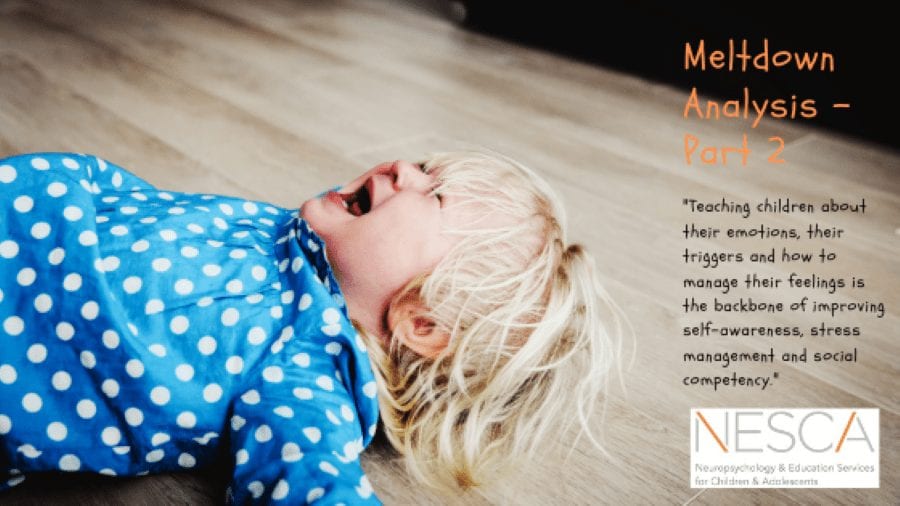
Teaching children about their emotions, their triggers and how to manage their feelings is the backbone of improving self-awareness, stress management and social competency (3 Ss). If children can label and recognize feelings, notice how their body feels with different emotions and know how to calm themselves when stressed, the better off they will be in life. In a previous role as the program director of Aspire/MGH, we focused on these 3 Ss and utilized a volcano image with our autism spectrum disorder (ASD) participants to teach them about their stress cycle. The volcano image represented a meltdown (see below).

In using this with your child, pick a quiet, calm moment to introduce it to him/her. You might want to start the conversation by reading a book about stress or big emotions. There are many to choose from depending upon the age of your child. You could also just begin a discussion with volcano image to help them understand what they look like and sound like when they are melting down. Discuss with your child what you think s/he looks like as s/he begins to meltdown starting at the bottom of the volcano and working all the way to the top (5) and then what s/he looks like when s/he begins to calm down and recover (moving down the right side of the volcano). If your child has not learned stress management strategies, this is a good time to practice. If your child has learned some techniques, you can also create a list of strategies that s/he can do at each step to help gain control so s/he doesn’t continue to escalate to the next stage. For instance, at a 3, you may be able to use humor to help redirect, but when s/he is at a 4 or 5, using humor may increase distress. I hope this image helps with understanding and reducing the meltdowns that are occurring every day in everyone’s home.

If you’d like assistance in creating your child’s personal meltdown plan, self-awareness plan or behavior plan, NESCA’s parent coaching services can assist you in the journey.


About the Author

NESCA’s Director of Consultation and Psychoeducational Services Dot Lucci has been active in the fields of education, psychology, research and academia for over 30 years. She is a national consultant and speaker on program design and the inclusion of children and adolescents with special needs, especially those diagnosed with Autism Spectrum Disorder (ASD). Prior to joining NESCA, Ms. Lucci was the Principal of the Partners Program/EDCO Collaborative and previously the Program Director and Director of Consultation at MGH/Aspire for 13 years, where she built child, teen and young adult programs and established the 3-Ss (self-awareness, social competency and stress management) as the programming backbone. She also served as director of the Autism Support Center. Ms. Lucci was previously an elementary classroom teacher, special educator, researcher, school psychologist, college professor and director of public schools, a private special education school and an education collaborative.

Ms. Lucci directs NESCA’s consultation services to public and private schools, colleges and universities, businesses and community agencies. She also provides psychoeducational counseling directly to students and parents. Ms. Lucci’s clinical interests include mind-body practices, positive psychology, and the use of technology and biofeedback devices in the instruction of social and emotional learning, especially as they apply to neurodiverse individuals.


To book a consultation with Ms. Lucci or one of our many expert neuropsychologists, complete NESCA’s online intake form. Indicate whether you are seeking an “evaluation” or “consultation” and your preferred clinician/consultant in the referral line.


Neuropsychology & Education Services for Children & Adolescents (NESCA) is a pediatric neuropsychology practice and integrative treatment center with offices in Newton, Massachusetts, Plainville, Massachusetts, and Londonderry, New Hampshire, serving clients from preschool through young adulthood and their families. For more information, please email info@nesca-newton.com or call 617-658-9800.


Meltdowns Happen

By | NESCA Notes 2020

By Dot Lucci, M.Ed., CAGS

Director of Consultation and Psychoeducational Services, NESCA

When we think of the word meltdown, we may think of the economy or stock market, glaciers, nuclear meltdowns or even volcanoes erupting. These are all examples of things collapsing from being over-stressed, overheating, a major disruption to a system or an internal collapse. Using the word meltdown to describe people is similar. In homes across America, even as we settle into quarantine, slow down our lives and find ways to enjoy our time together, there may be more meltdowns happening that are filled with tears, screams and lots of “No, I don’t want to!” Adults and children are becoming overheated, over-stressed, and our systems are over-burdened. And when a system can no longer take it, it melts down, boils over, erupts, or crashes and burns. In these moments, it is the only way of coping – to let loose, let off of steam, erupt – or just plain melt down. Sometimes it’s hard to believe, but each of us is doing the best we can to cope with a difficult environment. We’re trying to do the best we can, because our biological system is in a meltdown. We are not responding; instead we are reacting from our “downstairs” brain and not our “upstairs” brain.

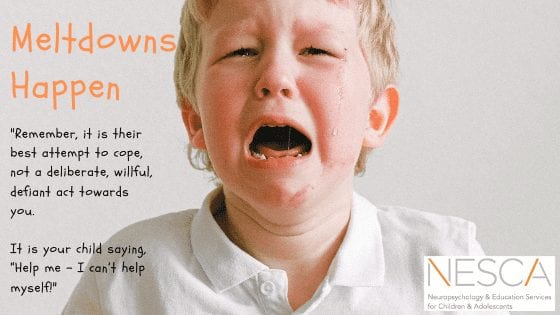
A meltdown may be an explosion and look like crying, throwing things, yelling, aggressing, breaking things, etc. Or it may be more like an implosion – a withdrawal from the family, hiding, sleeping more, lethargy, etc. Both are the same in many ways biologically; the system is in fight, fright or freeze. A meltdown should be viewed as a “neurological storm.” This fight, flight or freeze response is not a child being “bad” or disrespectful, but rather is “bad behavior” that needs to be changed. Remember, it is their best attempt to cope, not a deliberate, willful, defiant act towards you. It is your child saying, “Help me – I can’t help myself! I’ve lost it!” This is not a time to teach, reason with, or win a battle. It is a fire to be put out, and you as the parent or caretaker is the firefighter. It’s a crisis to be managed, and you become your child’s “upstairs brain” or frontal lobe (even though you may want to react from your “downstairs brain,” because you may also be losing it.

Everyone wants to have a good day. Remember, when it’s going in a different direction, you are the adult. You can take a breath and even walk away (if you can) for a few seconds to compose yourself. This allows you to respond versus react. It is your job to manage the situation and take the emotional high road (often easier said than done). In these moments, it is really only about a few things.

  1. Safety and dignity
  2. Keep calm and reduce/simplify your language
  3. Keep calm and know this too shall pass
  4. Don’t get pulled off topic by all the things your child is saying or doing – this is a rabbit hole that you won’t emerge from
  5. Mention what you want to have happen, rather than what you want to stop (“Bang your pillow” instead of “Stop banging the wall”)
  6. Establish connection – right brain to right brain. Remember the mantra, “Name it to tame it.” (i.e. I know this is hard; I know you don’t want to do it; I wouldn’t want to either; or I know you don’t like it, etc.)

Resources:

https://www.drdansiegel.com/books/the_whole_brain_child/


About the Author

NESCA’s Director of Consultation and Psychoeducational Services Dot Lucci has been active in the fields of education, psychology, research and academia for over 30 years. She is a national consultant and speaker on program design and the inclusion of children and adolescents with special needs, especially those diagnosed with Autism Spectrum Disorder (ASD). Prior to joining NESCA, Ms. Lucci was the Principal of the Partners Program/EDCO Collaborative and previously the Program Director and Director of Consultation at MGH/Aspire for 13 years, where she built child, teen and young adult programs and established the 3-Ss (self-awareness, social competency and stress management) as the programming backbone. She also served as director of the Autism Support Center. Ms. Lucci was previously an elementary classroom teacher, special educator, researcher, school psychologist, college professor and director of public schools, a private special education school and an education collaborative.

Ms. Lucci directs NESCA’s consultation services to public and private schools, colleges and universities, businesses and community agencies. She also provides psychoeducational counseling directly to students and parents. Ms. Lucci’s clinical interests include mind-body practices, positive psychology, and the use of technology and biofeedback devices in the instruction of social and emotional learning, especially as they apply to neurodiverse individuals.


To book a consultation with Ms. Lucci or one of our many expert neuropsychologists, complete NESCA’s online intake form. Indicate whether you are seeking an “evaluation” or “consultation” and your preferred clinician/consultant in the referral line.


Neuropsychology & Education Services for Children & Adolescents (NESCA) is a pediatric neuropsychology practice and integrative treatment center with offices in Newton, Massachusetts, Plainville, Massachusetts, and Londonderry, New Hampshire, serving clients from preschool through young adulthood and their families. For more information, please email info@nesca-newton.com or call 617-658-9800.


Good Ideas for Dogs are Good for People, Too

By | NESCA Notes 2020

By Dot Lucci, M.Ed., CAGS

Director of Consultation and Psychoeducational Services, NESCA

  • Play Every Day! — Play can promote calmness and reduce anxiety. This is true for adults and kids.
  • Play Is Learning — Reflect after play by creating and asking questions. Did you learn anything new? What surprised you? How did you feel before you played? How you feel now?
  • Walk, Walk, Walk! — Walking helps dogs stay engaged with the world and brains stimulated. Yup, works for humans, too.
  • Be Present While Walking — Go for walks with or without a dog. Feel the air blowing, smell the flowers, hear the birds singing, feel the rain on your face. Learn the bird calls, bring binoculars and look closely at the birds. Be present as you walk, laugh, sing, splash in puddles….
  • Game Play — Playing games can help satisfy natural instincts. Play old games, teach your children games you played as a child, learn new games. Any games will do – board, card, dice, movement, etc. Play skill games, games of chance or luck games, silly games, etc.
  • Feed Relationships Through Play and Exercise — Bond with each other (a child, a dog or both!) through playing or getting some exercise together. Be active together…teach new tricks, kick a ball around, play catch, take a yoga or Zumba class, watch GoNoodle as long as it’s together.
  • Be in gratitude that you are experiencing this time together to slow down and reconnect with each other. Laugh, play, sing and dance together. Love and care for each other. Enjoy each other.


About the Author

NESCA’s Director of Consultation and Psychoeducational Services Dot Lucci has been active in the fields of education, psychology, research and academia for over 30 years. She is a national consultant and speaker on program design and the inclusion of children and adolescents with special needs, especially those diagnosed with Autism Spectrum Disorder (ASD). Prior to joining NESCA, Ms. Lucci was the Principal of the Partners Program/EDCO Collaborative and previously the Program Director and Director of Consultation at MGH/Aspire for 13 years, where she built child, teen and young adult programs and established the 3-Ss (self-awareness, social competency and stress management) as the programming backbone. She also served as director of the Autism Support Center. Ms. Lucci was previously an elementary classroom teacher, special educator, researcher, school psychologist, college professor and director of public schools, a private special education school and an education collaborative.

Ms. Lucci directs NESCA’s consultation services to public and private schools, colleges and universities, businesses and community agencies. She also provides psychoeducational counseling directly to students and parents. Ms. Lucci’s clinical interests include mind-body practices, positive psychology, and the use of technology and biofeedback devices in the instruction of social and emotional learning, especially as they apply to neurodiverse individuals.


To book a consultation with Ms. Lucci or one of our many expert neuropsychologists, complete NESCA’s online intake form. Indicate whether you are seeking an “evaluation” or “consultation” and your preferred clinician/consultant in the referral line.


Neuropsychology & Education Services for Children & Adolescents (NESCA) is a pediatric neuropsychology practice and integrative treatment center with offices in Newton, Massachusetts, Plainville, Massachusetts, and Londonderry, New Hampshire, serving clients from preschool through young adulthood and their families. For more information, please email info@nesca-newton.com or call 617-658-9800.


Mindfulness: It’s Not Just for Grown-ups

By | NESCA Notes 2019

By: Cynthia Hess, PsyD
Pediatric Neuropsychologist Fellow

There has been increasing interest in intervention strategies that target self-regulation in childhood. Self-regulation is the process through which the systems of emotion, attention and behavior are controlled in response to a situation, stimulus or demand. It develops rapidly in the early years of life. Self-regulation is necessary for social development because it supports and enhances peer acceptance and social success. Furthermore, it increases academic performance, particularly in elementary school. Problems with self-regulation and the accompanying executive functioning have been shown to correlate with a number of behavioral and emotional problems, particularly depression and anxiety. Mindfulness is emerging as an effective intervention for children struggling with self-regulation, especially when implemented at a time when children are acquiring these foundational skills.

Mindfulness is a way of paying attention, on purpose and non-judgmentally, to the experience of the present moment. Being mindful involves reflecting on the current internal experiences such as thoughts or emotions and the current external environment, such as sights and sounds, both clearly and objectively. This act of purposeful reflection enhances and facilitates self-regulation by promoting control, such as sustained attention and cognitive flexibility. Furthermore, it helps to reduce the incidences of such things as snap judgments, emotional reactivity or distressing thoughts.

Mindfulness-based social-emotional training has been shown to be effective in reducing stress, improving coping skills and building resilience when used with children. Mindfulness teaches children the skills needed to improve focus, calm themselves, plan and organize, and behave in a thoughtful manner. Research on adult populations shows that practicing mindfulness may reduce symptoms of anxiety and depression, and limited number of studies show some of the same benefits in children. Mindfulness is well tolerated by children and has been proven to improve psychological well-being. Introducing mindfulness practices to children has the potential to make a positive impact on a child’s ability to self-regulate, and thus facilitate their social, emotional and educational growth.

There are a number of ways to introduce children to mindfulness. One activity that children have responded positively to is being challenged to sit still and silent for as long as they possibly can. I have used this strategy in classrooms of children from pre-k to high school, as well as individually with children of all ages. Sometimes they are able to sit for 15 seconds, but they embraced the challenge of trying to beat their record by trying it again. Another mindful technique that works well with children is called “grounding.” Grounding techniques use the five senses to bring ourselves into the present moment. One grounding technique is finding five things in the room – they can be 5 things of the same color or any five things; four things the child can feel; three things the child can hear; two things the child can smell; and one thing the child can taste. Mindfulness can be playful and fun for children and families while effectively reducing stress, improving coping skills, improving ability to self-regulate and building resilience in children.


Helpful resources for families:

Mindful Games Activity Cards: 55 Fun Ways to Share Mindfulness with Kids and Teens. Susan Kaiser Greenland and Annaka Harris

A Still Quiet Place: A Mindfulness Program for Teaching Children and Adolescents to Ease Stress and Difficult Emotions By Amy Salzman, MD

I am Peace: A Book of Mindfulness By Susan Verde and Peter H. Reynolds

Breathe Like a Bear: 30 Mindful Moments for Kids to Feel Calm and Focused Anytime, Anywhere By Kira Willey


References:

Britton, W. B., Lepp, N. E., Niles, H. F., Rocha, T., Fisher, N. E., & Gold, J. S. (2014). A randomized controlled pilot trial of classroom-based mindfulness meditation compared to an active control condition in sixth-grade children. Journal of School Psychology, 52(3), 263-278.

Masten, A. S., Best, K. M., & Garmezy, N. (1990). Resilience and development: Contributions from the study of children who overcome adversity. Development and psychopathology, 2(4), 425-444.

Schonert-Reichl, K. A., Oberle, E., Lawlor, M. S., Abbott, D., Thomson, K., Oberlander, T. F., & Diamond, A. (2015). Enhancing cognitive and social–emotional development through a simple-to-administer mindfulness-based school program for elementary school children: A randomized controlled trial. Developmental psychology, 51(1), 52.

Schonert-Reichl, K. A., & Lawlor, M. S. (2010). The effects of a mindfulness-based education program on pre-and early adolescents’ well-being and social and emotional competence. Mindfulness, 1(3), 137-151.

Sibinga, E. M., Webb, L., Ghazarian, S. R., & Ellen, J. M. (2016). School-based mindfulness instruction: an RCT. Pediatrics, 137(1), e20152532.


About the Author

Dr. Cynthia Hess recently graduated from Rivier University with a PsyD in Counseling and School Psychology. Previously, she earned an M.A. from Antioch New England in Applied Psychology. She also worked as an elementary school counselor and school psychologist for 15 years before embarking on her doctorate. During her doctorate, she did her pre-doctoral internship with RIT in Rochester, N.Y. where she worked with youth ages 5-17 who had experienced complex developmental trauma. Dr. Hess’s first post-doctoral fellowship was with The Counseling Center of New England where she provided psychotherapy and family therapy to children ages 5-18, their families and young adults. She also trained part-time with a pediatric neuropsychologist conducting neuropsychological evaluations. Currently, Dr. Hess is a second-year post-doctoral fellow in pediatric neuropsychological assessment, working with NESCA Londonderry’s Dr. Angela Currie and Dr. Jessica Geragosian.


To schedule an appointment with one of NESCA’s expert neuropsychologists, please complete our online intake form


Neuropsychology & Education Services for Children & Adolescents (NESCA) is a pediatric neuropsychology practice and integrative treatment center with offices in Newton and Plainville, Massachusetts, and Londonderry, New Hampshire, serving clients from preschool through young adulthood and their families. For more information, please email info@nesca-newton.com or call 617-658-9800.


Introduction to Acupuncture with Licensed Acupuncturist Meghan Meade

By | NESCA Notes 2019


By: Meghan Meade, L.Ac, MAOM, MS PREP, CYT

Licensed Acupuncturist, NESCA

Acupuncture is one of eight branches of Chinese Medicine that dates back over 3,000 years and involves the insertion of hair-thin needles into the body to provoke a healing response.

The body registers needling as a microinjury to which it responds by summoning the immune, nervous and endocrine systems to increase circulation, produce endorphins and other pain-relieving substances and flips the switch on the stress response.1,2,3 The treatment itself effectively assesses the internal imbalance and sends a signal to the body to address it; for this reason, acupuncture’s effects are often described as regulating – reducing elevations in inflammatory markers, enhancing the production and function of essential neurotransmitters, and so on. 1,2,3

Because acupuncture is so regulating to the body’s internal environment, the effects experienced by the patient can be both targeted and systemic2 – while pain relief could be achieved for a specific injury such as a sprained ankle, a patient might also noticed improved sleep or reduced anxiety, for example.

As a practitioner of Japanese style acupuncture, a style that is particularly reliant on using the body’s feedback to guide treatment decisions (though not to the exclusion of a patient’s verbal feedback about their health concerns and experiences), I incorporate pulse diagnosis and palpation into my overall diagnosis and treatments. Because an individual is considered to be the ever-changing reflection of their environment and experiences – physical, mental and emotional – my treatments for a given patient and a given condition will never look the same; each day the body is slightly different than the day prior, and treatments are designed with this principle in mind.

Another important theme within Chinese Medicine is that of duality; acupuncturists consider mutually opposing and complementary elements, such as heat and cold, internal and external, male and female, and yin and yang to be crucial in both assessment and treatment. Whereas yang represents heat, energy, masculinity, day time and light, yin, by contrast, represents coolness, substance, femininity, night time and darkness. When we are born, we are at our peak state of yang, which progressively gives way to yin throughout the lifetime. Because children are by nature more yang, their energy is ample and at the surface; accordingly, treating children and adolescents with acupuncture requires less stimulation to yield a desired response. Often needling is not involved, and non-insertive tools and techniques are preferred for their gentle, effective and often expedient results. Pediatric treatments may involve the use of magnets placed on acupuncture points, as well as brushing and tapping techniques using stainless steel, copper and/or silver tools. Because acupuncture points exist along 14 channels that run up and down the body, an acupuncturist can effect change both in a given channel/organ system and systemically by stimulating a channel through brushing and tapping techniques. While the above statement is true that inserting needles into the skin triggers an extensive sequence of immune, nervous and endocrine system events, so, too, does the more superficial work that acupuncturists perform for their pediatric patients.

The goal of acupuncture is always to harmonize, reducing what is in excess and restoring what is deficient. On a biomedical level, this typically entails a shift in the autonomic nervous system from a sympathetic dominant state – fight or flight mode – to a parasympathetic state – the calmer and more productive – though elusive – ‘rest and digest’ mode.2,3 Similarly, acupuncture regulates the function of hormones, neurotransmitters and immune mediators to achieve this balance. While many feel a positive response from a single treatment, acupuncture is generally not a ‘one and done’ therapy; instead, the response to acupuncture becomes stronger and more lasting over the course of several treatments, as a cumulative signal is often required for the body to carry out the work of regulating imbalances. Often after an initial series of treatments, a patient can enter a maintenance mode of treatment, spacing treatments out in increasingly longer windows and eventually receiving treatment on a maintenance or as-needed basis.

I hope this introductory conversation provides some insight as to how acupuncture works. I will be back with a follow-up post to shed some light on the effect of acupuncture on specific conditions commonly seen among NESCA’s client base.

  1. Cheng, Kwokming James. “Neurobiological Mechanisms of Acupuncture for Some Common Illnesses: A Clinician’s Perspective.” Journal of Acupuncture and Meridian Studies 7.3 (2014): 105-14. Web.
  2. Carlsson, C. “Acupuncture Mechanisms for Clinically Relevant Long-term Effects – Reconsideration and a Hypothesis.” Acupuncture in Medicine 20.2-3 (2002): 82-99. Web.
  3. Cheng, K. J. “Neuroanatomical Characteristics of Acupuncture Points: Relationship between Their Anatomical Locations and Traditional Clinical Indications.” Acupuncture in Medicine 29.4 (2011): 289-94. Web.


About the Author: 

Meghan Meade is a licensed acupuncturist practicing part-time at NESCA.

Having suffered from anxiety, digestive issues, hormonal imbalances and exercise-induced repetitive stress injuries throughout her adolescence and twenties, Meghan first sought out acupuncture as a last ditch effort to salvage some semblance of health and sanity during a particularly stressful period in her life. It worked. Remarkably well. So palpable was the influence of acupuncture on her well being that she was compelled to leave a career in advertising to study Chinese medicine so that she could help others benefit from its effects.

Meghan earned her masters degree in Acupuncture and Oriental Medicine from the New England School of Acupuncture at Massachusetts College of Pharmacy and Health Sciences (MCPHS) and a masters degree in Pain Research, Education and Policy from Tufts University Medical School. She is licensed by the Massachusetts Board of Medicine and is a Diplomate of Oriental Medicine, certified by the National Certification Commission for Acupuncture and Oriental Medicine (NCCAOM).

In her clinical practice, Meghan integrates both Eastern and Western perspectives to provide treatments unique to each patient’s needs and endeavors to empower patients to move forward on their paths to not just feeling good, but feeling like their true selves. In addition to her work as a licensed acupuncturist and herbalist, Meghan serves as adjunct faculty at MCPHS and is a certified yoga teacher.


To learn even more about Meghan and acupuncture, visit her alternate web site or read her blog: https://meghanmeadeacu.com/Meghan is practicing at NESCA during the following hours. Appointments at NESCA can be booked by reaching out to me directly at meghan@meghanmeadeacu.com.

Monday: 10am – 6pm

Thursday: 9am – 7pm


Neuropsychology & Education Services for Children & Adolescents (NESCA) is a pediatric neuropsychology practice and integrative treatment center with offices in Newton and Plainville, Massachusetts, and Londonderry, New Hampshire, serving clients from preschool through young adulthood and their families. For more information, please email info@nesca-newton.com or call 617-658-9800.

What Does Autism Look Like? Exploring the Differences among Girls and Boys

By | NESCA Notes 2019


By: Erin Gibbons, Ph.D.
Pediatric Neuropsychologist, NESCA

In 2018, the Centers for Disease Control and Prevention (CDC) determined that approximately 1 in 59 children is diagnosed with Autism Spectrum Disorder (ASD). Boys are still four times more likely be diagnosed with ASD; however, research indicates that the diagnosis is often missed in girls, especially those who have average intelligence and “milder” forms of ASD. To understand why ASD is more often missed in girls, let’s explore the differences between boys and girls with ASD. This discussion will focus on children with average to above average intelligence (about 50% of all children diagnosed with ASD).


Boys Girls
Poor impulse control, more acting out Likely to be quiet and withdrawn
Disruptive behaviors in the classroom setting Tend to be reserved and cooperative at school
Frequent repetitive motor behaviors that are directly observable Lower frequency of these motor behaviors
Lack of interest in imaginary play Very much engaged in imaginary play
Restricted interests may seem unusual – e.g., train schedules, maps, windmills Restricted interests may seem “age appropriate” – e.g., horses, unicorns, ballet
Trouble making friends Might have a few friends
Likely to exhibit angry outbursts when frustrated/anxious Likely to engage in self-harm or other behaviors that are not observed by others when frustrated/anxious
Lack of awareness of being different or not fitting in More motivated to fit in and “hide” social difficulties – might try to imitate the behavior of a peer that is perceived as popular


Due to these differences, the diagnosis of ASD is often missed in young girls. Adults might agree that a girl is “odd” or “quirky,” but dismiss these concerns because she has good eye contact, has some friends, and does not engage in hand flapping or other unusual behaviors. Unfortunately, other girls might be misdiagnosed, which could lead to ineffective or inappropriate treatment interventions. Most commonly, they might be misdiagnosed with ADHD or Anxiety Disorder.

In many cases, girls with ASD have increasing difficulties with social interactions as they get older and demands get higher. A young girl with ASD might be able to “get by” in social interactions but by the time she reaches adolescence, she is not able to navigate the intricacies of the social milieu. This can lead to social isolation and high risk of being bullied or rejected by peers.

Unfortunately, a missed diagnosis of ASD for a young girl can have long-reaching ramifications. She might experience depression, anxiety and/or low self-esteem, wondering why she doesn’t “fit in” and “feels different” from other girls. She might start to struggle in school or disconnect from activities that she used to enjoy. Moreover, missing the diagnosis in childhood means that she did not receive services to support her social and peer interaction skills during her formative years.

As always, when parents or other caregivers have concerns about a child’s development, it is important to seek an evaluation from a professional. And if the findings do not feel quite right, parents should never feel uncomfortable about seeking a second opinion.


About the Author: 

Erin Gibbons, Ph.D. is a pediatric neuropsychologist with expertise in neurodevelopmental and neuropsychological assessment of infants,

children, and adolescents presenting with developmental disabilities including autism spectrum disorders, Down syndrome, intellectual disabilities, learning disabilities, and attention deficit disorders. She has a particular interest in assessing students with complex medical histories and/or neurological impairments, including those who are cognitively delayed, nonverbal, or physically disabled. Dr. Gibbons joined NESCA in 2011 after completing a two-year post-doctoral fellowship in the Developmental Medicine Center at Boston Children’s Hospital. She particularly enjoys working with young children, especially those who are transitioning from Early Intervention into preschool. Having been trained in administration of the Autism Diagnostic Observation Schedule (ADOS), Dr. Gibbons has experience diagnosing autism spectrum disorders in children aged 12 months and above.


If you are interested in booking an evaluation with Dr. Gibbons or another NESCA neuropsychologist, please fill out and submit our online intake form


Neuropsychology & Education Services for Children & Adolescents (NESCA) is a pediatric neuropsychology practice and integrative treatment center with offices in Newton and Plainville, Massachusetts, and Londonderry, New Hampshire, serving clients from preschool through young adulthood and their families. For more information, please email info@nesca-newton.com or call 617-658-9800.

Skip to content