NESCA’s Newton, MA location has immediate availability for neuropsychological evaluations. Our MA clinicians specialize in the following evaluations: Neuropsychological; Autism; and Emotional and Psychological, as well as Academic Achievement and Learning Disability Testing.

Visit www.nesca-newton.com/intake for more information or to book an evaluation.

Tag

COVID-19 Archives - Page 3 of 5 - NESCA

Subscribe to NESCA Notes

Simple Executive Functioning Strategies When The World Is Anything But Simple

By | NESCA Notes 2020

By: Moira Creedon, Ph.D. 
Pediatric Neuropsychologist, NESCA

Whether your children have returned to school full-time, on a hybrid model or fully virtual learning, we are all juggling. Juggling work demands, family demands, household demands and educational demands in a time of remarkable uncertainty. The start of the school year typically brings the smell of fresh school supplies and our best organizational efforts, but many of us may feel hesitant to use organizing strategies to manage our lives. Why? Because our lives are unpredictable and anything but typical these days. If you’re hesitating to use pen on a calendar, I hear you!

The ability to plan and employ organizational strategies is a key task of our executive functioning system. It’s what allows us to coordinate multiple schedules, dance and sports practices, projects at work, PTO bake sale reminders, and get out the door each day on time. I have been hesitant to adopt routines because I recall vividly how all those plans imploded in March when the world stood still. I hear the buzz about how school will end up fully remote so “put it all down in pencil before it all changes.”  Maybe that will prove true, but in the meantime, let’s consider the ways that we can rally our executive systems to do what they do best: plan, organize and regulate. Some suggestions for how to do this now while the world is unpredictable:

  1. Adopt the Sunday Game Plan. Put information in a family or personal calendar once a week. Spend a few moments on Sunday night catching up on plans for the coming week. Even if we end up transitioning from “hybrid” to “remote” (or all remote), this planning routine can still be adopted. Conclude your Sunday Game Plan by previewing what may be coming the week after in the event of long-term projects. While the content of your game plan may change, the structure can remain consistent.
  2. Keep a consistent schedule for sleep for the family. When we were all in school and work, we had set times to wake up in the morning. We should adopt more consistent bed times at least from Sunday through Thursday nights. Engage kids and teens in a conversation about the plan for sleep. If there are days when children are not waking up to physically attend school, try to keep wake up times no more than an hour off to allow for more consistency in our overall sleep regulation.
  3. As part of your weekly plan, set aside time for exercise. This is particularly important for children who will have reduced physical education activities. Research about the positive impact of exercise on mood, anxiety and attention underscores how important movement is in the day.
  4. Work together with your child to identify a consistent work space. Needing a work space at home is not suddenly and dramatically forced on all of us like it was in the spring. Take the time to arrange a space that is as distraction-free as you can make it. It’s not necessary to run out and buy things as minimal distractions can allow your child to focus on their school work. Keep the supplies nearby in their own bin, basket or box top.
  5. Help your child to create visual schedules or checklists for the day. Include times for virtual school, times for completing assignments and steps to submit the work either electronically or packed for the next day in school. Keep checklists consistent throughout the week when possible.
  6. Plan and schedule breaks. For young kids, try to plan breaks from tasks for every 15-20 minutes. Incorporate movement or stretching when possible to improve focus. For older students, try to plan breaks every 30 minutes of sustained effort. Try to take a full break from screens rather than replacing a tablet/computer screen with a phone or video game.

Children and teens develop their executive functioning skills over time. Keep this in mind as you set up routines and expectations for your whole family as what is expected for a second grader should and will differ from a seventh grader. Again, the content can differ but the structure of using a checklist, planning a break, or working at a desk or table is the same.

Please remember: the pandemic has depleted our executive functioning systems, so it’s important that we are gentle and kind to ourselves. Think about simple and reasonable systems to organize yourself and your family.  And be flexible when we have to go back to the drawing board.


Resources:

Positive impact of exercise:

https://www.sciencedirect.com/science/article/abs/pii/S0022347612009948

Executive Functioning tips and sample schedules:

https://www.smartbutscatteredkids.com/


About the Author: 

Dr. Creedon has expertise in evaluating children and teens with a variety of presenting issues. She is interested in uncovering an individual’s unique pattern of strengths and weaknesses to best formulate a plan for intervention and success. With experiences providing therapy and assessments, Dr. Creedon bridges the gap between testing data and therapeutic services to develop a clear roadmap for change and deeper of understanding of individual needs.


If you are interested in booking an evaluation with Dr. Creedon or another NESCA neuropsychologist, please fill out and submit our online intake form


Neuropsychology & Education Services for Children & Adolescents (NESCA) is a pediatric neuropsychology practice and integrative treatment center with offices in Newton and Plainville, Massachusetts, and Londonderry, New Hampshire, serving clients from preschool through young adulthood and their families. For more information, please email info@nesca-newton.com or call 617-658-9800.

How Do I Prepare My Child for a Neuropsychological Evaluation?

By | NESCA Notes 2020

By: Erin Gibbons, Ph.D.
Pediatric Neuropsychologist, NESCA

Parents often ask us what they should tell their child about their upcoming neuropsychological evaluation, especially when it is their first experience with testing. I advise parents to refer to the neuropsychologist using his or her first name, as the term “doctor” can be scary and raise fears about medical exams. I might also add that the visit will not involve any shots! In order to describe the evaluation itself; here is some helpful language:

  • They are going to ask you questions, and you just need to do your best to answer.
  • They might ask you to do some drawing or writing.
  • Some activities might feel like you’re in school; for example, reading stories or doing math problems.

It may also be helpful to create a simple social story prior to the evaluation to help preview what to expect for your child.

To explain the reasons for doing the evaluation, some key phrases to use with your child include:

  • We want to understand how you learn, because everybody learns differently.
  • We are going to be “brain detectives” and figure out how your brain works!
  • This will help us identify your strengths and areas that we need to work on. That way, we can help you with things that are harder for you.
  • This will help your teachers understand your learning style so they can help you better at school.
  • Just try your best!

Testing in the age of Covid-19 is different. It can be harder to help children feel at ease when everyone is wearing masks, and we can’t offer a high five for good work. But as we are all learning, children are often more resilient than adults. Prior to coming in for an evaluation, you might want to remind your child to wear their mask, wash their hands and not approach people too closely.

It is also important to understand that a neuropsychological evaluation is a lot of work for your child! Finding a way to reward them for their effort will go a long way in helping them stay motivated and positive. This could be as simple as swinging by the drive-thru for a donut or something more extravagant, like a new video game. Whatever you choose to do, create a plan with your child and let the neuropsychologist know. When I have a child in my office who is starting to fatigue, it’s always a great motivator to remind them of the special prize they’ll get at the end of the visit!


About the Author: 

Erin Gibbons, Ph.D. is a pediatric neuropsychologist with expertise in neurodevelopmental and neuropsychological assessment of infants,

children, and adolescents presenting with developmental disabilities including autism spectrum disorders, Down syndrome, intellectual disabilities, learning disabilities, and attention deficit disorders. She has a particular interest in assessing students with complex medical histories and/or neurological impairments, including those who are cognitively delayed, nonverbal, or physically disabled. Dr. Gibbons joined NESCA in 2011 after completing a two-year post-doctoral fellowship in the Developmental Medicine Center at Boston Children’s Hospital. She particularly enjoys working with young children, especially those who are transitioning from Early Intervention into preschool. Having been trained in administration of the Autism Diagnostic Observation Schedule (ADOS), Dr. Gibbons has experience diagnosing autism spectrum disorders in children aged 12 months and above.


If you are interested in booking an evaluation with Dr. Gibbons or another NESCA neuropsychologist, please fill out and submit our online intake form


Neuropsychology & Education Services for Children & Adolescents (NESCA) is a pediatric neuropsychology practice and integrative treatment center with offices in Newton and Plainville, Massachusetts, and Londonderry, New Hampshire, serving clients from preschool through young adulthood and their families. For more information, please email info@nesca-newton.com or call 617-658-9800.

What In-person School Looks Like During COVID-19

By | NESCA Notes 2020

By: Tabitha Monahan, M.A., CRC
Transition Specialist/Counselor

Fall is approaching, and school is starting. As a student, I always knew summer was close to ending when Staples started their “Most Wonderful Time of the Year” commercial. The joy that parents and the community feel as fall approaches and another year of learning begins is understandably absent this year. Many parents, teachers and students are still unsure if they will be remote, in-person or both. All are too aware that even if students and teachers return to the school building, school will not look as it did in the fall of 2019. The comradery that our children experience through recess and interactive group work will be limited. Lunch will not be the boisterous room of students comparing who is in each class and what teachers are giving homework the first week.

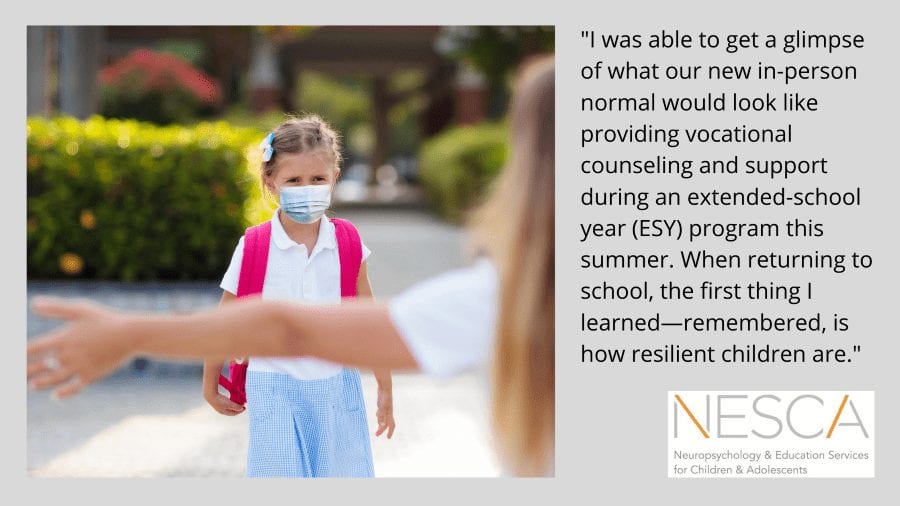
What can we expect then–especially our students who need the small in-person support they have received from their special education teachers, teaching assistants and related service providers? I was able to get a glimpse of what our new in-person normal would look like providing vocational counseling and support during an extended-school year (ESY) program this summer. When returning to school, the first thing I learned—remembered, is how resilient children are. Most students in the programs had very few issues with masks. For those who did, more frequent mask breaks and workarounds, such as face shields, greater distance between them and other students or neck scarves let them still participate in much needed in-person support. Hand-washing and sanitizer have become the norm, and staff and students had frequent opportunities to use both. Social Skills groups still occurred but were modified to continue to be possible. Community-based opportunities were limited, but again, teachers and service providers have long been accustomed to finding out of the box solutions for their students.

Yes, the first day was nerveracking. How were the students going to tolerate wearing a mask for hours on end? How were my co-workers and I going to wear a mask all day long? How was I going to get a drink safely while wearing a mask? But we did. Staff and students alike remained diligent with hand-washing, and the students were ready to learn. Teachers and teaching assistants (TAs) were available and came together for short periods to help students understand challenging tasks. Some of our children and students have behaviors or need activities of daily living (ADL) support that may have us more uneasy with their health and safety returning to in-person learning. Teachers and TAs were prepared for that, too. Whether it was a face shield with a mask, an extra set of clothes to change into or an additional layer of PPE, the student’s needs were met, and we all returned the next day.

Every district seems to have its own approach and plan. Still, in the end, each plan’s goal is the same: have every student continue to learn and prepare for life after high school and have each person return home safe and healthy.


About the Author

Tabitha Monahan, M.A., CRC, is an experienced transition evaluator and vocational counselor. While she is well-versed in supporting a wide range of transition-aged youth, she is especially passionate and knowledgeable in helping clients and their families navigate the complex systems of adult services and benefits as well as medical and mental health systems. She is further adept in working individually with students of all abilities to empower self-advocacy and goal achievement.


To schedule an appointment with one of NESCA’s expert transition specialists or neuropsychologists, please complete our online intake form


Neuropsychology & Education Services for Children & Adolescents (NESCA) is a pediatric neuropsychology practice and integrative treatment center with offices in Newton and Plainville, Massachusetts, and Londonderry, New Hampshire, serving clients from preschool through young adulthood and their families. For more information, please email info@nesca-newton.com or call 617-658-9800.


The Next Pandemic: Mental Health Issues

By | NESCA Notes 2020

By: Ann Helmus, Ph.D.
NESCA Founder/Director

The return to school, whether remotely or in person, will be a transition that is bound to be stressful for many children and adolescents as well as their parents and teachers. Coming on the heels of five stressful months of lockdown, remote learning, loss of social contact and so many other changes,  children will be meeting this challenge with depleted resources for coping with stress and may show new signs of anxiety or mood issues. This will be particularly true for children and adolescents who have underlying issues with mental health, attention or learning. Prioritizing the mental health of students and focusing on providing emotional support will be key to helping children manage the transition back to school. “When children feel connected, they’re going to learn better, do better, stay on track,” commented Dr. Nadine Kaslow, professor of psychiatry at Emory School of Medicine and past president of the American Psychological Association, in this article. She emphasized that “loving warm interactions need to take precedence” over struggling with them about behavior or about schoolwork.”   Remembering that undesirable behaviors are often driven by emotional distress and are a form of communication can be helpful for parents in responding in a positive and supportive manner. As we continue through this period of unprecedented levels of stress and change, children need to feel connected to and supported by their parents even more than is usual; maintaining this connection is far more important than any academic goals, no matter how far behind parents fear their child is as a result of the interruption to regular schooling.

If you have concerns about your child’s mental health, clinicians at NESCA are available for expert consultation or evaluation of your child’s emotional functioning so that the appropriate supports can be put in place. This work can be done either through teletherapy or in-person through contactless evaluations in all three of our locations (Newton and Plainville, MA and Londonderry, NH). NESCA has several suites in which there is a large plexiglass panel in the shared wall between two offices so that the child/parent and evaluator/therapist are in separate offices but have the benefit of full visibility and communication through headphones. For more information, please view, “Testing in the Age of COVID-19” on our Video Resources page.

If you have questions about your child’s mental health and would like professional help, please reach out to Dot Lucci, M.Ed., CAGS: dlucci@nesca-newton.com for an intake and screening.


About the Author: 

NESCA Founder/Director Ann Helmus, Ph.D. is a licensed clinical neuropsychologist who has been practicing for almost 20 years. In 1996, she jointly founded the  Children’s Evaluation Center (CEC) in Newton, Massachusetts, serving as co-director there for almost ten years. During that time, CEC emerged as a leading regional center for the diagnosis and remediation of both learning disabilities and Autism Spectrum Disorders.

In September of 2007, Dr. Helmus established NESCA (Neuropsychology & Education Services for Children & Adolescents), a client and family-centered group of seasoned neuropsychologists and allied staff, many of whom she trained, striving to create and refine innovative clinical protocols and dedicated to setting new standards of care in the field.

Dr. Helmus specializes in the evaluation of children with learning disabilities, attention and executive function deficits and primary neurological disorders. In addition to assessing children, she also provides consultation and training to both public and private school systems. She frequently makes presentations to groups of parents, particularly on the topics of non-verbal learning disability and executive functioning.

To book an evaluation with Dr. Helmus, NESCA Founder and Director, or one of our many other expert neuropsychologists or therapists, complete NESCA’s online intake form

Neuropsychology & Education Services for Children & Adolescents (NESCA) is a pediatric neuropsychology practice and integrative treatment center with offices in Newton and Plainville, Massachusetts, as well as Londonderry, New Hampshire. NESCA serves clients from preschool through young adulthood and their families. For more information, please email info@nesca-newton.com or call 617-658-9800.

“Doomscrolling” and Creating Space for Gratitude

By | NESCA Notes 2020

By: Cynthia Hess, PsyD
Pediatric Neuropsychologist Fellow and Therapist

A recent article in the New York Times (July 15, 2020) discusses a newly coined term for a coping strategy that has become pervasive amidst all the uncertainty: “Doomscrolling.” In the article, doomscrolling is defined as, “…the experience of sinking into emotional quicksand while bingeing on doom-and-gloom news.” It has become so common, it has a name.

We are collectively experiencing a great deal of anticipatory anxiety, which occurs when we feel anxious or stressed about an event that will happen in the future. We know there will be an event, but we do not know when or what that event will be. For those who participate in doomscrolling, perhaps it is an effort to find a sense of certainty. If we know what is coming next, it helps us feel more in control. However, while doomscrolling may provide a short-term sense of control, like many maladaptive ways of coping, it will eventually take a toll on our mental and physical well-being. Several wonderful suggestions are offered in the article and a follow-up piece to deal with doomscrolling. Another positive strategy for coping with anxiety and stress is practicing gratitude.

According to the National Institutes of Health, early research suggests that a daily habit of practicing gratitude may improve emotional and physical health. Practicing gratitude reduces stress and anxiety by regulating stress hormones in the brain. It also enhances the production of dopamine and serotonin, two neurotransmitters responsible for our emotions and sense of well-being. Practicing gratitude can be as simple as taking a moment to appreciate a good cup of coffee or a refreshing breeze on a hot day. There are many ways to create space for gratitude:

  • Take a few moments each day to write down as many things as you can that you are grateful for
  • Try to notice positive moments as they are happening
  • Compliment yourself each day and say it out loud
  • Keep a gratitude journal that includes: Compliments that you give yourself, current challenges and what you are learning, people you are grateful for, and significant assets of your life right now.
  • Start a gratitude jar with your family where each person writes one thing they are grateful for that day on a slip of paper and adds it to the jar. The notes can be read aloud at the start of each new week.

For further reading check out these articles:

https://www.nytimes.com/2020/07/15/technology/personaltech/youre-doomscrolling-again-heres-how-to-snap-out-of-it.html

https://www.nytimes.com/2020/07/16/technology/coronavirus-doomscrolling.html?searchResultPosition=2

https://positivepsychology.com/neuroscience-of-gratitude.


About the Author

Dr. Cynthia Hess recently graduated from Rivier University with a PsyD in Counseling and School Psychology. Previously, she earned an M.A. from Antioch New England in Applied Psychology. She also worked as an elementary school counselor and school psychologist for 15 years before embarking on her doctorate. During her doctorate, she did her pre-doctoral internship with RIT in Rochester, N.Y. where she worked with youth ages 5-17 who had experienced complex developmental trauma. Dr. Hess’s first post-doctoral fellowship was with The Counseling Center of New England where she provided psychotherapy and family therapy to children ages 5-18, their families and young adults. She also trained part-time with a pediatric neuropsychologist conducting neuropsychological evaluations. Currently, Dr. Hess is a second-year post-doctoral fellow in pediatric neuropsychological assessment, working with NESCA Londonderry’s Dr. Angela Currie.


To schedule an appointment with one of NESCA’s expert neuropsychologists, please complete our online intake form


Neuropsychology & Education Services for Children & Adolescents (NESCA) is a pediatric neuropsychology practice and integrative treatment center with offices in Newton and Plainville, Massachusetts, and Londonderry, New Hampshire, serving clients from preschool through young adulthood and their families. For more information, please email info@nesca-newton.com or call 617-658-9800.


Coronavirus & Social Injustice: A Crisis or an Opportunity? – Part 2

By | NESCA Notes 2020

By Dot Lucci, M.Ed., CAGS

Director of Consultation and Psychoeducational Services, NESCA

Last week in my blog post, I wrote about one’s perspective about the coronavirus as an opportunity or as a crisis. Initially, most everyone thought it was a crisis and we needed to mobilize to fight it. Massachusetts Governor Charlie Baker recognized it as a crisis early on and has handled it with steadfastness and clarity; whether or not you agree with his decisions. Recently, he mobilized a commission to discuss the re-opening of schools in the fall. This commission has stakeholders from across the Commonwealth, including parents, business leaders, community leaders, educators and administrators. As part of guidance on the reopening of schools, Governor Baker and the Massachusetts Department of Elementary and Secondary Education (DESE) told school district administrators to plan for three scenarios of returning to school in the fall: in-person, a hybrid of remote and in-person, and all remote learning. The districts were given deadlines to submit their plans – a daunting task for all involved. But this pandemic has created many daunting tasks for all of us, and we must come together thinking flexibly, creatively and collaboratively to handle this crisis and move towards thinking about it as an opportunity. Our world as we know it and much of the workings of our world have changed and probably will remain changed for the foreseeable future (i.e., open floor offices are a thing of the past; working from home is proving for some to be more productive).

We are all in this together and when parents, students, teachers and administrators think about the return to in-person instruction in the fall, it brings about many different emotions as well as concerns. Administrators have to plan for all three scenarios, because there are so many unknown variables to consider. For instance, we could start in-person learning then need to switch to remote if there is an uptick in positive cases of the coronavirus. School re-entry in the fall is an unknown, but our leaders are trying to plan as best they can for all possibilities. Ultimately, returning to in-person learning will be a personal decision for every parent based on many variables for each of their children. What’s good for one child may not be good for another in the same family, let alone one family to another.

I wonder about viewing the coronavirus and the havoc it’s wreaked on our educational systems as a genuine opportunity to truly rethink how we educate students. Maybe it is seriously time to consider dramatic school reform. Our education system is antiquated and has not changed much over the years even with the advent of STEAM. We still have achievement gaps with many students not succeeding even with reforms and many dollars spent. Maybe the coronavirus and the social injustice movement are just the crises that are the opportunity that will really change how we think about education, bringing about dynamic and dramatic school reform.

In last week’s blog, I quoted John F. Kennedy as saying, “The Chinese use two brush strokes to write the word ‘crisis.’ One brush stroke stands for danger; the other for opportunity. In a crisis be aware of the danger – but recognize the opportunity.” The coronavirus and social injustice are certainly crises of today, yet I do see them as an opportunity to heal the divisions in our country, increase dialogue and create change.

Last week Massachusetts DESE Commissioner Riley’s Weekly Update included “Protocols for Responding to COVID-19 Scenarios.” This guidance provides more information and protocols to answer the following questions:

  • What should a district do if there is a symptomatic individual – at home, on the bus or at school?
  • What should a district do if someone in the school community tests positive for COVID-19 – be it a student, teacher, staff, bus driver, or one of their household members or close contacts?
  • Who should get tested for COVID-19 and when?
  • In what circumstances would someone need to quarantine (when they have been exposed but are not sick) or isolate (when they are sick)?
  • What should school districts do to monitor COVID-19 spread in their communities?”

These guidelines may change as the situation changes, but as they stand now. I have heard a variety of responses to these guidelines, such as:

  • “This makes my head hurt and eyes blur.”
  • “They have got to be joking.”
  • “It’s an attempt. They’re trying.”
  • “Kids have to go back some day.”
  • “Deep breaths and an open mind are needed.”
  • “We’re all in this together. We have to try.”

As these comments demonstrate, there are many different feelings and thoughts about going back to in-person instruction in the fall. Our administrators and leaders are juggling so many different variables in making decisions. It “requires” us to trust them and show concern, compassion and gratitude in their attempts at re-opening schools. I recognize the three options presented are just that – three options. No matter what the decisions are about how we return to school, it will be what it will be in each community.

It is my hope that our leaders can view this pandemic, this crisis, as an opportunity to seriously contemplate and delve deeply into discussions about school reform within our country. This pandemic has dramatically shown the inequities that exist across our state and country and in our cities and towns. We knew they were there before, but now they are in our faces. We have an opportunity to think about education as not related to one’s zip code, socio-economic status, color of one’s skin/ethnicity or other factors; instead we can think about it as a basic human right that should be equal for all.

Education is about preparing children to become a competent member of our society and community. We have an opportunity to think about how and where we educate students. Education is about learning and preparing students for tomorrow. Many districts that were socially-emotionally-focused and had good technology capabilities were able to be nimble and pivoted smoothly to remote learning during the pandemic. These districts also had good leadership, solid communication with families and students, and staff felt cared for. There were many other districts that struggled to pivot to remote learning for a myriad of reasons, and this points out that equity in our educational system is necessary. So, while you think about the fall and schools reopening, do what you think is right for your child and family. Also, remember that this “new normal” of remote learning can be okay if done well.

In the special education vernacular, you often hear that special education isn’t a place or a program. That is also true for all education – education isn’t a place. It is so much more. The Center for Education Reform states that the future of schools is students, not systems. This might be a good time to devote some energy to reforming our educational system for the future.


About the Author

NESCA’s Director of Consultation and Psychoeducational Services Dot Lucci has been active in the fields of education, psychology, research and academia for over 30 years. She is a national consultant and speaker on program design and the inclusion of children and adolescents with special needs, especially those diagnosed with Autism Spectrum Disorder (ASD). Prior to joining NESCA, Ms. Lucci was the Principal of the Partners Program/EDCO Collaborative and previously the Program Director and Director of Consultation at MGH/Aspire for 13 years, where she built child, teen and young adult programs and established the 3-Ss (self-awareness, social competency and stress management) as the programming backbone. She also served as director of the Autism Support Center. Ms. Lucci was previously an elementary classroom teacher, special educator, researcher, school psychologist, college professor and director of public schools, a private special education school and an education collaborative.
Ms. Lucci directs NESCA’s consultation services to public and private schools, colleges and universities, businesses and community agencies. She also provides psychoeducational counseling directly to students and parents. Ms. Lucci’s clinical interests include mind-body practices, positive psychology, and the use of technology and biofeedback devices in the instruction of social and emotional learning, especially as they apply to neurodiverse individuals.


To book a consultation with Ms. Lucci or one of our many expert neuropsychologists, complete NESCA’s online intake form. Indicate whether you are seeking an “evaluation” or “consultation” and your preferred clinician/consultant in the referral line.


Neuropsychology & Education Services for Children & Adolescents (NESCA) is a pediatric neuropsychology practice and integrative treatment center with offices in Newton, Massachusetts, Plainville, Massachusetts, and Londonderry, New Hampshire, serving clients from preschool through young adulthood and their families. For more information, please email info@nesca-newton.com or call 617-658-9800.


Coronavirus & Social Injustice: A Crisis or an Opportunity? – Part 1

By | NESCA Notes 2020

By Dot Lucci, M.Ed., CAGS

Director of Consultation and Psychoeducational Services, NESCA

As our leaders try to handle the crises of today, we can be angry or pleased at their attempt. I know I’ve been both, but yet recognize that they are trying to make tough decisions while taking into consideration many uncontrollable variables. In making these tough decisions (i.e. opening/shutting down schools, stay at home orders, managing protesters, etc.), it is almost impossible to please everyone. As the days turn into months, panic, anger, guilt and irrational thinking won’t work for us as individuals nor as a community. Instead it would behoove us to come together, show care, concern, empathy and gratitude toward each other. Recognizing that the divisions that exist amongst us are what keeps us fighting, in fear and not working towards common goals. We must acknowledge our differences, yet come together to be problem solvers and be optimists to handle the crises of the coronavirus and the social injustice that is plaguing our cities and impacting our children.

John F. Kennedy was quoted as saying, “The Chinese use two brush strokes to write the word ‘crisis.’ One brush stroke stands for danger; the other for opportunity. In a crisis be aware of the danger – but recognize the opportunity.” The coronavirus is most certainly a daunting, unprecedented crisis that has befallen our country and our world.

In March, our lives changed dramatically as schools in Massachusetts were shut down and we were told to quarantine. Now five months later, we begin to reopen. Now, I wonder if we can look at this crisis a bit differently – maybe as an opportunity. But an opportunity for what? Seeing a crisis as an opportunity takes courage and faith and requires a peace of mind that is rooted in a sense of calm, not fear. This allows creative and flexible thinking to emerge. We become problem solvers. As days turned into months of quarantine and we tried to “settle into the new normal and go with the flow,” my hope is that some of the initial panic and fear has subsided slightly in your hearts and minds. Maybe new rhythms or routines have been created – we’re commuting less, enjoying time with family, cleaning the basement, cooking more, etc. Some opportunities have arisen whether we’ve noticed them or not and whether we’ve liked them or not. Do you think you’re ready to think differently about this crisis? Can you find moments in each day that arise because of the crisis that open up opportunities or possibilities?

As we settle into mid-summer, we also begin to think about schools reopening in the fall and what that will look like. Will it be a crisis or an opportunity? Only you can decide.


About the Author

NESCA’s Director of Consultation and Psychoeducational Services Dot Lucci has been active in the fields of education, psychology, research and academia for over 30 years. She is a national consultant and speaker on program design and the inclusion of children and adolescents with special needs, especially those diagnosed with Autism Spectrum Disorder (ASD). Prior to joining NESCA, Ms. Lucci was the Principal of the Partners Program/EDCO Collaborative and previously the Program Director and Director of Consultation at MGH/Aspire for 13 years, where she built child, teen and young adult programs and established the 3-Ss (self-awareness, social competency and stress management) as the programming backbone. She also served as director of the Autism Support Center. Ms. Lucci was previously an elementary classroom teacher, special educator, researcher, school psychologist, college professor and director of public schools, a private special education school and an education collaborative.

Ms. Lucci directs NESCA’s consultation services to public and private schools, colleges and universities, businesses and community agencies. She also provides psychoeducational counseling directly to students and parents. Ms. Lucci’s clinical interests include mind-body practices, positive psychology, and the use of technology and biofeedback devices in the instruction of social and emotional learning, especially as they apply to neurodiverse individuals.


To book a consultation with Ms. Lucci or one of our many expert neuropsychologists, complete NESCA’s online intake form. Indicate whether you are seeking an “evaluation” or “consultation” and your preferred clinician/consultant in the referral line.


Neuropsychology & Education Services for Children & Adolescents (NESCA) is a pediatric neuropsychology practice and integrative treatment center with offices in Newton, Massachusetts, Plainville, Massachusetts, and Londonderry, New Hampshire, serving clients from preschool through young adulthood and their families. For more information, please email info@nesca-newton.com or call 617-658-9800.


Positive Coping Strategies for Stress, Anxiety and Trauma During Times of Crisis

By | NESCA Notes 2020

By Renée Marchant, Psy.D.
Pediatric Neuropsychologist

Amidst the global pandemic, children, their caregivers, their teachers and therapists are naturally experiencing heightened stress and anxiety. We are more likely to be sent into “fight, flight, freeze, mode” – the body and brain’s critical survival strategy to prepare and deal with perceived threat. For example, when you see a Grizzly Bear on your hiking trail, you instinctually run, fight back or hide.

However, we can become “stuck” or more sensitive to this instinctual urge, which is not adaptive and can negatively impact physical, emotional and social health. For example, chronic deployment of the “flight, flight, freeze” response occurs for individuals who experience post-traumatic stress disorder. Chronic deployment of “fight, flight, freeze” responses is also more likely amidst a global pandemic, such as COVID-19. Importantly, chronic deployment of “fight, flight, freeze” responses also occurs for individuals and communities who experience chronic racial injustice and oppression.

Under chronic experiences of stress and threat, our body remains activated and hyper-aroused, even when deploying this response is not helpful. For example, children may shut down or dysregulate when faced with even small stressors – making an error on a math worksheet or even accidentally spilling something on the table. Children and teens may be more irritable, defiant or isolative. Overall, chronic deployment of the “fight, flight, freeze” response heightens anxiety, stress and general feelings of malaise.

So, what can we do? What can we do to “turn off” or lessen this stress response? What are some ways to positively cope during these difficult times?

  1. Research shows that the #1 resiliency factor is the reliable presence of at least one supportive relationship with an adult. Build connection and community through shared activities and conversations about your experiences. Remember to always take care of yourself before taking care of others – self-care is critical.
  2. Focus on validation first; problem-solving second. Validating, acknowledging and accepting pain, distress, hurt and the like builds communication and naturally decreases tension and stress. Validation is the essential first step prior to action, problem-solving and positive coping.
  3. In order to grow positive coping, it is helpful to build mastery and self-expression. Strategies that can help to both organize and “release” feelings and stressful experiences rather than “bottle them up” include:
  • Use your body to heal your mind: play, do yoga, engage with nature, exercise;
  • Engage in shared action to promote communication and change at a community and systemic level. Volunteer or advocate for a cause of importance. Contact your local legislators and express your concerns;
  • Write or draw about your experience. Use collages, images or videos to express your goals, experiences and fears;
  • Engage in therapeutic movement. Create a music playlist for various emotions. Dance or engage in rhythmic actions (e.g. knitting, pottery);
  • Identify your strengths and what you value in life. Happiness is fleeting – goals and values last longer and support positive coping. For a free strengths and values survey, check out: https://www.viacharacter.org/;
  • Connect with community resources available in your area, such as therapists, mentors, religious organizations, support groups, local-nonprofits, etc.; and
  • Be kind to yourself and practice self-compassion.

To learn more about this topic, a helpful webinar is available at “Supports for Students with a History of Trauma and Significant Anxiety,“ presented by Dr. Renee Marchant, PsyD, and Dr. Stephanie Monaghan-Blout, PsyD.


About the Author:

Dr. Renée Marchant provides neuropsychological and psychological (projective) assessments for youth who present with a variety of complex, inter-related needs, with a particular emphasis on identifying co-occurring neurodevelopmental and psychiatric challenges. She specializes in the evaluation of developmental disabilities including autism spectrum disorder and social-emotional difficulties stemming from mood, anxiety, attachment and trauma-related diagnoses. She often assesses children who have “unique learning styles” that can underlie deficits in problem-solving, emotion regulation, social skills and self-esteem.
Dr. Marchant’s assessments prioritize the “whole picture,” particularly how systemic factors, such as culture, family life, school climate and broader systems impact diagnoses and treatment needs. She frequently observes children at school and participates in IEP meetings.

Dr. Marchant brings a wealth of clinical experience to her evaluations. In addition to her expertise in assessment, she has extensive experience providing evidence-based therapy to children in individual (TF-CBT, insight-oriented), group (DBT) and family (solution-focused, structural) modalities. Her school, home and treatment recommendations integrate practice-informed interventions that are tailored to the child’s unique needs.

Dr. Marchant received her B.A. from Boston College with a major in Clinical Psychology and her Psy.D. from William James College in Massachusetts. She completed her internship at the University of Utah’s Neuropsychiatric Institute and her postdoctoral fellowship at Cambridge Health Alliance, a Harvard Medical School teaching hospital, where she deepened her expertise in providing therapy and conducting assessments for children with neurodevelopmental disorders as well as youth who present with high-risk behaviors (e.g. psychosis, self-injury, aggression, suicidal ideation).

Dr. Marchant provides workshops and consultations to parents, school personnel and treatment professionals on ways to cultivate resilience and self-efficacy in the face of adversity, trauma, interpersonal violence and bullying. She is an expert on the interpretation of the Rorschach Inkblot Test and provides teaching and supervision on the usefulness of projective/performance-based measures in assessment. Dr. Marchant is also a member of the American Family Therapy Academy (AFTA) and continues to conduct research on the effectiveness of family therapy for high-risk, hospitalized patients.


To book an evaluation with Dr. Marchant or one of our many other expert neuropsychologists, complete NESCA’s online intake form.


Neuropsychology & Education Services for Children & Adolescents (NESCA) is a pediatric neuropsychology practice and integrative treatment center with offices in Newton and Plainville, Massachusetts, and Londonderry, New Hampshire, serving clients from preschool through young adulthood and their families. For more information, please email info@nesca-newton.com or call 617-658-9800.


YES! COVID-19 May be Making Basic Daily Tasks More Difficult: The Link Between Executive Function Difficulties and Anxiety/Stress

By | NESCA Notes 2020

By: Sophie Bellenis, OTD, OTR/L

Occupational Therapist; Real-life Skills Program Manager and Coach

As our country continues to adapt to life in the era of COVID-19, it is quite well established that there has been a rise in anxiety and stress among our population. According to the Centers for Disease Control and Prevention (CDC), the mental health effects of the current pandemic have been substantial and include difficulty sleeping, worsening chronic health problems, changes in eating patterns, fear about personal health and the health of loved ones, and increased use of tobacco and alcohol (CDC, 2020). Many of these fears and new challenges are expected and understandable. They are responses that intuitively make sense to us as humans, as many of us experience them on a small scale throughout a typical year. Most people can name a time when they could not fall asleep before a big test or did not take excellent care of their physical health when they were hugely stressed or anxious. However, one effect of this newly heightened stress and anxiety that is less frequently mentioned is the decrease in executive function skills.

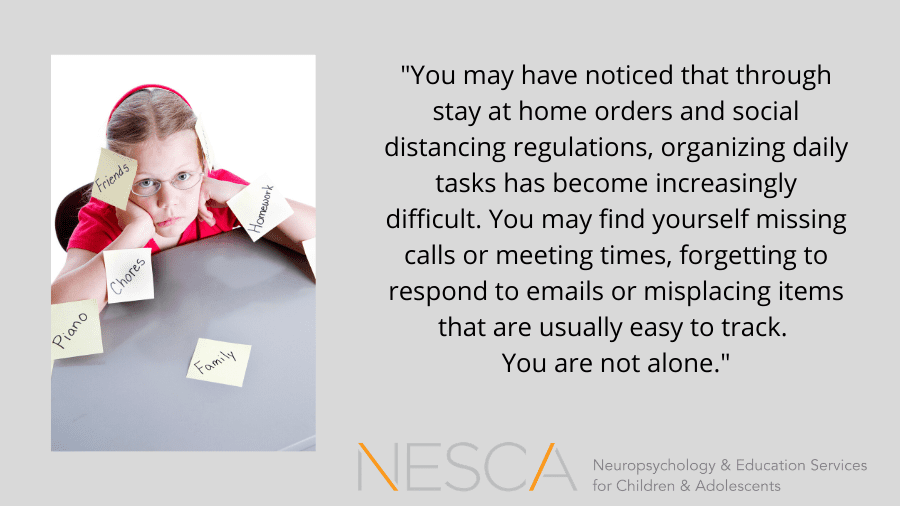
The term executive function refers to the brain processes that allow someone to stay organized, initiate tasks, maintain focus and attention, and manipulative information in their mind. As NESCA Pediatric Neuropsychologist Dr. Alissa Talamo describes in her piece, “What is Executive Function?,” this group of skills can be thought of as the conductor of the brain, similar to the conductor of an orchestra. They are keeping time, telling us when to start and stop tasks and helping us to stay regulated through the ups and downs of the day. You may have noticed that through stay at home orders and social distancing regulations, organizing daily tasks has become increasingly difficult. You may find yourself missing calls or meeting times, forgetting to respond to emails or misplacing items that are usually easy to track. You are not alone. Some people have started to describe a brain fog and a perceived inability to stay focused on a task for more than a short period of time.

While maybe not as intuitive as a lack of sleep, this decrease in executive function is to be expected as we collectively move through this stressful experience. Substantial research has described the correlation between depression, anxiety and stress, and executive function deficits. This seems to be particularly strong for adolescents with depressive and anxious symptoms, who have trouble with cognitive flexibility (Han, Helm, Iucha, Zahn-Waxler & Hastings, 2016). Similarly, university students are another population vulnerable to these effects, as described by Ajilchi and Nejati in 2017, who found specific difficulties with sustained attention and decision making. It is no surprise that one diagnostic criteria for generalized anxiety disorder is “difficulty concentrating or mind going blank” (APA, 2013). When reviewing the literature, it is clear that the brain fog and inability to focus through COVID-19 is not only unsurprising, for many people, it was inevitable.

So, what do we do? How do we soldier on through this incredibly unique time, despite the feeling that everything takes just a bit more time and effort?

It is increasingly important to cut ourselves some slack and stop expecting perfection. Focusing on self-care and taking care of each other emotionally will potentially lead to a natural return to successful executive function. By creating habits and routines that promote positive mental health, we are more likely to mitigate the feelings of being overwhelmed and the potential for burnout. Additionally, using technology and digital reminders to help take over the tasks of initiation and organization can give our over-extended brains a bit of a rest.

Finally, it is imperative that we think about the adolescents and students in our communities who are just starting to build these skills. Building executive function skills comes from a combination of direct instruction and opportunity to practice. Currently, students are being provided ample opportunity to practice, with limited direct instruction and guidance. Consider teaching your children and adolescents the tricks that you have learned to stay organized, prepared and productive. If you feel like teaching these skills is outside of your wheelhouse, or at all daunting, look into the prospect of an executive function coach. With all of the uncertainty about what education will look like this fall, helping students feel ready to tackle learning is one way to mitigate the anxiety and stress of this transitional time.


References

Ajilchi, B., & Nejati, V. (2017). Executive Functions in Students with Depression, Anxiety, and Stress Symptoms. Basic and clinical neuroscience8(3), 223–232. https://doi.org/10.18869/nirp.bcn.8.3.223

American Psychiatric Association. (2013). Diagnostic and statistical manual of mental disorders (5th ed.). Arlington, VA: American Psychiatric Publishing.

Center for Disease Control and Prevention. (2020) Coronavirus disease 2019: Coping with stress. Retrieved from: https://www.cdc.gov/coronavirus/2019-ncov/daily-life-coping/managing-stress-anxiety.html

Han, G., Helm, J., Iucha, C., Zahn-Waxler, C., Hastings, P. D., & Klimes-Dougan, B. (2016). Are Executive Functioning Deficits Concurrently and Predictively Associated with Depressive and Anxiety Symptoms in Adolescents?. Journal of clinical child and adolescent psychology : the official journal for the Society of Clinical Child and Adolescent Psychology, American Psychological Association, Division 5345(1), 44–58. https://doi.org/10.1080/15374416.2015.1041592


About the Author

Dr. Sophie Bellenis is a Licensed Occupational Therapist in Massachusetts, specializing in educational OT and functional life skills development. Dr. Bellenis joined NESCA in the fall of 2017 to offer community-based skills coaching services as a part of the Real-life Skills Program within NESCA’s Transition Services team. Dr. Bellenis graduated from the MGH Institute of Health Professions with a Doctorate in Occupational Therapy, with a focus on pediatrics and international program evaluation. She is a member of the American Occupational Therapy Association, as well as the World Federation of Occupational Therapists. Having spent years delivering direct services at the elementary, middle school and high school levels, Dr. Bellenis has extensive background with school-based occupational therapy services.  She believes that individual sensory needs and visual skills must be taken into account to create comprehensive educational programming.

To book an appointment or to learn more about NESCA’s Occupational Therapy Services, please fill out our online Intake Form, email info@nesca-newton.com or call 617-658-9800.


Neuropsychology & Education Services for Children & Adolescents (NESCA) is a pediatric neuropsychology practice and integrative treatment center with offices in Newton, Massachusetts, Plainville, Massachusetts, and Londonderry, New Hampshire, serving clients from preschool through young adulthood and their families. For more information, please email info@nesca-newton.com or call 617-658-9800.


“Can I Hug You?” – Why the pandemic has us craving closeness

By | NESCA Notes 2020

By: Angela Currie, Ph.D.
Pediatric Neuropsychologist, NESCA
Director of Training and New Hampshire Operations

At the end of a testing session last week, my young client and I stood looking at each other through the large glass window of our contactless, adjoined testing rooms. Our hands were newly washed; the fresh scent of antibacterial wipes emitted from the tables; and our face coverings were in place. And while looking at one another from our respective bubbles, inside this necessarily sterile setting, my client looked me in the eye and asked: “Can I hug you?”

The question hung in the air for a moment. In the 15 years that I have worked with children, I have rarely hesitated when a child asks me this. But there we were, mid-pandemic, in this brief, perhaps imperceptible, moment of uncertainty.

One thing I have become keenly aware of since starting to see family and friends for socially distanced visits is how much I, and my children, have to consciously fight the physical urge to embrace the people we love. The urge is palpable. But where does this come from?

There is a great body of research demonstrating the importance of physical touch, particularly hugging. Hugs are not just a simply a way of demonstrating your love or support for someone, but hugging actually causes physiological changes within the body. Stress hormones, such as cortisol, reduce, and the nervous system slows down. Oxytocin – a hormone integral to bonding – is released, increasing closeness and affection. Over time, close physical contact results in improved brain development, heart health, emotional health, relationship patterns and immune function.

In many ways, physical touch is a basic human need that must be met. Individuals who are deprived of these experiences, particularly early in life, can experience detrimental effects. Fortunately, some of these effects can be mitigated once opportunities for closeness are offered. As such, our bodies and brains never fully give up on the urge for closeness, even after long durations of it being unmet. And this urge has a name – skin hunger.

Most people have felt skin hunger at some point – a driving urge for human contact and connection. This may come after a particularly stressful day at work, an argument with a friend or just a general feeling of loneliness. In times of uncertainty, distress or instability, the human need for closeness increases. And yet, for so many who are enduring the COVID-19 pandemic, closeness is the exact thing that they are being deprived of. Even when we are lucky enough to still have access to our families, or perhaps a small group of close friends, our emotional needs are high. Physiologically, psychologically, we need more hugs.

The good news is, there are things that you can do to meet this need:

  • Consciously make an effort to hug those you can, and do it more often than typical.
  • Snuggle up with your dog, your cat or other pet of choice.
  • For those who live alone and do not have pets, a weighted blanket, warm bath or hugging a pillow can simulate the effects of human touch.
  • Maintain social connection through video chat, phone calls and socially distanced visits. Interpersonal contact without hugging is better than no contact.
  • Be careful to not accidentally over-associate hugs or touch with danger. Coronavirus will eventually be managed, but training our children to fear closeness could have enduring, negative effects. Choose words wisely, teaching pragmatic, unemotional caution, not fear.


About the Author:

Dr. Angela Currie is a pediatric neuropsychologist at NESCA. She conducts neuropsychological and psychological evaluations out of our Londonderry, NH office. She specializes in the evaluation of anxious children and teens, working to tease apart the various factors lending to their stress, such as underlying learning, attentional, or emotional challenges. She particularly enjoys working with the seemingly “unmotivated” child, as well as children who have “flown under the radar” for years due to their desire to succeed.


To book an evaluation with Dr. Currie or one of our many other expert neuropsychologists, complete NESCA’s online intake form. Indicate whether you are seeking an “evaluation” or “consultation” and your preferred clinician in the referral line.


Neuropsychology & Education Services for Children & Adolescents (NESCA) is a pediatric neuropsychology practice and integrative treatment center with offices in Londonderry, NH, Plainville, MA, and Newton, MA serving clients from preschool through young adulthood and their families. For more information, please email info@nesca-newton.com or call (603) 818-8526.

Skip to content