NESCA’s Newton, MA location has immediate availability for neuropsychological evaluations. Our MA clinicians specialize in the following evaluations: Neuropsychological; Autism; and Emotional and Psychological, as well as Academic Achievement and Learning Disability Testing.

Visit www.nesca-newton.com/intake for more information or to book an evaluation.

Tag

iep Archives - Page 2 of 4 - NESCA

Subscribe to NESCA Notes

October is Gap Year Exploration Month – Why Should Teens on IEPs Care?

By | NESCA Notes 2024

By: Kelley Challen, Ed.M., CAS
Director of Transition Services, NESCA

Last September, I received an email from a colleague with the title May I nominate you? The body of the email described that October is Gap Year Exploration Month (GYEM) and asked if I would be willing to be a GYEM Amplifier, meaning would I be willing to share information with my personal and professional network to create awareness about gap years and increase student consideration of gap years as one of their post-secondary options. This was an easy “YES!” for me because I have spent the majority of my career trying to help students and families who I work with to understand that there are many other options besides college, or before college, for students to pursue after high school. A common recommendation that I make for 10th- and 11th-grade students on IEPs is to have a specific goal and objectives that will help to enhance their understanding of a variety of post-12th grade options so that the can make an informed and active choice about their post-high school activities.

In the United States, every student who is on an IEP has the right to postsecondary transition planning. This is a process by which a young person is supported in the setting of goals and expectations for themselves and in building the skills and resources that will enable them to reach those goals. This should be a completely individualized process. However, in working with a large number of clients in Massachusetts and other Northeast states, I have observed that most middle and high school students have the same postsecondary vision: College. There is a strong consensus that college is the only goal to reach after high school, rather than an important step that leads to gainful employment in an area of strength, interest, or aptitude. Students with and without disabilities often know that they want to go to college (or that they are expected to go to college), but they have no career goals or sense about whether a college degree will actually benefit them in finding employment related to their aptitudes. Despite the data, most young people (and their parents) simply take as fact that college is what you do after high school. So how do we empower students to better manage the transition process? First and foremost, we need to start discussing career development, and to help our youth to understand the wide range of postsecondary options available to them, at earlier ages. A bachelor’s degree is one academic pursuit that has a place for many students, but for a great number of students, it is not the best immediate option available after high school. There are many other options worth exploring, such as two-year college programs, vocational or certificate programs, apprenticeships, military, employment, and gap year programs. So today, let’s talk about those gap year programs!

What is a gap year? A gap year is a deliberate period of personal growth typically taken by students after high school and before post-secondary education or career. During a gap year, individuals engage in various activities that foster personal growth, skill development, and exploration of different paths before committing to further education or career choices. These activities may include volunteering, interning, traveling, working, learning new skills, or pursuing other forms of experiential learning. The purpose of a gap year is to gain valuable life experiences, expand one’s perspective, and make informed decisions about future educational and career endeavors.

What can you do on a gap year? The options are endless! Gappers can choose from structured programs like service learning or volunteer projects, or pursue independent activities, such as interning, hiking, or working on organic farms. There are opportunities both within the US and abroad.

Is a gap year expensive? A meaningful gap year can be planned on various budgets. Students can offset costs through work, fundraising, scholarships, and financial aid. Some gap year programs accept funds from 529 Plans. Moreover, gap year students often graduate from college in less time, potentially saving families money in the long run. Explore a comprehensive list of scholarships here.

What are the evidence-based benefits of taking a gap year?

  • Academic Success: Recent studies show that gap year students outperform traditional students academically when they enter college.
  • Employability Boost: 88% of gap year graduates report that their experience significantly enhances their employability.
  • Personal Development: 98% of gap year graduates claim that their gap year helped them grow as a person.
  • Career Exploration: 60% of gap year graduates credit their experience with either confirming their choice of career or setting them on their current path.

References for these statistics can be found here.

Can you still attend college after a gap year? According to the best data on this question, 90% of gap year students who intended to go to college enroll within a year of graduating high school.

How can I learn more about planning a gap year?

Seek guidance from your school counselor.

Attend local USA Gap Year Fairs or online events to meet with programs and gather more information.

Check out some of the following Articles/Videos:

Visit the web sites below:

Listen to a Podcast

Read a Book

Is a transition program the same thing as a gap year program? Not exactly. Postsecondary transition programs are typically programs for young adults with disabilities that target skill development in one or more transition planning areas: life skill development, vocational skill development, and/or readiness for college. Often, developing executive function and social skills is a strong emphasis of these programs. Some of these programs are therapeutic and target the mental health needs of the young adult while supporting skill development in transition planning areas. While some students will participate in transition programs or transitional living programs as gap experiences, transition programs are typically a different category of program. At NESCA, we specialize in helping families determine whether transition programming is needed beyond 12th grade and support families to find – or create –

postsecondary transition programs. We also coordinate with local specialists – Gap Year Consultants, College Consultants, and Therapeutic Educational Consultants—when students may need special expert support in any of those areas.

REFERENCE: Several of the FAQs in this blog are copied directly from GYEM: Digital Dispatch materials created by the Gap Year Association of America and distributed to Gap Year Exploration Month Amplifiers throughout the world.


About the Author
Kelley Challen, Ed.M., CAS, is NESCA’s Director of Transition Services, overseeing planning, consultation, evaluation, coaching, case management, training and program development services. Ms. Challen also provides expert witness testimony in legal proceedings related to special education. She is also the Assistant Director of NESCA, working under Dr. Ann Helmus to support day-to-day operations of the practice. Ms. Challen began facilitating programs for children and adolescents with special needs in 2004. After receiving her Master’s Degree and Certificate of Advanced Study in Risk and Prevention Counseling from Harvard Graduate School of Education, Ms. Challen spent several years at the MGH Aspire Program where she founded an array of social, life and career skill development programs for teens and young adults with Asperger’s Syndrome and related profiles. She additionally worked at the Northeast Arc as Program Director for the Spotlight Program, a drama-based social pragmatics program, serving youth with a wide range of diagnoses and collaborating with several school districts to design in-house social skills and transition programs. Ms. Challen is co-author of the chapter “Technologies to Support Interventions for Social- Emotional Intelligence, Self-Awareness, Personality Style, and Self-Regulation” for the book Technology Tools for Students with Autism. She is also a proud mother of two energetic boys, ages six and three. While Ms. Challen has special expertise in supporting students with Autism Spectrum Disorders, she provides support to individuals with a wide range of developmental and learning abilities, including students with complex medical needs.

To schedule an appointment with one of NESCA’s transition specialists, please complete our online intake form

NESCA is a pediatric neuropsychology practice and integrative treatment center with offices in Newton, Plainville, and Hingham (coming soon), Massachusetts; Londonderry, New Hampshire; and the greater Burlington, Vermont region, serving clients from infancy through young adulthood and their families. For more information, please email info@nesca-newton.com or call 617-658-9800.

Going South: NESCA Announces New Hingham, MA Location

By | Nesca Notes 2023

By: Jane Hauser
Director of Marketing & Outreach, NESCA

NESCA is excited to announce that it is opening a Hingham location to serve clients on the South Shore of Massachusetts. NESCA is currently booking appointments now for Neuropsychological and Psychological Evaluation Services commencing on November 1, 2023. Learn more about what is being offered by our Hingham-based staff from my interview with Hingham Director; Pediatric & Adult Neuropsychologist Moira Creedon, Ph.D.

What prompted NESCA’s expansion to the South Shore or Massachusetts, and how can clients benefit from our Hingham location’s services?
NESCA is expanding our in-person services to Hingham on the South Shore to widen the breadth of neuropsychological and educational evaluation and consulting services offered within the state. We know that families have options as they partner with neuropsychologists, and we want to be in close proximity to communities we hope to serve. This is an exciting opportunity to support students in elementary, middle, and high school as well as adults, as they navigate the complexities of their daily lives. It is our priority to continue providing detailed, client-centered, thorough evaluations that highlight a client’s areas of strength and vulnerability. I am also excited to strengthen relationships with local care providers and schools, and to build new relationships as a new clinician within the South Shore community.

What services do you offer?
At this time, NESCA’s South Shore-based practice will offer Neuropsychological Evaluations and Projective Assessments. The goal of these services is to build a complete picture of a client’s functioning, including their intellectual, academic, and social-emotional profile. Team members are also available to participate in team meetings at school (IEP meetings), conduct school observations, and offer consultation to parents and team members. Sometimes, a child has already participated in evaluations in other settings (schools, hospitals), and a family needs help to review these documents and make meaning of the findings.

What types of clients will NESCA serve in its South Shore location?
NESCA’s South Shore-based practice is similar to our other locations and will serve children, teens, and adults with a range of presenting issues. The focus is in working with students in elementary, middle, and high school as well as young adults. I can see clients with diagnostic questions, including Autism Spectrum Disorder (ASD), Learning Disorders (e.g., dyslexia, dysgraphia), Attention-Deficit/Hyperactivity Disorder (ADHD), anxiety, depression, and complex psychiatric diagnoses.

A specialty we have at NESCA – including in Hingham – is working with clients who have multiple diagnoses or who don’t fit neatly into a singular diagnostic box. I also see clients who are high functioning and curious about their learning style, how to improve their study skills, and how to plan for their academic future based on their unique profile.

Where are you on the South Shore? Are services in-person or remote?
We are practicing in person in an office at 99 Derby Street, Suite 200, in Hingham, MA. Hingham is uniquely positioned to serve the South Shore/Southcoast, and the Cape and Islands. For those traveling for appointments, most clients schedule testing in two longer (2.5 hour) blocks of time so the commute is reduced for families. I am also available to participate in IEP team meetings and conduct student observations in person on the South Shore, which is an exciting way to collaborate and build strong relationships with families, schools, and organizations.

What is different about what NESCA offers on the South Shore compared to other organizations or services available locally?
NESCA is highly respected in the community for providing detailed, comprehensive evaluations of students that speak to their strengths as well as their needs. Compared to some practices, your child or teen will be assessed directly by a neuropsychologist rather than a technician. You can depend on your neuropsychologist to bring their own expertise as well as the “village” of NESCA, as I am always collaborating with NESCA’s team of innovative neuropsychologists, transition specialists, educational consultants, speech and language pathologists, occupational therapists, and therapists. We work routinely with special education attorneys, advocates, therapists, and school personnel in collaborative relationships to support children, teens, and adults. At NESCA, we live our core values everyday: being creative problem solvers, being collaborative and building lasting relationships, and caring deeply for students, their families, and the community.

Does insurance cover your services in Hingham?
Several NESCA providers take both Blue Cross Blue Shield and private pay for services. I am paneled with BCBS. Some families are able to obtain some coverage or reimbursement through other insurance agencies, and we can provide those families with brief billing information to submit to their insurance company. We can never guarantee insurance reimbursement, so it is important that families check with their insurance plan regarding covered services.

What if I am unsure if I should refer my child or client for an evaluation?
Give us a call! Our administrative team is happy to support you in navigating this process. We are also planning some community events to provide information to our community about a variety of topics, including who we are and how to recognize signs that an individual may need additional support. There is also a ton of information on our website.

How do people get more information about NESCA’s South Shore services?
You can fill out our online intake form, call 617-658-9800 to speak with an intake coordinator, or reach Hingham-based Pediatric Neuropsychologist Dr. Moira Creedon directly at mcreedon@nesca-newton.com.


About the Author

Hingham Director; Pediatric & Adult Neuropsychologist Dr. Moira Creedon has expertise in evaluating children, teens, and adults with a variety of presenting issues. She is interested in uncovering an individual’s unique pattern of strengths and weaknesses to best formulate a plan for intervention and success. With experiences providing therapy and assessments, Dr. Creedon bridges the gap between testing data and therapeutic services to develop a clear roadmap for change and deeper of understanding of individual needs.


If you are interested in booking an evaluation with Dr. Creedon or another NESCA neuropsychologist, please fill out and submit our online intake form


NESCA is a pediatric neuropsychology practice and integrative treatment center with offices in Newton, Plainville, and Hingham (coming soon), Massachusetts; Londonderry, New Hampshire; and the greater Burlington, Vermont region, serving clients from infancy through young adulthood and their families. For more information, please email info@nesca-newton.com or call 617-658-9800.

Transition Assessment: What Are You Testing that Hasn’t Already been Tested?

By | Nesca Notes 2023

By: Kelley Challen, Ed.M., CAS
Director of Transition Services, NESCA

Transition planning is a complex process centered around helping students, typically who receive special education services, to set goals for their postsecondary adult lives and to engage in learning, services, and experiences that will help them to ultimately reach those goals. Assessment is a critical aspect of this process, both as a means for collecting baseline information about the student and measuring progress throughout the planning process. Transition planning is federally mandated for students at age 16. However, some states require schools to start the process earlier. For instance, transition planning is required as part of the IEP process for students turning age 14 in Massachusetts.

Transition assessment is therefore required in middle school or early high school for most students in the United States. By this point in time, students on IEPs have often participated in lots of testing. Students may have had academic testing, psychological evaluation, speech and language testing, occupational and physical therapy assessments, functional behavioral assessment, and even home or health assessments. They have participated in so much previous testing, that some parents or professionals may ask, “What could a transition specialist be testing that has not already been addressed through other evaluations?”

The answer is, “A lot!” There are many areas that can and should be evaluated as part of an informed transition planning process, but which are not frequently evaluated when creating earlier IEPs. This is because initial IEPs and early reevaluations focus on helping students to access education and school life, but transition planning is about helping students to develop necessary skills for accessing learning, living, community, and employment as an adult. The following tables are based on on the Transition Assessment Planning Form developed by the Transition Coalition at the University of Kansas in 2008. These highlight many areas of assessment that can and should be considered as part of a comprehensive transition assessment and planning process. These also indicate which areas have usually not been considered for evaluation prior to a thorough transition assessment process.

Please note that every student on an IEP is an individual with unique strengths and disability-related needs and so these tables are offered as a general picture of what has been observed at NESCA in the majority of cases. Additionally, while all of the areas above are considered as part of a comprehensive transition assessment and planning process, they may not need direct assessment depending on student profile, postsecondary goals, and existing evaluation or report data.

For more information about transition assessment and transition planning at NESCA, visit our transition services page and our transition FAQs.


About the Author
Kelley Challen, Ed.M., CAS, is NESCA’s Director of Transition Services, overseeing planning, consultation, evaluation, coaching, case management, training and program development services. Ms. Challen also provides expert witness testimony in legal proceedings related to special education. She is also the Assistant Director of NESCA, working under Dr. Ann Helmus to support day-to-day operations of the practice. Ms. Challen began facilitating programs for children and adolescents with special needs in 2004. After receiving her Master’s Degree and Certificate of Advanced Study in Risk and Prevention Counseling from Harvard Graduate School of Education, Ms. Challen spent several years at the MGH Aspire Program where she founded an array of social, life and career skill development programs for teens and young adults with Asperger’s Syndrome and related profiles. She additionally worked at the Northeast Arc as Program Director for the Spotlight Program, a drama-based social pragmatics program, serving youth with a wide range of diagnoses and collaborating with several school districts to design in-house social skills and transition programs. Ms. Challen is co-author of the chapter “Technologies to Support Interventions for Social- Emotional Intelligence, Self-Awareness, Personality Style, and Self-Regulation” for the book Technology Tools for Students with Autism. She is also a proud mother of two energetic boys, ages six and three. While Ms. Challen has special expertise in supporting students with Autism Spectrum Disorders, she provides support to individuals with a wide range of developmental and learning abilities, including students with complex medical needs.

To schedule an appointment with one of NESCA’s transition specialists, please complete our online intake form

NESCA is a pediatric neuropsychology practice and integrative treatment center with offices in Newton and Plainville, Massachusetts, Londonderry, New Hampshire, and Burlington, Vermont, serving clients from preschool through young adulthood and their families. For more information, please email info@nesca-newton.com or call 617-658-9800.

Getting to Know NESCA’s Kristen Simon, M.ED, ED.S

By | Nesca Notes 2023

By: Jane Hauser
Director of Marketing & Outreach, NESCA

Although NESCA Transition Specialist and Psychoeducational Counselor Kristen Simon, M.Ed, Ed.S, has been with NESCA for several months, we are thrilled to announce that she will be joining NESCA on a full-time basis early this fall. Take a few minutes to learn more about her past experience and how she shares that experience with her students here at NESCA.  

Tell us about your educational and career path.

I studied psychology and counseling in undergrad and always knew I was interested in working with children and adolescents in a school setting. I entered graduate school right out of college and got my masters in School Psychology. I wanted to be able to advocate for children with disabilities and help provide students support in the moment they needed it most. When I finished my graduate work, I started as a school psychologist in a middle school and enjoyed my 10+ years in that role very much.

During my 10+ years at the middle school level, I spent a lot of time helping students understand themselves and their disability(ies). My work was strengths-based and focused on skill-building and self-advocacy. Middle school is a difficult time for any student. It was really rewarding to be able to do individual work and skill development with this age group. This is what really drew me to counseling students on social skills, learning disabilities, etc. School psychology offers a lot of variety in the day-to-day landscape.

In your 10+ years as a school psychologist, did you see any notable patterns or changes with students?

I think all educators have noticed a significant increase in anxiety and depression among school-aged students, and we certainly saw a shift in the increased need for support at the middle school I was working at. I was lucky to work in a school that responded to this shift by hiring additional counseling staff, creating therapeutic programs, and ensuring that mental health curriculums were provided to all students.

I also shifted the way I worked with students over the course of my time as a School Psychologist and helped students see themselves as a whole person with long-term goals. Helping students learn how to set goals, make informed decisions for themselves, and communicate and self-advocate across settings became the focus for almost all students I worked with. Many students in middle school had never been to one of their IEP meetings and had limited understanding of their disability(ies) and IEP goals, or why they were working with their school service providers. In Massachusetts, students who are 14 and older are invited to be part of their Team Meetings and IEP planning, so a big part of my job was helping to prepare students to participate. Most of the students I worked with initially were only focusing on their latest math test or English project, not looking at themselves as a person with a future to look toward and plan for. I noticed that they were more interested in the transition to 9th grade than the longer-term transition to adulthood and postsecondary plans. This is how I became interested in transition work.

How did you hear about NESCA?

I did not know too much about all NESCA’s services, but I certainly had read many neuropsychological evaluation reports written by NESCA clinicians for my students. I wasn’t as familiar with NESCA’s transition services and how in-depth they are. I learned that transition covers a lot of territory, and NESCA offers a huge range of those transition services, including the gaps in the services that schools can typically offer.

How do you explain your role as a Transition Specialist and Psychoeducational Counselor?

Transition services can encompass a lot of different things. Our team does transition assessments that look at a student’s skills across the areas outlined by IDEA: education/training, independent living, employment, and community participation. I do a lot of coaching with students to help them understand themselves, develop a vision, and then support them in goal-setting, self-determination, and advocacy. Psychoeducation can also encompass a range of services including self-awareness, understanding their disability and what it means to them, learning about the brain, developing regulation or social skills, and helping students participate in their IEP process.

How do you help prepare students to be part of their own IEP process?

Often, as a school counselor and now at NESCA, I help prepare students for their first IEP meeting in middle school, or whenever they begin attending. Some students have a clear vision for themselves, and I help them with their involvement and their delivery in their IEP meeting. Other students haven’t thought about postsecondary goals at all. The approach is individualized and very different for each student.

Some of the transition specialists at NESCA were involved in the IEP Improvement Project. What are your thoughts about the new Massachusetts IEP format?

I am thrilled that some of my fellow colleagues here at NESCA were involved in the development of the new IEP format. I’m excited about the new IEP format. The new format is intended to be much more student-driven. My hope is that student voices do become a bigger part of the conversation than they are now. Currently, students may say a little here or there in their team meetings. I hope their voices and visions really become a much larger part of the IEP meeting and overall plan.

What has been the most eye-opening finding for you since joining NESCA?

The most eye-opening and truly difficult realization for me has been how many parents and caregivers struggle to support their child after High School or don’t know the resources that are available to them (or what is no longer available to them). We understand that many families are operating “in the moment” and trying to support their teen in getting through High School but transition services and the IEP process are supposed to lead toward specific goals after high school and involve linkage with community services. Graduating from High School and special education tends to be a smoother process and less overwhelming if we can work with students and families to plan for this transition as early as middle school, if not beforehand.

What is the most rewarding aspect of your role with NESCA?

It’s always rewarding to help students find their voice and develop personalized goals. It has also been really rewarding to work with families to make a complicated and often overwhelming process more manageable for them.

What advice do you have for early middle school parents and caregivers?

Middle school is a great time for parents and caregivers to have conversations with their child around their IEP so they can be part of the educational decisions being made. Self-determination is a huge part of being able to succeed after high school. Middle school is a great time to help students think about and try to explain their longer-term goals and to identify the skills, actions, and steps needed to reach those goals. It’s also a great time for families to help their early-middle schooler present and participate in IEP team meetings.


About the Author

Kristen Simon, M.Ed, Ed.S, has worked with transition-aged youth as a licensed School Psychologist for more than a decade. She has extensive experience working with children and adolescents with a range of learning and social/emotional abilities. Kristen’s strengths lie in her communication and advocacy skills as well as her strengths-based approach. She is passionate about developing students’ self-awareness, goal-setting abilities, and vision through student-centered counseling, psychoeducation, social skills instruction, and executive functioning coaching. Mrs. Simon has particular interests working with children and adolescents on the Autism spectrum as well as individuals working to manage stress or anxiety-related challenges.

Mrs. Simon is an expert evaluator and observer who has extensive working knowledge of the special education process and school-based special education services, particularly in Massachusetts. She has been an integral part of hundreds of IEP teams and has helped to coordinate care, develop goals, and guide students and their families through the transition planning process. Mrs. Simon further has special expertise helping students to learn about their diagnoses and testing and the IEP process in general. She enjoys assisting students, families, and educators in understanding a student’s disability-related needs as well as the strategies that can help the student to be successful in both academic and nonacademic settings. Mrs. Simon has often been a part of teams in the years when students are initially participating in transition services, and she has helped countless students to build the skills necessary to be part of their first team meetings. She is committed to teaching students—as well as parents and educators—how to participate in student-centered team meetings and the IEP processes.

At NESCA, Mrs. Simon works as a transition specialist and psychoeducational counselor. She works with adolescents, their families, and their school communities to identify and build the skills necessary to achieve their postsecondary goals. Mrs. Simon provides transition assessment (including testing, functional evaluations, and observations), program observations and evaluations, case management and consultation, and individualized counseling and skills coaching.

To schedule an appointment with one of NESCA’s transition specialists, please complete our online intake form

NESCA is a pediatric neuropsychology practice and integrative treatment center with offices in Newton and Plainville, Massachusetts, Londonderry, New Hampshire, and Burlington, Vermont, serving clients from preschool through young adulthood and their families. For more information, please email info@nesca-newton.com or call 617-658-9800.


Explaining Neuropsychological Testing to Your Child

By | Nesca Notes 2023

By: Lauren Halladay, Ph.D.
Pediatric Neuropsychologist, NESCA

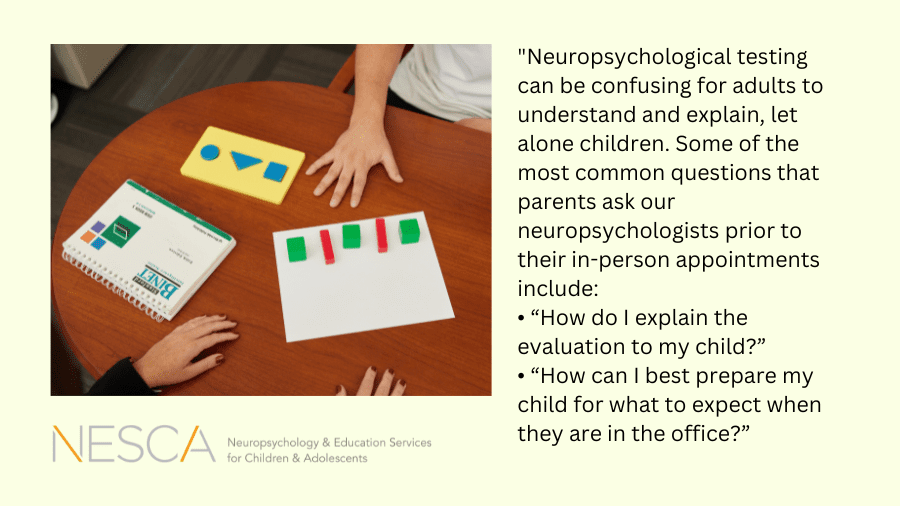
Neuropsychological testing can be confusing for adults to understand and explain, let alone children. Some of the most common questions that parents ask our neuropsychologists prior to their in-person appointments include:

  • “How do I explain the evaluation to my child?”
  • “How can I best prepare my child for what to expect when they are in the office?”

The answers vary depending on several factors. To name a few, your child’s age, level of awareness of areas they are struggling, and your child’s language abilities guide decision-making about the best way to discuss their upcoming evaluation experience. It is important to talk with your neuropsychologist to plan the most appropriate approach for your child. However, below is some standard guidance.

When describing the evaluation itself, I advise parents to use language that reduces pressure on the situation. In other words, it is best to frame the evaluation as a low stakes experience. For example, using words like “testing” or “evaluation” can create unnecessary worry. I often recommend describing the evaluation experience as a variety of “activities,” some of which may include looking at pictures, playing with toys, drawing, and answering questions. Other activities may seem similar to what your child is asked to do in school, such as reading stories, completing math problems, and writing.

Oftentimes, when children hear they are going to the “doctor” they may worry about medical exams. For this reason, it can be helpful to reassure your child that they are not going to be getting poked and prodded; and definitely will not be getting any shots!

To explain the reasons for doing the evaluation, some key phrases to use with your child include:

  • We want to understand how you learn, because everyone learns differently. It’s great that everyone learns differently because it keeps life interesting!
  • Everyone has things they are really good at and other things that are more challenging for them. This will help us understand what comes easy to you and what might be a little trickier, so that we can help you with things like schoolwork, completing activities around the house, and play.
  • We can also share this information with your teacher so they can better understand your learning style and support you at school.
  • Some activities might seem easy and others might be hard, but your job is just to try your best!

For more helpful tips, please see Dr. Gibbons’ previous blog posts, “How Do I Prepare My Child for a Neuropsychological Evaluation?” and “Preparing our Kids to Reenter the Community.”


About Lauren Halladay, Ph.D.

Dr. Halladay conducts comprehensive evaluations of toddlers, preschoolers, and school-aged children with a wide range of developmental, behavioral, and emotional concerns. She particularly enjoys working with individuals with Autism Spectrum Disorder, Intellectual and Developmental Disabilities, and complex medical conditions. She has experience working in schools, as well as outpatient and inpatient hospital settings. She is passionate about optimizing outcomes for children with neurodevelopmental disabilities by providing evidence-based, family-oriented care.


If you are interested in booking an appointment for an evaluation with a Dr. Halladay or another NESCA neuropsychologist/clinician, please fill out and submit our online intake form


Neuropsychology & Education Services for Children & Adolescents (NESCA) is a pediatric neuropsychology practice and integrative treatment center with offices in Newton and Plainville, Massachusetts, Londonderry, New Hampshire, and Burlington, Vermont, serving clients from preschool through young adulthood and their families. For more information, please email info@nesca-newton.com or call 617-658-9800.

Individualized Education Program or 504 Plan? How do I Know which is Right for My Child?

By | Nesca Notes 2023

By: Alissa Talamo, PhD
Pediatric Neuropsychologist, NESCA

Both an Individualized Education Program (IEP) and a 504 Plan can provide supports for students in grades K-12 who are struggling in school, to ensure the student is able to receive “free and appropriate public education (FAPE).” However, not all students who are struggling will qualify for these supports.

An IEP provides a plan for students who require special education supports and direct related services to meet their unique needs, and these supports need to be provided at no cost to the family.

There are two requirements a child must meet to qualify for an IEP. The student must have one or more of the 13 disabilities noted in The Individuals With Disability Education Act (IDEA), which is the federal special education law for children with disabilities. Some of the disabilities listed include a Specific Learning Disability, autism (ASD), other health impairment (e.g., AD/HD), speech or language impairment, or an intellectual disability (for a full list of the 13 disabilities, see https://www.doe.mass.edu › sped › definitions). The second requirement is that the disability must affect the child’s educational performance and/or ability to learn and benefit from the general education curriculum, meaning the child must need specialized instruction to make progress in school. The IEP sets learning goals and describes the services the school will provide. Some components the IEP must include are: how the child is currently performing in school (e.g., academic and functional performance) along with annual education goals and services the child will receive. Additionally, the school will track progress toward those goals and the IEP team must review the IEP at least once a year.

A 504 Plan stems from Section 504 of the Rehabilitation Act of 1973. This is a federal civil rights law to stop discrimination against people with disabilities and requires the school to provide support and remove barriers for a student with a disability. A 504 Plan provides services and changes to the learning environment to enable students to learn alongside their peers. As with an IEP, a 504 plan is provided at no cost to families. There are two requirements to be eligible for a 504 Plan. A child has any disability, and the disability must interfere with the child’s ability to learn in a general education classroom. According to Section 504, the disability must substantially limit one or more basic life activities. Because the definition of disability is broader on a 504 Plan, a child who does not qualify for an IEP might still be eligible for a 504 Plan. In general, a 504 Plan is a good option for students with disabilities who do not require specialized instruction but do need specific accommodations to receive FAPE (e.g., extended time on tests, larger print text, priority seating close to the front of the classroom).

To determine if your child would qualify for an IEP or 504, it is important that they receive a thorough evaluation (cognitive, educational, functional, social/emotional, etc.) to determine their level of need. This evaluation can be completed through the public school system or an independent evaluator.

Sources:

www.understood.org

https://www.mpgfirm.com/back-to-basic-rights-iep-vs-504/


About the Author

With NESCA since its inception in 2007, Dr. Talamo had previously practiced for many years as a child and adolescent clinical psychologist before completing postdoctoral re-training in pediatric neuropsychology at the Children’s Evaluation Center.

After receiving her undergraduate degree from Columbia University, Dr. Talamo earned her doctorate in clinical health psychology from Ferkauf Graduate School of Psychology and the Albert Einstein College of Medicine at Yeshiva University.

She has given a number of presentations, most recently on “How to Recognize a Struggling Reader,” “Supporting Students with Working Memory Limitations,” (with Bonnie Singer, Ph.D., CCC-SLP of Architects for Learning ), and “Executive Function in Elementary and Middle School Students.”

Dr. Talamo specializes in working with children and adolescents with language-based learning disabilities including dyslexia, attentional disorders, and emotional issues. She is also interested in working with highly gifted children.

Her professional memberships include MAGE (Massachusetts Association for Gifted Education), IDA (International Dyslexia Association), MABIDA (the Massachusetts division of IDA) and MNS (the Massachusetts Neuropsychological Society).

She is the mother of one college-aged daughter.


To book a consultation with Dr. Talamo or one of our many other expert neuropsychologists, complete NESCA’s online intake form.

Neuropsychology & Education Services for Children & Adolescents (NESCA) is a pediatric neuropsychology practice and integrative treatment center with offices in Newton and Plainville, Massachusetts, Londonderry, New Hampshire, and Burlington, Vermont, serving clients from preschool through young adulthood and their families. For more information, please email info@nesca-newton.com or call 617-658-9800.

Preparing Students for First Team Meetings and the Transition to High School

By | Nesca Notes 2023

By: Kristen Simon, M.Ed, Ed.S
Transition Specialist

With Spring right around the corner, eighth grade students will begin to prepare for a transition to a new building. For students on IEPs, this means shifting to a new team and planning for supports that will help your child adapt and thrive in a new setting with different adults and expectations. Eighth grade IEP transition meetings tend to begin in March or April after students have had exposure to courses that are required and available in their ninth grade year. For many eighth grade students in special education, the transition meeting is one of the first IEP meetings they are invited to participate in. How can we help middle school students to prepare for and engage in this meeting?

Participating in IEP meetings is a great way for eighth grade students to build self-determination skills. Self-determination is a combination of skills, knowledge, and beliefs that help an individual gain autonomy and allows them to set their own goals, make thoughtful decisions, and manage their own life. Research has shown that for students with disabilities, this set of skills leads to both more positive adult outcomes (employment, higher wages, better living situation) and a higher quality of life (increased satisfaction, community engagement, independence, and productivity) Wehmeyer & Schwarz, 1997. For the middle school student craving independence, this can be the perfect time to build and strengthen this set of skills. We can prepare students to engage in their IEP meeting in a multitude of ways.

  1. Familiarize your child with their IEP, including their disability, what teachers do to help in (or outside of) the classroom as well as the goals that they have been working on with special education teachers or related personnel.
  2. Ask for the agenda ahead of time and review how the meeting will run and what adults will be present. It might be helpful for special educators/related service providers to demonstrate a “mock IEP meeting” to allow a safe space for students to ask questions and plan for or rehearse how they’d like to participate.
  3. Use visual maps or outlines to summarize their current transition planning forms. Their vision will help them develop the questions they’d like to ask high school staff. Examples of these types of questions might include: What classes in robotics or coding are available, and when can I take those? Is there a debate team, and how can I be a part of that? How do I join one of the after-school clubs? How do I make sure that a digital art class fits in my schedule?

These same maps can be used to discuss what kinds of academic support will they need with the type and level of classes they are
choosing. While students will have academic supports built into their service delivery, it can also be helpful to know about any additional high school academic supports, such as a writing center, student mentoring, career exploration opportunities, etc.

  1. If your child tends to have difficulty adapting to or has anxiety around change, students should work with team members to brainstorm supports that might be helpful in making the transition to high school more successful. Cueing students to think back to previous changes or first days of school can help them initiate this task. Students might request to meet with their point person before the end of their eighth grade year, participate in a small group or personalized tour of the new building/campus, identify someone who can help the student navigate the cafeteria on the first few days or maybe identify an alternative lunch space. Additionally, students might want to ask if there are programs happening over the summer in the high school building that will help the student acclimate to their new school before the start date.

After the transition meeting is over, it can be helpful for students and family members to create a chart that outlines the student’s questions and who their point person would be. For example, if I have a question about my schedule, I should find Mr./Mrs. ______. This chart should also include their email and list where their office can be found in the building. Empowering students to use this reference guide with guiding questions even before the year ends will further strengthen both their self-advocacy and self-determination skills.


About the Author

Kristen Simon, M.Ed, Ed.S, has worked with transition-aged youth as a licensed School Psychologist for more than a decade. She has extensive experience working with children and adolescents with a range of learning and social/emotional abilities. Kristen’s strengths lie in her communication and advocacy skills as well as her strengths-based approach. She is passionate about developing students’ self-awareness, goal-setting abilities, and vision through student-centered counseling, psychoeducation, social skills instruction, and executive functioning coaching. Mrs. Simon has particular interests working with children and adolescents on the Autism spectrum as well as individuals working to manage stress or anxiety-related challenges.

Mrs. Simon is an expert evaluator and observer who has extensive working knowledge of the special education process and school-based special education services, particularly in Massachusetts. She has been an integral part of hundreds of IEP teams and has helped to coordinate care, develop goals, and guide students and their families through the transition planning process. Mrs. Simon further has special expertise helping students to learn about their diagnoses and testing and the IEP process in general. She enjoys assisting students, families, and educators in understanding a student’s disability-related needs as well as the strategies that can help the student to be successful in both academic and nonacademic settings. Mrs. Simon has often been a part of teams in the years when students are initially participating in transition services, and she has helped countless students to build the skills necessary to be part of their first team meetings. She is committed to teaching students—as well as parents and educators—how to participate in student-centered team meetings and the IEP processes.

At NESCA, Mrs. Simon works as a transition specialist and psychoeducational counselor. She works with adolescents, their families, and their school communities to identify and build the skills necessary to achieve their postsecondary goals. Mrs. Simon provides transition assessment (including testing, functional evaluations, and observations), program observations and evaluations, case management and consultation, and individualized counseling and skills coaching.

To schedule an appointment with one of NESCA’s transition specialists, please complete our online intake form

Neuropsychology & Education Services for Children & Adolescents (NESCA) is a pediatric neuropsychology practice and integrative treatment center with offices in Newton and Plainville, Massachusetts, Londonderry, New Hampshire, and Burlington, Vermont, serving clients from preschool through young adulthood and their families. For more information, please email info@nesca-newton.com or call 617-658-9800.


Age of Majority: Preparing Students to Make Special Education Decisions as Adults

By | Nesca Notes 2023

By: Kelley Challen, Ed.M., CAS
Director of Transition Services, NESCA

One of the exciting aspects of being a transition specialist who evaluates and provides consultation to students and schools across the country is that transition services are dictated by the Individuals with Disabilities Education Act (IDEA 2004), a federal law. Students have similar rights across all 50 states regarding how their IEPs must prepare them for postsecondary learning, living, and employment experiences. However, there are additional rights and responsibilities related to special education that are dictated by state laws and regulations. Age of Majority and the Transfer of Rights to students is one of these issues that varies from state to state.

At the Age of Majority, or the age of legal adulthood, in each state, young adults are granted certain legal rights (e.g., voting, marrying, opening a credit card, signing contracts). Each state determines which rights will transfer to young adults within their state. IDEA 2004 gives states the right to transfer educational decision-making rights to students who have reached the Age of Majority—this means that all of the educational rights previously accorded to parents/guardians may transfer directly to the student. The Age of Majority is 18 in most, but not all, states.

In states that transfer educational rights at the Age of Majority, school districts are required to provide notice to parents and students ahead of time so that families are not surprised that the parents’ rights will transfer to the student. Additionally, at least one year before the student reaches the Age of Majority, the student’s Individualized Education Program (IEP) needs to include a statement indicating that the student was informed of their rights under IDEA.

There are exceptions to the Transfer of Rights when a student has been determined to be “incompetent” under state law—this often involves a parent/guardian taking partial or complete guardianship of the student. Students may alternatively have a Power of Attorney drawn up so that a parent can continue to represent their educational interests. States may also have their own processes for electing decision-making when the student reaches the Age of Majority. For example, in Massachusetts, students who have turned 18 are presented with a choice to take over decision-making, share decision-making with a parent or other willing adult, or delegate decision making to their parent or another willing third party; They sign a document indicating their elected choice on or after their 18th birthday.

There are many educational rights that a student may assume when they reach the Age of Majority. Some of these include receiving notice of IEP meetings, consenting to evaluation, placement, and/or an IEP, deciding to drop out of school, or deciding to accept a diploma and end eligibility for transition services. Parents and educators can help students prepare for the Age of Majority and Transfer of Rights ahead of time. Pacer’s National Parent Center on Transition and Employment has put together a handout with tips for doing this important work. Some of the tips are included within my longer list of preparatory activities below:

  1. Start building choice-making and decision-making skills as young as possible.
  2. Teach students about the IEP process in elementary or middle school.
  3. Encourage students to observe and participate in IEP meetings.
  4. Allow students to invite preferred educators, family members, and community members to IEP meetings for support.
  5. Role-play IEP meetings prior to participation.
  6. Begin talking about Transfer of Rights when students first begin attending IEP meetings.
  7. Prior to reaching the Age of Majority, talk about how the student thinks they will want to make decisions across areas of life—What decisions do you want to make totally alone? What decisions do you want to make in collaboration with others? What decisions do you want other people to make for you?
  8. Help students to develop good working relationships with school personnel and team members.
  9. Stay involved in the IEP process even after a child reaches the Age of Majority—but allow the student to be the primary participant in the development of their IEP.

For parents or guardians who suspect that a child will not be competent to handle educational decision-making, it will be important to consult with clinical and legal experts well in advance of the child reaching the Age of Majority. It is also important to keep the IEP team informed regarding any legal proceedings or arrangements that may impact educational decision-making. With that said, many students who are not competent to manage complex medical or financial decisions can be strong participants in their educational processes and transition services. For tools that you can use to help educate students regarding the IEP process, please check out the video and document resources from imdetermined.org. For tools that you can use to explore decision-making and supported decision-making as students approach adulthood, please review these resources from Charting The Lifecourse.


About the Author
Kelley Challen, Ed.M., CAS, is NESCA’s Director of Transition Services, overseeing planning, consultation, evaluation, coaching, case management, training and program development services. Ms. Challen also provides expert witness testimony in legal proceedings related to special education. She is also the Assistant Director of NESCA, working under Dr. Ann Helmus to support day-to-day operations of the practice. Ms. Challen began facilitating programs for children and adolescents with special needs in 2004. After receiving her Master’s Degree and Certificate of Advanced Study in Risk and Prevention Counseling from Harvard Graduate School of Education, Ms. Challen spent several years at the MGH Aspire Program where she founded an array of social, life and career skill development programs for teens and young adults with Asperger’s Syndrome and related profiles. She additionally worked at the Northeast Arc as Program Director for the Spotlight Program, a drama-based social pragmatics program, serving youth with a wide range of diagnoses and collaborating with several school districts to design in-house social skills and transition programs. Ms. Challen is co-author of the chapter “Technologies to Support Interventions for Social- Emotional Intelligence, Self-Awareness, Personality Style, and Self-Regulation” for the book Technology Tools for Students with Autism. She is also a proud mother of two energetic boys, ages six and three. While Ms. Challen has special expertise in supporting students with Autism Spectrum Disorders, she provides support to individuals with a wide range of developmental and learning abilities, including students with complex medical needs.


Neuropsychology & Education Services for Children & Adolescents (NESCA) is a pediatric neuropsychology practice and integrative treatment center with offices in Newton, Massachusetts, Plainville, Massachusetts, and Londonderry, New Hampshire, serving clients from preschool through young adulthood and their families. For more information, please email info@nesca-newton.com, call 617-658-9800 or complete our online Intake Form.

Meet Pediatric Neuropsychologist Lauren Halladay, Ph.D.

By | NESCA Notes 2022

By: Jane  Hauser

Director of Marketing & Outreach, NESCA

I recently had the opportunity to learn more about Pediatric Neuropsychologist Lauren Halladay, Ph.D., who joins NESCA in September. Learn more about her background and specialties in today’s blog interview.

How did you choose pediatric neuropsychology as a profession?

My interest was originally piqued when I was younger, as early as my high school years. I volunteered at a therapeutic riding program for kids with disabilities. That’s what initially sparked my desire to work with kids, and those with disabilities, in particular. My mother was a third grade teacher, which also imparted the desire to work with kids and help them overcome their challenges at school.

I went on to major in psychology and had a strong interest in pediatrics for the reasons I mentioned previously. Based on some of the work I did in graduate school, I learned that I really enjoyed the assessment piece, especially with the younger kids, helping them in life by identifying the right diagnosis (when applicable) and helping to put the right interventions in place for them to build skills that will equip them for the future.

How have your previous work experiences prepared you to be a neuropsychologist?

I’ve had a wide breadth of work experiences where I was supervised by neuropsychologists, whether it be in satellite health systems, the hospital setting, etc. While in those clinics, I had the opportunity to work with a variety of populations and presentations, including those who have experienced trauma, or have developmental or learning disabilities.

Having worked in several states throughout the country, including Oregon, Ohio, New York and Massachusetts, I’ve had the pleasure of working closely with a variety of families who present with unique backgrounds, experiences, and cultural values, which I always consider when making diagnostic decisions and developing recommendations.

What areas of neuropsychology have you most enjoyed to date? What would you consider your specialty area?

There are several areas that I am very passionate about. I really enjoy working with young kids, those under the ages of five or six. I also have a great interest in working with families who have concerns about their child potentially having an autism spectrum disorder or an intellectual or developmental disability. In addition, I find it incredibly rewarding to work with and help families whose children are medically complex or have moderate to severe cognitive impairments.

Regardless of how the child or student presents or what challenges they may have, I always individualize my approach so that I can meet the needs of each child. This is especially true in cases where families have had a hard time getting assessments done in the school setting or even privately in the past.

What is the most rewarding experience in neuropsychology that you’ve had to date?

I find it rewarding to hear from families when the strategies I’ve recommended are or are not working for them. For example, hearing that parents achieve success in implementing behavior management strategies, accessing support in the community, and/or learning about their child’s diagnosis and how to create an environment that suits their needs is a wonderful feeling. On the other hand, when the initial recommendations are not as helpful as intended, I enjoy approaching the problem-solving process together and discussing alternate approaches.

I also find it incredibly rewarding to offer parents and caregivers a deeper perspective on a child who has a moderate to severe cognitive impairment or is medically complex. Being able to give them a sense of where their child is developmentally in relation to their peers can be enlightening. Additionally, having more information about a child’s developmental level can help families and school staff establish appropriate, and individualized, expectations that set the child up for success. I strive to make a difference in these cases by developing strong partnerships with families, as well as serving as a trusted resource and advocate as they navigate how to best access supports in the community and in school.

What benefits, having been trained in a school psychology department, do you bring to families at NESCA?

My school psychology background allows me to bring a deep awareness and perspective on how the IEP process works. My experience and knowledge of special education rights allows me to be a true partner to families who are trying to navigate and understand the IEP process. I am able to share that knowledge and better advocate for my clients in Team meetings.

Why did you decide to join the team at NESCA?

I knew that in my next career move, I wanted to be part of a collaborative community that puts an emphasis on work/life balance—I feel that both allow clinicians to produce the highest quality work. At NESCA, I will also have the opportunity to use my school psychology skills and be an active participant in the IEP process on behalf of our clients.

NESCA is known for creating and building long-lasting relationships with the families they work with. I look forward to working with families and their schools/districts for the long-term, helping students to build skills along the way that will help them throughout their lives.

Finally, not being a native Bostonian, I am excited to learn more about and partner with the different school systems on behalf of the families and students we work with at NESCA.


About Lauren Halladay, Ph.D.

Dr. Halladay conducts comprehensive evaluations of toddlers, preschoolers, and school-aged children with a wide range of developmental, behavioral, and emotional concerns. She particularly enjoys working with individuals with Autism Spectrum Disorder, Intellectual and Developmental Disabilities, and complex medical conditions. She has experience working in schools, as well as outpatient and inpatient hospital settings. She is passionate about optimizing outcomes for children with neurodevelopmental disabilities by providing evidence-based, family-oriented care.


If you are interested in booking an appointment for an evaluation with a NESCA neuropsychologist/clinician, please fill out and submit our online intake form


Neuropsychology & Education Services for Children & Adolescents (NESCA) is a pediatric neuropsychology practice and integrative treatment center with offices in Newton and Plainville, Massachusetts, and Londonderry, New Hampshire, serving clients from preschool through young adulthood and their families. For more information, please email info@nesca-newton.com or call 617-658-9800.

IEP or 504: What Do They Mean and How Can They Apply to My Child?

By | NESCA Notes 2022

By Miranda Milana, Psy.D.
Pediatric Neuropsychologist

If your child has ever undergone an evaluation through their school system or received an outside neuropsychological evaluation, chances are you have heard the terms “504 plan” or “IEP” thrown around. Given that it can be difficult to understand the differences between the two, we will break down what both of these terms mean and how they might apply to your child.

What is an IEP?

IEP stands for Individualized Education Program and provides specialized instruction, program modification, and accommodations through the public school system based on a student’s disability and how it impacts access to the curriculum. IEPs must include:

  • Annual goals that are measurable via benchmarks
  • Progress reports of the student’s current performance
  • Descriptions of how services will be provided
  • Outlined transition services as the child ages

In addition, IEPs must detail what academic environment would be the least restrictive, and therefore, most suitable for the student to appropriately access the educational curriculum.

Who is eligible for an IEP?

In order to qualify for an IEP, students must receive an evaluation either through the school system or through an outside provider that outlines the student’s disability status and how it negatively impacts accessing the educational curriculum. Importantly, a diagnosed disability is not enough to quality for an IEP on its own. Instead, the disability must be impacting the student’s ability to make effective progress in the general education program, which includes both academic and non-academic offerings of the district. Some examples of qualifying diagnoses include (but are not limited to):

  • Autism
  • Emotional Disturbance
  • Intellectual Disability
  • Specific Learning Disability

A parent or caregiver may ask what happens if  their child has a diagnosed disability but does not require special education services? Instead, the team may determine, through the eligibility process, that the student only requires accommodations, such as extended time on tests.

This is a perfect example of when a student might not qualify for an IEP and would instead be considered for a 504 plan. Simply put, IEPs and 504 plans both provide accommodations; however, 504 plans do NOT provide for specialized instruction or program modifications.

 What is a 504 plan?

A 504 plan is referred to as such because it is covered under Section 504 of a federal civil rights law called the Rehabilitation Act. This law works to ensure that students receive appropriate supports and accommodations within the academic setting. 504 plans outline accommodations for students which can include some of the following (but again, accommodations are not limited to the following):

  • Preferential seating
  • Extended time on tests and quizzes
  • Reduced distraction testing environments
  • Access to class notes
  • The use of a calculator during exams

As you can see, none of these accommodations is modifying the curriculum or providing a student with educational services as would be the case with an IEP.

Who is eligible for a 504 plan?

Any student with a disability impairing functioning in one or more areas is eligible for a 504 plan. One common example would be a student with diagnosed Attention Deficit Hyperactivity Disorder (ADHD) who requires distraction-reduced testing environments and/or other associated accommodations but does NOT require specialized academic instruction.

Another example is a parent of a child with an autism spectrum diagnosis may find that their child was found to be ineligible for an IEP through the special education eligibility determination process. Shouldn’t the student qualify for an IEP based on the autism disability?

The answer is not necessarily. If a student has a diagnosis of autism but is showing no signs of impairment within the academic setting (i.e., making appropriate academic progress, showing no signs of emotional distress, doing well with their peers, etc.), an IEP would not be warranted. Instead, a 504 plan would likely be considered (but again, is not guaranteed if academic functioning is not impaired).

If you feel your child requires a 504 plan or IEP and you are not sure where to start, contact your child’s special education program at their school. You may also wish to consult with an educational advocate or attorney who has a thorough understanding of special education laws.

References:

Massachusetts Department of Elementary and Secondary Education. (2018, June 29). Education Laws and Regulations. 603 CMR 28.00: Special Education – Education Laws and Regulations. Retrieved August, 2022, from https://www.doe.mass.edu/lawsregs/603cmr28.html?section=05

Massachusetts Department of Elementary and Secondary Education. (2014, July 14). Section 504 and the Americans with disabilities act. Section 504 – Special Education. Retrieved August, 2022, from https://www.doe.mass.edu/sped/links/sec504.html


About the Author

Dr. Miranda Milana provides comprehensive evaluation services for children and adolescents with a wide range of concerns, including attention deficit disorders, communication disorders, intellectual disabilities, and learning disabilities. She particularly enjoys working with children and their families who have concerns regarding an autism spectrum disorder. Dr. Milana has received specialized training on the administration of the Autism Diagnostic Observation Schedule (ADOS).

Dr. Milana places great emphasis on adapting her approach to a child’s developmental level and providing a testing environment that is approachable and comfortable for them. She also values collaboration with families and outside providers to facilitate supports and services that are tailored to a child’s specific needs.

Before joining NESCA, Dr. Milana completed a two-year postdoctoral fellowship at Boston Children’s Hospital in the Developmental Medicine department, where she received extensive training in the administration of psychological and neuropsychological testing. She has also received assessment training from Beacon Assessment Center and The Brenner Center. Dr. Milana graduated with her B.A. from the University of New England and went on to receive her doctorate from William James College (WJC). She was a part of the Children and Families of Adversity and Resilience (CFAR) program while at WJC. Her doctoral training also included therapeutic services across a variety of settings, including an elementary school, the Family Health Center of Worcester and at Roger Williams University.

Dr. Milana grew up in Maine and enjoys trips back home to see her family throughout the year. She currently resides in Wrentham, Massachusetts, with her husband and two golden retrievers. She also enjoys spending time with family and friends, reading, and cheering on the Patriots, Bruins, Red Sox, and Celtics.​


Neuropsychology & Education Services for Children & Adolescents (NESCA) is a pediatric neuropsychology practice and integrative treatment center with offices in Newton, Massachusetts, Plainville, Massachusetts, and Londonderry, New Hampshire, serving clients from preschool through young adulthood and their families. For more information, please email info@nesca-newton.com or call 617-658-9800.


To book an appointment with Dr. Miranda Milana, please complete our Intake Form today. For more information about NESCA, please email info@nesca-newton.com or call 617-658-9800.


Skip to content