Tag

nesca newton ma Archives - Page 4 of 14 - NESCA

Subscribe to NESCA Notes

Creating a Kinder, Gentler New Year

By | NESCA Notes 2024

By Dot Lucci, M.Ed., CAGS
Director of Consultation and Psychoeducational Counseling Services, NESCA

We use the start of every new year as motivation to set goals for ourselves, and we often ask children to do the same thing. A New Year’s Resolution is a tradition, in which we set our mind, heart, and spirit to change an undesired trait or behavior, accomplish a personal goal, or otherwise improve ourselves in some tangible way. We may set a goal to lose weigh, exercise more, eat less sugar, meditate daily for five minutes, do homework without a fuss, help out with chores around the house, or walk the dog when my parents ask, etc. Often, we make New Year’s Resolutions, but we don’t usually accomplish them. Within a month or so, we start slipping back into our old ways. Habits are hard to change, and we are resistant to change – it is partly due to our wiring. So, if you are one of these people who has good intentions and sets New Year’s Resolutions then fails, know you are not alone. Hopefully, this fact can help you feel less shame and guilt when you “fail” at keeping them.

I’d like to suggest that if you decide to set a New Year’s Resolution, you do it with yourself and other people in mind. There is so much angst and strife in the world right now that if we resolve to be kinder, gentler, and more patient with ourselves and each other, the world would be a better place.

One idea is to make group resolutions that impact the functioning of the collective. For instance, we could consider Family New Year’s Resolutions or Classroom New Year’s Resolutions. With this in mind, here are some sample suggestions for New Year’s Resolutions for families, classrooms, parents, teachers, and children. Keep your resolution(s) manageable – i.e., only pick one that you are truly committed to working on and putting the energy into changing, as your brain is partly “against you” changing! As they say, “May the Force Be With You!”

General New Year’s Resolutions

  • Sleep – It’s important for everyone, so try to set bedtimes for everyone and stick to them (parents included). Bedtimes should be different depending upon the ages of each child. Getting more sleep may afford us the ability to be more patient with others.
  • Unplug – Take time to unplug from your devices for an hour or more every day. Go for a walk, talk to each other, get the kids involved in preparing the dinner, play a board game. (i.e., take part in old fashioned “family time”). Unplugging affords us the opportunity to be more connected with each other, and being with others (Social Engagement) has been proven to improve one’s quality of life.

For All of Us:

  • Develop patience and compassion when you mess up, as you will mess up.
  • Develop patience and compassion with others because they, too, will mess up.
  • Develop a calming practice if you do not currently have one. Stress happens and is a “silent killer” (i.e., higher blood pressure, poor eating habits, etc.). We have smart watches that can remind us to take a breath…set it to remind yourself. Come back to your breath in moments of stress. Just a few minutes a day mindfully breathing can lower your heart rate and, over time, lower your blood pressure and reduce cortisol (a stress hormone) in your body.
  • Listen more/Talk less.

For Classrooms:

  • Encourage each student to identify one area related to Personal Growth (i.e., ask more questions in class, volunteer to help another classmate, remain calm when challenged academically, etc.). I will ___Settle Down___ when asked by the teacher by the end of the count; show ___Kindness___ to others in my class by___; Ask more questions; volunteer to ___.

For Teachers:

  • Start the New Year off with renewed energy and reimagine equity in your classroom.
  • Talk about fairness – Fair doesn’t mean equal; it means everyone gets what they need to succeed.
  • Talk about school-based stressors/triggers for students (i.e., a certain subject/activity type, tests/quizzes, speaking in front of the class, etc.). Teach them that stress is a normal part of life, then teach them simple stress-reduction techniques (i.e., mindfulness, deep breathing, yoga poses, etc.) they can weave into their day.
  • Teach students about perseverance, grit, and effort and how they are all entwined. Involve students in identifying when they are using them.

For Parents:

  • Self-care – Priority #1 for parents. Just like the airlines say, “Put your own oxygen mask on first.” Define what this means for you and make a plan to stick with it. One small step at a time.
  • “Be Present” with your kids. Often, we are “with” our kids a lot, but are we truly present in mind and body? Usually not; we are doing something else when they are talking to us (i.e., cooking, paying attention to our phones, packing lunches, etc.), so our attention is split. Try taking 10 minutes every day with each of your kids to be truly present in mind and body with your attention solely on them in the moment.
  • Talk with your children about home/life stressors/triggers (i.e., not getting to do what they want, having to do something they don’t want to do, moving from a preferred to non-preferred activity, etc.). Teach them that stress is a normal part of life, then teach them simple stress-reduction techniques (see above) and work together to weave them into the day. Model practicing them yourself!
  • Show gratitude for their words and actions.

Here’s to hoping we are blessed in 2024 with more peace in our hearts and a kinder, gentler, and more compassionate family, classroom, and world!

Resources on these topics:

Keeping Resolutions

Family Resolutions

Stress & the Body

Awesome Year by Kid President


About the Author

NESCA’s Director of Consultation and Psychoeducational Services Dot Lucci has been active in the fields of education, psychology, research and academia for over 30 years. She is a national consultant and speaker on program design and the inclusion of children and adolescents with special needs, especially those diagnosed with Autism Spectrum Disorder (ASD). Prior to joining NESCA, Ms. Lucci was the Principal of the Partners Program/EDCO Collaborative and previously the Program Director and Director of Consultation at MGH/Aspire for 13 years, where she built child, teen and young adult programs and established the 3-Ss (self-awareness, social competency and stress management) as the programming backbone. She also served as director of the Autism Support Center. Ms. Lucci was previously an elementary classroom teacher, special educator, researcher, school psychologist, college professor and director of public schools, a private special education school and an education collaborative.

Ms. Lucci directs NESCA’s consultation services to public and private schools, colleges and universities, businesses and community agencies. She also provides psychoeducational counseling directly to students and parents. Ms. Lucci’s clinical interests include mind-body practices, positive psychology, and the use of technology and biofeedback devices in the instruction of social and emotional learning, especially as they apply to neurodiverse individuals.


To book a consultation with Ms. Lucci or one of our many expert clinicians, complete NESCA’s online intake form. Indicate whether you are seeking an “evaluation” or “consultation” and your preferred clinician/consultant/service in the referral line.


NESCA is a pediatric neuropsychology practice and integrative treatment center with offices in Newton, Plainville, and Hingham, Massachusetts; Londonderry, New Hampshire; and the greater Burlington, Vermont region, serving clients from infancy through young adulthood and their families. For more information, please email info@nesca-newton.com or call 617-658-9800.
 

Navigating Screen Time: Understanding the Impact on Child Development

By | Nesca Notes 2023

By: Cynthia Hess, PsyD
Pediatric Neuropsychologist

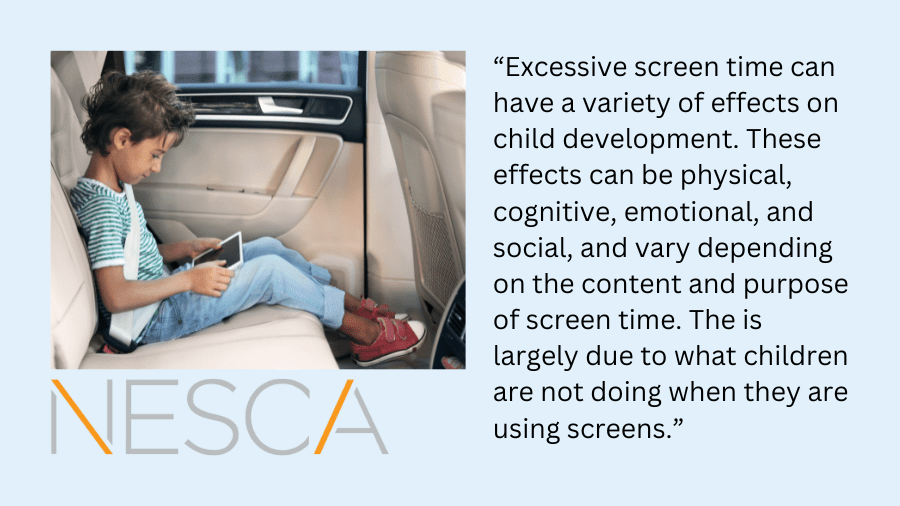
At school, we have had increasing difficulty with children refusing to leave their car at drop-off because they are on their tablets and do not want to stop what they are doing to go to school. Screen time has long been discussed regarding how much is too much and recommendations offered for limiting screen time. Now, with mobile devices, screens can be taken anywhere. Furthermore, there is never a shortage of entertaining options to engage with, from games like Minecraft, Roblox, and Fortnite to YouTube, all of which draw children in and make it difficult to stop. This article aims to provide a nuanced exploration of the impact of screen time on child development. While screen time is not inherently negative, it requires thoughtful management and consideration, particularly in the context of the developmental needs of children.

Screens are pervasive in daily life and have become integrated into the fabric of 21st century family dynamics, mostly due to the numerous ways of engaging with screens. According to the American Academy of Child and Adolescent Psychiatry (AACAP), children between the ages of eight to 12 spend at least four to six hours a day watching or using screens. According to Common Sense Media, children between birth and eight spend an average of two and one-half hours per day, with children two and under spending approximately 49 minutes on average. While screens can teach and entertain, too much may lead to problems.

Excessive screen time can have a variety of effects on child development. These effects can be physical, cognitive, emotional, and social, and vary depending on the content and purpose of screen time. The is largely due to what children are not doing when they are using screens. Extended periods of screen time can lead to a sedentary lifestyle, which can lead to obesity, poor posture, and disrupted sleep patterns. In terms of cognitive development, overuse of screens with fast-paced and visually stimulating content can overwhelm a child’s developing brain and potentially affect attention span, impulse control, and the ability to concentrate.  It can also impede the development of language and communication skills. When children spend too much time in front of screens, they may have fewer opportunities to engage in real-life conversations and interactions, which are crucial for language development. And, while educational content can have benefits, excessive screen time can still disrupt the learning process. It may lead to reduced engagement with traditional forms of learning and limit a child’s ability to exercise critical thinking and problem-solving skills.

It is important to note that not all screen time is detrimental. Age-appropriate and high-quality content, as well as supervised and interactive screen time, can have educational and social benefits. Additionally, technology can be a valuable tool for learning and creativity when used in moderation and with parental guidance. Parent and caregivers can help mitigate the potential negative effects of screen time by setting limits, monitoring content, and encouraging a balanced lifestyle that includes a variety of activities, such as physical play, reading, and face-to-face interactions. Sometimes the best conversations happen in the car.

References:


About the Author

Dr. Cynthia (Cindy) Hess conducts neuropsychological evaluations as a pediatric neuropsychologist at NESCA. Dr. Hess enjoys working with children and young adults with complex emotional and behavioral profiles. She is skilled at evaluating social and emotional challenges as well as a range of learning profiles. Her experience allows her to guide families in understanding the supports and services their child requires to be successful in school.


To schedule an appointment with one of NESCA’s expert neuropsychologists, please complete our online intake form


NESCA is a pediatric neuropsychology practice and integrative treatment center with offices in Newton, Plainville, and Hingham, Massachusetts; Londonderry, New Hampshire; and the greater Burlington, Vermont region, serving clients from infancy through young adulthood and their families. For more information, please email info@nesca-newton.com or call 617-658-9800.


Why Teletherapy?

By | Nesca Notes 2023

By: Carly Edelstein, MSW, LCSW
Licensed Clinical Social Worker and Executive Function Coach

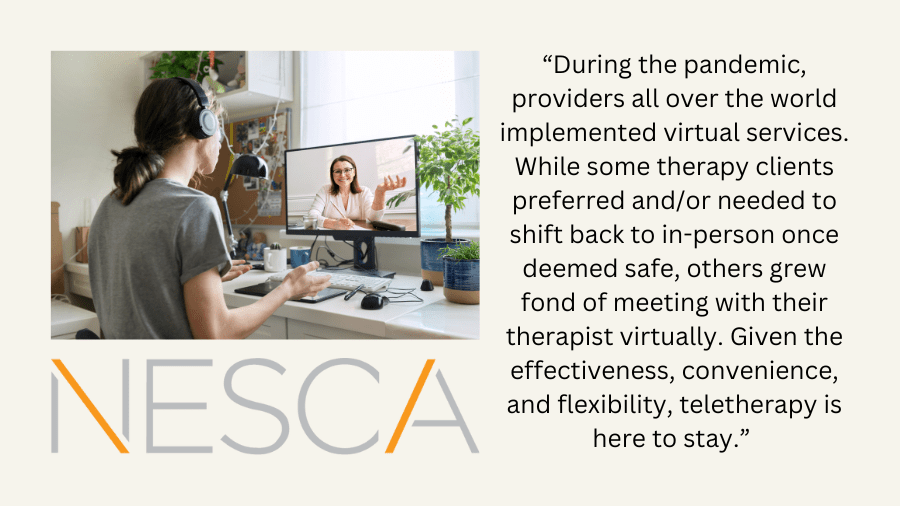
During the pandemic, providers all over the world implemented virtual services. While some therapy clients preferred and/or needed to shift back to in-person once deemed safe, others grew fond of meeting with their therapist virtually. Given the effectiveness, convenience, and flexibility, teletherapy is here to stay. Unlike medical doctors, most therapists don’t need to check your temperature or blood pressure when they see you. Rather, therapists aim to create a physical space where their clients feel safe and comfortable. That said, what if you feel the most comfortable being vulnerable in your home? While not everyone sees the appeal in teletherapy, having the option increases accessibility, and studies show clients attend teletherapy more consistently than in-person, yielding more desired outcomes.

Feeling emotionally and physically comfortable at home during teletherapy is just as important as its convenience. Perhaps you’re a college student or working parent with limited free time in your busy schedule. Teletherapy offers flexibility by removing transportation and wait times. With rates of anxiety, depression, and other mental health conditions rapidly rising, teletherapy is an option to consider if you’re seeking support.

Tips for preparing for your first teletherapy session:

  1. Consider privacy; place yourself in a room or space where you can discuss confidential information without others overhearing your conversation. Sound machines that make white noise can help to prevent sound waves from escaping the room.
  2. Limit any distractions; sign into the teletherapy platform in a brand new window versus a tab, so you’re not tempted to browse the web or check emails during your session. You want to set yourself up for success when it comes to being focused and staying present.
  3. Notice what’s in your background; in order to feel as comfortable as possible, make note of what your therapist may see behind you while on video.
  4. Sit back, relax, and trust the process!

Sources:

https://www.forbes.com/health/mind/teletherapy-for-mental-health-treatment/

How well is telepsychology working? (apa.org)


About the Author

Carly Edelstein is a Licensed Clinical Social Worker practicing in Massachusetts and Rhode Island. Having worked both in private practice and schools, she has extensive experience supporting students, families and educational teams to make positive changes. Ms. Edelstein provides executive function coaching and psychotherapy to clients ranging from middle school through adulthood. She also offers consultation to schools and families in order to support her clients across home and community environments.

To schedule an appointment with one of NESCA’s counselors, coaches, or other experts, please complete our online intake form

NESCA is a pediatric neuropsychology practice and integrative treatment center with offices in Newton, Plainville, and Hingham, Massachusetts; Londonderry, New Hampshire; and the greater Burlington, Vermont region, serving clients from infancy through young adulthood and their families. For more information, please email info@nesca-newton.com or call 617-658-9800.


October is Gap Year Exploration Month – Why Should Teens on IEPs Care?

By | NESCA Notes 2024

By: Kelley Challen, Ed.M., CAS
Director of Transition Services, NESCA

Last September, I received an email from a colleague with the title May I nominate you? The body of the email described that October is Gap Year Exploration Month (GYEM) and asked if I would be willing to be a GYEM Amplifier, meaning would I be willing to share information with my personal and professional network to create awareness about gap years and increase student consideration of gap years as one of their post-secondary options. This was an easy “YES!” for me because I have spent the majority of my career trying to help students and families who I work with to understand that there are many other options besides college, or before college, for students to pursue after high school. A common recommendation that I make for 10th- and 11th-grade students on IEPs is to have a specific goal and objectives that will help to enhance their understanding of a variety of post-12th grade options so that the can make an informed and active choice about their post-high school activities.

In the United States, every student who is on an IEP has the right to postsecondary transition planning. This is a process by which a young person is supported in the setting of goals and expectations for themselves and in building the skills and resources that will enable them to reach those goals. This should be a completely individualized process. However, in working with a large number of clients in Massachusetts and other Northeast states, I have observed that most middle and high school students have the same postsecondary vision: College. There is a strong consensus that college is the only goal to reach after high school, rather than an important step that leads to gainful employment in an area of strength, interest, or aptitude. Students with and without disabilities often know that they want to go to college (or that they are expected to go to college), but they have no career goals or sense about whether a college degree will actually benefit them in finding employment related to their aptitudes. Despite the data, most young people (and their parents) simply take as fact that college is what you do after high school. So how do we empower students to better manage the transition process? First and foremost, we need to start discussing career development, and to help our youth to understand the wide range of postsecondary options available to them, at earlier ages. A bachelor’s degree is one academic pursuit that has a place for many students, but for a great number of students, it is not the best immediate option available after high school. There are many other options worth exploring, such as two-year college programs, vocational or certificate programs, apprenticeships, military, employment, and gap year programs. So today, let’s talk about those gap year programs!

What is a gap year? A gap year is a deliberate period of personal growth typically taken by students after high school and before post-secondary education or career. During a gap year, individuals engage in various activities that foster personal growth, skill development, and exploration of different paths before committing to further education or career choices. These activities may include volunteering, interning, traveling, working, learning new skills, or pursuing other forms of experiential learning. The purpose of a gap year is to gain valuable life experiences, expand one’s perspective, and make informed decisions about future educational and career endeavors.

What can you do on a gap year? The options are endless! Gappers can choose from structured programs like service learning or volunteer projects, or pursue independent activities, such as interning, hiking, or working on organic farms. There are opportunities both within the US and abroad.

Is a gap year expensive? A meaningful gap year can be planned on various budgets. Students can offset costs through work, fundraising, scholarships, and financial aid. Some gap year programs accept funds from 529 Plans. Moreover, gap year students often graduate from college in less time, potentially saving families money in the long run. Explore a comprehensive list of scholarships here.

What are the evidence-based benefits of taking a gap year?

  • Academic Success: Recent studies show that gap year students outperform traditional students academically when they enter college.
  • Employability Boost: 88% of gap year graduates report that their experience significantly enhances their employability.
  • Personal Development: 98% of gap year graduates claim that their gap year helped them grow as a person.
  • Career Exploration: 60% of gap year graduates credit their experience with either confirming their choice of career or setting them on their current path.

References for these statistics can be found here.

Can you still attend college after a gap year? According to the best data on this question, 90% of gap year students who intended to go to college enroll within a year of graduating high school.

How can I learn more about planning a gap year?

Seek guidance from your school counselor.

Attend local USA Gap Year Fairs or online events to meet with programs and gather more information.

Check out some of the following Articles/Videos:

Visit the web sites below:

Listen to a Podcast

Read a Book

Is a transition program the same thing as a gap year program? Not exactly. Postsecondary transition programs are typically programs for young adults with disabilities that target skill development in one or more transition planning areas: life skill development, vocational skill development, and/or readiness for college. Often, developing executive function and social skills is a strong emphasis of these programs. Some of these programs are therapeutic and target the mental health needs of the young adult while supporting skill development in transition planning areas. While some students will participate in transition programs or transitional living programs as gap experiences, transition programs are typically a different category of program. At NESCA, we specialize in helping families determine whether transition programming is needed beyond 12th grade and support families to find – or create –

postsecondary transition programs. We also coordinate with local specialists – Gap Year Consultants, College Consultants, and Therapeutic Educational Consultants—when students may need special expert support in any of those areas.

REFERENCE: Several of the FAQs in this blog are copied directly from GYEM: Digital Dispatch materials created by the Gap Year Association of America and distributed to Gap Year Exploration Month Amplifiers throughout the world.


About the Author
Kelley Challen, Ed.M., CAS, is NESCA’s Director of Transition Services, overseeing planning, consultation, evaluation, coaching, case management, training and program development services. Ms. Challen also provides expert witness testimony in legal proceedings related to special education. She is also the Assistant Director of NESCA, working under Dr. Ann Helmus to support day-to-day operations of the practice. Ms. Challen began facilitating programs for children and adolescents with special needs in 2004. After receiving her Master’s Degree and Certificate of Advanced Study in Risk and Prevention Counseling from Harvard Graduate School of Education, Ms. Challen spent several years at the MGH Aspire Program where she founded an array of social, life and career skill development programs for teens and young adults with Asperger’s Syndrome and related profiles. She additionally worked at the Northeast Arc as Program Director for the Spotlight Program, a drama-based social pragmatics program, serving youth with a wide range of diagnoses and collaborating with several school districts to design in-house social skills and transition programs. Ms. Challen is co-author of the chapter “Technologies to Support Interventions for Social- Emotional Intelligence, Self-Awareness, Personality Style, and Self-Regulation” for the book Technology Tools for Students with Autism. She is also a proud mother of two energetic boys, ages six and three. While Ms. Challen has special expertise in supporting students with Autism Spectrum Disorders, she provides support to individuals with a wide range of developmental and learning abilities, including students with complex medical needs.

To schedule an appointment with one of NESCA’s transition specialists, please complete our online intake form

NESCA is a pediatric neuropsychology practice and integrative treatment center with offices in Newton, Plainville, and Hingham (coming soon), Massachusetts; Londonderry, New Hampshire; and the greater Burlington, Vermont region, serving clients from infancy through young adulthood and their families. For more information, please email info@nesca-newton.com or call 617-658-9800.

Falling through the Cracks

By | Nesca Notes 2023

By: Yvonne Asher, Ph.D.
NESCA Pediatric Neuropsychologist

“You’re going to have a tough conversation on your hands,” I said. The parent sighed and nodded in response. “That’s what her ABA provider said, too,” she responded.

This conversation would not be difficult because her child was acting out, engaging in challenging behaviors, or taking up a great deal of adult time. In fact, she was exactly the opposite. Quiet, calm, gentle, and well-regulated were some of the words I used during our feedback session. And this, we discussed, is a huge part of the problem.

Despite their best efforts, teachers simply cannot be with every child that needs help, each time they need help. School providers do not have infinite caseloads, time, or capacity. There are real-world limitations to providing support and services for children at school. And yet, the children who suffer from these very real constraints are so often the quietest and least disruptive. This is extremely unfortunate when the child has real, diagnosed, observable deficits that absolutely require special attention and intervention at school.

Our brains often develop schema in order to reduce the brain’s workload (these occur entirely outside of our conscious awareness). Many social psychology studies have characterized the harm that schema can do. One such harm often comes to children for whom teachers have either strong positive or strong negative schema about. The effects of negative schema are likely obvious, but the positive schema can be just as challenging to manage. When teachers view a child very positively, they may be more likely to “write off” concerns (e.g., “she was just tired today,” “he really does know, he’s just having a bad day”), over-emphasize the child’s effort and diligence (rather than their actual skill level or mastery), and focus on positive attributes of the child in place of focusing on their weaknesses.

It can be challenging for parents to hear such positive feedback, particularly when it does not correlate with their perception of the child’s difficulties. Although neuropsychology attempts to be a strength-based field as much as possible, fully exploring and adequately characterizing deficits is often an invaluable part of what we do. This can help us to bring objective, data-driven recommendations to school teams for all students, hopefully preventing those quiet, hard-working youngsters from “falling through the cracks.”


About the Author

Dr. Yvonne M. Asher enjoys working with a wide range of children and teens, including those with autism spectrum disorder, developmental delays, learning disabilities, attention difficulties and executive functioning challenges. She often works with children whose complex profiles are not easily captured by a single label or diagnosis. She particularly enjoys working with young children and helping parents through their “first touch” with mental health care or developmental concerns.

Dr. Asher’s approach to assessment is gentle and supportive, and recognizes the importance of building rapport and trust. When working with young children, Dr. Asher incorporates play and “games” that allow children to complete standardized assessments in a fun and engaging environment.

Dr. Asher has extensive experience working in public, charter and religious schools, both as a classroom teacher and psychologist. She holds a master’s degree in education and continues to love working with educators. As a psychologist working in public schools, she gained invaluable experience with the IEP process from start to finish. She incorporates both her educational and psychological training when formulating recommendations to school teams.

Dr. Asher attended Swarthmore College and the Jewish Theological Seminary. She completed her doctoral degree at Suffolk University, where her dissertation looked at the impact of starting middle school on children’s social and emotional wellbeing. After graduating, she completed an intensive fellowship at the MGH Lurie Center for Autism, where she worked with a wide range of children, adolescents and young adults with autism and related disorders.


NESCA is a pediatric neuropsychology practice and integrative treatment center with offices in Newton, Plainville, and Hingham (coming soon), Massachusetts; Londonderry, New Hampshire; and the greater Burlington, Vermont region, serving clients from infancy through young adulthood and their families. For more information, please email info@nesca-newton.com or call 617-658-9800.


To book an appointment with Dr. Yvonne Asher or another NESCA clinician, please complete our Intake Form today. For more information about NESCA, please email info@nesca-newton.com or call 617-658-9800.


Building Independence—How Independent Living Centers Can Help Youth with Disabilities

By | Nesca Notes 2023

By: Kelley Challen, Ed.M., CAS
Director of Transition Services, NESCA

Good transition planning is about building a “team” that can outlast special education and using resources wisely. There is often talk of “maximizing benefits” so that private funds can be reserved and made to last. In order to create an effective and individualized transition plan, you have to know what resources are available in your local community as well as on the state and federal levels. One resource that may be overlooked or underused is your local Center for Independent Living (CIL). In Massachusetts, and some other states, these are often named Independent Living Centers (ILC).

Across the United States, CILs are free community-based agencies that provide a range of services designed to help individuals with disabilities build skills for living more independently. The barrier to entry is typically very low as the intake process may sometimes just be a phone call and acknowledgement of having a disability.

At a minimum, each center is charged with providing the following core services:

  • Information and referral: Learning about services, providers, benefits, and programs within your local community that can help you achieve your goals (e.g., advocacy, daily living, housing, recreation, etc.). Also, learning about resources offered through state and national organizations.
  • Skills training: Explicit instruction of self-advocacy and/or life skills that can help you to live, learn, and work more independently. Examples areas for skill development include accommodations, personal care, housing and household management, managing finances, interview preparation, etc.
  • Peer counseling/mentoring: Talking with a peer by phone, video conference, or in person for mutual support, confidence building, and ultimately to make more independent and informed choices.
  • Advocacy: Learning to advocate on both individual and systems levels. Building skills to advocate for oneself, including filing complaints or taking legal action to remove barriers when needed.
  • Transition services: Services to facilitate transition to postsecondary adult life, services to facilitate transition from institutions to the community, and services to assist individuals at risk of needing to be in institutions.

Additionally, ILCs/CILs may have developed services that are specifically useful for consumers in their local community or state. And there is generally no age requirement for accessing services. For example, many ILCs in Massachusetts have specific youth programming or Transition to Adulthood Programs (TAPs) which offer advocacy, skills training, and peer counseling specifically tailored to students.

ILCs/CILs are awesome agencies run by, and for, individuals with disabilities. However, in my experience, they are not talked about or accessed nearly enough as part of transition planning. If you are reading the blog and interested in building independence at home and in the community for yourself, your child, or a youth you work with—I strongly recommend you look up your local Center for Independent Living and call to find out more about accessing services today.

Resources:

Administration for Community Living – What is Independent Living?  https://acl.gov/programs/aging-and-disability-networks/centers-independent-living

ILRU Directory of Centers for Independent Living and Associations – https://www.ilru.org/projects/cil-net/cil-center-and-association-directory

Massachusetts Independent Living Centers – https://www.mass.gov/independent-living-centers


About the Author
Kelley Challen, Ed.M., CAS, is NESCA’s Director of Transition Services, overseeing planning, consultation, evaluation, coaching, case management, training and program development services. Ms. Challen also provides expert witness testimony in legal proceedings related to special education. She is also the Assistant Director of NESCA, working under Dr. Ann Helmus to support day-to-day operations of the practice. Ms. Challen began facilitating programs for children and adolescents with special needs in 2004. After receiving her Master’s Degree and Certificate of Advanced Study in Risk and Prevention Counseling from Harvard Graduate School of Education, Ms. Challen spent several years at the MGH Aspire Program where she founded an array of social, life and career skill development programs for teens and young adults with Asperger’s Syndrome and related profiles. She additionally worked at the Northeast Arc as Program Director for the Spotlight Program, a drama-based social pragmatics program, serving youth with a wide range of diagnoses and collaborating with several school districts to design in-house social skills and transition programs. Ms. Challen is co-author of the chapter “Technologies to Support Interventions for Social- Emotional Intelligence, Self-Awareness, Personality Style, and Self-Regulation” for the book Technology Tools for Students with Autism. She is also a proud mother of two energetic boys, ages six and three. While Ms. Challen has special expertise in supporting students with Autism Spectrum Disorders, she provides support to individuals with a wide range of developmental and learning abilities, including students with complex medical needs.

To schedule an appointment with one of NESCA’s transition specialists, please complete our online intake form

NESCA is a pediatric neuropsychology practice and integrative treatment center with offices in Newton and Plainville, Massachusetts, Londonderry, New Hampshire, and Burlington, Vermont, serving clients from preschool through young adulthood and their families. For more information, please email info@nesca-newton.com or call 617-658-9800.

NESCA Welcomes Back Carly Edelstein, MSW, LCSW, Licensed Clinical Social Worker and Executive Function Coach

By | Nesca Notes 2023

By: Jane Hauser
Director of Marketing & Outreach, NESCA

NESCA welcomes Ms. Carly Edelstein, MSW, LCSW, back to its coaching and psychotherapy services teams. She previously interned with NESCA, and we are thrilled to have her back on board as both a Psychotherapist and Executive Function Coach. Read more about Ms. Edelstein’s career journey and her return to NESCA in the following Q&A interview.


This is your second time working with NESCA. Tell us what you did with NESCA previously.
Yes, and I am elated to be back! During my graduate studies at Simmons University, I interned at NESCA as a psychotherapist. In addition to providing individual psychotherapy to children, adolescents, and young adults, I worked with a few high school and college students as an executive function (EF) coach. I also provided psychotherapy to clients from India and the Philippines, which was an incredible and unique experience. I have yet to find a practice as dynamic and integrative as NESCA and look forward to rejoining as a seasoned clinician!

You will be splitting your time and talents in two roles here at NESCA. Fill us in on your dual role and what your previous experiences bring to both.
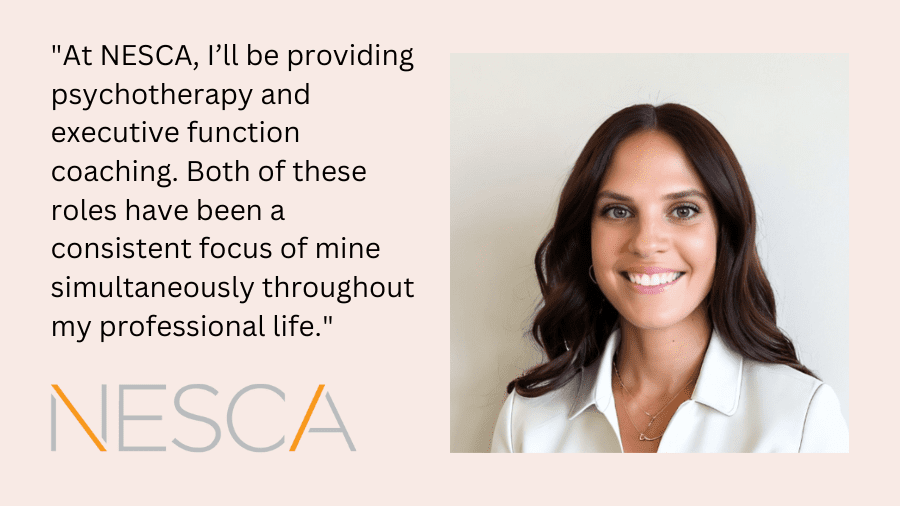
At NESCA, I’ll be providing psychotherapy and executive function coaching. Both of these roles have been a consistent focus of mine simultaneously throughout my professional life. After obtaining a B.S. in education at the University of Vermont, I worked in special education as a paraprofessional, supporting students with special needs in the classroom. In this role, I helped students learn new strategies to maintain their focus, self-regulate, and improve their organization. Additionally, throughout graduate school, I worked part-time as an EF coach at Engaging Minds, helping elementary, middle, and high schoolers with their homework and school assignments by finding ways to improve their task initiation, organization, time management, and planning skills.

My interest in social work/mental health counseling was sparked by my experience as a student teacher at UVM. During the entirety of my practicum, I found myself  gravitating towards students who struggled academically, mentally, socially, and emotionally. I was determined to help these students navigate their challenges by building meaningful connections, providing additional academic support, and increasing their self-confidence by focusing on their strengths.

My counseling experience officially started in graduate school with two full-year-long internships. My first internship took place in the counseling department at Boston Green Academy, a public charter school for grades 6-12, and my second was at NESCA. After graduate school, I worked as a school adjustment counselor at Newton South High School and also took on clients part-time at a private practice. In these roles, I supported the social and emotional wellbeing of students with special needs, as well as their families. After working in corporate wellness for the last year and a half, I am excited to return to the clinical setting, working for a practice that was a major part of my social work journey.

Having worked as a high school adjustment counselor, you must have seen many of the challenges students have with executive function. What are your biggest takeaways from that experience? How do you think that prepared you to be an EF coach?
The majority of my students struggled with executive function, therefore providing support in this area was part of my day-to-day routine. My biggest takeaways are:

  1. Identifying a “why” helps individuals become more motivated to be proactive in their EF journey. For example, I tend to ask people how improving these skills will affect their academic goals, mental health, social relationships, etc., so that there is significant meaning to the work being done.
  2. There is a system that works for everyone! Whether it’s electronic or physical, once someone identifies an organization system that increases their independence, it’s important that they stick to it and are consistent with it. Having a set system will allow them to easily locate their assignments, know when they are due, and how they’ll go about completing them. It’s always helpful for parents and teachers to be made aware of this system as well so that everyone is on the same page.
  3. Creating a regular homework routine is key to increasing productivity and limiting distractions. This includes having an identified start time, location, and plan. I always recommend structured breaks being part of this plan as well.
  4. I always advise folks to not compare themselves to others when it comes to their EF skills! We all have natural strengths. A skill that comes easy to you may be the most challenging task for someone else.

There have been countless reports and studies related to the negative impact COVID had on kids. As a psychotherapist to teens and young adults, what challenges are you seeing most in youth post-pandemic?
There’s no doubt that the impact of COVID on our youth has presented serious and complex challenges. The loss of structure, social opportunities, and extracurriculars (to name a few) is a shock to the system and very traumatic. The biggest challenges I’ve seen post-pandemic have been an increase in digital dependence, cyberbullying, school-based anxiety/refusal, and regression in social skills. That being said, as important as it is to identify post-pandemic challenges, there is value in pointing out gained strengths as well. A lot of students who I worked with learned new coping skills, acquired a deeper understanding of their needs, and discovered exciting new hobbies that they now get to share with others.


About Carly Edelstein, MSW, LCSW
Carly Edelstein is a Licensed Clinical Social Worker practicing in Massachusetts and Rhode Island. Having worked both in private practice and schools, she has extensive experience supporting students, families and educational teams to make positive changes. Ms. Edelstein provides executive function coaching and psychotherapy to clients ranging from middle school through adulthood. She also offers consultation to schools and families in order to support her clients across home and community environments.
 

To schedule an appointment with Ms. Edelstein for psychotherapy or EF coaching, please complete our online intake form


NESCA is a pediatric neuropsychology practice and integrative treatment center with offices in Newton and Plainville, Massachusetts, Londonderry, New Hampshire, and the greater Burlington, Vermont area, serving clients from preschool through young adulthood and their families. For more information, please email info@nesca-newton.com or call 617-658-9800.


On-the-Ground Parent & School Consultation in Honduras

By | Nesca Notes 2023

By Dot Lucci, M.Ed., CAGS
Director of Consultation and Psychoeducational Counseling Services, NESCA

NESCA’s International Work
NESCA is well regarded as an expert in providing neuropsychological evaluations for children and teens from around the globe as part of its International Evaluation program. To date, NESCA has provided evaluations to clients from more than 20 countries across Europe, Asia, Africa, South America, and North America.

Many families bring their child/children to our offices in New England to be evaluated, and NESCA’s founder and director Ann Helmus, Ph.D., has traveled to many countries to provide evaluations overseas. She also has a long-standing history training neuropsychologists in the Philippines. Our Transition and Coaching Services teams also conduct transition assessments for international clients as well as virtual executive function coaching to many young adults overseas.

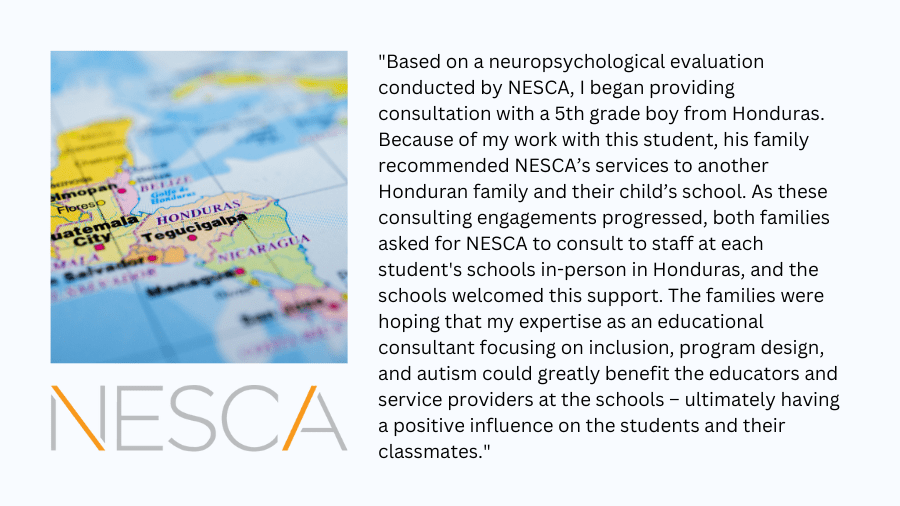
Based on a neuropsychological evaluation conducted by NESCA this past year, I began providing consultation with a 5th grade boy from Honduras who is a student at a non-profit, bilingual, independent, private PK-12 college preparatory school there. Because of my work with this student, his family recommended NESCA’s services to another Honduran family and their child’s school. As a provider, knowing that a family trusts us and finds what we do so beneficial that they recommend us to another family is extremely rewarding.

Setting the Stage: The Special Education Landscape in Honduras
The special education system in Honduras is very different than in the U.S. in that they do not have the variety of resources we are accustomed to in the U.S., and there are not many evaluators in Honduras in any discipline (i.e., neuropsychologists, speech/language, OT, etc.). For instance, there are only six neuropsychologists in the entire country. Another major difference is that it is the parents’ responsibility – not the school’s – to hire a 1:1 paraprofessional or aide if needed for their child. Paraprofessionals function similarly to their U.S. counterparts, but since they are not employed by the school, they are separate from the school.

The special education teachers and counselors also function similarly to those in the U.S.; however, there are unfortunately not enough of them, limiting treatment services. They work from documents similar to IEPs but that are qualitatively are very different from our IEPs.

There are only a couple of special education models used for students: 3 times a week for general special education support or 5 times a week for pull-out reading or math instruction. The 5 times a week options ends at 6th grade. Some of the teachers we worked with reportedly had training in Wilson and Orton-Gillingham, but there are no SLPs or OTs at the schools, and families pay for these services to be provided at the school or after school. Since there are so few professional service providers in the country, these interventions are extremely limited.

Parent & School Consultation in Honduras
As these consulting engagements progressed, both families asked for NESCA to consult to staff at each of the student’s schools in-person in Honduras, and the schools welcomed this support. The families were hoping that my expertise as an educational consultant focusing on inclusion, program design, and autism could greatly benefit the educators and service providers at the schools – ultimately having a positive influence on the students and their classmates.

Both schools are international, bilingual, non-profit, tuition-based college preparatory schools, and are accredited by the Honduran National Ministry of Education, AdvancED, and the International Baccalaureate Organization. One is a Christian faith-based school. Both serve students from nursery through high school and use N-12 American standards of Core Curriculum. They are similar to American schools in that they have a wide choice of classes/electives as students move up in the grades, as well as sports and after school clubs and activities. Upon completion of their high school careers, students at these schools have the opportunity to earn three diplomas: each school’s typical high school diploma, the Honduran Bachillerato, and the International Baccalaureate diploma. A high percentage of graduates go on to higher education in the United States and abroad. They accept students with a variety of “moderate” special needs and have special education teachers and mental health counselors to support them.

For these in-person school consults, I teamed up with another professional who was also already consulting at these schools. She is a Board Certified Behavior Analyst (BCBA) and speaks Spanish – a welcomed addition, as I do not. She is very skilled at providing behavioral support and is not overly rigid in her approach with students. Together, we presented Professional Development trainings for the two schools on the ground in Honduras. We brought a combined, well-rounded knowledge base to our work with the families and schools, offering lessons in a variety of topics, such as Universal Design in Learning (UDL), Differentiated Instruction (DI), Social Skills training/approaches, Mindset and Mindfulness, Sensory Integration, and Positive Behavioral Intervention and Supports (PBIS), along with the ABCs (antecedent-behavior-consequence) and functions of behavior (EATS: escape-attention-tangible-sensory). In this first engagement, we provided a broad overview of these topics, giving the staff much to think about regarding their instructional practices, behavior management, classroom design, and teaching styles. We will continue to provide both virtual and in-person consults this coming school year so their learning can continue to grow and deepen.

This is an ongoing training/learning process for the staff at these schools. As mentioned, we will continue providing ongoing training to help the staff implement Universal Design principles in developing their lessons. We will continue our discussion about viewing student aberrant behavior through multiple lenses – not just as “breaking the rules and needing consequences” (i.e., neurology-sensory, cognitive disconnect, attention, etc.), instead thinking about what the student is trying to communicate through their behavior. This education helps them to think differently about prevention and antecedents, thus impacting behavior management and discipline practices.

The Experience
Staff at both schools were willing to learn and collaborate, and welcomed our input, with one school attending the training the week before their school year started, because we were scheduled to be in-person! The Honduran teachers we worked with throughout the year, prior to our in-person visit, were so open to instruction, feedback, and learning more, often reaching out to us between our scheduled virtual meetings preceding our visit. They were eager to figure out how to support their neurodiverse (a new word for them) learners and allowed me to join their classes remotely so I could model different techniques and practices. They were willing to share their successes, questions, and challenges, making consultation both productive and powerful. They were open to the many “homework assignments” (i.e., articles/books to read, videos to watch, visuals to make, etc.) given to them and the recommendations provided. They implemented new class-wide and individual behavior plans (self-awareness plans) and benefited from the modeling of strategies I demonastrated.

It was a wonderful experience for them and us, and I am happy that our relationship is continuing and will deepen well into this new school year. I am looking forward to watching their continued growth – directly impacting the two students who started it all, as well as their classmates and those to come in future years.

If you are interested in learning more about NESCA’s international evaluation, transition, consultation, and coaching services, complete our online Intake Form.


About the Author

NESCA’s Director of Consultation and Psychoeducational Services Dot Lucci has been active in the fields of education, psychology, research and academia for over 30 years. She is a national consultant and speaker on program design and the inclusion of children and adolescents with special needs, especially those diagnosed with Autism Spectrum Disorder (ASD). Prior to joining NESCA, Ms. Lucci was the Principal of the Partners Program/EDCO Collaborative and previously the Program Director and Director of Consultation at MGH/Aspire for 13 years, where she built child, teen and young adult programs and established the 3-Ss (self-awareness, social competency and stress management) as the programming backbone. She also served as director of the Autism Support Center. Ms. Lucci was previously an elementary classroom teacher, special educator, researcher, school psychologist, college professor and director of public schools, a private special education school and an education collaborative.

Ms. Lucci directs NESCA’s consultation services to public and private schools, colleges and universities, businesses and community agencies. She also provides psychoeducational counseling directly to students and parents. Ms. Lucci’s clinical interests include mind-body practices, positive psychology, and the use of technology and biofeedback devices in the instruction of social and emotional learning, especially as they apply to neurodiverse individuals.


To book a consultation with Ms. Lucci or one of our many expert clinicians, complete NESCA’s online intake form. Indicate whether you are seeking an “evaluation” or “consultation” and your preferred clinician/consultant/service in the referral line.


NESCA is a pediatric neuropsychology practice and integrative treatment center with offices in Newton and Plainville, Massachusetts, Londonderry, New Hampshire, and Burlington, Vermont, serving clients from preschool through young adulthood and their families. For more information, please email info@nesca-newton.com or call 617-658-9800.


Transition Assessment: What Are You Testing that Hasn’t Already been Tested?

By | Nesca Notes 2023

By: Kelley Challen, Ed.M., CAS
Director of Transition Services, NESCA

Transition planning is a complex process centered around helping students, typically who receive special education services, to set goals for their postsecondary adult lives and to engage in learning, services, and experiences that will help them to ultimately reach those goals. Assessment is a critical aspect of this process, both as a means for collecting baseline information about the student and measuring progress throughout the planning process. Transition planning is federally mandated for students at age 16. However, some states require schools to start the process earlier. For instance, transition planning is required as part of the IEP process for students turning age 14 in Massachusetts.

Transition assessment is therefore required in middle school or early high school for most students in the United States. By this point in time, students on IEPs have often participated in lots of testing. Students may have had academic testing, psychological evaluation, speech and language testing, occupational and physical therapy assessments, functional behavioral assessment, and even home or health assessments. They have participated in so much previous testing, that some parents or professionals may ask, “What could a transition specialist be testing that has not already been addressed through other evaluations?”

The answer is, “A lot!” There are many areas that can and should be evaluated as part of an informed transition planning process, but which are not frequently evaluated when creating earlier IEPs. This is because initial IEPs and early reevaluations focus on helping students to access education and school life, but transition planning is about helping students to develop necessary skills for accessing learning, living, community, and employment as an adult. The following tables are based on on the Transition Assessment Planning Form developed by the Transition Coalition at the University of Kansas in 2008. These highlight many areas of assessment that can and should be considered as part of a comprehensive transition assessment and planning process. These also indicate which areas have usually not been considered for evaluation prior to a thorough transition assessment process.

Please note that every student on an IEP is an individual with unique strengths and disability-related needs and so these tables are offered as a general picture of what has been observed at NESCA in the majority of cases. Additionally, while all of the areas above are considered as part of a comprehensive transition assessment and planning process, they may not need direct assessment depending on student profile, postsecondary goals, and existing evaluation or report data.

For more information about transition assessment and transition planning at NESCA, visit our transition services page and our transition FAQs.


About the Author
Kelley Challen, Ed.M., CAS, is NESCA’s Director of Transition Services, overseeing planning, consultation, evaluation, coaching, case management, training and program development services. Ms. Challen also provides expert witness testimony in legal proceedings related to special education. She is also the Assistant Director of NESCA, working under Dr. Ann Helmus to support day-to-day operations of the practice. Ms. Challen began facilitating programs for children and adolescents with special needs in 2004. After receiving her Master’s Degree and Certificate of Advanced Study in Risk and Prevention Counseling from Harvard Graduate School of Education, Ms. Challen spent several years at the MGH Aspire Program where she founded an array of social, life and career skill development programs for teens and young adults with Asperger’s Syndrome and related profiles. She additionally worked at the Northeast Arc as Program Director for the Spotlight Program, a drama-based social pragmatics program, serving youth with a wide range of diagnoses and collaborating with several school districts to design in-house social skills and transition programs. Ms. Challen is co-author of the chapter “Technologies to Support Interventions for Social- Emotional Intelligence, Self-Awareness, Personality Style, and Self-Regulation” for the book Technology Tools for Students with Autism. She is also a proud mother of two energetic boys, ages six and three. While Ms. Challen has special expertise in supporting students with Autism Spectrum Disorders, she provides support to individuals with a wide range of developmental and learning abilities, including students with complex medical needs.

To schedule an appointment with one of NESCA’s transition specialists, please complete our online intake form

NESCA is a pediatric neuropsychology practice and integrative treatment center with offices in Newton and Plainville, Massachusetts, Londonderry, New Hampshire, and Burlington, Vermont, serving clients from preschool through young adulthood and their families. For more information, please email info@nesca-newton.com or call 617-658-9800.

The Benefits of Volunteering

By | Nesca Notes 2023

By: Kristen Simon, M.Ed, Ed.S
NESCA Transition Specialist; Psychoeducational Counselor

Volunteering has many benefits for school aged students beginning to participate in transition planning. Many charities and organizations rely on volunteers to continue their services and reach more people. In general, volunteering is a great way to form community connections, achieve a sense of purpose, and boost confidence and self-esteem, all while helping those in need. In thinking about a child’s eventual transition to adulthood, there are many additional hidden benefits to volunteering.

  • Build social connections: Volunteering allows individuals to engage and connect with others in a structured environment. Working with others through task completion towards a common goal is a great way for individuals to form friendships and positive connections in a low-pressure setting.
  • Mental health benefits: Volunteering has been shown to decrease symptoms of depression and loneliness. Many studies have shown that helping others and carrying out altruistic acts makes you happier. In fact, some therapists believe volunteering should be built into a treatment plan in the management of depression.
  • Employment/Transition Skills: Volunteering can help individuals build various skills that will help them in future jobs. Volunteering can help develop leadership skills, one’s ability to work in a team, customer service, following instructions, and punctuality to name a few important pre-employment skills. Volunteering helps individuals learn what type of work they enjoy through exposure to various work activities and work sites. Consistent volunteer work can also help build a young person’s resume.

It may be decided that a good match leads to long-term volunteering; however, it does not have to be a long-term commitment. Consistent volunteering can be a helpful tool in the stressful seasons of the year. Helping others can help to clear your head, reduce stress, and bring a perspective that allows you to engage more fully in your other commitments.

If your child and or family unit is looking for volunteer opportunities, you can start by contacting local animal shelters, senior centers, public libraries, community centers, or food pantries. Other websites to locate family volunteer opportunities in the greater Boston area include:

https://www.doinggoodtogether.org/family-volunteering-boston

https://community-harvest.org/

https://www.cradlestocrayons.org/boston/take-action/volunteer/


About the Author

Kristen Simon, M.Ed, Ed.S, has worked with transition-aged youth as a licensed School Psychologist for more than a decade. She has extensive experience working with children and adolescents with a range of learning and social/emotional abilities. Kristen’s strengths lie in her communication and advocacy skills as well as her strengths-based approach. She is passionate about developing students’ self-awareness, goal-setting abilities, and vision through student-centered counseling, psychoeducation, social skills instruction, and executive functioning coaching. Mrs. Simon has particular interests working with children and adolescents on the Autism spectrum as well as individuals working to manage stress or anxiety-related challenges.

Mrs. Simon is an expert evaluator and observer who has extensive working knowledge of the special education process and school-based special education services, particularly in Massachusetts. She has been an integral part of hundreds of IEP teams and has helped to coordinate care, develop goals, and guide students and their families through the transition planning process. Mrs. Simon further has special expertise helping students to learn about their diagnoses and testing and the IEP process in general. She enjoys assisting students, families, and educators in understanding a student’s disability-related needs as well as the strategies that can help the student to be successful in both academic and nonacademic settings. Mrs. Simon has often been a part of teams in the years when students are initially participating in transition services, and she has helped countless students to build the skills necessary to be part of their first team meetings. She is committed to teaching students—as well as parents and educators—how to participate in student-centered team meetings and the IEP processes.

At NESCA, Mrs. Simon works as a transition specialist and psychoeducational counselor. She works with adolescents, their families, and their school communities to identify and build the skills necessary to achieve their postsecondary goals. Mrs. Simon provides transition assessment (including testing, functional evaluations, and observations), program observations and evaluations, case management and consultation, and individualized counseling and skills coaching.

To schedule an appointment with one of NESCA’s transition specialists, please complete our online intake form

NESCA is a pediatric neuropsychology practice and integrative treatment center with offices in Newton and Plainville, Massachusetts, Londonderry, New Hampshire, and Burlington, Vermont, serving clients from preschool through young adulthood and their families. For more information, please email info@nesca-newton.com or call 617-658-9800.


Skip to content