NESCA’s Newton, MA location has immediate availability for neuropsychological evaluations. Our MA clinicians specialize in the following evaluations: Neuropsychological; Autism; and Emotional and Psychological, as well as Academic Achievement and Learning Disability Testing.

Visit www.nesca-newton.com/intake for more information or to book an evaluation.

Tag

Neuropsychological Evaluation Archives - Page 12 of 23 - NESCA

Subscribe to NESCA Notes

College Myth Buster: Four-Year College Degrees Are Most Often Not Completed in Four Years

By | NESCA Notes 2022

By: Kelley Challen, Ed.M., CAS
Director of Transition Services; Transition Specialist, NESCA

One of the biggest challenges in supporting students with disabilities, and their families, as they contemplate the transition from high school to college is combatting the many “myths” that exist in our culture and brains about college. Chief among those myths is the expectation that a 17- or 18-year-old should be able to:

  • Select “the right” college—which is a “fit” for their interests and personality during a period of time when they are quickly changing and forming a new view of themselves and their identity.
  • Easily bridge the transition from high school to college—even though the expectations for time management, class and study hours, life skills, extracurricular participation, meeting graduation requirements, etc., are completely different.
  • And, successfully complete 120 or more college credit hours within just four years.

The reality is that the majority of students who enroll at a “four-year” college in the United States will not finish their bachelor’s degree in four years. Instead, according to the National Center for Education Statistics, just 49 percent of first-time, full-time college students earn a bachelor’s degree in four years. To rephrase, the majority of students who enroll at a college expecting to graduate with a bachelor’s degree in four years will be disappointed, although there are some differences in retention at public and private institutions. Given that colleges are excellent at marketing, you may notice when researching schools, that it is far more common for public and private universities to advertise their “six-year” graduation rate, rather than the four-year rate. Even so, the National Student Clearhouse Research Center data indicates that the six-year completion rate for full-time undergraduate students in 2023 in the United States was 62.2 percent overall—which is effectively unchanged since 2015. There is essentially a more than one in three chance that a student who enrolls at a particular college, will not end up with a degree from that college six years later.

While these numbers can be somewhat startling, it is important to go into the college process with eyes wide open and to pay attention to each college’s retention rates from freshman to sophomore year as well as their four-year and six-year graduation rates. There is also a great opportunity here to rethink college planning and college paths. Rather than trying to find “the right” college for seeking a bachelor’s degree, students might instead look for “the right” college to start being a college student at. Sometimes, this is the community college right down the street where the student can trial classes of interest to narrow down their choices of major and also trial classes in areas of challenge (such as math, or a lab science) if the student is worried about being able to pass such classes at a four-year college. Another possibility for students with learning disabilities can be to start at a college that is designed for students with learning disabilities or that has a great learning disabilities program. We have the opportunity to help students forge a college path that looks a lot more like a career path, starting with an “entry-level” school and working up to a school that offers the student the rigor and academic concentration that reflects the student’s highest potential. For students interested in this type of planning, familiarity with transfer rates and transfer agreements between colleges can be an important part of the college research process. Financial planning is also critical—rather than a student needing to fund six years of college at a private institution, participation in a community college as a starter school or taking classes at a community college or public college during the summer might help to curb overall college costs.

In addition to thinking creatively about college planning, I think it is important to talk earnestly about college retention and graduation rates with teenagers—to let students know that there is actually a good chance they might not like the college they choose, might decide to change colleges, or might not graduate in four years. These are the facts of college, and we need to normalize the experience of trying college and deciding it’s not the right school or right time, needing to take a semester off for mental health reasons, or simply needing more time to get through it. Because that is what’s normal!


About the Author
Kelley Challen, Ed.M., CAS, is NESCA’s Director of Transition Services, overseeing planning, consultation, evaluation, coaching, case management, training and program development services. Ms. Challen also provides expert witness testimony in legal proceedings related to special education. She is also the Assistant Director of NESCA, working under Dr. Ann Helmus to support day-to-day operations of the practice. Ms. Challen began facilitating programs for children and adolescents with special needs in 2004. After receiving her Master’s Degree and Certificate of Advanced Study in Risk and Prevention Counseling from Harvard Graduate School of Education, Ms. Challen spent several years at the MGH Aspire Program where she founded an array of social, life and career skill development programs for teens and young adults with Asperger’s Syndrome and related profiles. She additionally worked at the Northeast Arc as Program Director for the Spotlight Program, a drama-based social pragmatics program, serving youth with a wide range of diagnoses and collaborating with several school districts to design in-house social skills and transition programs. Ms. Challen is co-author of the chapter “Technologies to Support Interventions for Social- Emotional Intelligence, Self-Awareness, Personality Style, and Self-Regulation” for the book Technology Tools for Students with Autism. She is also a proud mother of two energetic boys, ages six and three. While Ms. Challen has special expertise in supporting students with Autism Spectrum Disorders, she provides support to individuals with a wide range of developmental and learning abilities, including students with complex medical needs.


Neuropsychology & Education Services for Children & Adolescents (NESCA) is a pediatric neuropsychology practice and integrative treatment center with offices in Newton, Massachusetts, Plainville, Massachusetts, and Londonderry, New Hampshire, serving clients from preschool through young adulthood and their families. For more information, please email info@nesca-newton.com, call 617-658-9800 or complete our online Intake Form.

Pediatric Neuropsychologist Ferne Pinard, Ph.D., Joins NESCA

By | NESCA Notes 2022

By: Jane Hauser
Director of Marketing & Outreach

I recently had the opportunity to learn more about Pediatric Neuropsychologist Ferne Pinard, Ph.D., who joined NESCA in this August. We are thrilled to have her on board and hope you learn more about her background and specialty areas in today’s blog interview.

How did you choose pediatric neuropsychology as a profession?

I’ve had an interesting journey to get to where I am today professionally. I started working with adolescents in the West Indies as a high school teacher. There I quickly learned that meant not just teaching to the curriculum, but also looking at each student as a whole person – often along with their parents – providing counseling to them and additional academic support as needed to meet their needs. That sparked my initial interest in working to support children.

That spark turned into a deep interest in psychology. In college I decided to major in psychology. I became involved in research examining various aspects of child development and learned about statistical methods.

In graduate school, I worked with my mentor on research projects that involved administration of neuropsychological tests and examining how performance on these tests were related to various outcomes (e.g., academic performance, externalizing behaviors). I enjoyed doing assessment as part of the research project and other training experiences. Although I toyed with the idea of becoming a therapist – as I was trained to provide therapy and conduct assessment – I decided to further my knowledge in the brain/behavior relationship

How have your previous work experiences prepared you to be a neuropsychologist with NESCA?

I spent the last 11 years at Boston Children’s Hospital, first as a post-doctorate fellow and later as an attending neuropsychologist.

As a fellow at Boston Children’s, I had the opportunity to work in various specialty clinics, gaining exposure to patients with a range of medical and genetic conditions, including neurofibromatosis, cancer, etc.

Later, I went on to gain specialty experience in the Pediatric Neuro-immunology and Learning Disabilities programs. As an attending neuropsychologist, I worked with, trained, and supervised pre-doctorate psychology interns and post-doctoral fellows.

As part of the neuroimmunology program, you assisted with research on the impact of post-acute sequelae of COVID-19 (PASC) – also known as Long Haul Covid – on children and their education. Tell us about that.

Yes, I had the opportunity to provide consultation to a previous colleague examining the cognitive impact of Long Covid. I also conducted a few assessments of adolescent struggling with persistent symptoms after being diagnosed with Covid. Difficulties with attention, mood, executive functioning (e.g., working memory and slow processing speed), and fatigue are commonly reported among individuals with Long Covid. These students also experienced disruption in school due to their illness then ongoing symptoms and understandably find it difficult to keep up and meet academic expectations. So many young people were sadder and more anxious throughout Covid…layer Long Haul Covid on top of that, and it’s a huge problem.

How do you see your previous work experiences translating to the families we work with at NESCA?

I bring a lot of knowledge and evaluation experience to NESCA, but most importantly, I bring expertise and compassion in working with families – creating and maintaining relationships with them. The greatest thing I can do for a family is to listen to their concerns, let them feel heard, and allow them to express their feelings about what they and their child are going through. This helps the parents and the child’s school gain a better understanding of the child.

How do you tailor your evaluations for different children, say an anxious child?

Patience and validation are key. I think it is also important to include the child and their caregiver in the discussion. Perhaps I add additional structure to the evaluation (e.g., use of a checklist, breaks at predetermined times), integrate strategies to reduce anxiety (e.g., deep breathing, use of fidgets), or modify the evaluation to take place over three sessions instead of two. Sometimes, the child is allowed to have the parent in the room with them throughout the evaluation. There are different approaches that can be taken based on each individual, and it’s my role to work with the child and caregiver to identify what would work best for the child.

You’ve had a lot of experience evaluating medically complex children and children who are dealing with medical conditions that many think only affect adults. Tell us about that.

It’s true. I’ve worked closely with children who have gone through cancer treatments, including chemotherapy, radiation, and surgery. These are always very touching experiences. These children have been through so much medically that sometimes the medical experiences lead to mental health challenges. They may have gotten through the cancer itself, but there can be residual and sometimes long-term fears of a reoccurrence. Often, there is an intensely emotional component to these assessments because of what the children and their families have endured. I’ve heard the fear in the voices of both the children and their parents’ voices. It’s my job to listen and provide them with a safe space.

Some of the children seen may not be able to maintain engagement for a typical evaluation due to fatigue related to their medical condition and treatment, for example. In these cases, the evaluation will need to be carefully tailored to address the referral question (s). And again, the approach to the evaluation would have to be modified to meet the child where they are.

I’ve also worked with children who have been diagnosed with Multiple Sclerosis and other autoimmune conditions. With these children, I always factor in the amount of stress they are experiencing in life and school as well as the fears they have about how MS may impact them later in life. The stress they feel, whether at school or based on their diagnosis, can have a negative impact on their symptoms. There’s a cascading effect from the brain and all of its thoughts and worries, and that is what we help them deal with. I am always eager to advocate for these children who bear such a heavy load.

What is the most rewarding part of your job as a neuropsychologist?

I feel that I have added value to a child’s life, when I can provide them and their families with a meaningful and comprehensive understanding of their profile—one that includes strengths, not just a focus on weaknesses. I think this is essential as it enables the family and child to advocate for their needs.

Why did you want to be part of NESCA’s team?

Initially, I was really drawn to the integrative approach to care for the children who are with NESCA. Coordination of care, whenever possible, and consultation among professionals involved in a child’s care leads to better outcomes. I was also excited to work with the professionals who specialize in different areas than I am accustomed to working with, such as postsecondary transition. The team here is very willing to collaborate so we can all teach and learn from each other. While I know I will gain great knowledge from the group, it really best serves the families with whom we work.


About Pediatric Neuropsychologist Ferne Pinard, Ph.D.

Dr. Pinard provides comprehensive evaluation services for children, adolescents, and young adults with learning disabilities, attention deficit/hyperactivity disorders (ADHD), and psychiatric disorders as well as complex medical histories and neurological conditions. She has expertise in assessing children and adolescents with childhood cancer as well as neuro-immunological disorders, including opsoclonus-myoclonus-ataxia syndrome (“dancing eyes syndrome”), central nervous system vasculitis, Hashimoto’s encephalopathy, lupus, auto-immune encephalitis, multiple sclerosis (MS), acute disseminated encephalomyelitis (ADEM), and acute transverse myelitis (ATM), and optic neuritis.

To book a neuropsychological evaluation with Dr. Pinard or another expert neuropsychologist at NESCA, complete NESCA’s online intake form

Neuropsychology & Education Services for Children & Adolescents (NESCA) is a pediatric neuropsychology practice and integrative treatment center with offices in Newton and Plainville, Massachusetts, as well as Londonderry, New Hampshire. NESCA serves clients from preschool through young adulthood and their families. For more information, please email info@nesca-newton.com or call 617-658-9800.

The Importance of SMEDMERTS

By | NESCA Notes 2022

By: Ann Helmus, Ph.D.
NESCA Founder/Director; Clinical Neuropsychologist

While supporting a friend who was recently diagnosed with bipolar disorder, I have come to appreciate how challenging it is for people with this disorder to maintain a stable mood state. One of the most helpful resources I discovered in my search for information to help me support my friend was a TEDx talk by Ellen Forney, an author who has successfully managed her bipolar disorder for two decades by following SMEDMERTS, an acronym for: Sleep, Medication, Eat Well, Doctor/therapy, Mindfulness/Meditation, Exercise, Routine, Tools (coping), and Support System. I was struck that only 25% of the solution for managing her mental illness involves the mental health system: medication and doctor. The bulk of her treatment system relates to lifestyle choices.

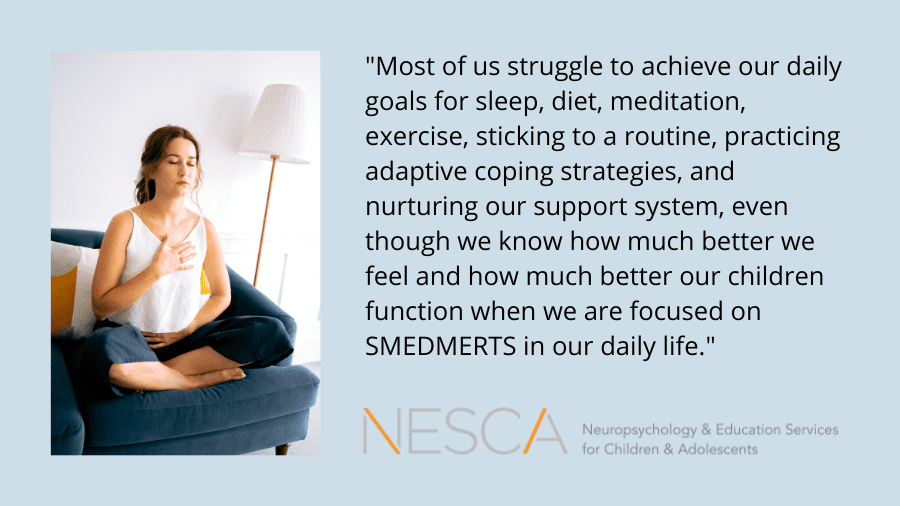
While attention to SMEDMERTS is important for all of us, especially in these stressful times, consistent focus on these lifestyle choices is particularly critical for the many children and adolescents who we see at NESCA presenting with anxiety, mood disorders, ADHD, and behavioral issues. Most of us struggle to achieve our daily goals for sleep, diet, meditation, exercise, sticking to a routine, practicing adaptive coping strategies, and nurturing our support system, even though we know how much better we feel and how much better our children function when we are focused on SMEDMERTS in our daily life. While the impact of medications and doctors on functioning is largely outside of our control, we can control our lifestyle choices, which are critical to the success of managing any mental health issue.

How can we help the children in our lives to embrace SMEDMERTS?

  • Modeling it for them. As Robert Fulgham said, “Don’t worry that your children never listen to you; worry that they are always watching you.”
  • Praising their efforts. Offer positive feedback, such as, “Great idea to get up early to go for a run,” or, “I like how you called a friend when you were upset to get some advice.”
  • Enlisting the help of a coach. NESCA offers real-life skills coaching, executive functioning coaching, and health coaching to help children, adolescents, and young adults build and maintain habits to support positive lifestyle choices.

Health coaching is available to parents of NESCA clients who are seeking support in developing positive health habits, such as exercise, diet, stress management, and meditation.

If you are interested in coaching services at NESCA to support your quest for SMEDMERTS, please contact Crystal Jean: cjean@nesca-newton.com or fill out our intake form at www.nesca-newton.com.


About the Author
NESCA Founder/Director Ann Helmus, Ph.D. is a licensed clinical neuropsychologist who has been practicing for almost 20 years. In 1996, she jointly founded the  Children’s Evaluation Center (CEC) in Newton, Massachusetts, serving as co-director there for almost ten years. During that time, CEC emerged as a leading regional center for the diagnosis and remediation of both learning disabilities and Autism Spectrum Disorders.

In September of 2007, Dr. Helmus established NESCA (Neuropsychology & Education Services for Children & Adolescents), a client and family-centered group of seasoned neuropsychologists and allied staff, many of whom she trained, striving to create and refine innovative clinical protocols and dedicated to setting new standards of care in the field.

Dr. Helmus specializes in the evaluation of children with learning disabilities, attention and executive function deficits and primary neurological disorders. In addition to assessing children, she also provides consultation and training to both public and private school systems. She frequently makes presentations to groups of parents, particularly on the topics of non-verbal learning disability and executive functioning.

To book an evaluation with one of NESCA’s many expert neuropsychologists, complete NESCA’s online intake form

Neuropsychology & Education Services for Children & Adolescents (NESCA) is a pediatric neuropsychology practice and integrative treatment center with offices in Newton and Plainville, Massachusetts, as well as Londonderry, New Hampshire. NESCA serves clients from preschool through young adulthood and their families. For more information, please email info@nesca-newton.com or call 617-658-9800.

October is Dyslexia Awareness Month

By | NESCA Notes 2022

By: Alissa Talamo, PhD
Pediatric Neuropsychologist, NESCA

According to the International Dyslexia Association (IDA), “Dyslexia is a language-based learning disability. Dyslexia refers to a cluster of symptoms, which result in people having difficulties with specific language skills, particularly reading. Students with dyslexia usually experience difficulties with other language skills such as spelling, writing, and pronouncing words. Dyslexia affects individuals throughout their lives; however, its impact can change at different stages in a person’s life. It is referred to as a learning disability because dyslexia can make it very difficult for a student to succeed academically in the typical instructional environment, and in its more severe forms, will qualify a student for special education, special accommodations, or extra support services.” Also, it is important to recognize that dyslexia is not due to either a lack of intelligence or a lack of desire to learn, and with appropriate and sufficient teaching methods, students with dyslexia can learn successfully.

Fortunately, there are effective strategies to help students with dyslexia. However, some common approaches to teaching reading (e.g., guided reading, balanced literacy) have not been found to be effective enough for the struggling reader. What research has found to be most effective is Structured Literacy. Structured Literacy instruction includes specific elements that are necessary for a dyslexic reader to make reading progress. Such elements include phonemic awareness (the ability to notice, think about, and work with individual sounds in words, such as separating the spoken word “cat” into three distinct phonemes), phonological awareness (the ability to recognize and manipulate the spoken parts of sentences and words), sound-symbol association (e.g., identify printed letters and what sounds they make), syllable instruction, morphology (smallest unit of meaning in the language), syntax (e.g., grammar), and semantics (meaning). In order to be most effective, students with dyslexia need to be taught using an explicit instruction method, with a teacher trained in a program that meets that student’s specific needs, the instruction needs to be taught in a logical order (basic concepts before more difficult ones), and each step needs to be based on previously learned concepts (cumulative).

According to the IDA, a comprehensive evaluation to assess for dyslexia, as well as to assess for any other potential language challenges or learning disabilities, should include intellectual and academic achievement testing, as well as assessment of critical underlying language skills that are closely linked to dyslexia, such as receptive and expressive language skills, phonology (phonological awareness, phonemic awareness), and rapid naming (e.g., quickly reading single letters or numbers). Additionally, a full evaluation should assess a student’s ability to read a list of unrelated real words as well as a list of pseudowords (made up pretend words to assess a child’s ability to apply reading rules), in addition to a student’s ability to read in context (e.g., stories). If a student is found to demonstrate that they meet criteria for a diagnosis of dyslexia, a specialized program should be developed by the school in order to provide appropriate services and accommodations.

Sources:

https://dyslexiaida.org/dyslexia-basics-2

https://dyslexiaida.org/effective-reading-instruction-for-students-with-dyslexia

www.readingrockets.org


About the Author

With NESCA since its inception in 2007, Dr. Talamo had previously practiced for many years as a child and adolescent clinical psychologist before completing postdoctoral re-training in pediatric neuropsychology at the Children’s Evaluation Center.

After receiving her undergraduate degree from Columbia University, Dr. Talamo earned her doctorate in clinical health psychology from Ferkauf Graduate School of Psychology and the Albert Einstein College of Medicine at Yeshiva University.

She has given a number of presentations, most recently on “How to Recognize a Struggling Reader,” “Supporting Students with Working Memory Limitations,” (with Bonnie Singer, Ph.D., CCC-SLP of Architects for Learning), and “Executive Function in Elementary and Middle School Students.”

Dr. Talamo specializes in working with children and adolescents with language-based learning disabilities including dyslexia, attentional disorders, and emotional issues. She is also interested in working with highly gifted children.

Her professional memberships include MAGE (Massachusetts Association for Gifted Education), IDA (International Dyslexia Association), MABIDA (the Massachusetts division of IDA) and MNS (the Massachusetts Neuropsychological Society).

She is the mother of one teenage girl.


To book a consultation with Dr. Talamo or one of our many other expert neuropsychologists, complete NESCA’s online intake form.

Neuropsychology & Education Services for Children & Adolescents (NESCA) is a pediatric neuropsychology practice and integrative treatment center with offices in Newton, Massachusetts, Plainville, Massachusetts, and Londonderry, New Hampshire, serving clients from preschool through young adulthood and their families. For more information, please email info@nesca-newton.com or call 617-658-9800.

Meet Pediatric Neuropsychologist Lauren Halladay, Ph.D.

By | NESCA Notes 2022

By: Jane  Hauser

Director of Marketing & Outreach, NESCA

I recently had the opportunity to learn more about Pediatric Neuropsychologist Lauren Halladay, Ph.D., who joins NESCA in September. Learn more about her background and specialties in today’s blog interview.

How did you choose pediatric neuropsychology as a profession?

My interest was originally piqued when I was younger, as early as my high school years. I volunteered at a therapeutic riding program for kids with disabilities. That’s what initially sparked my desire to work with kids, and those with disabilities, in particular. My mother was a third grade teacher, which also imparted the desire to work with kids and help them overcome their challenges at school.

I went on to major in psychology and had a strong interest in pediatrics for the reasons I mentioned previously. Based on some of the work I did in graduate school, I learned that I really enjoyed the assessment piece, especially with the younger kids, helping them in life by identifying the right diagnosis (when applicable) and helping to put the right interventions in place for them to build skills that will equip them for the future.

How have your previous work experiences prepared you to be a neuropsychologist?

I’ve had a wide breadth of work experiences where I was supervised by neuropsychologists, whether it be in satellite health systems, the hospital setting, etc. While in those clinics, I had the opportunity to work with a variety of populations and presentations, including those who have experienced trauma, or have developmental or learning disabilities.

Having worked in several states throughout the country, including Oregon, Ohio, New York and Massachusetts, I’ve had the pleasure of working closely with a variety of families who present with unique backgrounds, experiences, and cultural values, which I always consider when making diagnostic decisions and developing recommendations.

What areas of neuropsychology have you most enjoyed to date? What would you consider your specialty area?

There are several areas that I am very passionate about. I really enjoy working with young kids, those under the ages of five or six. I also have a great interest in working with families who have concerns about their child potentially having an autism spectrum disorder or an intellectual or developmental disability. In addition, I find it incredibly rewarding to work with and help families whose children are medically complex or have moderate to severe cognitive impairments.

Regardless of how the child or student presents or what challenges they may have, I always individualize my approach so that I can meet the needs of each child. This is especially true in cases where families have had a hard time getting assessments done in the school setting or even privately in the past.

What is the most rewarding experience in neuropsychology that you’ve had to date?

I find it rewarding to hear from families when the strategies I’ve recommended are or are not working for them. For example, hearing that parents achieve success in implementing behavior management strategies, accessing support in the community, and/or learning about their child’s diagnosis and how to create an environment that suits their needs is a wonderful feeling. On the other hand, when the initial recommendations are not as helpful as intended, I enjoy approaching the problem-solving process together and discussing alternate approaches.

I also find it incredibly rewarding to offer parents and caregivers a deeper perspective on a child who has a moderate to severe cognitive impairment or is medically complex. Being able to give them a sense of where their child is developmentally in relation to their peers can be enlightening. Additionally, having more information about a child’s developmental level can help families and school staff establish appropriate, and individualized, expectations that set the child up for success. I strive to make a difference in these cases by developing strong partnerships with families, as well as serving as a trusted resource and advocate as they navigate how to best access supports in the community and in school.

What benefits, having been trained in a school psychology department, do you bring to families at NESCA?

My school psychology background allows me to bring a deep awareness and perspective on how the IEP process works. My experience and knowledge of special education rights allows me to be a true partner to families who are trying to navigate and understand the IEP process. I am able to share that knowledge and better advocate for my clients in Team meetings.

Why did you decide to join the team at NESCA?

I knew that in my next career move, I wanted to be part of a collaborative community that puts an emphasis on work/life balance—I feel that both allow clinicians to produce the highest quality work. At NESCA, I will also have the opportunity to use my school psychology skills and be an active participant in the IEP process on behalf of our clients.

NESCA is known for creating and building long-lasting relationships with the families they work with. I look forward to working with families and their schools/districts for the long-term, helping students to build skills along the way that will help them throughout their lives.

Finally, not being a native Bostonian, I am excited to learn more about and partner with the different school systems on behalf of the families and students we work with at NESCA.


About Lauren Halladay, Ph.D.

Dr. Halladay conducts comprehensive evaluations of toddlers, preschoolers, and school-aged children with a wide range of developmental, behavioral, and emotional concerns. She particularly enjoys working with individuals with Autism Spectrum Disorder, Intellectual and Developmental Disabilities, and complex medical conditions. She has experience working in schools, as well as outpatient and inpatient hospital settings. She is passionate about optimizing outcomes for children with neurodevelopmental disabilities by providing evidence-based, family-oriented care.


If you are interested in booking an appointment for an evaluation with a NESCA neuropsychologist/clinician, please fill out and submit our online intake form


Neuropsychology & Education Services for Children & Adolescents (NESCA) is a pediatric neuropsychology practice and integrative treatment center with offices in Newton and Plainville, Massachusetts, and Londonderry, New Hampshire, serving clients from preschool through young adulthood and their families. For more information, please email info@nesca-newton.com or call 617-658-9800.

What Do We Mean by Individualized Neuropsychological Evaluations?

By | NESCA Notes 2022

By: Erin Gibbons, Ph.D.
Pediatric Neuropsychologist, NESCA

Previous blogs in our recent series addressing frequently asked questions during the intake process, have covered the important differences between school-based testing and an independent neuropsychological evaluation. A neuropsychological evaluation should always be comprehensive, meaning that it covers various aspects of the student’s learning profile: cognition, language, memory, attention, and social-emotional functioning. However, the evaluation should also be individualized. Essentially, a good evaluation should aim to answer the questions that are specific to that student, not just a cookie-cutter list of tests.

Prior to starting testing, the clinician reviews any previous records and holds an intake appointment with the student’s parents or caregivers. Through this process, the clinician gathers information about the student’s early developmental history, medical background, and current challenges. If the student is already receiving services – either privately or through the school district – that is also important information. All of this helps to shape the “Referral Questions” for the evaluation. In some cases, the questions are very specific; for example, “Does my child have dyslexia?” or “Does my child have ADHD?” In other cases, the question is less defined, such as when we are asked “What is going on with my child and how do I help them?”

We often get asked by parents or caregivers if their child can have all of the tests available performed during their child’s neuropsychological evaluation. As clinicians, we understand that temptation. An evaluation is both an investment of time and money for the parents or caregivers. But neuropsychological evaluations are a lot of work for children, so we want to be sure to tailor the tests to what is actually going to yield beneficial findings for them or will help answer the referral question.

Some families request the list of tests that will be included in the evaluation. Unfortunately, this is not always possible until after testing is underway. Following the intake process, the clinician starts to develop the “battery” – the specific tests that will be administered to the student. Most clinicians have a skeleton battery of tests that they include for every client – an intelligence test, some academic tests (reading, writing, and math), and tasks that assess skills, such as language, memory, and attention – as described above. The clinician then fills in the testing battery based on the specific questions for that student. For example:

  • An evaluation designed to test for dyslexia should include several tests of reading as well as tests that look at very specific skills related to reading (e.g., phonological processing). When there are no concerns about reading, this aspect of the evaluation would be briefer.
  • An evaluation designed to assess for autism spectrum disorder should include a variety of tasks that examine social communication and reciprocal social skills. These types of tasks would likely not be included for a student who has never had any challenges in the social domain.

If a school district or another provider is asking for the list of tests that will comprise the neuropsychological evaluation, please talk to your clinician about this during the intake process. The final list might not be available until testing is complete, but this is definitely something that your clinician can provide as soon as possible.


About the Author

Erin Gibbons, Ph.D. is a pediatric neuropsychologist with expertise in neurodevelopmental and neuropsychological assessment of infants,

children, and adolescents presenting with developmental disabilities including autism spectrum disorders, Down syndrome, intellectual disabilities, learning disabilities, and attention deficit disorders. She has a particular interest in assessing students with complex medical histories and/or neurological impairments, including those who are cognitively delayed, nonverbal, or physically disabled. Dr. Gibbons joined NESCA in 2011 after completing a two-year post-doctoral fellowship in the Developmental Medicine Center at Boston Children’s Hospital. She particularly enjoys working with young children, especially those who are transitioning from Early Intervention into preschool. Having been trained in administration of the Autism Diagnostic Observation Schedule (ADOS), Dr. Gibbons has experience diagnosing autism spectrum disorders in children aged 12 months and above.


If you are interested in booking an evaluation with a NESCA neuropsychologist/clinician, please fill out and submit our online intake form


Neuropsychology & Education Services for Children & Adolescents (NESCA) is a pediatric neuropsychology practice and integrative treatment center with offices in Newton and Plainville, Massachusetts, and Londonderry, New Hampshire, serving clients from preschool through young adulthood and their families. For more information, please email info@nesca-newton.com or call 617-658-9800.

IEP or 504: What Do They Mean and How Can They Apply to My Child?

By | NESCA Notes 2022

By Miranda Milana, Psy.D.
Pediatric Neuropsychologist

If your child has ever undergone an evaluation through their school system or received an outside neuropsychological evaluation, chances are you have heard the terms “504 plan” or “IEP” thrown around. Given that it can be difficult to understand the differences between the two, we will break down what both of these terms mean and how they might apply to your child.

What is an IEP?

IEP stands for Individualized Education Program and provides specialized instruction, program modification, and accommodations through the public school system based on a student’s disability and how it impacts access to the curriculum. IEPs must include:

  • Annual goals that are measurable via benchmarks
  • Progress reports of the student’s current performance
  • Descriptions of how services will be provided
  • Outlined transition services as the child ages

In addition, IEPs must detail what academic environment would be the least restrictive, and therefore, most suitable for the student to appropriately access the educational curriculum.

Who is eligible for an IEP?

In order to qualify for an IEP, students must receive an evaluation either through the school system or through an outside provider that outlines the student’s disability status and how it negatively impacts accessing the educational curriculum. Importantly, a diagnosed disability is not enough to quality for an IEP on its own. Instead, the disability must be impacting the student’s ability to make effective progress in the general education program, which includes both academic and non-academic offerings of the district. Some examples of qualifying diagnoses include (but are not limited to):

  • Autism
  • Emotional Disturbance
  • Intellectual Disability
  • Specific Learning Disability

A parent or caregiver may ask what happens if  their child has a diagnosed disability but does not require special education services? Instead, the team may determine, through the eligibility process, that the student only requires accommodations, such as extended time on tests.

This is a perfect example of when a student might not qualify for an IEP and would instead be considered for a 504 plan. Simply put, IEPs and 504 plans both provide accommodations; however, 504 plans do NOT provide for specialized instruction or program modifications.

 What is a 504 plan?

A 504 plan is referred to as such because it is covered under Section 504 of a federal civil rights law called the Rehabilitation Act. This law works to ensure that students receive appropriate supports and accommodations within the academic setting. 504 plans outline accommodations for students which can include some of the following (but again, accommodations are not limited to the following):

  • Preferential seating
  • Extended time on tests and quizzes
  • Reduced distraction testing environments
  • Access to class notes
  • The use of a calculator during exams

As you can see, none of these accommodations is modifying the curriculum or providing a student with educational services as would be the case with an IEP.

Who is eligible for a 504 plan?

Any student with a disability impairing functioning in one or more areas is eligible for a 504 plan. One common example would be a student with diagnosed Attention Deficit Hyperactivity Disorder (ADHD) who requires distraction-reduced testing environments and/or other associated accommodations but does NOT require specialized academic instruction.

Another example is a parent of a child with an autism spectrum diagnosis may find that their child was found to be ineligible for an IEP through the special education eligibility determination process. Shouldn’t the student qualify for an IEP based on the autism disability?

The answer is not necessarily. If a student has a diagnosis of autism but is showing no signs of impairment within the academic setting (i.e., making appropriate academic progress, showing no signs of emotional distress, doing well with their peers, etc.), an IEP would not be warranted. Instead, a 504 plan would likely be considered (but again, is not guaranteed if academic functioning is not impaired).

If you feel your child requires a 504 plan or IEP and you are not sure where to start, contact your child’s special education program at their school. You may also wish to consult with an educational advocate or attorney who has a thorough understanding of special education laws.

References:

Massachusetts Department of Elementary and Secondary Education. (2018, June 29). Education Laws and Regulations. 603 CMR 28.00: Special Education – Education Laws and Regulations. Retrieved August, 2022, from https://www.doe.mass.edu/lawsregs/603cmr28.html?section=05

Massachusetts Department of Elementary and Secondary Education. (2014, July 14). Section 504 and the Americans with disabilities act. Section 504 – Special Education. Retrieved August, 2022, from https://www.doe.mass.edu/sped/links/sec504.html


About the Author

Dr. Miranda Milana provides comprehensive evaluation services for children and adolescents with a wide range of concerns, including attention deficit disorders, communication disorders, intellectual disabilities, and learning disabilities. She particularly enjoys working with children and their families who have concerns regarding an autism spectrum disorder. Dr. Milana has received specialized training on the administration of the Autism Diagnostic Observation Schedule (ADOS).

Dr. Milana places great emphasis on adapting her approach to a child’s developmental level and providing a testing environment that is approachable and comfortable for them. She also values collaboration with families and outside providers to facilitate supports and services that are tailored to a child’s specific needs.

Before joining NESCA, Dr. Milana completed a two-year postdoctoral fellowship at Boston Children’s Hospital in the Developmental Medicine department, where she received extensive training in the administration of psychological and neuropsychological testing. She has also received assessment training from Beacon Assessment Center and The Brenner Center. Dr. Milana graduated with her B.A. from the University of New England and went on to receive her doctorate from William James College (WJC). She was a part of the Children and Families of Adversity and Resilience (CFAR) program while at WJC. Her doctoral training also included therapeutic services across a variety of settings, including an elementary school, the Family Health Center of Worcester and at Roger Williams University.

Dr. Milana grew up in Maine and enjoys trips back home to see her family throughout the year. She currently resides in Wrentham, Massachusetts, with her husband and two golden retrievers. She also enjoys spending time with family and friends, reading, and cheering on the Patriots, Bruins, Red Sox, and Celtics.​


Neuropsychology & Education Services for Children & Adolescents (NESCA) is a pediatric neuropsychology practice and integrative treatment center with offices in Newton, Massachusetts, Plainville, Massachusetts, and Londonderry, New Hampshire, serving clients from preschool through young adulthood and their families. For more information, please email info@nesca-newton.com or call 617-658-9800.


To book an appointment with Dr. Miranda Milana, please complete our Intake Form today. For more information about NESCA, please email info@nesca-newton.com or call 617-658-9800.


Why Delay a Diagnosis?

By | NESCA Notes 2022

By Angela Currie, Ph.D.
Pediatric Neuropsychologist, NESCA
Director of Training and New Hampshire Operations

As part of NESCA’s ongoing blog series addressing some of the most frequently asked questions about neuropsychological testing, today we are addressing why neuropsychologists may choose to delay a diagnosis.

At NESCA, I often supervise neuropsychology trainees, and one of the first questions I asked them is: “What is the goal of a neuropsychological evaluation?” I often hear answers, such as “to identify strengths and weaknesses” or “to determine appropriate diagnosis.” These answers are not wrong, per se – they are what we are taught in graduate school. However, I often explain that while these may be part of our goal, the primary goal is to tell a client’s story and help them understand a path for moving forward. While this may sound a bit aspirational, it is the approach that best appreciates developmental, systemic, and individual factors that may come into play. As addressed by Dr. Moira Creedon in the first blog within this series, this is also one of the reasons why neuropsychologists want to review all prior evaluations and documentation, as this helps to elucidate the developmental timeline.

When a neuropsychologist is approaching an evaluation through the above developmental lens, it is not always possible to land on a specific diagnosis. This may sometimes be referenced as a “deferred diagnosis” or “differential diagnosis,” meaning there is evidence to possibly support the diagnosis, but not enough evidence at this time to decide for certain. Another term that may be used is “provisional diagnosis.” This indicates that there is enough evidence to support the diagnosis at this time, and there is clinical utility to diagnosing (e.g., informs intervention, qualifies for services, etc.); however, more information or monitoring may be needed to be completely confident, so future reassessment is warranted.

There are several reasons why a diagnosis may be deferred or deemed provisional. First, children are constantly developing, and sometimes the challenges they are demonstrating may be developmental in nature. This may be particularly so when evaluating young children. For example, if a young child has significant language delays, it may be difficult to assess whether they are also on the autism spectrum or have early signs of a learning disability, as their observed weaknesses in these areas may be accounted for by their language. Often times these are children who may “catch up” in skills once provided intervention, meaning their difficulties were related to delayed acquisition, rather than an being an issue of innate impairment.

Similarly, another reason diagnosis may be deferred is if a child’s self-regulation challenges interfere with their ability to engage in typical daily demands. For example, for a child who has significant anxiety or behavioral dysregulation that interferes with their ability to engage in school, it may be difficult to determine if academic delays are related to a learning disability or are a secondary consequence to their dysregulation. While provision of targeted instruction may still be necessary in order to help the child regulate and close gaps in skills, a full understanding of their innate learning profile may not be possible until such supports are in place.

Deferred diagnosis is quite common when more significant psychiatric diagnoses are in question, such as whether a child or adolescent is presenting with a mood or thought disorder, such as bipolar or emerging psychosis. There are many other conditions that may “look like” these disorders, including trauma or co-occurring anxiety and ADHD. When diagnosing more significant, often life-course disorders, it is important to ensure that all other potential explanations are identified and addressed. This is important for informing the appropriate treatments while also allowing the evaluator to outline some of the “red flags” that should be monitored by the client, their parents, and their care team over time.

Another reason why a diagnosis may be deferred is that there may be systemic factors at play. In other words, there may be things going on within the child’s home, peer setting, school, or other surroundings that interfere with the evaluator’s ability to understand the child in isolation. This is a particular issue when evaluating a client with a trauma history. Developmental trauma can often “mimic” other symptom profiles, and so it may be important to first address issues within the system before providing a diagnosis for the individual.

There are other less common situations in which diagnosis may be deferred, but they warrant mention. One is when the neuropsychologist is concerned about possible malingering, which is when certain symptoms are being falsified or exaggerated for personal gain (e.g., a child with learning disability exaggerating mood symptoms to avoid school). Another less common situation is when prescribed medication or recreational drugs may be inadvertently causing the symptoms of concern (e.g., depression occurring as a side effect).

A final reason why a diagnosis may be deferred is simply that things can sometimes be messy. We often evaluate children and teens who have several presenting concerns, and sometimes it takes time to peel away the layers of the onion. In any of the above scenarios, we start with “what we know” and then describe “what is possible.” Regardless of whether or not a diagnosis is certain, as neuropsychologists, we are still able to tell the client’s story, describing how they “got here” and how to move forward. This developmentally-sensitive approach allows us to make recommendations based on their need, not just their diagnostic label. We are then able to assess how their profile and symptoms change as they access intervention. It is for this reason that we enjoy the opportunity to develop long-term relationships with our clients, helping to monitor growth over time. Children do not develop in one finite time point, and the neuropsychological evaluation process sometimes has to be patient and continue to develop alongside them.


About the Author

Dr. Angela Currie is a pediatric neuropsychologist at NESCA. She conducts neuropsychological and psychological evaluations out of our Londonderry, NH office. She specializes in the evaluation of anxious children and teens, working to tease apart the various factors lending to their stress, such as underlying learning, attentional, or emotional challenges. She particularly enjoys working with the seemingly “unmotivated” child, as well as children who have “flown under the radar” for years due to their desire to succeed.


To book an evaluation with Dr. Currie or one of our many other expert neuropsychologists, complete NESCA’s online intake form. Indicate whether you are seeking an “evaluation” or “consultation” and your preferred clinician in the referral line.


Neuropsychology & Education Services for Children & Adolescents (NESCA) is a pediatric neuropsychology practice and integrative treatment center with offices in Londonderry, NH, Plainville, MA, and Newton, MA serving clients from preschool through young adulthood and their families. For more information, please email info@nesca-newton.com or call (603) 818-8526.

Parenting is a Hard Job – Remember You are Good Enough!

By | NESCA Notes 2022

By Dot Lucci, M.Ed., CAGS
Director of Consultation and Psychoeducational Counseling Services, NESCA

Much has been published about parenting and parenting styles, whether in YouTube clips, books, podcasts, scholarly articles, newspaper articles, and so much more. But basically, if you are a parent, you are just doing your job – you are parenting, trying to guide your children, teens, and young adults on their own paths so they grow up to be “good humans and lead happy, successful lives.”

My guess is you probably haven’t given your parenting style too much thought. You just go about whatever the day brings you with whatever you’ve got in your tank that day. You’ve probably heard the terms Helicopter Parents, Tiger Moms, Free-range Parenting, etc., to describe different parenting styles. Usually, our parenting styles emerge from our own histories, role models, experiences, and personalities. You may be parenting how you were parented because it worked for you or because you disliked the way you were parented so you moved to the complete opposite way of parenting.

Remember the book, “Battle Hymn of The Tiger Mother,” by Amy Chua from 2011? She wrote this book as a memoir – not as a parenting guide – but what a controversy it stirred regarding parenting styles! Alan Paul, a journalist for The Wall Street Journal then wrote, “Tiger Mom…Meet Panda Dad,” as a commentary against the Tiger Mom mentality and to bring dads into the parenting discussion. During this time period, there was much written about parenting styles, often characterized into four styles: Authoritative, Authoritarian/Disciplinarian, Permissive/Indulgent, and Uninvolved/Neglectful. As you can imagine, each style has its driving principles. In case you are interested in what the research says about the four parenting styles, the Authoritative parenting style wins out over the others in helping children develop into well-functioning adults.

No matter what style you are, you are giving it your best shot. Each of the styles has much written about them and their impact on child development – some good some not so good. Parents may change their style(s) depending upon a variety of factors and adopt new ways. Try to be aware of your style and its impact on your kids – this realization may happen as you go. That’s okay. You are learning this job as you go, and we all know there is no manual. You are just doing it, living each and every day with what it brings to you. Most parents do not think about what parenting style they are going to use in the moment. Sometimes you may “catch yourself,“ see your child’s reaction, and adjust your style. Perhaps you are the “softie” most of the time, but then turn on the “tough love” style when needed.

As a parent consultant, I often hear, “I must be the worst parent you’ve ever seen. You must think I’m a fool. Do all kids do this? Am I the only one who struggles getting their kids to follow directions?”…and so much more. Sure, I give them specific suggestions for parenting their child who has ADHD or is autistic; however, I match my recommendations to their parenting styles and personalities.

As a consultant, I often find myself saying these mantras in parent sessions:

You are good enough.
Show and tell your kids you love them.
You are giving it your best shot in this moment.
Be kind and gentle with yourself and your kids.
Have compassion and empathy for yourself and your kids.
Stay calm in the eye of the storm. ___ Happens!
You are human, and humans make mistakes – own them.
Don’t expect perfection. It is overrated. Cut yourself some slack.
Point out the positives. Catch ‘em being good!
Tell them what to do not what not to do.
Develop honest, authentic relationships with your kids.
Lead with your heart.

And as the saying goes….

If you are interested in learning more about NESCA’s Consultation Services, please complete our online Intake Form.

References

Alan Paul http://alanpaul.net/panda-dad/

4 Research-Backed Parenting Styles and How they affect your kids by Caroline Bologna https://www.huffpost.com/entry/four-parenting-styles-affect-kids_l_6270493fe4b0bc48f57e705f

4 Types of Parenting Styles and their effects on the child https://www.parentingforbrain.com/4-baumrind-parenting-styles/

Here’s what makes ‘authoritative parents’ different from the rest—and why psychologists say it’s the best parenting style by Francyne Zelster
https://www.cnbc.com/2021/10/05/child-psychologist-explains-why-authoritative-parenting-is-the-best-style-for-raising-smart-confident-kids.html


About the Author

NESCA’s Director of Consultation and Psychoeducational Services Dot Lucci has been active in the fields of education, psychology, research and academia for over 30 years. She is a national consultant and speaker on program design and the inclusion of children and adolescents with special needs, especially those diagnosed with Autism Spectrum Disorder (ASD). Prior to joining NESCA, Ms. Lucci was the Principal of the Partners Program/EDCO Collaborative and previously the Program Director and Director of Consultation at MGH/Aspire for 13 years, where she built child, teen and young adult programs and established the 3-Ss (self-awareness, social competency and stress management) as the programming backbone. She also served as director of the Autism Support Center. Ms. Lucci was previously an elementary classroom teacher, special educator, researcher, school psychologist, college professor and director of public schools, a private special education school and an education collaborative.

Ms. Lucci directs NESCA’s consultation services to public and private schools, colleges and universities, businesses and community agencies. She also provides psychoeducational counseling directly to students and parents. Ms. Lucci’s clinical interests include mind-body practices, positive psychology, and the use of technology and biofeedback devices in the instruction of social and emotional learning, especially as they apply to neurodiverse individuals.


To book a consultation with Ms. Lucci or one of our many expert neuropsychologists, complete NESCA’s online intake form. Indicate whether you are seeking an “evaluation” or “consultation” and your preferred clinician/consultant in the referral line.


Neuropsychology & Education Services for Children & Adolescents (NESCA) is a pediatric neuropsychology practice and integrative treatment center with offices in Newton, Massachusetts, Plainville, Massachusetts, and Londonderry, New Hampshire, serving clients from preschool through young adulthood and their families. For more information, please email info@nesca-newton.com or call 617-658-9800.


Making the Most of Summer – Setting a Few Life Skill Goals (for College and Life in General after High School)

By | NESCA Notes 2022

By: Kelley Challen, Ed.M., CAS
Director of Transition Services; Transition Specialist, NESCA

Summer in the United States is in full swing. If you have teenagers, they may be working, completing driver’s education, visiting colleges, travelling, or even getting started with their college application this summer. No matter what your teenager is doing, this is great time to sit down and set a few “simple” life skill goals for the summer.

In 2020, I wrote a two-part blog series focused on eight life skills that are critical to build before college:

  1. Getting up “on time” each morning
  2. Washing, drying, and putting away laundry—including sheets
  3. Basic kitchen skills
  4. Using basic tools (e.g., screwdriver, hammer, measuring tape, etc.)
  5. Medication management
  6. Money management
  7. Routine exercise
  8. Using a calendar for scheduling

For teenagers in high school or heading off to college, these are great skills to begin tackling over the summer months. For example, getting up by a certain time is something that can be especially important to work on when consequences are low. For instance, it is hard to let a teen sleep in when they are going to miss an AP exam, but it can be easier to let them practice using an alarm (and possibly oversleeping) when they are going to a movie with a friend or attending a camp. Summer is a great time for teens to be able to experience natural consequences as they practice taking on new risks and responsibilities associated with some of the life skills above.

A challenge when working with, or parenting, teenagers who have a lot of skills to develop is figuring out where to start or how to gain “buy-in.” One of the ways that I like to work with students to set life skill goals is to have the student take a basic life skills inventory, such as the Casey Life Skills Toolkit, Life Skills Inventory, or Adolescent Autonomy Checklist. After a student rates their own skill levels, I ask them to review skills that they cannot already do and identify how important those skills are on a scale of 1 to 10. Then, we go through the list again, and I ask which skills they would like to learn in the next 2 months, 6 months, and year. Once the teenager has identified the importance of a skill and the desire to work on the skill in the near future, it is much easier to set short-term goals. We can work out a skill-building plan for the summer. including how much time to dedicate on a daily or weekly basis. We can also talk about the types of barriers or challenges that might get in the way of the teenager practicing these skills. Additionally, we can set expectations for how often the teen is going to report back to me on the skill so that there is built-in accountability, and the teen knows to expect the check-ins rather than feeling like someone is checking up on them.

Every teenager is different. If you are a parent wanting to help your child make the most of summer, you may find that you can go through the same process that I do to help your child set a few short-term goals. Other teenagers will be able to work on goals themselves—once they have gone through the exercise of setting them. And others, may benefit from having a coach who can build a relationship, support development of executive function and coping skills, and partner with the teen in making the most of summer. If you think your child would benefit from some coaching or an “expert” to work with them, we have a great team of professionals here at NESCA who are ready to help.

If you are interested in working with a transition specialist, executive function coach or real-life skills coach at NESCA for consultation, coaching, planning or evaluation, please complete our online intake form: https://nesca-newton.com/intake-form/.

About the Author
Kelley Challen, Ed.M., CAS, is NESCA’s Director of Transition Services, overseeing planning, consultation, evaluation, coaching, case management, training and program development services. Ms. Challen also provides expert witness testimony in legal proceedings related to special education. She is also the Assistant Director of NESCA, working under Dr. Ann Helmus to support day-to-day operations of the practice. Ms. Challen began facilitating programs for children and adolescents with special needs in 2004. After receiving her Master’s Degree and Certificate of Advanced Study in Risk and Prevention Counseling from Harvard Graduate School of Education, Ms. Challen spent several years at the MGH Aspire Program where she founded an array of social, life and career skill development programs for teens and young adults with Asperger’s Syndrome and related profiles. She additionally worked at the Northeast Arc as Program Director for the Spotlight Program, a drama-based social pragmatics program, serving youth with a wide range of diagnoses and collaborating with several school districts to design in-house social skills and transition programs. Ms. Challen is co-author of the chapter “Technologies to Support Interventions for Social- Emotional Intelligence, Self-Awareness, Personality Style, and Self-Regulation” for the book Technology Tools for Students with Autism. She is also a proud mother of two energetic boys, ages six and three. While Ms. Challen has special expertise in supporting students with Autism Spectrum Disorders, she provides support to individuals with a wide range of developmental and learning abilities, including students with complex medical needs.

Neuropsychology & Education Services for Children & Adolescents (NESCA) is a pediatric neuropsychology practice and integrative treatment center with offices in Newton, Massachusetts, Plainville, Massachusetts, and Londonderry, New Hampshire, serving clients from preschool through young adulthood and their families. For more information, please email info@nesca-newton.com, call 617-658-9800 or complete our online Intake Form.

Skip to content