Tag

students Archives - Page 3 of 4 - NESCA

Subscribe to NESCA Notes

If My Child Attends a Residential School, Will the State Pay for Housing When They Graduate?

By | NESCA Notes 2024

By: Kelley Challen, Ed.M., CAS
Director of Transition Services, NESCA

The goal of transition services is to help students who are on IEPs to progress toward their measurable postsecondary goals. This includes planning for future learning and work situations, and also planning for future living—as independently as possible. An enormous challenge that comes up in this planning process is that families (and sometimes the professionals supporting them) do not fully understand the realities of housing for adults who have exited public education.

There is a common misconception that if your child has qualified for residential special education programming, that will mean that your child will qualify for residential support as an adult. However, adult human service supports are not an entitlement like special education—these services are voted on by state legislature. The truth is that adult services and benefits are built to fill in the gaps of what you cannot physically or financially do to support your child. If you are alive and you can reasonably take care of your child, even with support, that is what you will be expected to do. If, instead, you want your child to be able to live in their own home or a shared home, then you and your child will be responsible for figuring out how to find and fund that living situation.

Hopefully, this data, shared by Cathy Boyle of Autism Housing Pathways in a January presentation, titled “Thinking About Housing,” will help to hammer home this point. Cathy shared numbers from fiscal year 2021 which quantified some of the residential supports awarded to young adults in Massachusetts who turned 22 during that fiscal year. Specifically, there were 1,233 students turning 22 who were served by the Department of Developmental Services (DDS) in Massachusetts. Of that number, only 263 received “residential supports.” However, the majority of those “residential supports” were provided in shared living situations where the housing was not being funded by DDS. It was only about 100 individuals statewide who turned 22 and entered into brick-and-mortar homes funded by DDS.

Regarding who is able to secure DDS housing in Massachusetts, it is typically only available to individuals who have an intellectual disability that was diagnosed before age 18 and (1) are a danger to themselves, and/or (2) are a danger to others, and/or (3) have pica (a condition in which a person eats items not usually considered food). There are some other criteria considered, including whether the caregiver can keep the individual healthy and safe (based on caregiver criteria, such as age, health, employment) and the judgment of the evaluator from the state. But, as previously described, housing is reserved for individuals with the most significant needs. Also, while there is funding through DDS for day services for adults with autism in Massachusetts, this budget explicitly does not cover residential services or housing. Only individuals with autism who also meet the intellectual disability criteria are eligible for housing under standard criteria.

If your child has a mental health condition, you may wonder about housing through Department of Mental Health (DMH). While it’s difficult to find current statistics on the number of young adults turning 22 and receiving group home services, there is a limited number of beds, and eligibility criteria for DMH services specifies that you can only be eligible for services if they are actually available. Also, the criterion for housing is quite similar to DDS in that an individual has to be entirely unable to live at home even with intensive in-home support. This often equates to the same variable of whether your child is actively at risk of harming themselves or another person.

While I’m providing data from Massachusetts in order to exemplify these housing challenges, the struggles are similar, if not more difficult, across the United States. The reality is that if you have a child with a disability, you and your child are more than likely going to have to plan for and figure out how to pay for their housing in adulthood. This is one of the ways that our children are treated 100% similarly to nondisabled adults. Although having a disability may help your child to qualify for accommodations in adulthood, living accommodations are most often not part of that right.

Resources:

NESCA offers many services designed to help students bridge the transition from high school to college including executive function coaching, pre-college coaching, transition planning, and neuropsychological evaluation. To learn more specifically about our transition planning services, visit https://nesca-newton.com/transition/. To learn about other coaching services, visit: https://nesca-newton.com/coaching-services/. To schedule an appointment with one of our expert clinicians or coaches, please complete our intake at: https://nesca-newton.com/intake/.


About the Author
Kelley Challen, Ed.M., CAS, is an expert transition specialist and national speaker who has been engaged in evaluation, development, and direction of transition-focused programming for teenagers and young adults with a wide array of developmental and learning abilities since 2004. While Ms. Challen has special expertise in working with youth with autism, she enjoys working with students with a range of cognitive, learning, communication, social, emotional and/or behavioral needs.

Ms. Challen joined NESCA as Director of Transition Services in 2013. She believes that the transition to postsecondary adulthood activities such as learning, living, and working is an ongoing process–and that there is no age too early or too late to begin planning. Moreover, any transition plan should be person-centered, individualized and include steps beyond the completion of secondary school.

Through her role at NESCA, Ms. Challen provides a wide array of services including individualized transition assessment, planning, consultation, training, and program development services, as well as pre-college coaching. She is particularly skilled in providing transition assessment and consultation aimed at determining optimal timing for a student’s transition to college, technical training, adult learning, and/or employment as well as identifying and developing appropriate programs and services necessary for minimizing critical skill gaps.

Ms. Challen is one of the only professionals in New England who specializes in assisting families in selecting or developing programming as a steppingstone between special education and college participation and has a unique understanding of local postgraduate, pre-college, college support, college transition, postsecondary transition, and 18-22 programs. She is additionally familiar with a great number of approved high school and postsecondary special education placements for students from Massachusetts including public, collaborative, and private programs.

Ms. Challen enjoys the creative and collaborative problem-solving process necessary for successfully transitioning students with complex profiles toward independent adulthood. As such, she is regularly engaged in IEP Team Meetings, program consultations, and case management or student coaching as part of individualized post-12th grade programming. Moreover, she continually works to enhance and expand NESCA’s service offerings in order to meet the growing needs of the families, schools and communities we serve.

When appropriate, Ms. Challen has additionally provided expert witness testimony for families and school districts engaged in due process hearings or engaged in legal proceedings centering on transition assessment, services and/or programming—locally and nationally.

Nearly two decades ago, Ms. Challen began her work with youth with special needs working as a counselor for children and adolescents at Camp Good Times, a former program of Milestones Day School. She then spent several years at the Aspire Program (a Mass General for Children program; formerly YouthCare) where she founded an array of social, life and career skill development programs for teens and young adults with Asperger’s Syndrome and related profiles. Also, she worked at the Northeast Arc as Program Director for the Spotlight Program, a drama-based social pragmatics program, serving youth with a wide range of diagnoses and collaborating with several school districts to design in-house social skill and transition programs.

Ms. Challen received her Master’s Degree and Certificate of Advanced Graduate Study in Risk and Prevention Counseling from the Harvard University Graduate School of Education. While training and obtaining certification as a school guidance counselor, she completed her practicum work at Boston Latin School focusing on competitive college counseling.

Ms. Challen has worked on multiple committees involved in the Massachusetts DESE IEP Improvement Project, served as a Mentor for the Transition Leadership Program at UMass Boston, participated as a member of B-SET Boston Workforce Development Task Force, been an ongoing member of the Program Committee for the Association for Autism and Neurodiversity (AANE), and is a member of the New Hampshire Transition State Community of Practice (COP).

She is also co-author of the chapter, “Technologies to Support Interventions for Social-Emotional Intelligence, Self-Awareness, Personality Style, and Self-Regulation,” for the book Technology Tools for Students with Autism: Innovations that Enhance Independence and Learning.

To schedule an appointment with one of NESCA’s transition specialists, please complete our online intake form

NESCA is a pediatric neuropsychology practice and integrative treatment center with offices in Newton, Plainville, and Hingham, Massachusetts; Londonderry, New Hampshire; the greater Burlington, Vermont region; and Brooklyn, NY (coaching services only) serving clients from infancy through young adulthood and their families. For more information, please email info@nesca-newton.com or call 617-658-9800.

How the Pandemic Changed In-Person Learning

By | NESCA Notes 2024

By: Maggie Rodriguez, Psy.D.
Pediatric Neuropsychologist, NESCA

Among the parts of my job that I find most meaningful are the conversations I get to have with parents during intake and feedback sessions. During an intake, much of the emphasis is on history taking. Some of it isn’t very exciting; trust me, I get that it can be tedious to review information like how much your child weighed at birth, how many ear infections they had, and when they learned to walk. Yet so often the information parents are able to share about a child’s history is crucial. There’s a quote attributed to Michael Ventura that says, “Without context, a piece of information is just a dot. It floats in your brain with a lot of other dots and doesn’t mean a damn thing. Knowledge is information-in-context… connecting the dots.” The history parents share provides essential context that helps us piece together and make sense of the data we get from doing an assessment in the office.

In recent years, we’ve added questions about COVID-19 to help us understand how that experience has impacted the children and teens we work with. I regularly ask parents, “How old was your child when COVID-19 hit? What grade were they in and how long did remote learning go on? When did they return to in-person instruction?” During a recent intake with a parent, I got an answer I wasn’t expecting. A very thoughtful and perceptive mom gave me some dates and ages then paused for a moment and added, “But even though they’re back in school, I don’t think learning has ever been the same since COVID.” I asked her to tell me more, and we had a wonderfully thought-provoking conversation. As so often happens, I learned a great deal from a parent. Since that time, I’ve extended the discussion to include some of my very insightful colleagues, who have also shared their thoughts. The consensus is that “in-person learning” in 2024 doesn’t mean the same thing it did in 2019. So, what’s changed?

Yes, students are, for the most part, sitting at desks inside classrooms rather than connecting remotely from their desks (or kitchen tables or couches) at home, but what happens in the classroom and beyond is different in some important ways.

  • Technology: In speaking with parents and colleagues in different fields, I’ve repeatedly heard that pandemic-related school closures “accelerated the use of technology” and “online learning platforms” in education. There was certainly a need to use online learning platforms during the pandemic, and the extent to which schools incorporated technology speaks to ingenuity and flexibility in the face of an unexpected and incredibly challenging situation. Moreover, technology is a wonderful tool that can be used to enhance learning in many ways. That being said, many parents and colleagues have observed that schools never went back to “how information and tasks were managed pre-COVID.” That is, technology and online platforms have remained a part of the learning experience. The challenge for some students is that even within the same school system, there can be a great deal of variability between the specific platforms individual teachers use and how they make use of them. Especially for students who struggle with anxiety or executive functioning weaknesses, keeping track of and switching between different platforms and applications for different classes can be overwhelming.
  • Different Teaching Methods: One of the trends I’ve observed directly and have gotten feedback on from others has to do with how teachers provide instruction in the classroom. Compared to “the before times,” the post-pandemic years have seen a rise in independent learning, even within the context of the classroom. More often, teachers have students work independently, whether that means reading through Google slides at their desks or completing worksheets and tasks on their own. There seems to be less direct teacher-led instruction and an increased reliance on independent learning, which often incorporates use of technology, such as Chromebooks, in the classroom. While some students thrive when given the freedom and flexibility to learn on their own, many students learn best when provided with instruction using more direct, structured, and an interactive approach.
  • The Boundaries are Blurred: Working adults will relate to this phenomenon. Back before COVID-19, many of us had pretty clear boundaries separating our work lives from our personal lives. We commuted to an office or other workplace, worked for a set time period, then went home. That all changed when many non-essential employees pivoted to working from home at the start of the COVID-19 lockdown. Suddenly our kitchens or bedrooms were transformed from private living areas to undefined spaces that housed both our personal lives and our work lives. And our work and home lives bled into each other as we tried to fit in work when we could, especially if we were also home-schooling or caring for children all day. Though many employees are back to the office at least to some extent, the boundaries remain somewhat blurred. The same phenomenon has happened for students. There is a “24-7 connectedness” that technology enables, which has both pros and cons. Because a lot of schools still use online platforms for assigning, submitting, and grading homework, teachers can post assignments at any time. One parent described a sense of assignments popping up online “like Jenga blocks, one layered in after another.” Similarly, students can turn in assignments at any hour of the day or night. One of my colleagues has observed that this has negatively impacted sleep habits for some students. Another colleague astutely pointed out that, not only can this be overwhelming for students, but it may also be contributing to some of the burn-out many teachers are experiencing.

Education has been perhaps permanently altered by the pandemic, just as many of us have been. The changes that have occurred bring benefits and challenges that our students and teachers are still adjusting to. I don’t have answers or solutions, but I know that I’m going to be adding to the questions I ask parents about COVID-19, education, and the impact on their student. It’s still important for me to learn when a student resumed “in-person learning,” but I’m no longer going to assume that phrase means the same thing it’s always meant. Instead, I’ll be asking parents to tell me what in-person learning looks like now, because the reality is that none of us has gone back to life circa 2019. Just like all of us, our students are living in the “new normal,” and we need to understand it so that we can support them in benefiting from the opportunities it brings and in navigating the challenges it poses.


About the Author

Maggie Rodriguez, Psy.D., provides comprehensive evaluation services for children, adolescents, and young adults with often complex presentations. She particularly enjoys working with individuals who have concerns about attention and executive functioning, language-based learning disorders, and those with overlapping cognitive and social/emotional difficulties.

Prior to joining NESCA, Dr. Rodriguez worked in private practice, where she completed assessments with high-functioning students presenting with complex cognitive profiles whose areas of weakness may have gone previously undiagnosed. Dr. Rodriguez’s experience also includes pre- and post-doctoral training in the Learning Disability Clinic at Boston Children’s Hospital and the Neurodevelopmental Center at MassGeneral for Children/North Shore Medical Center. Dr. Rodriguez has spent significant time working with students in academic settings, including k-12 public and charter school systems and private academic programs, such as the Threshold Program at Lesley University.

Dr. Rodriguez earned her Psy.D. from William James College in 2012, where her coursework and practicum training focused on clinical work with children and adolescents and on assessment. Her doctoral thesis centered on cultural issues related to evaluation.

Dr. Rodriguez lives north of Boston with her husband and three young children.  She enjoys spending time outdoors hiking and bike riding with her family, practicing yoga, and reading.

To book a consultation with Dr. Rodriguez or one of our many other expert neuropsychologists, complete NESCA’s online intake form.

NESCA is a pediatric neuropsychology practice and integrative treatment center with offices in Newton, Plainville, and Hingham, Massachusetts; Londonderry, New Hampshire; the greater Burlington, Vermont region; and Brooklyn, NY, serving clients from infancy through young adulthood and their families. For more information, please email info@nesca-newton.com or call 617-658-9800.

Preparing for a College Visit

By | NESCA Notes 2024

By: Kelley Challen, Ed.M., CAS
Director of Transition Services, NESCA

With vacation weeks coming up in Massachusetts and New Hampshire, many local families—especially those with juniors in high school—are contemplating visits to college campuses. School vacation weeks in the spring are a great time to visit colleges because you can tour the campus at a point in time when students are engaged in a typical flurry of academic and extracurricular activities. Summer may allow for more convenient or peaceful tours, but it is not a time of year when the happenings on campus accurately reflect student life (unless there is a very active summer session). Instead, spring and fall are often considered the optimal seasons for campus visits. For those of you planning upcoming visits, here are a few tips to consider—especially if you are a student with a learning disability, autism, or a mental health diagnosis.

  • Sign up ahead of time for the tour through the college’s web site. Even if a college does not require registration, potential students should go ahead and register for the college tour so that they get “credit” for their visit. There are lots of metrics that count as part of the college admissions process, and one of these important variables is literally the number of times that a potential student makes contact with the college. Things like registering for a tour, emailing admissions, following the college on social media, visiting with college representatives at college fairs, and signing up to receive materials by mail or email can all be considered “points of contact” with the college and may help students to ultimately be accepted.
  • Be prepared to answer a few questions about yourself. Most college information sessions or tours will start with the admissions staff and/or tour guide introducing themself and asking a few questions about the students in the group. Students should be prepared to share things like their name, hometown, grade, potential major, and clubs or activities they might want to participate in during college. Not all of this information will be requested outright, but some will typically be part of introductions and more may be asked during a presentation or tour. For students who have a hard time answering questions on the spot, they will feel much more comfortable if they have thought about—and practiced—answering these questions before the tour. They can also be more actively involved. Terms like undergraduate, graduate, first-year, and transfer may also come up when visiting colleges, and it can be helpful to review some college vocabulary ahead of time so that students are not flustered in the moment.
  • Ask questions of your own! (But make sure you are asking the right people your questions.) Information sessions and college tours are typically facilitated by admissions staff and college students. These are the times when you are learning about the college in general and getting a sense of campus culture, facilities, and services available to all students on the campus. For legal reasons, college admissions and college disability supports are notably separate entities. This means that college information sessions and tours are not typically the time and place for accommodation- and disability-specific questions. So, what questions should you ask? Well, there are plenty of web-based resources that you can look to in order to create your own personal list of tour questions. Here are just a few you might find interesting:

Even if you have done online research about a college, it’s a good idea to ask a few questions about items that are important to you to see if things on campus are really as described. Also, if you are a student with a disability, you might ask some of the questions that get at culture and inclusion: What’s it like to be a new student on campus? How do you see the college demonstrate commitment to diversity and inclusion? What controversial issues have come up on campus?

  • Don’t panic if you don’t see yourself or your student in the tour guide. College tour guides are typically some of the highest performing, actively involved students at the college and are usually representative of an extreme rather than the “average” student. While these students are certainly a part of the campus and culture, it is important to get a sense of who else is on the campus. Take time to observe and talk with other students you see walking around on campus. If you can, circle back to an academic building in an area of interest and find a student to talk to there. Or just stop a few students around campus and ask informal questions (e.g., Why did you pick this college? What do you wish you could change? What do you do like about being a student here? What do you wish you knew before you started college here?).
  • Take time to eat on campus. Make time before or after your tour to eat in a main cafeteria or campus center. If you are going to be eating three meals a day on campus, its important to know what that experience will be like. Certainly, the food is important. You need to know if there are a variety of food options and that there is something you would be comfortable eating for all meals. Also, you want to get a sense of the atmosphere, including how crowded it is and how easy it is to find a table.
  • If you are just getting started on your college search process and do not have a set list of schools yet, don’t worry. You can still get out and visit schools. I often suggest starting with different college archetypes (e.g., big school, little school, school spread out in a city, school with more defined campus, private, public, community, etc.). It can be good to just pick a few different school types, visit the colleges, and then do some real downloading of information and preferences immediately after the visits. I often ask students to do some ratings of colleges as they leave the schools so that they can quantify their “gut feeling” about a school and use that for comparison even if they aren’t sure exactly what it was that they liked or disliked. Even a bad college visit can help to determine some of the things that are most important about the college search process!

Embarking on college campus visits is a bit of a house hunting process—you are looking at potential academic homes. It can definitely be overwhelming, especially when it’s a process that you have not been through before and you may not know exactly what you want or what’s worth looking at. But you have to start somewhere. Following these suggestions should allow you to get a true sense of campus life and culture while also learning about yourself and your own preferences and values. Be prepared, but also trust yourself, and let each experience help you learn who you want to be as a future college student.


NESCA offers many services designed to help students bridge the transition from high school to college, work, and more independent adult life. Such services include executive function coaching, pre-college coaching, transition planning, and neuropsychological evaluation. To learn more specifically about our coaching services, visit: https://nesca-newton.com/coaching-services/ . NESCA also offers postsecondary transition consultation to families who want support identifying whether students are ready for college transition, or they may need a step in between or a scaffolded transition: https://nesca-newton.com/transition/#planning. To schedule an appointment with one of our expert clinicians or coaches, please complete our intake at: https://nesca-newton.com/intake/.


About the Author
Kelley Challen, Ed.M., CAS, is an expert transition specialist and national speaker who has been engaged in evaluation, development, and direction of transition-focused programming for teenagers and young adults with a wide array of developmental and learning abilities since 2004. While Ms. Challen has special expertise in working with youth with autism, she enjoys working with students with a range of cognitive, learning, communication, social, emotional and/or behavioral needs.

Ms. Challen joined NESCA as Director of Transition Services in 2013. She believes that the transition to postsecondary adulthood activities such as learning, living, and working is an ongoing process–and that there is no age too early or too late to begin planning. Moreover, any transition plan should be person-centered, individualized and include steps beyond the completion of secondary school.

Through her role at NESCA, Ms. Challen provides a wide array of services including individualized transition assessment, planning, consultation, training, and program development services, as well as pre-college coaching. She is particularly skilled in providing transition assessment and consultation aimed at determining optimal timing for a student’s transition to college, technical training, adult learning, and/or employment as well as identifying and developing appropriate programs and services necessary for minimizing critical skill gaps.

Ms. Challen is one of the only professionals in New England who specializes in assisting families in selecting or developing programming as a steppingstone between special education and college participation and has a unique understanding of local postgraduate, pre-college, college support, college transition, postsecondary transition, and 18-22 programs. She is additionally familiar with a great number of approved high school and postsecondary special education placements for students from Massachusetts including public, collaborative, and private programs.

Ms. Challen enjoys the creative and collaborative problem-solving process necessary for successfully transitioning students with complex profiles toward independent adulthood. As such, she is regularly engaged in IEP Team Meetings, program consultations, and case management or student coaching as part of individualized post-12th grade programming. Moreover, she continually works to enhance and expand NESCA’s service offerings in order to meet the growing needs of the families, schools and communities we serve.

When appropriate, Ms. Challen has additionally provided expert witness testimony for families and school districts engaged in due process hearings or engaged in legal proceedings centering on transition assessment, services and/or programming—locally and nationally.

Nearly two decades ago, Ms. Challen began her work with youth with special needs working as a counselor for children and adolescents at Camp Good Times, a former program of Milestones Day School. She then spent several years at the Aspire Program (a Mass General for Children program; formerly YouthCare) where she founded an array of social, life and career skill development programs for teens and young adults with Asperger’s Syndrome and related profiles. Also, she worked at the Northeast Arc as Program Director for the Spotlight Program, a drama-based social pragmatics program, serving youth with a wide range of diagnoses and collaborating with several school districts to design in-house social skill and transition programs.

Ms. Challen received her Master’s Degree and Certificate of Advanced Graduate Study in Risk and Prevention Counseling from the Harvard University Graduate School of Education. While training and obtaining certification as a school guidance counselor, she completed her practicum work at Boston Latin School focusing on competitive college counseling.

Ms. Challen has worked on multiple committees involved in the Massachusetts DESE IEP Improvement Project, served as a Mentor for the Transition Leadership Program at UMass Boston, participated as a member of B-SET Boston Workforce Development Task Force, been an ongoing member of the Program Committee for the Association for Autism and Neurodiversity (AANE), and is a member of the New Hampshire Transition State Community of Practice (COP).

She is also co-author of the chapter, “Technologies to Support Interventions for Social-Emotional Intelligence, Self-Awareness, Personality Style, and Self-Regulation,” for the book Technology Tools for Students with Autism: Innovations that Enhance Independence and Learning.

To schedule an appointment with one of NESCA’s transition specialists, please complete our online intake form

NESCA is a pediatric neuropsychology practice and integrative treatment center with offices in Newton, Plainville, and Hingham, Massachusetts; Londonderry, New Hampshire; the greater Burlington, Vermont region; and Brooklyn, NY (coaching services only) serving clients from infancy through young adulthood and their families. For more information, please email info@nesca-newton.com or call 617-658-9800.

The Intersection of Mental Health and Executive Function

By | NESCA Notes 2024

By: Carly Edelstein, MSW, LCSW
Licensed Clinical Social Worker and Executive Function Coach

Mental Health challenges and executive function (EF) deficits are often intertwined, as one can easily impact the severity of the other. As a psychotherapist and executive function coach, I find myself regularly assessing my clients with comorbid EF and mental health challenges in order to identify which presented first.

Why does this matter?
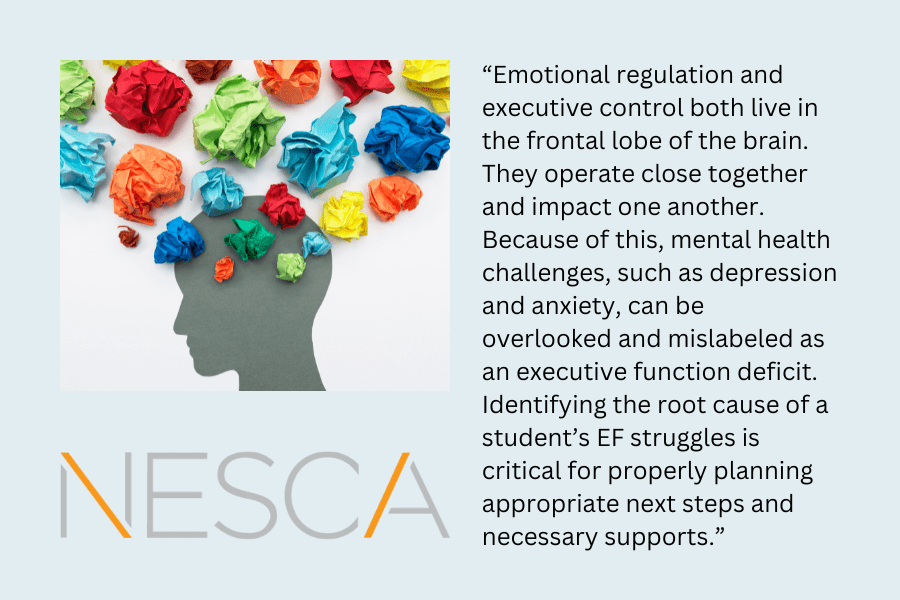
Emotional regulation and executive control both live in the frontal lobe of the brain. They operate close together and impact one another. Because of this, mental health challenges, such as depression and anxiety, can be overlooked and mislabeled as an executive function deficit. Identifying the root cause of a student’s EF struggles is critical for properly planning appropriate next steps and necessary supports. For example, if a student’s depression is causing them not to initiate and/or complete work, the depression usually needs to be addressed before they receive EF coaching. If the student is already working with a mental health professional, such as a therapist, it is important for them to be cleared by the therapist to add in an EF coach. Working on too many new skills at once can be overwhelming, so it is important that enough foundational coping skills are learned first.

An example of anxiety causing an EF deficit:
Clara gets extremely anxious in social situations due to a lack of self-esteem. She had a negative experience in middle school where other students made fun of her lisp whenever she read out loud in class. Now, in high school, Clara is afraid to ask questions, even when she is confused. She is left not fully understanding the material, class assignment expectations, or how to approach studying for quizzes and tests. Rather than asking for help, Clara keeps to herself. Even when teachers offer to help her, she responds with, “Thank you, but I’m all set.”

Clara’s parents can see that she struggles to initiate homework assignments, rarely studies for upcoming tests, and that her grades are declining. They don’t fully understand why, because when they ask her, she is quick to deflect and change the subject.

By checking in with Clara’s teachers, her parents may receive feedback that she often shies away from their support. With a lack of understanding why, her teachers aren’t sure how else to approach the situation other than continuing to check in. Jumping into EF coaching to address her task initiation and study skills may help, but it doesn’t address the root of the problem. A more appropriate action plan would be for Clara to first receive psychotherapy, addressing the bullying that led to her social anxiety and self-esteem issues and then shifting to EF skill building.

An example of an EF deficit causing anxiety/depression:
Gabriel is a seventh grade student diagnosed with ADHD. He has a difficult time advocating for himself and asking for help due to some additional communication challenges. His ADHD also makes it challenging to stay on task and pay attention to details. This results in Gabriel constantly forgetting what his homework assignments are and when they are due, creating a lot of missing work. Gabriel’s teachers are often redirecting him and reminding him of incomplete work. They have tried to help him develop plans to make it up, but he struggles to follow through with these plans. At home, Gabriel’s parents often share their frustrations with him and try to help him get back on track. With adults constantly reminding him he’s behind, Gabriel has developed internalized anxiety, often wondering why he can’t be like everyone else. He tries so hard to remember what his homework is and when it is due, but can never seem to get it right. Over time, he begins to experience symptoms of depression as his self-esteem declines.

In this situation, Gabriel’s lack of EF skills is the root cause of his negative thinking patterns. By receiving EF coaching, he can learn ways to regularly track his assignments. He can be taught how to break them down into smaller, more manageable tasks in a way that helps him overcome procrastination. Additionally, he is able to become proactive and communicate with his teachers so that they are kept on the same page. As these skills get stronger, Gabriel becomes more responsible, and gets praise from his teachers and parents in return. Given the impact of this situation, he may also benefit from short-term counseling to better understand the connection between his EF and anxiety. Increased self-awareness helps students learn how to advocate for themselves the next time they encounter a similar situation.

Does this sound familiar?
These scenarios are common and can be difficult to navigate without proper assessment and guidance from professionals. If you or your child struggles with mental health and EF-related challenges and you are not sure where to start, book a free introductory call with me or one of our other wonderful and experienced EF coaches. NESCA also offers comprehensive neuropsychological evaluation services and neuropsychological consultation for families who are wondering about possible missed learning, attention, mental health, or other diagnoses. We look forward to working with you!


About the Author

Carly Edelstein is a Licensed Clinical Social Worker practicing in Massachusetts and Rhode Island. Having worked both in private practice and schools, she has extensive experience supporting students, families and educational teams to make positive changes. Ms. Edelstein provides executive function coaching and psychotherapy to clients ranging from middle school through adulthood. She also offers consultation to schools and families in order to support her clients across home and community environments.

To schedule an appointment with one of NESCA’s counselors, coaches, or other experts, please complete our online intake form

NESCA is a pediatric neuropsychology practice and integrative treatment center with offices in Newton, Plainville, and Hingham, Massachusetts; Londonderry, New Hampshire; and staff in the greater Burlington, Vermont region and Brooklyn, New York, serving clients from infancy through young adulthood and their families. For more information, please email info@nesca-newton.com or call 617-658-9800.


Summer Planning for Teenagers

By | NESCA Notes 2024

By: Kelley Challen, Ed.M., CAS
Director of Transition Services, NESCA

March is an incredibly busy time in my household. Three out of four of our family members celebrate birthdays, winter sports turn into playoffs, and school events seem to pop up every week. March is also the time when we finalize our “summer camp plan” and manage lengthy online registration processes. If you have a teenager in the household, particularly a teen with a disability, you may also be thinking about summer and feeling particular pressure to “make the most” of the time while your child is still in high school. In case you are still scrambling for your own summer plan, I wanted to offer up several activities that are worth considering as part of your teen’s summer plan.

Get a paid summer job! Time and time again, research indicates that individuals who have paid employment in high school are more successful college students and more successful in obtaining employment as adults. If your child is college bound, having a paid work experience among their high school activities is a huge boost to their college applications. And, if not, paid work experiences teach soft skills for employment, help students figure out more about their career interests and preferences, and help to build meaningful resumes. Being able to do work that meets someone else’s standards is a vital life skill, and summer is an optimal time to build that skill.

Gain overnight experience. Students who plan to go to college but have never spent a night away from home need to know how they are going to handle that experience. There are all sorts of summer programs where students can spend time overnight, away from home, among peers. Overnight programs vary in length. Students who are just venturing out for the first time may feel most comfortable in a program that lasts a week or less, whereas other students may want a 3-week or 6-week experience. For college-bound students, I often recommend taking advantage of programs that happen right on college campuses in dorms. But there are also great programs outdoors or even travel programs in the United States or overseas. Knowing that you can spend the night away from family (and knowing what it’s like to “live” among a whole group of young people) is often a critical step in setting post-high school goals.

Use the time to build new executive functioning or emotional regulation skills. Students who struggle with executive functioning or emotional regulation often need coaching or therapy during the school year, just to keep up with school activities. However, students and families often reach out for these resources because they are already in crisis. A student will seek out an executive function coach when a student is already behind with assigned work or grades. Families often seek out therapy when an emotional crisis has occurred. School provides a number of executive functioning and emotional demands, so it can be hard for a coach or therapist to build new skills with a student while the student is also meeting those demands. Summer can be an optimal time to work more intensively to build new skills, strategies, and systems because it is a time when other demands are reduced. If your teen has a therapist, tutor, executive function coach, social pragmatic coach, or other support person who is helping them to tread water during the school year, it’s definitely worth asking whether intensive services over the summer might help the student to build skills that will last long-term and help the student be better prepared for the following school year.

Summer can also be a great time to tackle time-consuming activities, like completing the college application, drafting a college essay or two, cleaning out a bedroom or reorganizing study space, or building a new life skill, like driving, cooking, or mastering a laundry routine.

March is a great time to take stock of what your teenager wants to do after high school, what challenges might impede them smoothly transitioning to those activities, and thinking about how summer might be the perfect time to eliminate some of those challenges!

NESCA offers many services designed to help students bridge the transition from high school to college, work, and more independent adult life. Such services include executive function coaching, pre-college coaching, transition planning, and neuropsychological evaluation. To learn more specifically about our coaching services, visit: https://nesca-newton.com/coaching-services/. NESCA also offers postsecondary transition consultation to families who want support identifying the most meaningful ways for their student to spend the summer: https://nesca-newton.com/transition/#planning. To schedule an appointment with one of our expert clinicians or coaches, please complete our intake at: https://nesca-newton.com/intake/.


About the Author
Kelley Challen, Ed.M., CAS, is an expert transition specialist and national speaker who has been engaged in evaluation, development, and direction of transition-focused programming for teenagers and young adults with a wide array of developmental and learning abilities since 2004. While Ms. Challen has special expertise in working with youth with autism, she enjoys working with students with a range of cognitive, learning, communication, social, emotional and/or behavioral needs.

Ms. Challen joined NESCA as Director of Transition Services in 2013. She believes that the transition to postsecondary adulthood activities such as learning, living, and working is an ongoing process–and that there is no age too early or too late to begin planning. Moreover, any transition plan should be person-centered, individualized and include steps beyond the completion of secondary school.

Through her role at NESCA, Ms. Challen provides a wide array of services including individualized transition assessment, planning, consultation, training, and program development services, as well as pre-college coaching. She is particularly skilled in providing transition assessment and consultation aimed at determining optimal timing for a student’s transition to college, technical training, adult learning, and/or employment as well as identifying and developing appropriate programs and services necessary for minimizing critical skill gaps.

Ms. Challen is one of the only professionals in New England who specializes in assisting families in selecting or developing programming as a steppingstone between special education and college participation and has a unique understanding of local postgraduate, pre-college, college support, college transition, postsecondary transition, and 18-22 programs. She is additionally familiar with a great number of approved high school and postsecondary special education placements for students from Massachusetts including public, collaborative, and private programs.

Ms. Challen enjoys the creative and collaborative problem-solving process necessary for successfully transitioning students with complex profiles toward independent adulthood. As such, she is regularly engaged in IEP Team Meetings, program consultations, and case management or student coaching as part of individualized post-12th grade programming. Moreover, she continually works to enhance and expand NESCA’s service offerings in order to meet the growing needs of the families, schools and communities we serve.

When appropriate, Ms. Challen has additionally provided expert witness testimony for families and school districts engaged in due process hearings or engaged in legal proceedings centering on transition assessment, services and/or programming—locally and nationally.

Nearly two decades ago, Ms. Challen began her work with youth with special needs working as a counselor for children and adolescents at Camp Good Times, a former program of Milestones Day School. She then spent several years at the Aspire Program (a Mass General for Children program; formerly YouthCare) where she founded an array of social, life and career skill development programs for teens and young adults with Asperger’s Syndrome and related profiles. Also, she worked at the Northeast Arc as Program Director for the Spotlight Program, a drama-based social pragmatics program, serving youth with a wide range of diagnoses and collaborating with several school districts to design in-house social skill and transition programs.

Ms. Challen received her Master’s Degree and Certificate of Advanced Graduate Study in Risk and Prevention Counseling from the Harvard University Graduate School of Education. While training and obtaining certification as a school guidance counselor, she completed her practicum work at Boston Latin School focusing on competitive college counseling.

Ms. Challen has worked on multiple committees involved in the Massachusetts DESE IEP Improvement Project, served as a Mentor for the Transition Leadership Program at UMass Boston, participated as a member of B-SET Boston Workforce Development Task Force, been an ongoing member of the Program Committee for the Association for Autism and Neurodiversity (AANE), and is a member of the New Hampshire Transition State Community of Practice (COP).

She is also co-author of the chapter, “Technologies to Support Interventions for Social-Emotional Intelligence, Self-Awareness, Personality Style, and Self-Regulation,” for the book Technology Tools for Students with Autism: Innovations that Enhance Independence and Learning.

To schedule an appointment with one of NESCA’s transition specialists, please complete our online intake form

NESCA is a pediatric neuropsychology practice and integrative treatment center with offices in Newton, Plainville, and Hingham, Massachusetts; Londonderry, New Hampshire; the greater Burlington, Vermont region; and Brooklyn, NY (coaching services only) serving clients from infancy through young adulthood and their families. For more information, please email info@nesca-newton.com or call 617-658-9800.

Why is it so hard to develop Executive Function skills for college as a high school student?

By | NESCA Notes 2024

By: Kelley Challen, Ed.M., CAS
Director of Transition Services, NESCA

Students with disabilities often have challenges with executive function skills. These may include difficulties with organization, planning and prioritization, time management, task initiation, attention and effort, working memory, self-regulation, self-monitoring, and mental flexibility. Being successful as a college student often depends on using and integrating these skills. Therefore, it’s no surprise that most of the IEPs I read when working with teenage and young adult students have goals or objectives aimed at remediating executive function (EF) skills. However, many students on IEPs have these “EF” goals for years and still don’t effectively develop the skills they need to successfully manage executive functioning tasks as college students.

One of the reasons for the remaining skill gap when students matriculate to college is because high school student responsibilities are pretty radically different from college student responsibilities. While research indicates that individuals can continue developing executive function skills throughout the lifespan, this requires a very particular set of activities. Executive function skills develop through a combination of direct instruction and opportunities to practice using the learned skills with and without support. But there often are not opportunities for practicing the skills needed for college as a high school student.

Below is a list of executive function supports that exist in high school, but often disappear in college:

  • Classes are small and always taught by teachers
  • Class material is centralized in books or on the board in the classroom
  • Time is structured by the school
  • Students are told what they need to learn from homework
  • Students are reminded of assignments and due dates
  • Completed homework is checked by teachers
  • Reading is discussed in classes
  • Studying is limited to a few hours per week
  • Testing is frequent and covers small amounts of material
  • Teachers approach students who need help
  • Schools are required to find students with disabilities who need specialized instruction and accommodations
  • Parents and teachers will remind students of their responsibilities
  • Parents and teachers will help to set priorities (or simply set them for the student)
  • Parents and teachers will correct students when behavior is unexpected

In college, students may have large classes taught by other students or experts in their fields who aren’t experts on teaching. They have to use syllabi, manage their own schedules (with large swaths of unscheduled time), integrate academic materials from a wide range of sources, and self-direct long hours of reading and studying. They also have to be responsible for advocating for themselves, knowing when they need help, and knowing what they are responsible for (academically, socially, and in their dorms) and getting those things done without parent and teacher reminders. For students who have strengths with executive functioning, often the transition to college still presents a steep learning curve. But for those who have vulnerabilities in these areas, it can be critical to recognize that the gaps are large between these two learning environments, and sometimes additional support and instruction is necessary while students are taking college classes. Some students will still need to build effective academic and executive function skills, and practice and master those executive function skills, while they are in college and managing this new set of demands.

NESCA offers many services designed to help students bridge the transition from high school to college, including executive function coaching, pre-college coaching, transition planning, and neuropsychological evaluation. To learn more specifically about our coaching services, visit: https://nesca-newton.com/coaching-services/ . To schedule an appointment with one of our expert clinicians or coaches, please complete our intake at: https://nesca-newton.com/intake/ .

Reference:

Many of the bulleted items of executive function supports that exist in high school are adapted from this high school versus college comparison by King’s College: https://www.kings.edu/admissions/high_school_vs_college


About the Author
Kelley Challen, Ed.M., CAS, is an expert transition specialist and national speaker who has been engaged in evaluation, development, and direction of transition-focused programming for teenagers and young adults with a wide array of developmental and learning abilities since 2004. While Ms. Challen has special expertise in working with youth with autism, she enjoys working with students with a range of cognitive, learning, communication, social, emotional and/or behavioral needs.

Ms. Challen joined NESCA as Director of Transition Services in 2013. She believes that the transition to postsecondary adulthood activities such as learning, living, and working is an ongoing process–and that there is no age too early or too late to begin planning. Moreover, any transition plan should be person-centered, individualized and include steps beyond the completion of secondary school.

Through her role at NESCA, Ms. Challen provides a wide array of services including individualized transition assessment, planning, consultation, training, and program development services, as well as pre-college coaching. She is particularly skilled in providing transition assessment and consultation aimed at determining optimal timing for a student’s transition to college, technical training, adult learning, and/or employment as well as identifying and developing appropriate programs and services necessary for minimizing critical skill gaps.

Ms. Challen is one of the only professionals in New England who specializes in assisting families in selecting or developing programming as a steppingstone between special education and college participation and has a unique understanding of local postgraduate, pre-college, college support, college transition, postsecondary transition, and 18-22 programs. She is additionally familiar with a great number of approved high school and postsecondary special education placements for students from Massachusetts including public, collaborative, and private programs.

Ms. Challen enjoys the creative and collaborative problem-solving process necessary for successfully transitioning students with complex profiles toward independent adulthood. As such, she is regularly engaged in IEP Team Meetings, program consultations, and case management or student coaching as part of individualized post-12th grade programming. Moreover, she continually works to enhance and expand NESCA’s service offerings in order to meet the growing needs of the families, schools and communities we serve.

When appropriate, Ms. Challen has additionally provided expert witness testimony for families and school districts engaged in due process hearings or engaged in legal proceedings centering on transition assessment, services and/or programming—locally and nationally.

Nearly two decades ago, Ms. Challen began her work with youth with special needs working as a counselor for children and adolescents at Camp Good Times, a former program of Milestones Day School. She then spent several years at the Aspire Program (a Mass General for Children program; formerly YouthCare) where she founded an array of social, life and career skill development programs for teens and young adults with Asperger’s Syndrome and related profiles. Also, she worked at the Northeast Arc as Program Director for the Spotlight Program, a drama-based social pragmatics program, serving youth with a wide range of diagnoses and collaborating with several school districts to design in-house social skill and transition programs.

Ms. Challen received her Master’s Degree and Certificate of Advanced Graduate Study in Risk and Prevention Counseling from the Harvard University Graduate School of Education. While training and obtaining certification as a school guidance counselor, she completed her practicum work at Boston Latin School focusing on competitive college counseling.

Ms. Challen has worked on multiple committees involved in the Massachusetts DESE IEP Improvement Project, served as a Mentor for the Transition Leadership Program at UMass Boston, participated as a member of B-SET Boston Workforce Development Task Force, been an ongoing member of the Program Committee for the Association for Autism and Neurodiversity (AANE), and is a member of the New Hampshire Transition State Community of Practice (COP).

She is also co-author of the chapter, “Technologies to Support Interventions for Social-Emotional Intelligence, Self-Awareness, Personality Style, and Self-Regulation,” for the book Technology Tools for Students with Autism: Innovations that Enhance Independence and Learning.

To schedule an appointment with one of NESCA’s transition specialists, please complete our online intake form

NESCA is a pediatric neuropsychology practice and integrative treatment center with offices in Newton, Plainville, and Hingham, Massachusetts; Londonderry, New Hampshire; the greater Burlington, Vermont region; and Brooklyn, NY (coaching services only) serving clients from infancy through young adulthood and their families. For more information, please email info@nesca-newton.com or call 617-658-9800.

The ABCs of Challenging Behavior

By | Nesca Notes 2023

By: Erin Gibbons, Ph.D.
Pediatric Neuropsychologist, NESCA

When a child or adolescent is exhibiting challenging behaviors, it is helpful to understand why the behaviors are occurring. The first step is to analyze the situational factors surrounding the behaviors:

A: Antecedent. What is happening right before the behavior occurred?
B: Behavior. What is the specific behavior that the child/adolescent exhibited?
C: Consequence. What happened right after the behavior occurred?

By looking at the ABCs of a particular behavior, we can start to understand the function of the behavior. That is to say, why is the child/adolescent engaging in the behavior? How is the behavior being reinforced?

Let’s look at an example:
Tom is in 6th grade. He arrives to math class, and the teacher distributes a worksheet. Tom rips up the math sheet and throws it on the floor. The teacher sends him to principal’s office.

A: Math class, being given a worksheet
B: Ripping up the paper
C: Being sent to the principal/leaving the class

In this example, the aversive situation might be math class itself, it could be the worksheet, or it could be the specific concept being worked on (e.g., multiplication is hard for Tom). Alternatively, something might have happened right before math class that upset him.

The consequence is that Tom is allowed to avoid the problematic situation. Thus, the teacher is inadvertently reinforcing the behavior. Tom has learned that if he refuses to do the work, he gets to leave class.

The more effective intervention would be to understand why he refused the work. In this case, it would be important to have a conversation with Tom. Was the work too hard? Does he need extra explanation of the concepts being covered in the worksheet? Did something happen before math class that Tom was still upset about? If the teacher is not able to engage him in this type of conversation, perhaps it would be better to send him to the school counselor as opposed to the principal.

As you think about your own children, it might be helpful to consider the ABCs of any challenging behaviors that are occurring. What was happening right before? If you can identify antecedents, you might be able to make some concrete environmental changes in order to avoid the behavior. What happened right afterward? Did your reaction to the behavior somehow reinforce it? Could you do something different next time the behavior occurs that would be more effective?

Resources
The Explosive Child by Ross Greene
How to Talk So Kids Will Listen & Listen So Kids Will Talk by Adele Faber and Elaine Mazlish
The Behavior Code Companion by Jessica Minahan


About the Author

Erin Gibbons, Ph.D., evaluates children presenting with a range of attentional, learning, and developmental disabilities. She has a particular interest in children with autism spectrum disorders, intellectual disabilities, and those with complex medical histories.

If you are interested in booking an evaluation with a NESCA neuropsychologist/clinician, please fill out and submit our online intake form

NESCA is a pediatric neuropsychology practice and integrative treatment center with offices in Newton, Plainville, and Hingham, Massachusetts; Londonderry, New Hampshire; and the greater Burlington, Vermont region, serving clients from infancy through young adulthood and their families. For more information, please email info@nesca-newton.com or call 617-658-9800.

Going South: NESCA Announces New Hingham, MA Location

By | Nesca Notes 2023

By: Jane Hauser
Director of Marketing & Outreach, NESCA

NESCA is excited to announce that it is opening a Hingham location to serve clients on the South Shore of Massachusetts. NESCA is currently booking appointments now for Neuropsychological and Psychological Evaluation Services commencing on November 1, 2023. Learn more about what is being offered by our Hingham-based staff from my interview with Hingham Director; Pediatric & Adult Neuropsychologist Moira Creedon, Ph.D.

What prompted NESCA’s expansion to the South Shore or Massachusetts, and how can clients benefit from our Hingham location’s services?
NESCA is expanding our in-person services to Hingham on the South Shore to widen the breadth of neuropsychological and educational evaluation and consulting services offered within the state. We know that families have options as they partner with neuropsychologists, and we want to be in close proximity to communities we hope to serve. This is an exciting opportunity to support students in elementary, middle, and high school as well as adults, as they navigate the complexities of their daily lives. It is our priority to continue providing detailed, client-centered, thorough evaluations that highlight a client’s areas of strength and vulnerability. I am also excited to strengthen relationships with local care providers and schools, and to build new relationships as a new clinician within the South Shore community.

What services do you offer?
At this time, NESCA’s South Shore-based practice will offer Neuropsychological Evaluations and Projective Assessments. The goal of these services is to build a complete picture of a client’s functioning, including their intellectual, academic, and social-emotional profile. Team members are also available to participate in team meetings at school (IEP meetings), conduct school observations, and offer consultation to parents and team members. Sometimes, a child has already participated in evaluations in other settings (schools, hospitals), and a family needs help to review these documents and make meaning of the findings.

What types of clients will NESCA serve in its South Shore location?
NESCA’s South Shore-based practice is similar to our other locations and will serve children, teens, and adults with a range of presenting issues. The focus is in working with students in elementary, middle, and high school as well as young adults. I can see clients with diagnostic questions, including Autism Spectrum Disorder (ASD), Learning Disorders (e.g., dyslexia, dysgraphia), Attention-Deficit/Hyperactivity Disorder (ADHD), anxiety, depression, and complex psychiatric diagnoses.

A specialty we have at NESCA – including in Hingham – is working with clients who have multiple diagnoses or who don’t fit neatly into a singular diagnostic box. I also see clients who are high functioning and curious about their learning style, how to improve their study skills, and how to plan for their academic future based on their unique profile.

Where are you on the South Shore? Are services in-person or remote?
We are practicing in person in an office at 99 Derby Street, Suite 200, in Hingham, MA. Hingham is uniquely positioned to serve the South Shore/Southcoast, and the Cape and Islands. For those traveling for appointments, most clients schedule testing in two longer (2.5 hour) blocks of time so the commute is reduced for families. I am also available to participate in IEP team meetings and conduct student observations in person on the South Shore, which is an exciting way to collaborate and build strong relationships with families, schools, and organizations.

What is different about what NESCA offers on the South Shore compared to other organizations or services available locally?
NESCA is highly respected in the community for providing detailed, comprehensive evaluations of students that speak to their strengths as well as their needs. Compared to some practices, your child or teen will be assessed directly by a neuropsychologist rather than a technician. You can depend on your neuropsychologist to bring their own expertise as well as the “village” of NESCA, as I am always collaborating with NESCA’s team of innovative neuropsychologists, transition specialists, educational consultants, speech and language pathologists, occupational therapists, and therapists. We work routinely with special education attorneys, advocates, therapists, and school personnel in collaborative relationships to support children, teens, and adults. At NESCA, we live our core values everyday: being creative problem solvers, being collaborative and building lasting relationships, and caring deeply for students, their families, and the community.

Does insurance cover your services in Hingham?
Several NESCA providers take both Blue Cross Blue Shield and private pay for services. I am paneled with BCBS. Some families are able to obtain some coverage or reimbursement through other insurance agencies, and we can provide those families with brief billing information to submit to their insurance company. We can never guarantee insurance reimbursement, so it is important that families check with their insurance plan regarding covered services.

What if I am unsure if I should refer my child or client for an evaluation?
Give us a call! Our administrative team is happy to support you in navigating this process. We are also planning some community events to provide information to our community about a variety of topics, including who we are and how to recognize signs that an individual may need additional support. There is also a ton of information on our website.

How do people get more information about NESCA’s South Shore services?
You can fill out our online intake form, call 617-658-9800 to speak with an intake coordinator, or reach Hingham-based Pediatric Neuropsychologist Dr. Moira Creedon directly at mcreedon@nesca-newton.com.


About the Author

Hingham Director; Pediatric & Adult Neuropsychologist Dr. Moira Creedon has expertise in evaluating children, teens, and adults with a variety of presenting issues. She is interested in uncovering an individual’s unique pattern of strengths and weaknesses to best formulate a plan for intervention and success. With experiences providing therapy and assessments, Dr. Creedon bridges the gap between testing data and therapeutic services to develop a clear roadmap for change and deeper of understanding of individual needs.


If you are interested in booking an evaluation with Dr. Creedon or another NESCA neuropsychologist, please fill out and submit our online intake form


NESCA is a pediatric neuropsychology practice and integrative treatment center with offices in Newton, Plainville, and Hingham (coming soon), Massachusetts; Londonderry, New Hampshire; and the greater Burlington, Vermont region, serving clients from infancy through young adulthood and their families. For more information, please email info@nesca-newton.com or call 617-658-9800.

NESCA Offers Vermont-based Transition and Coaching Services

By | Nesca Notes 2023

By: Jane Hauser
Director of Marketing & Outreach, NESCA

NESCA recently announced that it is now offering transition services and coaching services in the Greater Burlington, Vermont region. Learn more about what is being offered by our Vermont-based staff from my interview with Vermont-based Program Manager Dr. Lyndsay Wood, OTD, OTR/L.

Why did NESCA expand to Vermont and how can clients benefit from your services?

NESCA is expanding our in-person services to Vermont to widen the breadth of transition services offered within the state. Through research and conversations with local professionals and parents, we recognized that there is an opportunity to bolster local transition services for students to meet their personal postsecondary goals and to live fulfilling lives post-high school. Through our variety of services, our goal is to empower teens and young adults to create their own vision for the future and build the skills necessary to achieve it. This is important for students currently in public middle and high schools as well as local college students and young adults new to the world of work. At NESCA, we take a relational approach with to build a strong foundational relationship between ourselves and the clients we support. Our priority to is create a safe, inclusive, and welcoming environment within our sessions.

What services do you offer?

At this time, NESCA’s Vermont-based practice will offer transition assessment, real-life skills coaching, executive function coaching, transition consultation, and functional community-based occupational therapy evaluations. All Vermont-based services are delivered by experienced occupational therapists and transition specialists with expertise in developing functional and relevant goals. For more information on each of these services, please visit our website and view our Post-Secondary Transition Services and Coaching Services links: https://nesca-newton.com/our-services/. Many folks are unfamiliar with transition assessments, so to learn more, see the following blog written by our Director of Transition Services Kelley Challen, Ed.M., CAS: https://nesca-newton.com/transition-assessment-what-is-it-anyway-how-is-it-different-from-neuropsychological-evaluation/.

What type of client does NESCA serve in Vermont?

NESCA’s Vermont-based practice primarily works with teens and young adults with autism spectrum disorders (ASD), attention-deficit/hyperactivity disorder (ADHD), mental health diagnoses, specific learning disabilities, executive function (EF) challenges, and other complex cases based on the expertise of our providers. A specialty at NESCA is working with clients who have multiple diagnoses or who don’t fit neatly into a singular diagnostic box.

Where are you in Vermont? Are services in-person or remote?

Coaching services will be offered in the home, school, or community within the greater Burlington area. Services can also be delivered remotely if deemed appropriate for the client. Transition assessment is typically conducted within the client’s school setting.

What is different about what NESCA offers in Vermont compared to other organizations or services already available?

NESCA will be a premier independent transition assessment provider in Vermont. We are happy to collaborate with school districts or work with families directly. Additionally, we are unique in providing one-on-one occupational therapy services that specifically address life skills within a client’s home and community setting. Working within the home and community, and not only within the school setting, is incredibly important for the generalization of life skills as well as social skills, functional academic skills, and executive functioning skills.

Does insurance cover your services in Vermont?

NESCA is primarily a private pay service provider. Some families are able to obtain some coverage or reimbursement for our real-life skills coaching service with their health insurance, but it is vital that folks first check with their insurance provider to ensure our services would be covered.

How do people get more information about NESCA’s Vermont services?

To learn more about NESCA, please visit our website at: https://nesca-newton.com/.

If you would like to fill out an intake form, follow this link: https://nesca-newton.com/intake.

If you have more specific questions, do not hesitate to call: 617-658-9818

Additionally, you can contact our Vermont-based Program Manager Dr. Lyndsay Wood, OTD, OTR/L, directly at: lwood@nesca-newton.com


About Lyndsay Wood, OTD, OTR/L

Lyndsay Wood, OTD, OTR/L, is an occupational therapist who focuses on helping students and young adults with disabilities to build meaningful skills in order to reach their goals. She has spent the majority of her career working in a private school for students with ASD. She has also spent some time working in an inpatient mental health setting. Lyndsay uses occupation-based interventions and strategies to develop life skills, executive functioning, and emotional regulation. While completely her doctoral degree at MGH Institute of Health Professions, Lyndsay worked with the Boston Center for Independent Living to evaluate transition age services. She uses the results from her research to deliver services in a way that is most beneficial for clients. Specifically, she focuses on hands-on, occupation-based learning that is tailored the client’s goals and interests.


To book coaching and transition services at NESCA, complete NESCA’s online intake form

NESCA is a pediatric neuropsychology practice and integrative treatment center with offices in Newton and Plainville, Massachusetts, Londonderry, New Hampshire, and Burlington, Vermont, serving clients from preschool through young adulthood and their families. For more information, please email info@nesca-newton.com or call 617-658-9800.

Transition Assessment: What Are You Testing that Hasn’t Already been Tested?

By | Nesca Notes 2023

By: Kelley Challen, Ed.M., CAS
Director of Transition Services, NESCA

Transition planning is a complex process centered around helping students, typically who receive special education services, to set goals for their postsecondary adult lives and to engage in learning, services, and experiences that will help them to ultimately reach those goals. Assessment is a critical aspect of this process, both as a means for collecting baseline information about the student and measuring progress throughout the planning process. Transition planning is federally mandated for students at age 16. However, some states require schools to start the process earlier. For instance, transition planning is required as part of the IEP process for students turning age 14 in Massachusetts.

Transition assessment is therefore required in middle school or early high school for most students in the United States. By this point in time, students on IEPs have often participated in lots of testing. Students may have had academic testing, psychological evaluation, speech and language testing, occupational and physical therapy assessments, functional behavioral assessment, and even home or health assessments. They have participated in so much previous testing, that some parents or professionals may ask, “What could a transition specialist be testing that has not already been addressed through other evaluations?”

The answer is, “A lot!” There are many areas that can and should be evaluated as part of an informed transition planning process, but which are not frequently evaluated when creating earlier IEPs. This is because initial IEPs and early reevaluations focus on helping students to access education and school life, but transition planning is about helping students to develop necessary skills for accessing learning, living, community, and employment as an adult. The following tables are based on on the Transition Assessment Planning Form developed by the Transition Coalition at the University of Kansas in 2008. These highlight many areas of assessment that can and should be considered as part of a comprehensive transition assessment and planning process. These also indicate which areas have usually not been considered for evaluation prior to a thorough transition assessment process.

Please note that every student on an IEP is an individual with unique strengths and disability-related needs and so these tables are offered as a general picture of what has been observed at NESCA in the majority of cases. Additionally, while all of the areas above are considered as part of a comprehensive transition assessment and planning process, they may not need direct assessment depending on student profile, postsecondary goals, and existing evaluation or report data.

For more information about transition assessment and transition planning at NESCA, visit our transition services page and our transition FAQs.


About the Author
Kelley Challen, Ed.M., CAS, is NESCA’s Director of Transition Services, overseeing planning, consultation, evaluation, coaching, case management, training and program development services. Ms. Challen also provides expert witness testimony in legal proceedings related to special education. She is also the Assistant Director of NESCA, working under Dr. Ann Helmus to support day-to-day operations of the practice. Ms. Challen began facilitating programs for children and adolescents with special needs in 2004. After receiving her Master’s Degree and Certificate of Advanced Study in Risk and Prevention Counseling from Harvard Graduate School of Education, Ms. Challen spent several years at the MGH Aspire Program where she founded an array of social, life and career skill development programs for teens and young adults with Asperger’s Syndrome and related profiles. She additionally worked at the Northeast Arc as Program Director for the Spotlight Program, a drama-based social pragmatics program, serving youth with a wide range of diagnoses and collaborating with several school districts to design in-house social skills and transition programs. Ms. Challen is co-author of the chapter “Technologies to Support Interventions for Social- Emotional Intelligence, Self-Awareness, Personality Style, and Self-Regulation” for the book Technology Tools for Students with Autism. She is also a proud mother of two energetic boys, ages six and three. While Ms. Challen has special expertise in supporting students with Autism Spectrum Disorders, she provides support to individuals with a wide range of developmental and learning abilities, including students with complex medical needs.

To schedule an appointment with one of NESCA’s transition specialists, please complete our online intake form

NESCA is a pediatric neuropsychology practice and integrative treatment center with offices in Newton and Plainville, Massachusetts, Londonderry, New Hampshire, and Burlington, Vermont, serving clients from preschool through young adulthood and their families. For more information, please email info@nesca-newton.com or call 617-658-9800.

Skip to content