

By: Rebecca Dautoff, Psy.D.
Pediatric Neuropsychologist, NESCA
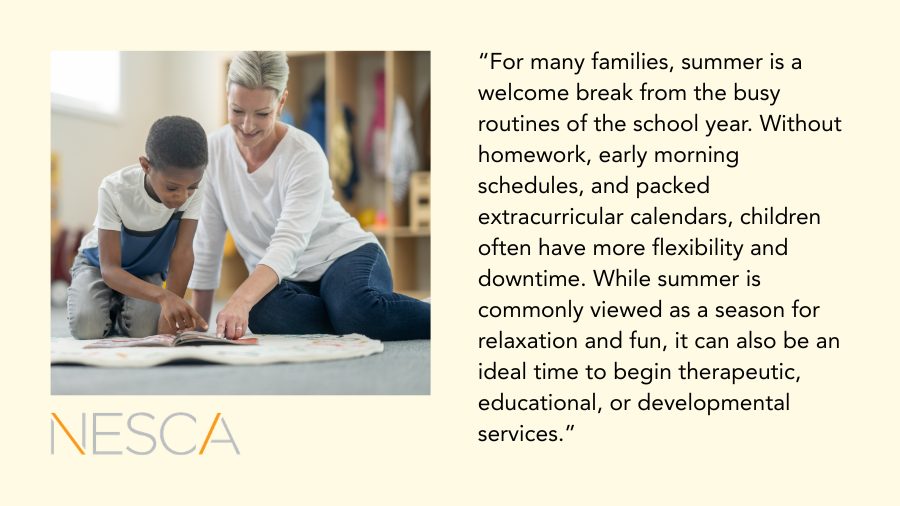
For many families, summer is a welcome break from the busy routines of the school year. Without homework, early morning schedules, and packed extracurricular calendars, children often have more flexibility and downtime. While summer is commonly viewed as a season for relaxation and fun, it can also be an ideal time to begin therapeutic, educational, or developmental services.
As a psychologist, I often hear parents wonder whether they should wait until the fall to start services. In most cases, my recommendation is simple: if a child would benefit from support, summer is one of the best times to begin. Schedules are more open, and you may even be able to meet more often and make as much progress in the summer as you would over the course of an entire semester. I personally have two children getting services this summer, and here is why:
Reduced Academic Demands Create More Capacity for Growth
During the school year, children are balancing academics, social expectations, extracurricular activities, and family responsibilities. Adding a new service can sometimes feel overwhelming for both children and parents. Summer offers a different environment. With fewer academic pressures and more flexible schedules, children often have greater emotional and cognitive bandwidth to engage in learning new skills, and parents may have more bandwidth to take on the scheduling of yet another thing. Whether they are working on emotional regulation, social communication, executive functioning, speech and language development, or motor skills, children may be more receptive to intervention when they are not simultaneously managing the demands of a full school day.
Time to Build Relationships Before School Starts
One of the most important factors in successful intervention is the relationship between the child and the provider. Trust and comfort take time to develop. Starting services during the summer allows children to establish rapport with therapists, specialists, or support providers before the school year begins. By the time fall arrives, many children feel more comfortable, confident, and familiar with the therapeutic process, allowing them to make more meaningful progress when academic demands increase.
Opportunities to Practice Skills in Real-Life Settings
Summer often provides more opportunities for children to practice new skills in everyday situations. Family outings, camps, playdates, vacations, and community activities create natural opportunities to apply what they are learning.
For example:
- Children working on social skills can practice initiating conversations and maintaining friendships.
- Children receiving counseling can use coping strategies during new experiences and transitions.
- Children developing executive functioning skills can practice planning, organization, and independence.
- Children receiving speech or occupational therapy can apply newly learned skills across a variety of environments.
This real-world practice helps strengthen learning and promotes generalization of skills beyond the therapy setting.
Preventing the “Wait and See” Delay
Parents sometimes hope that a challenge will improve on its own over time. While development naturally occurs as children grow, delaying support can sometimes mean missing valuable opportunities for intervention. Summer provides a proactive window to address concerns before they potentially become more significant during the school year. Beginning services early allows professionals to assess needs, develop goals, and implement strategies that can help children start the school year with greater confidence and support.
Easing School-Year Transitions
Transitions can be challenging for many children. Starting a new school year often brings changes in routines, teachers, expectations, and social dynamics. When children begin services during the summer, they can enter the school year with established supports already in place. They may have stronger coping skills, increased confidence, and a clearer understanding of their strengths and challenges. This foundation can make the transition back to school smoother and less stressful for both children and parents.
More Opportunities to Participate
Parent involvement is one of the strongest predictors of successful outcomes in many therapeutic and educational interventions. The school year in our house often feels hectic. With two working parents and three kids in school, our day-to-day is fast-paced and complicated, to say the least. During the summer, families like ours often have more flexibility to attend appointments, participate in consultations, and implement recommended strategies at home. This increased bandwidth and collaboration allows providers and families to work together more effectively, creating consistency between sessions and daily life.
Progress Before the Next School Year Begins
Perhaps one of the greatest advantages of starting services during the summer is the opportunity to make meaningful progress before school resumes. A few months of targeted support can help children develop new skills, increase confidence, and establish positive routines. Rather than beginning services while already managing the demands of a new school year, children can start the fall with momentum and a stronger foundation for success.
About the Author
Dr. Rebecca Dautoff provides comprehensive neuropsychological and psychological (projective) evaluation services for children, adolescents, and young adults who have complex presentations with a wide range of concerns, including attention deficit disorders, psychiatric disorders, intellectual disabilities, and autism spectrum disorders (ASD). She also values collaboration with families and outside providers to facilitate supports and services that are tailored to each child’s specific needs.
If you are interested in booking an appointment for an evaluation with Dr. Dautoff or another NESCA neuropsychologist/clinician, please fill out and submit our online intake form.
NESCA is a pediatric neuropsychology and related services practice with offices in Newton, Plainville, and Hingham, Massachusetts; Londonderry, New Hampshire; and the Coral Gables, Florida, serving clients from infancy through young adulthood and their families. For more information, please email info@nesca-newton.com or call 617-658-9800.


Connect with Us