

By: Maggie Rodriguez, Psy.D.
Pediatric Neuropsychologist, NESCA
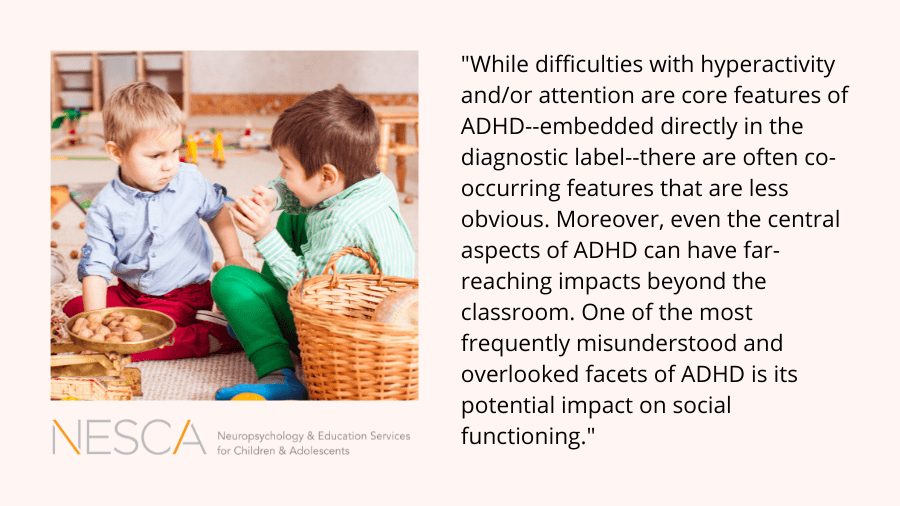
When most of us hear the term “ADHD (attention deficit hyperactivity disorder),” we think of the little boy who can’t sit still at his desk or the girl gazing out the window lost in her own thoughts during class. While difficulties with hyperactivity and/or attention are core features of ADHD–embedded directly in the diagnostic label–there are often co-occurring features that are less obvious. Moreover, even the central aspects of ADHD can have far-reaching impacts beyond the classroom. One of the most frequently misunderstood and overlooked facets of ADHD is its potential impact on social functioning.
In clinical practice, parents of children with ADHD are often confused by the unexpected and indirect ways that attentional and executive functioning deficits can affect social functioning. They sometimes wonder if their children have an additional challenge, such as autism spectrum disorder. Most often, that’s not the case. Rather, it’s more likely that one or more of the following is at play:
- Kids with ADHD can have difficulty selectively attending to relevant social cues
- Imagine looking through a camera with a broken zoom lens. At first everything is in frame at once; it’s too much information. Then you try to zoom in, but when you do, sometimes the lens focuses on unimportant things (like the random details in the background), leaving out what’s most relevant (like the person you’re trying to capture in your photo). Children with ADHD have difficulty figuring out what details to focus on and struggle to effectively “zoom in” on those elements. In social settings, which are often unstructured, kids with ADHD are even more prone to “zoom in” on unimportant things and miss the more salient information. They can also become easily distracted and fail to register important information in the moment. To others, this can come across as lack of interest (for instance, the child who seems not to be listening or is distracted by sounds, sights, or other sensory information in the moment). It can also lead children with ADHD to overlook contextual cues about what’s expected in a given social setting, which can lead to inappropriate behavior.
- Children with ADHD often struggle with nuance, making inferences, and reading between the lines
- Social situations are much more complex than we often realize. Successfully navigating social interactions requires paying attention, not just to surface level information but to the often subtle, implied meaning embedded in things like figures of speech, tone of voice, and body language. For many with ADHD, it’s already a challenge to maintain focus at the surface level; the task of trying to simultaneously attend to and interpret subtext is too much. Individuals with ADHD may focus on what another person says (the content of their speech) but fail to notice the eye roll or sarcastic tone of voice that goes along with it.
- Impulsivity can lead to social faux pas
- Impulsivity is a central feature of ADHD in many cases. In social settings, difficulty inhibiting impulses can take many forms. For some, it may simply present as rapid-fire speech, leaving little room for others to respond in conversation. It can also look like interrupting, cutting others in line, or expressing ideas and opinions in a way that can be hurtful or seem rude. Especially in younger children, impulsive behavior can lead to difficulty sharing, physical aggression towards others, and trouble with turn taking. Children who have more difficulty slowing down and inhibiting impulses are more likely to inadvertently offend others or to engage in behavior that their peers may view as odd or inappropriate; in turn, this can lead to trouble developing and sustaining friendships and other positive relationships.
- Hyperactivity makes participating appropriately in some social settings difficult
- There are some social contexts in which an abundance of energy is a very good thing. For this reason, many ADHD kids can excel in activities like sports, into which they can channel their high energy. But other social situations demand a different set of skills. For kids with hyperactivity as part of their ADHD, sitting still and maintaining quiet can be a challenge. They may struggle with activities like going to the library, watching a movie in a theater, attending church or religious ceremonies, or sitting at the table in order to have family dinner.
The good news is that there are ways to manage these social challenges. If your child with ADHD has difficulty with any aspects of social functioning, it may help to seek out social skills training with a therapist or through a structured social skills training program. Interventions often include a combination of explicit instruction, modeling, role playing, and feedback. Parents can also help by implementing simple, consistent ground rules for behavior and providing gentle but clear reminders as needed. Additionally, parents can facilitate play dates with peers, during which the parents take an active role in helping children utilize social skills and engage with each other appropriately.
Finally, though ADHD can present challenges in the social domain, kids with ADHD often possess many strengths that can help actually them succeed socially. Children with ADHD can be highly engaging, curious, energetic, creative, and open-minded. When these strengths are reinforced, kids with ADHD can often utilize them to create fun, rewarding social interactions and to develop rich, dynamic relationships.
About the Author

Maggie Rodriguez, Psy.D., provides comprehensive evaluation services for children, adolescents, and young adults with often complex presentations. She particularly enjoys working with individuals who have concerns about attention and executive functioning, language-based learning disorders, and those with overlapping cognitive and social/emotional difficulties.
Prior to joining NESCA, Dr. Rodriguez worked in private practice, where she completed assessments with high-functioning students presenting with complex cognitive profiles whose areas of weakness may have gone previously undiagnosed. Dr. Rodriguez’s experience also includes pre- and post-doctoral training in the Learning Disability Clinic at Boston Children’s Hospital and the Neurodevelopmental Center at MassGeneral for Children/North Shore Medical Center. Dr. Rodriguez has spent significant time working with students in academic settings, including k-12 public and charter school systems and private academic programs, such as the Threshold Program at Lesley University.
Dr. Rodriguez earned her Psy.D. from William James College in 2012, where her coursework and practicum training focused on clinical work with children and adolescents and on assessment. Her doctoral thesis centered on cultural issues related to evaluation.
Dr. Rodriguez lives north of Boston with her husband and three young children. She enjoys spending time outdoors hiking and bike riding with her family, practicing yoga, and reading.
To book a consultation with Dr. Rodriguez or one of our many other expert neuropsychologists, complete NESCA’s online intake form.
Neuropsychology & Education Services for Children & Adolescents (NESCA) is a pediatric neuropsychology practice and integrative treatment center with offices in Newton, Massachusetts, Plainville, Massachusetts, and Londonderry, New Hampshire, serving clients from preschool through young adulthood and their families. For more information, please email info@nesca-newton.com or call 617-658-9800.


 M.A. from Antioch New England in Applied Psychology. She also worked as an elementary school counselor and school psychologist for 15 years before embarking on her doctorate. During her doctorate, she did her pre-doctoral internship with RIT in Rochester, N.Y. where she worked with youth ages 5-17 who had experienced complex developmental trauma. Dr. Hess’s first post-doctoral fellowship was with The Counseling Center of New England where she provided psychotherapy and family therapy to children ages 5-18, their families and young adults. She also trained part-time with a pediatric neuropsychologist conducting neuropsychological evaluations.

 attention deficit disorders, communication disorders, intellectual disabilities, and learning disabilities. She particularly enjoys working with children and their families who have concerns regarding an autism spectrum disorder. Dr. Milana has received specialized training on the administration of the Autism Diagnostic Observation Schedule (ADOS).
 neuropsychologist who has been practicing for almost 20 years. In 1996, she jointly founded the Children’s Evaluation Center (CEC) in Newton, Massachusetts, serving as co-director there for almost ten years. During that time, CEC emerged as a leading regional center for the diagnosis and remediation of both learning disabilities and Autism Spectrum Disorders.
 Erin Gibbons, Ph.D.

 and academia for over 30 years. She is a national consultant and speaker on program design and the inclusion of children and adolescents with special needs, especially those diagnosed with Autism Spectrum Disorder (ASD). Prior to joining NESCA, Ms. Lucci was the Principal of the Partners Program/EDCO Collaborative and previously the Program Director and Director of Consultation at MGH/Aspire for 13 years, where she built child, teen and young adult programs and established the 3-Ss (self-awareness, social competency and stress management) as the programming backbone. She also served as director of the Autism Support Center. Ms. Lucci was previously an elementary classroom teacher, special educator, researcher, school psychologist, college professor and director of public schools, a private special education school and an education collaborative.

Connect with Us