NESCA’s Newton, MA location has immediate availability for neuropsychological evaluations. Our MA clinicians specialize in the following evaluations: Neuropsychological; Autism; and Emotional and Psychological, as well as Academic Achievement and Learning Disability Testing.

Visit www.nesca-newton.com/intake for more information or to book an evaluation.

Tag

AUTISM Archives - Page 4 of 4 - NESCA

Subscribe to NESCA Notes

Key Facts about Early Diagnosis of Autism Spectrum Disorder (ASD)

By | NESCA Notes 2020

By Renée Marchant, Psy.D.
Pediatric Neuropsychologist

Early diagnosis is a catalyst for propelling children on positive trajectories. If a family and child identify and focus on areas of growth earlier rather than later, there is more time and more possibility of change and improvement. This tenant is particularly critical for diagnosing ASD in toddlerhood and early childhood.

Here are critical facts about the diagnosis of ASD in early childhood and the positive impact of early diagnosis on youngsters as they age into adulthood.

  1. Most children with ASD are not diagnosed until approximately 4 years-old, yet ASD can be reliably identified by the age of 2. There is also expanding research on early identification of infants who may be at risk for ASD. Early detection is possible.
  2. Genes play an important role in ASD. A child’s odds of having an ASD diagnosis increases if he/she has a sibling or parent with ASD, attention deficit hyperactivity disorder (ADHD), intellectual disability, schizophreniadepression, bipolar disorder or anxiety. Family medical history is an important factor for families considering a diagnostic evaluation.
  3. Co-occurring disorders (such as anxiety and depression) are more likely in individuals with ASD than the general population. Identifying emotion regulation issues in early childhood is thus essential.
  4. Neuroplasticity matters. Because ASD is a neurodevelopmental disorder, early treatment improves neuroplastic brain functioning and subsequent behavior. As a child develops, his/her brain becomes less plastic.
  5. Interventions geared at a child’s “first relationships” with their caregivers may exert a strong positive effect on the developmental trajectories of toddlers at high-risk of ASD and also have a positive impact on a child’s social skills with peers as they age.
  6. Research indicates that parent-child interactions in early childhood predict long-term gains in language skills into adulthood for individuals with diagnoses of ASD. Acquiring communicative, pragmatic and useful language by kindergarten has also been identified as a strong predictor of adaptive or functional “real life” skills, which are needed to navigate the environment in adolescence and adulthood.
  7. Social skills instruction in a child’s early years increases competency with peers in school. This social competency is associated with greater adaptive independence in children with ASD.
  8. Working with a “diagnostic navigator” early in your child’s life improves outcomes. Research clearly indicates that social support is vital to relieve stress associated with caregiving for a child with ASD and that a positive parent–professional relationship is helpful in alleviating family stress.

If you suspect your child has or is at higher risk for ASD and you are looking for a “diagnostic navigator” for your child, consider an evaluation with NESCA.  While early diagnosis of ASD can make a positive impact on a child’s trajectory, obtaining the accurate diagnosis and recommendations for interventions at any age is critical.


References:

Elder JH, Kreider CM, Brasher SN, Ansell M. Clinical impact of early diagnosis of autism on the prognosis and parent-child relationships. Psychol Res Behav Manag. 2017;10:283-292. Published 2017 Aug 24. doi:10.2147/PRBM.S117499.

Dawson G, Jones EJ, Merkle K, Venema K, Lowy R, Faja S, Kamara D, Murias M, Greenson J, Winter J, Smith M, Rogers SJ, Webb SJ. Early behavioral intervention is associated with normalized brain activity in young children with autism. J Am Acad Child Adolesc Psychiatry. 2012 Nov;51(11):1150-9. doi: 10.1016/j.jaac.2012.08.018. PMID: 23101741; PMCID: PMC3607427.

Jokiranta-Olkoniemi E, Cheslack-Postava K, Sucksdorff D, Suominen A, Gyllenberg D, Chudal R, Leivonen S, Gissler M, Brown AS, Sourander A. Risk of Psychiatric and Neurodevelopmental Disorders Among Siblings of Probands With Autism Spectrum Disorders. JAMA Psychiatry. 2016 Jun 1;73(6):622-9. doi: 10.1001/jamapsychiatry.2016.0495. PMID: 27145529.

Kasari C, Siller M, Huynh LN, Shih W, Swanson M, Hellemann GS, Sugar CA. Randomized controlled trial of parental responsiveness intervention for toddlers at high risk for autism. Infant Behav Dev. 2014 Nov;37(4):711-21. doi: 10.1016/j.infbeh.2014.08.007. Epub 2014 Sep 26. PMID: 25260191; PMCID: PMC4355997.

Mayo, J., Chlebowski, C., Fein, D.A. et al. Age of First Words Predicts Cognitive Ability and Adaptive Skills in Children with ASD. J Autism Dev Disord 43, 253–264 (2013). https://doi.org/10.1007/s10803-012-1558-0.

Siller, M., Swanson, M., Gerber, A., Hutman, T., & Sigman, M. (2014). A parent-mediated intervention that targets responsive parental behaviors increases attachment behaviors in children with ASD: results from a randomized clinical trial. Journal of Autism and Developmental Disorders, 44(7), 1720-1732.

Xie S, Karlsson H, Dalman C, Widman L, Rai D, Gardner RM, Magnusson C, Schendel DE, Newschaffer CJ, Lee BK. Family History of Mental and Neurological Disorders and Risk of Autism. JAMA Netw Open. 2019 Mar 1;2(3):e190154. doi: 10.1001/jamanetworkopen.2019.0154. PMID: 30821823; PMCID: PMC6484646.


About the Author:

Dr. Renée Marchant provides neuropsychological and psychological (projective) assessments for youth who present with a variety of complex, inter-related needs, with a particular emphasis on identifying co-occurring neurodevelopmental and psychiatric challenges. She specializes in the evaluation of developmental disabilities including autism spectrum disorder and social-emotional difficulties stemming from mood, anxiety, attachment and trauma-related diagnoses. She often assesses children who have “unique learning styles” that can underlie deficits in problem-solving, emotion regulation, social skills and self-esteem.

Dr. Marchant’s assessments prioritize the “whole picture,” particularly how systemic factors, such as culture, family life, school climate and broader systems impact diagnoses and treatment needs. She frequently observes children at school and participates in IEP meetings.

Dr. Marchant brings a wealth of clinical experience to her evaluations. In addition to her expertise in assessment, she has extensive experience providing evidence-based therapy to children in individual (TF-CBT, insight-oriented), group (DBT) and family (solution-focused, structural) modalities. Her school, home and treatment recommendations integrate practice-informed interventions that are tailored to the child’s unique needs.

Dr. Marchant received her B.A. from Boston College with a major in Clinical Psychology and her Psy.D. from William James College in Massachusetts. She completed her internship at the University of Utah’s Neuropsychiatric Institute and her postdoctoral fellowship at Cambridge Health Alliance, a Harvard Medical School teaching hospital, where she deepened her expertise in providing therapy and conducting assessments for children with neurodevelopmental disorders as well as youth who present with high-risk behaviors (e.g. psychosis, self-injury, aggression, suicidal ideation).

Dr. Marchant provides workshops and consultations to parents, school personnel and treatment professionals on ways to cultivate resilience and self-efficacy in the face of adversity, trauma, interpersonal violence and bullying. She is an expert on the interpretation of the Rorschach Inkblot Test and provides teaching and supervision on the usefulness of projective/performance-based measures in assessment. Dr. Marchant is also a member of the American Family Therapy Academy (AFTA) and continues to conduct research on the effectiveness of family therapy for high-risk, hospitalized patients.


To book an evaluation with Dr. Marchant or one of our many other expert neuropsychologists, complete NESCA’s online intake form.


Neuropsychology & Education Services for Children & Adolescents (NESCA) is a pediatric neuropsychology practice and integrative treatment center with offices in Newton and Plainville, Massachusetts, and Londonderry, New Hampshire, serving clients from preschool through young adulthood and their families. For more information, please email info@nesca-newton.com or call 617-658-9800.


How Do I Prepare My Child for a Neuropsychological Evaluation?

By | NESCA Notes 2020

By: Erin Gibbons, Ph.D.
Pediatric Neuropsychologist, NESCA

Parents often ask us what they should tell their child about their upcoming neuropsychological evaluation, especially when it is their first experience with testing. I advise parents to refer to the neuropsychologist using his or her first name, as the term “doctor” can be scary and raise fears about medical exams. I might also add that the visit will not involve any shots! In order to describe the evaluation itself; here is some helpful language:

  • They are going to ask you questions, and you just need to do your best to answer.
  • They might ask you to do some drawing or writing.
  • Some activities might feel like you’re in school; for example, reading stories or doing math problems.

It may also be helpful to create a simple social story prior to the evaluation to help preview what to expect for your child.

To explain the reasons for doing the evaluation, some key phrases to use with your child include:

  • We want to understand how you learn, because everybody learns differently.
  • We are going to be “brain detectives” and figure out how your brain works!
  • This will help us identify your strengths and areas that we need to work on. That way, we can help you with things that are harder for you.
  • This will help your teachers understand your learning style so they can help you better at school.
  • Just try your best!

Testing in the age of Covid-19 is different. It can be harder to help children feel at ease when everyone is wearing masks, and we can’t offer a high five for good work. But as we are all learning, children are often more resilient than adults. Prior to coming in for an evaluation, you might want to remind your child to wear their mask, wash their hands and not approach people too closely.

It is also important to understand that a neuropsychological evaluation is a lot of work for your child! Finding a way to reward them for their effort will go a long way in helping them stay motivated and positive. This could be as simple as swinging by the drive-thru for a donut or something more extravagant, like a new video game. Whatever you choose to do, create a plan with your child and let the neuropsychologist know. When I have a child in my office who is starting to fatigue, it’s always a great motivator to remind them of the special prize they’ll get at the end of the visit!


About the Author: 

Erin Gibbons, Ph.D. is a pediatric neuropsychologist with expertise in neurodevelopmental and neuropsychological assessment of infants,

children, and adolescents presenting with developmental disabilities including autism spectrum disorders, Down syndrome, intellectual disabilities, learning disabilities, and attention deficit disorders. She has a particular interest in assessing students with complex medical histories and/or neurological impairments, including those who are cognitively delayed, nonverbal, or physically disabled. Dr. Gibbons joined NESCA in 2011 after completing a two-year post-doctoral fellowship in the Developmental Medicine Center at Boston Children’s Hospital. She particularly enjoys working with young children, especially those who are transitioning from Early Intervention into preschool. Having been trained in administration of the Autism Diagnostic Observation Schedule (ADOS), Dr. Gibbons has experience diagnosing autism spectrum disorders in children aged 12 months and above.


If you are interested in booking an evaluation with Dr. Gibbons or another NESCA neuropsychologist, please fill out and submit our online intake form


Neuropsychology & Education Services for Children & Adolescents (NESCA) is a pediatric neuropsychology practice and integrative treatment center with offices in Newton and Plainville, Massachusetts, and Londonderry, New Hampshire, serving clients from preschool through young adulthood and their families. For more information, please email info@nesca-newton.com or call 617-658-9800.

Preparing our Kids to Reenter the Community

By | NESCA Notes 2020

By: Erin Gibbons, Ph.D.
Pediatric Neuropsychologist, NESCA

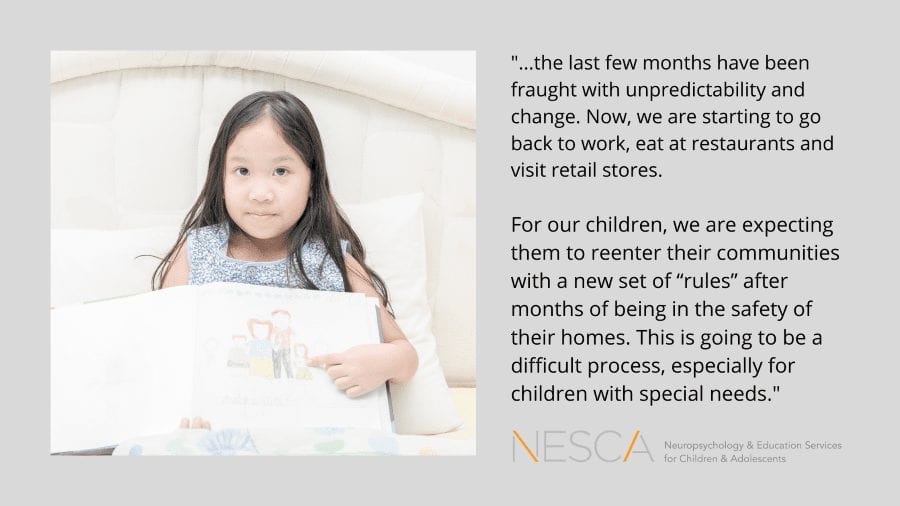
For many children, new experiences are frightening and anxiety-provoking. Children thrive on routine and predictability; when these get interrupted, it can be hard for them to understand what is happening. As we all know, the last few months have been fraught with unpredictability and change. Now, we are starting to go back to work, eat at restaurants and visit retail stores. As adults, we might have mixed feelings about this – relief to get out of the house but also fear about the ongoing pandemic. For our children, we are expecting them to reenter their communities with a new set of “rules” after months of being in the safety of their homes. This is going to be a difficult process, especially for children with special needs.

So how do we prepare children for all of the new experiences they are about to face?

One method that has been found to be effective is the use of Social Stories™. Social Stories were first developed in 1990 by Carol Gray, a special education teacher. In essence, Social Stories are used to explain situations and experiences to children at a developmentally appropriate level using pictures and simple text. In order to create materials that are considered a true Social Story, there are a set of criteria that must be used. More information can be found here: https://carolgraysocialstories.com/social-stories/what-is-it/.

While special educators or therapists are expected to use this high standard in their work, it is also relatively easy for parents to create modified versions of these stories to use at home. I was inspired by one of my clients recently who made a story for her son with Down syndrome to prepare him for the neuropsychological evaluation. During her parent intake, she took pictures of me and the office setting. At home, she created a short book that started with a picture of her son, a picture of their car, a picture of my office, a picture of me and so on. On each page, she wrote a simple sentence:

  • First we will get in the car
  • We will drive to Dr. Gibbons’ office
  • We will play some games with Dr. Gibbons
  • We will go pick a prize at Target
  • We will drive home

Throughout the evaluation, she referred to the book whenever her son became frustrated by the tests or needed a visual reminder of the day’s schedule. Something that probably only took a few minutes to create played an important role in helping her son feel comfortable and be able to complete the evaluation.

The options for creating similar types of stories are endless, giving parents a way to prepare their children for a scary experience.

Some examples of stories to create during the ongoing pandemic:

  • Wearing a mask when out of the house
  • Proper hand washing
  • Socially distant greetings (bubble hugs, elbow bumps, etc.)

Some examples of more general stories include:

  • Doctor’s visits
  • Going to the dentist
  • Getting a haircut
  • Riding in the car
  • First day of school

You can use stock photos from the internet or pictures of your child and the actual people/objects they will encounter. If you have a child who reads, you can include more text; if your child does not read, focus on pictures only. Read the story with the child several times in the days leading up to the event. For ongoing expectations (e.g., wearing a mask) – you can review the story as often as needed. Keep it short and simple. And have fun with it!


About the Author: 

Erin Gibbons, Ph.D. is a pediatric neuropsychologist with expertise in neurodevelopmental and neuropsychological assessment of infants,

children, and adolescents presenting with developmental disabilities including autism spectrum disorders, Down syndrome, intellectual disabilities, learning disabilities, and attention deficit disorders. She has a particular interest in assessing students with complex medical histories and/or neurological impairments, including those who are cognitively delayed, nonverbal, or physically disabled. Dr. Gibbons joined NESCA in 2011 after completing a two-year post-doctoral fellowship in the Developmental Medicine Center at Boston Children’s Hospital. She particularly enjoys working with young children, especially those who are transitioning from Early Intervention into preschool. Having been trained in administration of the Autism Diagnostic Observation Schedule (ADOS), Dr. Gibbons has experience diagnosing autism spectrum disorders in children aged 12 months and above.


If you are interested in booking an evaluation with Dr. Gibbons or another NESCA neuropsychologist, please fill out and submit our online intake form


Neuropsychology & Education Services for Children & Adolescents (NESCA) is a pediatric neuropsychology practice and integrative treatment center with offices in Newton and Plainville, Massachusetts, and Londonderry, New Hampshire, serving clients from preschool through young adulthood and their families. For more information, please email info@nesca-newton.com or call 617-658-9800.

When Grandparents Become Parents Again

By | NESCA Notes 2020

By Yvonne M. Asher, Ph.D. 

Pediatric Neuropsychologist

Grandparents can hold a special place for any child. For some, though, grandparents play a central role in their day-to-day lives. When grandparents raise a child, it is often related to parental challenges, tragic circumstances or government intervention. This brings inherent, understandable stressors for grandparents. Additionally, grandparents face the more typical challenges of child-rearing, such as managing educational experiences, ensuring emotional well-being and navigating health care.

When concerns with educational achievement, behavior, emotional or social functioning arise, there are many obstacles with which grandparents must wrestle. Feelings of guilt may arise, which can stem from a variety of sources. Grandparents may question their own parenting practices, worrying about past “mistakes” in raising their children. They may be especially sensitive to shielding their grandchildren from exposure to risky situations that their children may have faced without their knowledge. Grandparents may struggle when grandchildren are given diagnoses such as ADHD, autism or learning disabilities, wondering if their children faced these same challenges without formal diagnosis or intervention. Many grandparents express understandable fears around their grandchildren’s future, particularly their level of independence. While many caregivers have concerns with the independence of the children in their care, grandparents are often acutely aware of the limited time they will have to support, counsel and assist their grandchildren through their young adult years.

In navigating the special education and mental health care systems, grandparents can face many complex situations. Complexity may be increased if grandparents are in a caregiving role due to parents’ substance use or dependence. Depending on the timing and extent of substance use, there can be long-lasting impacts on grandchildren’s educational, cognitive or emotional health. This can substantially increase the difficulties that grandparents encounter, both in terms of accessing necessary services and supports, as well as coping with the stresses of caregiving.

There are also a number of strengths that grandparents can bring to their time as caregivers. They may be more aware of their rights as caregivers within the educational system, seeking out services and interventions when the “first signs” of difficulty arise. They may have a broader perspective on the school system, potentially having raised children who went through the same schools in the past. With the wisdom that comes in later adulthood, grandparents may be more discerning and skeptical about the opinions of professionals. They may ask more pointed questions, with less reserve or fear. Grandparents may also have built stronger support networks and have deeper connections to community organizations. These strengths can serve grandparents well in managing the complex systems that all caregivers face.

Several states have created advisory councils or legislation specifically designed to support grandparents raising grandchildren. In addition, there are many resources available to grandparents who are caring for and raising grandchildren, including:

https://www.helpguide.org/articles/parenting-family/grandparents-raising-grandchildren.htm

https://www.grandfamilies.org

http://www.massgrg.com/massgrg_2019/index.html

https://sixtyandme.com/resources-for-grandparents-raising-grandchildren/


About Pediatric Neuropsychologist Dr. Yvonne Asher:

Dr. Yvonne M. Asher enjoys working with a wide range of children and teens, including those with autism spectrum disorder, developmental delays, learning disabilities, attention difficulties and executive functioning challenges. She often works with children whose complex profiles are not easily captured by a single label or diagnosis. She particularly enjoys working with young children and helping parents through their “first touch” with mental health care or developmental concerns.

Dr. Asher’s approach to assessment is gentle and supportive, and recognizes the importance of building rapport and trust. When working with young children, Dr. Asher incorporates play and “games” that allow children to complete standardized assessments in a fun and engaging environment.

Dr. Asher has extensive experience working in public, charter and religious schools, both as a classroom teacher and psychologist. She holds a master’s degree in education and continues to love working with educators. As a psychologist working in public schools, she gained invaluable experience with the IEP process from start to finish. She incorporates both her educational and psychological training when formulating recommendations to school teams.

Dr. Asher attended Swarthmore College and the Jewish Theological Seminary. She completed her doctoral degree at Suffolk University, where her dissertation looked at the impact of starting middle school on children’s social and emotional wellbeing. After graduating, she completed an intensive fellowship at the MGH Lurie Center for Autism, where she worked with a wide range of children, adolescents and young adults with autism and related disorders.


Neuropsychology & Education Services for Children & Adolescents (NESCA) is a pediatric neuropsychology practice and integrative treatment center with offices in Newton, Massachusetts, Plainville, Massachusetts, and Londonderry, New Hampshire, serving clients from preschool through young adulthood and their families. For more information, please email info@nesca-newton.com or call 617-658-9800.


To book an appointment with Dr. Yvonne Asher, please complete our Intake Form today. For more information about NESCA, please email info@nesca-newton.com or call 617-658-9800.


Introduction to Acupuncture with Licensed Acupuncturist Meghan Meade

By | NESCA Notes 2019


By: Meghan Meade, L.Ac, MAOM, MS PREP, CYT

Licensed Acupuncturist, NESCA

Acupuncture is one of eight branches of Chinese Medicine that dates back over 3,000 years and involves the insertion of hair-thin needles into the body to provoke a healing response.

The body registers needling as a microinjury to which it responds by summoning the immune, nervous and endocrine systems to increase circulation, produce endorphins and other pain-relieving substances and flips the switch on the stress response.1,2,3 The treatment itself effectively assesses the internal imbalance and sends a signal to the body to address it; for this reason, acupuncture’s effects are often described as regulating – reducing elevations in inflammatory markers, enhancing the production and function of essential neurotransmitters, and so on. 1,2,3

Because acupuncture is so regulating to the body’s internal environment, the effects experienced by the patient can be both targeted and systemic2 – while pain relief could be achieved for a specific injury such as a sprained ankle, a patient might also noticed improved sleep or reduced anxiety, for example.

As a practitioner of Japanese style acupuncture, a style that is particularly reliant on using the body’s feedback to guide treatment decisions (though not to the exclusion of a patient’s verbal feedback about their health concerns and experiences), I incorporate pulse diagnosis and palpation into my overall diagnosis and treatments. Because an individual is considered to be the ever-changing reflection of their environment and experiences – physical, mental and emotional – my treatments for a given patient and a given condition will never look the same; each day the body is slightly different than the day prior, and treatments are designed with this principle in mind.

Another important theme within Chinese Medicine is that of duality; acupuncturists consider mutually opposing and complementary elements, such as heat and cold, internal and external, male and female, and yin and yang to be crucial in both assessment and treatment. Whereas yang represents heat, energy, masculinity, day time and light, yin, by contrast, represents coolness, substance, femininity, night time and darkness. When we are born, we are at our peak state of yang, which progressively gives way to yin throughout the lifetime. Because children are by nature more yang, their energy is ample and at the surface; accordingly, treating children and adolescents with acupuncture requires less stimulation to yield a desired response. Often needling is not involved, and non-insertive tools and techniques are preferred for their gentle, effective and often expedient results. Pediatric treatments may involve the use of magnets placed on acupuncture points, as well as brushing and tapping techniques using stainless steel, copper and/or silver tools. Because acupuncture points exist along 14 channels that run up and down the body, an acupuncturist can effect change both in a given channel/organ system and systemically by stimulating a channel through brushing and tapping techniques. While the above statement is true that inserting needles into the skin triggers an extensive sequence of immune, nervous and endocrine system events, so, too, does the more superficial work that acupuncturists perform for their pediatric patients.

The goal of acupuncture is always to harmonize, reducing what is in excess and restoring what is deficient. On a biomedical level, this typically entails a shift in the autonomic nervous system from a sympathetic dominant state – fight or flight mode – to a parasympathetic state – the calmer and more productive – though elusive – ‘rest and digest’ mode.2,3 Similarly, acupuncture regulates the function of hormones, neurotransmitters and immune mediators to achieve this balance. While many feel a positive response from a single treatment, acupuncture is generally not a ‘one and done’ therapy; instead, the response to acupuncture becomes stronger and more lasting over the course of several treatments, as a cumulative signal is often required for the body to carry out the work of regulating imbalances. Often after an initial series of treatments, a patient can enter a maintenance mode of treatment, spacing treatments out in increasingly longer windows and eventually receiving treatment on a maintenance or as-needed basis.

I hope this introductory conversation provides some insight as to how acupuncture works. I will be back with a follow-up post to shed some light on the effect of acupuncture on specific conditions commonly seen among NESCA’s client base.

  1. Cheng, Kwokming James. “Neurobiological Mechanisms of Acupuncture for Some Common Illnesses: A Clinician’s Perspective.” Journal of Acupuncture and Meridian Studies 7.3 (2014): 105-14. Web.
  2. Carlsson, C. “Acupuncture Mechanisms for Clinically Relevant Long-term Effects – Reconsideration and a Hypothesis.” Acupuncture in Medicine 20.2-3 (2002): 82-99. Web.
  3. Cheng, K. J. “Neuroanatomical Characteristics of Acupuncture Points: Relationship between Their Anatomical Locations and Traditional Clinical Indications.” Acupuncture in Medicine 29.4 (2011): 289-94. Web.


About the Author: 

Meghan Meade is a licensed acupuncturist practicing part-time at NESCA.

Having suffered from anxiety, digestive issues, hormonal imbalances and exercise-induced repetitive stress injuries throughout her adolescence and twenties, Meghan first sought out acupuncture as a last ditch effort to salvage some semblance of health and sanity during a particularly stressful period in her life. It worked. Remarkably well. So palpable was the influence of acupuncture on her well being that she was compelled to leave a career in advertising to study Chinese medicine so that she could help others benefit from its effects.

Meghan earned her masters degree in Acupuncture and Oriental Medicine from the New England School of Acupuncture at Massachusetts College of Pharmacy and Health Sciences (MCPHS) and a masters degree in Pain Research, Education and Policy from Tufts University Medical School. She is licensed by the Massachusetts Board of Medicine and is a Diplomate of Oriental Medicine, certified by the National Certification Commission for Acupuncture and Oriental Medicine (NCCAOM).

In her clinical practice, Meghan integrates both Eastern and Western perspectives to provide treatments unique to each patient’s needs and endeavors to empower patients to move forward on their paths to not just feeling good, but feeling like their true selves. In addition to her work as a licensed acupuncturist and herbalist, Meghan serves as adjunct faculty at MCPHS and is a certified yoga teacher.


To learn even more about Meghan and acupuncture, visit her alternate web site or read her blog: https://meghanmeadeacu.com/Meghan is practicing at NESCA during the following hours. Appointments at NESCA can be booked by reaching out to me directly at meghan@meghanmeadeacu.com.

Monday: 10am – 6pm

Thursday: 9am – 7pm


Neuropsychology & Education Services for Children & Adolescents (NESCA) is a pediatric neuropsychology practice and integrative treatment center with offices in Newton and Plainville, Massachusetts, and Londonderry, New Hampshire, serving clients from preschool through young adulthood and their families. For more information, please email info@nesca-newton.com or call 617-658-9800.

What Does Autism Look Like? Exploring the Differences among Girls and Boys

By | NESCA Notes 2019


By: Erin Gibbons, Ph.D.
Pediatric Neuropsychologist, NESCA

In 2018, the Centers for Disease Control and Prevention (CDC) determined that approximately 1 in 59 children is diagnosed with Autism Spectrum Disorder (ASD). Boys are still four times more likely be diagnosed with ASD; however, research indicates that the diagnosis is often missed in girls, especially those who have average intelligence and “milder” forms of ASD. To understand why ASD is more often missed in girls, let’s explore the differences between boys and girls with ASD. This discussion will focus on children with average to above average intelligence (about 50% of all children diagnosed with ASD).


Boys Girls
Poor impulse control, more acting out Likely to be quiet and withdrawn
Disruptive behaviors in the classroom setting Tend to be reserved and cooperative at school
Frequent repetitive motor behaviors that are directly observable Lower frequency of these motor behaviors
Lack of interest in imaginary play Very much engaged in imaginary play
Restricted interests may seem unusual – e.g., train schedules, maps, windmills Restricted interests may seem “age appropriate” – e.g., horses, unicorns, ballet
Trouble making friends Might have a few friends
Likely to exhibit angry outbursts when frustrated/anxious Likely to engage in self-harm or other behaviors that are not observed by others when frustrated/anxious
Lack of awareness of being different or not fitting in More motivated to fit in and “hide” social difficulties – might try to imitate the behavior of a peer that is perceived as popular


Due to these differences, the diagnosis of ASD is often missed in young girls. Adults might agree that a girl is “odd” or “quirky,” but dismiss these concerns because she has good eye contact, has some friends, and does not engage in hand flapping or other unusual behaviors. Unfortunately, other girls might be misdiagnosed, which could lead to ineffective or inappropriate treatment interventions. Most commonly, they might be misdiagnosed with ADHD or Anxiety Disorder.

In many cases, girls with ASD have increasing difficulties with social interactions as they get older and demands get higher. A young girl with ASD might be able to “get by” in social interactions but by the time she reaches adolescence, she is not able to navigate the intricacies of the social milieu. This can lead to social isolation and high risk of being bullied or rejected by peers.

Unfortunately, a missed diagnosis of ASD for a young girl can have long-reaching ramifications. She might experience depression, anxiety and/or low self-esteem, wondering why she doesn’t “fit in” and “feels different” from other girls. She might start to struggle in school or disconnect from activities that she used to enjoy. Moreover, missing the diagnosis in childhood means that she did not receive services to support her social and peer interaction skills during her formative years.

As always, when parents or other caregivers have concerns about a child’s development, it is important to seek an evaluation from a professional. And if the findings do not feel quite right, parents should never feel uncomfortable about seeking a second opinion.


About the Author: 

Erin Gibbons, Ph.D. is a pediatric neuropsychologist with expertise in neurodevelopmental and neuropsychological assessment of infants,

children, and adolescents presenting with developmental disabilities including autism spectrum disorders, Down syndrome, intellectual disabilities, learning disabilities, and attention deficit disorders. She has a particular interest in assessing students with complex medical histories and/or neurological impairments, including those who are cognitively delayed, nonverbal, or physically disabled. Dr. Gibbons joined NESCA in 2011 after completing a two-year post-doctoral fellowship in the Developmental Medicine Center at Boston Children’s Hospital. She particularly enjoys working with young children, especially those who are transitioning from Early Intervention into preschool. Having been trained in administration of the Autism Diagnostic Observation Schedule (ADOS), Dr. Gibbons has experience diagnosing autism spectrum disorders in children aged 12 months and above.


If you are interested in booking an evaluation with Dr. Gibbons or another NESCA neuropsychologist, please fill out and submit our online intake form


Neuropsychology & Education Services for Children & Adolescents (NESCA) is a pediatric neuropsychology practice and integrative treatment center with offices in Newton and Plainville, Massachusetts, and Londonderry, New Hampshire, serving clients from preschool through young adulthood and their families. For more information, please email info@nesca-newton.com or call 617-658-9800.

Addressing Anxiety through the IEP Process

By | NESCA Notes 2019

By: Erin Gibbons, Ph.D.
Pediatric Neuropsychologist, NESCA

Anxiety disorders are becoming more and more common among children and adolescents. Recent data from the National Institute of Mental Health (NIMH) reported that 31.9% of adolescents between 13-19 have an identified anxiety disorder. Although fewer statistics are available, it is clear that students who have a developmental, learning, or attention disorder are at high risk for developing clinically significant anxiety in light of their struggles with academics, learning, and/or social development. Given the rising numbers of affected children and adolescents, it has become increasingly important that a student’s emotional health is addressed both at home through private counseling, as well as through the provision of school-based services. When students experience a high level of unmitigated anxiety throughout the day, they are less able to learn and meet their potential.

When parents are seeking services for anxiety through their school system, there are different levels of support. First, teachers can provide classroom supports and address emotional health with all students, whether or not they have an identified anxiety disorder. Some examples of useful classroom strategies include:

  • Create predictable routines and clear expectations.
  • Provide warnings about upcoming transitions.
  • Have a “cool down space” available in the classroom or another room in the school.
  • Incorporate movement into lessons throughout the day.

There are also programs designed to address emotional regulation that can be used throughout the school or district. For example:

If these supports are not sufficient to meet a student’s needs, then it is necessary to develop goals through the IEP process. In order to make needed progress, it is important that the goals and benchmarks in the IEP are specific. For example, a benchmark might state: “Johnny will show better emotional regulation in stressful situations.” A more specific benchmark might state: “When Johnny starts to shut down or refuse to participate during a math class, he will identify his current emotion(s) in 4 out of 5 opportunities.”

When parents seek supports for their child’s anxiety through the IEP, they should consider whether their child needs accommodations, specialized instruction or both.

Examples of accommodations for anxiety include:

  • Extra time in testing situations.
  • Opportunities to take tests in a quiet setting.
  • Access to breaks as needed.
  • Access to the school counselor as needed.
  • Student does not need to sign out of class to use the bathroom.
  • Student is prompted to take breaks when showing signs of distress.
  • Student has modified homework.
  • Teacher will check in with student before independent work blocks.
  • Specialized instruction can be provided in the classroom (push-in) or in a different setting (pull-out).

Push-in services might include:

  • Provision of an instructional aide to support emotion identification and regulation.
  • The school counselor/psychologist works with the entire class once or twice a month to discuss emotional health.

Pull-out services might include:

  • Regular sessions with the school counselor/psychologist.
  • Social skills groups.

Consultation services are also important, especially if a student participates in private therapy outside of school. Parents should consider giving permission for the private therapist to speak with the school counselor to discuss common treatment goals and ways in which the student’s coping skills can be supported and reinforced in school.

About the Author:

GibbonsErin Gibbons, Ph.D. is a pediatric neuropsychologist with expertise in neurodevelopmental and neuropsychological assessment of infants, children, and adolescents presenting with developmental disabilities including autism spectrum disorders, Down syndrome, intellectual disabilities, learning disabilities, and attention deficit disorders. She has a particular interest in assessing students with complex medical histories and/or neurological impairments, including those who are cognitively delayed, nonverbal, or physically disabled. Dr. Gibbons joined NESCA in 2011 after completing a two-year post-doctoral fellowship in the Developmental Medicine Center at Boston Children’s Hospital. She particularly enjoys working with young children, especially those who are transitioning from Early Intervention into preschool. Having been trained in administration of the Autism Diagnostic Observation Schedule (ADOS), Dr. Gibbons has experience diagnosing autism spectrum disorders in children aged 12 months and above.

Dr. Gibbons recently began serving clients in NESCA’s newest location in Plainville/Foxborough, MA. She is thrilled to bring her expertise in evaluating and supporting children with a wide range of abilities to this area of the state.


To book an evaluation with Dr. Gibbons or one of our many other expert neuropsychologists and transition specialists, complete NESCA’s online intake form.


Neuropsychology & Education Services for Children & Adolescents (NESCA) is a pediatric neuropsychology practice and integrative treatment center with offices in Newton, Massachusetts, Plainville, Massachusetts, and Londonderry, New Hampshire, serving clients from preschool through young adulthood and their families. For more information, please email info@nesca-newton.com or call 617-658-9800.


Social Creativity and ASD – Challenging the assumption that autistic people are not social

By | NESCA Notes 2018

Photo from the documentary, Autism: The Musical (2007)

By: Rebecca Girard, LICSW, CAS
Licensed Clinical Social Worker

The New York Times recently published an opinion piece titled, How to Meet Autistic People Halfway, an article that challenges the common belief that people on the autism spectrum are avoidant of social interaction and do not desire social connections. The authors, Vikram K. Jaswal and Nameera Akhtar are psychologists and researchers who study the social lives of people on the autism spectrum. They assert that while core deficits of autism may make social interaction more challenging, it does not mean people on the spectrum do not desire meaningful social connection. For years, many in the ASD community and their allies in the neurodiversity rights movement have attempted to combat this anti-social stereotype, but the notion stubbornly persists. Counter-narratives of the autistic social experience often reflect autistic people as extremely emotionally sensitive, hyper-aware of the feeling states of others, and indeed motivated to experience social success in the form of friendships and social acceptance. Additionally, an increasing number of people believe those on the spectrum may actually display more creative and interesting ways to connect and choose to describe autistic individuals as “socially creative” rather than having “social deficits”.

If we then acknowledge the desire to connect is present, how can we best facilitate social learning and promote social success? First, we can acknowledge that a person on the spectrum will have a myriad of ASD-related challenges that will likely make socializing difficult. These include trouble reading and interpreting social cues (eye contact, body language, facial expressions), attending to and managing sensory challenges during interaction, and repetitive and inflexible thinking (getting “stuck”, echolalia), all of which can lead to preemptive social rejection by peers and a lack of social opportunities to practice and improve upon their social interaction skills. These challenges require multi-disciplinary supports, including (but not limited to) occupational therapy, speech therapy, and cognitive-behavioral therapy. Second, we can provide positive social learning interventions that address and ameliorate the impact of these factors, while providing opportunities to explore and understand the social world.

A popular method of intervention is that of “social knowledge”, or didactic social skills training. This entails imparting concrete social skills, in the effort to explicitly teach what a person may not know about socializing. Think – programming a social computer with many algorithms; if a person does A, you do B. While this may be great at teaching the basics, it often does not adequately prepare ASD individuals for the unpredictability and fluidity of everyday interactions. Another approach is that of “social performance”, a dynamic method of encouraging social pragmatic development by providing semi-structured socialization opportunities in small group settings with immediate, in vivo feedback on what’s working or not. Think – flexing a social muscle. Drama-based social pragmatic groups are gaining in popularity as a method for not only promoting social connections but as a fun way to create an encouraging and supportive space to finds one’s own intrinsically motivating social style.

But enhancing individual social skills and providing adequate social opportunities is admittedly a one-sided approach. Equally important is challenging the stigma and bias that plague the ASD community. We need to be allies to this community by promoting greater acceptance of a wide-range of social styles and approaches to social engagement. To honor the neurodiversity mission, which “rejects the idea that autism should be cured, advocating instead for celebrating autistic forms of communication and self-expression, and for promoting support systems that allow autistic people to live as autistic people.” (What is Neurodiversity? [Website]. (2011).  National Symposium on Neurodiversity at Syracuse University)

As a therapist who has worked with ASD individuals across the lifespan since 2004, I know firsthand that autistic people feel the same loneliness and isolation when chronically socially disconnected, and feel the same anxiety and unease when experiencing social rejection. I have also had the pleasure of witnessing individuals find their own distinctive social style and the joy of connecting with others who appreciate what is different as interesting and exceptional, rather than off-putting or strange. The autistic people in my life, both professionally and personally, have challenged me to rethink narrow and strictly defined social expectations, and have made all my relationships richer as a result. Autistic people are often credited with “out of the box” thinking and innovation, which can be applied to their social lives as well, as they are uninhibited by social convention. For example, Asperger’s are Us are the first all-autistic sketch comedy troupe, and their performances reflect their original and offbeat sense of humor, as well as their deep connection to one another as friends. A great example of what is possible.

The New York Times article said it best in its conclusion, “improving the social lives of autistic people will require putting aside assumptions about how social interest is expressed and recognizing that it can be shown in unexpected ways.” As parents, professionals, and allies, let’s commit to challenging this very basic and long-held assumption and appreciate and embrace the unique and creative ways autistic people chose to engage the world around them.


About the Author: 

Rebecca Girard, LICSW, CAS is a licensed clinical social worker specializing in neurodivergent issues, sexual trauma, and international social work. She has worked primarily with children, adolescents, adults with Autism Spectrum Disorders and their families for over a decade. Ms. Girard is highly experienced in using Cognitive Behavior Therapy (CBT) as well as Socio-dramatic Affective Relational Intervention (SDARI), in addition to a number of other modalities. She provides enhanced psychotherapy to children with ASD at NESCA as well as to provide therapeutic support to youth with a range of mood, anxiety, social and behavioral challenges. Her approach is child-centered, strengths-based, creative and compassionate.

Reach out if you would like to work with Rebecca: Email rgirard@nesca-newton.com or call 617-658-9825


Neuropsychology & Education Services for Children & Adolescents (NESCA) is a pediatric neuropsychology practice and integrative treatment center with offices in Newton, Massachusetts, and Londonderry, New Hampshire, serving clients from preschool through young adulthood and their families. For more information, please email info@nesca-newton.com or call 617-658-9800.

Neurodevelopmental Evaluations – Where and When to Start

By | NESCA Notes 2018

By: Erin Gibbons, Ph.D.
Pediatric Neuropsychologist, NESCA

Parenthood is a daunting task to say the least. Not only must we worry about keeping our children healthy and safe, but we are constantly bombarded with information about potentially harmful foods, chemicals, toys, etc. Many parents also have concerns about whether their children are meeting developmental milestones on time and/or whether they should worry about certain behaviors their children are displaying.

When concerns arise about older children, parents are often advised to seek a neuropsychological evaluation to rule out possible attention, learning, or developmental challenges. However, parents of children under 5 are often urged to “wait and see” or might be told it is “too early” to seek an evaluation. The truth of the matter is that it is never too early to have your child evaluated when you are worried about his or her development.

Where do I start?

If you have concerns about your child’s development, it is always a good idea to start with your pediatrician. Describe what you are seeing at home and any difficulties you have noticed. Your pediatrician might recommend that you seek a comprehensive neurodevelopmental evaluation to assess for any developmental delays.

What is a neurodevelopmental evaluation?

This is a comprehensive set of tests designed to assess all aspects of your child’s development, including cognition, language, motor, and social skills. This type of evaluation is conducted by a pediatric neuropsychologist. First, you will be asked to provide information about your child’s developmental and medical histories. Your child will then be asked to participate in a series of activities over the course of 2 or 3 hours. For example, he/she will have to solve simple puzzles, label pictures, or play with different types of toys.

Why is a neurodevelopmental evaluation useful?

After completing the evaluation, the neuropsychologist will analyze all of the information and develop a comprehensive picture of your child’s developmental profile. In addition to helping you understand your child’s strengths and weaknesses, the neuropsychologist will also identify any developmental delays that require intervention.

What happens next?

An evaluation will identify developmental delays that need to be treated in order to help your child catch up with peers. Some examples include speech/language therapy, occupational therapy, physical therapy or applied behavior analysis (ABA).

For children under 3, this means they can start receiving Early Intervention services right away. Early Intervention is a system of services for babies and toddlers who have developmental delays or disabilities and is available in every state in the US.

For children over 3, parents can seek services privately, or can work with their local school district to develop an Individualized Education Program (IEP) for their child. Having an independent evaluation completed prior to your child’s transition to public education is extremely useful as it provides the district with the child’s type of disability and informs the process of developing necessary services.

Where can I go?

Neurodevelopmental evaluations are available at many local area hospitals as well as private neuropsychology clinics. Parents can also contact their insurance company for a list of providers or search through the Massachusetts Neuropsychological Society: https://www.massneuropsych.org/i4a/pages/index.cfm?pageID=3309.

At NESCA, we are proud to offer neurodevelopmental evaluations for children ages 1-5 and will provide parents with a comprehensive report, extensive recommendations for services, and ongoing consultation through the years. Our clinicians are able to do observations of children in their natural environments (e.g., day care, preschool) to gain a full picture of the child and provide environmental recommendations that would be most supportive. Moreover, we are available to attend meetings with early intervention specialists and special educators to help a child’s team fully understand their individual learning and service needs.

If you are interested in scheduling a consultation or evaluation at NESCA, please complete our on-line intake form: https://nesca-newton.com/intake-form/.

About the Author:

GibbonsErin Gibbons, Ph.D. is a pediatric neuropsychologist with expertise in neurodevelopmental and neuropsychological assessment of infants, children, and adolescents presenting with developmental disabilities including autism spectrum disorders, Down syndrome, intellectual disabilities, learning disabilities, and attention deficit disorders. She has a particular interest in assessing students with complex medical histories and/or neurological impairments, including those who are cognitively delayed, nonverbal, or physically disabled. Dr. Gibbons joined NESCA in 2011 after completing a two-year post-doctoral fellowship in the Developmental Medicine Center at Boston Children’s Hospital. She particularly enjoys working with young children, especially those who are transitioning from Early Intervention into preschool. Having been trained in administration of the Autism Diagnostic Observation Schedule (ADOS), Dr. Gibbons has experience diagnosing autism spectrum disorders in children aged 12 months and above.


Skip to content