

By Olivia Rogers, MA, CCC-SLP
Speech-Language Pathologist, NESCA
Written language refers to the system of communication that involves the use of written symbols to represent language, and it encompasses skills such as fluent word recognition, reading comprehension, written spelling, and written expression. It is one of the most complex academic skills students are asked to master. It requires vocabulary, grammar, organization, working memory, attention, reading skills, and the ability to translate ideas into structured sentences and paragraphs.
Because written expression sits at the intersection of language, literacy, and executive functioning, Speech-Language Pathologists (SLPs) are uniquely positioned to support it. At NESCA, speech language pathologists bring specialized training – including EmPOWER, Brain Frames, and The Orton-Gillingham Approach – that allows them to address writing and reading comprehension in a comprehensive, structured, and functional way.
Written Language Is… Language
Writing is not just handwriting or spelling. At its core, writing is language expressed on paper. Students must generate ideas and vocabulary, use grammar and sentence structure, organize thoughts into narratives or explanations, maintain cohesion across sentences, and consider audience and purpose.
Reading is not just decoding words on a page. True, reading happens when a child understands, connects, and makes meaning from what they read. Comprehension – linking new information to background knowledge, vocabulary, and language skills – is what transforms word calling into real literacy.
These are core areas of SLP expertise. SLPs are trained to analyze how language breaks down, whether at the word, sentence, or discourse level, and to teach skills explicitly and systematically.
The Executive Function Connection
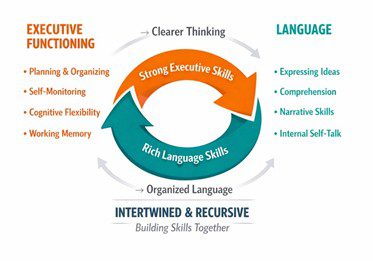
As discussed in last week’s blog, writing and reading are executive functioning tasks. When writing, students must plan what to say, hold ideas in working memory, organize information, initiate writing, and revise and edit. When reading, students exercise their working memory, inhibition, and metacognitive skills.
NESCA SLPs use the EmPOWER and Brain Frames approaches to make these invisible thinking processes visible. EmPOWER supports students in navigating “how” to bring the writing process from start to finish. Brain Frames provide visual scaffolds that help students map ideas before writing, organize paragraphs, and understand the structure of different text types.
Structured Literacy Strengthens Writing
Strong writing depends on strong reading and spelling skills. NESCA SLPs, trained in Orton-Gillingham, also bring a structured literacy lens to written language intervention through explicit teaching of phonology, morphology, and spelling patterns – all while integrating reading and writing instruction systematically.
SLPs Bridge Ideas and Expression
Many students know what they want to say but cannot translate it into written form. SLPs help students expand sentences, develop narrative and expository structure, use academic vocabulary, improve cohesion and clarity, verbalize ideas before writing, and revise language for precision. Because SLPs focus on communication, written language therapy is functional and meaningful. Intervention often targets classroom assignments, essays and projects, note-taking, digital communication, and self-advocacy writing so that strategies learned transfer directly to school demands. SLPs brings a functional, real-world approach to written language.
Speech-Language Pathologists are not an alternative option for written language support; they are a natural fit. With explicit strategy instruction, visual scaffolding, and structured literacy methods, SLPs help students move from uncertainty to confident, organized expression. When writing is approached through language, thinking, and literacy together, students gain tools that extend far beyond the page.
The NESCA Difference
NESCA SLPs combine deep knowledge of language development with specialized training in executive functioning and structured literacy. Our intervention addresses how students think, understand language, read and spell, and express ideas in writing.
At NESCA, we use evidence-based strategy to target written language. Our clinicians use a comprehensive approach to treat the systems of learning as integrative, helping students develop valuable skills they can use in and out of the classroom! For more information on written language support at NESCA, please complete our online Intake Form or email me directly at orogers@nesca-newton.com.
About the Author
To learn more about NESCA’s Speech and Language Services or schedule appointments, complete our online Intake Form or email orogers@nesca-newton.com.
NESCA is a pediatric neuropsychology and related services practice with offices in Newton, Plainville, and Hingham, Massachusetts; Londonderry, New Hampshire; and Coral Gables, Florida, serving clients from infancy through young adulthood and their families. For more information, please email info@nesca-newton.com or call 617-658-9800.



 families better understand their child’s unique neurocognitive, developmental, learning, and social-emotional profiles. She specializes in the assessment of toddlers, school-aged children, adolescents, and young adults. Her expertise involves working with youth exhibiting a diverse range of clinical presentations, including neurodevelopmental disorders, such as autism spectrum disorder, attention and executive functioning deficits, learning disabilities, developmental delays, intellectual disabilities, and associated emotional challenges. Dr. Manning is also trained in the assessment of children with medical complexities, recognizing how health conditions can impact a child’s development and functioning. She partners closely with families to develop practical, personalized recommendations that support each individual’s success and growth at home, in school, and within the community.
 Currie in NESCA’s Londonderry, N.H. office from 2023-2024 as a practicum student, Dr. Jessica Greene re-joins NESCA to complete her postdoctoral fellowship in pediatric neuropsychological assessment. Dr. Greene has a particular interest in understanding clients’ strengths as well as differences, integrating a therapeutic assessment approach, when appropriate.


 and developmental disabilities. She has a particular interest in children with autism spectrum disorders, intellectual disabilities, and those with complex medical histories. In addition, she evaluates adults who have concerns about whether they meet criteria for an ASD or ADHD diagnosis.
 Deficit Hyperactivity Disorder (ADHD), Nonverbal Learning Disability (NVLD), and executive functioning disorders (e.g. slow processing speed). She also has experience in working with individuals with psychiatric difficulties, such as anxiety, mood disorders (e.g. depression), and behavioral disorders. Dr. Weinberg has expertise in working with children with complex profiles or multiple areas of strength and weakness that cannot be encapsulated by a single diagnosis. Dr. Weinberg is passionate about helping families better understand their child’s neuropsychological profile and the impact it may be having on their behavior or functioning in order to best support them in all areas of their life.
 and young adults who have complex presentations with a wide range of concerns, including attention deficit disorders, psychiatric disorders, intellectual disabilities, and autism spectrum disorders (ASD). She also values collaboration with families and outside providers to facilitate supports and services that are tailored to each child’s specific needs.
Connect with Us