

By Miranda Milana, Psy.D.
Pediatric Neuropsychologist
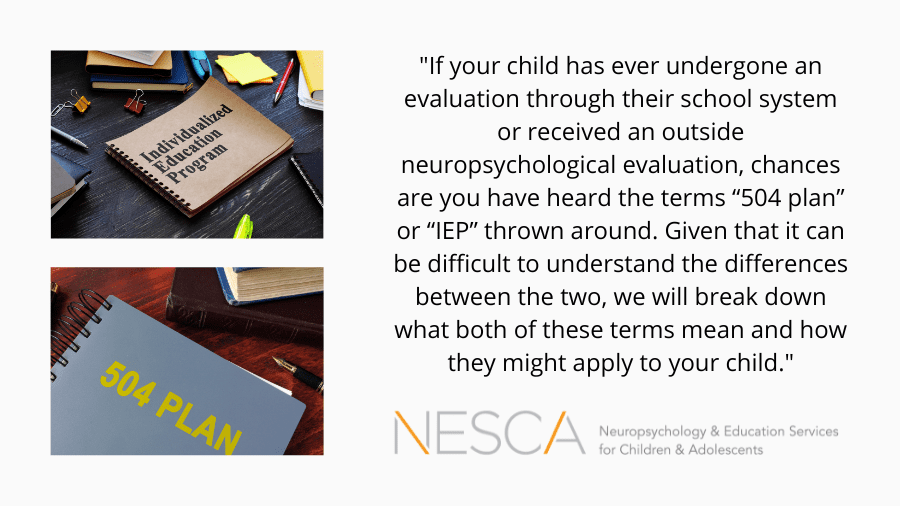
If your child has ever undergone an evaluation through their school system or received an outside neuropsychological evaluation, chances are you have heard the terms “504 plan” or “IEP” thrown around. Given that it can be difficult to understand the differences between the two, we will break down what both of these terms mean and how they might apply to your child.
What is an IEP?
IEP stands for Individualized Education Program and provides specialized instruction, program modification, and accommodations through the public school system based on a student’s disability and how it impacts access to the curriculum. IEPs must include:
- Annual goals that are measurable via benchmarks
- Progress reports of the student’s current performance
- Descriptions of how services will be provided
- Outlined transition services as the child ages
In addition, IEPs must detail what academic environment would be the least restrictive, and therefore, most suitable for the student to appropriately access the educational curriculum.
Who is eligible for an IEP?
In order to qualify for an IEP, students must receive an evaluation either through the school system or through an outside provider that outlines the student’s disability status and how it negatively impacts accessing the educational curriculum. Importantly, a diagnosed disability is not enough to quality for an IEP on its own. Instead, the disability must be impacting the student’s ability to make effective progress in the general education program, which includes both academic and non-academic offerings of the district. Some examples of qualifying diagnoses include (but are not limited to):
- Autism
- Emotional Disturbance
- Intellectual Disability
- Specific Learning Disability
A parent or caregiver may ask what happens if their child has a diagnosed disability but does not require special education services? Instead, the team may determine, through the eligibility process, that the student only requires accommodations, such as extended time on tests.
This is a perfect example of when a student might not qualify for an IEP and would instead be considered for a 504 plan. Simply put, IEPs and 504 plans both provide accommodations; however, 504 plans do NOT provide for specialized instruction or program modifications.
What is a 504 plan?
A 504 plan is referred to as such because it is covered under Section 504 of a federal civil rights law called the Rehabilitation Act. This law works to ensure that students receive appropriate supports and accommodations within the academic setting. 504 plans outline accommodations for students which can include some of the following (but again, accommodations are not limited to the following):
- Preferential seating
- Extended time on tests and quizzes
- Reduced distraction testing environments
- Access to class notes
- The use of a calculator during exams
As you can see, none of these accommodations is modifying the curriculum or providing a student with educational services as would be the case with an IEP.
Who is eligible for a 504 plan?
Any student with a disability impairing functioning in one or more areas is eligible for a 504 plan. One common example would be a student with diagnosed Attention Deficit Hyperactivity Disorder (ADHD) who requires distraction-reduced testing environments and/or other associated accommodations but does NOT require specialized academic instruction.
Another example is a parent of a child with an autism spectrum diagnosis may find that their child was found to be ineligible for an IEP through the special education eligibility determination process. Shouldn’t the student qualify for an IEP based on the autism disability?
The answer is not necessarily. If a student has a diagnosis of autism but is showing no signs of impairment within the academic setting (i.e., making appropriate academic progress, showing no signs of emotional distress, doing well with their peers, etc.), an IEP would not be warranted. Instead, a 504 plan would likely be considered (but again, is not guaranteed if academic functioning is not impaired).
If you feel your child requires a 504 plan or IEP and you are not sure where to start, contact your child’s special education program at their school. You may also wish to consult with an educational advocate or attorney who has a thorough understanding of special education laws.
References:
Massachusetts Department of Elementary and Secondary Education. (2018, June 29). Education Laws and Regulations. 603 CMR 28.00: Special Education – Education Laws and Regulations. Retrieved August, 2022, from https://www.doe.mass.edu/lawsregs/603cmr28.html?section=05
Massachusetts Department of Elementary and Secondary Education. (2014, July 14). Section 504 and the Americans with disabilities act. Section 504 – Special Education. Retrieved August, 2022, from https://www.doe.mass.edu/sped/links/sec504.html
About the Author
Dr. Miranda Milana provides comprehensive evaluation services for children and adolescents with a wide range of concerns, including attention deficit disorders, communication disorders, intellectual disabilities, and learning disabilities. She particularly enjoys working with children and their families who have concerns regarding an autism spectrum disorder. Dr. Milana has received specialized training on the administration of the Autism Diagnostic Observation Schedule (ADOS).
Dr. Milana places great emphasis on adapting her approach to a child’s developmental level and providing a testing environment that is approachable and comfortable for them. She also values collaboration with families and outside providers to facilitate supports and services that are tailored to a child’s specific needs.
Before joining NESCA, Dr. Milana completed a two-year postdoctoral fellowship at Boston Children’s Hospital in the Developmental Medicine department, where she received extensive training in the administration of psychological and neuropsychological testing. She has also received assessment training from Beacon Assessment Center and The Brenner Center. Dr. Milana graduated with her B.A. from the University of New England and went on to receive her doctorate from William James College (WJC). She was a part of the Children and Families of Adversity and Resilience (CFAR) program while at WJC. Her doctoral training also included therapeutic services across a variety of settings, including an elementary school, the Family Health Center of Worcester and at Roger Williams University.
Dr. Milana grew up in Maine and enjoys trips back home to see her family throughout the year. She currently resides in Wrentham, Massachusetts, with her husband and two golden retrievers. She also enjoys spending time with family and friends, reading, and cheering on the Patriots, Bruins, Red Sox, and Celtics.
Neuropsychology & Education Services for Children & Adolescents (NESCA) is a pediatric neuropsychology practice and integrative treatment center with offices in Newton, Massachusetts, Plainville, Massachusetts, and Londonderry, New Hampshire, serving clients from preschool through young adulthood and their families. For more information, please email info@nesca-newton.com or call 617-658-9800.
To book an appointment with Dr. Miranda Milana, please complete our Intake Form today. For more information about NESCA, please email info@nesca-newton.com or call 617-658-9800.

 M.A. from Antioch New England in Applied Psychology. She also worked as an elementary school counselor and school psychologist for 15 years before embarking on her doctorate. During her doctorate, she did her pre-doctoral internship with RIT in Rochester, N.Y. where she worked with youth ages 5-17 who had experienced complex developmental trauma. Dr. Hess’s first post-doctoral fellowship was with The Counseling Center of New England where she provided psychotherapy and family therapy to children ages 5-18, their families and young adults. She also trained part-time with a pediatric neuropsychologist conducting neuropsychological evaluations.
 By
By  Londonderry, NH office. She specializes in the evaluation of anxious children and teens, working to tease apart the various factors lending to their stress, such as underlying learning, attentional, or emotional challenges. She particularly enjoys working with the seemingly “unmotivated” child, as well as children who have “flown under the radar” for years due to their desire to succeed.
 unique pattern of strengths and weaknesses to best formulate a plan for intervention and success. With experiences providing therapy and assessments, Dr. Creedon bridges the gap between testing data and therapeutic services to develop a clear roadmap for change and deeper of understanding of individual needs.
 No matter what style you are, you are giving it your best shot. Each of the styles has much written about them and their impact on child development – some good some not so good. Parents may change their style(s) depending upon a variety of factors and adopt new ways. Try to be aware of your style and its impact on your kids – this realization may happen as you go. That’s okay. You are learning this job as you go, and we all know there is no manual. You are just doing it, living each and every day with what it brings to you. Most parents do not think about what parenting style they are going to use in the moment. Sometimes you may “catch yourself,“ see your child’s reaction, and adjust your style. Perhaps you are the “softie” most of the time, but then turn on the “tough love” style when needed.
 and academia for over 30 years. She is a national consultant and speaker on program design and the inclusion of children and adolescents with special needs, especially those diagnosed with Autism Spectrum Disorder (ASD). Prior to joining NESCA, Ms. Lucci was the Principal of the Partners Program/EDCO Collaborative and previously the Program Director and Director of Consultation at MGH/Aspire for 13 years, where she built child, teen and young adult programs and established the 3-Ss (self-awareness, social competency and stress management) as the programming backbone. She also served as director of the Autism Support Center. Ms. Lucci was previously an elementary classroom teacher, special educator, researcher, school psychologist, college professor and director of public schools, a private special education school and an education collaborative.


 meaningful skills in order to reach their goals. She has spent the majority of her career working in a private school for students with ASD. She has also spent some time working in an inpatient mental health setting. Lyndsay uses occupation-based interventions and strategies to develop life skills, executive functioning, and emotional regulation. While completely her doctoral degree at MGH Institute of Health Professions, Lyndsay worked with the Boston Center for Independent Living to evaluate transition age services. She uses the results from her research to deliver services in a way that is most beneficial for clients. Specifically, she focuses on hands-on, occupation-based learning that is tailored the client’s goals and interests.


Connect with Us